The bachelor named Sampson is pictured. He appears about twenty four years of age, round-faced, flat-nosed, and wide-mouthed, with a bushy moustache and black buttoned apparel.
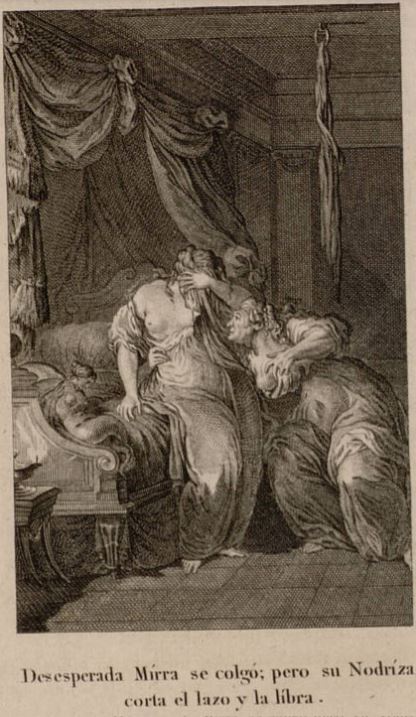
This engraving illustrates a young girl named Myrrha attempting to kill herself by hanging. She does this due to her sinful thoughts of lusting over her father. Myrrha understood that her thoughts were wrong, so she decided to kill herself to evade her incestuous feelings. Myrrha’s nurse came into the room as she heard moaning, and she cut her from the constricting rope when she saw Myrrha hanging. Myrrha is sitting on the bed in the image crying after she had just been cut loose from the rope. The nurse is depicted consoling the young girl. Reluctantly, Myrrha eventually shares her incestuous thoughts with her loyal nurse who had promised to help her.
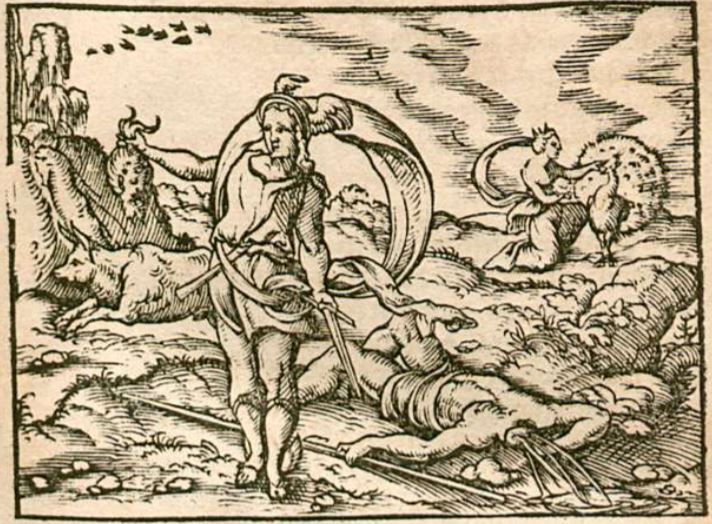
The messenger god Mercury is depicted in the foreground of the engraving, illustrated with his winged helmet. He is illustrated holding the head of the giant Argus, with the body lying on the ground behind him. Argus had one hundred eyes and Juno is depicted in the background of the image putting the eyes of Argus onto the feathers of her favourite bird: the peacock. There is a cow illustrated running away from the situation behind Mercury towards the left side of the image. The cow is Io, a woman who was raped by Jupiter and transformed into a cow by him as well. Mercury was given orders by Jupiter to slay Argus in order to free Io from his careful watch.
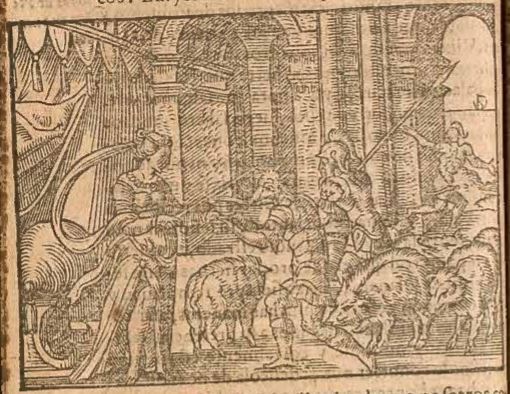
This engraving illustrates the companions of Ulysses being transformed into pigs. The companions of Ulysses had been welcomed into Circe’s courts, until they realized that Circe had put a potion in their drinking vessels which turned them all into hogs, as illustrated in the engraving. There is one man who is being touched on the head with Circe’s magic wand, and his head is already mid-transformation. There is one man in the engraving, Eurylochus, who is not transforming, as he did not drink anything. He was able to run back to Ulysses to explain what Circe had done.
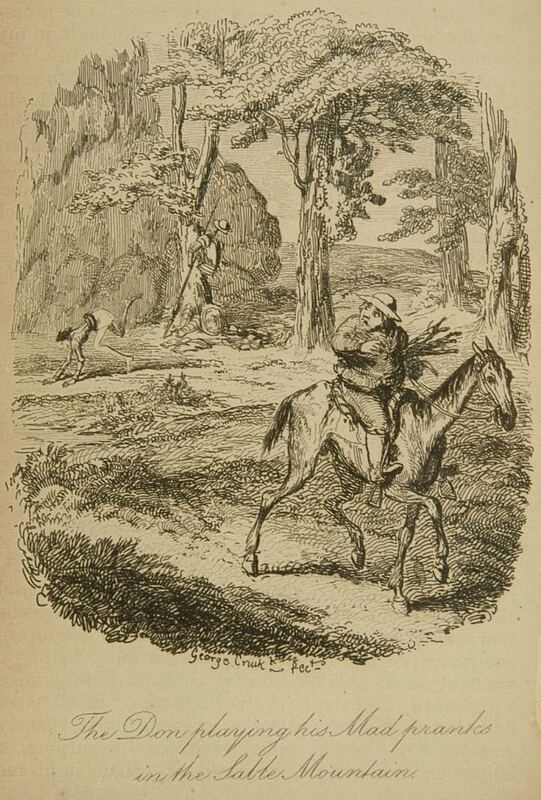
Sancho Panza (foreground), holding a bundle of broom stalks and mounted on Rocinante, leaves for El Toboso. Don Quixote (background) remains in Sierra Morena and is pictured performing a somersault as penance. Don Quixote’s armour hangs on a nearby tree. Signed by G. Cruikshank (illustrator and engraver). Part 1, ch. 25.
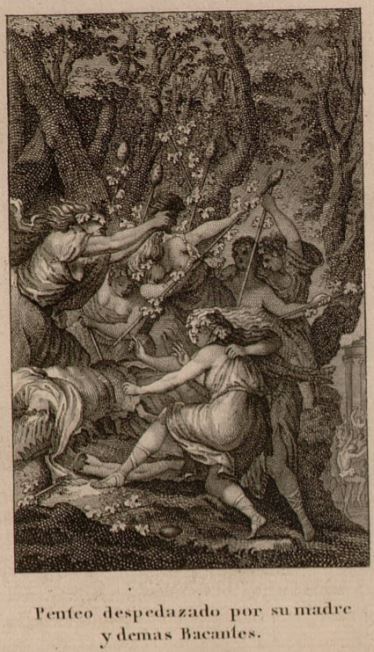
This image depicts Pentheus, the king of Thebes, being torn apart by the Bacchantes, one of them being his mother. Pentheus had denied Bacchus as a god and did not think he was worthy of festivals being held in his name. The Bacchantes, a frenzied group of women who worship the god Bacchus are depicted tearing Pentheus apart for having disrespected the god. One of Pentheus’ limbs is depicted lying on the ground after having been torn off from his body. Some of the Bacchantes having long spears in their hands and others are using their hands to kill him.
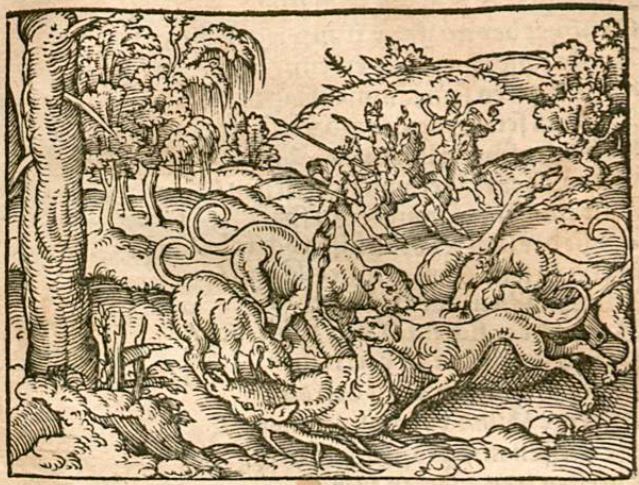
This engraving illustrates Actaeon in a transformed state of a stag being attacked by his own hunting hounds. Actaeon was transformed into a stag for gazing upon the goddess Diana whilst she was bathing. Actaeon was unable to command his hounds to stop due to his transformed state. The background of the engraving illustrates a group of soldiers riding on horses looking onto the scene of the dogs. These are the companions of Actaeon, and they are exploring the lands searching for him, unaware that he has been transformed and unaware that the hounds are killing him.
Don Quixote, sits on his bed in a very pensive mood, a sword on his lap, his left foot resting on a pillow. The image is occasioned by Don Quixote waiting for the bachelor Sampson Carrasco.
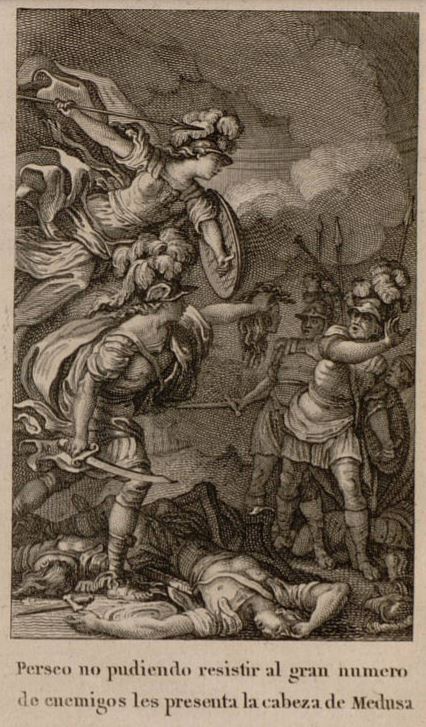
This image takes place at the wedding banquet of Perseus and Andromeda. Phineus, Andromeda’s uncle, interrupted the wedding banquet to try to claim Andromeda as his own bride. This created a battle between Perseus and Phineus’ army. Perseus had no choice but to use the head of Medusa since he was vastly outnumbered. Perseus is depicted on the left side of the image holding the head of Medusa out to Phineus and his soldiers to turn them to stone. There are men already laying on the ground who have been turned to stone as well. The goddess Minerva is depicted flying above Perseus to demonstrate that he is protected by the goddess of war.
Don Quixote charges on horseback down from a mountain into the plains towards a flock of sheep. He thinks the flock of sheep to be an army made to look like sheep by means of witchcraft. Quixote assaults the flock of sheep with a sword in his right hand whilst donning his signature armour. During his siege he successfully flays two sheep before two shepherds try and stop him from harming their flock. The shepherd nearest Quixote brandishes a stick, while the one on the right takes out a sling and flings two medium sized rocks at Quixote.
Don Diego de Miranda (middle) dressed in a long buttoned coat, hands a coin to the outstretched hand of a dark-haired man with a staff in hand. Don Diego's wife stands next to him and leans on his shoulder. An old man with a full beard (right) holds open a pouch, hoping for it to be filled by the graces of Diego. Kneeling before Diego and his wife, a woman prays, and to her right a child stands absently. The image is occasioned by Don Diego saying "I hear mass every day; I share my substance with the poor, making no parade with my good works, nor harboring in my breast hypocrisy and vain glory, those enemies which so slyly get possession of the best guarded hearts."
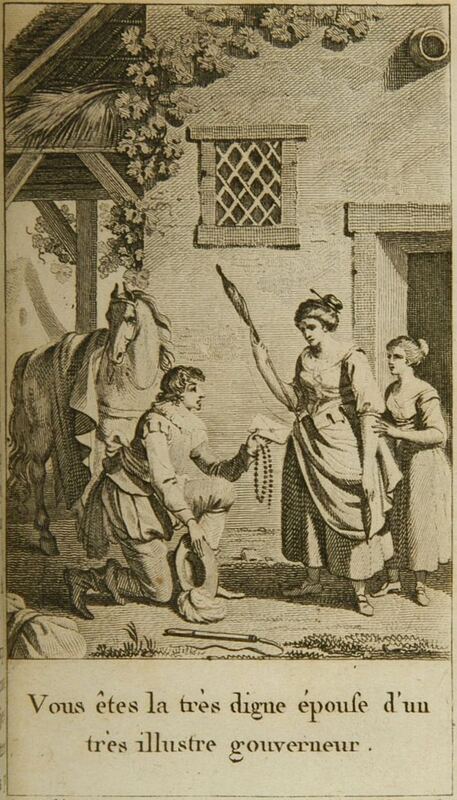
The duchess’ page kneels before Teresa Panza and her daughter Sanchica. He presents them with letters and gifts from the duchess and Sancho Panza. Teresa is spinning a bunch of flax (accurate to the text). Teresa’s thatched-roof house is also depicted. Signed by J.-J.-F. Le Barbier (illustrator) and F. Godefroy (engraver). Part 2, ch. 50.
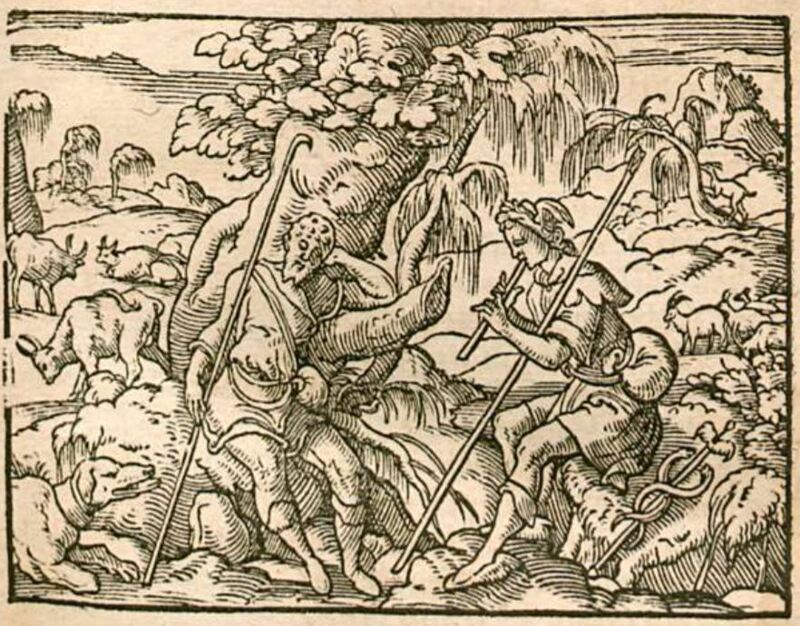
This image illustrates the messenger god, Mercury, sitting on a rock on the right side of the image playing his reed pipe. It is apparent that this is Mercury as he is commonly illustrated with his winged helmet. Mercury had been sent by order of Jupiter to kill Argus, the one who watched over Io. Io was the daughter of the river god Inachus, and after Jupiter raped her, he transformed her into a cow in order to protect her from the wrath of his jealous wife Juno. Juno ordered the giant Argus to watch over the transformed Io after suspecting what Jupiter had done. Jupiter wished to release Io from her transformed state, so he sent Mercury to kill the watchful Argus. Mercury is depicted playing his reed pipe in order to put Argus to sleep with the music it produces. He successfully does this, as Argus is illustrated sleeping against a tree with his head leaning on his left hand.
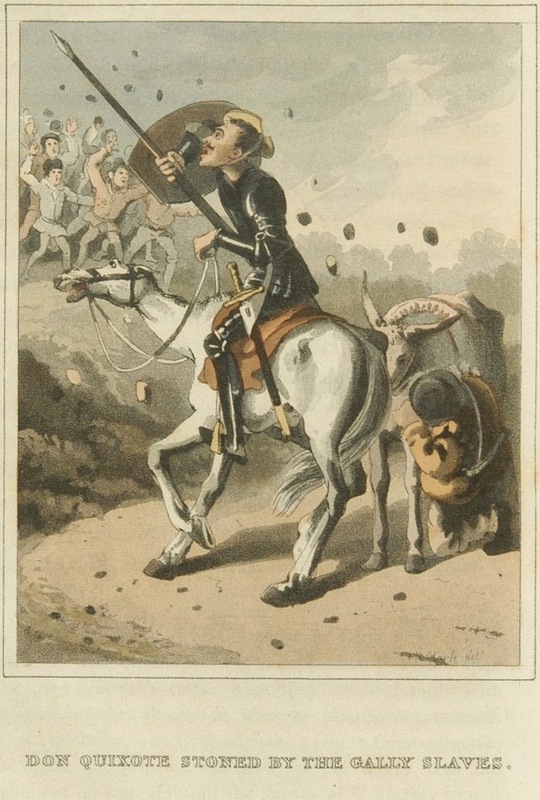
After their release, the galley slaves (left background) throw stones at Don Quixote and Sancho Panza (right foreground). They are led by Ginés de Pasamonte, who refuses to travel to Toboso to present himself to Dulcinea. Unsigned. Part 1, ch. 3.
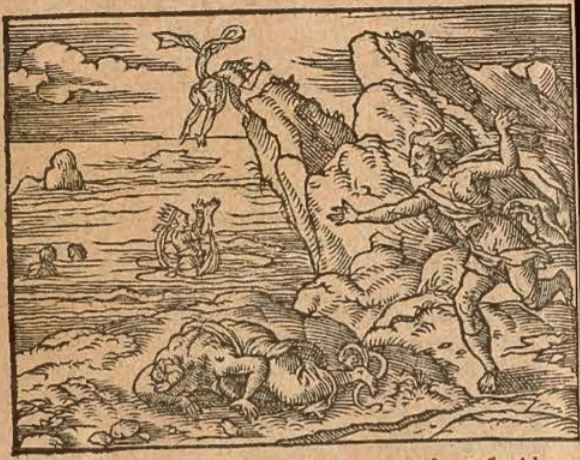
This engraving illustrates Aesacus, a son of King Priam of Troy, chasing a nymph named Hesperie. Aesacus fell madly in love with Hesperie and often pursued her. During one of his pursuits of the nymph, Hesperie fell prey to a snake hiding in tall grass. The bite from the snake was fatal and killed her. The illustration shows Hesperie on the ground with the snake by her ankles, and Aesacus running after her. Aesacus blamed himself for her death, so he threw himself from a cliff, which is depicted in the background of the engraving. The sea-goddess, Thetis, pitied Aesacus and transformed him into a loon just before he hit the water. Thetis is visible in the water in the background of the engraving with her hands pointing up towards Aesacus as he falls.
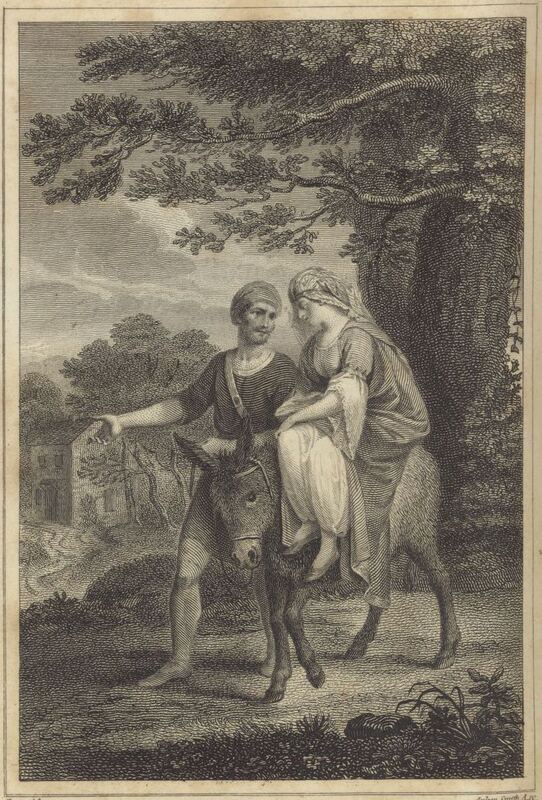
After Sancho Panza accepts to give himself lashes for money to disenchant Dulcinea, Don Quixote prevents him from continuing to do so. The scene is illuminated by the light of a full moon (upper right). Signed by F. Hayman (illustrator) and L. G. Scotin (engraver). Part 2, ch. 71.
Having been left by the players, Don Quixote (right) and Sancho Panza (left) spend the night beneath some lofty and shady trees. They eat some of the provisions carried by Dapple, Sancho with his legs crossed and Quixote with his legs stretched.
Don Quixote finds himself caught in nets of green string that are stretched between trees. Imagining that enchanters want to entangle him, he tries to break the nests when two shepherdesses appear before him and Sancho Panza. They are dressed in jackets and skirts made of fine brocade and rich moiré shot with gold. Signed by S. Shelley (illustrator) and J. Fittler (engraver). Part 2, ch. 58.
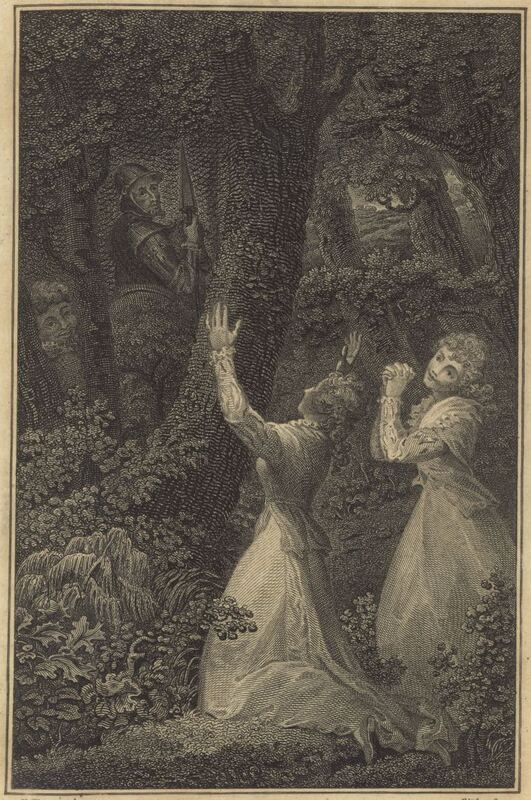
The liberated galley slaves gather around Don Quixote, who instructs them to present themselves to the lady Dulcinea. The dialogue between Don Quixote and Gines de Passamonte, one of the slaves, is captured by the hand gestures of the two figures. Plate no. 15, signed by J. Vanderbank (illustrator) and B. Baron (engraver). Vol. 1, book 3, ch. 8.
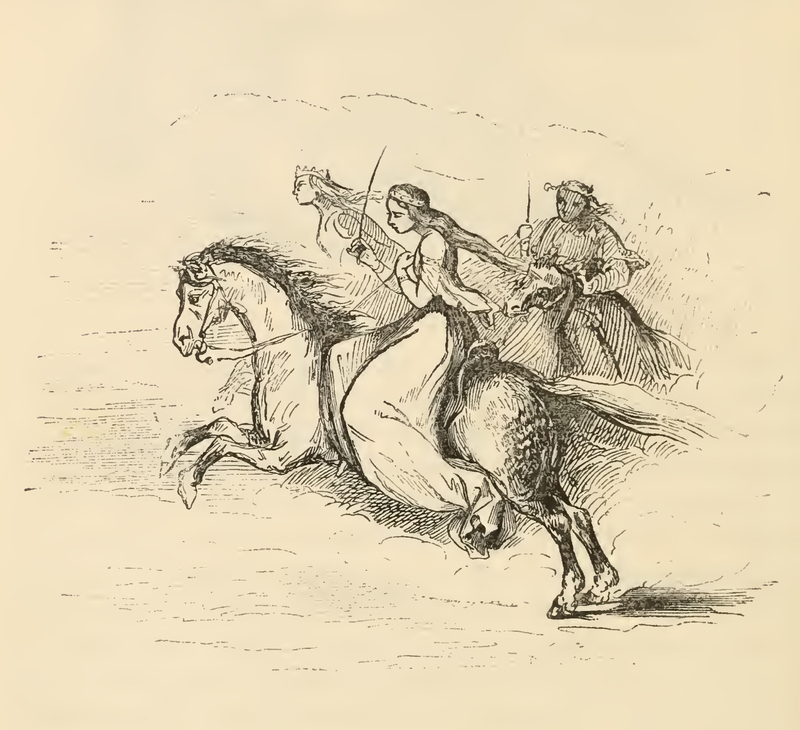
Seeking a story to tell Don Quixote, Sancho espies three women riding from Toboso on donkeys and returning to Quixote claims that he saw Dulcinea and her damsels riding from the city on powerful horses with crowns of diamonds, rubies, and cloth of tissue 5 feet long. In their hands they hold whips to spur the horses forward.
At the door of an inn stands a bearded man clad from head to foot in shamois leather hose, doublet, and breeches, his left eye covered with a patch of green taffeta who holds a walking stick in his right hand and a hat with his left against his waist. This man is the infamous thief Gines de Passamontes, dressed in his current garb as Master Peter the puppeteer.
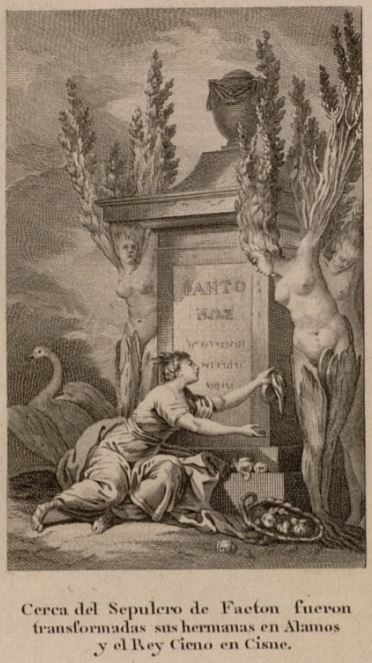
This image depicts the Heliads (the sisters of Phaethon) mourning for him at his tomb and transforming into poplar trees. After Phaethon had fallen from the sky after driving his father’s golden chariot, his sisters had gone to the place where his body fell to mourn for him. They stayed there for four months before they were transformed into poplar trees. Three sisters are depicted mid transformation in the image, while one is still resting on the ground holding her arms out to her sisters. Another relative (and a lover) that deeply grieved for Phaethon was Cycnus. He too had a transformation after hearing the news of Phaethon's death, but instead of a poplar tree like the Heliads, Cycnus transformed into a swan. Cycnus, in the form of a swan, is illustrated on the left side of the image in the background.
A hawk flies over a heron and looks down into its beak, the heron cranes its neck to look upwards in flight. The image is occasioned by Don Quixote saying "perhaps we are now making a point and soaring aloft to a certain height, to come sowse down upon the kingdom of Candaya, like a hawk upon a heron." (Page 438)
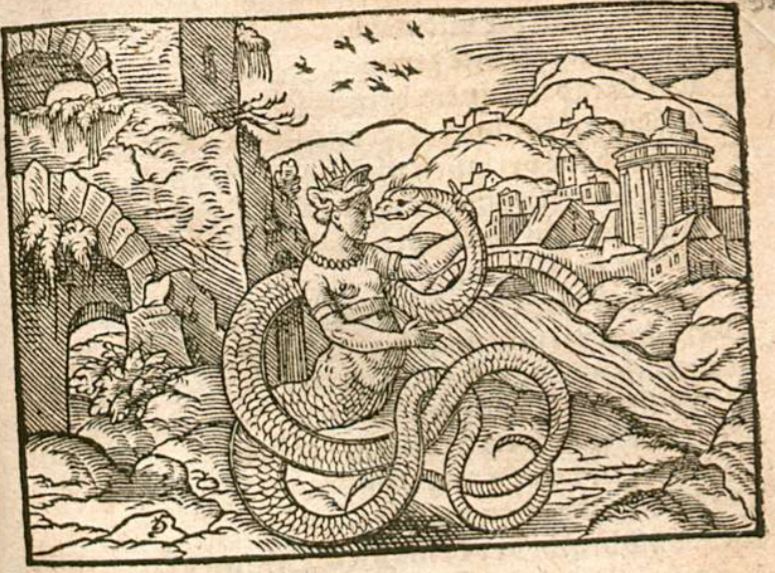
This image illustrates the king of Thebes, Cadmus, transformed into a snake. His wife Harmonia is depicted holding him as she wishes to be transformed into a snake as well in order to be with him. Harmonia’s lower half of her body is depicted mid-transformation. Cadmus was transformed into a snake as punishment for slaying a serpent after he founded the city of Thebes.

![[Portrait of Sampson Carrasco]](https://collections.cemvc.ca/files/large/2eecdae3a6c77a338f753443649b4e56fc49e6f1.jpg)
![[Of How Don Quixote was Pensive]](https://collections.cemvc.ca/files/large/8e69d0f40ebb516d6d19321ea59e16bf0b900998.jpg)
![[Don Quixots Encounter with a Flock of Sheep]](https://collections.cemvc.ca/files/large/ea2d10f5753536d12a0855b481a8b0d066aabff9.jpg)
![[Don Diego de Miranda Gives to the Poor]](https://collections.cemvc.ca/files/large/84c7b864b72bb861491ce2a58b4005a057e5c536.jpg)
![[Don Quixote prevents Sancho Panza whipping himself]](https://collections.cemvc.ca/files/large/44478695db7a5440d00c004deb8037f383eb7894.jpg)
![[Don Quixote and Sancho Panza Pass the Night Beneath Trees]](https://collections.cemvc.ca/files/large/c56c0dca0685be31f2c493e6b28bf1af47558e74.jpg)
![[Don Quixote addresses the galley slaves]](https://collections.cemvc.ca/files/large/c3642794c2133ec84c5036005c34e9c94f2709cc.jpg)
![[Master Peter Introduction]](https://collections.cemvc.ca/files/large/0e613a450c760e1731b44b3f1bb316eb82ba2c5b.jpg)
![[A Hawk Upon a Heron]](https://collections.cemvc.ca/files/large/9ed34f2730fa9c37ff8de7f372a7d7e0e77763dc.jpg)