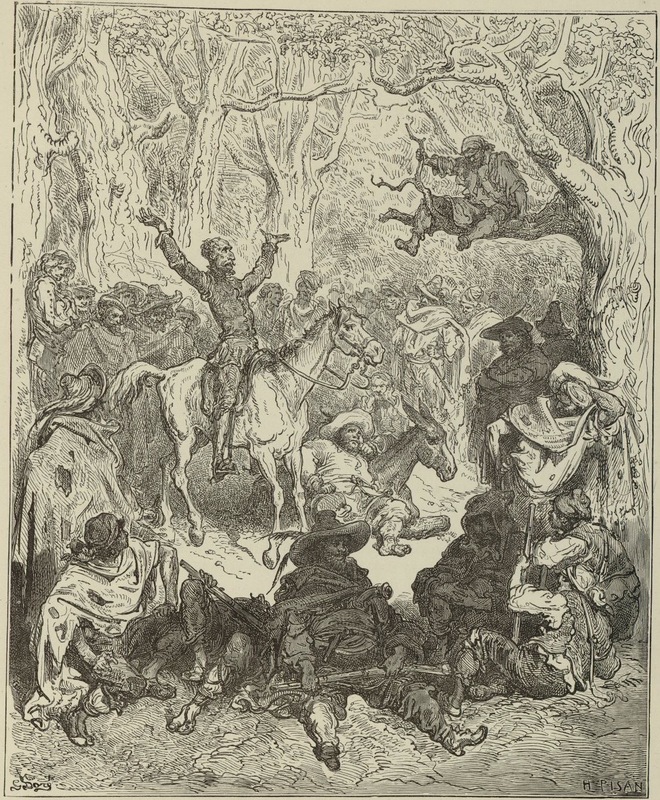
Don Quixote, mounted on Rocinante, tries to persuade Roque Guinart’s outlaws to abandon their way of life. Signed by G. Doré (illustrator) and H.-J. Pisan (engraver). Part 2, ch. 60.
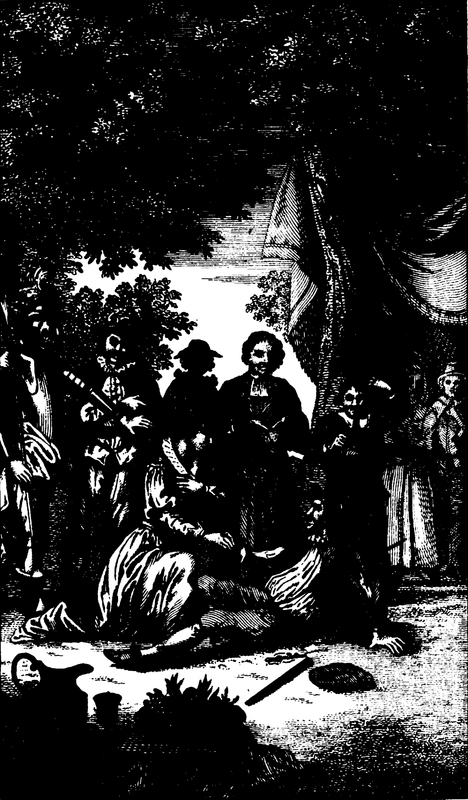
Quiteria gives her hand in marriage to Basilius, who has faked his own suicide so that she may marry him instead Camacho out of pity for his plight. The priest oversees these vows, thinking that Basilius is on death's door and bestows upon them the nuptial benediction. The sword which Basilius used to fool everyone into thinking he had stabbed himself lies by his side next to his hat. Under this image is the caption "Basilius stabs himself, with mimic pain; Quiteria soon returns her heart again. A desperate lover always finds success; Fortune the Bold in all affairs will bless".
Countess Trifaldi and her retinue of duennas lift their veils and reveal their faces, which are covered by beards, some blond, some black, and some white. Don Quixote, Sancho Panza, the duke, and the duchess are astonished. Signed by R. Smirke (illustrator) and C. Warren (engraver). Part 2, ch. 39.
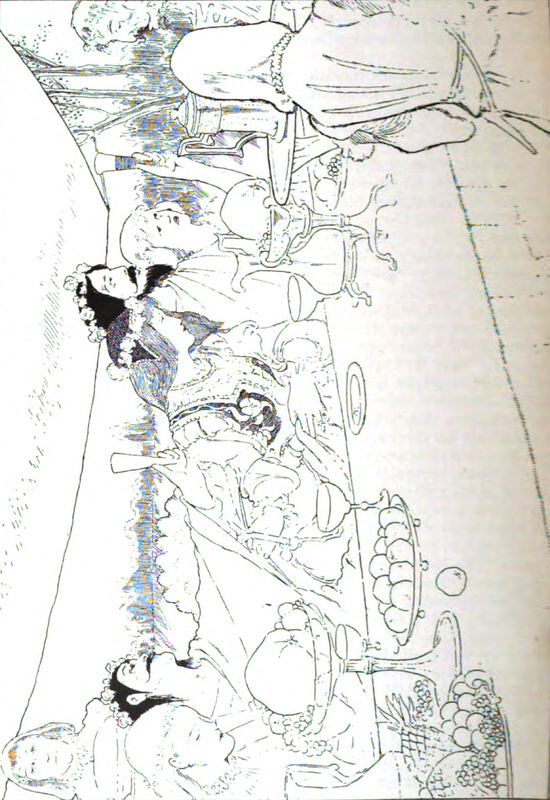
Having bid the Duke and Duchess farewell, Don Quixote becomes entangled in some bird snares. He is found by the shepherdesses who placed the snares and invited along with Sancho Panza to their villages pastoral tents. Arriving at the scene, Don Quixote is surprised to see more than thirty villagers whom all introduce themselves to him, though they are no strangers to his history. Hastening to the tents, Don Quixote and Sancho Panza find the table spread neatly with rich and plentiful morsels. The villagers honor Don Quixote by placing him at the upper end. They all gaze at him and admire the sight.
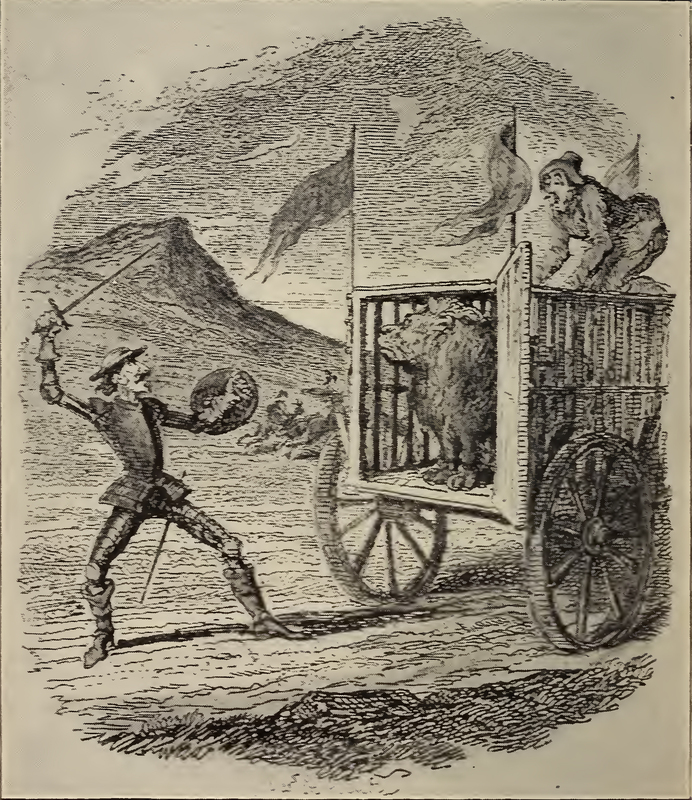
Don Quixote meets a lion keeper during his travels and ceases the opportunity to bolster his chivalrous reputation and become the 'knight of the lions' . The lion keeper is frightened by Quixote's preposition to release the lions from their cages and remarks that the lions are very large and very hungry. Quixote is unperturbed by this knowledge and threatens the keeper with his lance, forcing him to open the cages so he can fight the lions. Sufficiently intimidated, the lion keeper opens the lion cage and cowers atop the cage. As Quixote assumes a fighting stance with which to battle, the lion coolly stands up, passively observes its surrounding and shows no interest in escaping the cage or attacking the knight.
As night falls, Don Quixote gathers his armour and places it on a trough next to a well in a corral near the inn. Taking up his lance, he paces back and forth in front of the trough, standing vigil over his arms. The scene is illuminated by the light of a full moon. Approached by one of the muleteers, Don Quixote orders him not to touch his arms. When the muleteer ignores him, the errant knight knocks him to the ground. Signed by T. Stothard (illustrator) and W. Angus (engraver). Plate XII. Part 1, ch. 3.
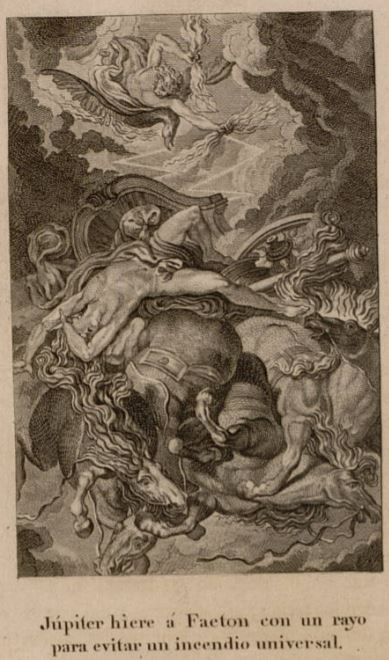
Phaethon had been given permission by his father, the sun god Sol (Helios), to drive his golden chariot to prove his parental legitimacy to Phaethon. Sol drives the chariot in order to bring upon daylight across the world. Phaethon, however, being inexperienced at driving the chariot, caused chaos. Sol had warned Phaethon that the horses were difficult to control and told him to fly at a happy medium between the sky and the earth. Phaethon was unable to control the chariot and drove too close to the sky and lost the reigns of the horses which caused a massive fire. This image shows the chaos that Phaethon had caused. In order to save the world from being engulfed in flames, Jupiter strikes Phaethon out of the sky with his lightning bolts. Jupiter is illustrated at the top of the image with lightning bolts in hand as he throws them at Phaethon. Phaethon and the horses are depicted falling out of the sky and down towards the earth.
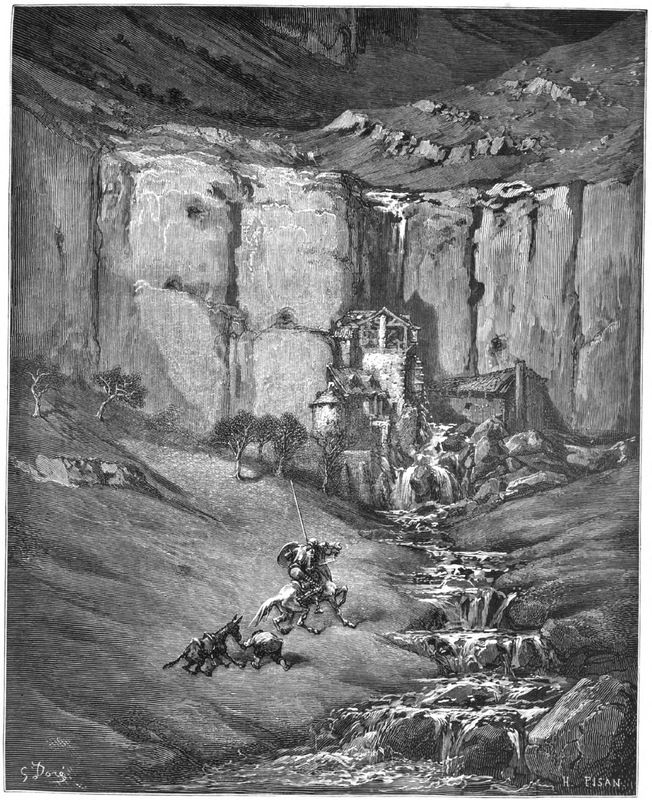
Don Quixote attempts to find the source of the loud noises coming from the river that had kept Sancho Panza and himself awake with fear all night. Rocinante was scared of the noises, which turned out to be made by the mills powered with the running water. The illustration shows Don Quixote urging Rocinante onwards towards the river while Sancho and his donkey follow timidly behind. The mills are nestled into the cliff and the river flows out of them towards the foreground. This scene can be found in Part I, Book 3, Chapter 6.
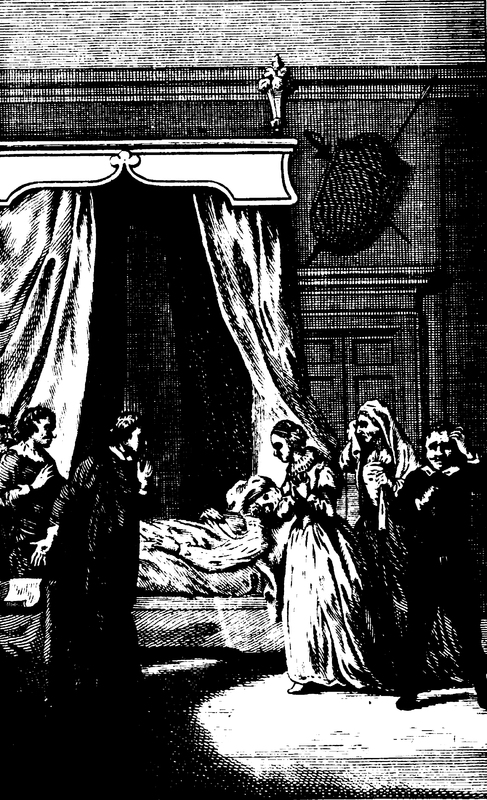
Having returned to his house in La Mancha having been defeated at the hands of the Knight of the White Moon, Don Quixote (pictured lying lifeless in bed) fell ill of a fever,which confined him to his bed six days, and terminated in his death. His old friends the curate (pictured to the left closest to Quixote) and barber (to the left of the curate),with the bachelor Carrasco, frequently visited him while he lay on his sick bed, and Sancho Panza (pictured scratching his brow to the right of Quixote's niece) never stirred from his poor master's side. Sancho Panza, the niece (pictured holding Quixote's head) and Quixote's housekeeper (pictured to the right of the niece) wept profusely at Quixote's passing. Beneath the image is written the following inscription: "As death approaches, reason clears his eyes; knight errantry before religion flies our Don, who thought the oaths of death were vain, in sickness cursed, by a fever slain".
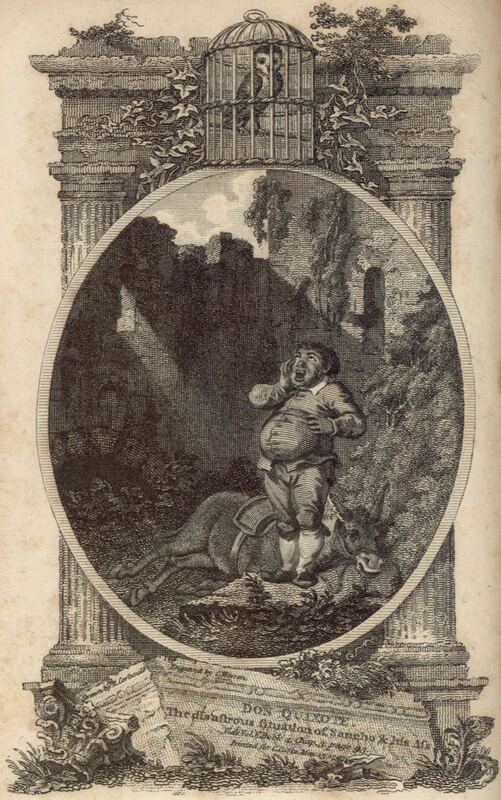
As night falls, Sancho Panza and his donkey fall into a deep and dark pit between some old buildings while returning to the duke’s palace. The illustration is set in a decorative and architectural frame, complete with ruins, columns, and an owl in a cage. Signed by R. Corbould (illustrator) and C. Warren (engraver), dated 1797. Part 2, ch. 55.
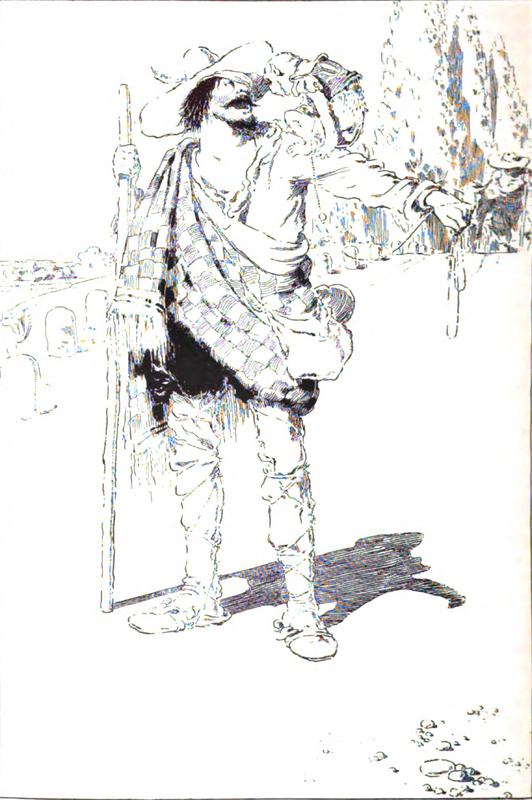
Master Peter stands on the road to Saragosa with his ape on his shoulder and a walking stick in hand. He is a well known and renowned puppeteer who travels between inns and puts on puppet shows. According to Hamete Benengeli, Master Peter is actually Gines de Pasamonte, the galley slave whom Don Quixote frees earlier near the Sierra Morena, and whom later goes on to steal Sancho Panza's donkey Dapple. He is pictured here before meeting Don Quixote at the inn wherein Master Peter will recognize the man and put on a play for him with a plot much like Quixote's own story, at which point Quixote will take up arms and destroy the puppet show.
Donna Rodriguez (right) receives Quixote (middle) into her home. Don Quixote clad in full armor save a small cap on his head, returns the tokens of affection and civility. On the left, Don Lorenzo (pictured wearing a feathered cap) introduces himself to Sancho Panza. In the background of Don Diego's spacious home stands a marble statue of a woman casting her arm over her head.
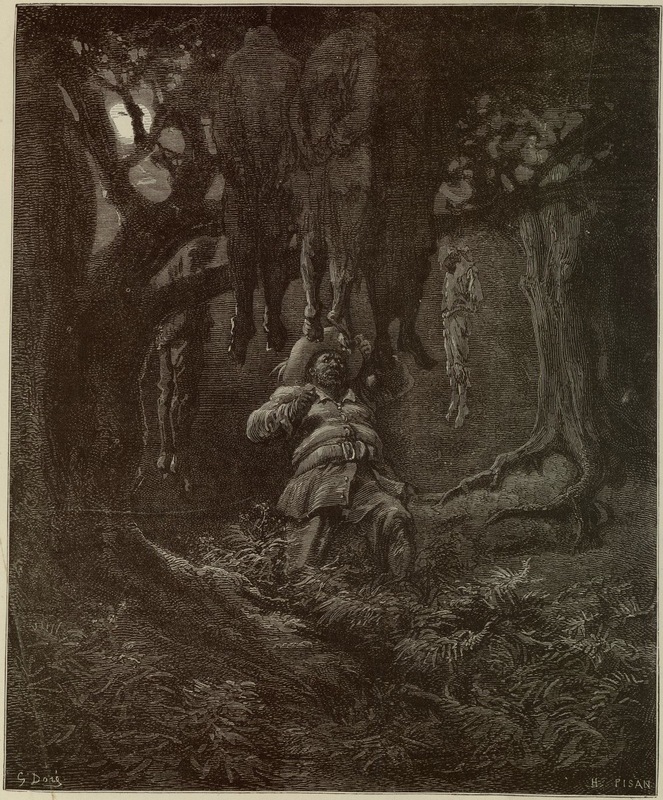
After his brief fight with Don Quixote, Sancho Panza discovers the bodies of outlaws and bandits hanging from tree branches. He shouts, calling for Don Quixote to help him. Signed by G. Doré (illustrator) and H.-J. Pisan (engraver). Part 2, ch. 60.
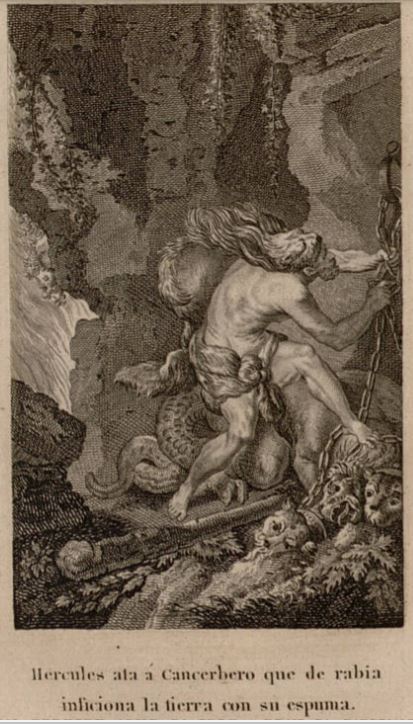
This image depicts the demi-god Hercules in the Underworld battling the three headed beast named Cerberus. Hercules is tying the beast up with chains as he steps on their heads. It is suggested that the poison aconite (also known as wolfsbane) came from the mouth of Cerberus. When Hercules had chained up Cerberus and brought him up from the Underworld, he started foaming at the mouth when he saw daylight, which turned into aconite when it touched the ground.
In an inn, Don Quixote (middle) holds an open book in his right hand. Sancho Panza (left) sits upon a stool and looks to the right towards his master. To the right of Quixote, Geronimo wraps his right hand amiably around Quixote's shoulder. In Geronimo's left hand he holds his hat by his side. On the right, a gentleman enters the inn through an open door (page 263).
Despite Sancho Panza’s warning (he is pictured gesticulating in the background), Don Quixote charges a flock of sheep. He is mounted on Rocinante and holds his lance. Some of the shepherds are also pictured beneath a tree (right, one holding a horn and a staff). Signed by T. Stothard (illustrator) and W. Angus (engraver). Plate VIII. Part 1, ch. 18.
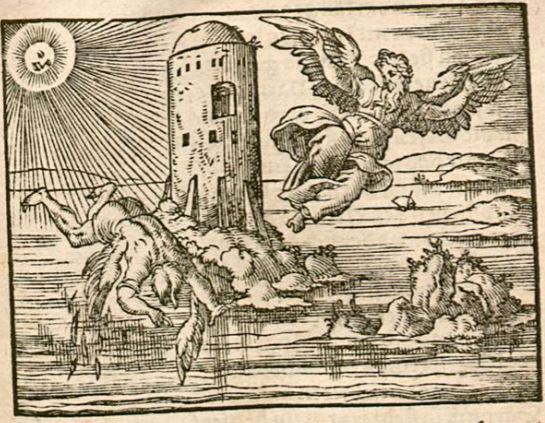
After creating the labyrinth to contain the Minotaur, Daedalus was taken prisoner by King Minos. He came up with a way to escape that did not involve traveling by land or sea, as to avoid being recaptured. He gathered up feathers and created human sized wings and fastened them together with string and bees’-wax. He made a pair of wings for himself and a pair for his son, Icarus. Before taking flight, Daedalus instructed his son not to fly too close to the water or the moisture will ruin the wings, and not too close to the sun as the heat would melt the wax. As depicted in the engraving, Icarus did not listen to his father and flew too close to the sun. The wax melted, and Icarus fell into the sea.
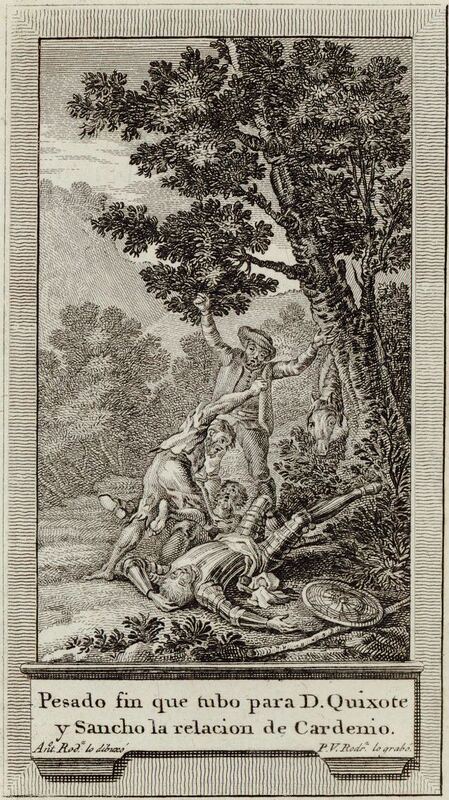
Don Quixote interrupts Cardenio, calling him a liar and a villain. In response, Cardenio knocks him to the ground. Cardenio does the same to Sancho Panza when he tries to defend Don Quixote. When the goatherd comes to Sancho’s aid, Cardenio attacks him. Signed by A. Rodríguez (illustrator) and P. Rodríguez (engraver). Part 1, ch. 24.
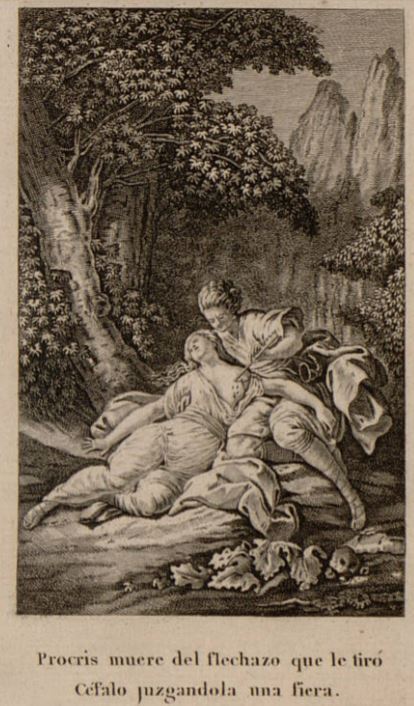
This engraving depicts Cephalus, whose hunting trip went awry as he had accidentally shot his wife Procris with the spear that she had gifted him. Cephalus was hunting, and when he heard movement in the trees, he threw his magical spear at the target. His spear is magic as it never misses the target. While Cephalus was hunting, Procris was walking through the woods to discover if he was being unfaithful to her or not. Cephalus is depicted leaning over the body of his wife as she is illustrated with the spear impaling her breast.
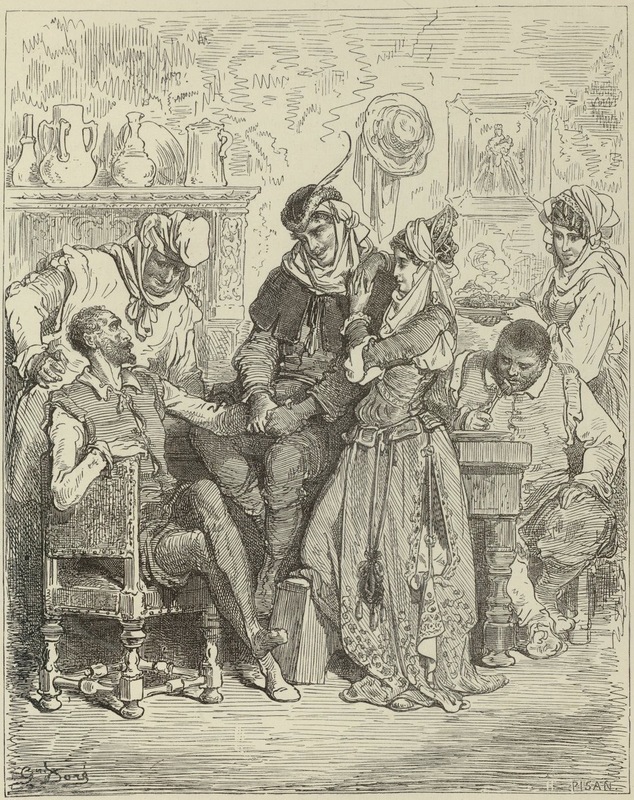
The newlyweds Basilio and Quiteria host Don Quixote and Sancho Panza at their house for three days and present many gifts to the knight. They are depicted in the kitchen, where Don Quixote gives them advice while Sancho eats. Signed by G. Doré (illustrator) and H.-J. Pisan (engraver). Part 2, ch. 22.
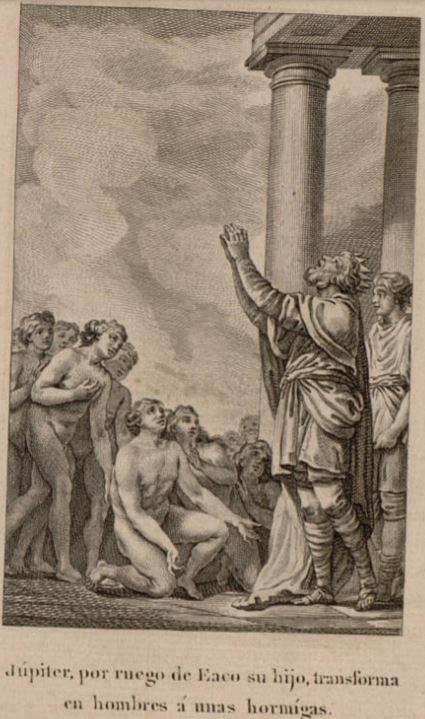
King Aeacus of Aegina had survived a ravenous plague which wiped out his population, and he had asked his father Jupiter for help to rebuild his city. Aeacus is illustrated on the right side of the image with his hands in the air as he prays to his father. Jupiter led Aeacus to an oak tree that had ants climbing on it, and the ants began to transform into humans. The naked people depicted in the image are the ants who had just been transformed from ants. The transformed humans go on to create the new population of Aegina and are thenceforth known as the Myrmidons.
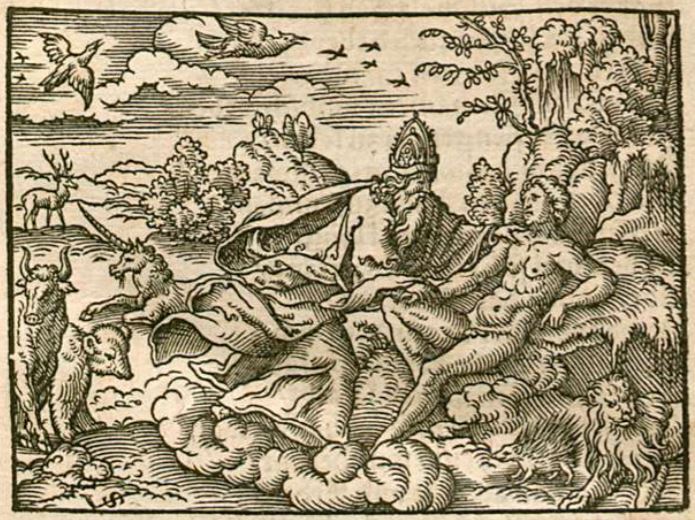
This image illustrates the creation of the first human. There is a god in the center of the image with his clothing blowing in his newly created winds. Depicted behind him are the all the animals he had just created as well. His hands are touching his new creation: humankind. According to Ovid, this god wanted to create a being with higher intelligence than any of the animals he had made, as well as a being that had their heads pointed to the skies, as opposed to the ground beneath them. The human is depicted nude, with his gaze pointing upwards towards the sky.
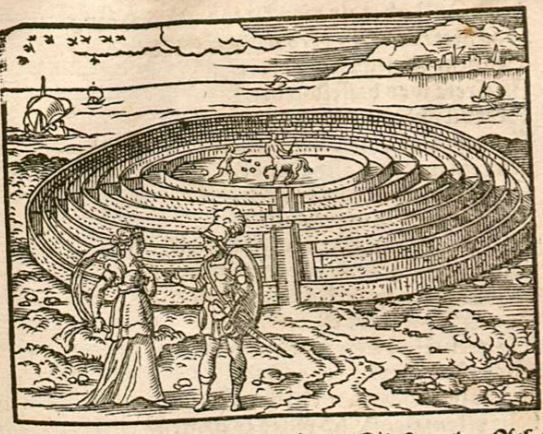
King Minos of Crete had Daedalus design and create an elaborate labyrinth to contain a minotaur that was born from his unfaithful wife. The minotaur is illustrated in the center of the Labyrinth. Every nine years, King Minos demands that people be sent to him from Athens in order to feed the minotaur. Theseus is one of the youths on the third occasion that Athens sends people to feed the minotaur. Theseus is illustrated at the forefront of the engraving, speaking to a woman. This woman is Ariadne, the daughter of King Minos. She gives Theseus a thread for him to unwind while he goes through the Labyrinth in order to find his way back once he has defeated the minotaur. Theseus successfully destroys the minotaur, and leaves with Ariadne.
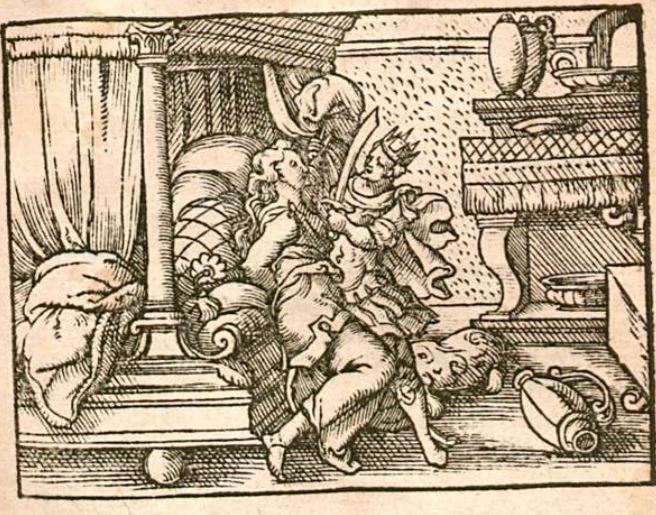
This engraving depicts Tereus, a Thracian prince, cutting off the tongue of his sister-in-law, Philomela. Tereus was overcome by lust when he had first set eyes on his sister-in-law, and instead of bringing her to his wife as she had requested, he tied her up in a cabin in the woods and kept her to himself. When Philomela declared she would scream and yell for everyone to hear her until she was found, Tereus decided to cut her tongue out so that no one would find her. Tereus is depicted holding a sword up to Philomela’s face and Philomela’s arms are depicted behind her back as her hands are bound.
This image appears at the beginning of the ninth book. It depicts a fable within the ninth book which is the story of Hercules and Achelous. The demi-god Hercules and the river god Achelous fight each other for the right to marry a woman named Deianira. The fight between the two is depicted on a slab of stone in this image with Hercules on top of Achelous.

![[Vigil of arms]](https://collections.cemvc.ca/files/large/a8b6e897cfb9b0579eadf1d6a55c0e11428a6960.jpg)
![[Of How Quixote Walked through the House of Don Diego with Donna Christiana]](https://collections.cemvc.ca/files/large/d09307f9c13d8fd4923e46225714130e52a15407.jpg)
![[Don Quixote Reads a Fake Copy of his History]](https://collections.cemvc.ca/files/large/532a6cefd8fd3c1af8515849c1f842c0ef422fa1.jpg)
![[Don Quixote attacks a flock of sheep]](https://collections.cemvc.ca/files/large/318093cf68e4fc0a54fa80e9204f40c3053de86e.jpg)
![[Hercules Wrestles Achelous]](https://collections.cemvc.ca/files/large/ae2f8aac4d95cfa226c95c0c639e5c21f76f57a1.jpg)