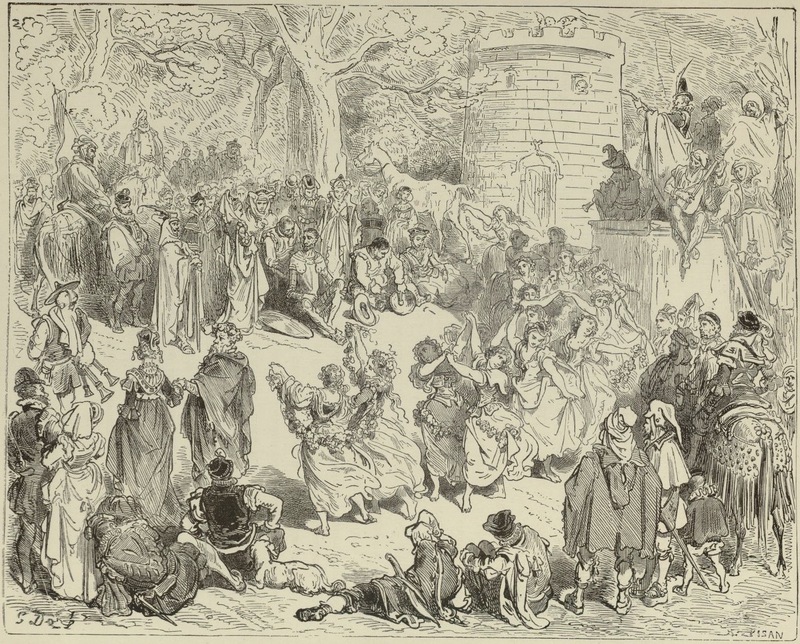
At Camacho’s wedding, a group of shepherdesses begins to dance. They are led by a venerable old man and an ancient matron, more agile and nimble than their years would lead one to expect. A Zamoran bagpiper plays music to accompany them. Signed by G. Doré (illustrator) and H.-J. Pisan (engraver). Part 2, ch. 20.
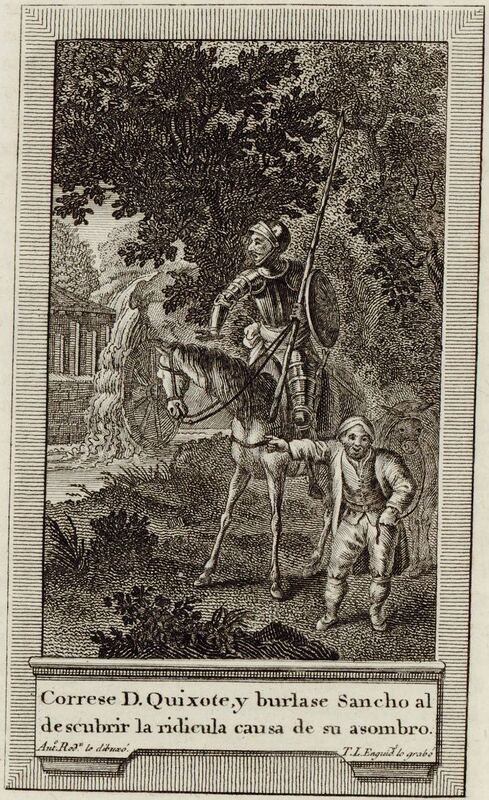
Don Quixote and Sancho Panza discover that the cause of the terrifying noise that had kept them frightened throughout the night was six wooden fulling hammers in some dilapidated hovels at the foot of high crags over which a great rush of water falls. Rocinante becomes agitated by the clamour of the water and the pounding. Sancho begins to laugh aloud and mock Don Quixote, angering him. Signed by A. Rodríguez (illustrator) and T. Enguídados (engraver). Part 1, ch. 20.
Don Quixote reads chivalric books in his study while observing his family arms displayed over the fireplace. Don Quixote’s figure and chair are richly detailed while the furnishings of the room are simply drawn. Plate no. 2, signed by J. Vanderbank (illustrator) and G. Vertue (engraver). Vol. 1, book 1, ch. 1.
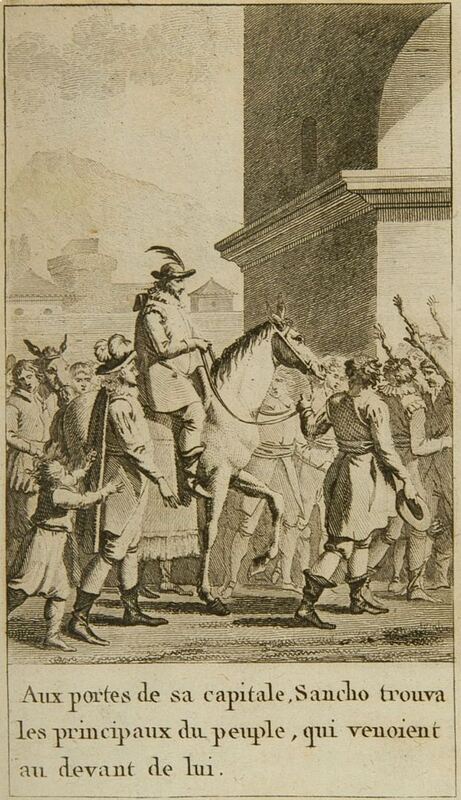
Sancho Panza arrives at Barataria Island and is welcomed by the local authorities. Signed by J.-J.-F. Le Barbier (illustrator) and F. Godefroy (engraver). Part 2, ch. 45.
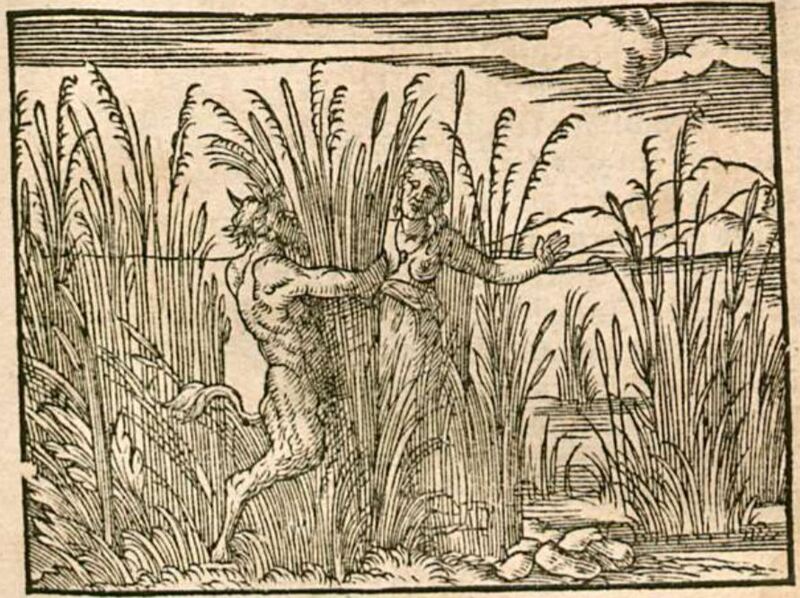
This image depicts the story of the god Pan and the nymph Syrinx. Pan is half goat, half man. He is illustrated as such in the engraving with the bottom half of his body in the form of a goat, and his top half in the form of a man, aside from the horns on his head. Pan had spotted Syrinx and noticed that she resembled the goddess Diana. He became infatuated with Syrinx and chased her until they came upon the bank of a river, where Syrinx asked the water nymphs for help in evading Pan. The water nymphs then transformed Syrinx into reeds from the marsh. Syrinx is illustrated in the engraving surrounded by the reeds as she begins to transform into them. Pan takes the reeds and with the wind from his loud sigh of disappointment, a sound is produced from them which he then turns into a musical instrument.
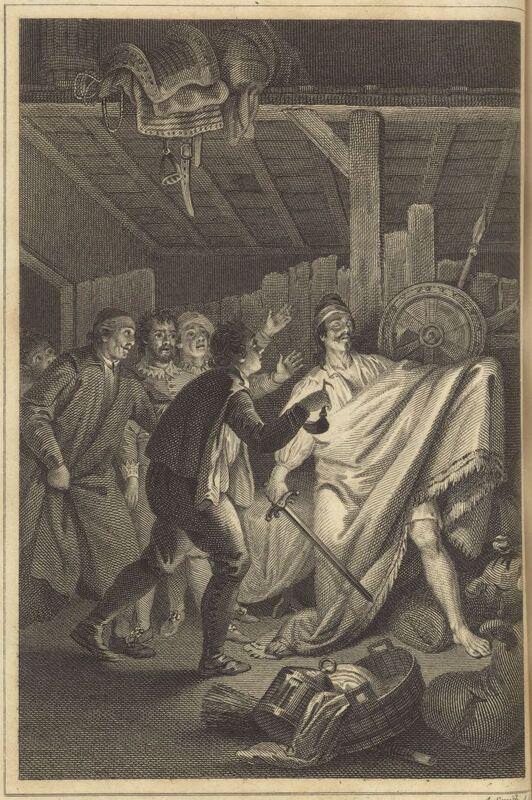
At Juan Palomeque’s inn, Sancho Panza, Cardenio, the priest, and the innkeeper discover Don Quixote attacking the wineskins while sleepwalking. He is half-dressed, has a blanket draped over his arm, and wields his sword. The light from a lamp held by the innkeeper illuminates the scene. Signed by A. Smith (engraver). Part 1, ch. 35.
Quiteria tends to Basilio, who stages his own suicide in the hopes of convincing her and the crowd that she should leave Camacho and return to him. The priest marries the two of them, while Sancho Panza observes them with distrust. Don Quixote tries to convince Camacho not to stop the marriage. Signed by F. Hayman (illustrator) and J. S. Müller (engraver). Part 2, ch. 21.
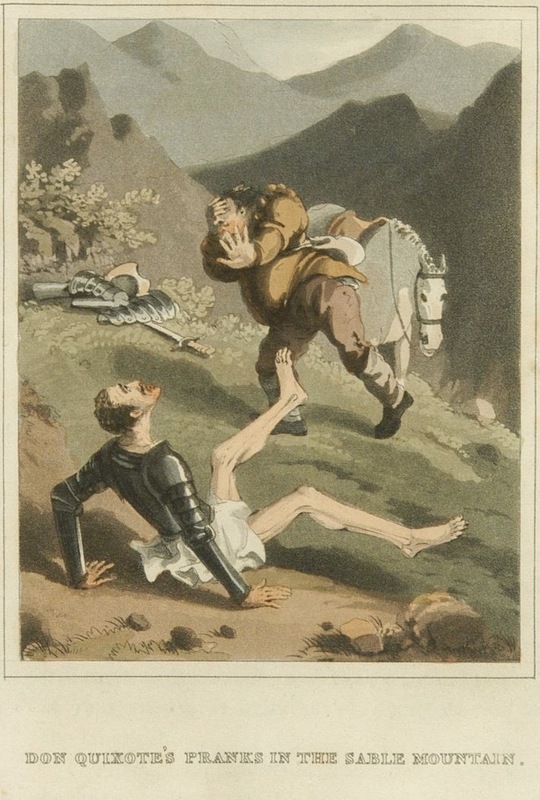
In Sierra Morena, Don Quixote and Sancho Panza arrive at the foot of a high mountain, standing alone among the many others that surround it. Don Quixote chooses this place for his penance. He removes his armour, for he must be as naked as the day he was born if he is to follow Roland. Half-naked, he performs somersaults while Sancho averts his eyes. Unsigned. Part 1, ch. 3.
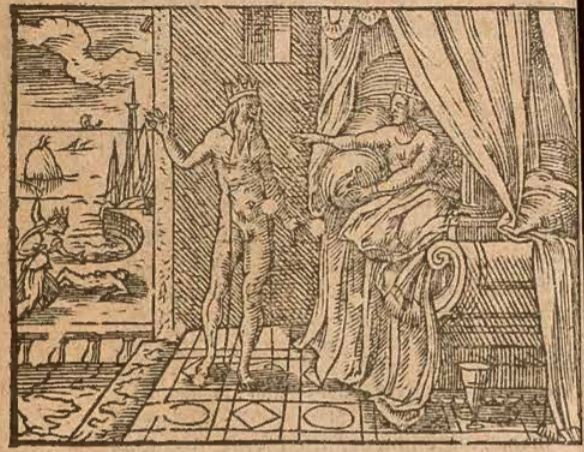
This engraving illustrates Morpheus, the son of the god of sleep, appearing to Alcyone in a dream in the form of King Ceyx. Unbeknownst to Alcyone, her husband King Ceyx of Thessaly had died in a shipwreck. She constantly prayed to the goddess Juno for her husband’s safe return, however, Juno wanted to reveal to Alcyone that he was in fact dead. Juno sent her messenger, Iris, to the god of Sleep and told him to appear to Alcyone in a dream to reveal her husband’s death. The god of sleep sent his son Morpheus to handle the task, as he can shape shift into any human being. As depicted in the engraving, Morpheus took the form of a dead King Ceyx, and appeared to Alcyone to reveal his death. Alcyone is illustrated pointing at him as she is surprised by his appearance and grieved to know that he is dead. The background of the engraving illustrates Alcyone after she has woken from her dream. She walked along the shores and came across the washed-up body of King Ceyx on the shores of the beach. She is depicted with her arms in the air, about to throw herself onto the body of her husband.
Don Quixote and Sancho Panza get in a boat that fell off from the shore. Sancho (left) looks back and sees himself about a couple of yards from the bank causing him to quake and cover his eyes and weep bitterly with his hands by his eyes. Don Quixote, clad in armor, places his left hand on Sancho's shoulder, his spear in his right hand and his shield on his back. In the background on the left Quixote's horse and Sancho's donkey watch their owners set off in a boat.
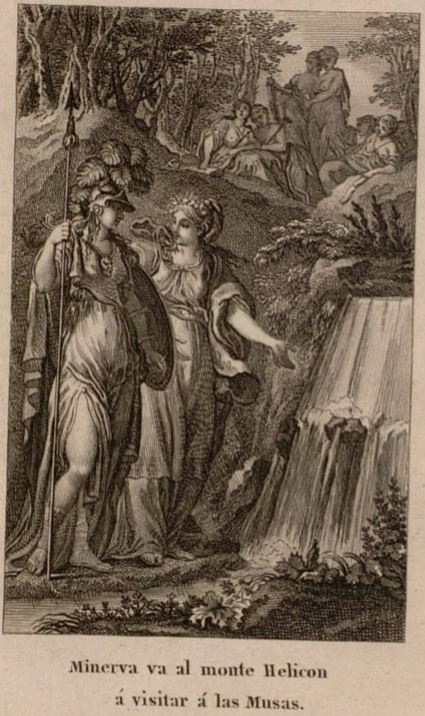
This image depicts the goddess Minerva visiting the Muses on Mount Helicon. Minerva is depicted on the left side of the image holding her spear and shield and wearing her helmet. She goes to Mount Helicon to see a fountain that she had heard about. The fountain is called Hippocrene and is said to have been formed by the hooves of Pegasus. One of the muses is standing beside Minerva and gesturing with her hand to show Minerva the fountain. The other Muses are depicted in the background of the image above the fountain.
A mustached man rides upon a very handsome flea-bitten mare. He is clad in a fine cloth gaban, faced with velvet, and a montera. The mare's furniture was all of the field fashion. The horseman wears a Moorish scimitar hanging at a shoulder-belt; and a whip by hand. His spurs are neat and polished matching his rich attire. This man is Don Diego de Miranda, a rich gentleman.
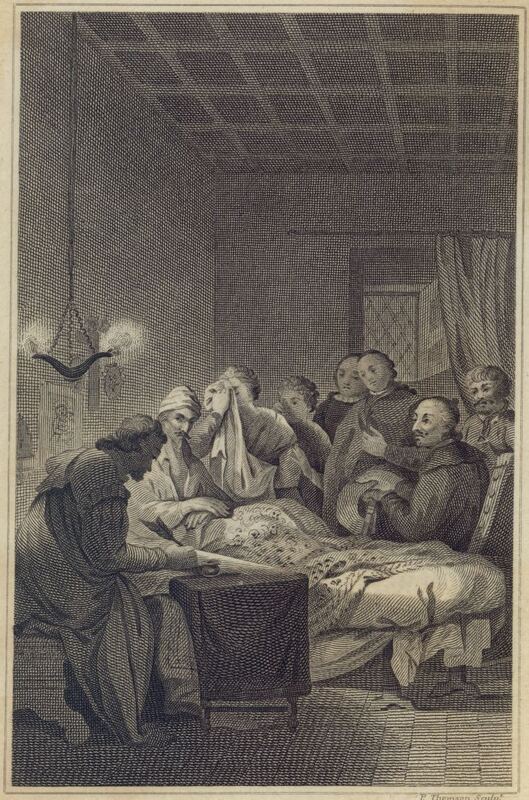
From his bed, Don Quixote dictates his last will to a notary (foreground). Also pictured are Sancho Panza, Sansón Carrasco, the housekeeper, the priest, and the niece. Signed by P. Thomson (engraver). Part 2, ch. 74.
In the foreground, Sancho Panza contemplates the barber’s basin (which Don Quixote believes to be Mambrino’s enchanted helmet) before giving it to Don Quixote. In the background, the barber flees the scene. Plate no. 14, signed by J. Vanderbank (illustrator) and G. van der Gucht (engraver). Vol. 1, book 3, ch. 7.
Don Quixote (right), and Sancho Panza (left) sleep in the Sierra Morena mountains upon their steeds. Don Quixote, clad in full armor, upon his spindly horse Rocinante whilst leaning upon his lance and Sancho Panza upon a saddle held up by sticks with his hands on his stomach, still thinking Dapple is beneath him.
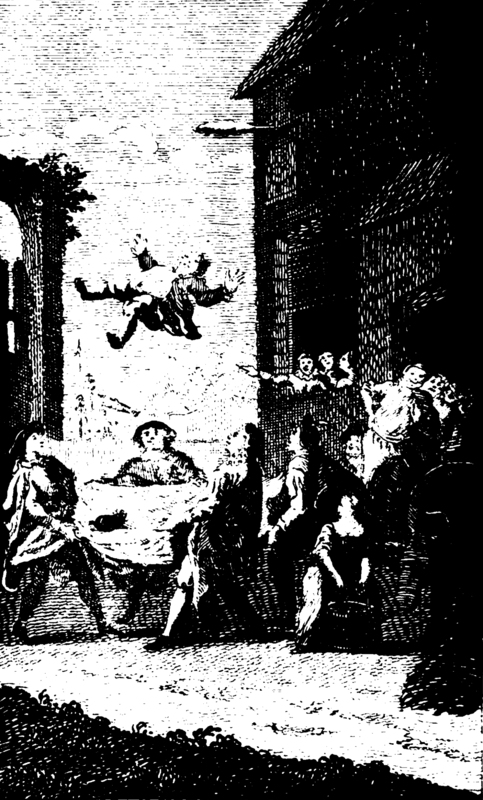
Having been beaten by the carriers in the meadow, Don Quixote and Sancho Panza take refuge in an inn which Quixote mistakes for a castle. Once Quixote has regained his health he seeks to repay his debt to innkeeper by paying revenge to any of the innkeeper's enemies. The innkeeper tells Quixote that this is an inn, not a castle, and that he must pay for his lodgings, but Don Quixote refuses to pay, lest he break the "laws of knight-errantry" and rides off. None impeded Quixote, but the Innkeeper set after Sancho Panza immediately, who was still in a feeble state after having been beaten by the carriers. Nonetheless, Sancho Panza copied his master and refused to pay for he would rather die than part with his money and dishonor his master. Unfortunately for Sancho Panza , there happened to be in the inn four Segovia clothiers, three Cordoua point-makers, and two Seville hucksters who pulled Sancho Panza from his donkey to the backyard of the inn while one of them fetched a blanket. These fellows put Sancho into the blanket and proceeded to toss him many feet into the air multiple times. Sancho made such an outcry upon being tossed that his master heard his wails and returned to see what the fuss was about.
Sancho Panza (left) clasps his hands together, his head having turned to the right his mouth falls agape at the sight of the Squire of the Woods' gargantuan nose. The Squire of the Woods (right) grasps Sancho gently, his left hand brushing Sancho's shoulder and his right hand warmly touches Sancho's back. He is wearing a brimmed hat with the front bill folded upon itself, beneath which he has tied a large nose that droops to his chin for the purpose of frightening Sancho.
A stone castle is pictured atop a peninsula of rock, surrounded on all sides by water, the only entrance a winding pathway drawing from a beach. The image is occasioned by Quixote seeing a water mill and saying "O friend, behold, yonder appears the city, castle or fortress in which some knight lies under oppression, or some queen or princess in evil plight, for whose relief I am brought hither."
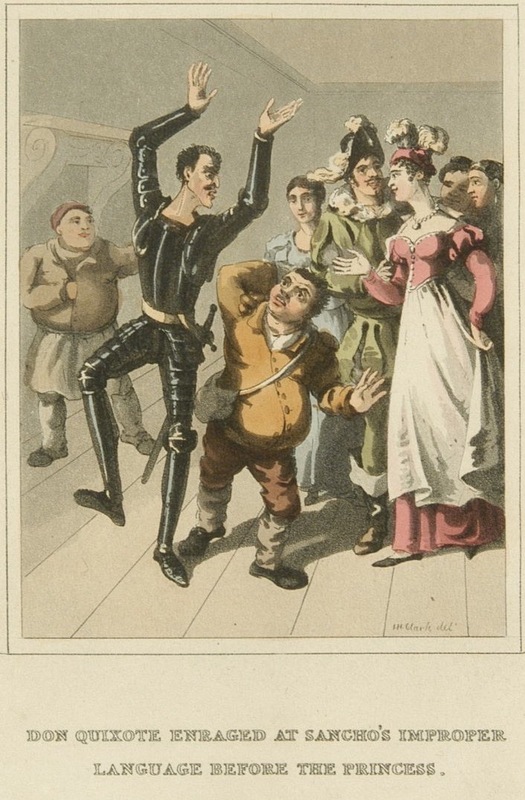
At the inn, Sancho Panza suggests that Mimicona (Dorotea) is not a genuine princess, provoking Don Quixote. The knight is infuriated and tries to punish him. Dorotea, who understands Don Quixote’s madness, tries to pacify him by claiming that Sancho Panza saw illusions that offended her good name. Also pictured are don Fernando, Doña Clara, Luscinda, the innkeeper, and the priest. Unsigned. Part 1, ch. 3.
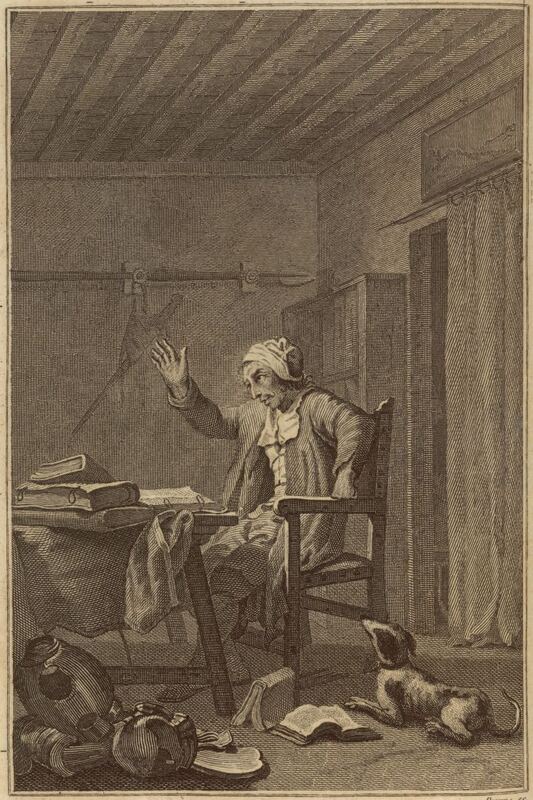
Don Quixote reads chivalric books in his library, slowly descending into madness. Anecdotal detail from Cervantes’ text: skinny greyhound at Don Quixote’s feet. Signed by W. Byrne (engraver). Part 1, ch. 1.
Don Quixote introduces himself to the duchess, who rides a white horse and holds a goshawk. He bows to her while Sancho Panza lies fallen from his mount. The duchess is accompanied by several squires. Signed by F. Hayman (illustrator) and S. F. Ravenet (engraver). Part 2, ch. 30.
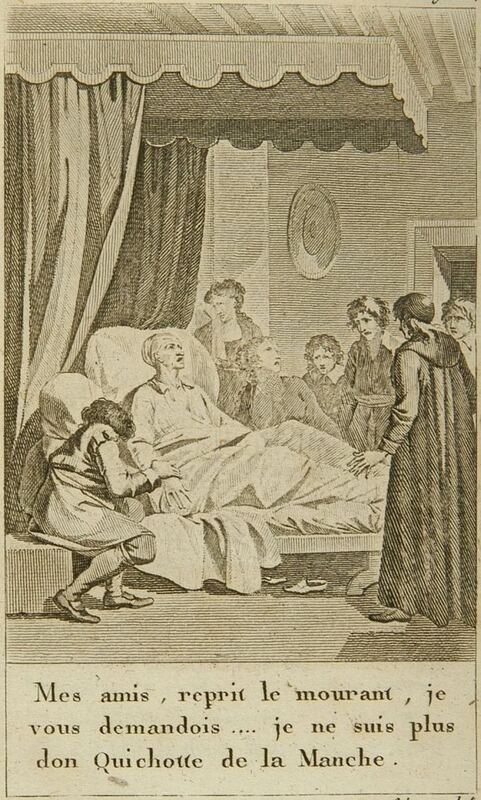
On his deathbed, Don Quixote becomes Alonso Quijana again. He is surrounded by Sancho Panza, Sansón Carrasco, the housekeeper, the priest, the niece, the barber, and the notary. Signed by J.-J.-F. Le Barbier (illustrator) and J.-J. Coiny (engraver). Part 2, ch. 74.
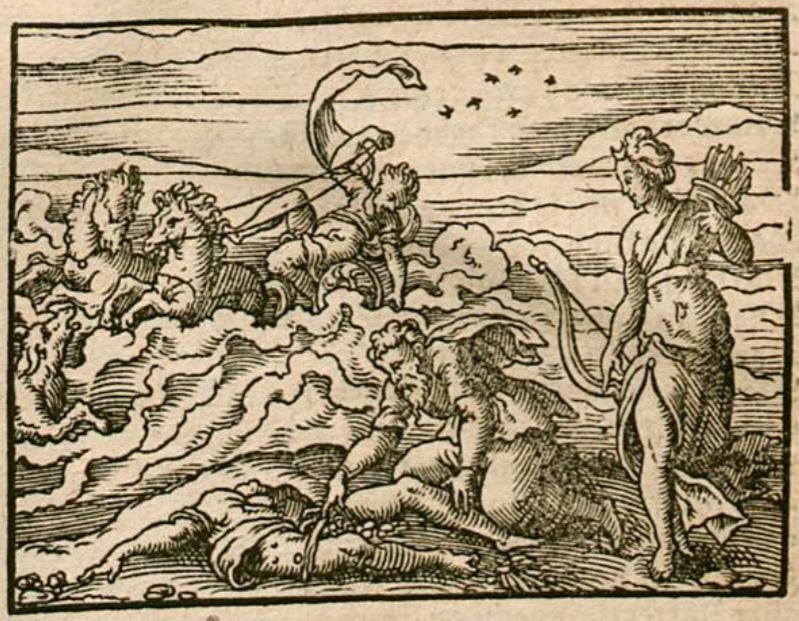
This engraving illustrates the death of Hippolytus, the son of Theseus. Hippolytus is illustrated in his horse-drawn chariot being overtaken by massive waves from the ocean. There is a bull coming out of the waves on the left side of the engraving directly in front of the horses. Hippolytus is depicted falling out of the chariot as he loses control of the horses. This accident kills Hippolytus. His mangled body is illustrated in the foreground of the engraving as he is being healed by the god Aesculapius. Diana is depicted standing beside Aesculapius with her bow and arrows. Ovid explains that Diana helped Hippolytus find a new life and home after he was healed.
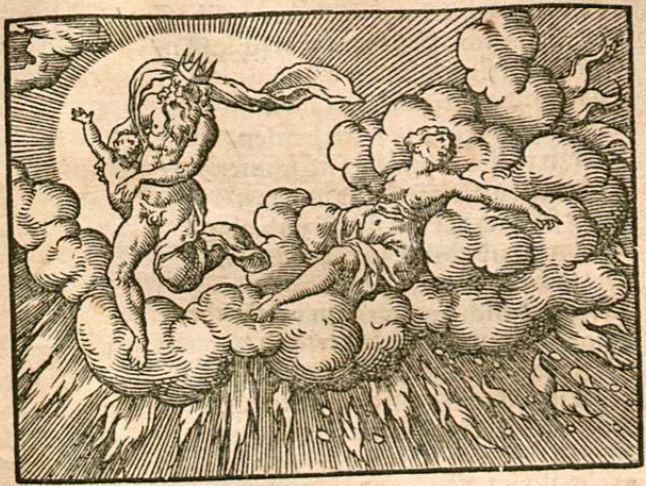
This engraving illustrates Semele, the daughter of Cadmus (founder of Thebes), being engulfed by the flames of Jupiter. She was unknowingly tricked by Juno into asking Jupiter to show his true godly form to her. Juno did this out of jealously, as she had found out that Semele was pregnant with a child from the seed of Jupiter. Semele followed the advice and requested Jupiter to show her his true form. Jupiter reluctantly did this, knowing it would incinerate her. The engraving shows the flames and storms that Jupiter’s full form unleashes unto Semele. Jupiter is depicted on the left-hand side of the engraving with his crown to signify his status as king of the gods. Once Semele was destroyed, Jupiter had taken the unborn child out of her womb in order to save him. He is illustrated with the child in his arms. He eventually sews the child into his thigh for him to finish developing. This child will become Bacchus, the god of wine and theatre.
Don Quixote (left) clad in full armor, steps towards his horse, Rocinante, while also being held in farewell by Don Diego (middle) who leans to his ear to offer services and civilities. Donna Cristina, the lady of the castle (middle) bids farewell to Don Quixote as well. On the right Sancho Panza waits patiently upon his donkey for his master to be finished with farewells so they may depart. The doorway to the house on the left is very large and without a door, at the top of the arch is engraved Don Diego's coat of arms.

![[Don Quixote in his study]](https://collections.cemvc.ca/files/large/ba4413c130df20ed24a892f05667f6dc8fd4d282.jpg)
![[Marriage of Basilio and Quiteria]](https://collections.cemvc.ca/files/large/9f1b6f42aaf2b7f8d6babde43a5fd6ebab65730e.jpg)
![[Sancho Weeps at Going Afloat]](https://collections.cemvc.ca/files/large/aebef3d8ef27902263364e87ad334afdf84adefd.jpg)
![[The Appearance of Don Diego de Miranda]](https://collections.cemvc.ca/files/large/b2867b67c32620fd78c9379be36595712f9af3de.jpg)
![[Mambrino's helmet]](https://collections.cemvc.ca/files/large/9c43a7ca0aef2d9739d6241f1a1570aa6e842b0a.jpg)
![[Sancho Panza's Donkey Named Dapple]](https://collections.cemvc.ca/files/large/1c269a263d6dcdcabfec6443ff37b1a2560a3e51.jpg)
![[Of How Sancho Was Frightened by the Squire of the Woods' Enlarged Nose]](https://collections.cemvc.ca/files/large/8e206f6c6509b0d7e2312b588cd24fd84cf2c626.jpg)
![[A Fortress Amidst the Rocks]](https://collections.cemvc.ca/files/large/77aa5b0254ea17e5a707ea8ee792a82de6fc3b56.jpg)
![[Don Quixote and Sancho Panza meet the duchess]](https://collections.cemvc.ca/files/large/8ee32fbc258d56f070c362841c6597f599f188f0.jpg)
![[Don Quixote's Departure from the Home of Don Diego]](https://collections.cemvc.ca/files/large/b7fe066643eb254b9782b48d4f28d0509bbed207.jpg)