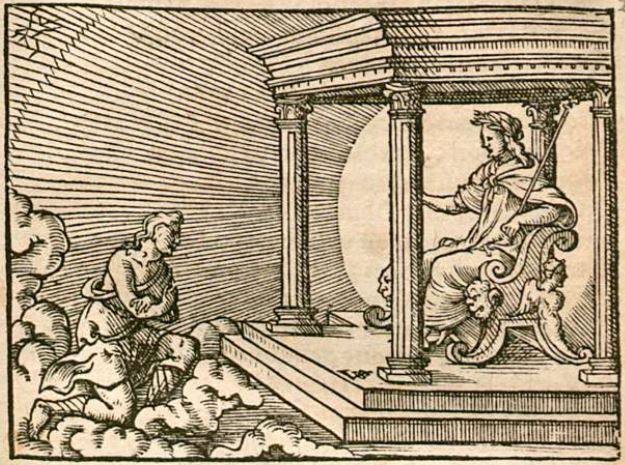
This image depicts Phaethon kneeling before his father, the Sun god, Phoebus. Phoebus is depicted sitting on his throne within his temple as the sun beams brightly behind him. Phaethon had questioned whether the Sun god was his legitimate father, so his mother Clymene told him to go to the Sun god himself for proof. Once Phaethon reaches the god, Phoebus confirms his parentage to Phaethon.
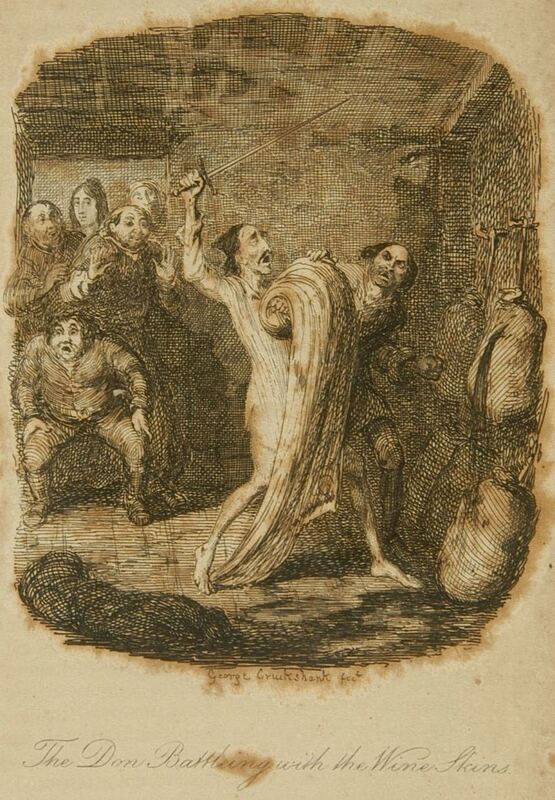
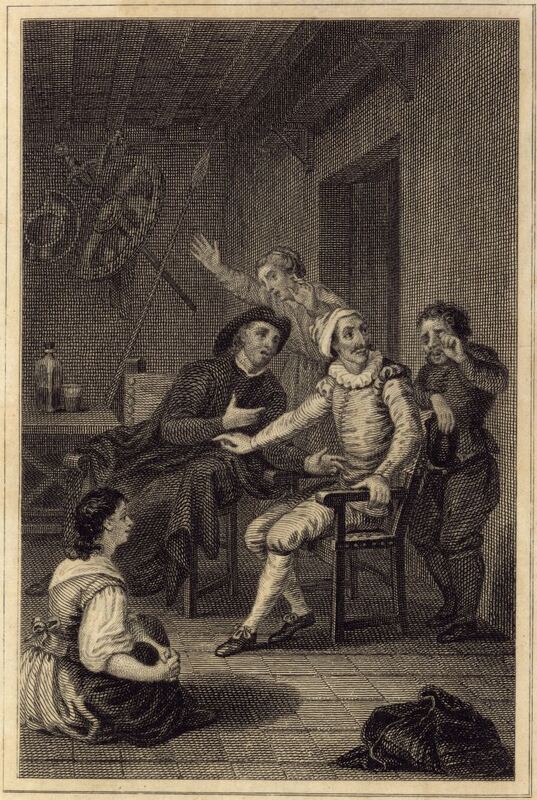
Don Quixote attacks the wineskins while sleepwalking. He is half-dressed, has a blanket draped over his left arm, and wields his sword. The innkeeper grabs him by the shoulder and clenches his fist, preparing to hit Don Quixote. The wine from a punctured wineskin spills onto the floor in the foreground. The barber, the priest, Sancho Panza, and Dorotea look on. Some are depicted with amused expressions on their faces. Signed by G. Cruikshank (illustrator and engraver). Part 1, ch. 35.
This engraving illustrates the cyclops, Polyphemus, eating the companions and comrades of Ulysses after he had sailed away from the rocks of Aetna. This story is being told by Achaemenides, who had been accidentally left behind on the rocks after Ulysses had sailed away. Polyphemus was in a rage, as Ulysses had sailed away before he could kill him. Polyphemus is depicted with limbs in his hands as he devours them, and dead bodies surrounding him.
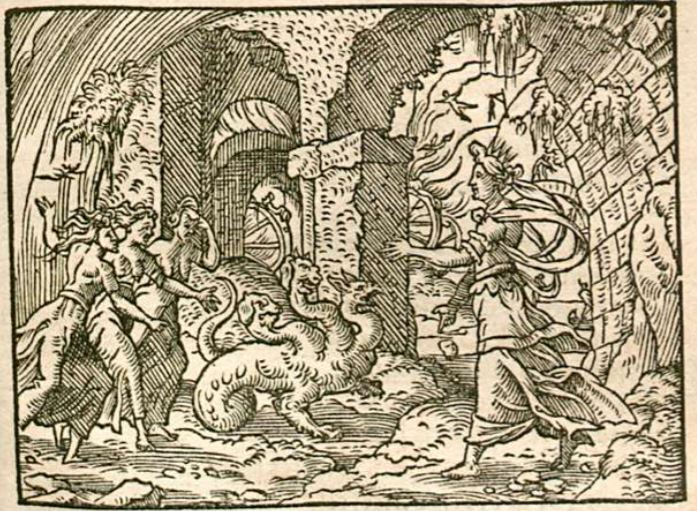
This engraving illustrates Juno on the right side of the image in The Underworld. Juno is depicted wearing a crown to symbolize her status as queen of the Olympian Gods. Juno went to The Underworld to seek help from the Furies. She wants the Furies to help her punish a mortal who had angered her. The Furies are illustrated as a trio on the left side of the image. The three-headed beast named Cerberus who guards The Underworld is depicted standing in between the Furies and Juno.
At first, there existed only Chaos. The four elements (earth, water, air, and fire) were separated from this state of chaos, allowing for creation to take place. This image depicts God separating and ordering each of these elements to form a harmonious whole.
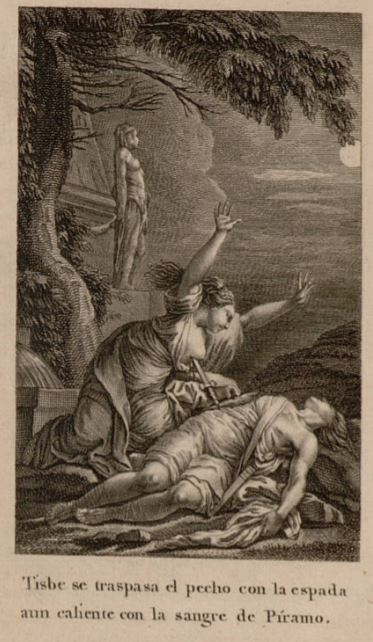
This image depicts the story of Pyramus and Thisbe, two lovers that share a tragic fate. Pyramus and Thisbe were lovers who tried to run away from their homes in order to be with each other. The pair had arranged to meet in the forest, and while Thisbe was on her way to meet Pyramus, she had a close encounter with a lion. The lion stopped to drink at a fountain, as depicted in the engraving. To escape, Thisbe runs as fast as she can into a cave to seek safety. While running away, she drops her cloak on the ground and the lion picks it up with its blood-stained mouth. Pyramus comes to the fountain and sees the blood-stained cloak left by the lioness and assumes that Thisbe had been killed. Pyramus takes his sword and kills himself in grief. Thisbe later returns to see that Pyramus had killed himself, so she takes his sword and kills herself with it as well. Pyramus is depicted dead in this image with the cloak in his left hand and Thisbe is illustrated falling onto Pyramus’ sword.
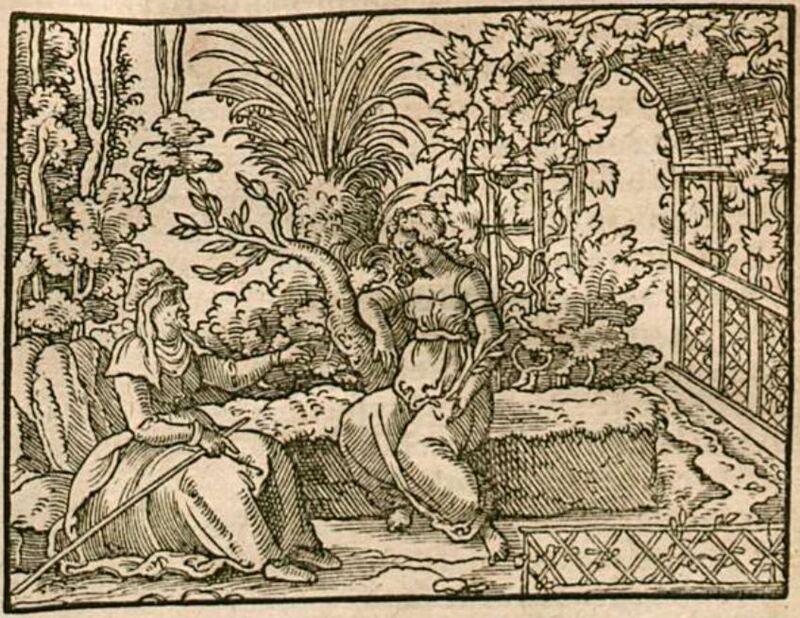
This engraving illustrates the nymph Pomona engaging in a conversation with what seems to be an elderly woman. The elderly woman is in fact the god Vertumnus in disguise. Pomona is a nymph who has a passion for gardening. Ovid explains that she allows no men to enter her garden, which is why Vertumnus disguises himself as an old woman. Taken by her beauty, Vertumnus does whatever it takes to spend time with Pomona, even putting on disguises. The disguised old woman is depicted pointing at an elm tree while Pomona sits and listens. Pomona is depicted holding a curved pruning knife in her left hand which is what she uses to maintain her garden.
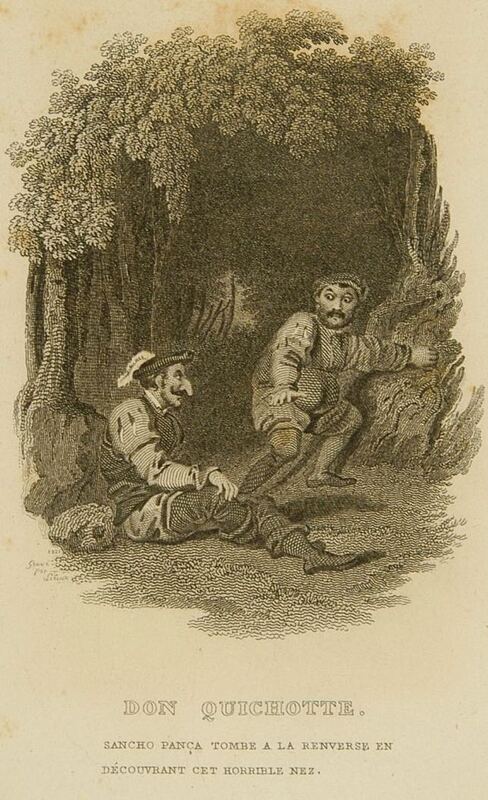
Sancho Panza discovers the Knight of the Mirrors’ ugly nose and stumbles backwards in fear. The nose is part of Tomé Cecial’s disguise. Signed by Leroux (engraver), no given name, and dated 1821. Part 2, ch. 14.
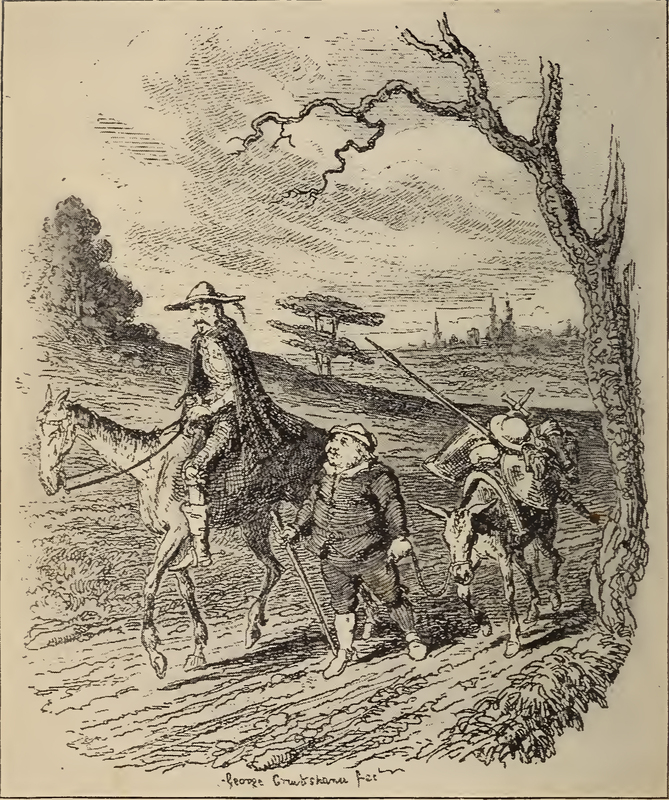
Don Quixote and Sancho Panza walk along a beaten path in the plains of La Mancha in search of adventure. The knight errant (left) rides atop his horse Rocinante next to his loyal squire Sancho Panza. Sancho Panza (right) walks on foot with a walking stick in hand in order for his donkey Dapple to carry Quixote's armor.
After having attacked a flock of sheep and been stoned by shepherds (in the background), Don Quixote asks Sancho Panza to count his remaining teeth. Don Quixote’s shield, sword, and lance are pictured, as is Rocinante. Plate no. 12, signed by J. Vanderbank (illustrator) and G. van der Gucht (engraver). Vol. 1, book 3, ch. 4.
Led by Sancho's daughter (pictured grabbing her mother's arm), the page arriving at the Panza household, kneels on one leg, presses his right hand to his chest and holding aloft his feathered cap with his left hand and introduces himself. Teresa Panza (left), dressed in a grey pettticoat and bodice, stands before the page with a distaff of tow which she had been spinning in her left hand. In the background the village's church can be seen.
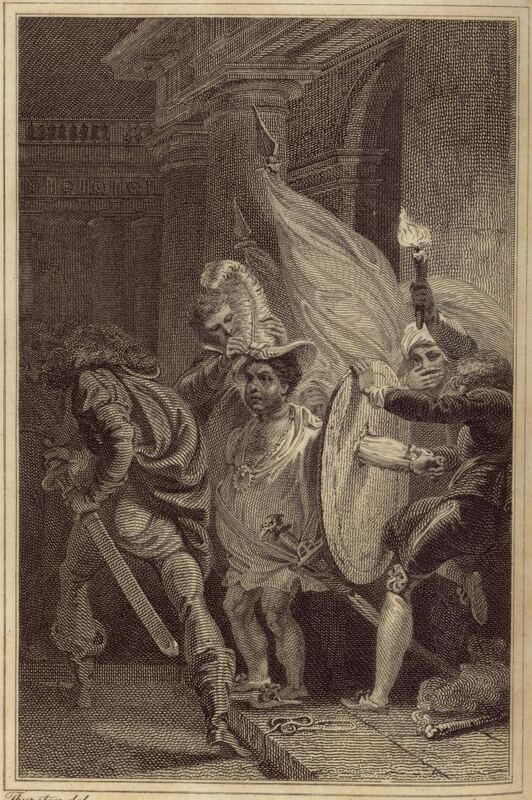
During the invasion of Barataria Island, the soldiers wake Sancho Panza, who appears at the entrance to his residence in his nightclothes. Signed by J. Thurston (illustrator) and C. Armstrong (engraver). Part 2, ch. 53.
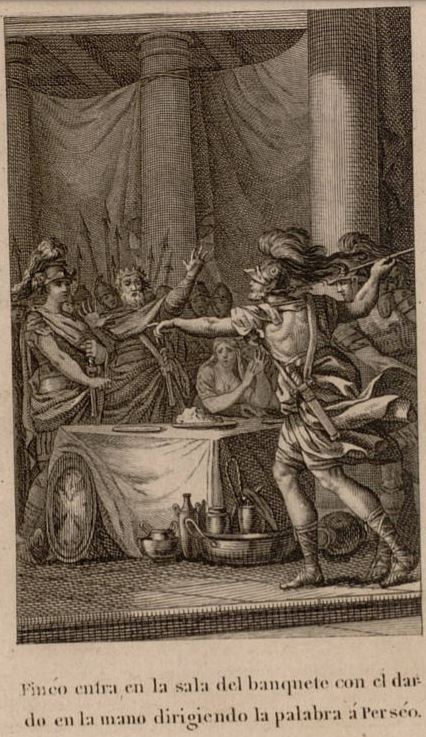
This image depicts the wedding banquet of Andromeda and Perseus. The figures at the table from left to right are Perseus, King Cepheus (Andromeda’s father), and Andromeda. There are other soldiers and companions depicted standing behind them. Phineus, the brother of King Cephus had interrupted the banquet to announce that Perseus had stolen Andromeda from him. Phineus is illustrated on the right side of the image as he throws a spear at Perseus. This causes an uproar, and a battle breaks out at the banquet. Perseus ends up using the decapitated head of Medusa to beat Phineus.
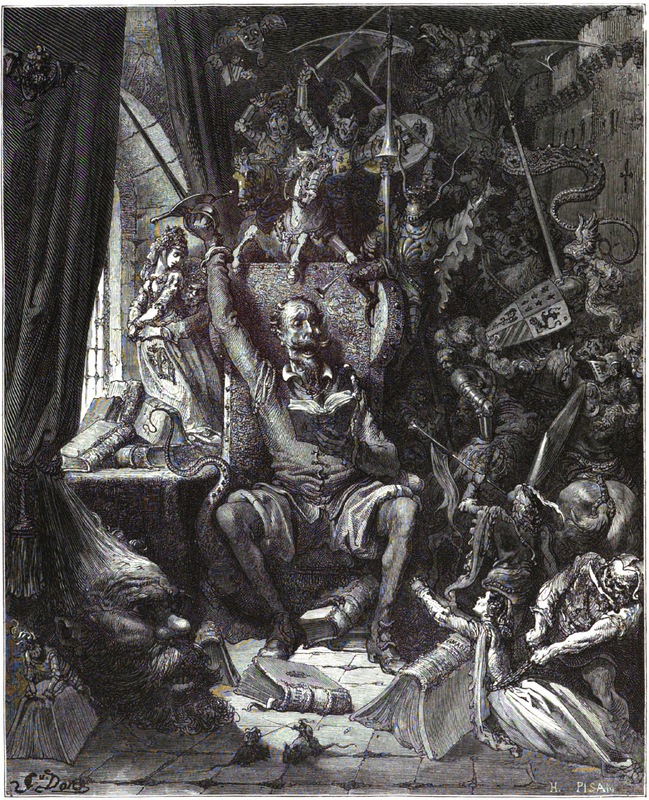
Don Quixote sits in his armchair in the centre of the image, books strewn across the floor. One book is open in his left hand, his right hand holds a sword above his head. Images from fairy tales, including a castle, dragon, giant’s head, princesses, knights in shining armor on horses, damsels in distress, villains, shields, lances and monsters fill the room and surround him. All the figures appear to be looking at Don Quixote. Scene found in Part I, Book 1, Chapter 1.
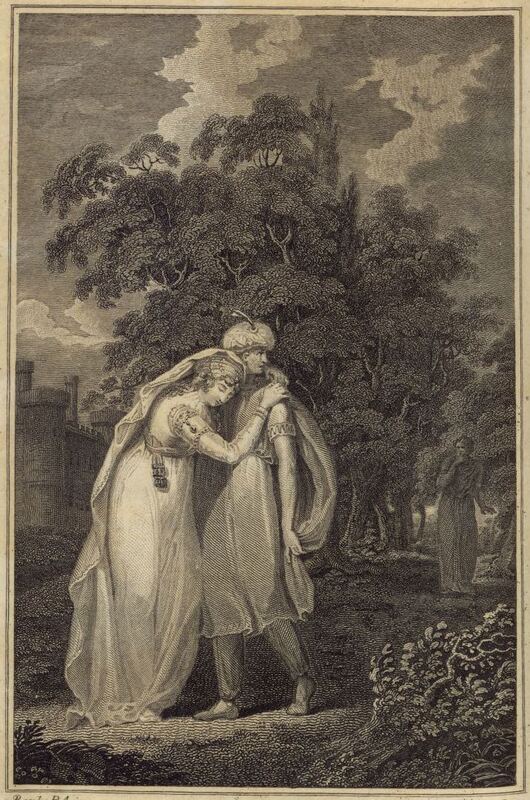
The illustration represents part of the captive’s tale: Zoraida pretends to faint when her father, Agi Morato, discovers her with the captive. Signed by Banks (illustrator) and J. Fittler (engraver). Part 1, ch. 41.
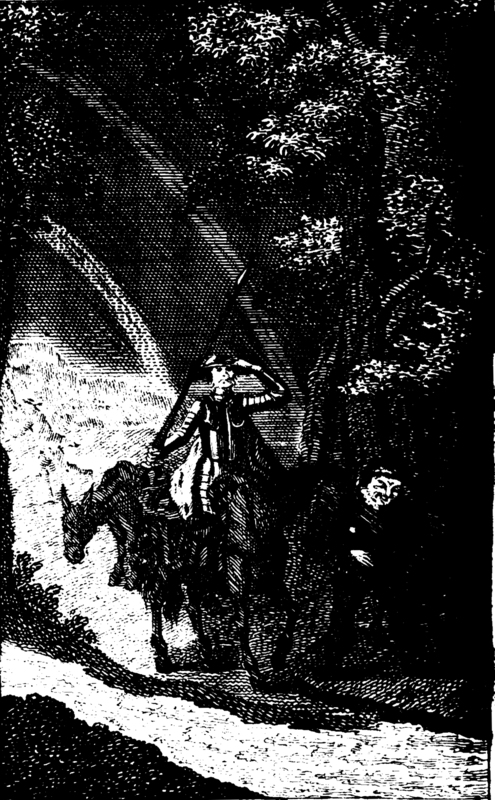
Don Quixote (pictured peering into the distance atop Rocinante) see's a man in the distance with something glittering atop his head. In reality, it is a barber wearing a basin on his head to protect him from the rain, but Don Quixote mistakes the basin for Mambrino's legendary helmet, and seeks to claim the helmet for himself. Sancho Panza (pictured to the right of Quixote) steps down from his donkey, unconvinced that the glittering object is Mambrino's helmet.
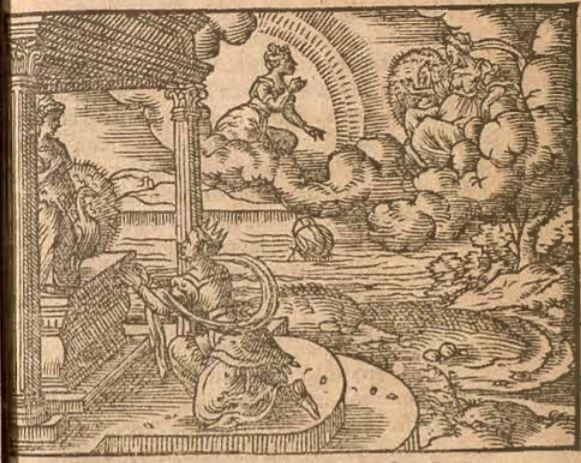
This engraving illustrates Alcyone, the wife of King Ceyx, kneeling at the temple of Juno praying for her husband’s return from sea. King Ceyx had traveled by sea to seek out the Oracle at Claros and ended up dying in a shipwreck due to a storm. Alcyone continuously prayed at the temple to Juno in the hopes that her husband would soon return. Juno is depicted at the altar with her sacred animal, the peacock, at her side. Juno decides to reveal to Alcyone that her husband is dead by sending Iris, the messenger of the gods, to the god of sleep to reveal Ceyx’s fate through a dream. Juno is depicted on a cloud in the background of the engraving giving these commands to Iris.
Don Quixote’s niece (left), the housekeeper (centre), the priest (right), and the barber (kneeling) scrutinise the books in Don Quixote’s library, later deciding to burn them for their responsibility in Don Quixote’s madness. The housekeeper carries a pot of holy water and sprigs of hyssop, and her figure is framed by the doorway. Plate no. 5, signed by J. Vanderbank (illustrator) and G. van der Gucht (engraver). Vol. 1, book 1, ch. 6.
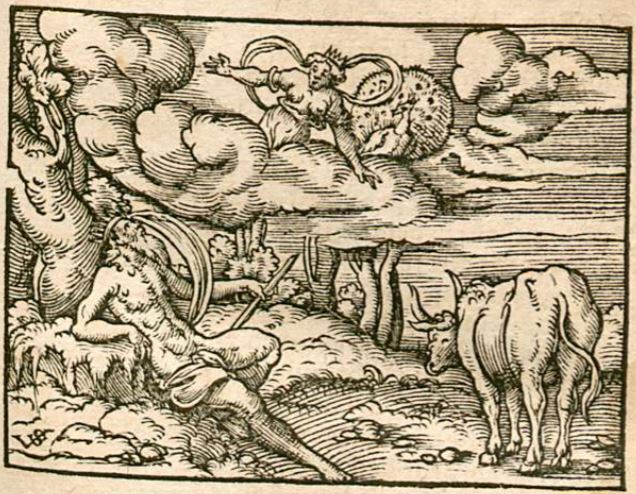
This image depicts Juno, the wife of Jupiter, in the sky flying above the clouds. She is illustrated wearing a crown to signify that she is the wife of the king of the gods. She is coming down to earth because she saw the clouds that Jupiter had created and got suspicious that he was being unfaithful to her. Juno was right to suspect something as Jupiter did create the clouds to hide the fact that he was raping Io, the daughter of the river god Inachus. When Jupiter saw that Juno was coming to check on him, he reluctantly transformed Io into a cow. Jupiter is depicted laying against a tree on the left side of the image looking up to Juno, and Io is depicted on the right side of the image in the form of a cow.
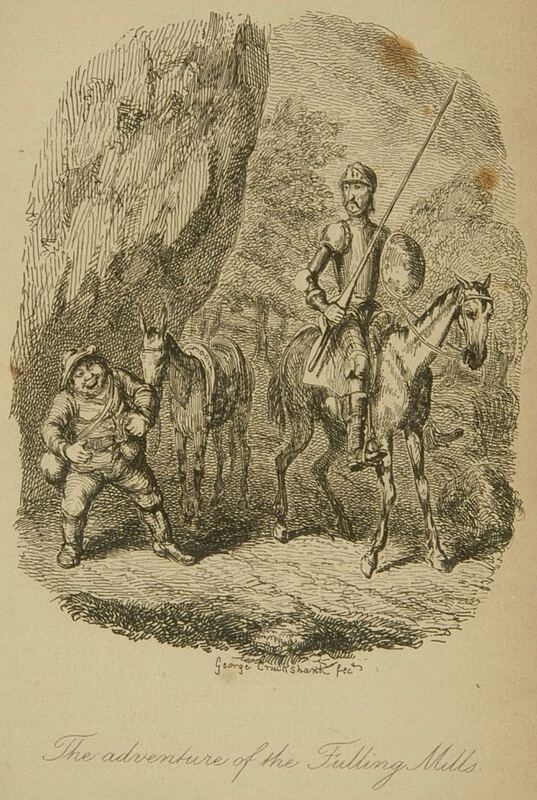
Don Quixote and Sancho Panza discover that the cause of the terrifying noise that had kept them frightened throughout the night was six wooden fulling hammers. Sancho begins to laugh aloud and mock Don Quixote, angering him. Signed by G. Cruikshank (illustrator and engraver). Part 1, ch. 20.
Don Quixote and Sancho Panza chance to lodge at the same an inn as a trooper of the Holy Brotherhood. Having angered a Carrier by trying to sleep with a female servant against her will, a skirmish ensues between the three of them, destroying Quixote's bed and extinguishing the lights in the process. Badly beaten during the scuffle, Quixote lies forlorn on the ground, as a trooper of the Holy Brotherhood enters the room with a candle in his left hand and a beating stick in his right. Seeing a member of the holy brotherhood, the female servant (pictured grabbing Quixote by the beard) and the carrier (pictured grabbing the servant girl by the hair) flee the scene. Upon seeing Quixote's forlorn visage strewed across the ground the trooper mistakes the knight-errant for dead. Meanwhile, Sancho Panza sleeps peacefully in the background.
Sansón Carrasco offers to serve as squire to Don Quixote, making Sancho Panza distressed and sad. The actions of the characters are well represented in the illustration with gestures. The housekeeper and the niece are also pictured, although Cervantes makes no mention of them in the text. Signed by J. Collyer (engraver). Part 2, ch. 7.
Amid a tempestuous sea, a knight with a crown stands and looks out into the distance, a cross or sword in his right hand and a broad shield in his left hand. The knight stands on a tiny row boat fit for two the ocean waves rocking furiously. The image is occasioned by Quixote saying "There is no knight now who, issuing out of the forest, ascends the mountain, who thence penetrates to a barren and desert shore of the sea, most commonly stormy and tempestuous, where finding on the beach a small skiff without oar, sail, mast, or any kind of tackle, he boldly throws himself into it, exposing himself to the implacable billows of the profound sea, which now mount him up to the skies, and then cast him down to the abyss."
After defeating the Basque, Sancho Panza takes Don Quixote’s hand and asks for the government of an island. The knight tells Sancho to be patient, as indicated by his hand gesture. The fallen Basque is depicted in the middle ground with the ladies of the carriage. The figures of Don Quixote and Sancho Panza are darkened in contrast with the other elements of the composition. Plate no. 7, signed by J. Vanderbank (illustrator) and G. van der Gucht (engraver). Vol. 1, book 2, ch. 2.
In a green meadow Sancho Panza (left) kneels on both legs with his hat by his chest, gesticulating outwards with his right hand which also holds the reigns for his donkey (left). The Duchess (right) sits upon a palfrey fitted onto a white horse, she's dressed in rich and fanciful apparel befitting her rank. In the rightmost background the Duchess' men, also mounted accompany her on her hunt, at the feet of the duchess' horse two hunting dogs are pictured.

![[Polyphemus Eating the Companions of Ulysses]](https://collections.cemvc.ca/files/large/b8897fd6ec04467aaf2051e8e438b1471d7c180d.jpg)
![[God Creating Order from Chaos]](https://collections.cemvc.ca/files/large/370df68508579984e1acbb762a2fafeadbf21b29.jpg)
![[Sancho Panza counts Don Quixote's teeth]](https://collections.cemvc.ca/files/large/3b4d9069b48d17bed2c9b2fe8944bd1374312951.jpg)
![[The Page Delivers a Message to Teresa Panza]](https://collections.cemvc.ca/files/large/7e65ef87014d5bfcdc17f84ddec990ba2b09f18e.jpg)
![[Scene in Don Quixote's library]](https://collections.cemvc.ca/files/large/31734dca5f55ff6b9480acf908b1822aa8534271.jpg)
![[The Holy Brotherhood Mistakes Don Quixote for Dead]](https://collections.cemvc.ca/files/large/b4b0509c2931423e71571c5b72fc55850398f132.jpg)
![[A Knight Braves the Tempestuous Seas]](https://collections.cemvc.ca/files/large/e106e6c884d27a791088fb7c914dda0115708a51.jpg)
![[Sancho Panza asks Don Quixote for the government of an island]](https://collections.cemvc.ca/files/large/098dd4cba9f58608fef9dd4c2642cf3ccaea197e.jpg)
![[Sancho Panza Meets the Duchess]](https://collections.cemvc.ca/files/large/ea9ef2763be0d448c3b30cd279b1d1aaa5536236.jpg)