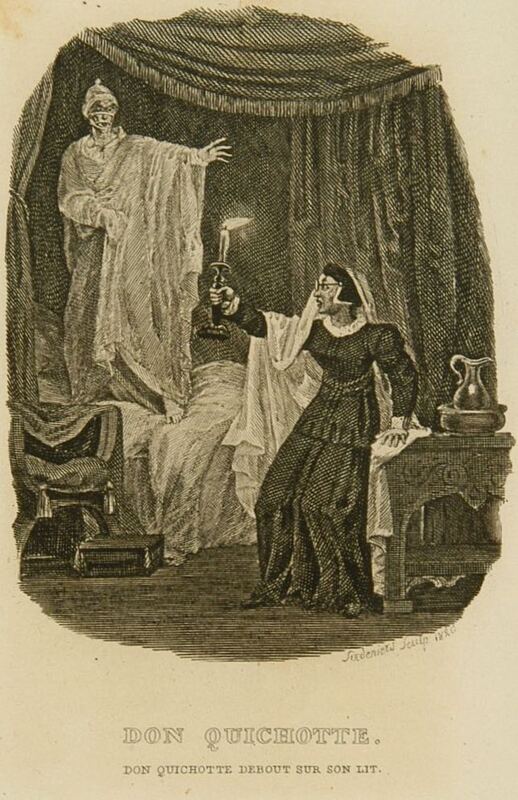
Doña Rodríguez enters Don Quixote’s room at night and they frighten each other. Wearing his robe, Don Quixote appears as a ghost. Signed by A. V. Sixdeniers (engraver). Part 2, ch. 48.
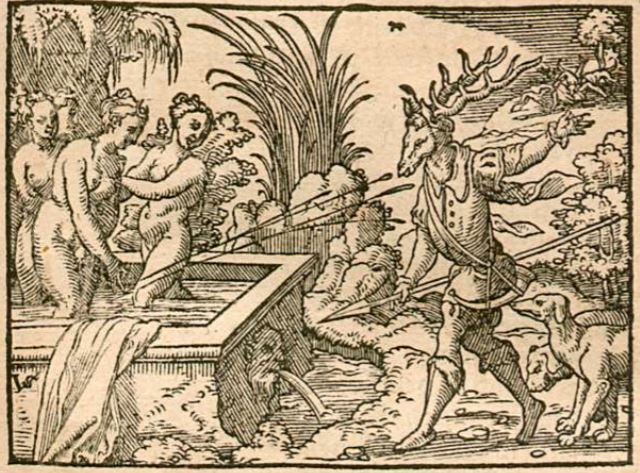
This engraving depicts Actaeon, the grandson of Cadmus, wandering through the forest after hunting with his dogs who are illustrated at his feet. While walking through the forest, Actaeon stumbled upon Gargaphie, a place sacred to the goddess Diana. Diana is illustrated in the bathing pool on the left side of the engraving surrounded by her nymphs who were helping her bathe. Diana and the nymphs have a look of surprise on their face as they notice that Actaeon was watching. To punish Actaeon for gazing upon her naked, Diana throws the water on his face which transforms him into a stag. The water is illustrated spraying onto him as Actaeon is mid-transformation.
On the left Quiteria walks, her eyes closed wearing rich coral, and a courtly gown of velvet with trimmings of satin. On her hands are rings of jet and gold and adorned with pearls. Camacho (right) holds her hand, richly dressed in his own right. They are bride and bridegroom, proceeding towards their ceremony.
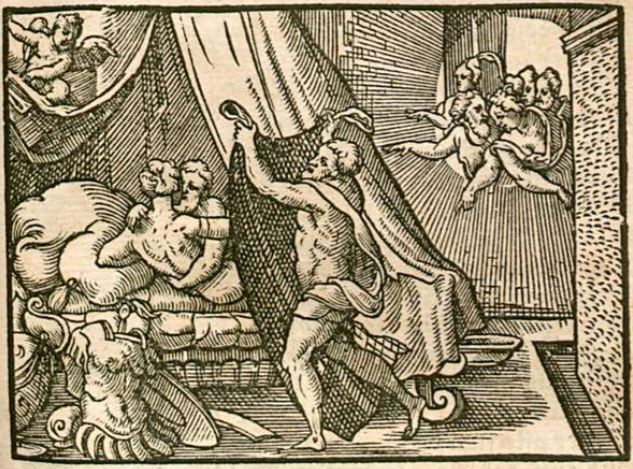
This engraving illustrates the god Mars and Venus having an affair. They are depicted naked wrapped in each other's embrace on the left side of the image. The Sun god, who sees everything on Earth had seen Venus and Mars in bed together, and told Venus’ husband, Vulcan. In a jealous rage, Vulcan, the god of craftsmanship and fire, had created thin wires made from gold to fashion a net in order to trap the adulterers. Vulcan is illustrated in the image with his hands on the net, ready to trap Venus and Mars. In order to shame the adulterers even further, Vulcan had invited a group of gods to witness their humiliation. These gods are depicted in the background of the engraving, looking and waiting for the scene to unfold.
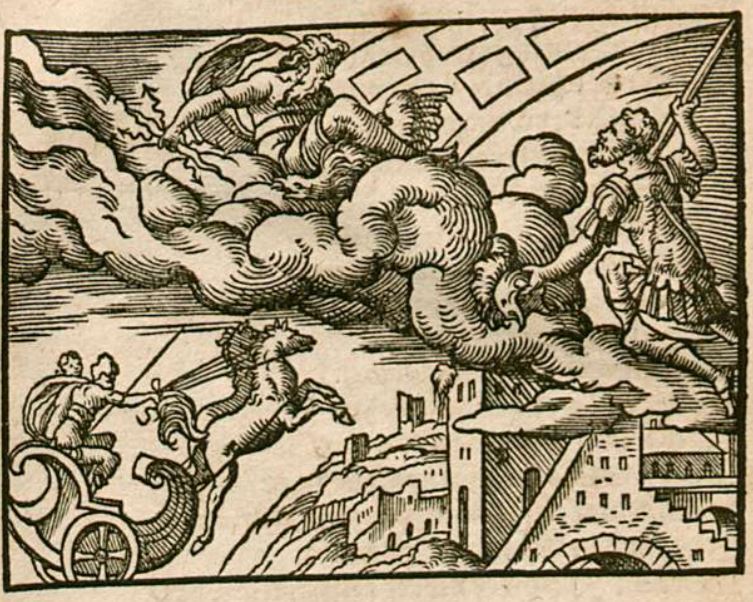
The god Mars is depicted on the right side of the engraving holding his helmet in his left hand and a spear in his right as he looks up to his father, Jupiter. Jupiter is identifiable as he is holding thunder bolts in his hand. Mars is pleading to his father to allow his son, Romulus, to become a god. Jupiter grants this request and Mars brings Romulus up into the sky in his chariot and they fly over Rome. Ovid explains that as Mars brings Romulus up into the sky, Romulus’ mortality dissolves while traveling through the atmosphere.
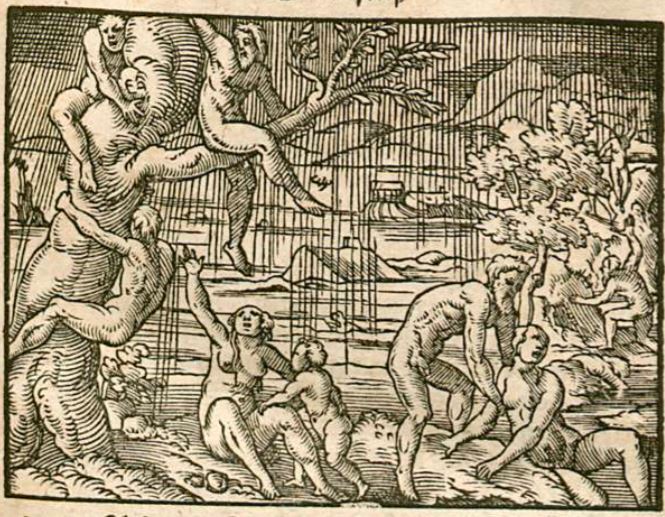
Jupiter, angry with the humans on earth, has decided to destroy them. He did not want to use his thunder bolts as he did not want to risk burning the heavens. Jupiter decided instead to send a flood to rid the world of humankind. This image depicts the flood sent by Jupiter. There are people attempting to climb trees in order to evade the water. There is a house in the background, however all that can be seen of the house is the roof in order to illustrate how high the flood has risen.
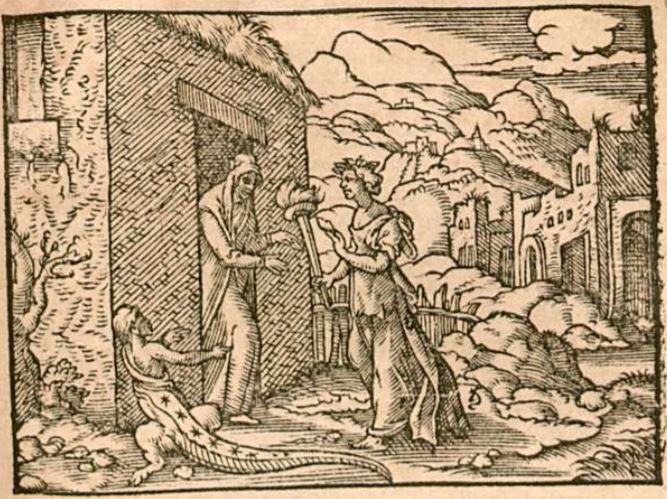
This engraving illustrates the goddess Ceres looking for her daughter, Proserpina, who had been abducted by Pluto, the god of the Underworld. Ceres becomes tired and thirsty from looking for her daughter, so she finds an old hut with a roof made of straw and asks the host for some hospitality. The host is an elderly woman who obliges the goddess and provides her with a drink. While Ceres is at this hut, a young, foul-mouthed boy named Stellio taunted the goddess and called her greedy. The goddess was taken aback by this rude child, and she threw her drink onto him which transformed him into a lizard. The young boy is depicted on the left side of the image with the lower half of his body already transformed into a lizard.
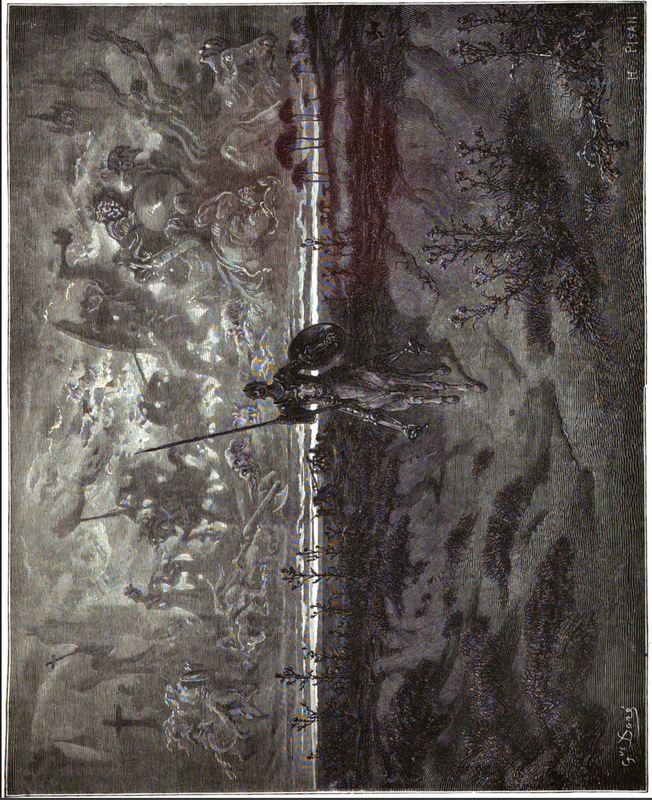
Don Quixote rides Rocinante in search of adventure. He speaks to himself, describing what a future sage will say about his exploits. The dark, stormy sky is full of images of war, including a cross, knights on galloping horses, a knight with a mace and shield, and people lying dead. The landscape is barren. Don Quixote is carrying a lance and a shield. Scene found in Part I, Book 1, Chapter 2.
The illustration depicts a meal share by Don Quixote, Sancho Panza, the duke, the duchess, and an ecclesiastic. The ecclesiastic leaves the table because he is angry with the duke and duchess for humouring Don Quixote. Signed by F. Hayman (illustrator) and C. Grignion I (engraver). Part 2, ch. 32.
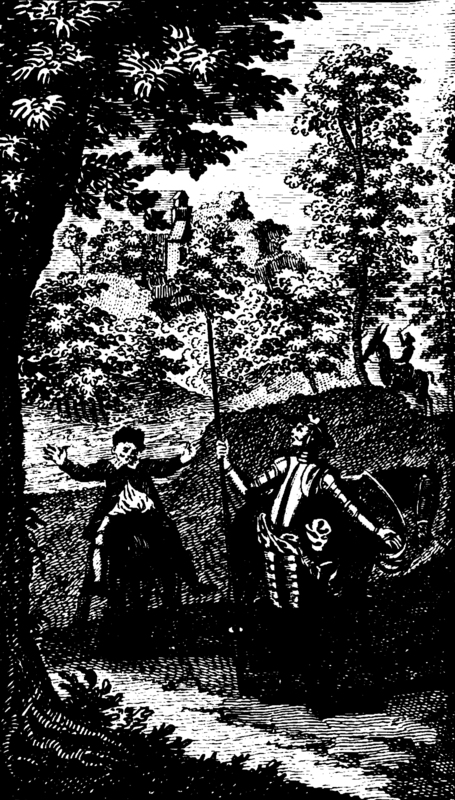
Don Quixote (pictured in his armour pointing his lance towards the sky) and Sancho Panza (pictured waking up to the horrible surprise that his donkey has been stolen) sleep in the heart of the Sierra Morena mountains, Sancho upon his donkey named Dapple, and Quixote upon his horse Rocinante. As they sleep they are visited by Gines de Passamonte (portrayed in the background of the image as a silhouette with a sword held high upon a donkey), the rogue who Quixote had freed from the galley. Passamonte lifts Sancho Panza from his donkey and places him on a saddle propped upon a post and steals the donkey for himself. As the sun rises Sancho Panza awakens to find his loyal donkey stolen from beneath him, leaving Sancho in a pitiable state. Quixote wakes up after hearing Sancho's sobs and unsuccesfully attempts to console his squire.
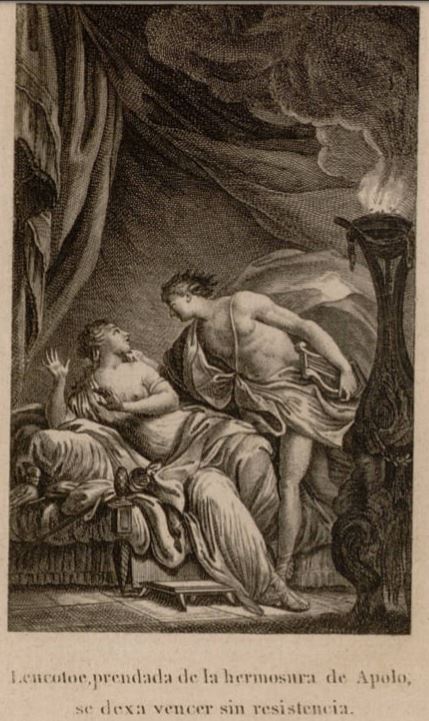
This image depicts Apollo having sexual relations with Leucothoë, the daughter of a Persian king. The goddess Venus had cursed Apollo to fall madly in love with Leucothoë as a punishment for humiliating her. Apollo had disguised himself as Leucothoë’s mother and commanded the slaves to leave the room. Once the god was alone with Leucothoë, he showed her his true godly form, and proceeded to have sex with her. Leucothoë is depicted laying on a bed with Apollo approaching her.
While Don Quixote sleeps, some of his closest acquaintances sneak into his library with the intention of burning all his books so that Quixote will not be influenced by them any longer. This company consists of the housekeeper (middle), Don Quixote's niece (right), the barber (left standing), the priest (left, holding the shepherd), and the shepherd Darinel. The housekeeper has brought with her a pot of holy water in her left hand and some sprigs of hyssop in her right hand in order to disenchant the books. Quixote's niece has begun pulling volumes off of the shelf to be burnt, and the priest, the barber, and the shepherd discuss the books before placing them in a pile to be burnt.
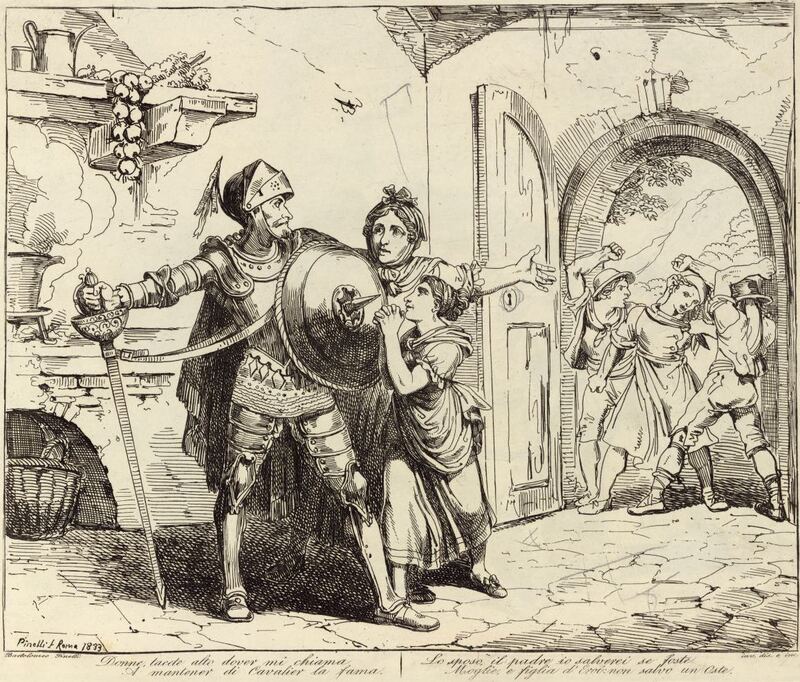
In the background, two guests who attempted to leave the inn without paying what they owed beat the innkeeper, who cries out and pleads for help. The innkeeper’s wife and her daughter beg Don Quixote to help her husband, but Don Quixote refuses to do so, replying that he cannot embark on an adventure until he has brought a felicitous conclusion to the one to which he is currently pledged. Signed by Bartolomeo Pinelli (engraver and illustrator) and dated Rome, 1833. Plate 32. Part 1, ch. 44.
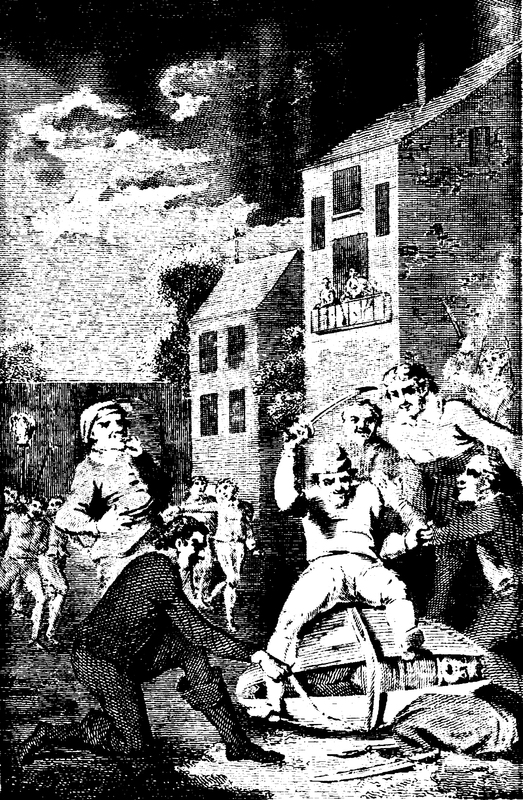
During the invasion on Barataria (the town Sancho Panza has been given governance of) Sancho tries his hardest to repel the invading forces. Having been armed with two shields tied to his torso and nothing else, Sancho quickly falls over and is unable to stand back up. Tortoised between his two shields, the soldiers trample and beat upon Sancho while laughing.
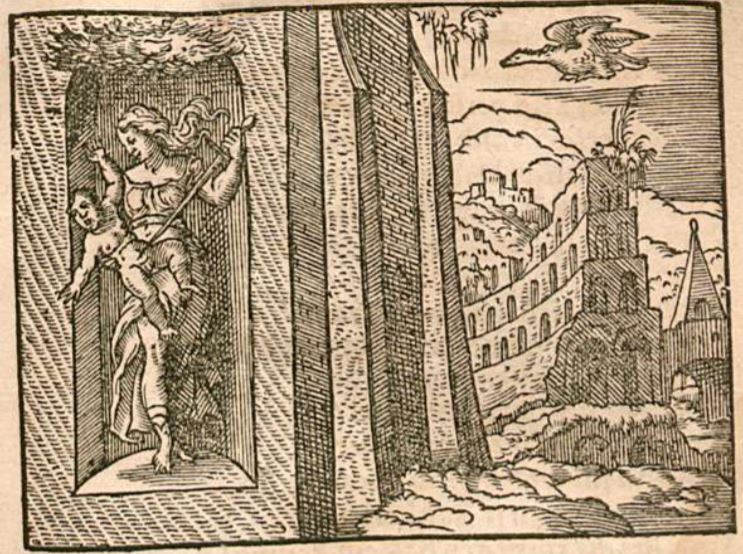
This engraving depicts Medea, the wife of Jason, seconds away from killing their child with her sword. Medea traveled to Corinth to found out that her husband had married another woman. To exact her revenge on Jason, she killed his new wife, as well as their own children to end his line. The city of Corinth is depicted in the background of the engraving.
Don Quixote is procured a famous scholar and a great lover of books of chivalry, to lead them him the mouth of the cave of Montesinos. The scholar (pictured) came, wearing a wide hat and a long cape, mounted on a donkey big with foal whose pack-saddle was covered with a doubled piece of an old striped carpet.
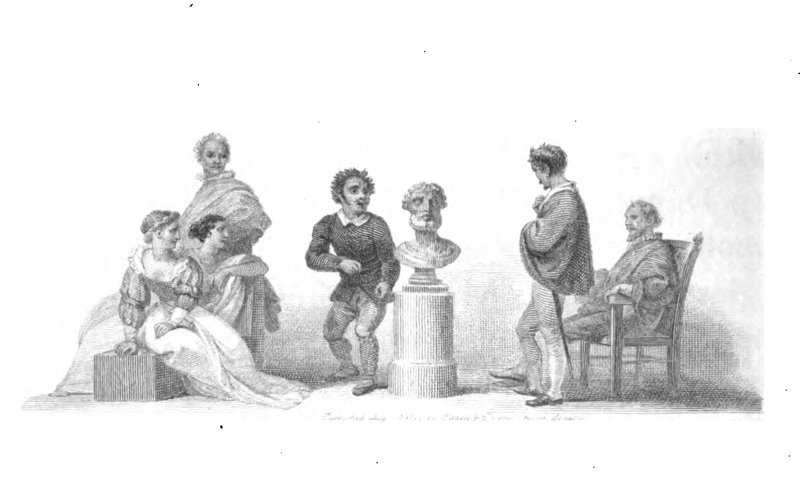
Don Quixote (right), dressed in a straight shamois doublet, and Sancho Panza (left) are led to a barren room by Don Antonio. The room has no other furniture than a small table of jasper, supported by a pillar; and upon it was placed a bust of bronze, the effigy of some high roman person. The knight and squire are accompanied by Don Antonio (pictured on the right sitting in a chair next to Quixote), Don Antonio's wife (pictured sitting on the left), and two ladies who are friends with Don Antonio's wife. Both Quixote and Sancho carefully examine this enchanted bust. le , strongly excited Don Quixote'scuriosity, Don Antonio made him examinecarefully the brazen head , the table, and thejasper pedestal upon which it stood
Having been tricked by the Duke and Duchess into thinking that the wooden horse Clavileno was capable of flight, Don Quixote (clad in full armour) and Sancho (wearing his usual hat, hose, and jacket) dismount the horse and are amazed to find themselves in the same garden, which now had a number of people strewed about. Their wonder increased when, on a huge lance sticking in the earth, they beheld a sheet of white parchment attached to it by silken strings, whereon letters of gold were written.
Don Quixote and Sancho Panza kneel before three peasant girls mounted on donkeys. Sancho introduces one of them as the enchanted Dulcinea and Don Quixote tries to kiss her foot. Unsigned. Part 2, ch. 10.
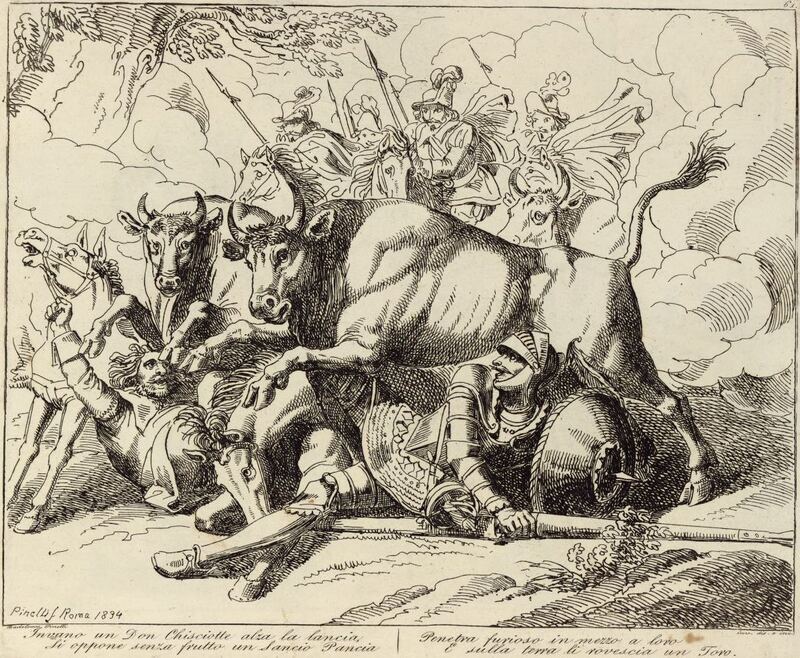
Don Quixote, Sancho Panza, and Rocinante are trampled by a herd of bulls. In the background, the herders are pictured. Signed by Bartolomeo Pinelli (engraver and illustrator) and dated Rome, 1833. Plate 61. Part 2, ch. 58.
Dorotea kneels before Don Fernando, while Lucinda confesses her love for Cardenio (left to right). Dorotea urges Don Fernando not to draw his sword. The priest and Sancho Panza are pictured, but the barber is missing from the illustration (not accurate to the text). Signed by F. Hayman (illustrator) and S. F. Ravenet (engraver). Part 1, ch. 36.
On the left lie a pair of thread gloves; one the right of which are a new pair of black fencing-foils, with their buttons. Two epee's lie in the foreground. The image is occasioned by Don Quixote overtaking two ecclesiastics, and two country fellows, who have the aforementioned items tied up in a portmanteau.
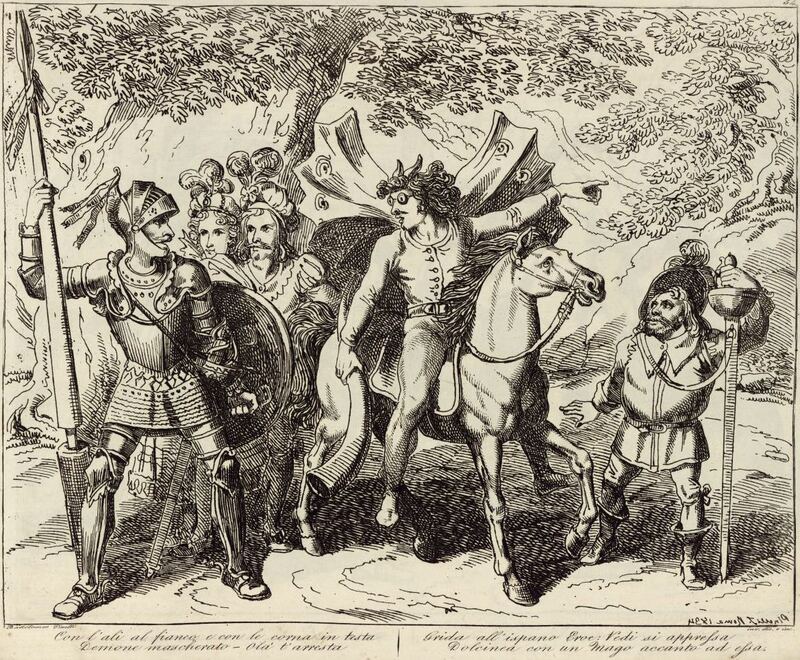
A postillion dressed as a demon approaches the hunting party, playing a huge, hollow animal horn that emits a harsh and terrifying sound. The devil announces the arrival of the enchanted Dulcinea and the gallant Montesinos. Signed by Bartolomeo Pinelli (engraver and illustrator) and dated Rome, 1833. Plate 54. Part 2, ch. 34.
Don Quixote and Sancho Panza find the cooks in charge of Camacho's wedding. Sancho beheld this kitchen with wonder and delight and wasted no time accosting one of the busy cooks with his hunger and begged for luncheon of bread from one of the pans. The cook, whose name was Basil (pictured to the left) took a kettle, and sousing it into one of the pots, he fished out three hens and a couple of geese at one heave and offered the pot to Sancho Panza who was ever so delighted.

![[Quiteria and Camacho]](https://collections.cemvc.ca/files/large/c87e75a68cafa2cabddbb5402cfc48ddc274afff.jpg)
![[The ecclesiastic leaves the duke's table]](https://collections.cemvc.ca/files/large/6c96d73d937030d1671833e71556a13fa912bbe2.jpg)
![[Of the Pleasant and Grand Scrutiny Made by the Priest and the Barber in our Ingenious Gentleman's Library]](https://collections.cemvc.ca/files/large/4f97a3a18f8e3f9e1b9097131d33df6830c22183.jpg)
![[The Introduction of the Scholar Who Would Bring Don Quixote to the Cave of Montesinos]](https://collections.cemvc.ca/files/large/a2a0b7dd62730d661c3fd438c72dd8e872bfdadf.jpg)
![[Clavelino Lands Back in the Duchess' Garden]](https://collections.cemvc.ca/files/large/4d22819046282ed195b19730efc92d5f12c10844.jpg)
![[Don Quixote meets the enchanted Dulcinea]](https://collections.cemvc.ca/files/large/939c5db04c82574125c43417fe76fabf63ade3d6.jpg)
![[Dorotea kneels before Don Fernando]](https://collections.cemvc.ca/files/large/af17b619fae1dc26e53d53c087bfbe03716f80a7.jpg)
![[The Belongings of Two Ecclesiastics or Scholars]](https://collections.cemvc.ca/files/large/31dd8980b7b7f0620f80324176d8ff06f39837c7.jpg)
![[Sancho Panza asks a Cook at Camacho's Wedding for a Morsel]](https://collections.cemvc.ca/files/large/d059ee45e619b041196691c4a1dfee5049d35777.jpg)