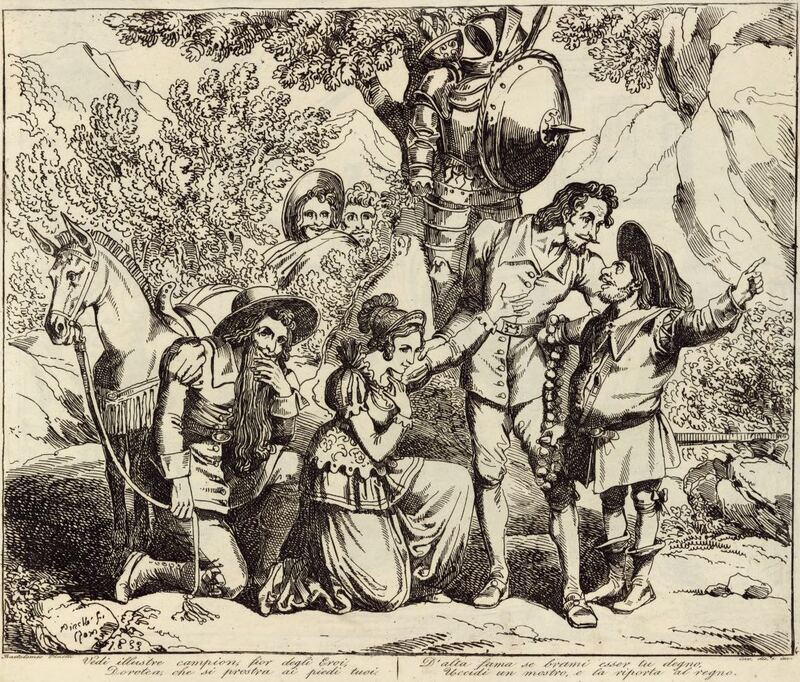
Princess Mimicona (Dorotea) kneels before Don Quixote while he tries to prevent her from doing so. The barber, disguised with a beard as her squire, tries to suppress a laugh. Sancho Panza stands to the right, holding the barber’s basin. The priest and Cardenio are hidden behind a tree trunk. Unsigned. Part 1, ch. 29.
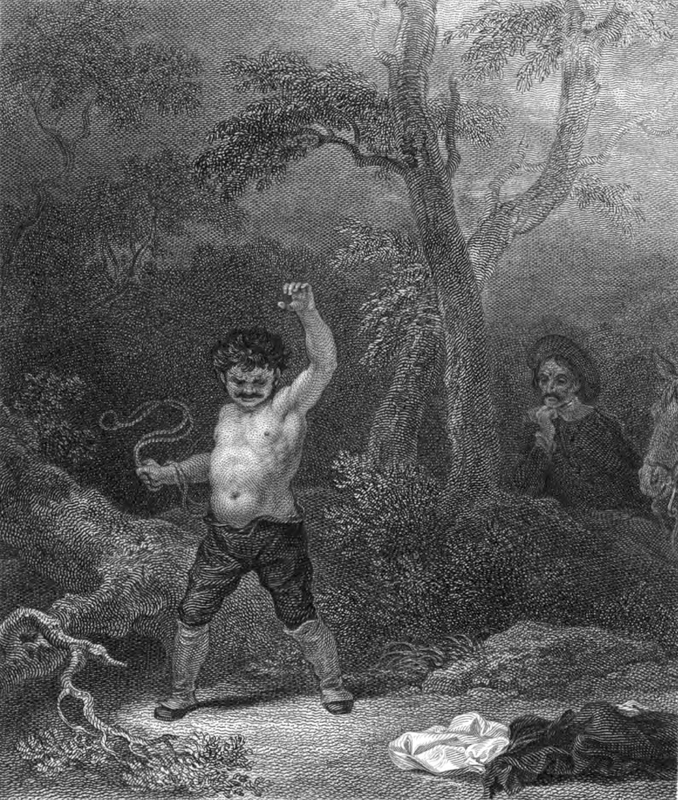
In the mountains of Sierra Morena, with supper being ended, Sancho made himself a powerful whip out of Dapple's halter, retired twenty paces from his master and stripped himself naked from the waist upward, and snatching up the whip, began to lash himself. In the background, Don Quixote can be seen next to Rocinante with a hand beneath his chin, counting the number of lashes his squire has given to himself. In the bottom right, Sancho's clothes have been strewn aside.
In the middle of the night, a woman in the outfit of a servant-maid (left) opens a door for two children to come in. The boy in the front extends his hands towards her while his sister's head is all that can be seen behind him.
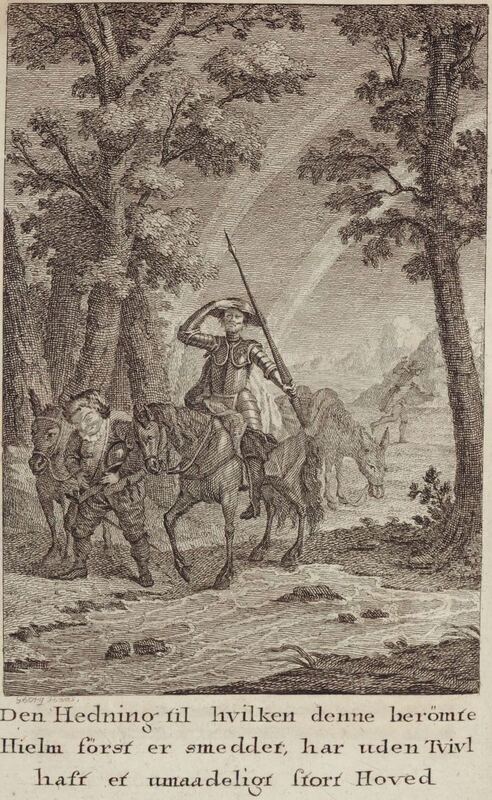
In the foreground, Don Quixote puts the barber’s basin on his head, mistaking it for Mambrino’s helmet. Sancho Panza laughs while the barber flees the scene (background). Signed by J.-J.-G. Haas (engraver). Part 1, ch. 21.
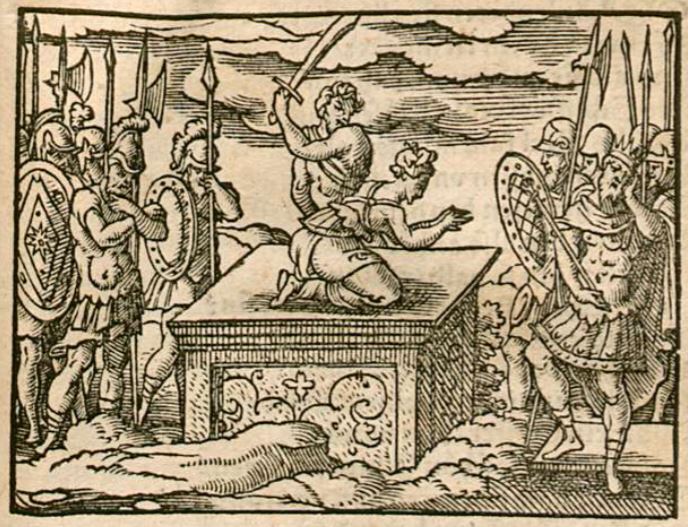
This engraving illustrates Polyxena, the daughter of King Priam of Troy, seconds away from being sacrificed. King Agamemnon, illustrated on the right side of the engraving with a crown on his head, was confronted by the ghost of Achilles who demanded a sacrifice in his honour. Agamemnon chose Polyxena as the sacrifice. Polyxena is illustrated on a table with her hands in front of her. She accepts her fate as a noble woman rather than being forcefully sacrificed as a slave. She asks the soldiers to give her body back to her mother so she can grieve for her. The soldiers who are onlookers to the sacrifice are depicted with their heads facing down as Polyxena’s words had moved them and they feel pity for her. The man who holds the sword is Neoptolemus, who also pities the young girl and regretfully sacrifices her.
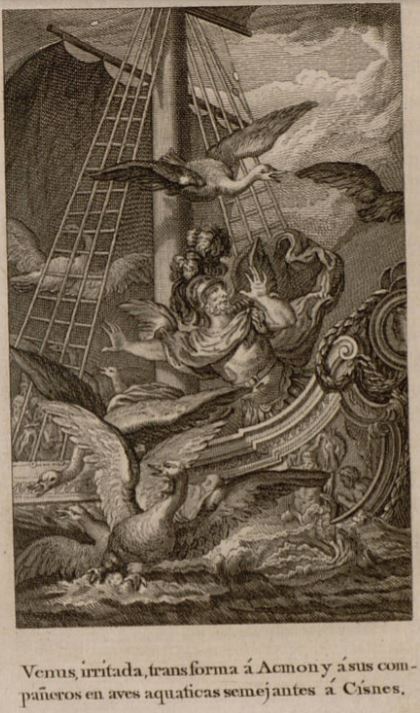
This image depicts Acmon, a companion to the warrior Diomedes, being transformed into a swan-like bird. Acmon had said something that angered the goddess Venus, so she transformed Acmon and his companions into birds. This image depicts Acmon on a ship in a full suit of armour as he watches his companions transform.
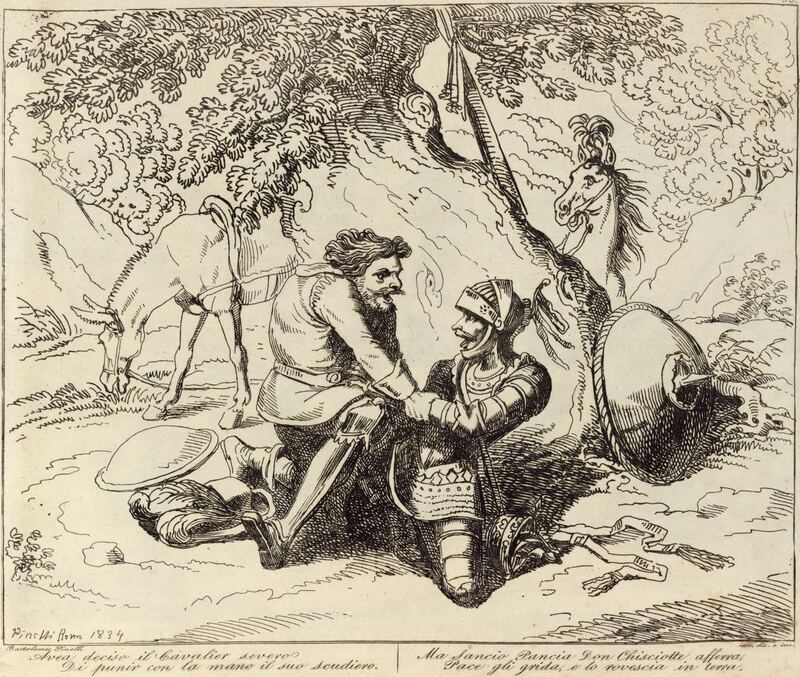
Don Quixote intends to give Sancho Panza two thousand lashes to discharge the debt that he had assumed. They struggle and Sancho gains the upper hand. He makes Don Quixote promise not to try to whip him. Rocinante and Sancho’s donkey are pictured in the background. Signed by Bartolomeo Pinelli (engraver and illustrator) and dated Rome, 1833. Plate 63. Part 2, ch. 60.
Sitting upon a bench, Teresa Panza, dressed in a bodice and a cap of cloth, holds a needle in her right hand while in her left she holds a large winnowing basket. On the right upon the floor lies a horse's holster.
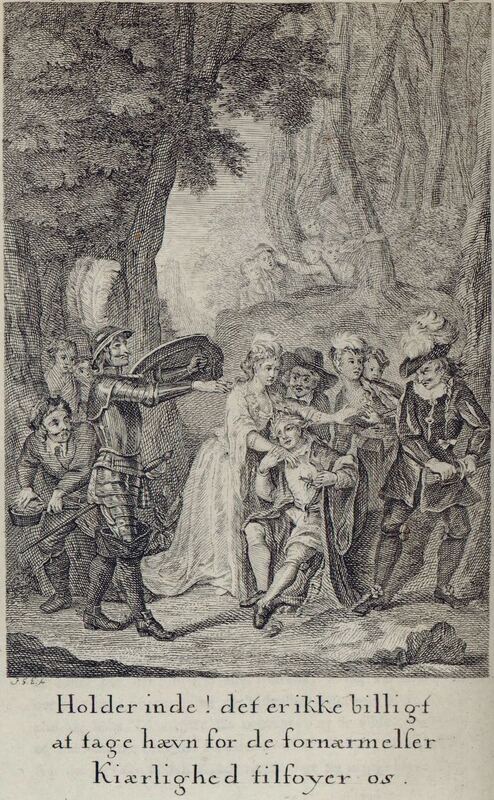
At the marriage of Basilio and Quiteria, the former pretends to stab himself. To the left, Don Quixote moves to stop him. To the right, Camacho makes ready to draw his sword. Sancho Panza and the priest are also pictured. Signed by J. G. Preisler (engraver). Part 2, ch. 21.
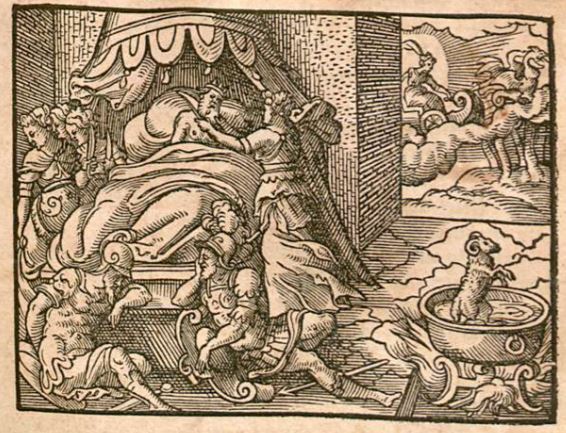
This engraving illustrates multiple scenes within one fable. In order to help Jason reclaim the throne of Iolcus, Medea tricks the daughters of King Pelias to kill their own father. She told them that she was able to rejuvenate him to his younger self. To prove this, she performed the ritual on a ram and it turns into its younger form as a lamb, which is illustrated in the bottom right corner of the engraving. The daughters of King Pelias beg Medea to perform the ritual on their father after seeing the lamb. Medea performs the ritual; however, she does not use the proper herbs for the rejuvenation to work. Medea orders the daughters to kill their father and drain his blood for the ritual. This is illustrated on the left side of the engraving. Once the daughters kill King Pelias, Medea flees on her chariot drawn by dragons, having successfully overthrown the King of Iolcus. Medea is illustrated in the top right corner of the engraving flying away from the scene.
In Sierra Morena, princess Mimicona (Dorotea) kneels before Don Quixote and begs for his help. The barber is disguised as Dorotea’s page with a fake beard (an oxtail). Don Quixote holds a rosary, used in his penance, and his armour hangs in a tree. In the background, the priest and Cardenio watch the scene, hidden behind some shrubs. Signed by Bartolomeo Pinelli (engraver and illustrator) and dated Rome, 1833. Plate 30. Part 1, ch. 29.
Don Quixote returns to his home in La Mancha after having been severely beaten by the mule driver of a travelling merchant. He is brought back home by a kindly peasant who lives near Quixote and recognizes him after Quixote has been severely beaten and left for dead. Whence they arrive, Quixote is met at the door by his niece who carries with her a black cross, Quixote's housekeeper, and his friend the curate, each of which worry for his health and safety.
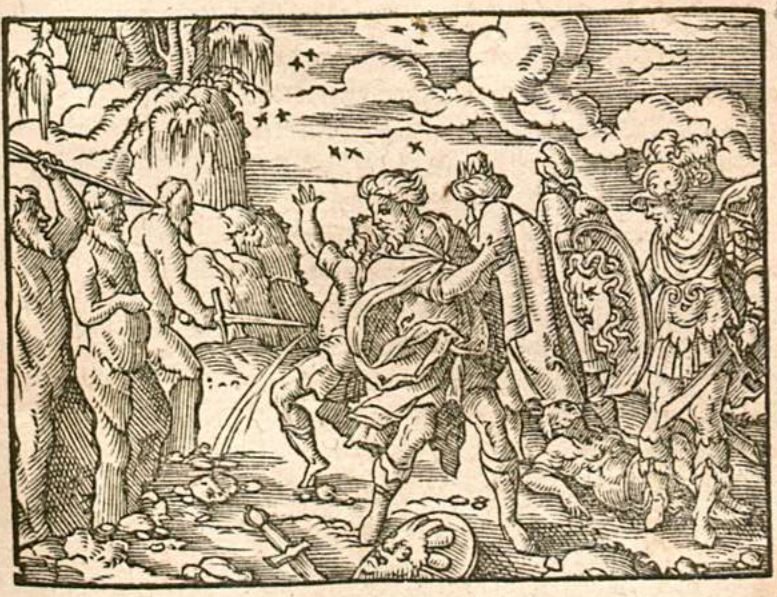
This engraving depicts Perseus turning his rivals, Phineus and his companions, into stone using the decapitated head of Medusa. Perseus is depicted on the right side of the engraving holding a shield that has the head of Medusa on the front. Perseus uses Medusa’s gaze to win a battle against Phineus, his bride Andromeda’s uncle, who had rivaled Perseus for Andromeda’s hand in marriage. The image depicts the chaotic battle with the men killing one another. The battle is won when Perseus turns them all into stone.
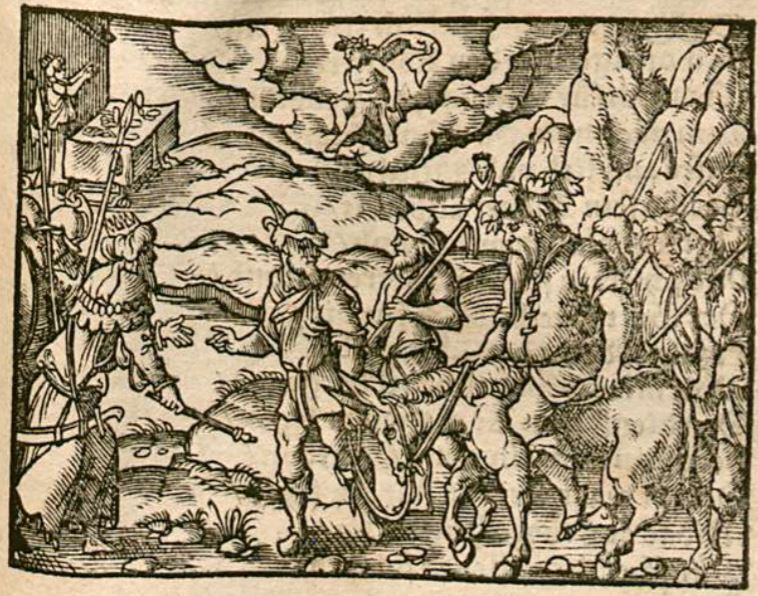
Silenus, one of Bacchus’ companions, had one day gone missing. He had found himself captured by Phrygian men while he was stumbling around in a drunken stupor. This engraving illustrates the Phrygian men leading Silenus to King Midas. King Midas is depicted on the left side of the engraving holding his arms out towards Silenus because they were once old friends who had learned Bacchic rites together. Bacchus is illustrated at the top of the engraving sitting on a cloud looking down on the scene as he searches for Silenus. When Silenus was brought back to Bacchus, Bacchus had given Midas the choice of a gift for having taken care of Silenus. Midas chose to turn anything he touches into gold.
In the foreground, two shepherds dig Grisóstomo’s grave. In the background, Don Quixote, Sancho Panza, Ambrosio, Vivaldo, and the other shepherds are gathered around Grisóstomo’s body. They all look up at Marcela, whom appears at the top of the crag where the grave is being dug. To Vivaldo, her appearance seems to be a marvelous vision. Grisóstomo’s body is depicted like Christ’s in pietà, balancing Renaissance ideals of classical beauty with naturalism. Signed by F. Hayman (illustrator) and L. G. Scotin (engraver). Part 1, ch. 14.
A well dressed man (left) shakes the arm of the youth Don Louis dressed as a peasant (right) who is sleeping on a pile of straw in the stable by the side of a muleteer whose face can barely be parsed on the right/middle. In the background there is a reined mule.
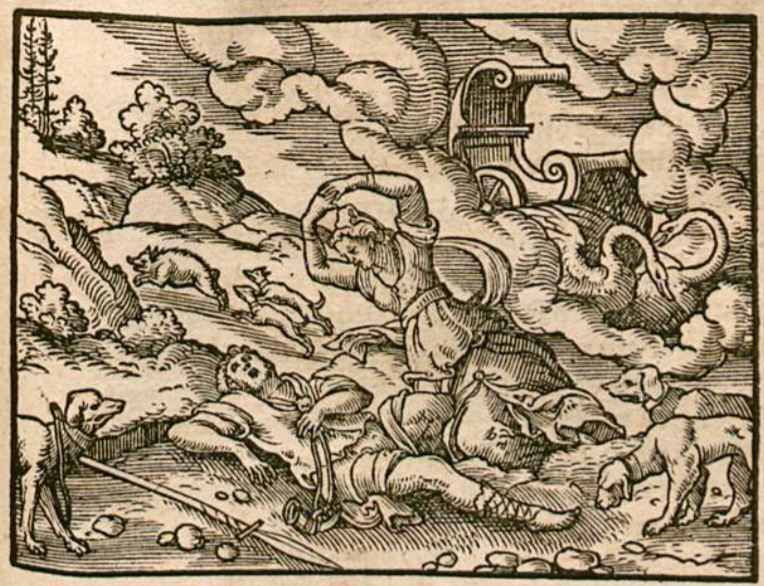
This engraving illustrates the death of Venus’ lover, Adonis. Adonis had ignored Venus’ advice of hunting smaller, less threatening animals and had chased after a boar while on a hunt. One of Adonis’ hounds is illustrated chasing the boar away in the background of the engraving. Unfortunately, the boar attacked Adonis by piercing his groin with one of his sharp tusks. Adonis is illustrated laying on the ground in pain by his fatal wounds. Venus heard his groans while she was flying in her chariot drawn by swans. She found Adonis’ lifeless body and mourned over him. She then turns his blood into an anemone flower.
Princess Micomicona (Dorotea) kneels before Don Quixote, while Sancho Panza explains who she is. The barber, disguised with a beard, appears as her squire. In the text, the priest and Cardenio are hidden from view, while in the illustration they are pictured in the scene. Don Quixote’s armour hangs on a tree, as a reference to his penance in the previous chapter. Signed by F. Hayman (illustrator) and L. G. Scotin (engraver). Part 1, ch. 29.
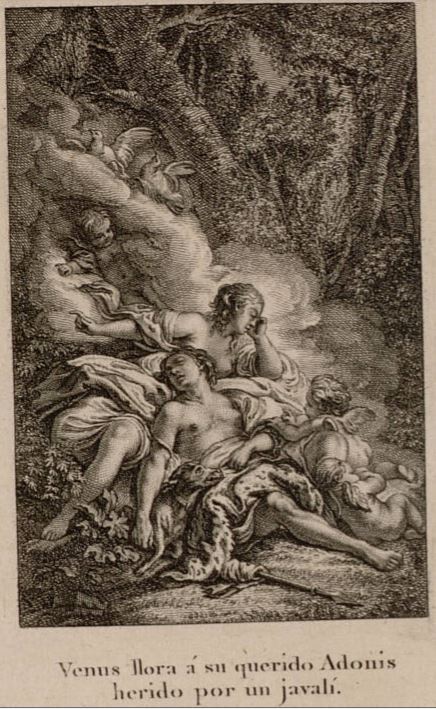
This engraving depicts the death of Venus’ lover Adonis. Adonis had ignored Venus’ advice on hunting smaller, less threatening animals, and had chased after a boar while on a hunt. The boar attacked Adonis by piercing his groin with one of his sharp tusks. Adonis is illustrated laying on the ground, in pain by his fatal wounds. Venus heard his groans while she was flying in her chariot drawn by swans. She found Adonis’ lifeless body and mourned over him. Venus is depicted sitting with Adonis and his hunting hound. Her cherubs are sharing the grief with her as well. She then turns his blood into an anemone flower.
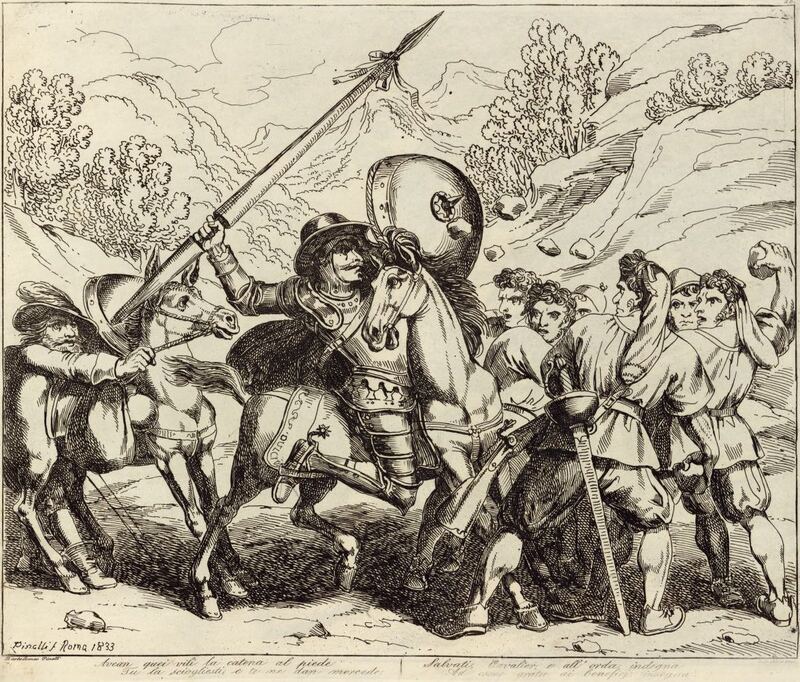
After their release, the galley slaves stone Don Quixote and Sancho Panza. They are led by Ginés de Pasamonte, who refuses to travel to Toboso to present himself to Dulcinea. Signed by Bartolomeo Pinelli (engraver and illustrator) and dated Rome, 1833. Plate 25. Part 1, ch. 22.
Don Quixote (right) clad in armor, a sword equipped to his waist steps forward as he is adressed by a companion of Dulcinea, his hands receptive. The companion of Dulcinea (left) is dressed in mourning robes and crowned with a large turban on her head, she bows slightly, her eyes closed, her right hand clutching the cloth of her robe. In the background Montesinos (middle) stands, an old man with a great beard and a cap upon his head with his eyes also closed abidingly.
In Sierra Morena, princess Mimicona (Dorotea) kneels before Don Quixote and begs for his help. The barber is disguised as Dorotea’s page with a fake beard (an oxtail). In the background, the knight’s armour hangs in a tree and the priest and Cardenio watch the scene, hidden behind some shrubs. Signed by J. Rivelles (illustrator) and T. L. Enguídanos (engraver). Part 1, ch. 29.
Dorotea runs away when the priest, the barber, and Cardenio surprise her. The latter are mounted on mules, while Dorotea carries her shoes (she had been washing her feet in the stream (foreground). Signed by D.-N. Chodowiecki (illustrator) and D. Berger (engraver), dated 1779. Plate 5. Part 1, ch. 28.

![[Dorotea kneels before Don Quixote]](https://collections.cemvc.ca/files/large/4dc1b296bbe9c77f86d77b11009a7b256932b4f1.jpg)
![[The Maid Opens the Door for the Crossdressing Siblings of Barataria]](https://collections.cemvc.ca/files/large/6edc389e55c8a2f361eb064ca42f4b2ec2a8cf58.jpg)
![[The Hunted Boar Lies Upon the Ground]](https://collections.cemvc.ca/files/large/b8d4a33481fa380effd2dc06e9baf92cc0db1300.jpg)
![[Teresa Panza Weaves a Winnowing Basket]](https://collections.cemvc.ca/files/large/d9935913db46e745d5cfc08a5f909b270ec9a136.jpg)
![[Quixote Brought Back to His Home Battered and Bruised]](https://collections.cemvc.ca/files/large/95fa0ce1b9eb5d103b148f33f0967522c739ab6e.jpg)
![[Grisóstomo's burial and Marcela's appearance]](https://collections.cemvc.ca/files/large/2085cddf162171f69fc42c916f3955d9030d52d5.jpg)
![[Don Louise is Captured by his Father's Servant]](https://collections.cemvc.ca/files/large/c5febb41f326416eae2ee54f33db6ea31f28e893.jpg)
![[Don Quixote meets princess Micomicona]](https://collections.cemvc.ca/files/large/86ece3093ae4bbdf154196fff097aae5358a80e2.jpg)
![[Don Quixote Speaks with One of Dulcinea's Attendants in the Cave of Montesinos]](https://collections.cemvc.ca/files/large/06f7b471d6bcad45cfbc01730cad0d3099b24d9c.jpg)
![[Don Quixote meets princess Mimicona]](https://collections.cemvc.ca/files/large/bd69605d6241d79173b51587b96ba3548aa6f76c.jpg)
![[The priest, the barber, and Cardenio encounter Dorotea]](https://collections.cemvc.ca/files/large/c9798c78a6800ef6763601dad2fb91b07e4dcad0.jpg)