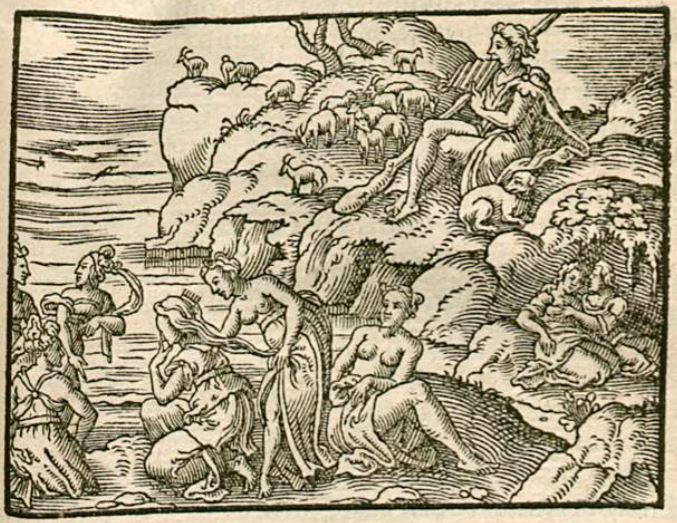
This engraving depicts Scylla surrounded by her nymph friends while she combs Galatea’s hair. As Scylla combs Galatea’s hair, she discusses her love life and how she is always sought out by men. Galatea is depicted kneeling by the water with her hand to her face as she cries due to her own unfortunate love life. Galatea explains that she was once in love with a man named Acis, but he was killed by a cyclops named Polyphemus.
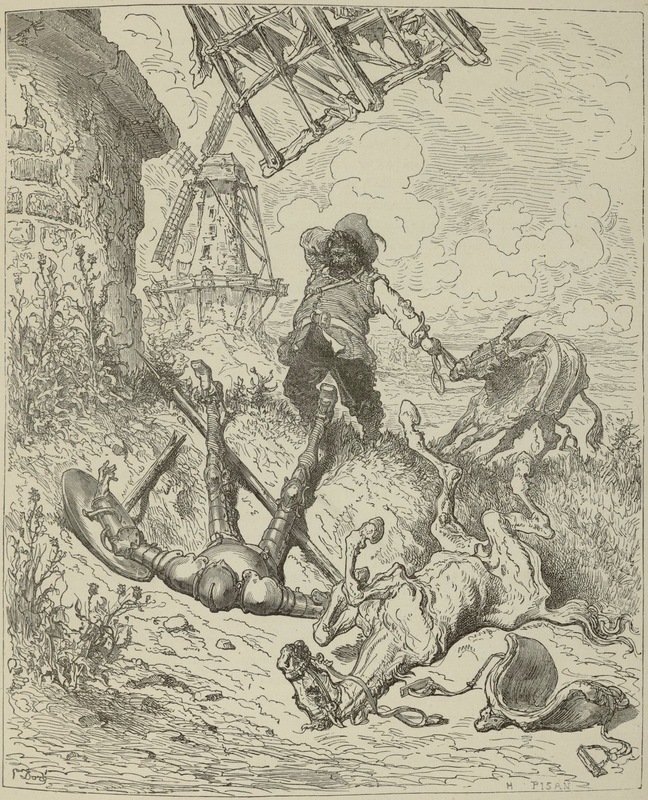
Sancho Panza comes to help Don Quixote and Rocinante, who were thrown to the ground by the windmill’s sail. Signed by G. Doré (illustrator) and H.-J. Pisan (engraver). Part 1, ch. 8.
Don Quixote, standing on a bench, attacks the puppets of Maese Pedro’s theatre while several astonished theatregoers watch him. Maese Pedro appears from hehind a curtain. Unsigned. Part 2, ch. 26.
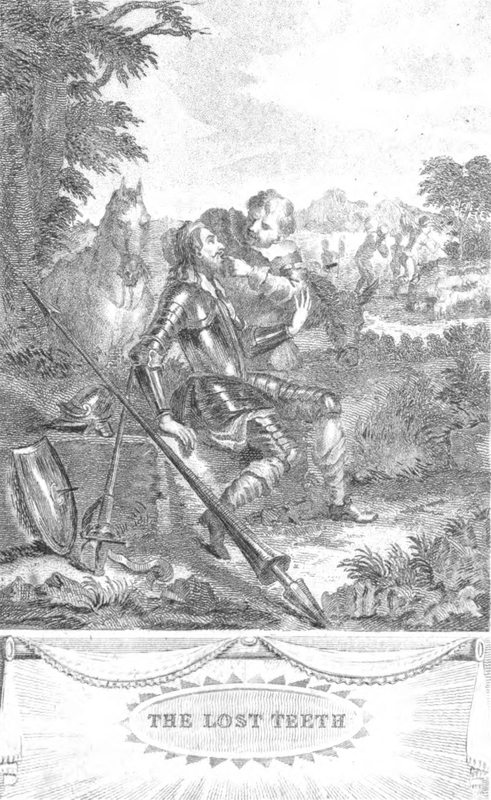
Sancho Panza opens Don Quixote's mouth and sticks a finger into his oral cavity to see the state of his teeth. The knight errant has had three teeth shattered after being pelted by rocks thrown by shepherds, who were incensed by Quixote's slaughter of their sheep. Clad in full armour, Quixote waits for Sancho's verdict, who is counting Quixote's teeth one by one. To the left, Quixote has strewn his lance, helmet, sword, and shield, while his horse Rocinante waits patiently behind him. To the right of Sancho, his Donkey also waits and stares at the ground. In the background, the shepherds carry their dead sheep to greener pastures.
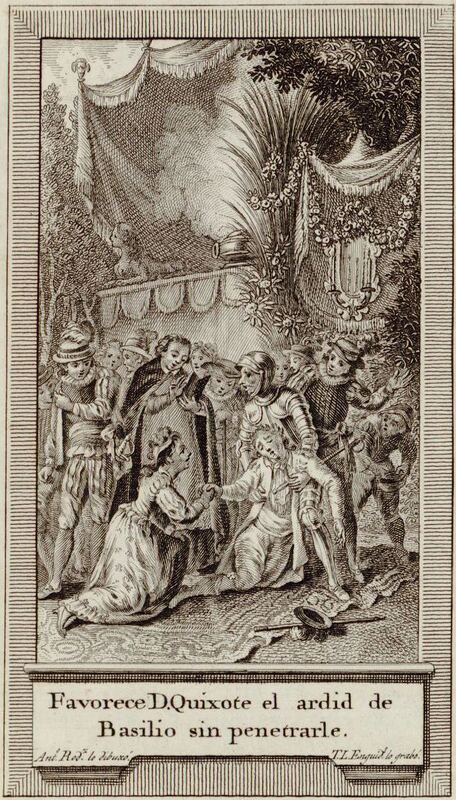
Basilio, pretending to have stabbed himself, is married to Quiteria. Don Quixote (holding Basilio’s body), Sancho Panza, Camacho, and the priest (giving them his blessing) are also pictured. Signed by A. Rodríguez (illustrator) and T. Enguídanos (engraver). Part 2, ch. 21.
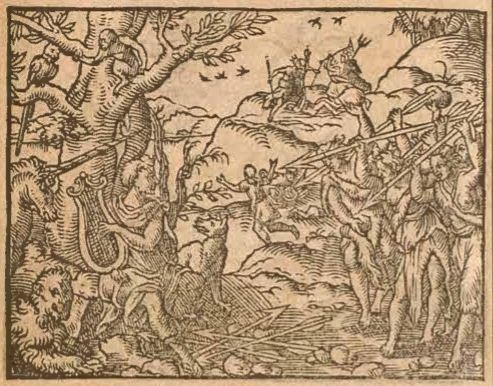
This engraving illustrates the horrific death of Orpheus. Orpheus is illustrated sitting by a tree on the left-hand side of the engraving, playing his lyre whilst surrounded by the animals who listen to him. Orpheus is being approached by the Maenads, a frenzied group of women who worship the god Bacchus. They first attack the animals that surround Orpheus and tear them to pieces. Then they attacked Orpheus by throwing stones and spears at him until he bled. Just like the animals, the Maenads end up tearing Orpheus to pieces.
After causing a fight in the same inn in which Don Quixote had stayed in during his first sally, he attempts to leave without paying once again. The innkeeper demands payment for the food, beds, animal feed, and damages which Don Quixote refuses to pay. Don Quixote rides off, leaving Sancho Panza behind to pay the bill which he also refuses to do. Don Quixote sits atop Rocinante in full armor, while the innkeeper attempts to convince him to pay his bill. A crowd surrounds the altercation, and Sancho Panza is barely visible behind Don Quixote. This scene can be found in Part 1, Book 3, Chapter 3.
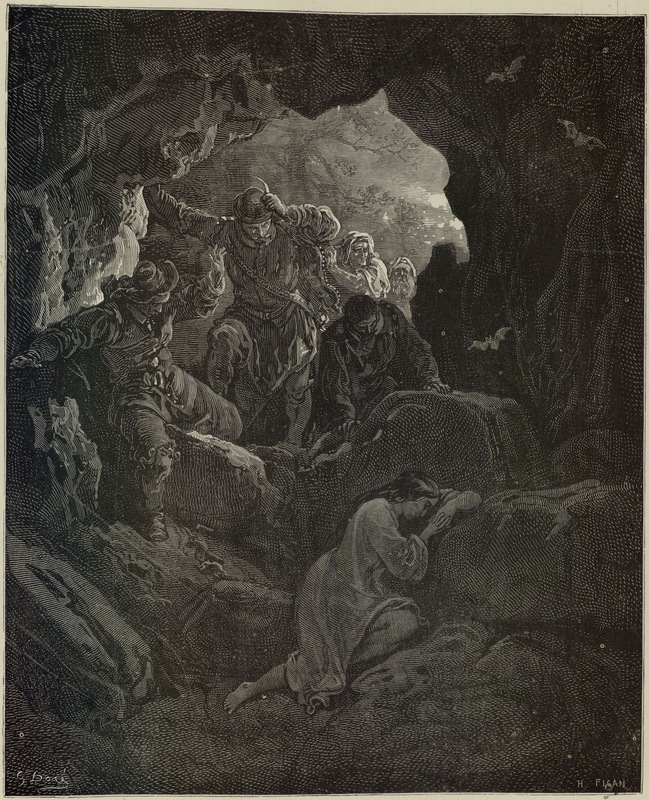
The illustration represents part of the story told by the goatherd Eugenio: after searching for three days, the villagers find Leandra in a cave, wearing only her chemise and without the money or jewels she had taken from the house. She had fled to the cave with Vicente de la Rosa, where he robbed and abandoned her. Signed by G. Doré (illustrator) and H.-J. Pisan (engraver). Part 1, ch. 51.
Sancho Panza, wearing his nightshirt, is awakened by soldiers who inform him of the invasion of Barataria Island. The architecture is well detailed. Signed by J. Rivelles (illustrator) and A. Blanco y Asensio (engraver). Part 2, ch. 53.
Don Quixote, enraged after Sancho Panza confesses to preferring Mimicona’s beauty to Dulcinea’s, prepares to punish him. Mimicona (Dorotea) attempts to placate him. Don Quixote is mounted on Rocinante, wears a buckler and Mambrino’s helmet (the barber’s basin), and menaces Sancho with a lance. In the background, the priest, Cardenio, and the barber (disguised as Mimicona’s page with a fake beard) are pictured. The crags of Sierra Morena rise behind them. Unsigned. Part 1, ch. 30.
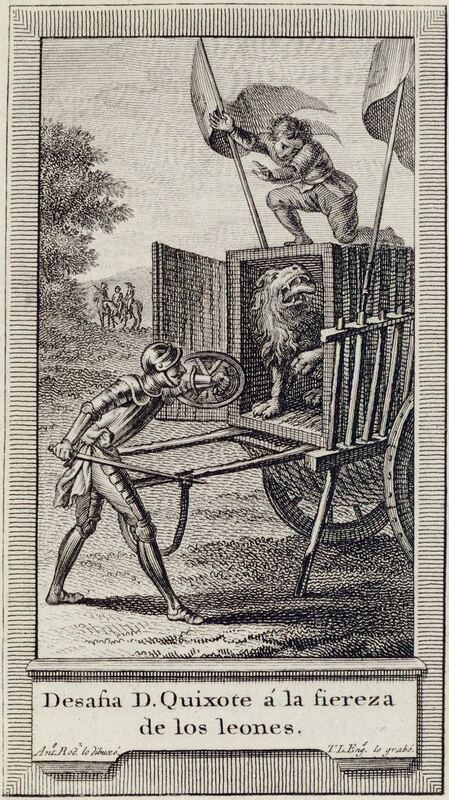
On the road, Don Quixote encounters a wagon carrying two lions in cages that the General of Oran is sending as a present to the king. The errant knight demands that the lion keeper open the cages so that he can fight them, threatening violence if he does not. While Sancho Panza and Don Diego de Miranda run away to a safe distance (background), Don Quixote takes up his shield, unsheaths his sword, and approaches the cage. However, when the keeper opens the cage, the lion refuses to leave, instead yawning and stretching. Signed by A. Rodríguez (illustrator) and T. Enguídanos (engraver). Part 2, ch. 17.
Don Quixote falls from Rocinante and hangs by his hand, tied to a window. Four travellers, servants of Don Luis’ father, arrive to the inn and Rocinante moves to smell one of the mares. The innkeeper appears at the window, having heard Don Quixote shouting. The plate is placed in ch. 41 in the text, but the scene is from ch. 43. Unsigned. Part 1, ch. 43.
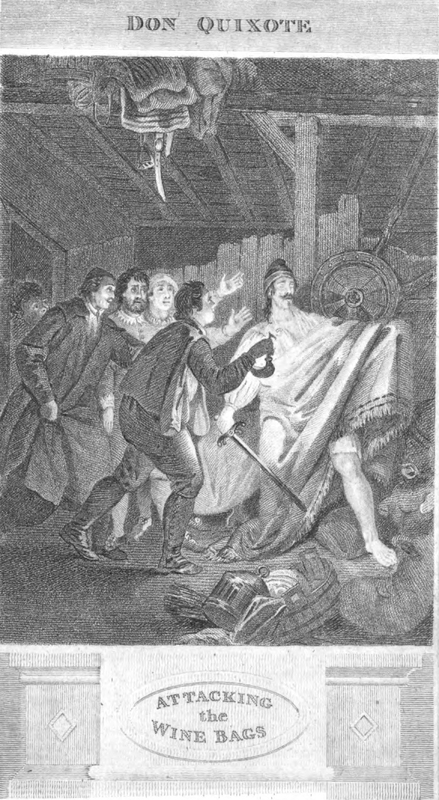
Don Quixote stands upright in an oversized white shirt, with a greasy little red cap upon his head, which belonged to the innkeeper. On his left arm Quixote twisted the blanket as if it was a shield, and in his right hand he held his drawn sword, which he was swinging about him on all sides, and uttering words, as if he had really been fighting a giant. All the while his eyes are shut for he is both and sleepwalking and talking. The innkeeper, seeing the wineskins cut open and drained (pictured with a candle in his right hand) sets upon Quixote, but is stopped by the priest (pictured wearing robes and a cap). The barber (the bearded fellow next to the priest), Cardenio (the man in white standing behind the barber) , and Sancho Panza (just entering the room) are also present.
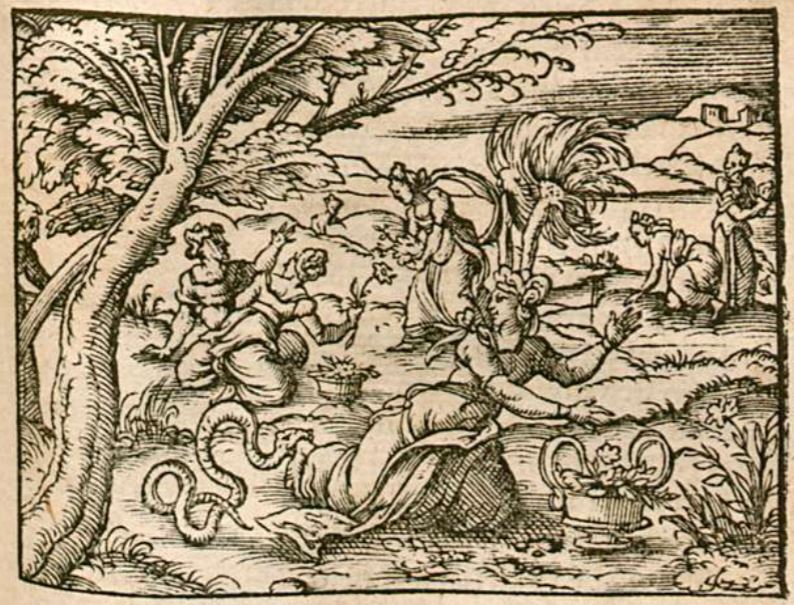
This engraving illustrates the new wife of Orpheus, Eurydice, surrounded by Naiads. While taking a walk with the Naiads one day, Eurydice had stepped on a poisonous snake that had been hiding in the grass. It bit her. This is depicted in the engraving, with Eurydice’s hands in the air in shock, with her head facing the snake to look at what had bit her. The poison ends up killing her, which results in her husband, Orpheus, going to the Underworld to save her.
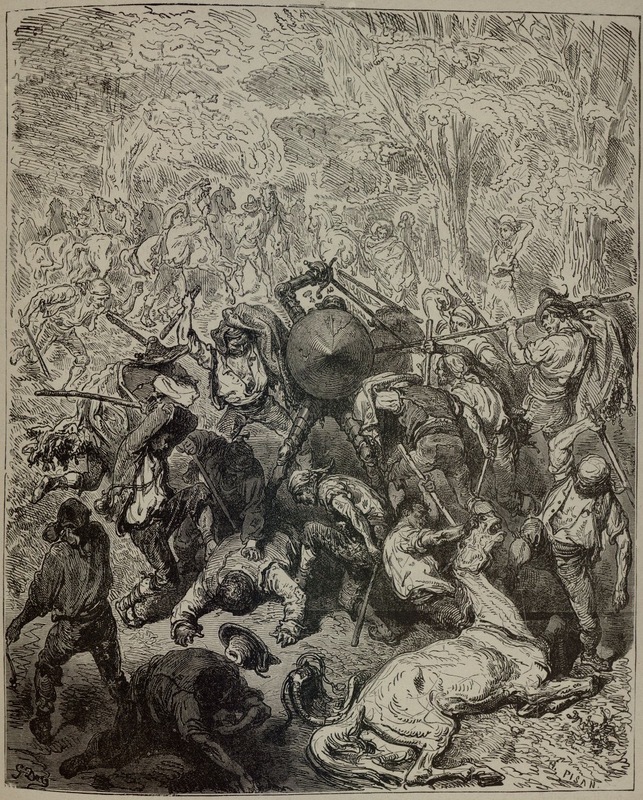
The Yanguesans, seeing themselves attack by only two men, surround Don Quixote and Sancho Panza and rain blows down on them with their staffs. Signed by G. Doré (illustrator) and H.-J. Pisan (engraver). Part 1, ch. 15.
The peasant girl playing the part of the enchanted Dulcinea spurs her jenny with a goad, irritating it such that she bucks and throws the girl to the ground. Don Quixote, seeing this, hurries to help her up. Sancho Panza adjusts and tightens her packsaddle, which had slipped under the donkey’s belly. Signed by D.-N. Chodowiecki (illustrator) and D. Berger (engraver), dated 1781. Plate B.III. Part 2, ch. 10.
In master Peter's puppet show Don Gaiferos, clad in armor, (right) rides a horse with a spear and a magnificent feathered helm. Melisandra (left) wearing long white robes of the Algerian make sits behind him on his horse, and clasps her arms about his shoulders till they cross and meet over his breast, that she may not fall, though her puppet arms only allow so much limber movement. In the background on the left stands the tower she has just recently escaped from.
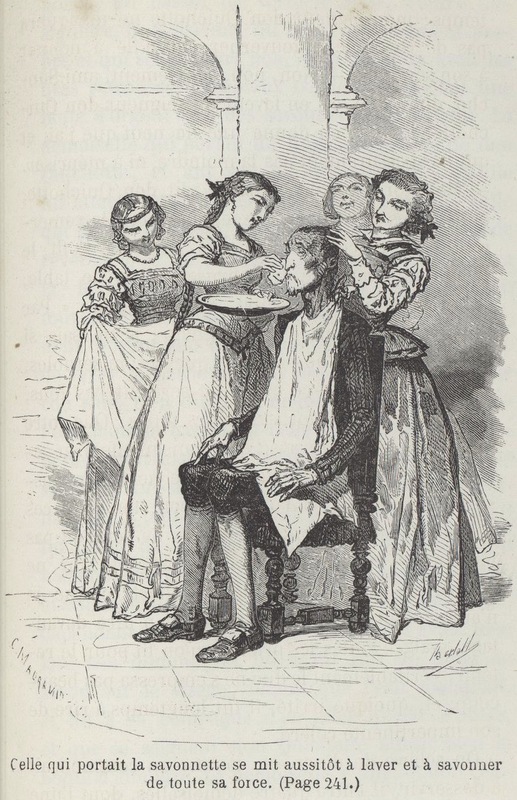
Don Quixote seated and surrounded by the duchess’ maidens, who soap and wash his beard. Signed by A. ‘Bertall’ d’Arnoux (illustrator) and C. Maurand (engraver). Part 2, ch. 32.
The Squire of the Woods stands with his arms crossed, a sword in his right hand, he is wearing a buttoned up shirt with rigid collar, and a belt of rope by his waist. His brimmed hat is folded at the front back over his black hair and his face is obscured by his enormous (fake) nose that hangs over his mouth.
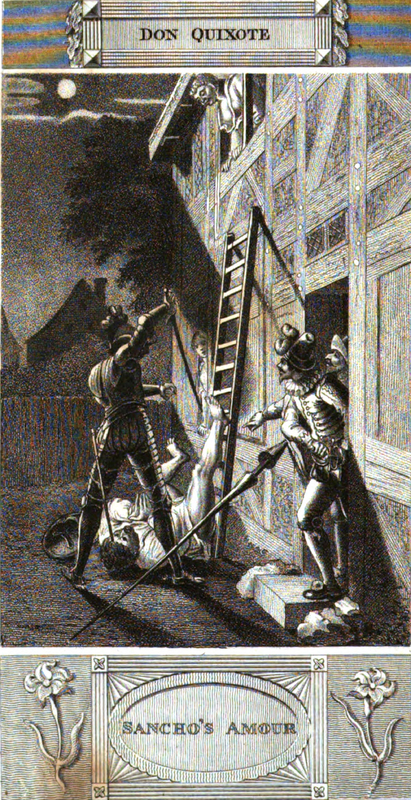
After being brought back to his home in La Mancha with the purpose of curing Quixote of his madness, the priest and the barber try to see whether Quixote is still obsessed with knight-errantry. At the entrance to the home of Don Quixote, Sancho Panza tries to climb a ladder to see his master but is refused entry by Quixote's niece and housekeeper who send him tumbling back to the ground. The barber, priest and Quixote all run to the entrance to see what the noise is about. Sancho Panza lies on the ground next to his ladder, having fallen from its peak. The housekeeper looks down upon Sancho, satisfied in her defence of the house, whilst Quixote's niece looks upon Sancho out of a left-hand ground floor window.
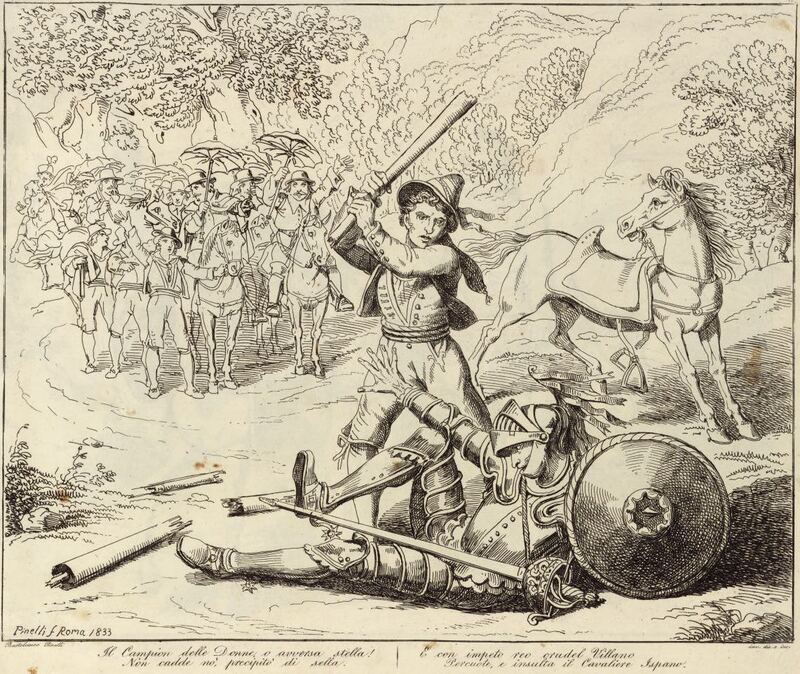
In the foreground, one of the grooms of the silk merchants of Toledo breaks Don Quixote’s lance and beats him with it. In the background, the silk merchants are mounted on horses and hold parasols. Signed by Bartolomeo Pinelli (engraver and illustrator) and dated Rome, 1833. Plate 8. Part 1, ch. 4.
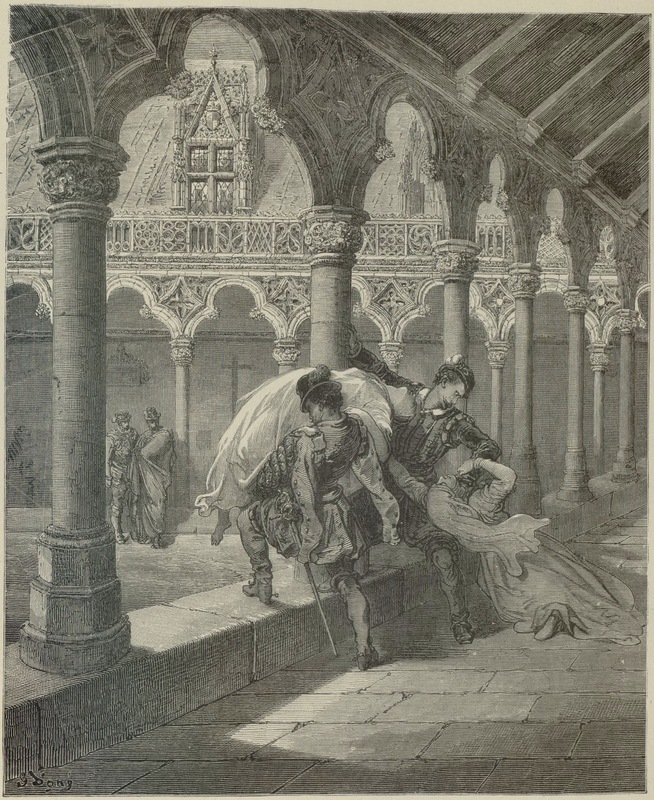
Don Fernando relates what had happened to him after the letter was discovered in Luscinda’s bodice: he and three gentlemen abduct her from the convent in which she had hidden herself, seizing her from the cloister where she was talking to a nun. Signed by G. Doré (illustrator) and H.-J. Pisan (engraver). Part 1, ch. 36.
Sancho Panza, mounted atop his donkey, extends his arms to his left, where a man in the garb of a pilgrim in a white robe and wide brimmed hat greets him similarly, a walking stick in his right hand. On the left, an old pilgrim in the same white clothes and hat stands watching Sancho along with a third man dressed the same to the right of Sancho. In the background some more men watch next to a tree.

![[Don Quixote attacks the puppets]](https://collections.cemvc.ca/files/large/5fff09f892c88050b4a65dedaf58f3003ab33417.jpg)
![[An Iron Gauntlet Amidst Two Swords]](https://collections.cemvc.ca/files/large/41fa5f25ff65381949beb26e9b21184f7329c41b.jpg)

![[The invasion of Barataria Island]](https://collections.cemvc.ca/files/large/953aa9ce26844ff08c90d36ca6b421946a7418d0.jpg)
![[Don Quixote punishes Sancho Panza]](https://collections.cemvc.ca/files/large/30331b86f37d80c081fa923d0ac928f5dc52e2aa.jpg)
![[Don Quixote hangs by his hand]](https://collections.cemvc.ca/files/large/bb3ee7c06f3b8ec8508abfb32e6686f8ee274d4b.jpg)
![[The enchanted Dulcinea falls from her donkey]](https://collections.cemvc.ca/files/large/aba2b1486a073e0554f0d6dfdb0421f6498c3e5f.jpg)
![[The Puppets Ride on Horseback]](https://collections.cemvc.ca/files/large/5fc9a1b518809bf39b728ec83a233316303e0ba4.jpg)
![[The Squire of the Woods' Very Large Nose]](https://collections.cemvc.ca/files/large/ad202cf7c640a2cc7b5e7a9136c6e4de6ae23803.jpg)
![[Don Quixote and Sancho Panza release the galley slaves]](https://collections.cemvc.ca/files/large/6762593eb8fb9e29ed3ff84254f341eeef9bb8bf.jpg)
![[Sancho us Met By Ricote in Disguise]](https://collections.cemvc.ca/files/large/16dc01abb4409fafdce3ffd6661d7bdfe4816e45.jpg)