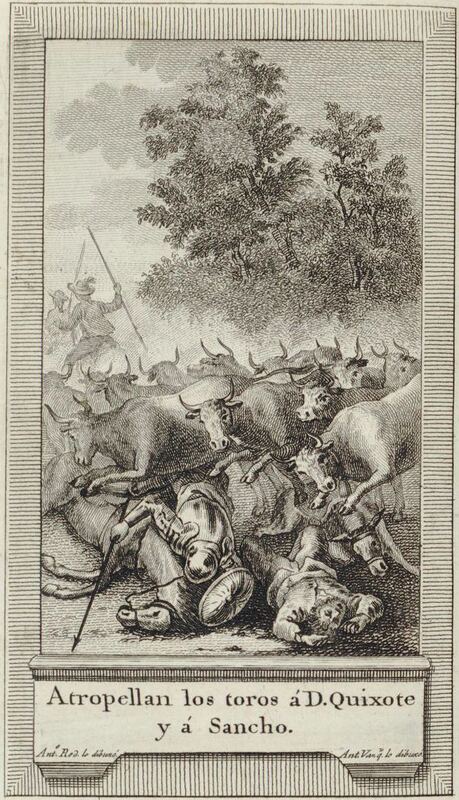
After Don Quixote confronts some herders on the king’s highway to Zaragoza, a herd of bulls tramples him, Sancho Panza, and Rocinante. Signed by A. Rodríguez (illustrator) and B. Vázquez (engraver). Part 2, ch. 58.
A postillion dressed as a demon approaches the hunting party, playing a huge, hollow animal horn that emits a harsh and terrifying sound. The devil announces the arrival of the enchanted Dulcinea and the gallant Montesinos. The duke and Don Quixote are depicted with expressions of surprise; the duchess and Sancho Panza, fear. Signed by J. Rivelles (illustrator) and A. Blanco y Asensio (engraver). Part 2, ch. 34.
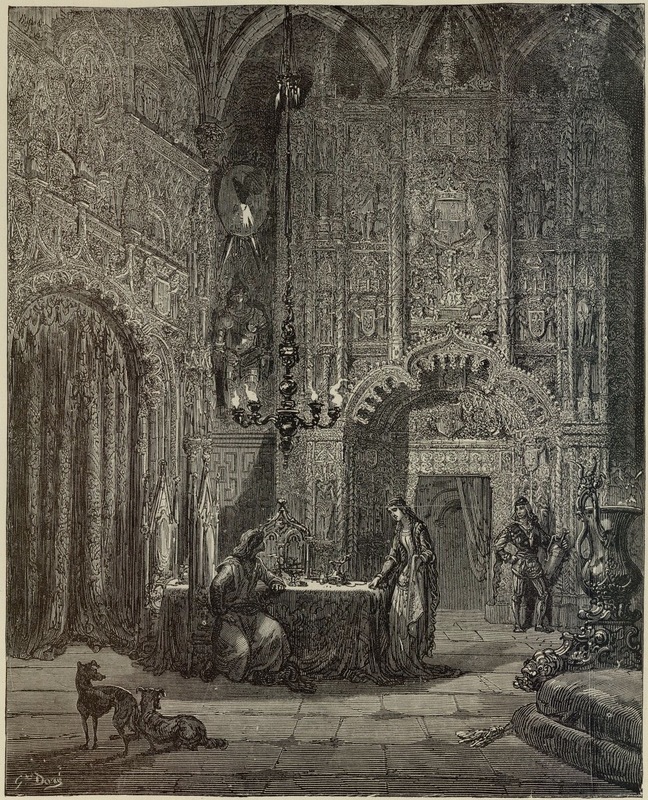
The illustration represents part of the tale of the Knight of the Lake, as told by Don Quixote to the canon of Toledo in defense of chivalric novels: as the Knight waits in a chamber of the castle, a maiden enters and begins to explain to him what this castle is, that she resides there, and that she is enchanted. The architecture of the chamber is richly detailed. Signed by G. Doré (illustrator) and H.-J. Pisan (engraver). Part 1, ch. 50.
In the background, the duke, the duchess, and Don Quixote are seated at a table. In the foreground, the duke’s servants try to wash Sancho Panza’s beard. They hold towels and a bowl of water. Unsigned. Part 2, ch. 32.
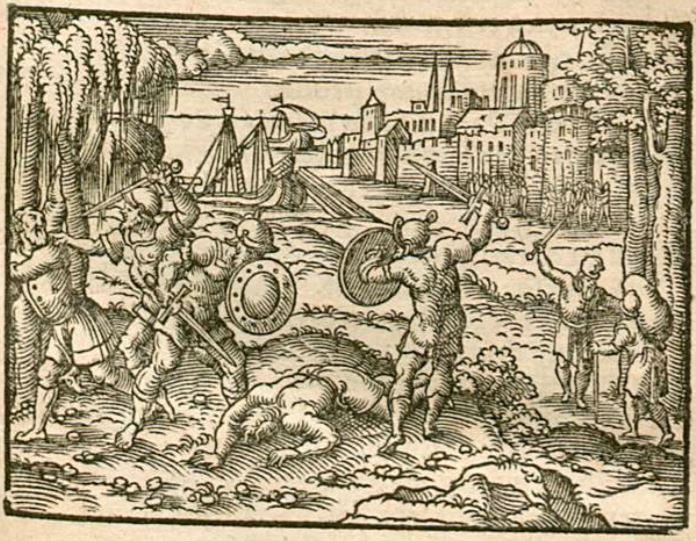
This image illustrates the violence that ensues after the time of the Silver Age. The image demonstrates the Bronze Age and Iron Age, where humankind began to indulge in warfare and became fiercer than in previous ages. As shown in the image, there are soldiers battling one another, with one soldier depicted slain on the ground. There are massive fortifications in the background as their desires for bigger and stronger shelters grew. In the far background, there are ships illustrated on the water, as the people of the Bronze Age began cutting down trees in order to construct the ships. The image is to signify the changing ways of the world and the violence that will come from humankind.
During Sancho Panza's role as governor of Barataria, he sits upon a high regal chair (middle) with a wand in his right hand and points towards a cane with his left hand. A group of people gather around and behind the throne to see and hear Sancho's decree. On the left and right of the foreground there are two old men who have approached Sancho for the purpose of having their altercation resolved. One of Sancho's men takes the governor's order and snaps a hollow cane in half with his knee, from which coins fall to the floor. At the top right on a pillar hangs a cross depicting the crucifixion of Christ.
At Juan Palomeque’s inn, Sancho Panza, Cardenio, the priest, and the innkeeper discover Don Quixote attacking the wineskins while sleepwalking. He is half-dressed, has a blanket draped over his arm, and wields his sword. The wine from a punctured wineskin spills onto the floor in the foreground. The light from a lamp held by the innkeeper illuminates the scene. Signed by J. Rivelles (illustrator) and T. L. Enguídanos (engraver). Part 1, ch. 35.
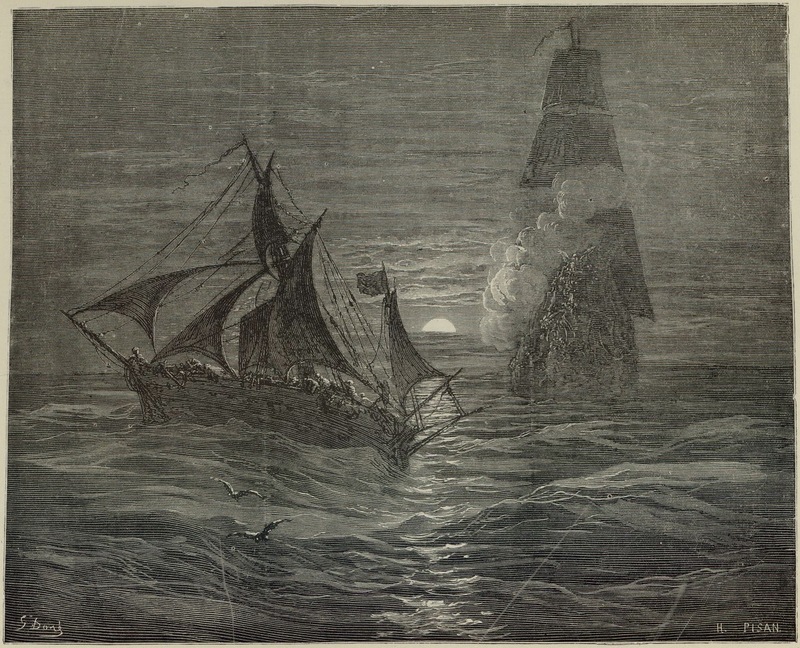
In the bright moonlight, the captive, Zoraida, and the crew see a square-rigged ship (a French corsair vessel) approaching them. Without warning, the ship fires two cannons loaded with chain shot. The first cuts their mast in two and the second strikes them amidships. Signed by G. Doré (illustrator) and H.-J. Pisan (engraver). Part 1, ch. 41.
A bald old one-legged man walks forward, his back hunched. He holds a cane in his left hand and a hat in his right, with a jacket draped over his forearm. The image is occasioned by Don Quixote saying "Observe, my son, that a soldier had better smell of gunpowder than of musk ; and if old age overtake you in this noble profession, though lame, maimed, and covered with wounds, at least it will not overtake you without honour, and such honour as poverty itself cannot deprive you of."
At their house, Sancho Panza explains to his wife Teresa why he has decided to undertake another sally with Don Quixote. The illustration is detailed and accurate: the architecture of the house, Sancho’s packsaddle, and the garlic hanging from the windowsill. Signed by J. Rivelles (illustrator) and A. Blanco y Asensio (engraver). Part 2, ch. 5.
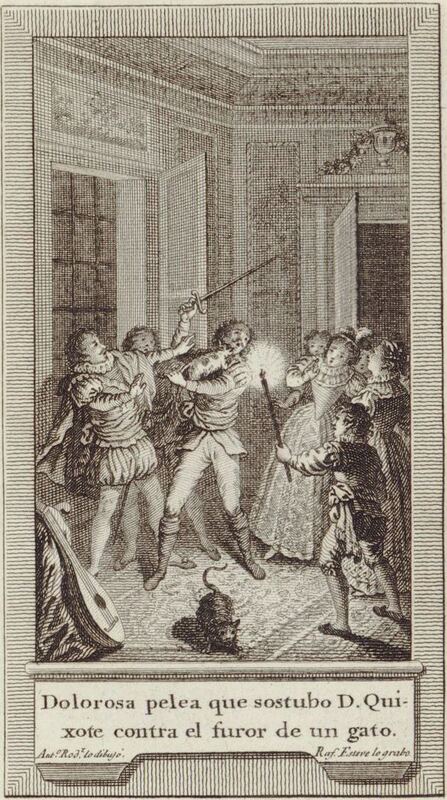
The duke and the duchess hear Don Quixote shouting and enter his room using a master key. They find him struggling to remove a cat that has sunk its claws and teeth into his nose. The lute (bottom left) is an accurate detail; Don Quixote played it in the previous episode. Signed by A. Rodríguez (illustrator) and R. Vilella (engraver). Part 2, ch. 46.
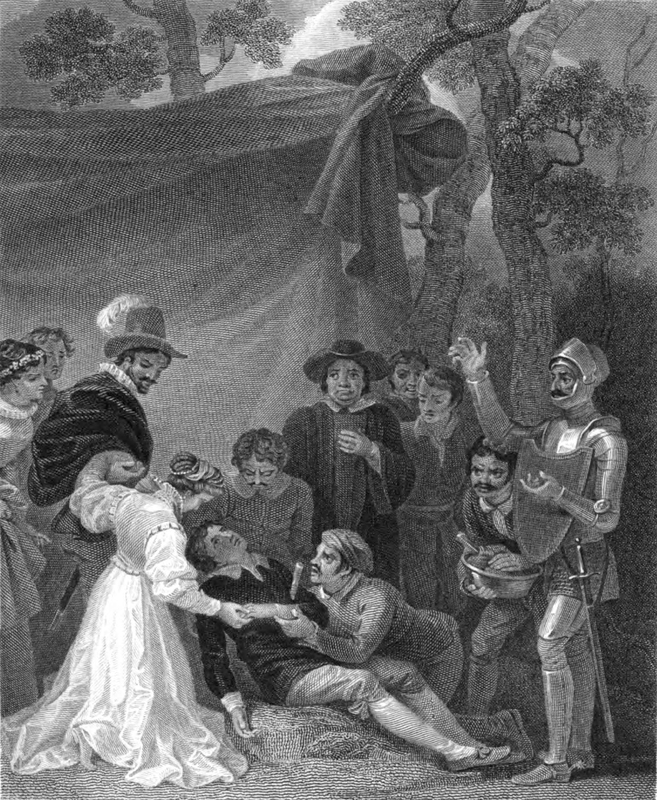
Basilius lies stretched upon the ground, clad in a black doublet, welted with flaming crimson. Having drawn a blade from within the hollow of a staff he fixed the hilt into the ground and threw himself upon the point. Having pierced himself, he welters in his blood. Don Quixote (pictured to the right clad in armor) hastened also to lend his aid , andtaking the dying man in his arms, found that he was still alive. They were going to pull out the blade from Basilius' body but the priest (pictured to the right of Basilius holding his body)thought that it should not be done till he had made his confession. Basilius confesses that he will renounce God unless he is married to Quiteria before drawing his final breath. So hearing, many in the crowd tell Quiteria to fulfill his request. And so, Quiteria kneeling down by him, made signs to him for his hand. To the left of Quixote, Sancho Panza watches on, suspicious of Basilius, with his pot of morsels in hand.
Dressed in his standard apparel, Sancho Panza he embraces his donkey Dapple in the stable of Barataria, and gives him a kiss of on the forehead. In the background, the walls of the stable are visible as is a window behind the donkey. In the bottom right, a saddle lies on the ground.
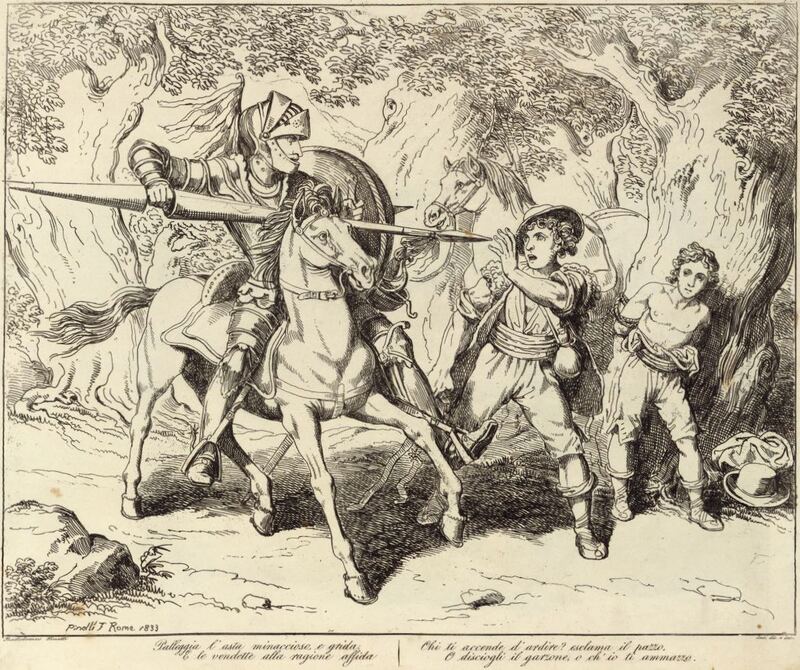
Don Quixote, mounted on Rocinante, discovers Juan Haldudo reprimanding and whipping Andrés with a leather strap. Andrés is tied to and oak, and Juan’s mare is tied to another (background). Don Quixote aims his lance at Juan and orders him to release Andrés. Signed by Bartolomeo Pinelli (engraver and illustrator) and dated Rome, 1833. Plate 7. Part 1, ch. 4.
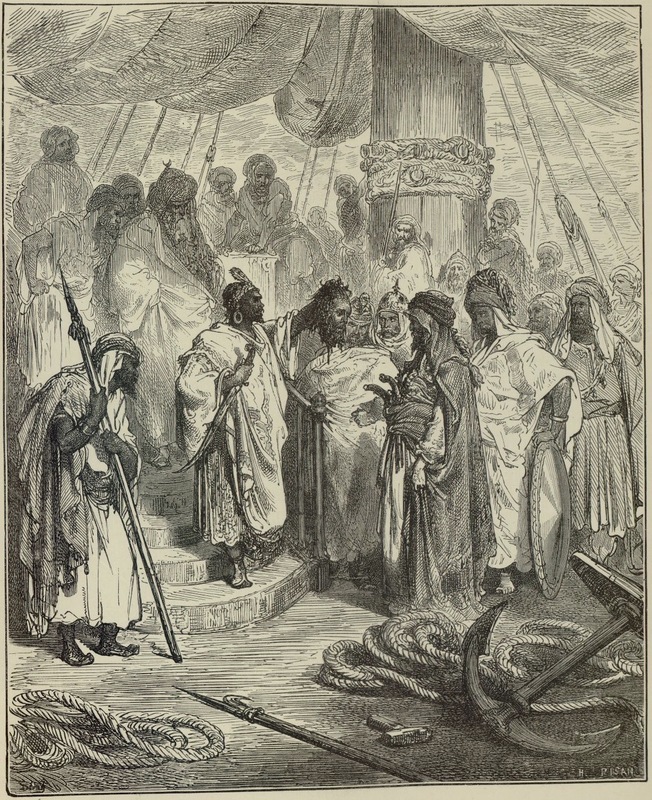
The illustration represents part of the captive’s tale: a group of Arabs bring Juan de Andrea Doria’s head to the commander of the Turkish fleet, who orders the two who brought him the head hanged. This confirms the Spanish proverb: ‘For the treason we are grateful, though we find the traitor hateful.’ The Arabs had betrayed Juan’s trust after the Goletta fortress fell, promising to take him to Tabarca dressed as a Moor. Signed by G. Doré (illustrator) and H.-J. Pisan (engraver). Part 1, ch. 39.
While in the accommodations of the Duke and Duchess, Don Quixote and Sancho are met by six duennas, the likes of which Sancho Panza refuses to be touched by. Two of the Duenna's in the middle aid Don Quixote in wearing formal attire, while a third Duenna to the left holds up a mirror. To the right, Sancho Panza politely refuses the services of two Duenna, placing his cap to his heart in solidarity.
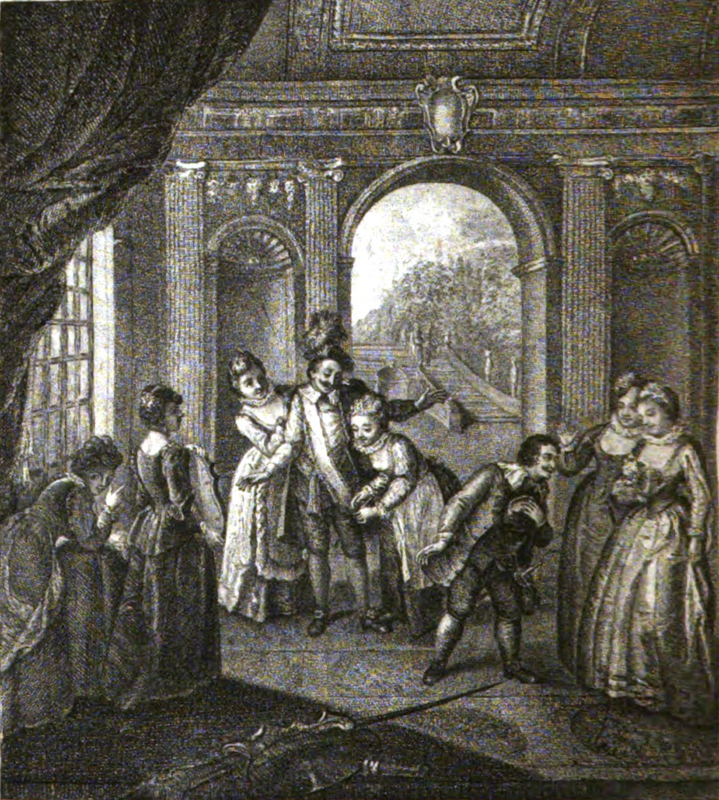
Having been given a letter addressed to Teresa Panza, one of the duchess' pages mounts their horse. The page is dressed in shorts and stockings and a doublet along with a tall plumed hat upon his head. In the background, the walls of the duchess' estate can be seen.
Don Quixote defeats the Knight of the Mirrors (Sansón Carrasco), knocking him off his mount. Meanwhile Sancho Panza (right background), startled by the big nose of the Knight of the Mirrors’ squire (Tomé Cecial, left foreground), climbs into a tree. Signed by D.-N. Chodowiecki (illustrator) and D. Berger (engraver), dated 1779. Plate 10. Part 2, ch. 14.
Having been dragged back to the Duke's castle by ten horsemen, Don Quixote see's the beautiful Altisidora lying upon a funeral coffin, apparently dead. The courtyard of the castle has been set up as a theatre of sorts, with the Duke and Duchess seated alongside similarly garish, and supposedly royal individuals. Two old judges, Minos and Rhadamanthus sit above the rest. Quixote and Panza are told that Altisidora has died due to her unrequited love for Don Quixote, and Rhadamanthus demands that Sancho Panza undertake a beating in order for Altisidora to be brought back to life. Sancho is sick of taking beatings for Don Quixote's lovers and refuses, but he still ends up taking the beatings and Altisidora "revives" succesfully.
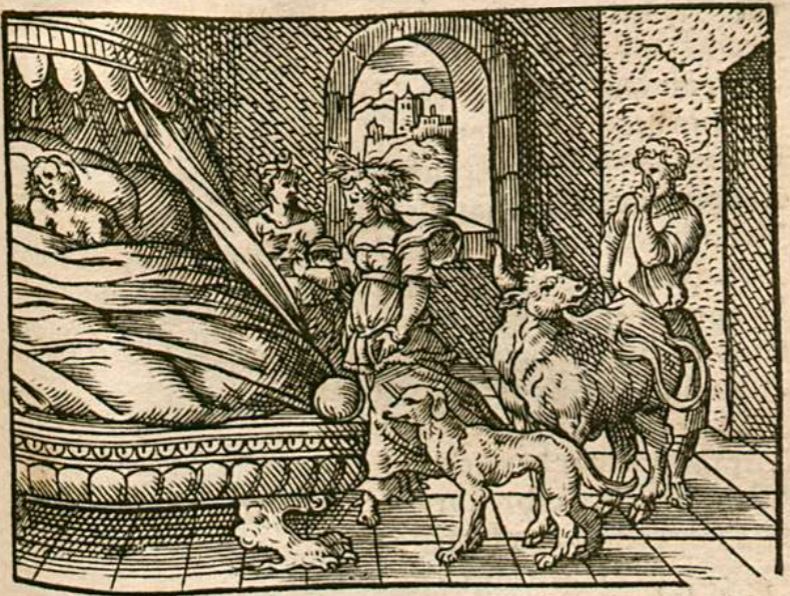
This engraving illustrates a pregnant Telethusa sleeping in her bed. Telethusa is worried about giving birth as her husband, Ligdus, vowed to put the child to death if it is to be a girl. Many Egyptian deities appeared to Telethusa in a dream, including Isis, Anubis, Apis, Harpocrates and Osiris. The deities are depicted surrounding the bed of Telethusa in the engraving. Isis speaks to Telethusa and tells her that no matter the outcome of the gender, she must raise the baby. Isis promises that everything will be okay, and no harm will come to the child after birth.
After being beaten by a group of ruthless Yanguesans (people that come from Yanguas, a municipality in the province of Soria, Castile and León), Don Quixote and Sancho Panza arrive at an inn to seek hospitality. The innkeeper, seeing the bruises upon Quixote's body enquires as to what has transpired, Sancho Panza lies that the bruises came about after falling off of a horse and landing upon a misshapen rock. The innkeeper's wife (the rightmost of the three women), a servant of the inn named Maritornes who held a candle for seeing (leftmost of the three women), and the innkeeper's daughter (middle of the three women) made Quixote a sorry bed of four wooden boards in the horse loft and a flock bed no thicker than a quilt. In this wretched bed was Don Quixote laid and the innkeeper and her daughter set to work wiping his bruises with wet cloths. Sancho Panza notes that although he himself has not been beaten to the same degree as his master, the fright alone has made him bruised, feeling his arm to check said bruises.
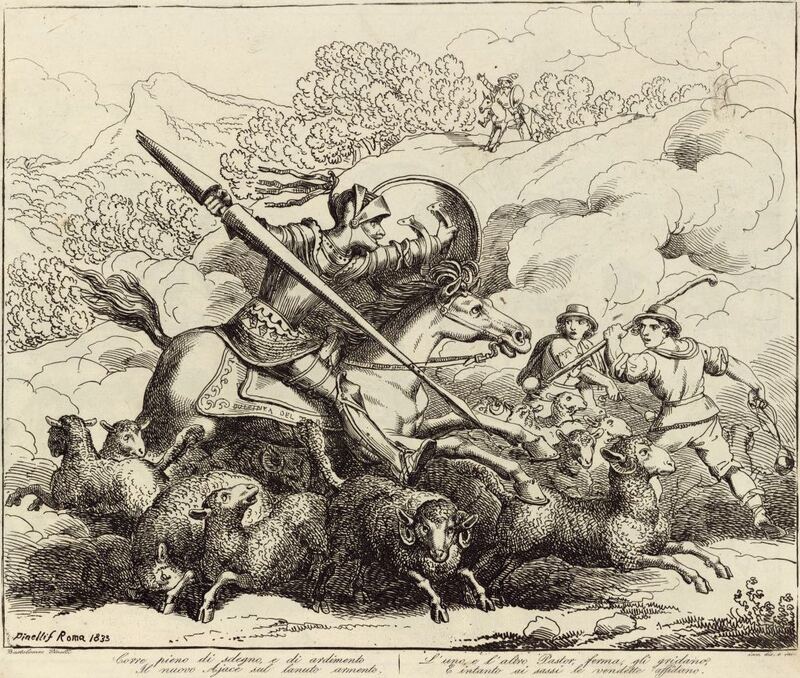
Despite Sancho Panza’s warning (he is pictured waving in the background), Don Quixote charges a flock of sheep. He is mounted on Rocinante and holds his buckler to defend himself from the stones the shepherds are throwing. Signed by Bartolomeo Pinelli (engraver and illustrator) and dated Rome, 1833. Plate 24. Part 1, ch. 18.
Don Quixote, clad in armor, takes countess Trifaldi's hands in his own. The countess is pictured as an older woman clad in black robes, kneeling on the ground. The three corners of her robe are held by three pages who stand at the ready behind her on the right. On the left, Sancho Panza sits on a rock next to the duchess, who sits regally on a chair, and the duke who stands next to Quixote in his plumed hat. In the background, behind the countess, stands a very tall man with a very long and thick white beard, this is the countess' squire.
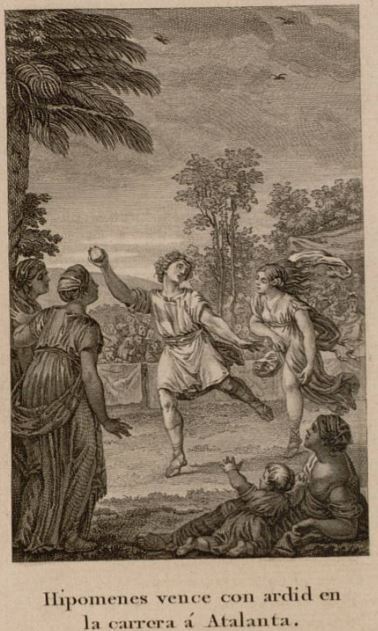
A man named Hippomenes had sought the help of Venus so he could win a race against a woman named Atalanta and claim her as his prize. Venus gave Hippomenes three golden apples to use during the race. Hippomenes throws the apples on the ground during the race to distract Atalanta. Hippomenes is depicted running in the image throwing an apple behind him as Atalanta looks distracted. Many people are watching their race on the sidelines. Hippomenes ends up winning the race.
A clear and limpid fountain runs in the midst of a cool grove wherein trees grow on the bank. The fountain has been found by Don Quixote and Sancho Panza (not pictured) who have recently been trampled by a stampede of bulls.

![[Appearance of the devil]](https://collections.cemvc.ca/files/large/81e10816fe697f82598a3024551db992e661d2ac.jpg)
![[The duke's servants try to wash Sancho Panza's beard]](https://collections.cemvc.ca/files/large/84dbecaa81929d9fb6450558bfdca51f6576794f.jpg)
![[Sancho Panza Orders for a Cane to Be Broken]](https://collections.cemvc.ca/files/large/682670db26eb6af9ed28ed72274f85cbddf7fb2e.jpg)
![[Don Quixote attacks the wineskins]](https://collections.cemvc.ca/files/large/839420fa3628ceeaef21ce18a816e047a2a12c9d.jpg)
![[Quixote's Honourable Man]](https://collections.cemvc.ca/files/large/ff01fac349c5dd363533d4eb05ea4ea60389ff80.jpg)
![[Sancho Panza speaks with his wife Teresa]](https://collections.cemvc.ca/files/large/8ff86930bd59030dfad8ef8480007ee494ed6433.jpg)
![[Sancho Kisses Dapple]](https://collections.cemvc.ca/files/large/6f4d47a43cc04acb1e6235ff0fbb41e950bcba89.jpg)
![[One of the Duchess' Pages Mounts a Horse]](https://collections.cemvc.ca/files/large/d82ebe6d233df2c1ac257f3d43bcf3fd680f964b.jpg)
![[Don Quixote defeats the Knight of the Mirrors]](https://collections.cemvc.ca/files/large/604f4794a7d9a45e9797d468a55d2d823e7379eb.jpg)
![[Rhadamanthus Demands that Sancho Panza Recieve a Beating to Revive Altisidora]](https://collections.cemvc.ca/files/large/1746f2dbefa5a310f01f9208434bc7e74072f9fe.jpg)
![[Of How Don Quixote and Sancho Panza were Treated in the Inn After Being Beaten by the Yanguesans]](https://collections.cemvc.ca/files/large/4c4528d77a95b510e97c86d1ea922e2518c3b5d4.jpg)
![[Don Quixote Greets the Countess Trifaldi]](https://collections.cemvc.ca/files/large/2a39b393d2242fe4888aadcfc5b3711075a5b1f3.jpg)
![[The Fountain Which Quixote and Sancho Found Relief In]](https://collections.cemvc.ca/files/large/7544c5ea6c8ab35da0f55b44c5c561cac50e8bac.jpg)