Clad in his iron helmet, Don Quixote eats at an inn that he has mistaken for a castle. He sits at a table outside the entrance of the inn with a cloth laid out overtop. Having brought out a dish of bacallao and a loaf of bread the innkeeper brought out a reed and putting one end to the knight's mouth poured in the wine from the other. On the opposite end of the table, two ladies were called to feed Don Quixote his food, as the Knight's hands were used for keeping his helmet on his head, and he refused to take it off.
Don Quixote (centre) falls to his knees in a lengthy white bed shirt and a little red cap having shred the wineskins of the innkeeper. The priest (left) dressed in black, takes Quixote's right hand in his own and talks to him. To the right, Sancho Panza bends slightly, incensed at the promises his master has made to him, which he now realize were made in disillusioned faith. The innkeeper (in the background by the ladder) raises his right hand and clenches it into a fist in anger with Quixote for destroying his wineskins, but he is restrained by Cardenio. In the background, a ladder leads up and out of the cellar. The barber, Dorotea, and the innkeeper's wife are pictured on the left.
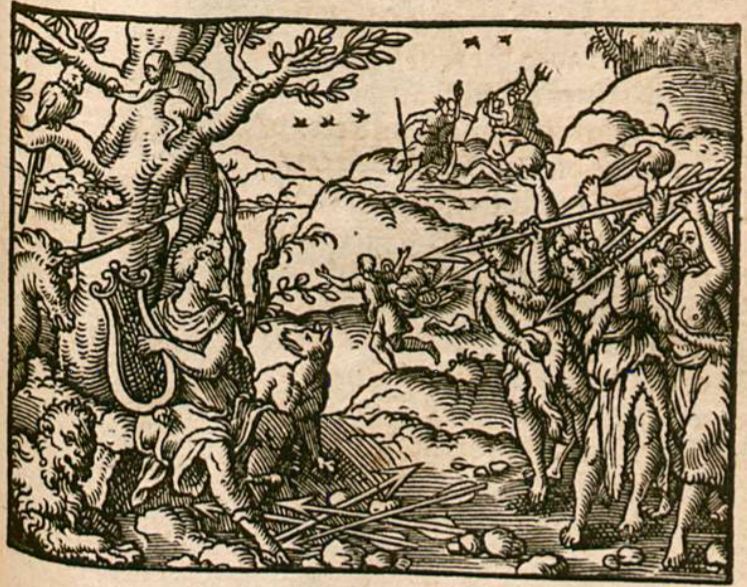
This engraving illustrates the horrific death of Orpheus. Orpheus is illustrated sitting by a tree on the left-hand side of the engraving playing his lyre whilst surrounded by the animals who listen to him. Orpheus is being approached by the Maenads (also known as the Bacchantes), a frenzied group of women who worship the god Bacchus. They first attack the animals that surround Orpheus and tear them to pieces. Then they attacked Orpheus by throwing stones and spears at him until he bled. Just like the animals, the Maenads end up tearing Orpheus to pieces.
Don Quixote calls Cardenio a liar and a villain. In response, Cardenio knocks him to the ground. Cardenio does the same to Sancho Panza when he attempts to defend Don Quixote. The illustration inaccurately depicts the goatherd as appearing to help them after the battle. In the text, Cardenio attacks the goatherd when he tries to defend Sancho. Signed by F. Hayman (illustrator) and S. F. Ravenet (engraver). Part 1, ch. 24.
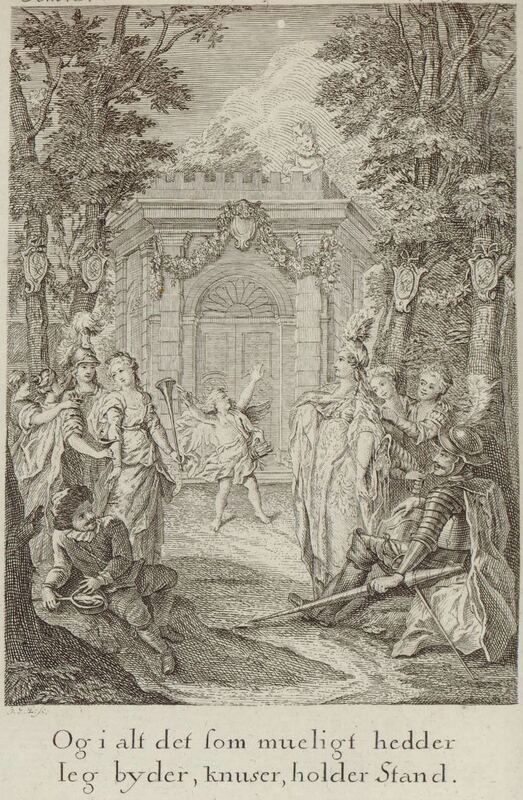
In the centre of the composition, the nymph Cupid dances before a wooden castle, while a maiden standing on the parapets watches. Cupid leads four nymphs (three pictured), Poetry, Discretion, Good Lineage, and Valor (left). To the right, the nymph Interest leads Liberality, Gifts, Treasure, and Peaceful Ownership. The first retinue refers to Basilio, the second to Camacho. Sancho Panza eats chicken and geese while Don Quixote observes the performance. Signed by J. G. Preisler (engraver). Part 2, ch. 20.
Having laid the mighty boar across a sumpter-mule, and covered it with branches of rosemary and myrtle, the hunters carry it, as the spoil of victory. A page on the left of the donkey holds two hunting dogs on a leash, followed on foot by many more hunters with spears and dogs by their feet on either side and behind the donkey. In the background, Don Quixote clad in full armor and equipped with a spear rides a horse to the left of the duchess and the duke, who are also mounted on steeds.
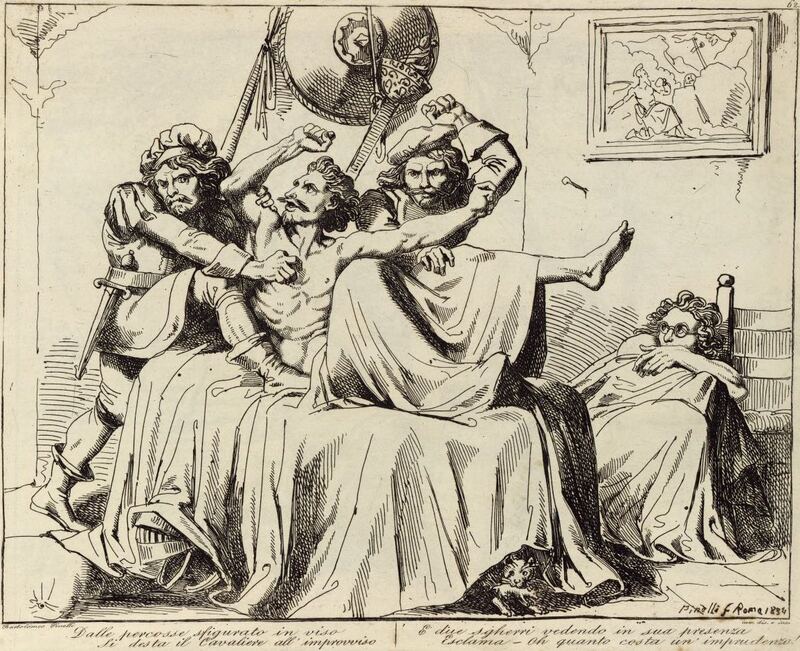
Two of the duke’s servants beat Don Quixote while Doña Rodriguez cowers behind the bed. The illustration is not accurate to the text: Cervantes writes that the duchess and Altisidora beat Don Quixote and Doña Rodriguez. Signed by Bartolomeo Pinelli (engraver and illustrator) and dated Rome, 1833. Plate 62. Part 2, ch. 48.
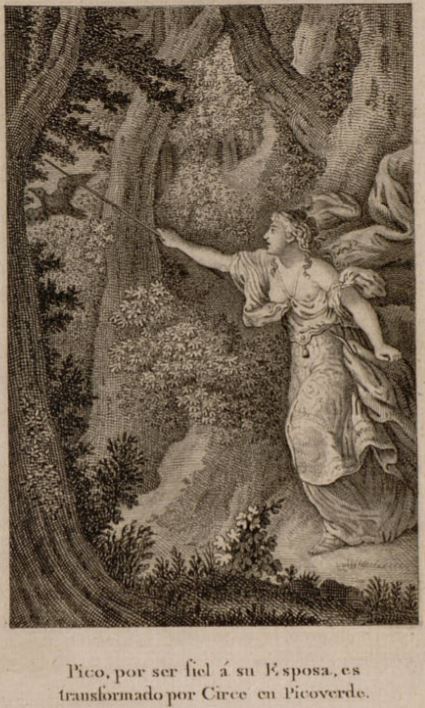
This image depicts the enchantress Circe transforming a man named Picus into a bird. Circe had seen Picus hunting one day and instantly fell in love with him. When she approached him and confessed her love, Picus admitted that he was fully devoted to his wife Canens and had eyes for no one else. Circe, in a jealous rage, transformed Picus into a woodpecker for rejecting her. Circe is depicted holding a magical wand in her right hand as she points it to Picus, who is depicted flying away in his new transformed state as a bird.
From his bed, Don Quixote dictates his last will to a notary. Also pictured are Sancho Panza (kneeling and weeping), the housekeeper, the priest, and the niece. Signed by A J.-J.-M. Devéria (illustrator) and A. J. Simonet, jeune (engraver). Part 2, ch. 74.
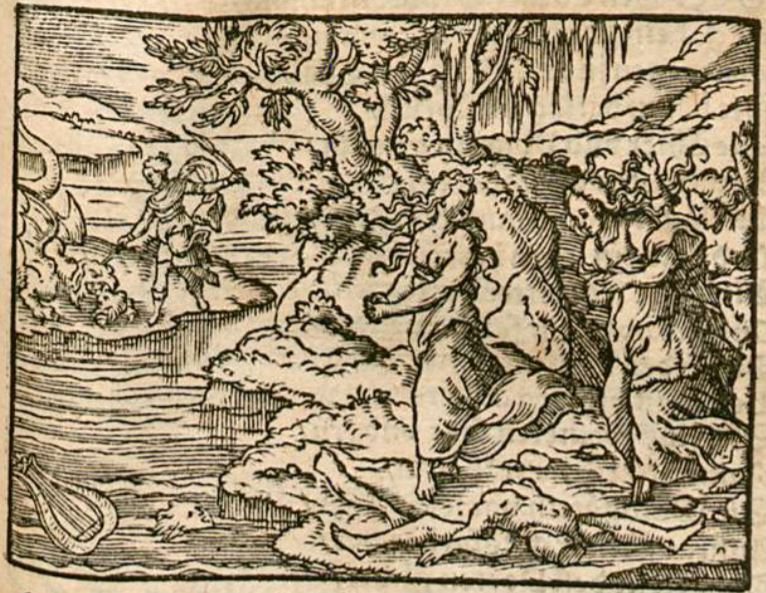
This engraving illustrates the moments that followed the death of Orpheus. The Maenads, who brutally murdered him, are illustrated throwing the head of Orpheus and his lyre into the river Hebrus. His body parts are depicted scattered across the ground near the Maenad as they had killed him by tearing him to pieces. Orpheus’ lyre continued playing down the river and his lifeless tongue continued singing. When his head and lyre appeared on the shores of Lesbos, a snake was nearby and tried to attack the severed head. Before the snake could attack, Phoebus appeared and turned the snake to stone. This is illustrated in the background of the engraving.
Sancho Panza fights Maritornes and the muleteer. The innkeeper enters the room, carrying a candle and a baton. In the background, Don Quixote lies on a bed, wounded by the muleteer. Signed by F. Hayman (illustrator) and J. S. Müller (engraver). Part 1, ch. 16.
Sancho Panza (left), places his left hand on his wife's back and extends his right arm softly before her in a peaceable manner. Teresa Panza (right) holds a cloth in her hand which she is using to wipe the tears from her eyes. On the left, Sancho Panza's wide-brimmed hat lies upside-down upon a cushioned stool. They are located in a room within Sancho's house. The reason for Teresa's tears is that Sancho informs her that he will be departing once more with Don Quixote to find himself a governorship.
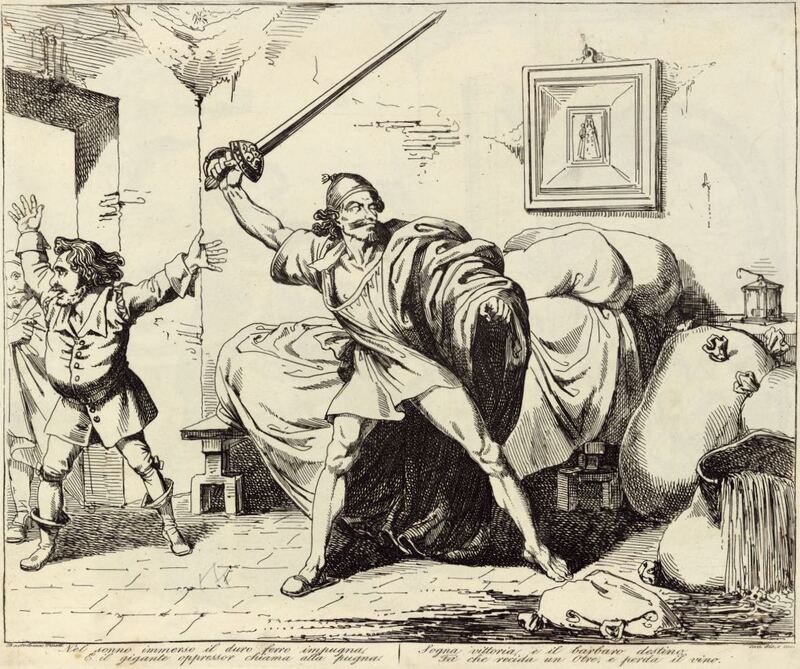
At the inn, Sancho Panza discovers Don Quixote attacks the wineskins while sleepwalking. He is half-dressed, wears a nightcap, has a blanket draped over his left arm, and wields his sword with his right arm (all details accurate to the text). The wine from a punctured wineskin spills onto the floor in the foreground. Signed by Bartolomeo Pinelli (engraver and illustrator) and dated Rome, 1833. Plate 31. Part 1, ch. 35.
Don Quixote attacks the wineskins while sleepwalking. He is half-dressed, wears a nightcap, has a blanket draped over his left arm, and wields his sword with his right arm. The innkeeper grabs him by the shoulder and clenches his fist, preparing to hit Don Quixote. The wine from a punctured wineskin spills onto the floor in the foreground. The barber, the priest, Sancho Panza, and Dorotea look on. Some are depicted with amused expressions on their faces. Signed by F. Hayman (illustrator) and C. Grignion I (engraver). Part 1, ch. 35.
Four men ride on donkeys, two countrymen (left) and two scholars (right). The countrymen appear, confused, older and more worn with small hats and sacks upon their backs. Meanwhile, the scholars dressed in long black robes and large wide hats confide in each other, the scholar in the background with two epee's underneath his arm. The image is occasioned by Don Quixote overtaking this company and desiring to travel with them.
During the night in Sierra Morena, Ginés de Pasamonte (background) makes away with Sancho Panza’s donkey. In the foreground, Sancho awakens and is astonished to find his saddle propped up with four branches. Signed by J.-J.-G. Haas (engraver). Part 1, ch. 23.
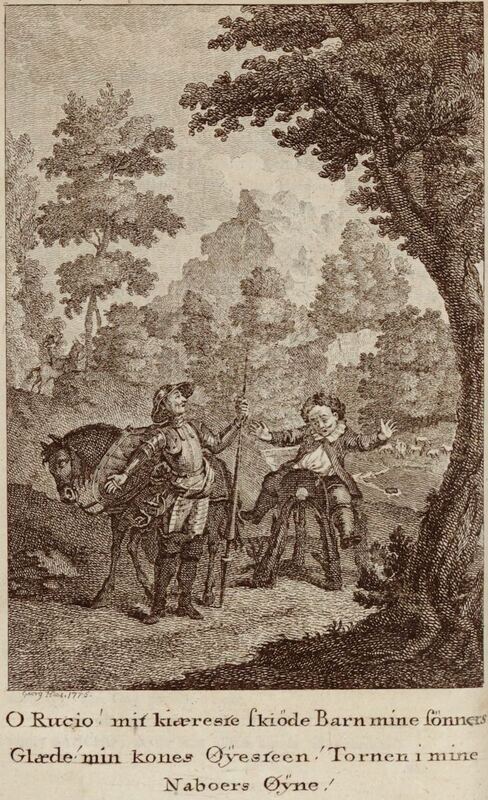
Having endeavoured to climb up into a tall oak, Sancho Panza fell from about half-way up the trunk, and, in tumbling down, he was caught in air by the stump of the branch. Finding himself stuck by this branch, the green coat he was wearing began to tear, and considering that, he began to cry out for help.
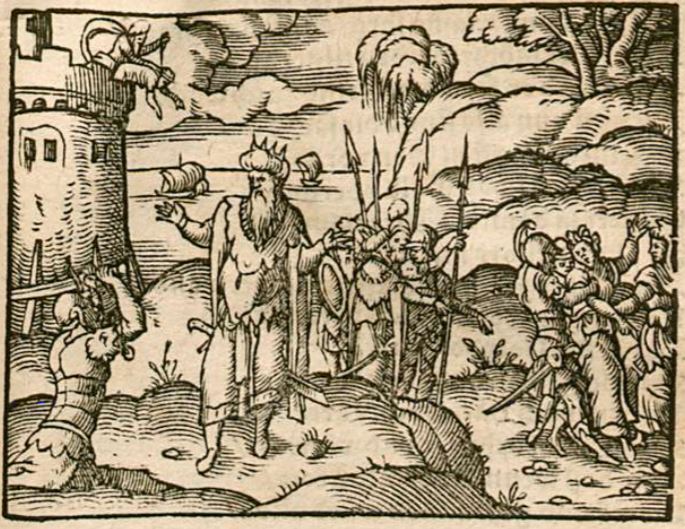
This engraving illustrates multiple events. In the background, Polymestor, the king of Phrygia, is illustrated atop a tower throwing someone off the edge. The person he is throwing off the edge is Polydorus, the son of King Priam of Troy. King Priam had sent Polydorus to live with Polymestor during the Trojan War to avoid being killed. King Priam’s mistake was to send treasure and wealth along with Polydorus. The king of Phrygia was greedy and killed his foster son in order to take the wealth that King Priam had sent with him. The foreground of the engraving illustrates King Agamemnon and his soldiers on a beach in Thrace. There is a ghost emerging from the ground thrusting his sword towards Agamemnon. It is the ghost of Achilles. Achilles attempts to attack Agamemnon for his injustice of not offering him a sacrifice after he died. King Agamemnon then takes Polyxena, a daughter of King Priam of Troy, as a sacrifice to Achilles. She is depicted on the right side of the engraving being detained by Greek soldiers.
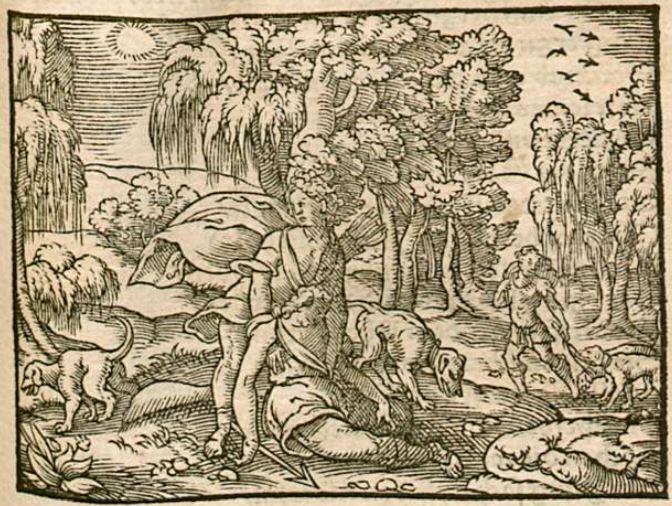
This engraving depicts the love story and tragedy of the god Apollo and his lover, Hyacinthus. The two would often engage in physical activities together, and one day they decided to have a disc throwing contest. Apollo threw the discus, which cut through the heavens and the skies. As it was falling back to Earth, Hyacinthus wanted to impress Apollo by catching it, but he got too close to it as it hit the ground. When the discus rebounded off the ground, it fatally hit Hyacinthus in the head. Apollo is illustrated holding his lover in his arms in the centre of the engraving. Apollo’s dogs are illustrated in the engraving as well. In order to be with Hyacinthus forever, he transforms him into the Hyacinth flower, which will bloom every year.
Sancho Panza embraces his donkey after recovering it (foreground). Don Quixote, Dorotea, and Cardenio are depicted mounted on their horses. Ginés de Pasamonte, an ungrateful galley slave that Don Quixote and Sancho Panza freed in ch. 22, flees the scene (background). Signed by Bonard (illustrator), no given name, and L. Cars (engraver). Part 1, ch. 30.
This image depicts multiple fables that appear throughout the twelfth book in Ovid’s Metamorphoses. On the very left side of the image, the magical Circe is depicted standing in front of a group of pigs. These pigs are the companions of Ulysses that she had just transformed. The centre of the image depicts the beautiful Scylla being transformed into a sea creature by Circe. Scylla has her arms in the air as a group of hounds emerge out of the lower half of her body and become a part of her. The right side of the image appears to be Circe speaking with the sea-God Glaucus. There are snakes all around the image as snakes would emerge from the ground when Circe used her magic.
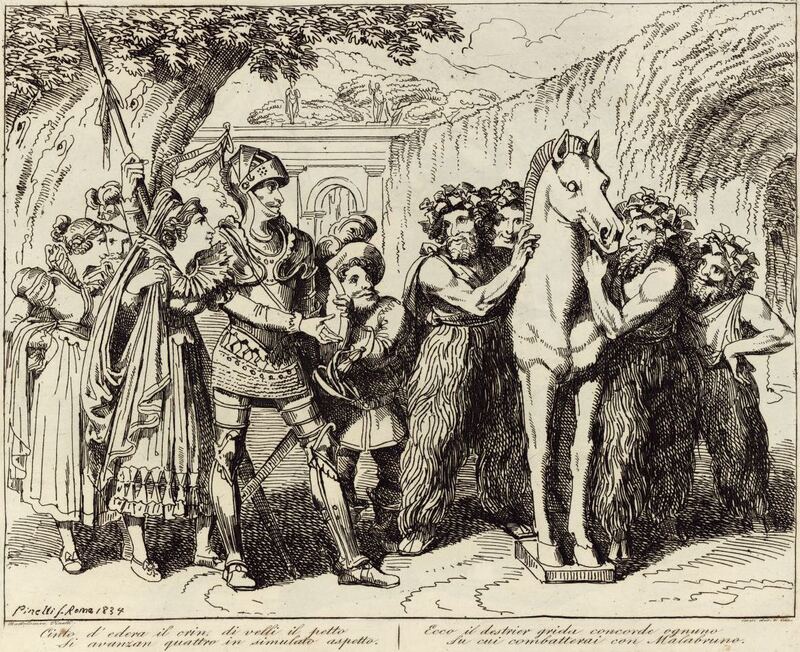
The wooden horse Clavileño arrives, carried by four men clad in green ivy. Don Quixote, Sancho Panza, countess Trifaldi, the duke, and the duchess are pictured. Signed by Bartolomeo Pinelli (engraver and illustrator) and dated Rome, 1833. Plate 55. Part 2, ch. 41.
Don Quixote and Sancho Panza ascend a little eminence and see their village once more. Upon seeing the village, Sancho kneels down and extends a hand towards the village's entrance, while in his other hand he holds the reigns of Dapple, who is dressed in expensive cloth and has a mitre adorned on its head. On the right, Quixote looks disappointedly upon his squire, while riding Rocinante.
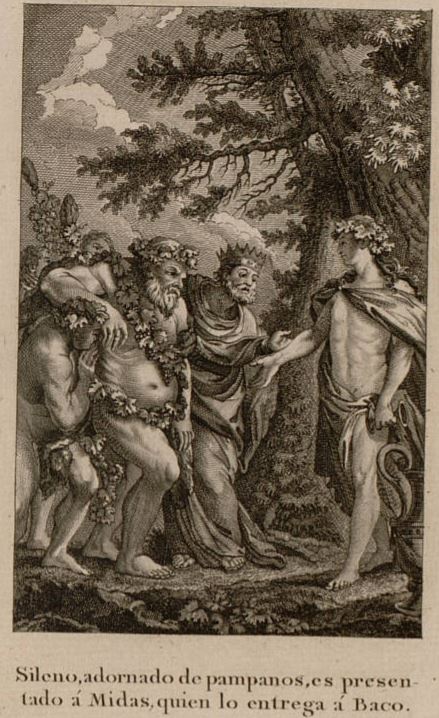
Silenus, one of Bacchus’ companions, had one day gone missing. He had found himself captured by Phrygian men while he was stumbling around in a drunken stupor, and they brought him to King Midas. King Midas recognized Silenus as they were once old friends who had learned Bacchic rites together. After enjoying each other’s company for eleven days and nights, King Midas returns Silenus to Bacchus. Midas is depicted wearing a crown in the image to demonstrate his status as a king. He is holding on to Silenus who is wearing a crown of flowers and branches which also is draped around his body. The god Bacchus is depicted on the right side of the image wearing a laurel wreath and holding a lyre in his left hand and holding his right hand out to take Silenus back.
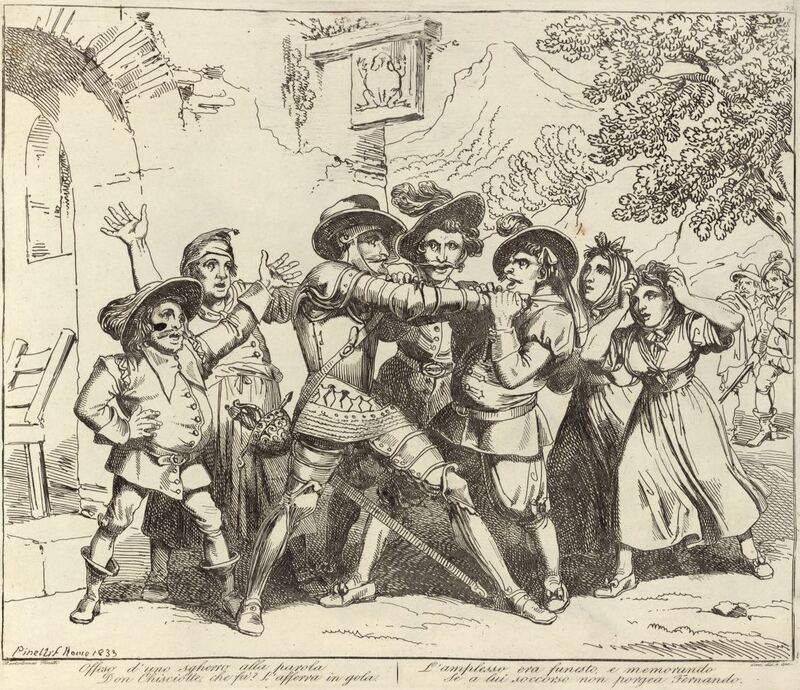
At the inn, a member of the Holy Brotherhood tries to arrest Don Quixote after reading his description. Don Quixote seizes him by the neck while Don Fernando and Sancho Panza rush to stop him. Also pictured are the innkeeper, his wife, and his daughter. Signed by Bartolomeo Pinelli (engraver and illustrator) and dated Rome, 1833. Plate 33. Part 1, ch. 45.

![[Of How the Innkeeper Gave Wine to Quixote Through a Reed]](https://collections.cemvc.ca/files/large/198cc924377d1de9c9e7ff2fbd8d02a336a8a3c7.jpg)
![[Don Quixote Falls to his Knees Having Destroyed the Wineskins]](https://collections.cemvc.ca/files/large/093dcbbad945f62677471471a8fe6f990e3f8a5d.jpg)
![[Cardenio attacks Don Quixote and Sancho Panza]](https://collections.cemvc.ca/files/large/83098cb7af55f0597835be4cae35709278dbc669.jpg)
![[The Hunted Boar of the Duke and Duchess is Carried to a Banquet]](https://collections.cemvc.ca/files/large/f30ed7578c9e44811e0f68c8587f88ab156fa093.jpg)
![[Don Quixote makes his will]](https://collections.cemvc.ca/files/large/6e9b7e2ee2af306558911367c5940116e4813929.jpg)
![[Scuffle between Sancho Panza, Maritornes, and the muleteer]](https://collections.cemvc.ca/files/large/87235b620c71d66a368af0f72a939e977b29d32a.jpg)
![[Sancho Panza Attempts to Comfort Teresa]](https://collections.cemvc.ca/files/large/fcd23f1b154d3fe3359806000f10af971b45310c.jpg)
![[Don Quixote attacks the wineskins]](https://collections.cemvc.ca/files/large/0f72535ee3d32349714146007131e6b7901f6ddc.jpg)
![[The Scholars and Countrymen Fall into Wonder at the Sight of Quixote]](https://collections.cemvc.ca/files/large/5eadbdca4460a19f463af28cbd93fde8c5cf6668.jpg)
![[Sancho Panza Hangs From the Branch of a Tree]](https://collections.cemvc.ca/files/large/17e7c4b29ef276c10e3dffdea95782ac161ce7e9.jpg)
![[Recovery of Sancho Panza's donkey]](https://collections.cemvc.ca/files/large/54e1b06df7b22bee671a724046a056b58963d0d3.jpg)
![[Fables from the Twelfth Book]](https://collections.cemvc.ca/files/large/d2fa2d73de59500e0d0ddd0463f269f19249b5e9.jpg)
![[Of How Don Quixote and Sancho Panza arrived at their Village]](https://collections.cemvc.ca/files/large/aa056d01c48c9ffe13b6f2bbe55c18410ebace64.jpg)