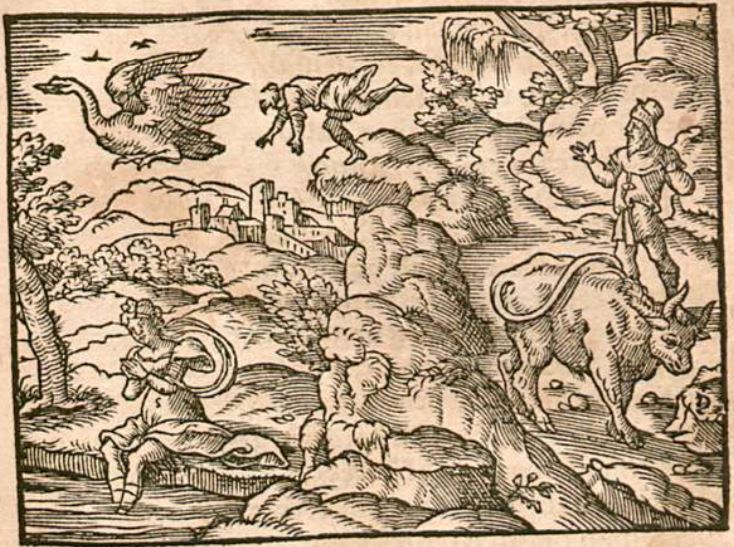
This engraving represents the story of Cycnus, his mother Hyrie, and his companion Phylius. Cycnus had given his companion Phylius tasks to overcome, one of them requiring him to tame a bull. Phylius and the bull are illustrated on the right side of the image. Phylius had completed the task, but he refused to hand the bull over due to Cycnus’ arrogance towards him. When Phylius refuses to hand over the bull, Cycnus attempts suicide by jumping from a cliff, as illustrated at the top of the engraving. No harm, however, befalls Cycnus as he transforms into a swan and flies away. His mother, Hyrie, does not know that Cycnus survived the fall, and her tears from weeping turn her into a lake. Hyrie is illustrated in the bottom left corner sitting by the water.
Don Quixote, clad in full armor, talks to his squire Sancho Panza, who is distracted by the lady Dulcinea Del Toboso who he now believed was really enchanted. Sancho's belief in Dulcinea's enchantment is portrayed in this illustration by her long white flowing apparel, divine posture and the clothed chariot she appears to be riding. Furthermore, proof of Sancho's diluusion is provided by the three cherubs which accompany Dulcinea.
A woman with long hair (right), dressed in a bodice and frock with a cap upon her head leans over a table and looks down upon a letter, her right hand motioning for something specific to be written. On the left, a man is seated in the habit of a friar with his hair ordered in a circle round his head, in his right hand he holds a quill which he uses to write upon a piece of paper. On the bottom right in the foreground beside a table leg lies a basket filled with bread and eggs.
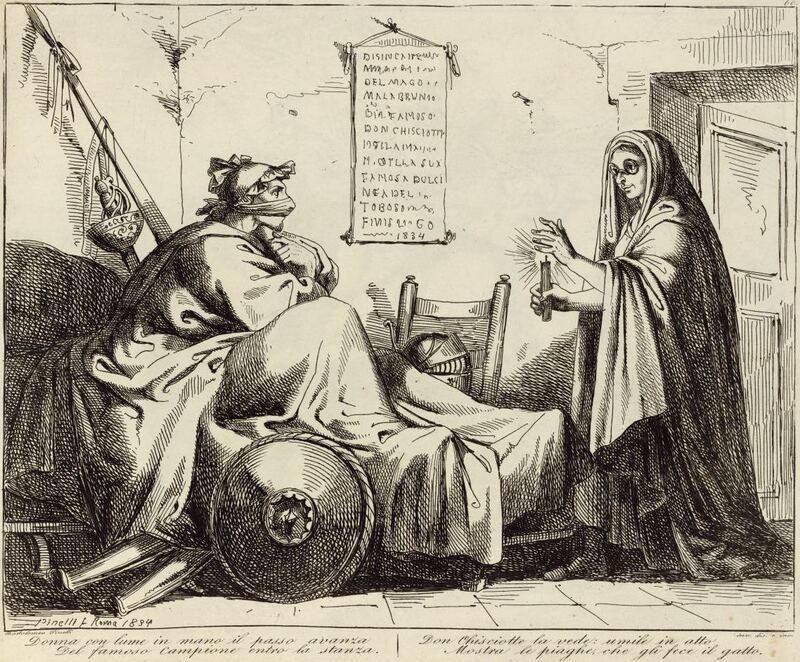
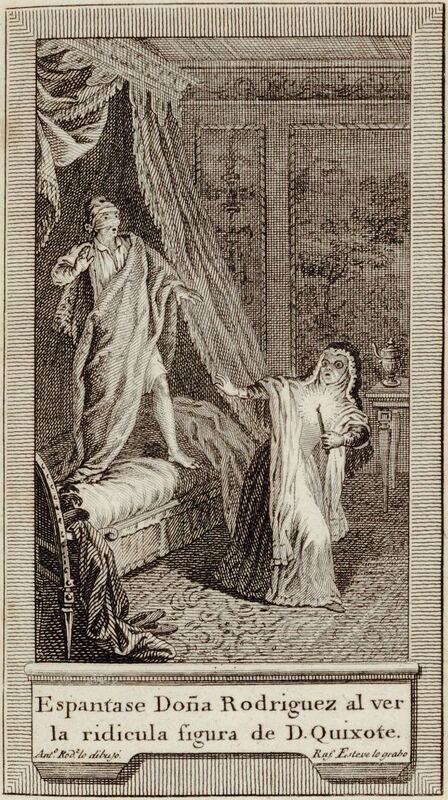
Don Quixote, his face bandaged and marked by the cat’s claws, lies sleepless in bed. Doña Rodríguez, duenna to the duchess, visits him in his room. She holds a candle and wears spectacles. Signed by Bartolomeo Pinelli (engraver and illustrator) and dated Rome, 1833. Plate 60. Part 2, ch. 48.
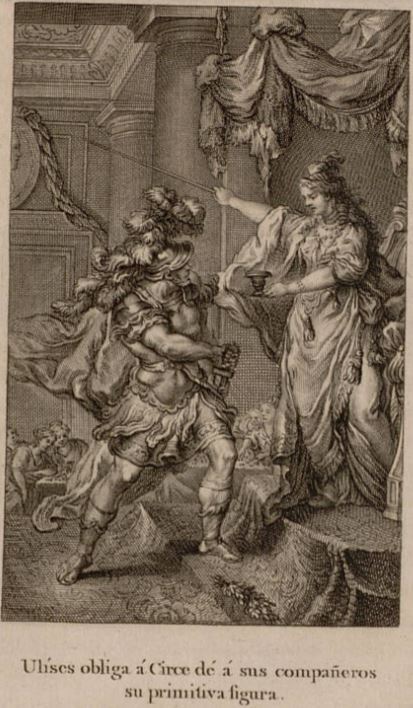
This image depicts the Greek warrior Ulysses unsheathing his sword to threaten the enchantress Circe. Circe had transformed the companions of Ulysses into animals for landing on her island of Aeaea. One of the companions escaped the transformation and was able to go to Ulysses to tell him what had happened. In this image, Circe is holding a cup in her left hand which she is offering to Ulysses. This cup contains a drink that will make Ulysses also transform into an animal. She is holding her magical want in her right hand. Ulysses rejected the cup and used his sword to threaten her. He ends up offering himself as her lover in exchange for the release of his companions from their transformed states.
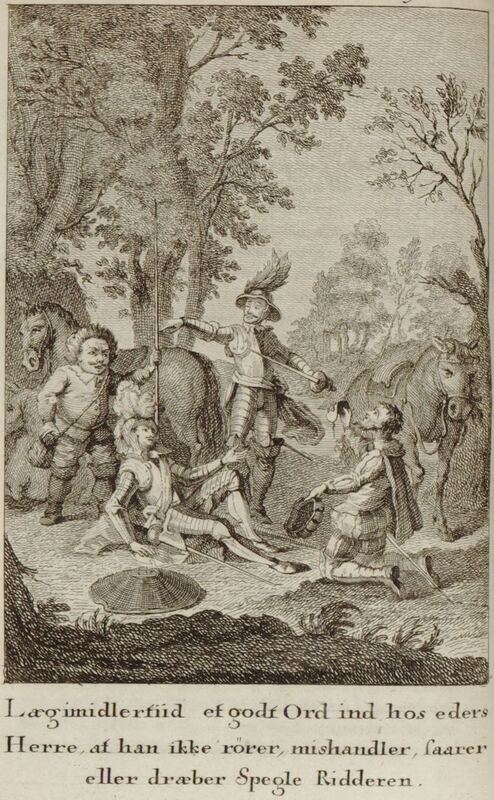
In the aftermath of their battle, Don Quixote, with a gesture of clemency, orders the Knight of the Mirrors (Sansón Carrasco) to present himself to Dulcinea in El Toboso on his behalf. Sansón’s squire, Tomé Cecial (left) takes off his fake big nose, revealing himself to Don Quixote and Sancho Panza. Unsigned. Part 2, ch. 14.
In the streets of Barataria a large group of people have gathered to suffer Sancho's departure and see him off. On the left, Doctor Pedro Recio, wearing black robes and a wool cap crosses his arms and looks at Sancho. In the middle, Sancho Panza, bearded and dressed in a buttoned shirt with a cap, sits upon his donkey Dapple and motions to embrace a bearded man who approaches him. On the right, a line of people are waiting to embrace Sancho and say their farewells. In the background on the left, two women watch the departure from a window.
Doña Rodríguez, wearing a pair of spectacles and holding a candle, visits Don Quixote in his room at night. She discovers him standing on his bed, wrapped in his blanket, his face bandaged and marked by the cat’s claws. They scare each other, each believing that the other is a ghost. Signed by A. Rodríguez (illustrator) and R. Vilella (engraver). Part 2, ch. 48.
Don Quixote and Sancho Panza arrive at the wedding between Camacho and Quiteria. The first thing that presented itself to Sancho's sight, was a large group of 50 chefs and their cooking accoutrements. Sancho beheld this sight with wonder and delight, being first captivated by the many pots of meat, and being unable to abstain any loger, ventured toward one of the busy cooks. In persuasive and hungry terms, Sancho begged for a luncheon of bread in one of the pots. So saying, the cook laid hold of a kettle, he fished outthree pullets, and a couple of geese, and gave the pot to Sancho to partake in. Sancho dismounts from his donkey, dapple, and happily takes the pot. Don Quixote, clad in armor and mounted upon Rocinante, watches his squire satiate his hunger in disappointment. Two more cooks are pictured in the background talking to each other.
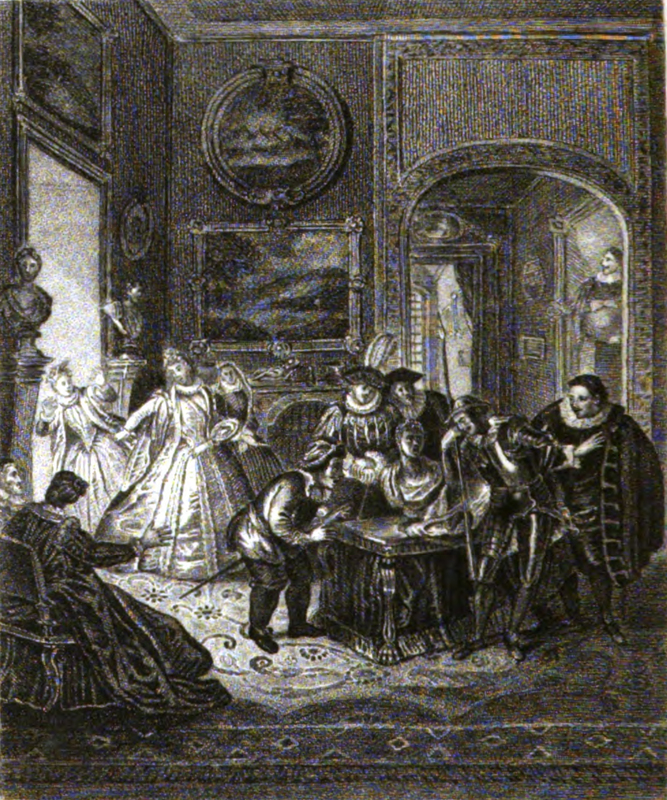
In Don Antonio's home, Don Quixote, Sancho Panza, Don Antonio's wife, two of her friends, two of Don Antonio's friends were led by Don Antonio into a sparsely decorated room with a lone table and a roman styled bust upon the table. Don Antonio talks to the head and it talks back, having been elaborately installed so a person talking from the room above may project their voice to come from within the voice through copper tubing. The head stands upon a table and frame, the legs of which resemble four eagle claws, carved from wood and varnished to look like jasper. The head, which looked like the bust of a roman emperor was of a brass color and hollow on the inside. Quixote, clad in full armor pictured to the right of the bust asks about Dulcinea de Toboso and Sancho Panza, pictured to the left of the bust whispering into its ear asks the head about whether he will ever come to govern his own house once more.
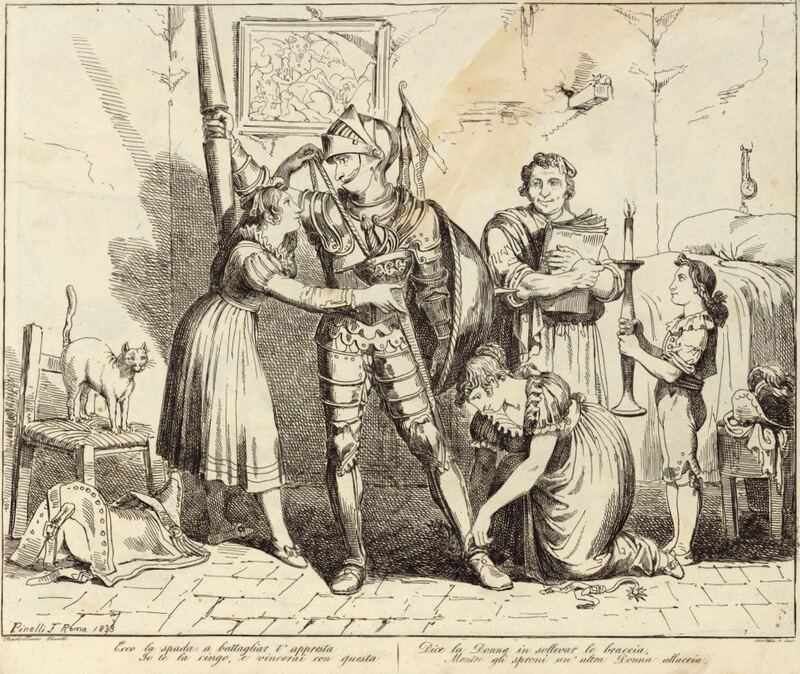
Doña Molinera and Doña Tolosa fit Don Quixote’s sword and spurs. The innkeeper, having just knighted Don Quixote, holds a book to his chest. To the right, a boy holds a candle. Don Quixote’s figure seems disproportionate relative to the other characters. Signed by Bartolomeo Pinelli (engraver and illustrator) and dated Rome, 1833. Plate 6. Part 1, ch. 3.
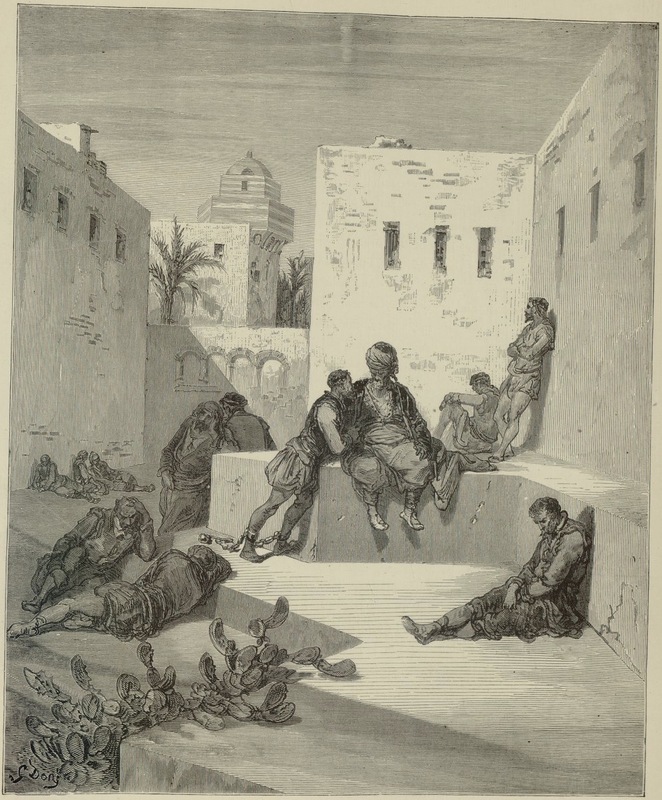
The illustration represents part of the captive’s tale: the captive asks a renegade, a native from Murcia, to translate Zoraida’s letter. He unfolds it and spends a long time looking at it, murmuring to himself. Finally, he asks for ink and a pen so that he can translate it word for word. Signed by G. Doré (illustrator) and H.-J. Pisan (engraver). Part 1, ch. 40.
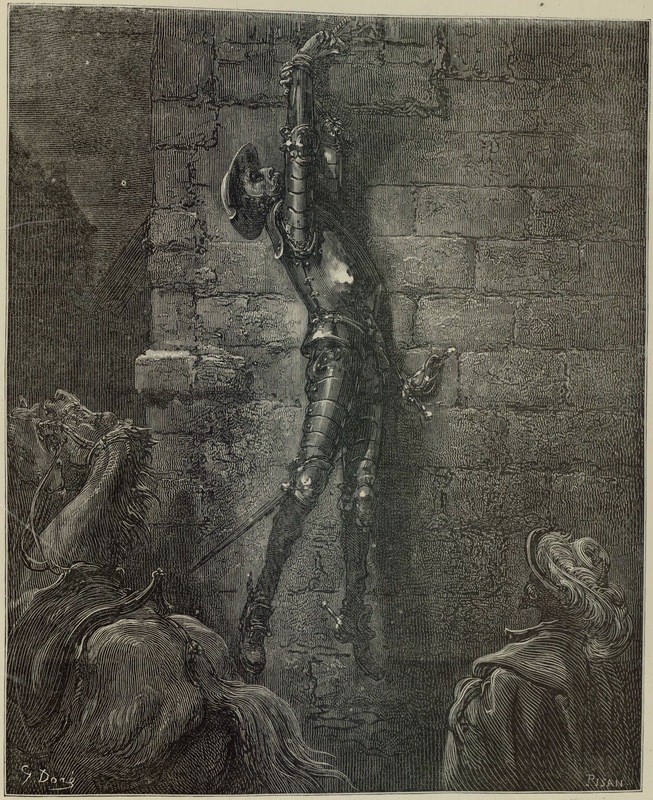
As four travellers (only one represented) arrive to the inn, Rocinante moves toward one of the mares, leaving Don Quixote hanging from the window by his hand. Signed by G. Doré (illustrator) and H.-J. Pisan (engraver). Part 1, ch. 43.
As four travellers (not pictured) arrive to the inn, Rocinante moves toward one of the mares, leaving Don Quixote hanging from the window by his hand. Hearing the knight’s cries for help, the innkeeper, his daughter, and Maritornes appear at the entrance of the inn. Signed by J. Rivelles (illustrator) and T. L. Enguídanos (engraver). Part 1, ch. 43.
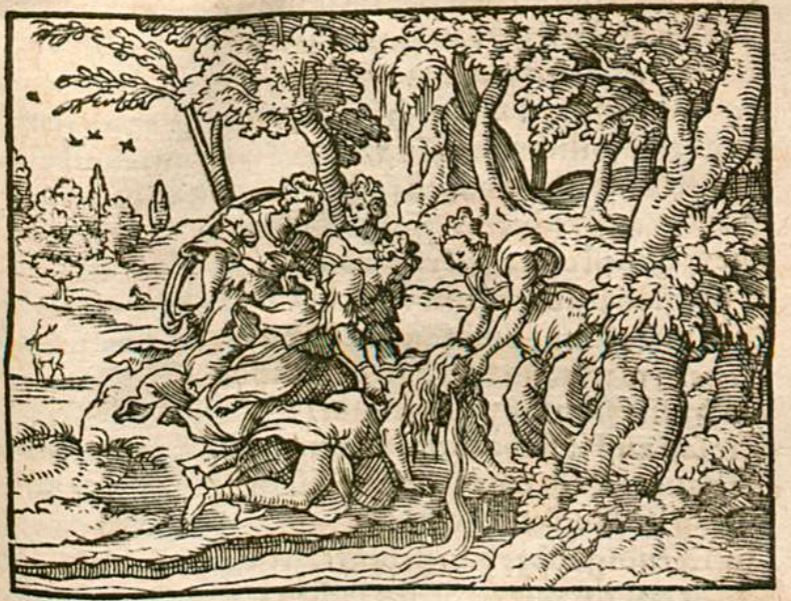
After Byblis confessed her incestuous love for her twin brother Caunus, he fled the country to escape her approaches. She became so upset by his rejection that she traveled distant lands looking for him. As illustrated in the engraving, there were Lelegeian nymphs who had attempted to comfort Byblis and heal her broken heart. Overcome by grief, there was no end to Byblis’ tears. Her tears were so plentiful that they created a spring. The nymphs ended up transforming Byblis into a fountain to keep the spring flowing, and to help heal the broken-hearted Byblis.
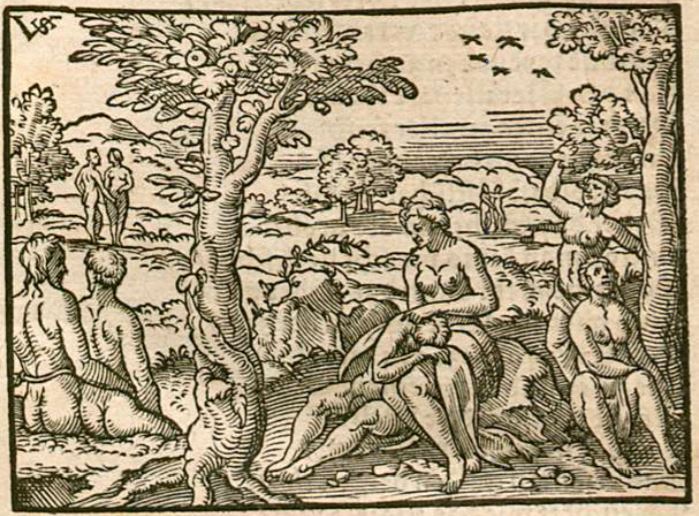
This image illustrates the Golden Age of the world, where there was no coercion, dangers, fears or laws. This illustration depicts pure tranquility and peace among humans, animals, and nature. The people in the image are depicted being harmonious with each other, as well as with the nature that surrounds them, including the animals and the trees. There are fruit trees depicted in the image to illustrate that agriculture was not needed to be done by humans, as the Earth cultivated the food that was necessary for all beings.
In the estate of the duchess, Don Quixote (right) clad in a doublet with travelling boots and a scarlet mantle with a sword by his waist puts his right arm on his chest to introduce himself to Altisidora, who, upon spying Don Quixote, pretends to faint away, into her companion's arms.
At the marriage of Basilio and Quiteria, the former pretends to stab himself (centre of the composition). Don Quixote, Sancho Panza, Camacho, and the other wedding guests observe them. Signed by D.-N. Chodowiecki (illustrator) and D. Berger (engraver), dated 1779. Plate 11. Part 2, ch. 21.
After Sancho Panza’s departure for Barataria Island, Don Quixote retires to his room in the palace. He has trouble sleeping and opens a jalousied window overlooking a beautiful garden. He hears Altisidora and Emerencia talking below. Emerencia hears his window open and urges Altisidora to play the harp and sing her song for the knight. Signed by J. Rivelles (illustrator) and A. Blanco y Asensio (engraver). Part 2, ch. 44.
On the right, a knight clad in full armor grasps a lance with both hands, his visor is up revealing revealing his open mouth and wrathful visage. He is piercing the abdomen of a lizard-like dragon about the size of a large horse with large wings and a skulking tail, the dragon's frightening face and bulging eyes directed towards the night in anguish and fury. The image is occasioned by Don Quixote taking the road to Saragossa from the duchess' castle and thinking himself in his proper element, prosecute afresh his scheme of knight errantry.
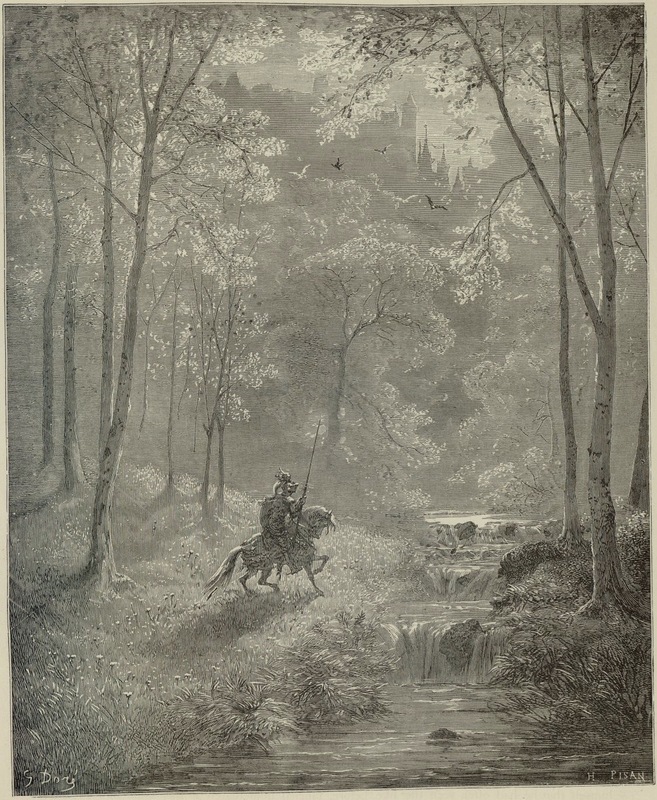
The illustration represents part of the tale of the Knight of the Lake, as told by Don Quixote to the canon of Toledo in defense of chivalric novels: after throwing himself into the boiling lake, the Knight finds himself among flowering meadows, in a peaceful grove of leafy green trees. He discovers a brook whose cool waters, like liquid crystal, run over fine sand and white pebbles that seem like sifted gold and perfect pearls. Suddenly, an elegant fortress appears before him (background). Its walls are made of solid gold, its parapets of diamonds, and its doors of sapphires. Signed by G. Doré (illustrator) and H.-J. Pisan (engraver). Part 1, ch. 50.
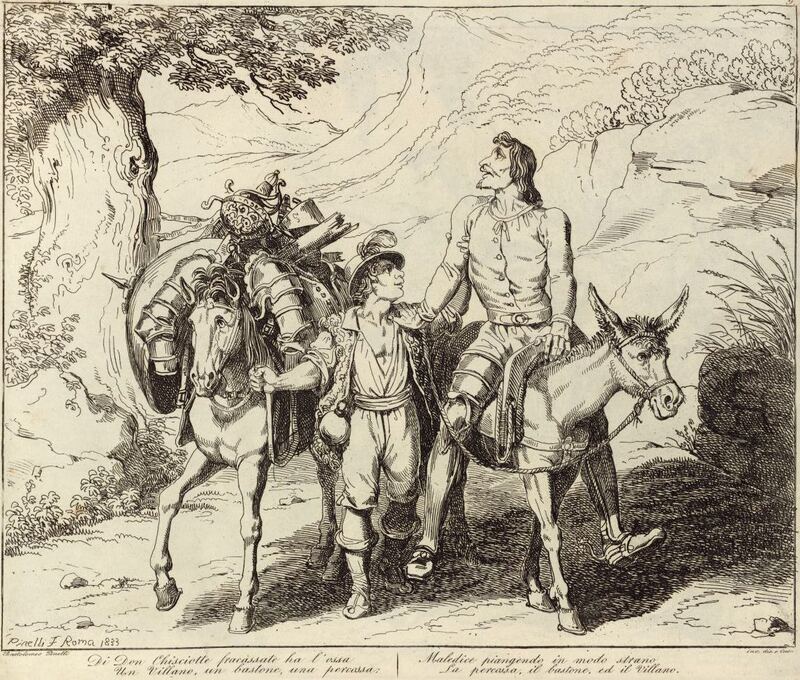
A local farmer, Pedro Alonso, rescues Don Quixote after his encounter with the silk merchants of Toledo and takes him home on his mule. Rocinante carries Don Quixote’s armour and broken lance. Signed by Bartolomeo Pinelli (engraver and illustrator) and dated Rome, 1833. Plate 9. Part 1, ch. 5.
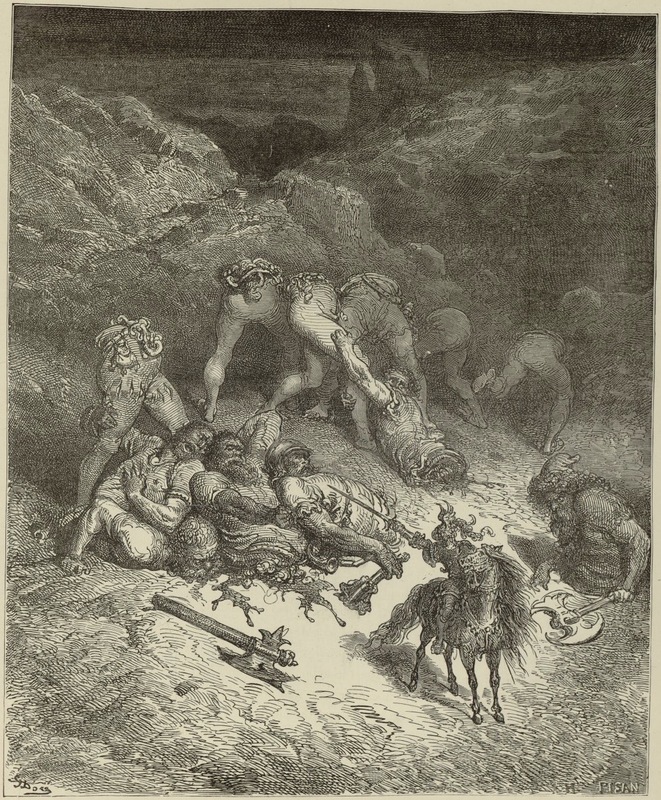
The illustration represents the story of Felixmarte of Hyrcania as told by the innkeeper to the priest while discussing chivalric novels. The innkeeper urges the priest to read about the feats of Felixmarte, who, with one reverse stroke, split five giants down to the waist like the dolls children make out of beans. Signed by G. Doré (illustrator) and H.-J. Pisan (engraver). Part 1, ch. 32.
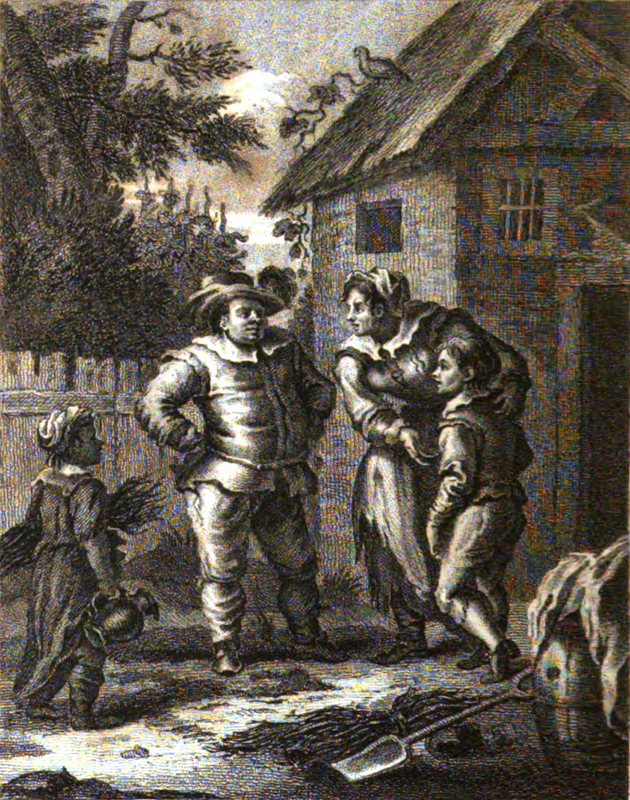
Sancho Panza returns to the village, whose arrival reaches the ears of Teresa Panza, Sancho's wife, and who is disappointed by the riches he has brought back with him, for she was told he was going to be a governor. Hands on his hips, Sancho Panza listens to his wife explain how they needed money to send their son Sanchico (pictured walking towards Sancho on the right) to school, and also for the dowry of their daughter Sanchica (pictured holding sticks in her left arm and an urn in her right.
Sancho Panza, holding a bundle of broom stalks and mounted on Rocinante, leaves for El Toboso. Don Quixote remains in Sierra Morena and is pictured performing a somersault as penance. Don Quixote’s armour hangs on a nearby tree. Unsigned. Part 1, ch. 25.

![[Of the Method Prescribed For Disenchanting the Peerless Dulcinea Del Toboso]](https://collections.cemvc.ca/files/large/cd8d4090ddd2e0943137a16cacc645135c7c3bd7.jpg)
![[Teresa Panza Gives a Basket of Eggs to a Friar in Exchange for Writing a Letter]](https://collections.cemvc.ca/files/large/e4ab2a1dbefe6d751179215ea6b273a3b27203ae.jpg)
![[Sancho Panza Departs From Barataria]](https://collections.cemvc.ca/files/large/d527b709f66aa73dd66e32c3cf421c7a20ead03d.jpg)
![[Of How Sancho Asked for Food at Camacho's Wedding]](https://collections.cemvc.ca/files/large/a13a09e7b3956bbeb1b18f9a55f12f8f89deed51.jpg)
![[Don Quixote hangs by his hand]](https://collections.cemvc.ca/files/large/379109015e3881a6445499a12ae9bb4eb62686c6.jpg)
![[Altisidora Pretends to Feint Away Before Don Quixote]](https://collections.cemvc.ca/files/large/bb11913edbb0553ea5156388fbf01b7a3a4e4c02.jpg)
![[Marriage of Basilio and Quiteria]](https://collections.cemvc.ca/files/large/0128157c027236a2ca1b159a1951bf5a4e800139.jpg)
![[Altisidora's love song for Don Quixote]](https://collections.cemvc.ca/files/large/11f23fc965a892df354a1151c48e03ead06d51d3.jpg)
![[A Knight Slays a Dragon]](https://collections.cemvc.ca/files/large/34e6e11134887d83f5b5aae8ecf6b57137158881.jpg)
![[Don Quixote's penance in Sierra Morena]](https://collections.cemvc.ca/files/large/61b0045640e22ab8e8e4e7394e2dbaa3a95868f4.jpg)