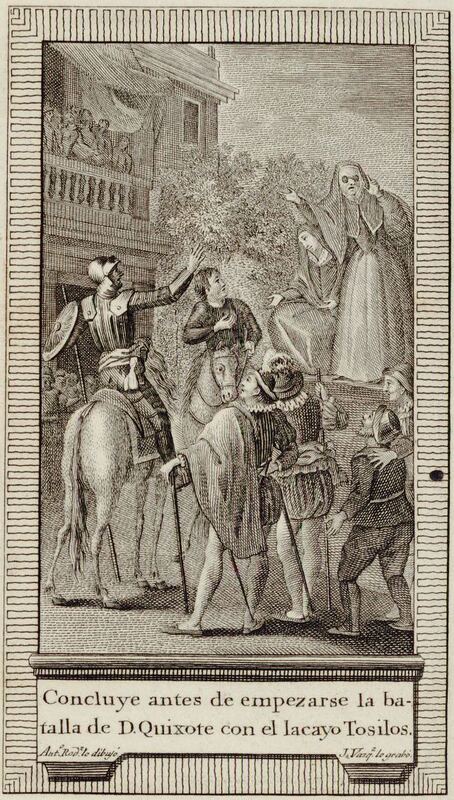
When Tosilos removes his helmet and reveals his face, Doña Rodríguez and her daughter cry out. They protest that Tosilos, a footman to the duke, is not her true husband—the man who agreed to marry her. Don Quixote insists that enchanters have transformed the face of her husband into that of Tosilos, and advises her to marry him. In the background, the duke and duchess are pictured observing the scene from a balcony. Signed by A. Rodríguez (illustrator) and B. Vázquez (engraver). Part 2, ch. 56.
In a field, a plot of grapes has been planted on a stick, from which grow wide leaves and full grapes. A shovel leans against these planting sticks on the left. On the right a sickle lies upon the ground and in the middle in front of the grape vine lies a hoe. In the background there is a wooden fence. The image is occasioned by Sancho Panza leaving Barataria, which had fertile vineyards.
Amidst a field of wheat a herdsman grabs the waist of a barefooted woman who resists the advance by planting her hands in the man's face. In the foreground lies a bundle of wheat and a sickle.
Andrés encounters the party having lunch near the road. After Don Quixote introduces him and recounts his story, Andrés reveals that after the knight had left, Juan Haldudo had continued to whip him. He blames the knight for the extra lashes he received and curses him, running away before Don Quixote can punish him. Signed by J. Rivelles (illustrator) and T. L. Enguídanos (engraver). Part 1, ch. 31.
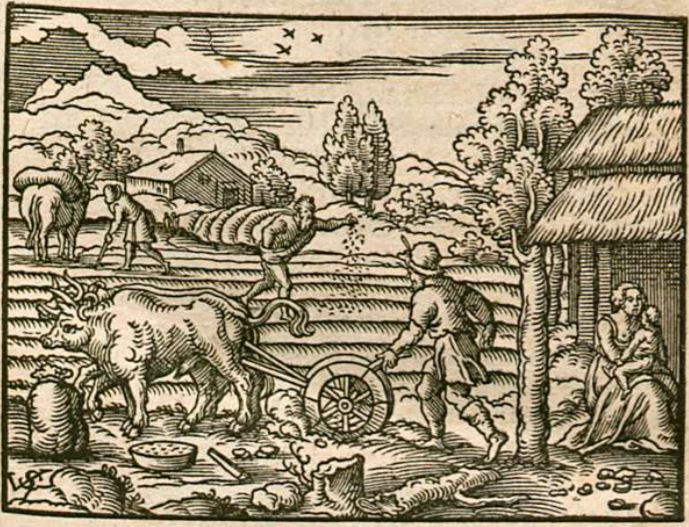
This image depicts the Silver Age, which Ovid describes to be inferior to the Golden Age, yet superior to the Bronze Age. The Silver Age consists of humans beginning to create houses for shelter rather than living in caves. This is illustrated on the right side of the image, as well as in the background where small houses are depicted with roofs made of straw and wood. The Silver Age also consists of the cultivation of corn. This is shown in the image by a man standing in the crop field sprinkling seeds into the ground. Cattle and animals are also being used in the Silver Age for labor, as depicted in the image.
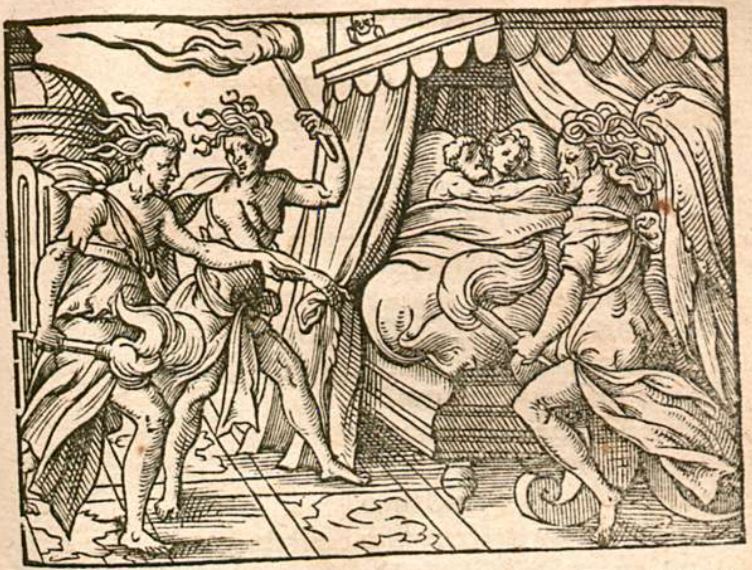
This image illustrates Tereus, a prince of Thrace, joined with his new wife Procne in their marriage bed. They are surrounded by guests who attended their wedding, including the Furies, who are depicted holding torches. There is a screech-owl that is illustrated over their marriage bed to signify that they will become parents.
Don Quixote, armed with his lance and buckler, prepares to charge the braying mayors squadron while Sancho Panza falls from his donkey. Unsigned. Part 2, ch. 27.
During master Peter's puppet show, Melisandra's puppet, clad in Algerian garb lets herself down from the balcony, to get on horseback and escape the tower, but the skirt ofher petticoat catches hold on one of the iron rails of the balcony. There the puppet hangs dangling in the air, arms and legs extended stiffly,
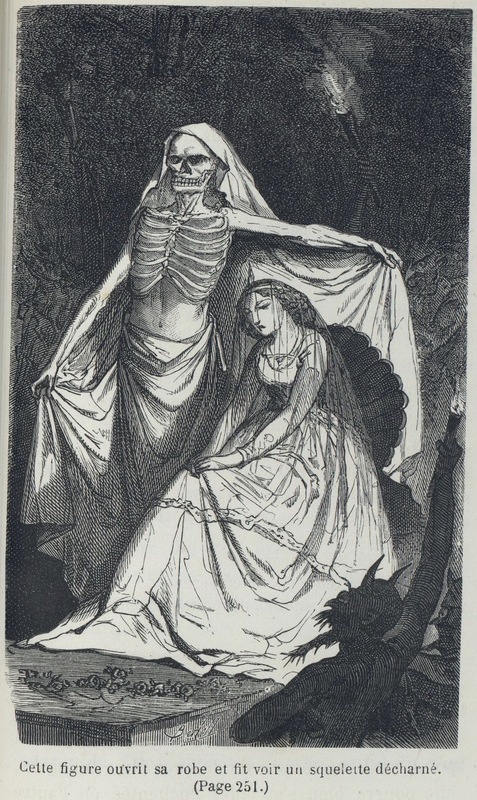
Merlin, as Death, with the enchanted Dulcinea. The illustration is more accurate to the caption than it is to Cervantes’ text: Merlin is depicted as Death although he is in fact a servant in disguise; Dulcinea is depicted as a maiden although she is a servant in disguise. Signed by A. ‘Bertall’ d’Arnoux (illustrator). Part 2, ch. 35.
Don Quixote and Sancho Panza encounter a cart carrying the actors of Angulo el Malo’s company for the mystery play ‘The Assembly of Death.’ The latter are dressed as Devil, Cupid, Death, Angel, Emperor, Queen, and Soldier. Rocinante is alarmed by the sound of bells and runs across the field. While Sancho runs to Don Quixote’s assistance (background), a member of the company makes off with his donkey. Signed by D.-N. Chodowiecki (illustrator) and D. Berger (engraver), dated 1779. Plate 9. Part 2, ch. 11.
Don Quixote dines at the inn with the innkeeper, Doña Molinera, and Doña Tolosa. They are seated at a table at the door of the inn to take advantage of the cooler air. The innkeeper helps Don Quixote drink wine with a hollow reed through his helmet. A swineherd arrives at the inn and plays his reed pipe. The knight mistakes this sound for music played for his entertainment. The details of the illustration are remarkable: the shadows cast by the light of the lamp (left), the dog, and the architecture. Signed by J. Rivelles (illustrator) and T. L. Enguídanos (engraver). Part 1, ch. 2.
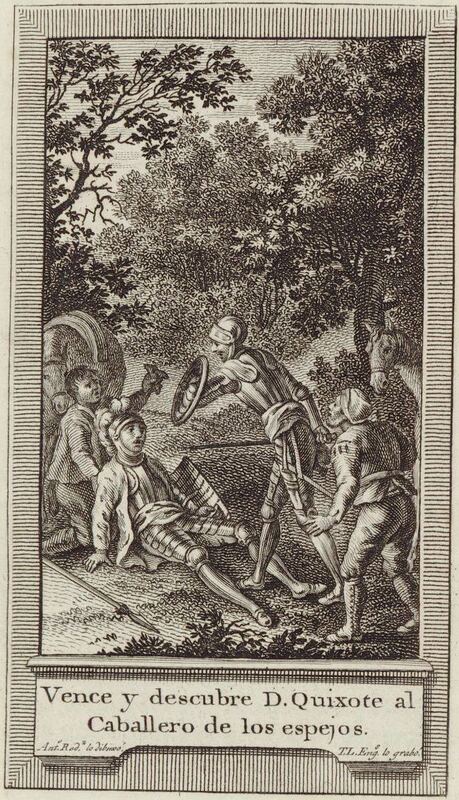
In the aftermath of their duel, Don Quixote, with a gesture of clemency, orders the Knight of the Mirrors (Sansón Carrasco in disguise) to present himself to Dulcinea in El Toboso on his behalf. Sansón’s squire, Tomé Cecial, takes off his fake big nose, revealing himself to Don Quixote and Sancho Panza. Signed by A. Rodríguez (illustrator) and T. Enguídanos (engraver). Part 2, ch. 14.
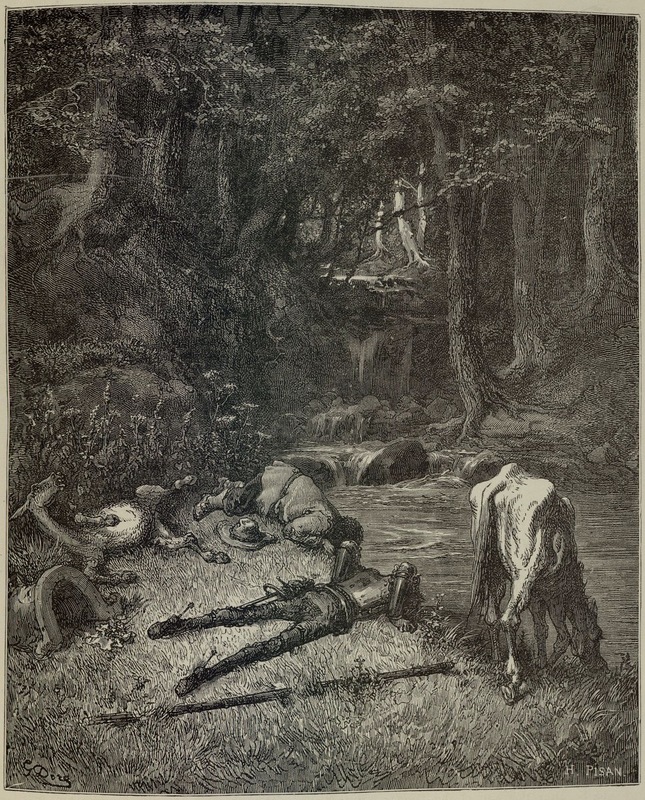
Having ridden in the forest for a few hours looking for the shepherdess Marcela, Don Quixote and Sancho Panza stop in a meadow where a cool, gentle stream runs. They spend the hottest hours of the day there, while Rocinante grazes nearby. Signed by G. Doré (illustrator) and H.-J. Pisan (engraver). Part 1, ch. 15.
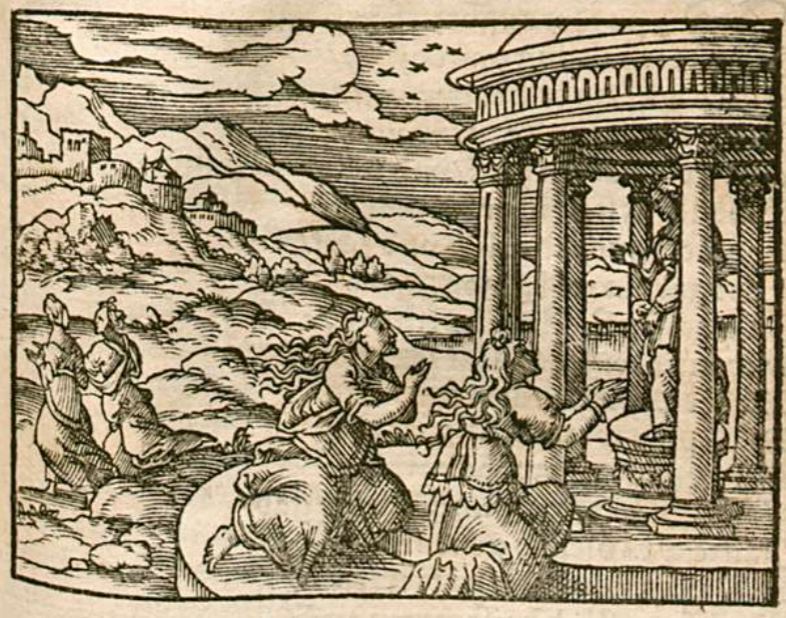
This engraving illustrates Telethusa and her daughter, Iphis, kneeling on the steps of an altar, praying to the Egyptian deity, Isis. Before Iphis was born, her father vowed to kill the child if she were to be born a girl. Isis had appeared to Telethusa in a dream and told her to keep the child no matter what. With the help of Isis, Iphis was disguised as a boy after being born to evade death. This engraving takes place when Iphis is set to marry a woman who is unaware that Iphis is a female. Telethusa and her daughter are praying to the goddess Isis once again for her help. Isis answers the prayers of the mother and daughter and she transforms Iphis into a man, so that she may marry her betrothed.
Don Quixote, wearing Mambrino’s helmet (the barber’s basin), shouts in an attempt stop the fighting depicted around him. The sources of the dispute are Mambrino’s helmet and the packsaddle. In the lower left of the plate, Sancho Panza and the barber fight over the packsaddle. Also pictured are Don Fernando, the officers of justice, and the innkeeper. The plate is placed in ch. 42 in the text, but the scene is from ch. 45. Unsigned. Part 1, ch. 45.
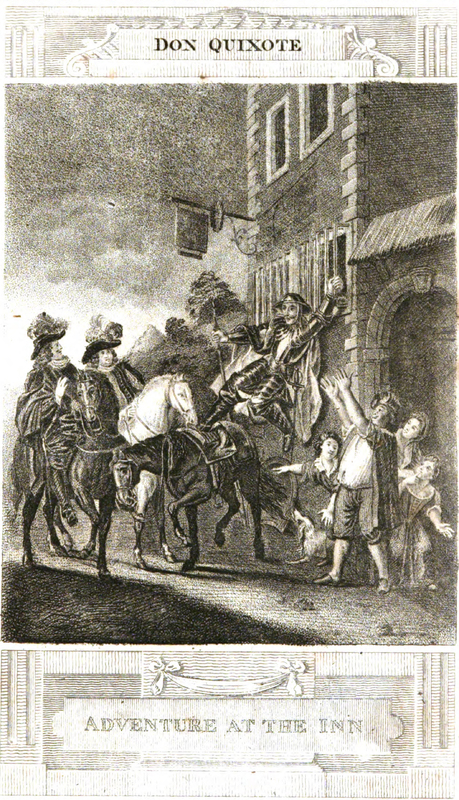
Two well-appointed men on horseback arrive at the inn and knocked on the door very hard. Don Quixote answered and chastised the men for arriving at such inopportune hours, as everyone is either asleep. As Don Quixote talked to these travelers, Rocinante reared up causing Quixote tumble from the saddle. Quixote would have fallen to theground, had he not caught his hand in some rope which hung from a barred window. As Quixote hung so near the ground he screamed in pain so loudly, that the innkeeper opened the inn's door, accompanied by three women, to see who was making the noise.
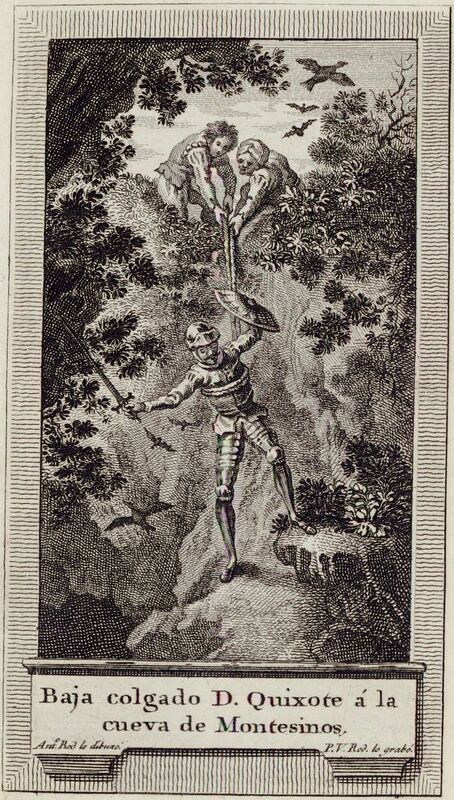
As Don Quixote tries to descend in Montesinos’ cave, a flock of birds surprises him. Sancho Panza and the bachelor’s cousin are pictured to the left, holding a rope that is tied to Don Quixote’s waist. Don Quixote holds his buckler and his sword. Unsigned. Part 2, ch. 22.
Having stopped to let Quixote help his squire up a cork tree, the Knight of the Mirrors falls headfirst off of his horse onto the ground below next to his lance after Quixote (left) knocks him off with his lance. Don Quixote, clad in full armor and mounted atop Rocinante charges forth with his shield in his right hand and his lance couched on his left. In the background Sancho Panza can be seen looking over the duel from atop a cork tree.
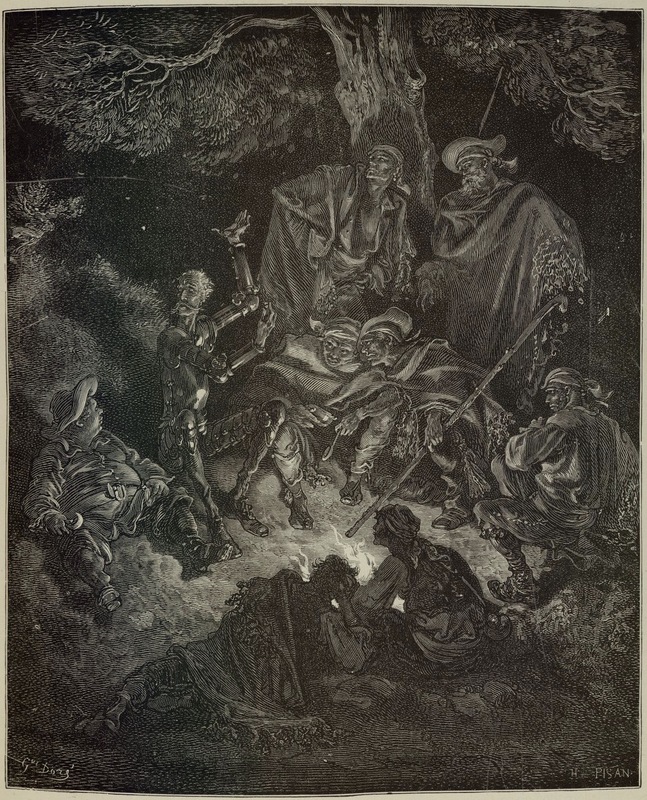
Don Quixote, sitting on an overturned wooden trough, delivers a speech about the Golden Age to a group of goatherds. Some of the goatherds are gathered around a fire, and others are huddled under a neaby tree. Sancho Panza sits next to him. Signed by G. Doré (illustrator) and H.-J. Pisan (engraver). Part 1, ch. 11.
A tidy straw basket filled with acorns sits upon the ground behind a wheel of cheese which has been placed on a woven platter. The image is occasioned by Teresa Panza givingthe duchess some acorns, and also a cheese.
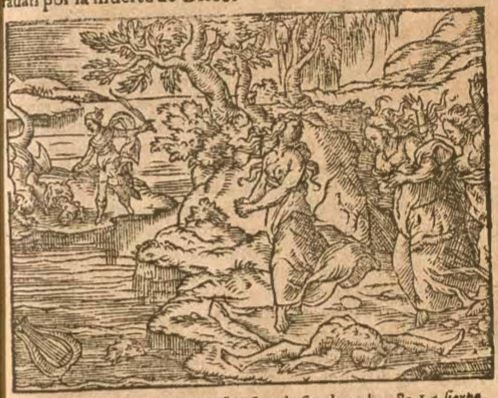
This engraving illustrates the moments that followed the death of Orpheus. The Maenads, who brutally murdered him, are illustrated throwing the head of Orpheus and his lyre into the river Hebrus. His body parts are depicted scattered across the ground near the Maenads, as they had killed him by tearing him to pieces. Orpheus’ lyre continued playing down the river, and his lifeless tongue continued singing. When his head and lyre appeared on the shores of Lesbos, a snake was nearby and tried to attack the severed head. Before the snake could attack, Phoebus appeared and turned the snake to stone. This is illustrated in the background of the engraving.
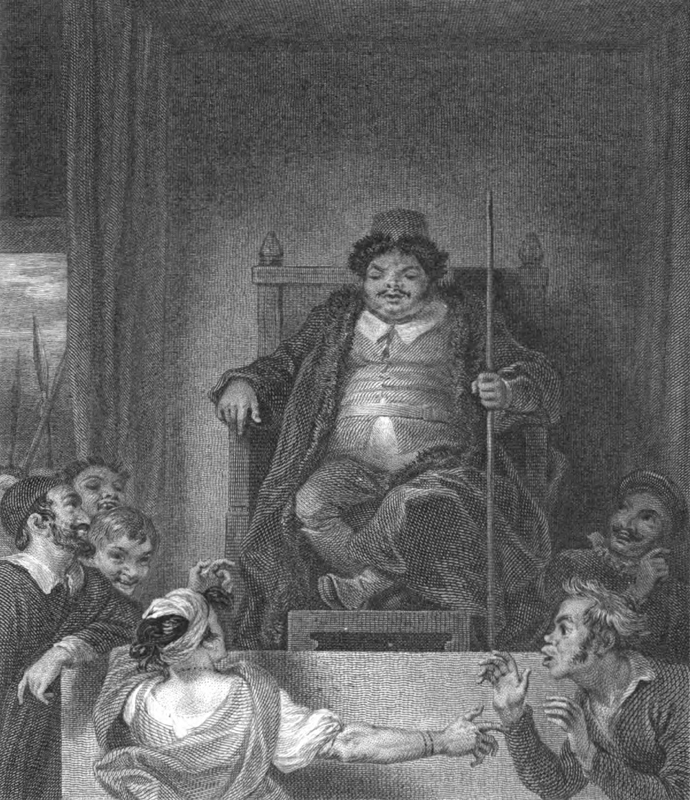
Sancho Panza sits in the tribunal court as governor of Barataria dressed in a long black robe, round fur cap and a tightly fitting shirt with a wooden staff in his right hand. Sancho is overseeing a trial brought before him by a woman who came into court holding a wealthy herdsman. The woman (pictured on the left) points to the herdsman on her right and accuses him of sexually assaulting her. The herdsman with the sideburns raises his hands defensively in protest. A large attendance of people have gathered around Quixote's high seat to see what Quixote will decree, and they laugh at the ensuing trial.
Sancho Panza and the bachelor’s cousin lower Don Quixote into Montesinos’ cave, using a rope tied to the errant knight’s waist. Sancho Panza blesses Don Quixote and prays that he return safe and sound, making the sign of a thousand crosses over him. Signed by A. Rodríguez (illustrator) and P. Rodríguez (engraver). Part 2, ch. 22.
In Sierra Morena, Cardenio attacks Don Quixote and Sancho Panza after the knight interrupts his story. The goatherd tries to stop him, while Rocinante grazes nearby. Signed by J. Rivelles (illustrator) and T. L. Enguídanos (engraver). Part 1, ch. 24.
Six playing cards are scattered on a dark surface, a five of spades, four of daimonds, two cards with clubs, and two unknown face cards. The image is occasioned by Durandarte saying "patience, and shuffle the cards."

![[A Vineyard and Tools]](https://collections.cemvc.ca/files/large/332895150a6961afe70c5a3f4bd2416d27d37294.jpg)
![[A Herdsman Lays his Hands Upon a Woman]](https://collections.cemvc.ca/files/large/d8f48eb9f9c0b42c1fc68fde3d326a670425bc81.jpg)
![[Andrés reappears]](https://collections.cemvc.ca/files/large/3b2352505262e5456749018d567c3f9f54701cbc.jpg)
![[Battle with the braying mayors squadron]](https://collections.cemvc.ca/files/large/9a9f375c6463345cae17ade772b3cd84c737943a.jpg)
![[Melisandra's Puppet Hangs from a Balcony]](https://collections.cemvc.ca/files/large/3ba5130f8b4051e72700a9c651081a258ef38607.jpg)
![[Encounter with the cart of actors]](https://collections.cemvc.ca/files/large/10744d3ac919e57f3607204524e7a0415a20109f.jpg)
![[Don Quixote's dinner at the inn]](https://collections.cemvc.ca/files/large/964d83056ea41553d9763025c62f89f8faf4291d.jpg)
![[Dispute at the inn over Mambrino's helmet and the packsaddle]](https://collections.cemvc.ca/files/large/634067b0aadf60611fc949805479f77c814b676a.jpg)
![[Don Quixote enters Montesinos' cave]](https://collections.cemvc.ca/files/large/f15bd1ea7894a7479b3292276c2bac6298f89aad.jpg)
![[The Knight of the Mirrors Falls from his Mount]](https://collections.cemvc.ca/files/large/3e37f0949c1704806150cf7e4fe76cea2fdd88e7.jpg)
![[A Basket Full of Acorns and a Wheel of Cheese]](https://collections.cemvc.ca/files/large/4ed09d94aad36cb730dae3cda4fd5cb49dc54039.jpg)
![[Cardenio beats Don Quixote and Sancho Panza]](https://collections.cemvc.ca/files/large/af96c6f7993b6934e6e6ecd2b3df690749cf2944.jpg)
![[Playing Cards]](https://collections.cemvc.ca/files/large/6398d86053d68726b1cb3fc72ac25d842fda483b.jpg)