Don Quixote attacks a procession of priests. They are bound for Segovia and are carrying the bones of a gentleman who died and was originally interred in Baeza. After knocking Alonso López and his mule to the ground, Don Quixote interrogates him. Meanwhile, Sancho Panza searches the mule packsaddle. The scene is lit by a fallen torch. In the background, the other priests flee into the fields. Signed by D.-N. Chodowiecki (illustrator) and D. Berger (engraver), dated 1779. Plate 4. Part 1, ch. 19.
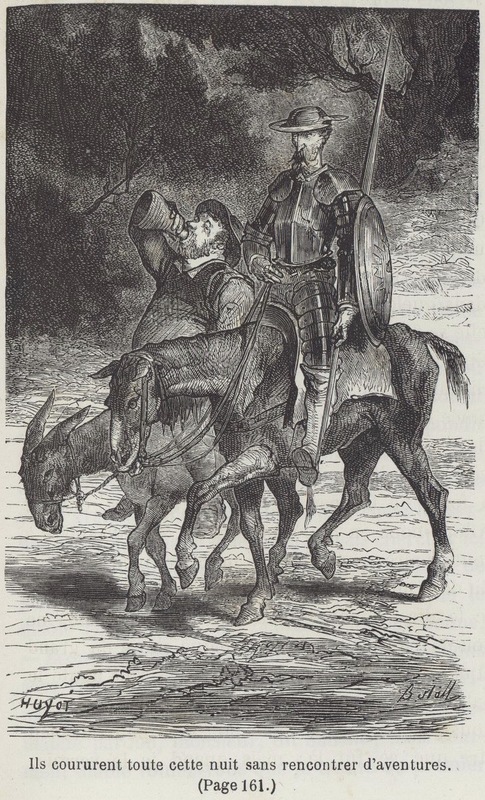
Don Quixote and Sancho Panza make their way to El Toboso to visit Dulcinea. Sancho Panza drinks from a flask while Don Quixote holds Rocinante’s reins. Signed by A. ‘Bertall’ d’Arnoux (illustrator) and J.-J.-M.-J. Huyot (engraver). Part 2, ch. 8.
Dorotea kneels before Don Fernando and begs him to let Lucinda go with Cardenio. Luscinda has lost her mask and is no longer disguised. Sancho, the priest, and the barber look on. Unsigned. Part 1, ch. 36.
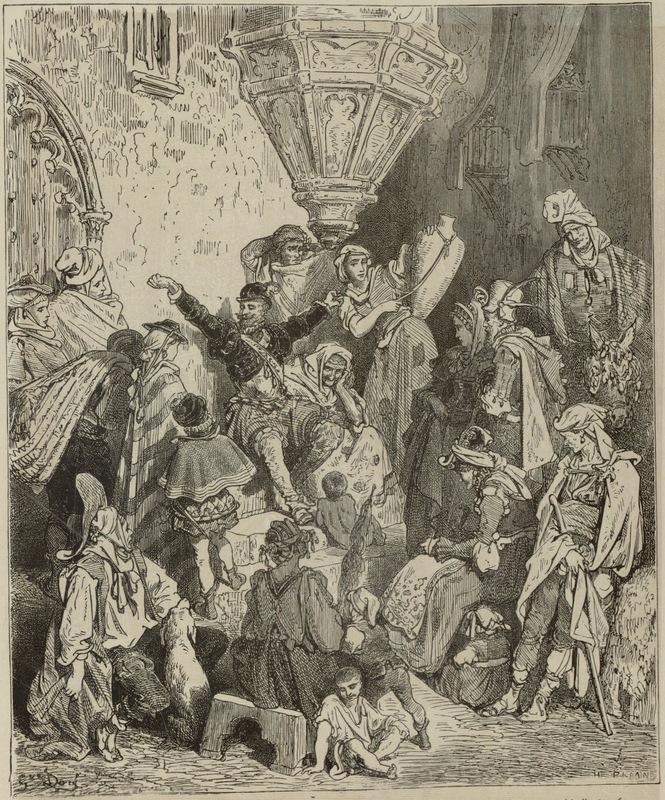
The illustration represents part of the story told by the goatherd Eugenio: Vicente de la Rosa sits on a stone bench under a great poplar tree (not represented) in the village square, recounting his great deeds to the villagers gathered around him. There was no land anywhere in the world he had not seen and no battle in which he had not fought. Signed by G. Doré (illustrator) and H.-J. Pisan (engraver). Part 1, ch. 51.
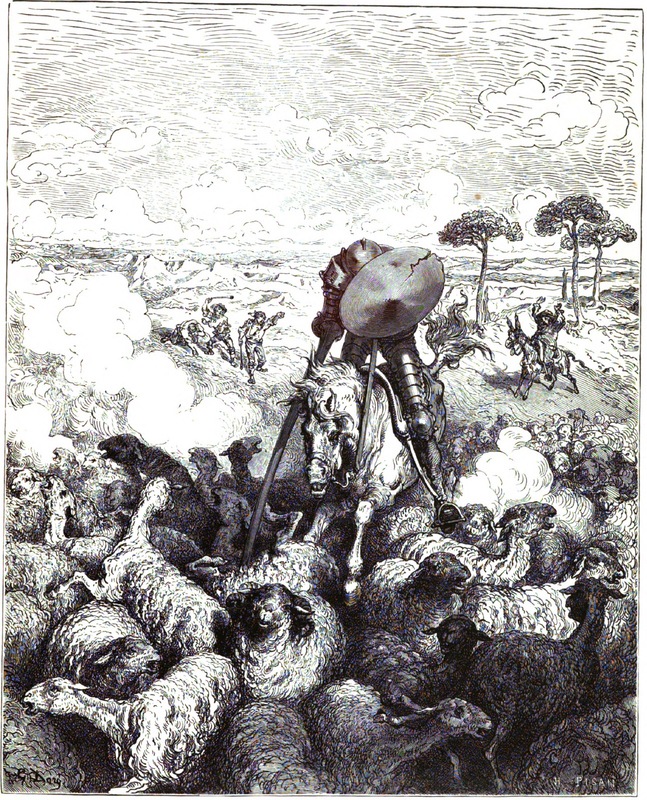
Don Quixote charges into a herd of sheep. The cloud of dust raised by two approaching herds of sheep leads Don Quixote to believe that two armies are about to engage in a battle. He believes that he sees the various leaders and knights that compose the two armies, and decides to take the side of one of them. He therefore charges down the hill and begins to attack the sheep of one of the herds with his lance. Sancho Panza sits on his donkey in the background to the right, waving his arms in the air and yelling at his master to stop. To the left can be seen the angry shepherds who are using slingshots to attack Don Quixote with rocks. This scene can be found in Part I, Book 3, Chapter 4.
Don Quixote finds himself caught in nets of green string that are stretched between trees. Imagining that enchanters want to entangle him, he tries to break the nests when two shepherdesses appear before him and Sancho Panza. They are dressed in jackets and skirts made of fine brocade and rich moiré shot with gold. Signed by J. Rivelles (illustrator) and A. Blanco y Asensio (engraver). Part 2, ch. 58.
Having finished his work in the court of judicature, Sancho Panza, donning a regal cape, enters a great hall where four pages with water to wash his hands stand in waiting. Sancho extends his hands to wash them within the silver basin.
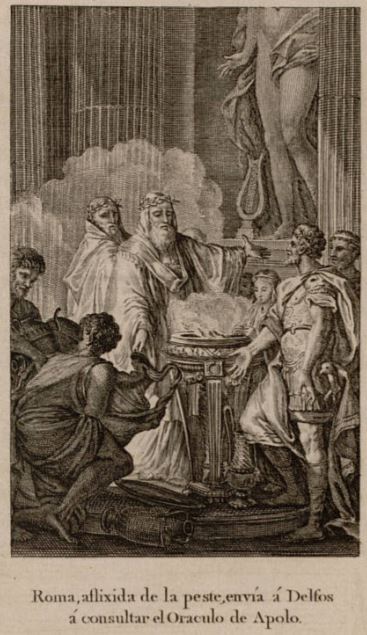
This image depicts a group of Roman citizens at the Oracle of Apollo at Delphi. The city of Rome could not keep up with the amount of deaths happening due to the plague, so they sought the help of the oracle at Delphi. Three is a large statue of Apollo in the background of the engraving with only the lower half of his body visible and a lyre by his legs. There are two priests with wreaths on their heads as they pour libations into the fire on the altar that is in the centre of the image. The roman citizens are surrounding the altar.
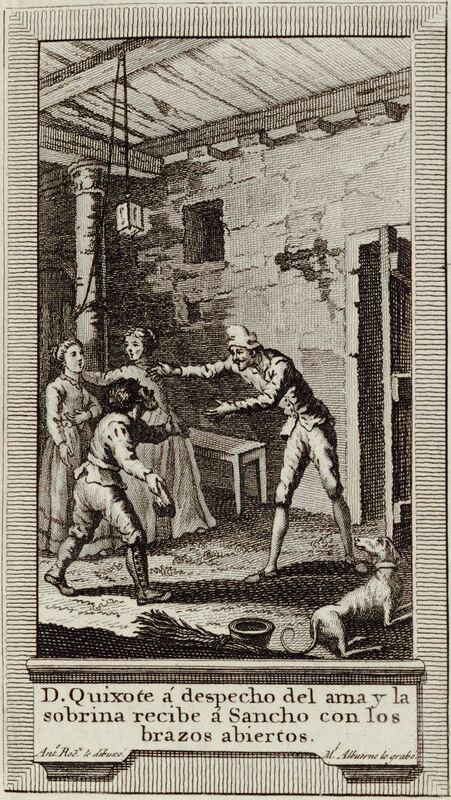
Don Quixote welcomes Sancho Panza with open arms, angering the housekeeper and the niece. The errant knight and his squire shut themselves away in Don Quixote’s room, where they discuss second third sally together. Signed by A. Rodríguez (illustrator) and M. Albuerne (engraver). Part 2, ch. 6.
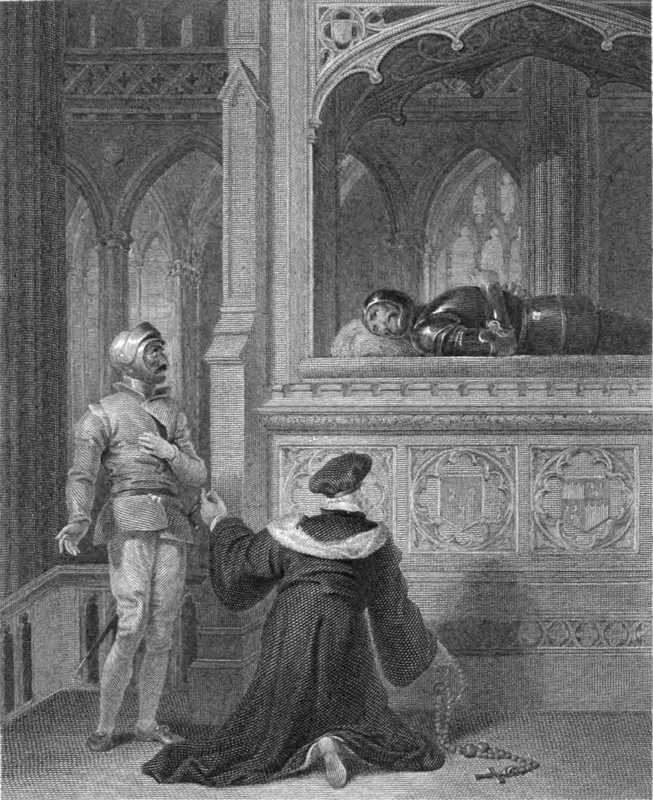
While in the cave of Montesinos, Don Quixote claims he discovered a royal and splendid palace or castle, whose walls seemed to be composed of bright and transparent crystal. In a lower hall, formed of alabaster, there stood a marble tomb, whereon a knight is extended (Durandarte). Quixote speaks to Durandarte with his left hand on his chest and his right hand by his side as if to explain himself. Beside Quixote, kneeled a man clad in along mourning cloak, which trailed upon the ground. He had a black Milan cap on his head , and his hoary beard reached below his girdle. He held a rosary of beads in his hand, as large as walnuts , and every tenth bead, the size of an ordinary ostrich egg. This man introduced himself as the same Montesinos for whom the cave was named after. ,
Sancho Panza, as governor and judge of Barataria Island, rules that the twenty ducados be given back to the herder accused by a woman of having raped her. Unsigned. Signed by T. Stothard (illustrator) and C. Grignion I (engraver). Plate VI. Part 2, ch. 45.
Sancho Panza, with eyes wide and mouth agape, gets hoisted by the waist with a bundle of rope and pulled out of a dark chasm towards the surface. His right hand is balled into a fist while his left hand he holds his wide brimmed hat.
In Juan Palomeque’s inn, Don Quixote dressed in nothing more than an oversized shirt and a nightcap swings his sword wildly and defends himself with a bundle of blankets that he uses as a shield. Being seized by a dream, Quixote thinks himself to be fighting terrible giants, but he is in fact only destroying the landlord's wineskins. The innkeeper (middle) grasps Quixote by his shirt with both hands, incensed at the knight-errant. The priest, pictured in black with a novel hat behind the innkeeper grabs Quixote's arm, but appears almost bemused. A woman with a candle in her right hand enters the room, followed by Sancho, Cardenio, the barber, and other guests of the inn. On the bottom left a flayed wineskin sprays wine into the air.
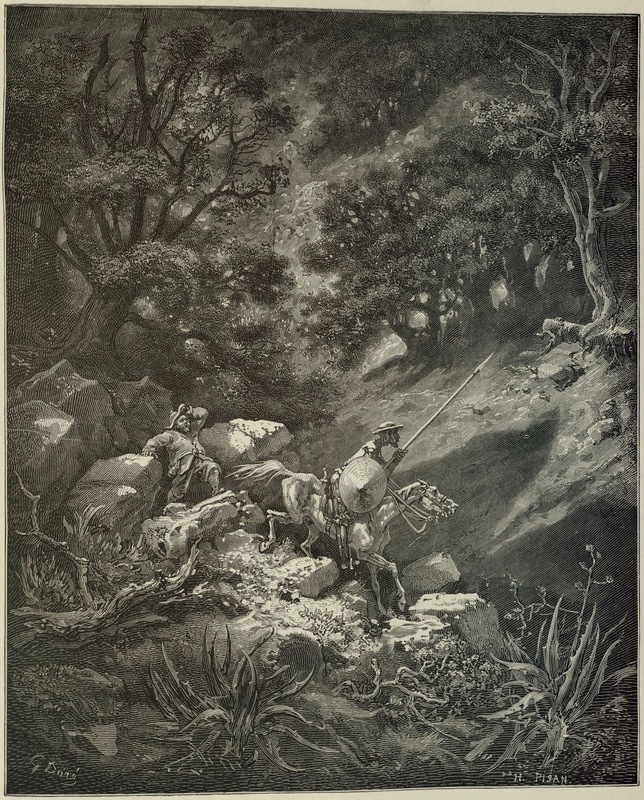
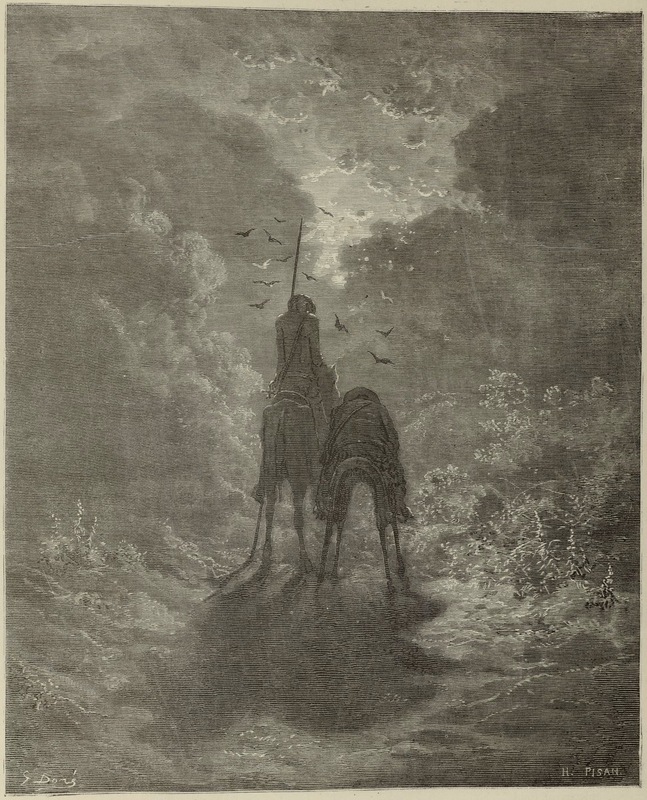
In Sierra Morena, Don Quixote and Sancho Panza begin to search for Cardenio. Signed by G. Doré (illustrator) and H.-J. Pisan (engraver). Part 1, ch. 25.
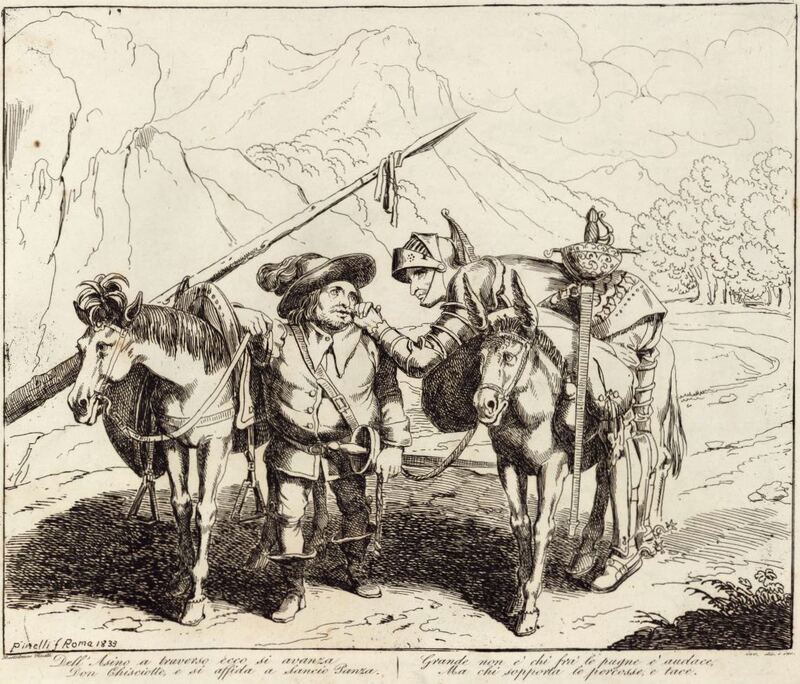
After their encounter with the Yanguesans, Sancho Panza settles Don Quixote on his donkey and leads him and Rocinante by their halters to an inn. Signed by Bartolomeo Pinelli (engraver and illustrator) and dated Rome, 1833. Plate 20. Part 1, ch. 15.
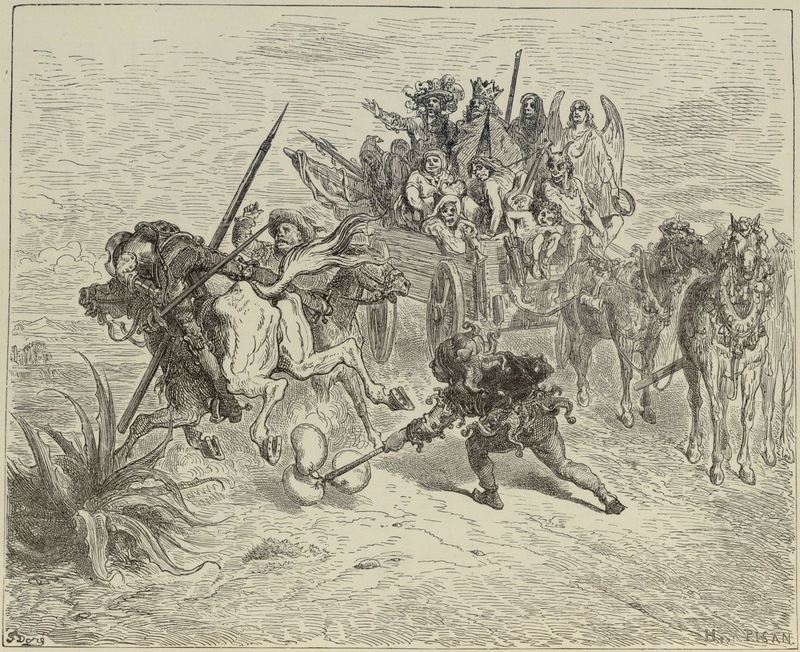
Don Quixote and Sancho Panza encounter a cart carrying the actors of Angulo el Malo’s company for the mystery play ‘The Assembly of Death.’ The latter are dressed as Devil, Cupid, Death, Angel, Emperor, Queen, and Soldier. Rocinante is alarmed by the sound of bells and runs across the field. While Sancho runs to Don Quixote’s assistance, a member of the company makes off with his donkey. Signed by G. Doré (illustrator) and H.-J. Pisan (engraver). Part 2, ch. 11.
Don Quixote, clad in armor, and a shield with a rabbit printed on its exterior, advances into the midst of the people of the braying village, each of whom carries weapons of their own from crossbows to halberds and is received as one of their own. Don Quixote, lifting up his vizor, approached the donkey-banner and all the chiefs of the army gathered about him to look at him. Don Quixote, seeing them so intent upon looking at him, raised his hand to take the silence, and cried out for them to cease their march.
A youth with long curly hair is pictured carrying a sword upon his shoulders, and upon it a bundle of his clothes, such as breeches or his cloak, and a shirt or two. He wears on a velvet jacket lined with satin. His stockings are white, and his shoes square-toed. He faces forward his mouth open.
The face of Tosilos, a young man in service of the duke. His face is round and planted in a knight's helmet with its visor lifted, his lips are thick and his nose harbors a somewhat pronounced hook. His eyes are sunken and thin with rounded eyebrows.
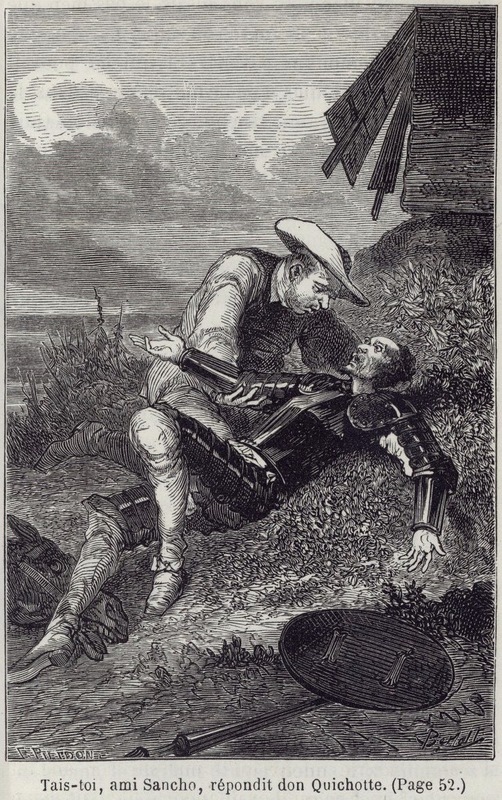
Sancho Panza helps Don Quixote, who lays defeated by the windmill. Signed by A. ‘Bertall’ d’Arnoux (illustrator) and F. Pierdon (engraver). Part 1, ch. 8.
Not being able to forbear himself any longer, Sancho Panza tucks his hat beneath his arm and approaches one of the busy cooks to sop a junk of bread in one of the pots. The cook instead lays hold of a long handled kettle, and, laying it into one of the cauldrons, he fished out two geese. Sancho looks down at the pot with hungry eyes, his hands motioning to grab at the morsels.
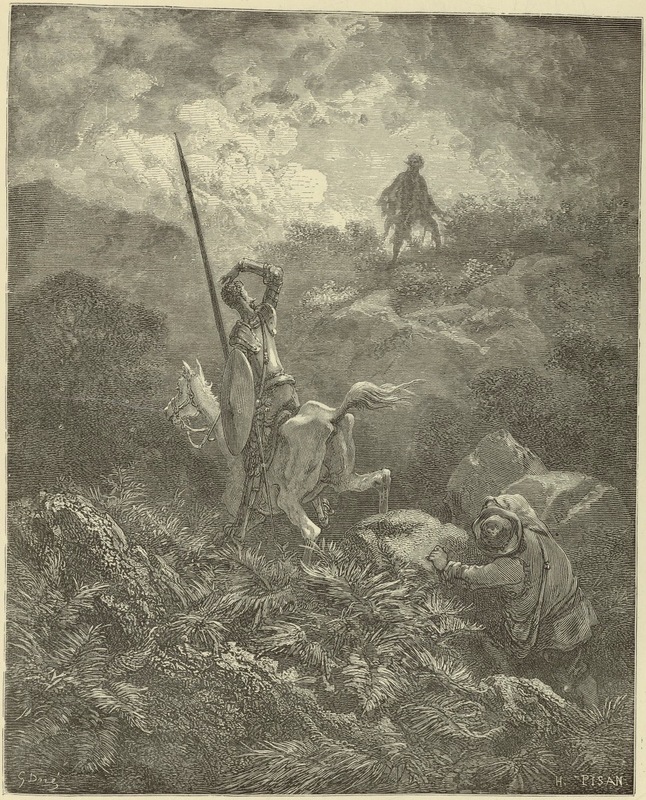
Riding across Sierra Morena, Don Quixote sees a man (Cardenio) leaping from crag to crag and bush to bush with uncommon speed. The man appears to be half-dressed and has a heavy black beard, long disheveled hair, no shoes on his feet, and breeches. Don Quixote imagines that the man is the owner of the saddle cushion they found and he resolves to look for him until he finds him. Doré has represented the scene as if Don Quixote and Sancho Panza are seeing an apparition. Signed by G. Doré (illustrator) and H.-J. Pisan (engraver). Part 1, ch. 23.
Sancho Panza explains to the bachelor Sansón Carrasco how Ginés de Pasamonte stole his donkey. In the night, Ginés propped up Sancho’s packsaddle on four stakes and left him mounted on them, taking his donkey out from under him. Signed by G. Doré (illustrator) and H.-J. Pisan (engraver). Part 2, ch. 4.
A flag is attached to a wooden stick by rope and string in the fashion of a banner with the depiction of a donkey adorned to its material. Below the flag four spears and a halberd are also carried. The image is occasioned by the holy brotherhood pursuing Gines de Passamonte, the freed slave and infamous who has previously stolen Sancho Panza's donkey, Dapple.
Reading from a manuscript, the priest tells the story of Lothario, Anselmo, and Camilla. In this image, Camilla, Anselmo's wife, sits on a stone bench in a garden dressed in white flowing apparel talking jovially to Anselmo on the left, who leans comfortably on the left arm of the bench. On Camilla's left a dog lies down on the flowing cloth from her dress and stares toward Lothario, Anselmo's best friend, who looks up at the sky, forlorn and in love with Camilla. A cherub flies over Anselmo and Camilla, waving its arms in the air.

![[Don Quixote attacks Alonso López]](https://collections.cemvc.ca/files/large/1caafdb2d915808baba1e13006d4fd6005931e0c.jpg)
![[Dorotea kneels before Don Fernando]](https://collections.cemvc.ca/files/large/fcbff4ce130ea7f4a58b0d83b9b2071c2a4f8d55.jpg)
![[Don Quixote and Sancho Panza meet two shepherdesses]](https://collections.cemvc.ca/files/large/00cd364bd03aed4bd62b78f01c51c6a9bee8f846.jpg)
![[Sancho Panza Washes His Hands Before Eating in Barataria]](https://collections.cemvc.ca/files/large/be670d4d6955b7e39a39c604f2c51b2715c8e2dc.jpg)
![[Sancho Panza as judge at Barataria Island]](https://collections.cemvc.ca/files/large/d6b8667cb9129c13b6d660cf9c12b6536547f0c8.jpg)
![[Sancho Panza Gets Lifted from a Pit]](https://collections.cemvc.ca/files/large/7f066c045cee166c80f2f2e8db74a397323b111d.jpg)
![[Don Quixote Attacks the Wine Skins in his Sleep]](https://collections.cemvc.ca/files/large/b9a84ee0a59d478b105ad06ba28f926b87bc2fe9.jpg)
![[Don Quixote Attempts to Persuade the Braying Village Against Taking Revenge]](https://collections.cemvc.ca/files/large/9bf55e688bef29e7a4bd61edb1fe03f6d4ef6900.jpg)
![[Of the Youth that Walked to War]](https://collections.cemvc.ca/files/large/02347f58bff606568155d825b6fe67f97f1e3a2f.jpg)
![[A Portrait of the Lacquey Tosilos]](https://collections.cemvc.ca/files/large/2816f8c9792bbdbdd290d3133dbc82b123b80055.jpg)
![[Of How a Cook Gave Sancho Two Geese From a Pot]](https://collections.cemvc.ca/files/large/a110e3c1a5b480f4c2b27baa65d2862458aaaaa2.jpg)
![[The Holy Brotherhood in Pursuit of Gines de Passamonte]](https://collections.cemvc.ca/files/large/b2b176a425ae6e12973600cd7dc42d466bb11ce6.jpg)
![[The Tale of Anselmo, Lothario, and Camilla]](https://collections.cemvc.ca/files/large/ef1799fc0662858acd0321e26f693a7f1184a964.jpg)