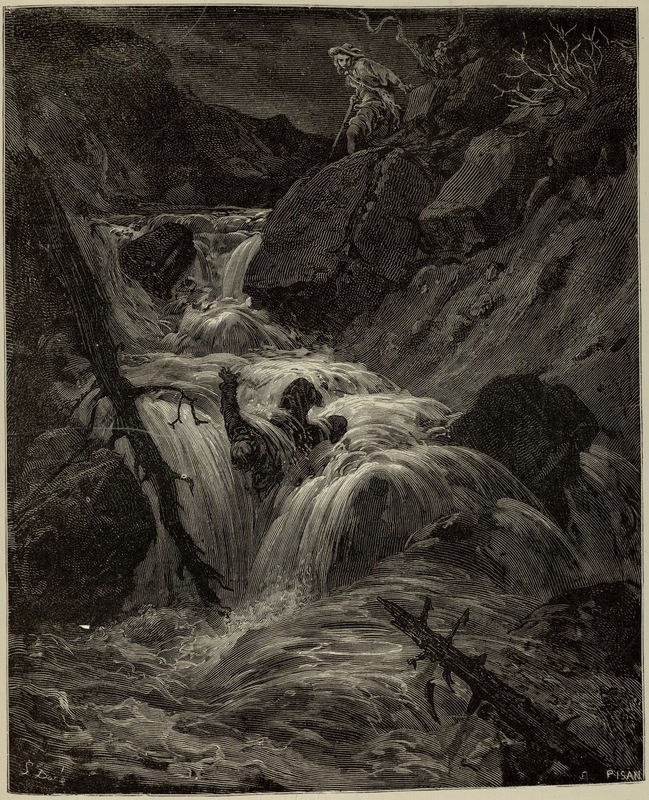
The illustration represents part of Dorotea’s story as she tells it to Cardenio, the priest, and the barber: after hearing news of Don Fernando and Luscinda’s wedding, Dorotea flees the city with one of her father’s servants. When he tries to take advantage of her, Dorotea pushes him over a precipice (a river in the illustration). She leaves him, not knowing whether he is dead or alive, and enters Sierra Morena. Signed by G. Doré (illustrator) and H.-J. Pisan (engraver). Part 1, ch. 28.
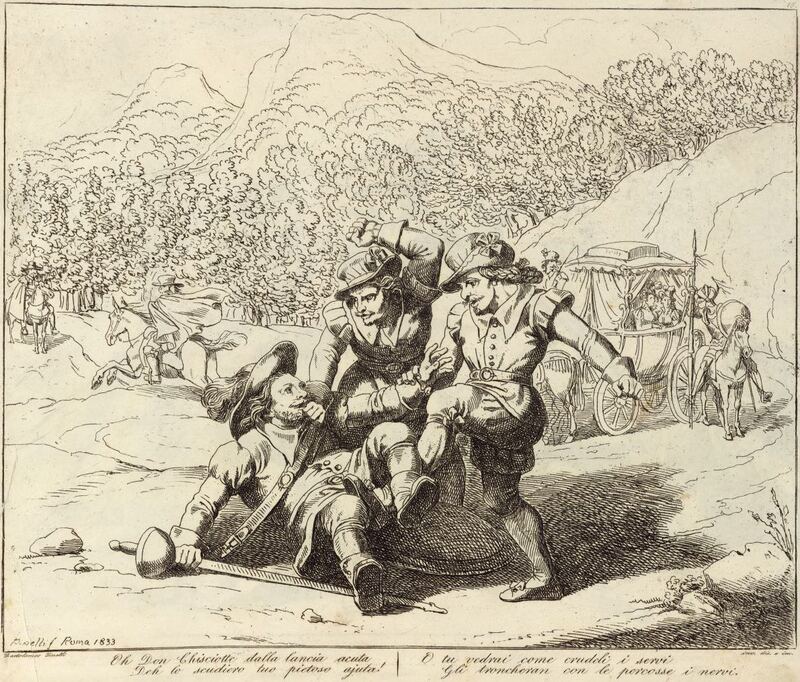
The illustration depicts a scene on the road to Puerto Lápice. In the foreground, the Benedictine friars’ servants beat Sancho Panza. In the background, Don Quixote talks to the ladies in the carriage (right) while the Benedictine friars flee the scene (left). Signed by Bartolomeo Pinelli (engraver and illustrator) and dated Rome, 1833. Plate 15. Part 1, ch. 8.
In the background, Sancho Panza runs away (Don Diego de Miranda is not pictured), while in the foreground, Don Quixote prepares to fight the lion as the lion keeper opens the gate. However, the lion refuses to leave its cage. Don Quixote holds his sword in one hand and his buckler in the other. Signed by T. Stothard (illustrator) and Walker (engraver). Plate XIII. Part 2, ch. 17.
Two skeletons lie prostrate upon the ground in the darkness. The skeleton in the foreground is human and lying on its front, wearing nothing but a pair of shoes. In the background lies a donkey's skeleton with its ears still attached. On the right sits a pile of folded clothes and a drinking vessel. The image is occasioned by Sancho Panza saying "Hence shall my bones be taken up, when it shall please God that I am found, clean, white, and bare, and with them those of my trusty Dapple, whence perhaps it will be conjectured who we were, at least by those who have been informed that Sancho Panza never parted from his ass, nor his ass from Sancho Panza" (Page 580).
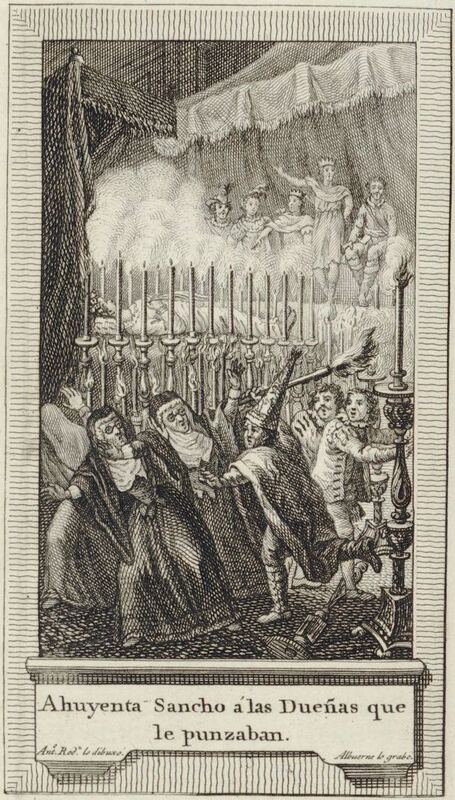
Grabbing a nearby torch, Sancho Panza chases after the duennas and the other tormentors at Altisodora’s funeral. Also pictured: candles of white wax in silver candelabras; raised catafalque with black velvet canopy bearing Altisodora’s body; and the duke and the duchess on a stage. Signed by A. Rodríguez (illustrator) and M. Albuerne (engraver). Part 2, ch. 69.
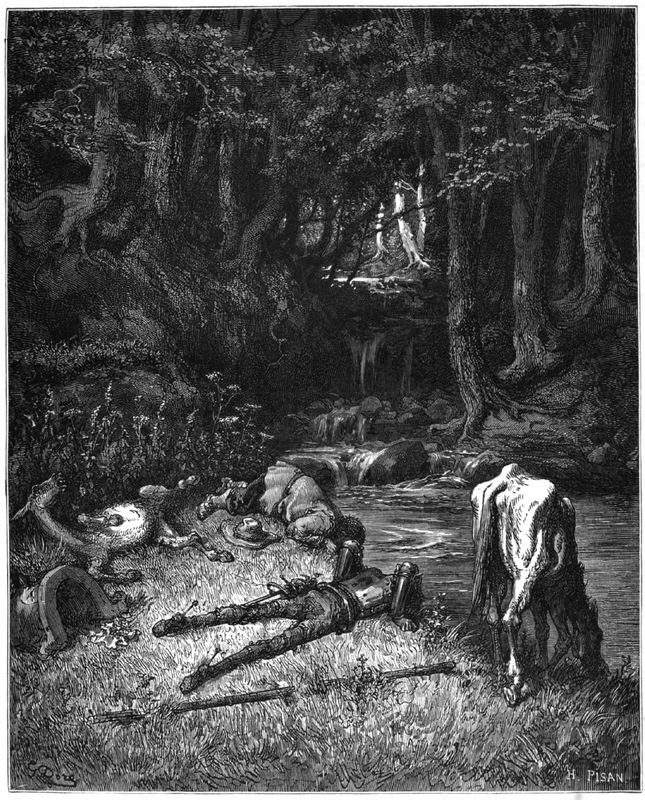
After searching in vain for the lady Marcella, Don Quixote and Sancho Panza decide to spend the hours of the siesta in a pretty meadow. Don Quixote and Sancho Panza are lying on the bank of the river and drinking from it. The donkey is rolling in the grass, and the emaciated Rocinante is drinking from the river. This scene can be found in Part 1, Book 3, Chapter 1.
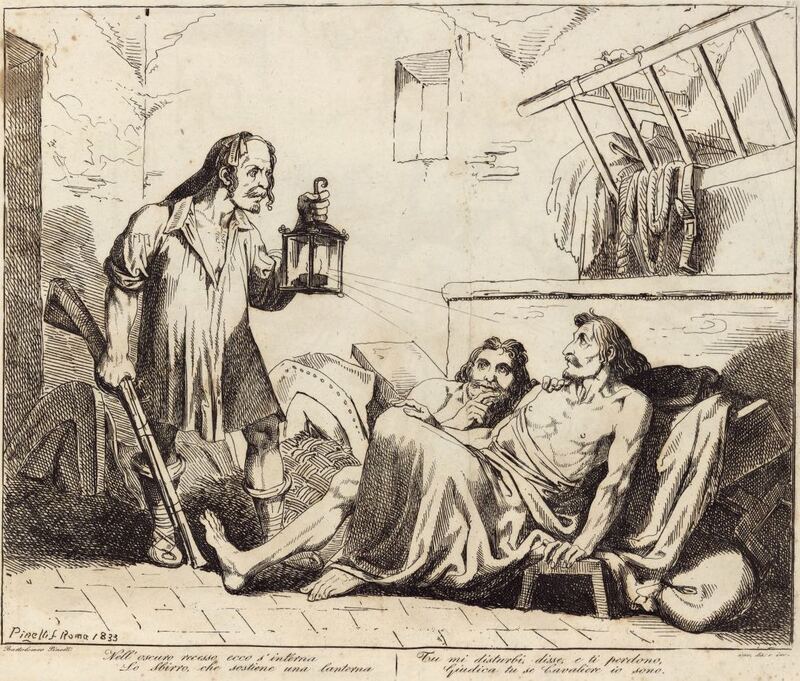
After the scuffle between Don Quixote, Sancho Panza, Maritornes, and the muledriver, an officer of the old Holy Brotherhood of Toledo discovers a badly beaten Don Quixote lying on his broken bed. The illustration is not accurate to the text: the officer is depicted carrying a lamp and a musket, while in the text he carries his staff of office and a tin box containing his documents. Also pictured is Sancho Panza. Signed by Bartolomeo Pinelli (engraver and illustrator) and dated Rome, 1833. Plate 22. Part 1, ch. 16.
A half empty wine skin is pictured on the ground, upside-down so that its legs are propped up in the air. To the right of the wine skin, a half-eaten meat pie sits with its frontal exterior gaping wide. in front of the pie, a scythe-like knife with a rounded tip lies on the ground. The image is occasioned by Sancho Panza and the Squire of the Woods talking and drinking from an almost empty skin, with their meat half chewed, before falling asleep.
An older woman (right) walks in the direction of a church located in the background on the right. She is wearing a courtly petticoat, regal hat, and holds a distaff in her left hand. She is followed by a male attendant who carries the back end of her dress so it does not drag along the dirt, he is also wearing regal attire and a plumed hat. On the left, a group of women have gathered in farmer's clothing with baskets in hand, pointing and gesturing to the countess as if to mock her. In the background on the left, the silhouette of people pointing at the countess can be seen from the windows of buildings. The image is occasioned by Teresa Panza saying "No, I would not have people, when they see me decked out like a countess or governess, immediately say : ' Look how stately madam hog-feeder moves ! Yesterday she toiled at her distaff from morning to night, and went to mass with the tail of her petticoat over her head instead of a veil, and to-day, forsooth, she goes with her farthingale, her embroideries, and her nose in the air, as if we did not know her'" (Page 59).
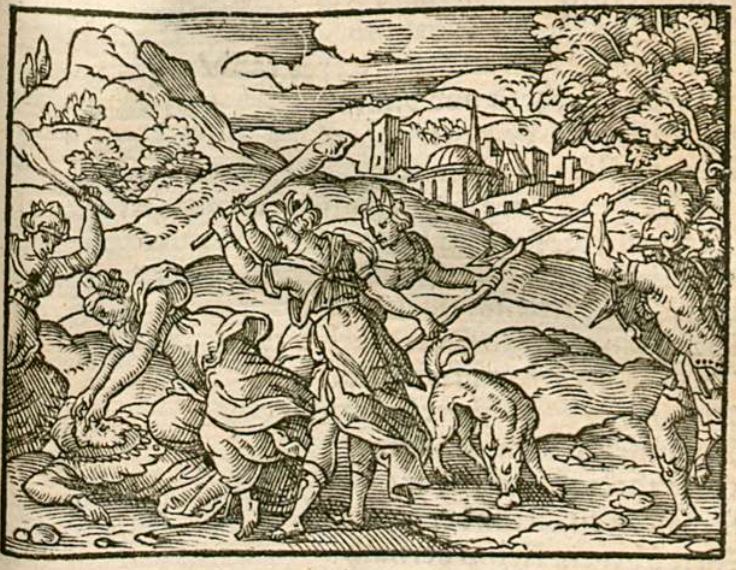
This engraving depicts Hecuba, the wife of King Priam of Troy, murdering King Polymestor. Hecuba is depicted sitting on top of Polymestor gouging his eyes out. His right eye has already been gouged in the image while Hecuba mutilates the other. Hecuba is surrounded by fellow Trojan women who have been taken captive by the Greeks. They are illustrated with large sticks as they bludgeon the king to death. Hecuba murders King Polymestor because he murdered her son, Polydorus. After killing the king, Hecuba is transformed into a hound. The transformed Hecuba is illustrated to the right of the group of the Trojan women.
Don Quixote (left) ,clad in full armor, braces his shield and lays hand to his sword having perceived an enormous boar, pursued by the dogs and followed by hunters in the background. The boar is making its way around the bend towards them. The duke (middle) turns to the duchess and raises his hands to prevent her from participating, and the duchess holds a venablo with both of her hands, eager to advance towards the board had not the duke prevented her.
During the invasion of Barataria Island, Sancho Panza, trapped between two shields, is trampled on by several soldiers. Signed by D.-N. Chodowiecki (illustrator) and D. Berger (engraver), dated 1779. Plate 15. Part 2, ch. 53.
A female lap dog lies on the ground, three of her whelps lying by her stomach and drinking her milk. A plate lies in the foreground. The image is occasioned by Don Quixote saying "I know a certain lady who asked one of these figure-raisers whether a little lap-dog she had would breed, and how many, and of what colour the puppies would be. To which master astrologer, after raising a figure answered that the bitch would pup, and have three whelps, one green, one carnation, and the other mottled, provided that she proved with young between the hours of eleven or twelve at noon or night, and that it were on a Monday or a Saturday."
Having slept in the forest next to the town where Quiteria was to be wed, Don Quixote calls to his squire to wake, his hands lifted before his knees as he tries to wake Sancho with his voice. Sancho, for his part, lies with his face to the roots of a tree, his legs spread out behind him, sound asleep.
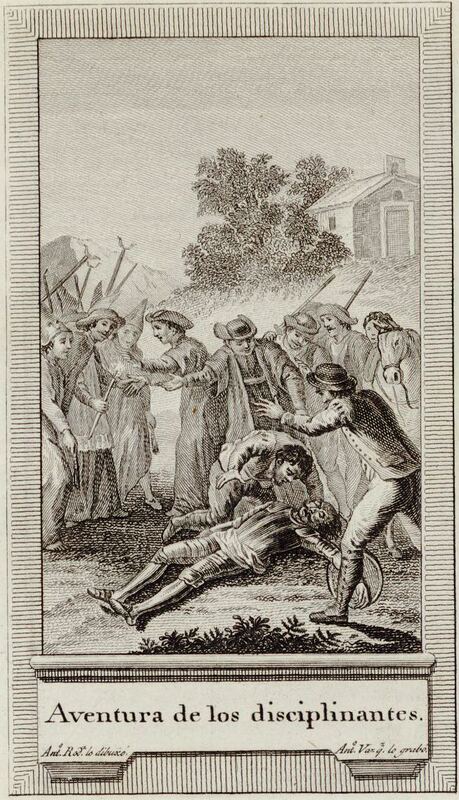
Sancho Panza tends to Don Quixote after he was beaten by one of the penitents. Surrounding them are the canon of Toledo, the priest, the barber, the officers of the Holy Brotherhood, and the penitents with their pointed hoods. Signed by A. Rodríguez (illustrator) and B. Vázquez (engraver). Part 1, ch. 52.
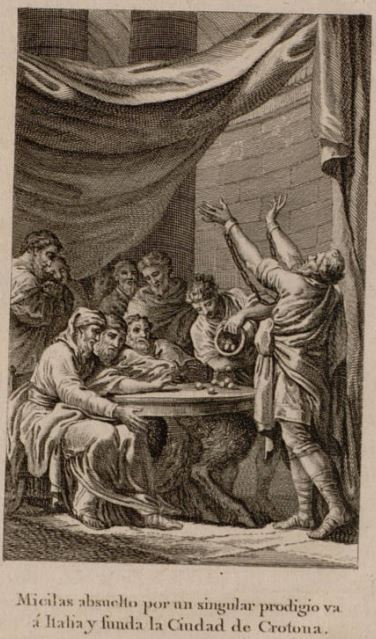
Myscelus, the founder of the city of Crotona, is depicted on the right side of the image with his hands bound by chains. Myscelus had been visited by the demi-God Hercules who instructed him to leave his native land. It was forbidden for Myscelus and his people to leave their native land and change nationalities, so Myscelus was on trial for his plans to leave. The townspeople used black and white pebbles to vote for or against conviction. There is a group of men depicted in the image sitting around a table and pouring out their marbles on to the table to see if Myscelus would be convicted or not. Hercules had intervened and changed all of the pebbles to reflect that Myscelus would not be convicted. He was freed and followed Hercules’ instructions and founded the city of Crotona.
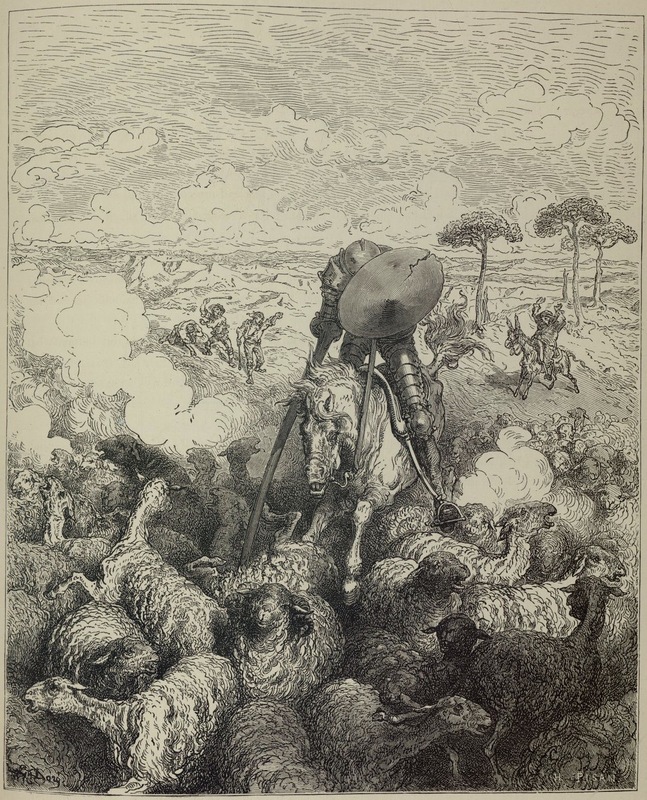
Despite Sancho Panza’s warning (he is pictured gesticulating in the background), Don Quixote charges a flock of sheep. He is mounted on Rocinante and holds his lance. In the left background, the shepherds are depicted preparing their slings to throw stones at the knight. Signed by G. Doré (illustrator) and H.-J. Pisan (engraver). Part 1, ch. 18.
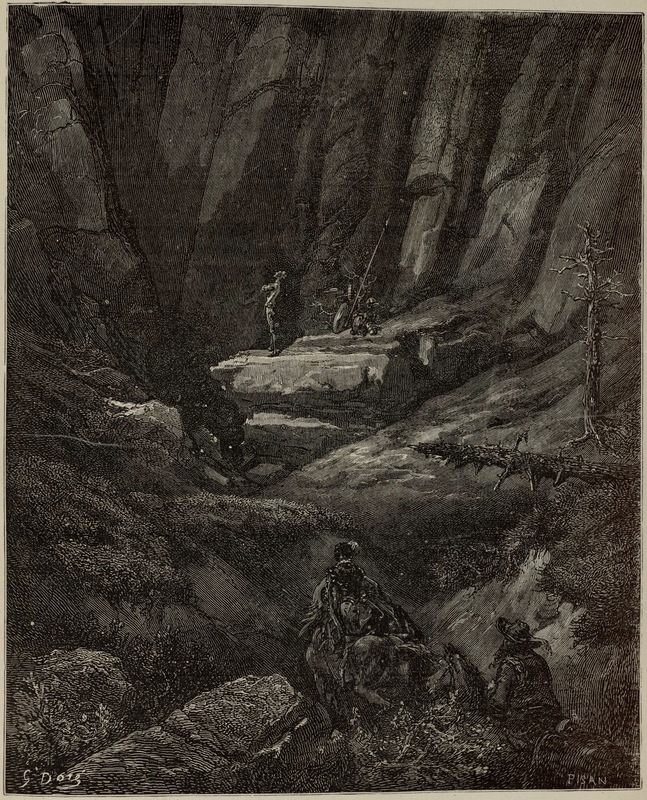
Dorotea, accompanied by the barber (disguised with an oxtail beard), catches sight of Don Quixote among some crags. He is dressed now but has not put on his armour. Signed by G. Doré (illustrator) and H.-J. Pisan (engraver). Part 1, ch. 29.
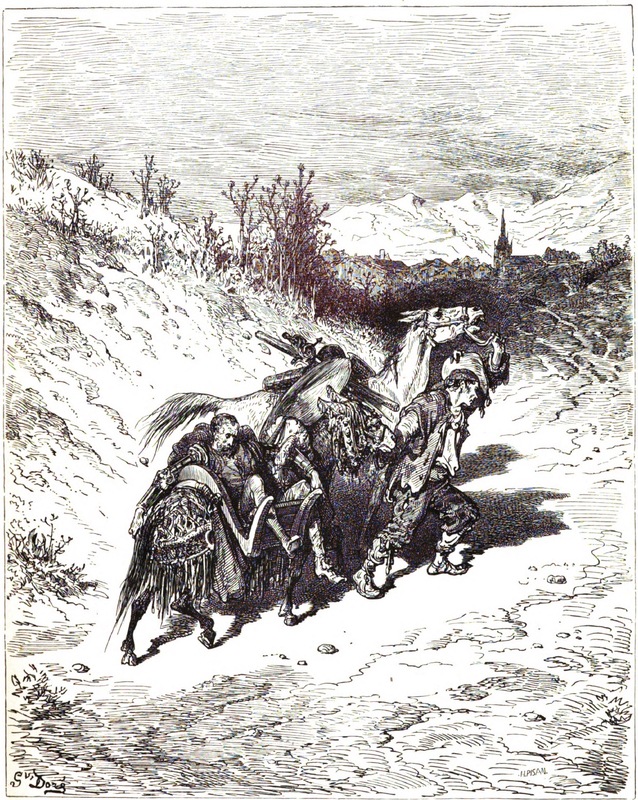
A peasant neighbour of Don Quixote stumbles across the injured knight. Upon realizing that Don Quixote his both injured and crazy he lifts him onto his mule, straps the armour and weapons onto Rocinante and leads both back to the village. This scene can be found in Part I, Book 1, Chapter 5.
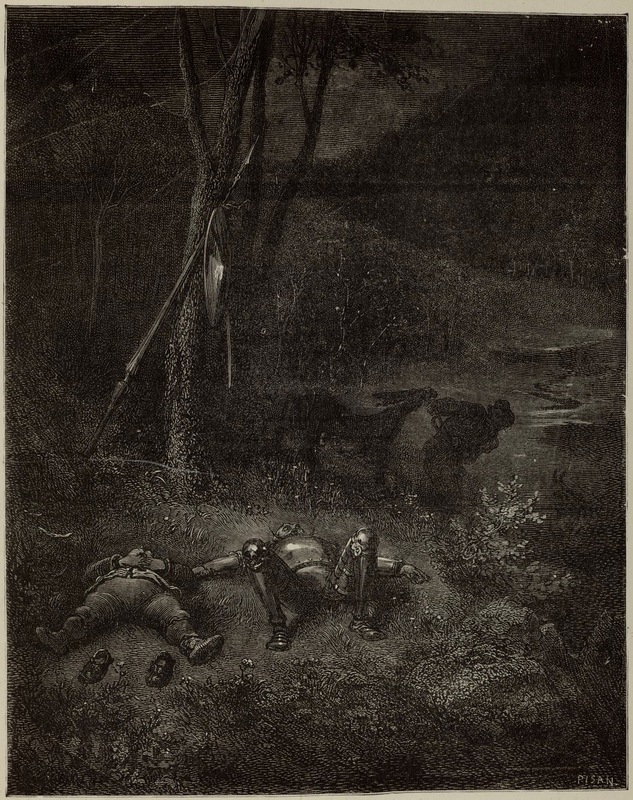
In Sierra Morena, while Don Quixote and Sancho Panza sleep, Ginés de Pasamonte steals Sancho’s donkey. Doré has not represented the scene as later described by Sancho (waking up mounted on his packsaddle propped up with four sticks). Signed by G. Doré (illustrator) and H.-J. Pisan (engraver). Part 1, ch. 23.
Sancho Panza, as governor and judge of Barataria Island, rules that the twenty ducados be given back to the herder accused by a woman of having raped her. Unsigned. Part 2, ch. 45.
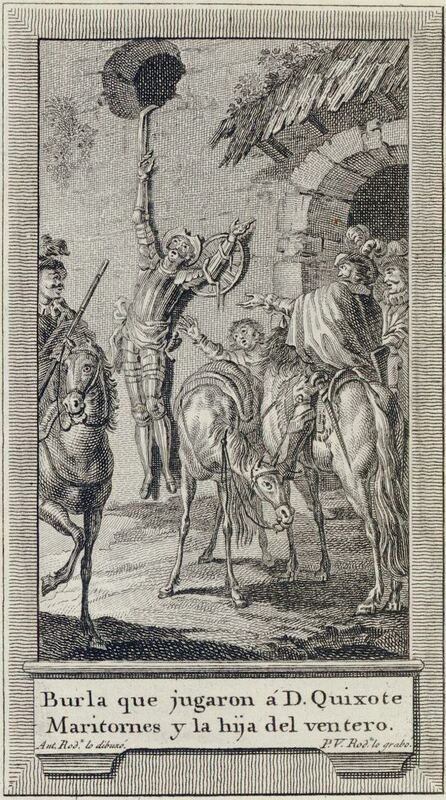
As four travellers (servants of Don Luis’ father) arrive at Juan Palomeque’s inn, Rocinante moves to smell one of their mares, leaving Don Quixote hanging from the window by his hand. Hearing the knight’s cries for help, the innkeeper appears at the entrance of the inn. Signed by A. Rodríguez (illustrator) and P. Rodríguez (engraver). Part 1, ch. 43.
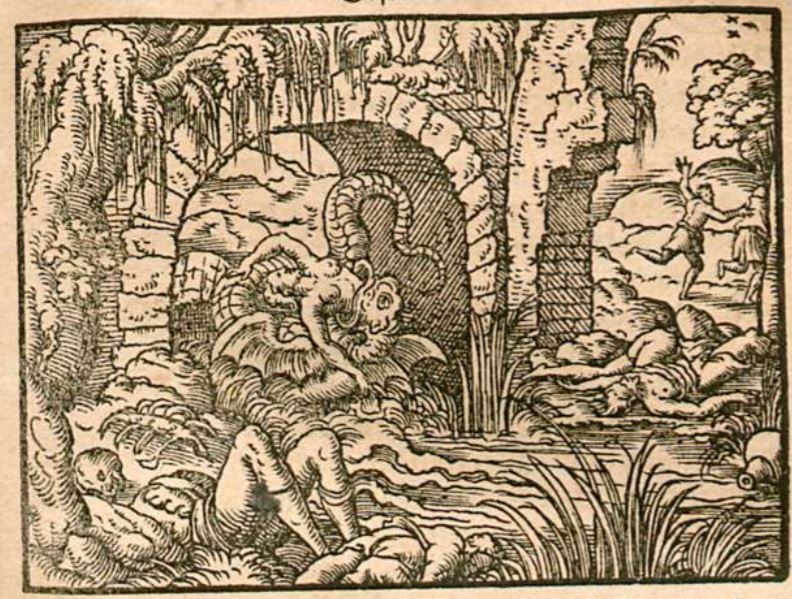
This engraving illustrates the companions of Cadmus, the founder of Thebes, getting killed by the serpent sacred to the god Mars. Cadmus had ordered his companions to find fresh water suitable for a sacrifice to the gods, and they happened to come across the cave illustrated in the engraving. The serpent lived in this cave and began killing the soldiers when they tried to take the water. There is a dead soldier depicted in the bottom left corner of the image. Another soldier is depicted being devoured by the snake. There are two men depicted on the right side of the image that managed to get away.
Don Quixote, wearing his armour, reads chivalric books in his library. The niece and the housekeeper (background) watch him, concerned. Signed by A. d’Arnoux (illustrator) and Midderigh (engraver). Part 1, ch. 1.
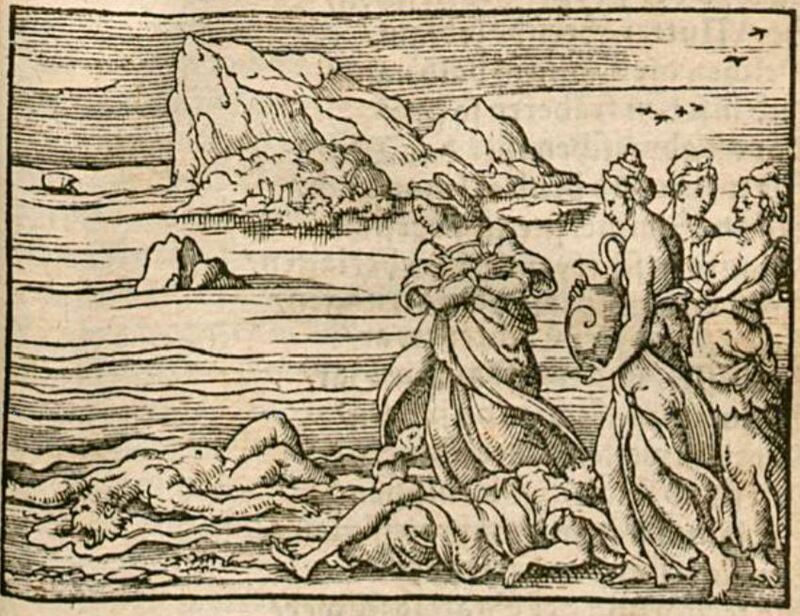
This engraving illustrates Hecuba, the wife of King Priam of Troy, mourning over the loss of her children who had been killed in the Trojan War. She is illustrated standing above her daughter Polyxena’s body, with other Trojan women by her side. While lamenting about Polyxena’s death, a body washed up on the shore. The body is her son, Polydorus, who had been murdered by King Polymestor.

![[Don Quixote and the lion]](https://collections.cemvc.ca/files/large/57ece5b6fe1d02675010ba78ec280f26d9697f22.jpg)
![[The Skeleton of Sancho and Dapple]](https://collections.cemvc.ca/files/large/55960351205a585d8410b2309409d549be5172d5.jpg)
![[An Almost Empty Skin of Wine and a Half-Eaten Meat Pie]](https://collections.cemvc.ca/files/large/169ce97a26d11c6e389fe00b7583b59d78c810e7.jpg)
![[Teresa Panza in the Guise of a Countess]](https://collections.cemvc.ca/files/large/b738132dcbe254af1853173afbdad7276fc34535.jpg)
![[Quixote Hunts the Boar ft. Duke & Duchess]](https://collections.cemvc.ca/files/large/ea4c0ecb9eb0ee9e3e9aaef926a8c48f6c59d574.jpg)
![[Invasion of Barataria Island]](https://collections.cemvc.ca/files/large/4d9de712aed8bf6e3f322d934303bb32dc66299a.jpg)
![[A Lap Dog and her Whelp]](https://collections.cemvc.ca/files/large/979086ebe2ba34c7892ffaacebb69dd7da825d41.jpg)
![[Don Quixote Wakes up Sancho from his Slumber]](https://collections.cemvc.ca/files/large/f1b1142e72d62773698119da61200dc1710b8de8.jpg)
![[Sancho Panza as judge at Barataria Island]](https://collections.cemvc.ca/files/large/fecd1d5a33cc8368e44226f6bde3bed33b9494bc.jpg)
![[Don Quixote reads chivalric books in his library]](https://collections.cemvc.ca/files/large/676717508b4eecf908c4d46fc0d5a664bfda220f.jpg)