Sancho Panza is pictured to the left of the duchess seated on a small stool, he is scruffily bearded and shaggy haired with his right hand on his knee and his right hand gesticulating as he tells his story. The duchess (middle) sits with her hands resting on a regal chair, dressed in a courtly ruffled gown and a jewelled necklace. Behind the duchess stand four of her servants of varying ages.
In the foreground, Sancho Panza kneels before his village (background). Signed by D.-N. Don Quixote, mounted on Rocinante and wearing no armour, observes him. Sancho Panza’s donkey carries the knight’s armour. Chodowiecki (illustrator) and D. Berger (engraver), dated 1779. Plate 16. Part 2, ch. 72.
Don Quixote intends to give Sancho Panza two thousand lashes to discharge the debt that he had assumed. They struggle and Sancho gains the upper hand. He makes Don Quixote promise not to try to whip him. In the background, the bodies of outlaws and bandits hang from tree branches. Signed by Bonard (illustrator), no given name, and L. Cars (engraver). Part 2, ch. 60.
Eight sorrowful people are pictured with veils lifted up over their head. Their faces are all planted with beards, some red, some black, some white, and some piebald. The image is occasioned by countess Trifaldi telling her duenna's to lift their veils and revealing their beards.
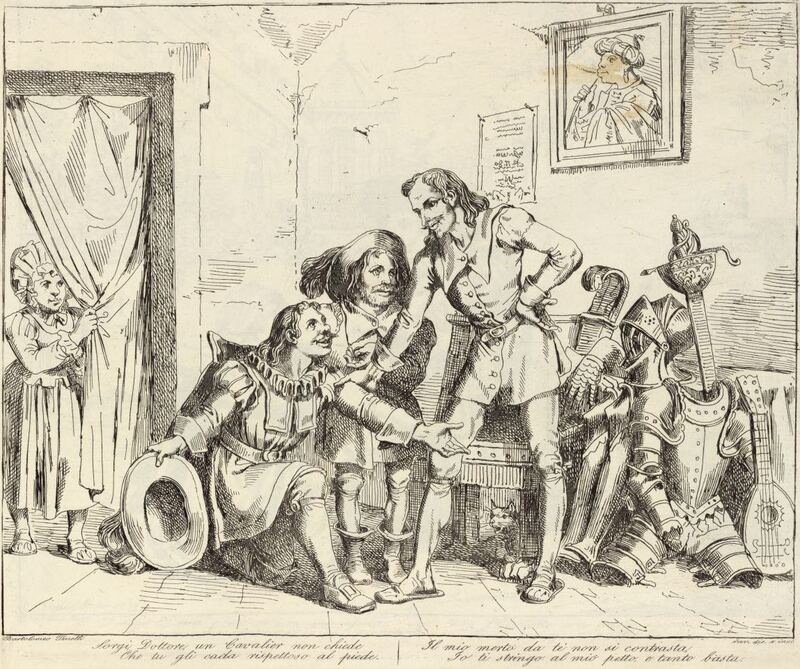
Sansón Carrasco arrives at Don Quixote’s house and kneels before the knight. He has come to tell Don Quixote and Sancho Panza about the publication of the story of the first part of their adventures. Signed by Bartolomeo Pinelli (engraver and illustrator) and dated Rome, 1833. Plate 38. Part 2, ch. 3.
Beneath a cork tree, Cardenio (middle) tries to attack Sancho Panza (left), but is restrained by a shepherd (background). Cardenio is wearing ragged clothes and raises his fist towards Sancho who he he has just knocked to the ground. Sancho lands on his master Don Quixote, who is adorned entirely in armor save for his helmet.
Don Quixote (left) clad in an iron breastplate, oversees a fencing match between Corchuelo (right) and a licentiate (middle), his right hand behind his back and his left hand stroking his beard pensively. The licentiate, with a graceful motion of body and measured step, holds his left hand behind his back and looks towards Quixote was making Corchuelo look trite. Corchuelo attacked like an enraged lion ; but was met with a smart tap on the hat from the button of the licentiate's foil, making it fall to the ground. Corchuelo's apparel was also torn for the licentiate, by dint of clean thrusts, counted him all the buttons of a little cassock he had on, and tore the skirts, so that they hung in rags. In the background, Sancho and the two countrymen, served as spectators of the match.
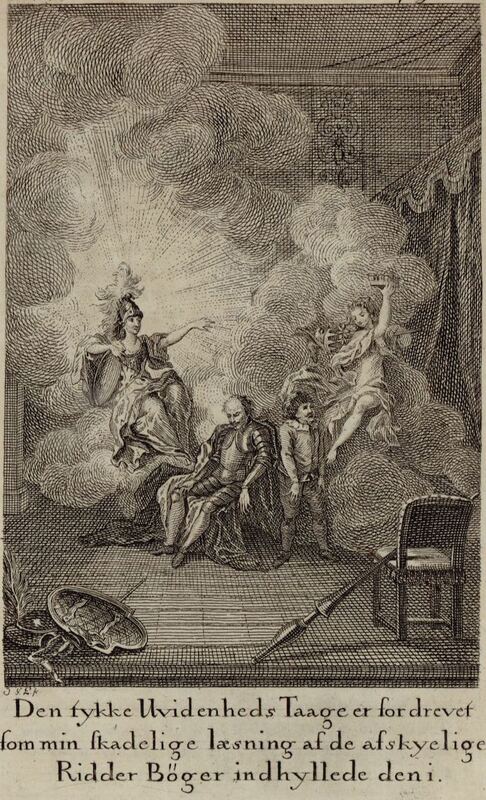
The illustration is an allegorical representation: Don Quixote, asleep, is protected by Wisdom (figure of Athena appearing between clouds). Sancho Panza is captivated by Folly, who shows him a crown and a castle (representing the promised governorship of an insula. Signed by J. G. Preisler (engraver). Part 2, ch. 74.
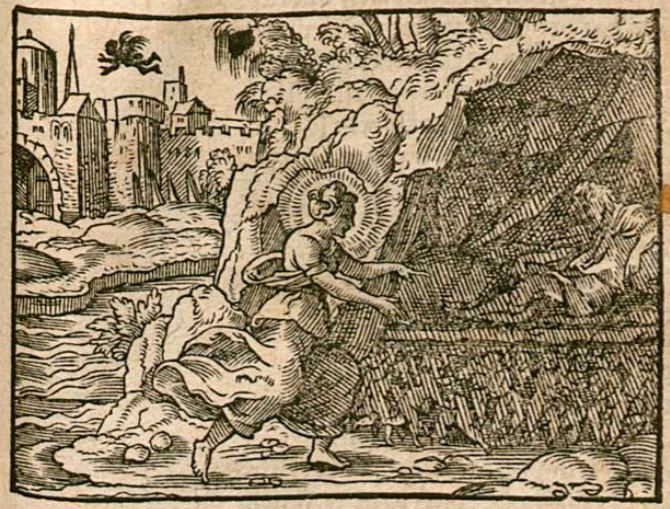
This engraving depicts Iris, the messenger of the Gods, entering the cave of the god of sleep. The god of sleep is illustrated laying on a bed of ebony on the right side of the image which is veiled by a dark-grey sheet. Iris was sent to seek out the god of sleep by Juno. Juno wishes for the god to appear to Alcyone in a dream to reveal that her husband, King Ceyx of Thessaly, has died in a shipwreck. Iris is depicted pulling back the veil to reveal the god of sleep.
Miguel de Cervantes Saavedra, imprisoned and writing Don Quixote’s story. Signed by A J.-J.-M. Devéria (illustrator) and P. J. A. Vallot (engraver). Prologue.
Sancho Panza, governor of Barataria Island, orders that a staff be broken, spilling the coins that were hidden inside. The plaintiff and the defendant stand to the left, while in the background a man and a woman wait for the next judgement. Signed by Bonard (illustrator), no given name, and L. Cars (engraver). Part 2, ch. 45.
Thetis, the mother of Achilles, is depicted standing on the right side of the engraving as she approaches the blacksmith god, Vulcan. Thetis sought out Vulcan as she wanted him to forge special weapons and armour for Achilles to protect him in war. Vulcan is depicted forging a helmet as he sits at his workstation. There is a cuirass that had already been forged resting on the ground in front of Vulcan.
Don Quixote and Sancho Panza encounter a cart with flags led by mules and a man sitting upon the forepart. Don QuixoteQ halts the cart and asks what the cart's purpose is and what it holds within it. The carter answers that the cart is his own and he's keeping two fierce hungry lions within the cart which he's bringing to the king as a gift from the General of Oran. Sensing an opportunity to test his bravery, Quixote intimidates the lion keeper into opening the lion's cage so he may slay the beast. Fearing that Don Quixote will do him harm, the keeper (right) assents and opens up the cage while Sancho Panza (background left) flees from the scene, lamenting the death of his master from afar. Once the cage is opened, Don Quixote observes the lion on foot with sword and shield in hand ready to do battle with the lion. The lion shows no interest in Don Quixote nor his bravado and turns his posterior to the knight-errant before lying down in the cage once more.
A woman (the duchess) with short curly hair holds a sheet of paper between her hands and reads the ink penned words. She is wearing a droopy collared dress with a medallion hung across her neck.
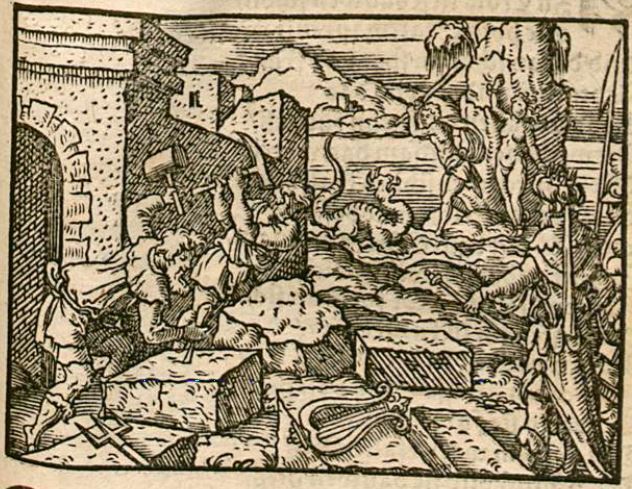
This engraving illustrates the gods Apollo and Neptune in human form on the left side of the engraving with tools in their hands. There are big stones at their feet as they help build the walls of the soon-to-be city, Troy. The trident of Neptune and the lyre of Apollo are resting on the stones beside them. There is a man illustrated in the foreground on the right side of the engraving facing the two gods. This is King Laomedon, who had promised Apollo and Neptune a sum of gold in return for their help to build the walls of Troy. King Laomedon, however, does not keep his word and fails to provide the gods with their payment. Upset by this, Neptune causes a great flood which destroys the country’s crops. To further the punishment, Neptune orders that King Laomedon’s daughter, Hesione, will be tied to a rock and fed to a sea-monster. Hesione is illustrated in the background of the engraving, tied to the rock whilst being rescued by Hercules.
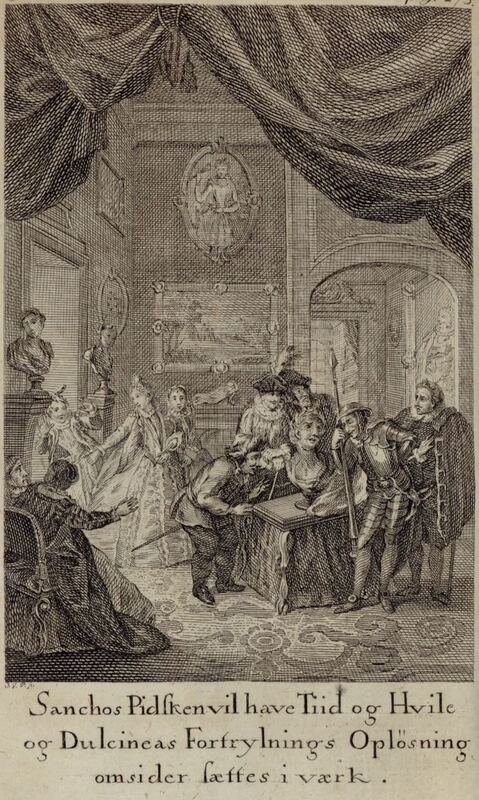
Don Antonio Moreno leads Don Quixote to a side room, where there is a table of jasper on a base of the same material. On it is a bronze bust made in the fashion of Roman emperors. While his friends and Sancho Panza gather in the room, Don Antonio tells Don Quixote that the enchanted head has the property and virtue of responding to any question spoken in its ear. The illustration is finely detailed (paintings, draperies, busts, clothes, rugs). Signed by J. G. Preisler (engraver). Part 2, ch. 62.
Having arrived at Quiteria's wedding, Quixote's company see an arch made from the boughs of an arbour, beneath which stand many musicians with various instruments, as drums, tambourines, psalteries, cymbals, little drums and bells. The musicians go up and down in bands through the street, some dancing, others singing, and others playing upon the different instruments aforesaid. Several others were busied about raising scaffolds, from which they might commodiously be spectators, next day, of the plays and dances that were to be performed in that place.
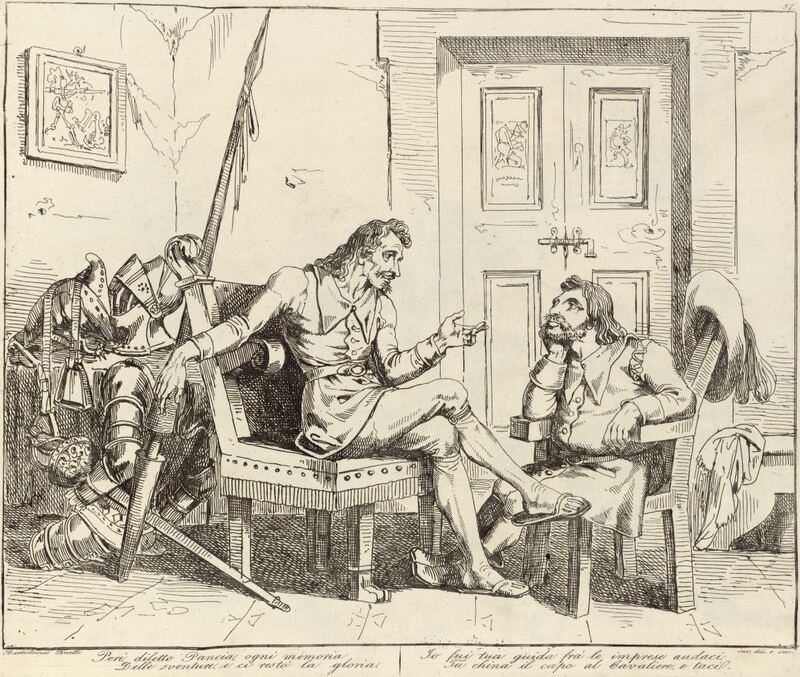
Seated in Don Quixote’s house, the knight and Sancho Panza discuss and reminisce about the first part of their adventures. Don Quixote’s armour, lance, and sword are depicted on a table in the room. Signed by Bartolomeo Pinelli (engraver and illustrator) and dated Rome, 1833. Plate 37. Part 2, ch. 2.
Four men enter a garden, all clad in green ivy, equipped with clubs and bearing on their shoulders a large wooden horse. The image is occasioned by the countess Trifaldi calling for Clavileno the allegedly flying wooden horse.
Having listened to Altisidora's song by the windowsill, Don Quixote clad in an extra large loose white shirt that falls to his knees and a greasy cap upon his head, steps into a bed. Quixote is pictured midway through entering the covers, his right foot planted on the ground and his left foot beneath a thin white blanket.
In the cave of Montesinos, a woman (the Lady Belerma) dressed in white mourning, wearing a large turban with a bushy eyebrows and full lips looks down at what she carries in her hand within a linen handkerchief, that is, the dried heart of Durandarte within (not pictured).
Don Quixote spots a group of people dressed in white in the manner of disciplants. Due to the lack of rain, crops were bare and throughout all of the villages they made procession and public prayers asking for god to bring rain down upon the villages. Perceiving this procession, Don Quixote imagined that they were enchanters who could only be foiled by a knight errant such as himself. His fantasy was only reinforced by the presence of a woman covered in black held aloft by the procession, who Don Quixote assumed was a notable woman being carried away by the "miscreants" and "ruffians". Seeking to save the woman Quixote spurred Rocinante (his horse) towards the procession and accused the nearest disciplant of kidnapping a "noble lady". Sancho Panza (bottom left) runs after his master and futilely cries for Quixote to leave the procession be.
The goatherd ridicules Don Quixote, starting a fight. The knight seizes a loaf a bread from the table and hits the goatherd in the face. The goatherd tries to choke Don Quixote, while people in the crowd prevent Sancho Panza from helping the knight. The vignette is not accurate to the text: the fight is depicted at an inn, whereas it should be set in a natural landscape. Signed by A J.-J.-M. Devéria (illustrator) and A. J. Simonet, jeune (engraver). Part 1, ch. 52.
Having lowered Don Quixote into the cave of Montesinos, Sancho (right) tries to pull his master back up to the surface, leaning backwards and bringing up the rope with all his strength while on his knees. On the left the scholar who guided them towards the cave of Montesinos plants his right hand on the ground and points down into the cave where he can see Quixote (not pictured).
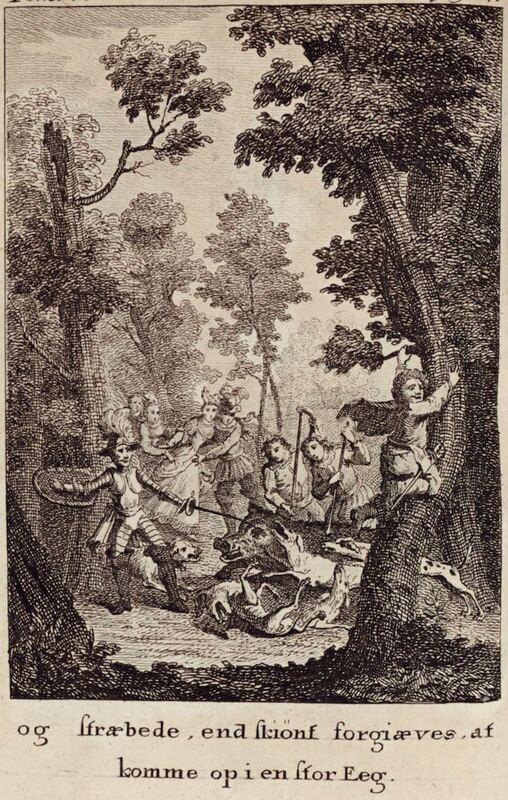
In the foreground, Sancho Panza climbs a tree in fear. In the middle ground, Don Quixote is pictured driving his sword into a wild boar. In the background, the duke embraces the duchess. Also pictured are several hunting dogs. Unsigned. Part 2, ch. 34.

![[Sancho Panza Speaks With the Duchess and her Servants]](https://collections.cemvc.ca/files/large/423a364ff84b7a1fa1f6da06d8482c3570011aa9.jpg)
![[Don Quixote and Sancho Panza return to their village]](https://collections.cemvc.ca/files/large/c055ef4f17d901f76ee7a399f01ddfbf95a885d6.jpg)
![[Sancho Panza fights Don Quixote]](https://collections.cemvc.ca/files/large/6b0ee58cf3840594d4dd747ad0e07d2ac9747224.jpg)
![[The Duennas of Countess Trifaldi Lift Their Veils to Reveal their Beards]](https://collections.cemvc.ca/files/large/cfc20b4d8991911ea591e89c03f5f8ddfbe6fe85.jpg)
![[Cardenio Assaults Sancho and Quixote in a Fit of Rage]](https://collections.cemvc.ca/files/large/fb0285ee8f8f32addac65014feb1ced64928b014.jpg)
![[Of How Quixote Oversaw a Fencing Match]](https://collections.cemvc.ca/files/large/472957b1de27a06fc898bc2f9bd02bc0ae0657b9.jpg)
![[Cervantes imprisoned writing Don Quixote]](https://collections.cemvc.ca/files/large/35a64836c86638449ba9de8bfa983cc7f4c4a958.jpg)
![[Sancho Panza's judgments at Barataria Island]](https://collections.cemvc.ca/files/large/f600ea5a9547d9e1c8c66204c2e4e650957be6d4.jpg)
![[Vulcan Forging Weapons for Achilles]](https://collections.cemvc.ca/files/large/9423c52c9af09b90e6d62d08f828ee377fc7ff06.jpg)
![[Don Quixote Challenges the Lions]](https://collections.cemvc.ca/files/large/d5e1624ed5d6fc846958aa1bb5e0cf9969bb6f35.jpg)
![[The Duchess Reads Sancho's Letter]](https://collections.cemvc.ca/files/large/a533a3003d7ff1f86c7cdff760426bd233619cf6.jpg)
![[The Lavish Entrance to Quiteria's Village]](https://collections.cemvc.ca/files/large/653ef43a2150d9ab3e7c48ffa9ad1d38781e03cd.jpg)
![[The Famous Horse Clavileno Carried Forth]](https://collections.cemvc.ca/files/large/a069ee63bfc56ba3955ed7e03b61cdd0de7dbe1f.jpg)
![[Don Quixote Descends Into His Bed]](https://collections.cemvc.ca/files/large/7bc65165e767ba0c6babcb2b501b9ab519cf3b7c.jpg)
![[The Lady Belerma Herself]](https://collections.cemvc.ca/files/large/09697a84f92e9e0aa01a5e6f39c092e6f471db2f.jpg)
![[Don Quixote Encounters a Procession of Disciplants]](https://collections.cemvc.ca/files/large/8371c02087e965985c770aa468432ab399262cba.jpg)
![[Don Quixote's quarrel with the goatherd Eugenio]](https://collections.cemvc.ca/files/large/1d249cc96cfcb3c9e5f083710b4817085ecc35f3.jpg)
![[Sancho Gathers Up the Rope]](https://collections.cemvc.ca/files/large/6e1e89f713a76b12175e2bdbf5a6b5da9f6d4339.jpg)