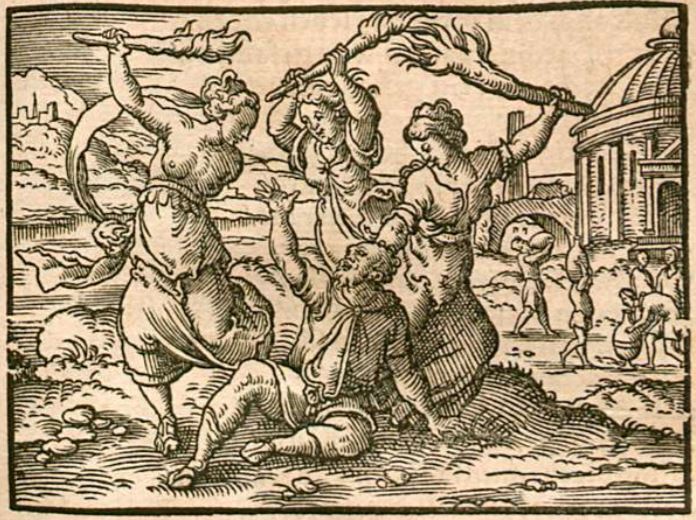
This engraving illustrates the Bacchantes, frenzied women who worship the god Bacchus, seconds away from ripping Pentheus apart. Pentheus, the prince of Thebes, disrespected Bacchus by not believing in him and did not want to participate in the festival held in his honour. Pentheus’ punishment for his hubris was to be murdered by his own mother and two aunts. The woman in the engraving who is holding onto Pentheus’ head is his mother, Agave, who will rip his head off his body. The other two women are his aunts Ino and Autonoë, who will rip his arms off. The city in the background represents the city of Thebes.
Pictured on the right on an elevated throne upon a drawn cart sits a young woman clad in a veil of silver tissues. To her right stands a figure arrayed in a gown of state, which reaches his feet, his face is that of a skeleton's, without flesh and skin. This living Death lifts his right hand which holds an ivory rod that he takes for a wand, and speaks with heavy words to Don Quixote (not pictured).
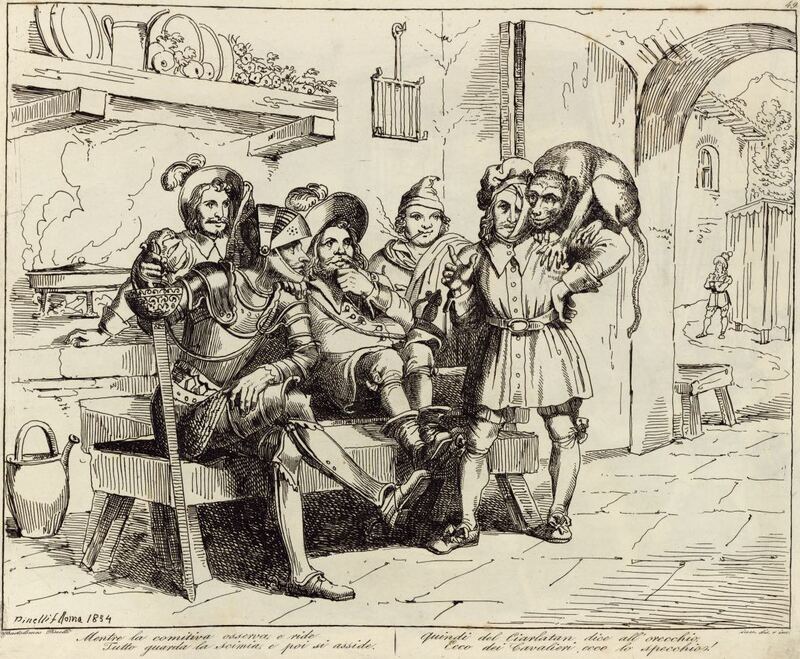
At the inn, Maese Pedro pretends to know the answers to Don Quixote and Sancho Panza’s questions. He claims that the monkey knows the answers, and whispers them in his ear. Also pictured are the bachelor’s cousin and the innkeeper. Signed by Bartolomeo Pinelli (engraver and illustrator) and dated Rome, 1833. Plate 49. Part 2, ch. 25.
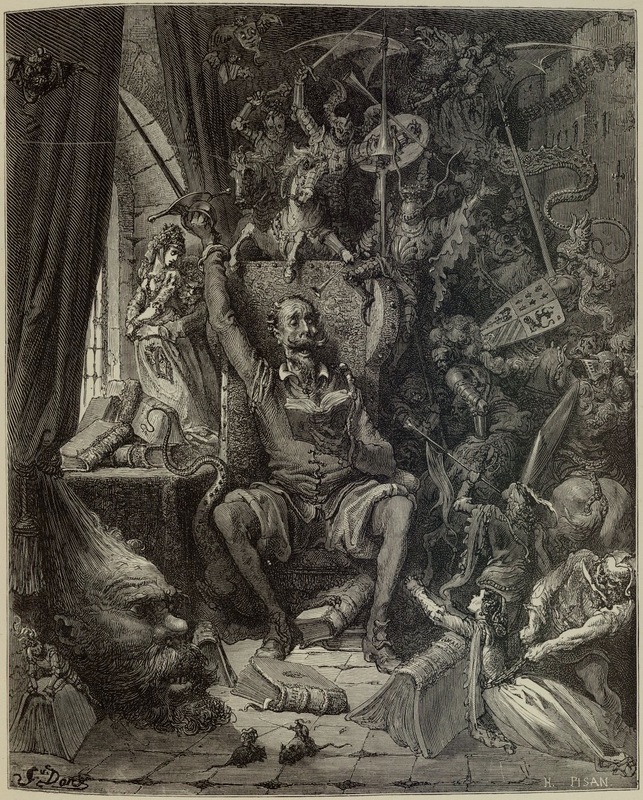
While Don Quixote reads chivalric novels, his library fills with figures of errant knights, maidens, dragons, castles, and coats of arms. In the right foreground, the bottom of a curtain is tranformed into a giant’s head. The illustration masterfully combines reality (Don Quixote reading in his library) and fantasy (adventures, knights, and all other figments of his imagination). Signed by G. Doré (illustrator) and H.-J. Pisan (engraver). Part 1, ch. 1.
A mitre (right) and a crown (left) with a cross at its peak rest upon the ground before a lavishly engraved staff. The image is occasioned by Sancho Panza (not pictured) mentioning to the Squire of the Woods that his master "is a mere layman, though I remember some discreet persons (but in my opinion with no very good design) advised him to endeavour to be an archbishop. He wisely rejected their counsel. and would be nothing but an emperor, and I trembled all the while, lest he should take it into his head to be of the church, because I am not qualified to hold ecclesiastical preferments." The image illustrates the possible objects of Quixote's desire.
Don Quixote and Sancho Panza are mounted on Clavileño, the famed wooden horse. Servants simulate its flight with bellows and torches. The duke and the duchess, to the right, look on. Signed by Bonard (illustrator), no given name, and L. Cars (engraver). Part 2, ch. 41.
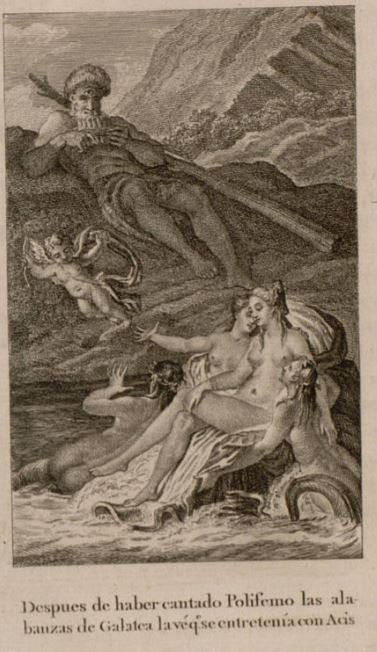
This image depicts the water nymph Galatea sitting on a rock surrounded by other nymph companions as she tells a story about her lover Acis. As she talks about her lover, the cyclops Polyphemus overhears her and becomes outraged with jealousy because he was in love with Galatea. Polyphemus is depicted at the top of the image watching over Galatea as she talks about Acis. Polyphemus becomes so jealous of Acis that he kills him by throwing a boulder at him.
Two men stand in a dark room with a thick bundle of hay in their left hands, poised to flog an elderly woman on the right in the white habit and spectacles. The two notable faces in the image are the man in the middle who appears to be smiling and the woman on the right who opens her mouth out of fear.
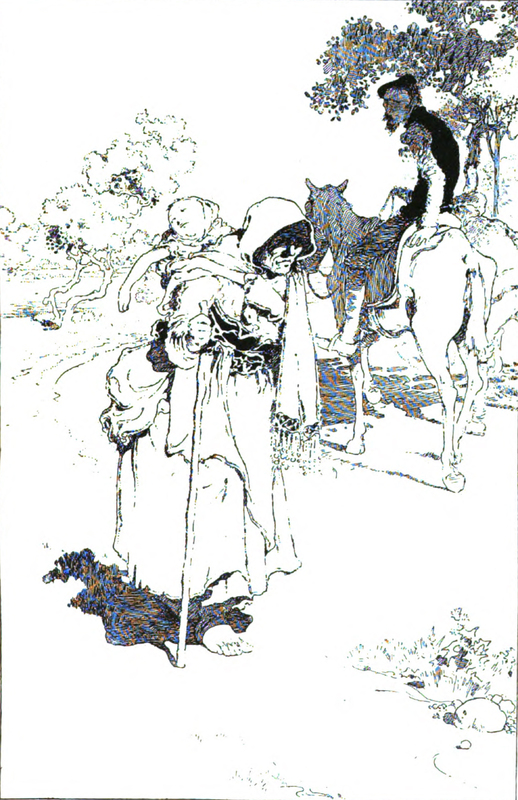
Don Quixote and Sancho Panza return to their village, nearing the end of their journey. That day and night of travelling pass without any events worth relating save that in the day Quixote used the light to try and find his lady, the disenchanted Dulcinea in his way. And as they continued along the road back to his village, Quixote looked narrowly at every woman he met, to see if she were Dulcinea del Toboso, holding it for infallible that Merlin's promises (that Quixote would undo the enchantment upon Dulcinea) would not lie.
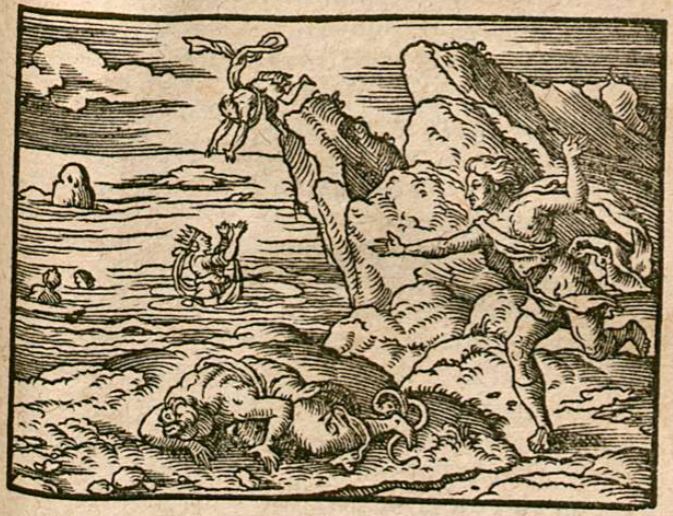
This engraving illustrates Aesacus, a son of King Priam of Troy, chasing a nymph named Hesperie. Aesacus fell madly in love with Hesperie and often pursued her. During one of his pursuits of the nymph, Hesperie fell prey to a snake hiding in tall grass. The bite from the snake was fatal and killed her. The illustration shows Hesperie on the ground with the snake by her ankles and Aesacus running after her. Blaming himself for her death, Aesacus threw himself from a cliff which is depicted in the background of the engraving. The sea-goddess, Thetis, pitied Aesacus and transformed him into a loon just before he hit the water. Thetis is visible in the water in the background of the engraving with her hands pointing up towards Aesacus as he falls.
Being set upon his donkey by those of the braying village who had knocked him out to begin with, Sancho Panza suffered to follow his master, and rested his head against his hand which had his hat in hand, his left hand dangling from the side of Dapple. Its master unfit to guide, Dapple naturally followed Rocinante's steps and carried Sancho as it pleased without a hand on the reins.
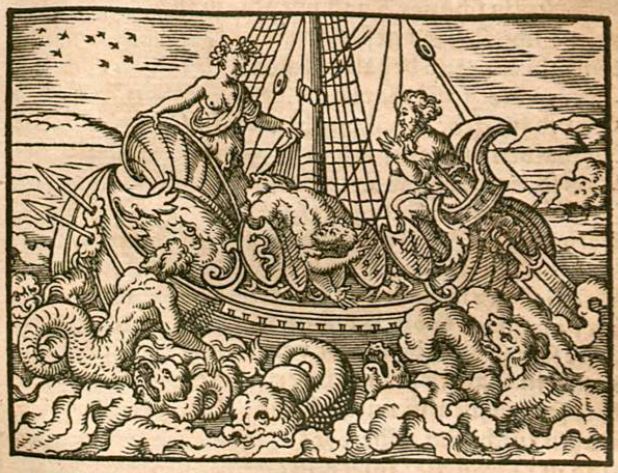
This engraving illustrates Bacchus punishing a ship of men due to their disrespect towards him. Actoetes is recounting this story to Pentheus, the prince of Thebes, who is being disrespectful towards Bacchus. Actoetes tells him this story to prove to him that Bacchus is entitled to being worshipped just as any other god. The story involves Actoetes and his sailor companions on a ship being turned into dolphins by Bacchus, who is depicted standing upright on the ship with a laurel wreath on his head. The sailors were unaware that they were in the presence of Bacchus, as he was disguised as a young boy until he finally revealed himself after all the disrespect he received. The only person he did not punish on the ship was Actoetes. The men are depicted falling off the ship as they transform into dolphins.
Don Antonio Moreno leads Don Quixote to a side room, where there is a table of jasper on a base of the same material. On it is a bronze bust made in the fashion of Roman emperors. While his friends and Sancho Panza gather in the room, Don Antonio tells Don Quixote that the enchanted head has the property and virtue of responding to any question spoken in its ear. Signed by Bonard (illustrator), no given name, and L. Cars (engraver). Part 2, ch. 62.
Don Quixote looks to the right, the majority of his head covered in bandages from his head to his chin. Only his eyes, brow, nose, moustache and mouth are visible along with a single tooth. For clothing he wears a white collared shirt that hangs loosely over his shoulders.
Montesinos kneels before Don Quixote at Durandarte’s tomb. The knight describes this scene when telling the story of his adventure in Montesinos’ cave. Signed by A J.-J.-M. Devéria (illustrator) and A. J. Simonet, jeune (engraver). Part 2, ch. 23.
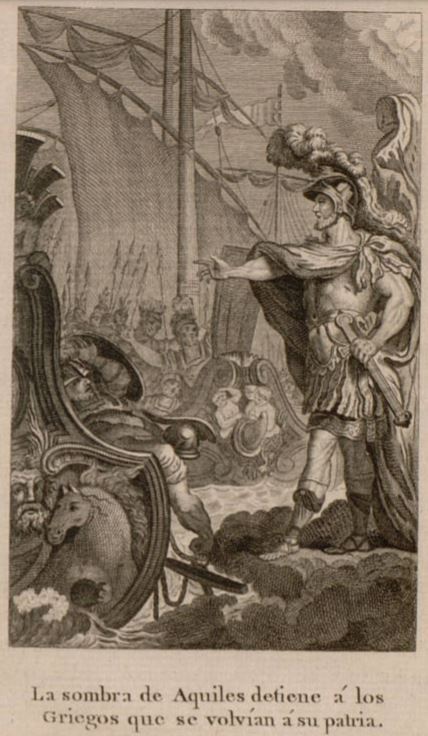
The ghost of Achilles is depicted on the right side of the image in his full suit of armour holding his arm out to stop the ships in front of him. Achilles had died in the Trojan War, and when the Greeks returned home, Achilles’ ghost appeared to them and demanded a sacrifice in his honour for his bravery throughout the war. The Greeks end up sacrificing Polyxena, the daughter of King Priam of Troy.
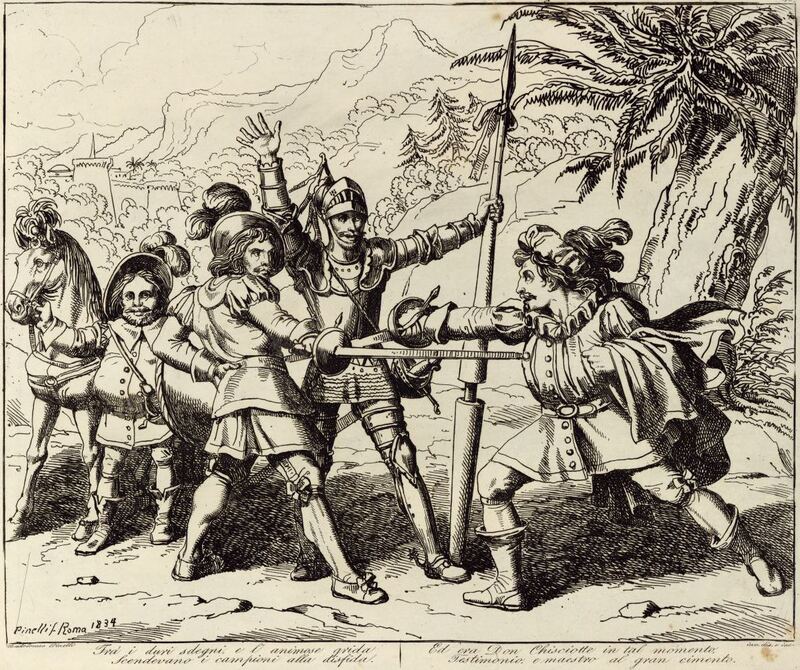
In the foreground, Don Quixote judges a fencing duel between Corchuelo and another student. Also pictured is Sancho Panza (left). Signed by Bartolomeo Pinelli (engraver and illustrator) and dated Rome, 1833. Plate 46. Part 2, ch. 19.
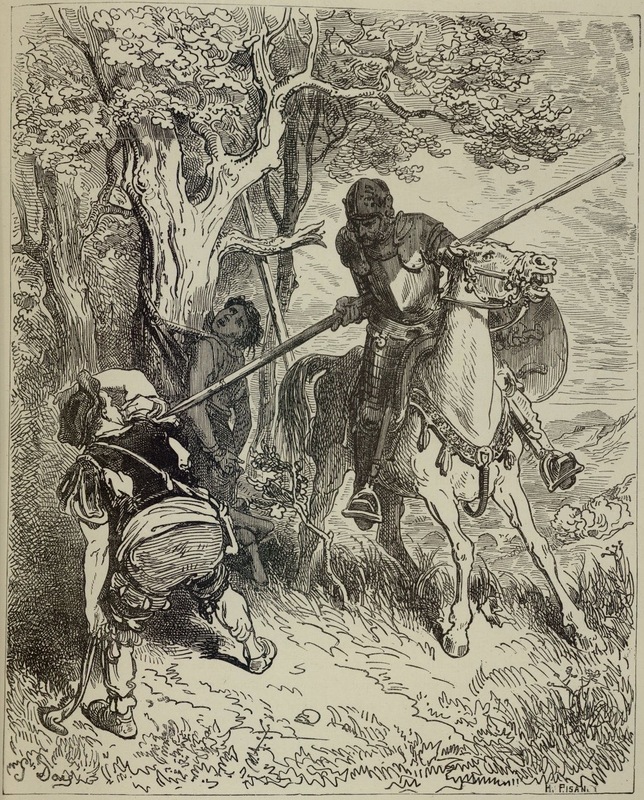
Don Quixote, mounted on Rocinante, discovers Juan Haldudo reprimanding and whipping Andrés with a leather strap. Don Quixote brandishes his lance over Juan’s head and orders him to take his lance and defend himself (there is a lance leaning against the oak to which Andrés is tied in the background). Signed by G. Doré (illustrator) and H.-J. Pisan (engraver). Part 1, ch. 4.
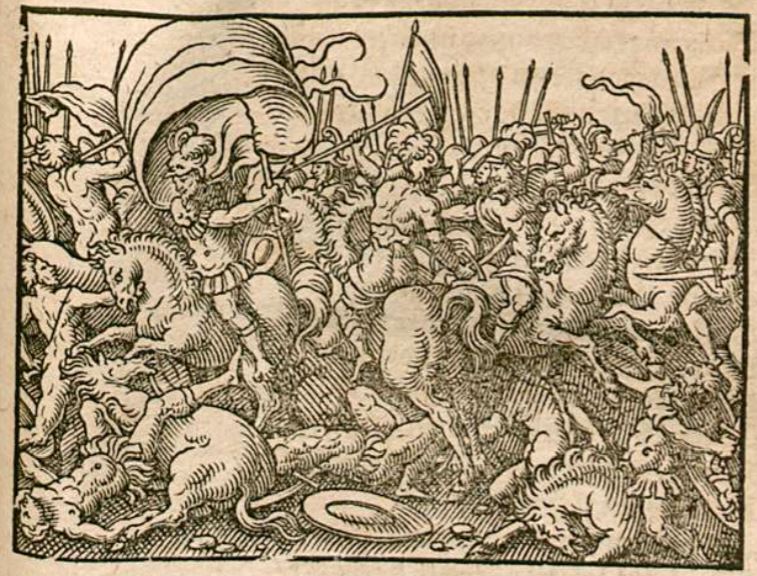
This engraving illustrates the pure chaos of the first battle between the Greeks and the Trojans. This battle signifies the beginning of the Trojan war, as it is the first encounter the two armies have with one another. Protesilaus is the first Greek to step onto the shores of Troy, as well as the first to die. He is most likely one of the men in the forefront of the engraving who are depicted to have been slain.
Having arrived in the city of Barataria, the bells are rung, and, with all the demonstrations of a general joy and in great number the people conducted Sancho to their church. The doors of the church are opened wide as a large procession of people enter in celebration of their new governor.
In regaling Sancho with the story of his descent in to the cave of Montesinos, Quixote speaks of how he met the knight Durandarte in depths of the cave. Durandarte (right) clad in armor, lies on an elegant tomb engraved with angels on its side, his head resting on a pillow. On his knees, an old man in dark robes, a cap on his head and a long beard speaks to Durandarte passionately, his arms convincingly by his side. Don Quixote, clad in armor, listens to the conversation between these two men, looking down into the eyes of Durandarte.
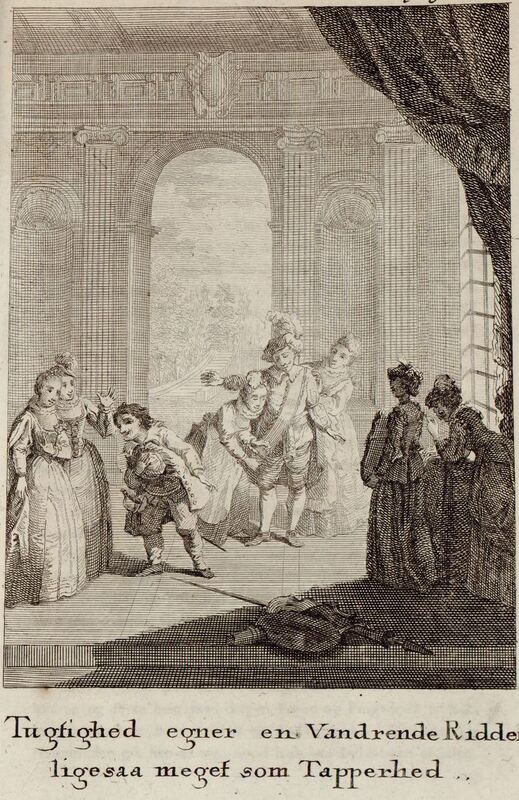
The illustration is richly detailed (architecture, clothes, draperies, gardens) but is not accurate to the text: Cervantes writes that Don Quixote was undressed by the duchess’ maidens, but dressed himself alone with Sancho Panza. Unsigned. Part 2, ch. 31.
Three children sit against a wall, the boy on the right stretches his legs with his right shoe dislodged, the boy in the middle eats some morsel and the girl on the left rests against her brother's back. They are the children of the Squire of the Woods. The image is occasioned by the Squire of the Woods saying "Really and truly, Signor squire," answered he of the Grove, " I have resolved and determined with myself to quit the frolics of these knights-errant, to get me home again to our village, and bring up my children, for I have three, like three oriental pearls."
A man rides a broomstick which is carried by a devil on each end. In the background in the distance lies the city of Madrid. The image is occasioned by Don Quixote saying "remember the true story of the licentiate Torralva, whom devils carried through the air, riding on a cane, with his eyes shut. In twelve hours he arrived at Rome, and alighted atthe tower of Nona, which is a street of that city, and saw all the tumult, assault and death of the constable of Bourbon ; and the next morning he returned to Madrid, where he gave an account of all he had seen." (Page 437)
Sancho Panza sits atop Rocinante at the entrance of the inn in Toboso with his arms raised by his shoulders defensively. He is being questioned by the barber (foreground) and the priest (background) about why he is riding on Quixote's horse. The barber raises his right hand in accusation and with his left hand grasps his sword, accusing Sancho of murdering Quixote and stealing his belongings. Sancho denies these accusations and tells the two men that Quixote is partaking in penance within the mountains, and that as a squire he has been tasked with delivering a message for Dulcinea Del Toboso on his master's behalf.

![[The Man Who Claimed to be Merlin]](https://collections.cemvc.ca/files/large/bb02e000156a57995c1b7ff4d7f75fb04a6222df.jpg)
![[An Archbishop's Mitre and an Emperor's Crown]](https://collections.cemvc.ca/files/large/e858a82dbae62c32963746f7c5ea67291a7e9985.jpg)
![[Don Quixote and Sancho Panza mounted on Clavileño]](https://collections.cemvc.ca/files/large/5393b8a6ab3da7ab82896990e46bdac86388f7a5.jpg)
![[The Flogging of Duenna Rodriguez]](https://collections.cemvc.ca/files/large/a16d663969221eb21865b9d275bda3fda9bbc057.jpg)
![[Of How an Unconscious Sancho Panza was Carried Away by his Donkey]](https://collections.cemvc.ca/files/large/43a28144ae0fc490ff16961827b2496e894eca51.jpg)
![[Episode of the enchanted head]](https://collections.cemvc.ca/files/large/2950dda41a7ca118254756c70d95c79ddf6f2cd8.jpg)
![[Don Quixote's Bandaged Face in Profile]](https://collections.cemvc.ca/files/large/381b581da2e946476c5799daa268d43e01d64b23.jpg)
![[Don Quixote and Montesinos at Durandarte's tomb]](https://collections.cemvc.ca/files/large/fface348815897c7400eeedaff4626f6407d3d63.jpg)
![[Sancho's Arrival at Barataria's Church]](https://collections.cemvc.ca/files/large/883850929d693ed4cfe22f8e9153a9487cdc1b4a.jpg)
![[Don Quixote Meets Durandarte]](https://collections.cemvc.ca/files/large/dcfa2cbef73c89e1780d6d98b58ea40696441244.jpg)
![[The Squire of the Woods' Children]](https://collections.cemvc.ca/files/large/24d75d3b0a0ef2f7cb1e4831a73d33bf2c41e192.jpg)
![[Devils Carry the Blindfolded Licentiate Torralva on a Broom]](https://collections.cemvc.ca/files/large/148b0570373d5b5ce4418976239a56f9444f8ca4.jpg)
![[The Priest Questions Sancho Panza as to the Location of his Master Don Quixote]](https://collections.cemvc.ca/files/large/a5193b59690ec8af032236bd23a5e896cfc78a5f.jpg)