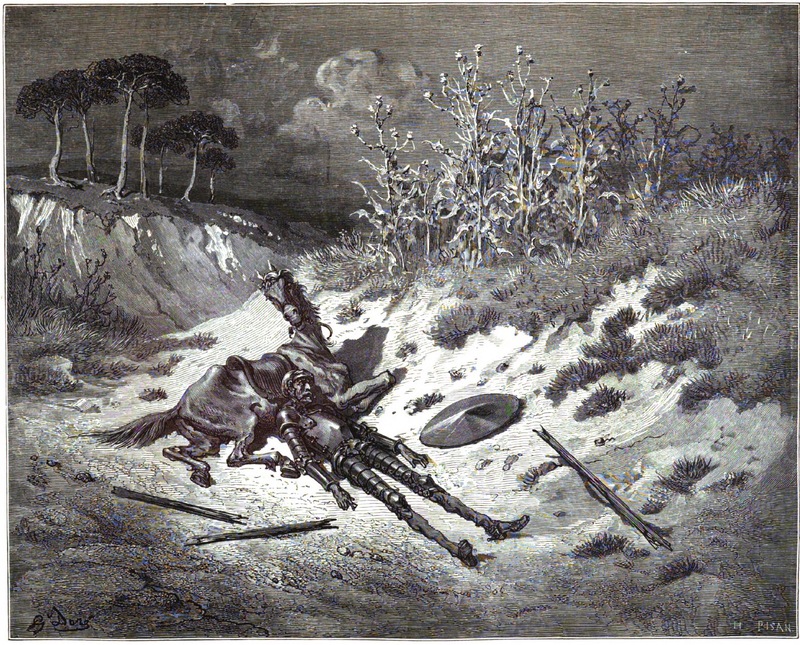
Don Quixote lies wounded from his beating from the muleteer. Unable to think of a method used by the knights in his stories to cure himself, he sings an old song from the tale of Baldwin and the Marquis of Mantua, the same song which Baldwin is supposed to have sung while lying wounded in the forest. Don Quixote lies propped up against Rocinante, his broke lance at his feet. This scene can be found in Part I, Book 1, Chapter 5.
Don Quixote holds a mandoline in his chamber by a window looking out into the night. He strums the instrument, and looking out the window into a garden sings for the people walking outside. Of particular note is his white mantle hanging from his shoulders to his knees and the use of his right elbow to lean against the windowsill as he performed.
Five cats, released from a bag, find their way into Quixote's room and scramble about. The knight-errant slashes wildly with his sword in his right hand thinking the cats to be invading necromancers; in his left hand Quixote holds a lighted candle, knocking over a table in assault. One cat attaches itself to his nose and scratches his face. On the right, a cat jumps out the window where a hanging row of bells jingle. Next to the window, Quixote's shield hangs askew.
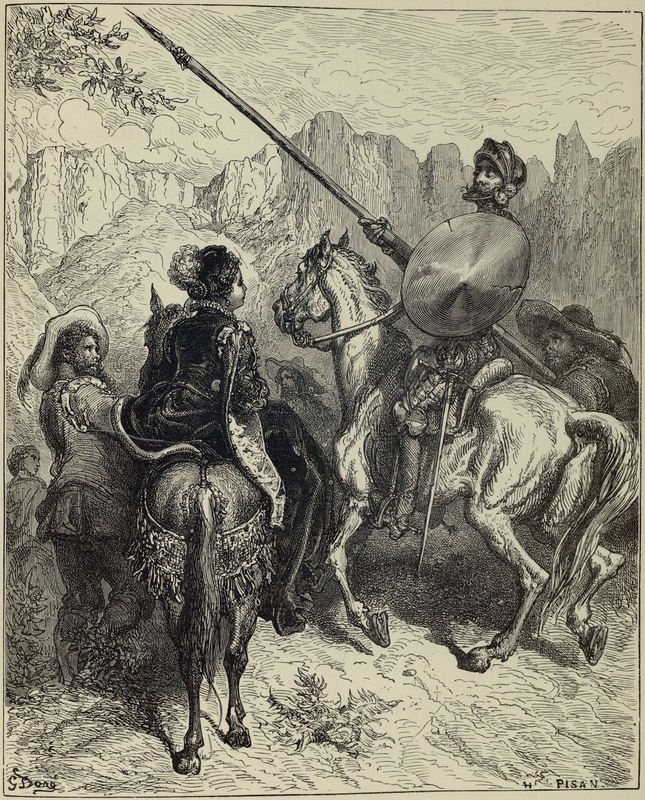
Don Quixote, princess Mimicona (Dorotea), Cardenio, Sancho Panza, the priest, and the barber prepare to leave Sierra Morena. Signed by G. Doré (illustrator) and H.-J. Pisan (engraver). Part 1, ch. 29.
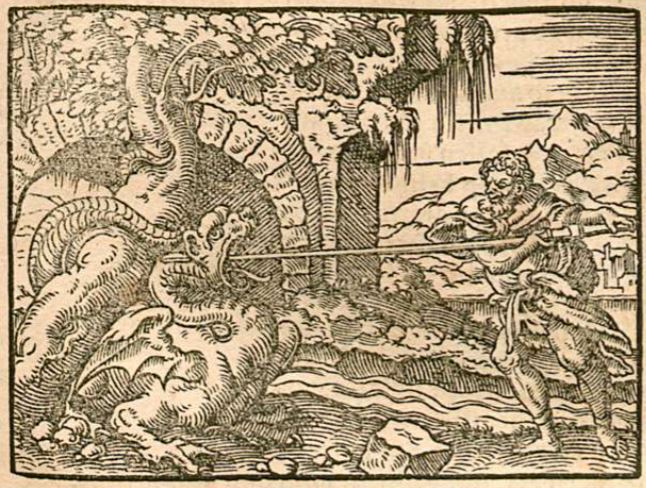
This image depicts Cadmus, the founder of Thebes, on the right side of the engraving with a long spear grasped within his hands. Cadmus is thrusting the spear into the mouth of the serpent to slay it. The serpent belonged to the god Mars. Cadmus kills the serpent for revenge because the beast had killed his companions.
Second representation of the same subject: Don Quixote reading chivalric books in his library (see title page). Alonso Quijano descends into madness, while in the background an errant knight is pictured fighting against giants and monsters to save a princess. It is unclear whether this is a painting on the wall or Don Quixote’s imagination. Signed by A. ‘Bertall’ d’Arnoux (illustrator) and C. Maurand (engraver). Part 1, ch. 1.
On the right, master Peter, a bearded man with an eyepatch ran and kneeled before Don Quixote who sat on a chair, clad in armor and, embraced his legs having dropped his walking stick in the foreground. Master Peter's monkey sits on the right and looks backwards towards his master. On the left Sancho Panza stands behind his master behind the table.
During the invasion of Barataria Island, governor Sancho Panza, is tied between two planks, which, in Cervantes’ text, are shields. He is armed and watches several men fighting below with swords and torches. Unsigned. Part 2, ch. 53.
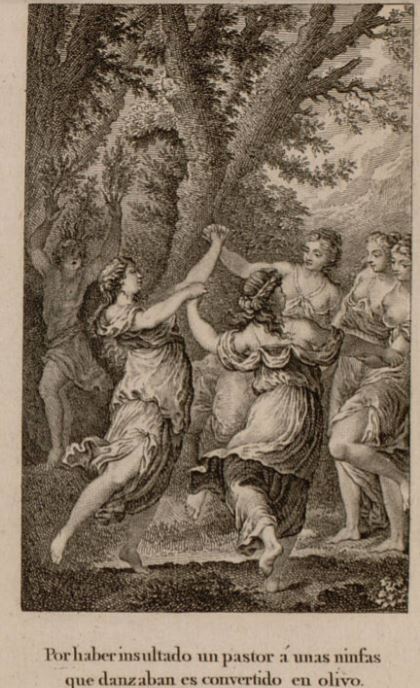
This engraving depicts a group of nymphs gathered in a circle dancing and skipping. The nymphs had been approached by a shepherd from Apulia and began to mock them by imitating their dancing and cursing at them. As punishment, the nymphs transformed him into an olive tree. The shepherd in his transformed state is illustrated in the background of the engraving on the left side of the image. The nymphs continued to dance and enjoy themselves after the transformation of the shepherd.
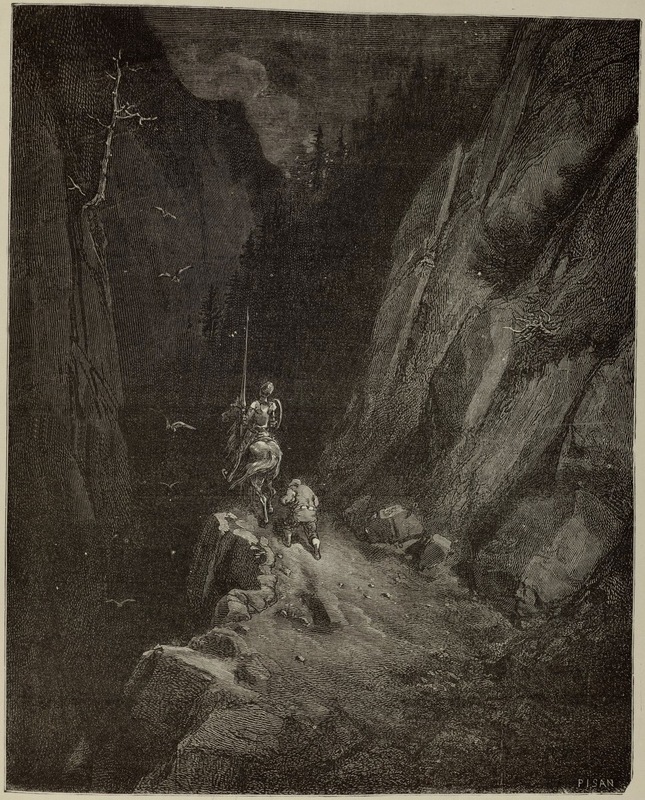
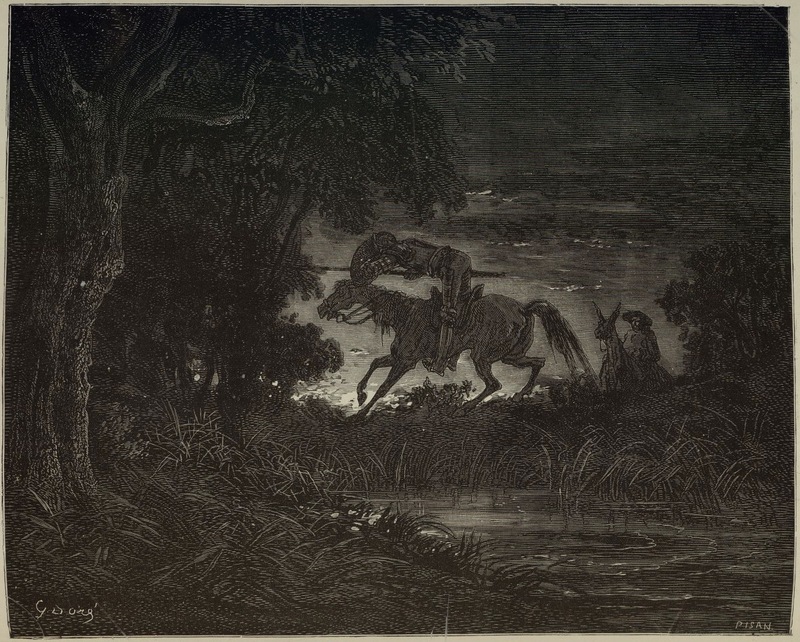
As night falls, Don Quixote and Sancho Panza cross Sierra Morena, following a narrow path surrounded by high crags and deep precipices. In Cervantes’ text Sancho’s donkey has not been stolen yet, but Doré has not represented it. Signed by G. Doré (illustrator) and H.-J. Pisan (engraver). Part 1, ch. 23.
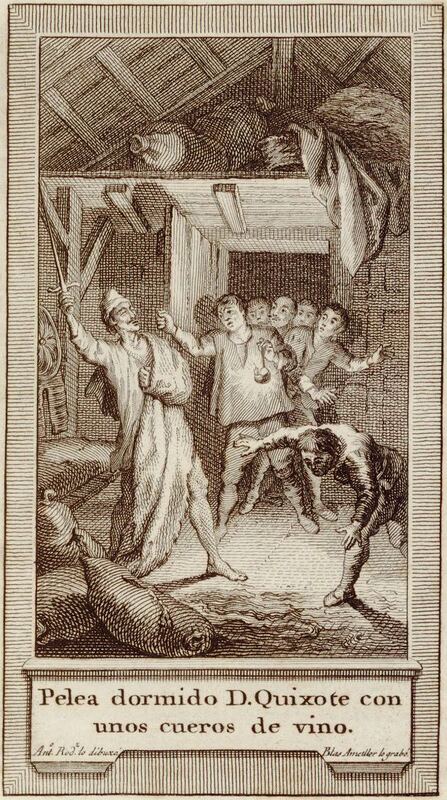
In the attic of the inn, Don Quixote attacks the wineskins while sleepwalking. He is half-dressed, has a blanket draped over his arm, and wields his sword. The innkeeper bursts into the room, followed by the priest, the barber, Sancho Panza, and Dorotea. The innkeeper clenches his fist, preparing to hit Don Quixote. The wine from a punctured wineskin spills onto the floor in the foreground. Signed by A. Rodríguez (illustrator) and B. Ametller (engraver). Part 1, ch. 35.
A woman in a long flowing dress stands atop a round pinnacle, a metal helmet on her head. In her left hand she holds aloft a long cross with a round flag waving by its middle. Both her and the object she is standing on are surrounded by billowing clouds. This image is occasioned during the discussion between the Knight of Mirrors and Don Quixote, when Quixote says "In short, Sir knight, I would have you to know that my destiny, or rather my choice, led me to fall in love with the peerless Casildea de Vandalia; peerless I call her, not so much on account of her stature as the excellency of her state and beauty."
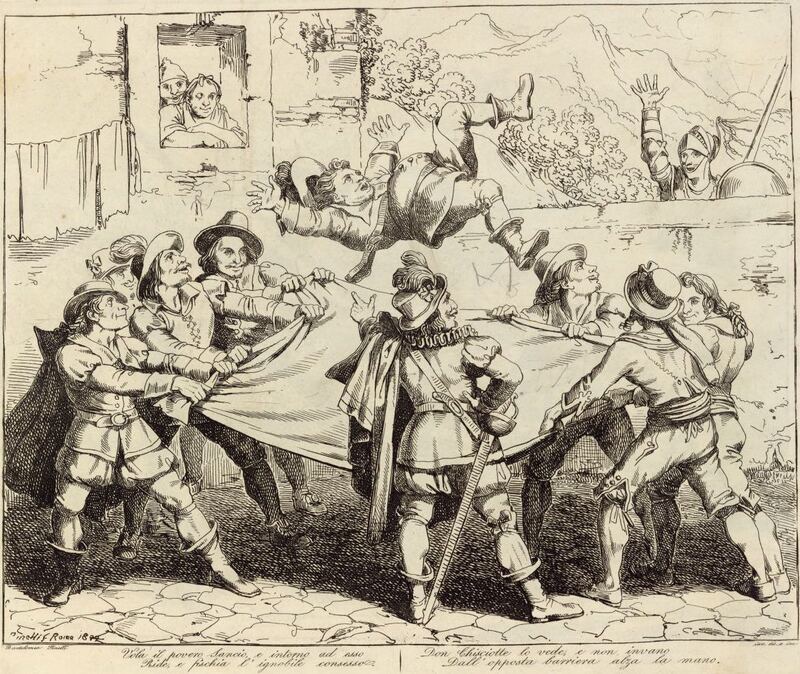
When Sancho Panza refuses to pay the innkeeper, guests at the inn toss him in a blanket in the courtyard and make merry with him. Among the guests are four wool carders from Segovia, three needlemakers from El Potro in Córdoba, and two residents of La Feria in Sevilla. In the background, Don Quixote looks on from behind the inn wall, while Maritornes watches from a window. Signed by Bartolomeo Pinelli (engraver and illustrator) and dated Rome, 1833. Plate 23. Part 1, ch. 17.
Don Quixote (left), clad in armor, equipped with lance and shield, and mounted atop a horse enters the castle of the duchess alongside Sancho Panza (right) who rides by his side upon his donkey. From within the archway of the castle a man on the right greets the two men with a wave of his hand. Quixote and Sancho surrounded by young boys and girls as a crowd of people gathers behind them.
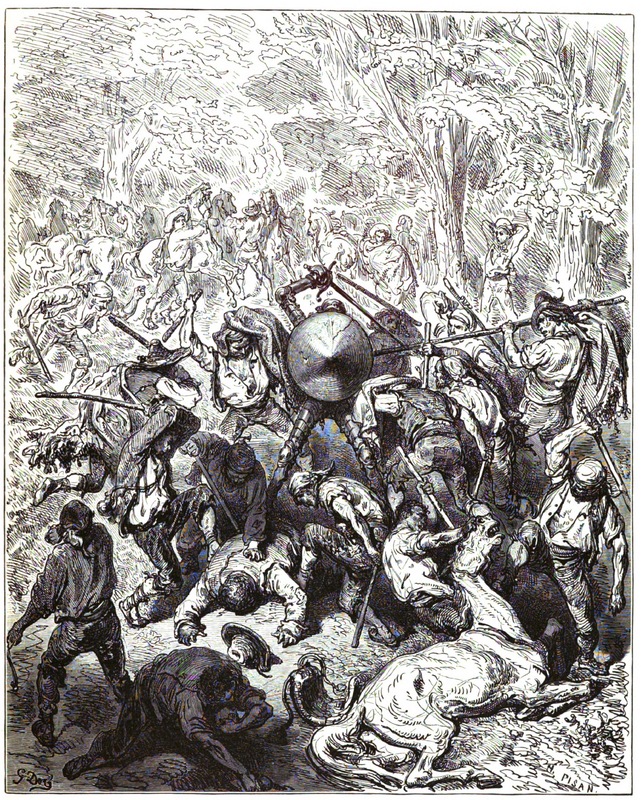
After the stallion Rocinante approaches a group of mares nearby, he is attacked by both the mares and their Yanguesan owners. Don Quixote and Sancho Panza rush to defend Rocinante but are quickly beaten by the many Yanguesans who force them into the middle and attack them from all sides. This scene can be found in Part I, Book 3, Chapter 1.
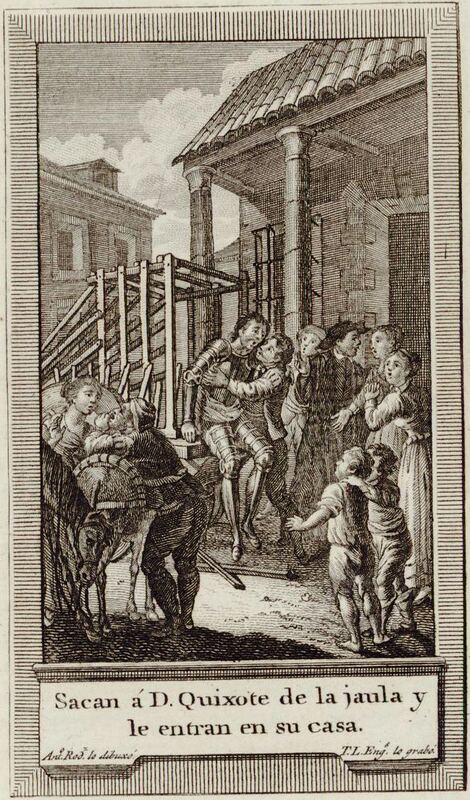
After a long journey, Don Quixote, Sancho Panza, the barber, the priest, and Rocinante reach their village. They enter the village square on a Sunday at noon. At the news of their arrival, Teresa Panza comes running to welcome her husband. The barber is pictured helping Don Quixote out of the cage while the priest talks to the housekeeper and the niece. Signed by A. Rodríguez (illustrator) and T. Enguídanos (engraver). Part 1, ch. 52.
At night, Don Quixote and Sancho Panza hear the frightening sound of rhythmic pouding, along with the clanking of irons and the clamorous fury of falling water. The knight, finding strength in his intrepid heart, leaps on Rocinante and tells Sancho to wait no more than three days for him while he embarks on an adventure to discover what is causing the sounds. Signed by G. Doré (illustrator) and H.-J. Pisan (engraver). Part 1, ch. 20.
In the foreground, the fallen Don Quixote and Rocinante are defeated by the Knight of the White Moon (Sansón Carrasco) on the beach in Barcelona. Sancho Panza, Don Antonio Moreno, and the viceroy look on. In the background, the galley and tower of Barcelona are pictured. Unsigned. Part 2, ch. 64.
This image appears at the beginning of the fifteenth book. The centre of the image depicts a circular tablet that has a side portrait of Julius Caesar, whose story is told at the end of the fifteenth book. The letters “imp” are written after “Caesar” beside the portrait which stands for “imperator” [emperor]. There is a star in the top right corner of the image which represents the deification of Caesar and his transformation into a constellation.
Don Quixote, clad in armor, comes where the show is and sets down on a stool before it. Master Peter, the puppeteer, placed himself beside the show, with his right hand on the string that raised the curtains. All the folks in the inn of all ages gather in the background without stools of their own.
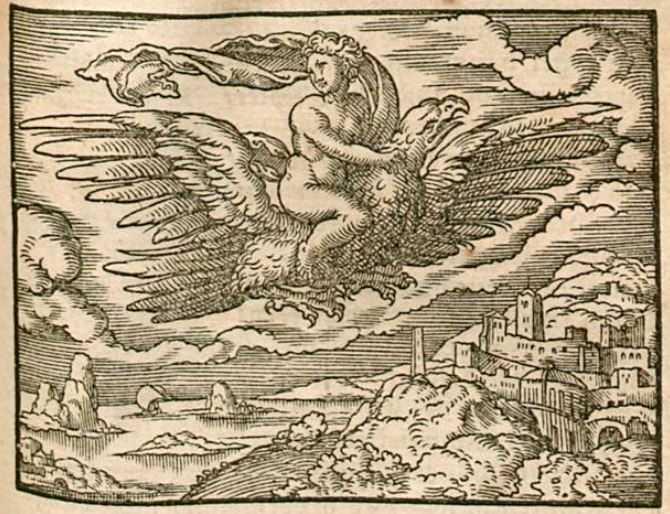
This image depicts Jupiter disguising himself to abduct a boy that he was in love with. The engraving illustrates Jupiter in the form of a giant eagle, carrying away the Phrygian boy named Ganymede. The young boy has tears running down his face as he looks behind him and watches his city fade away into the distance. Jupiter took him away from Phrygia and brought him up to the heavens to handle his mixing cups.
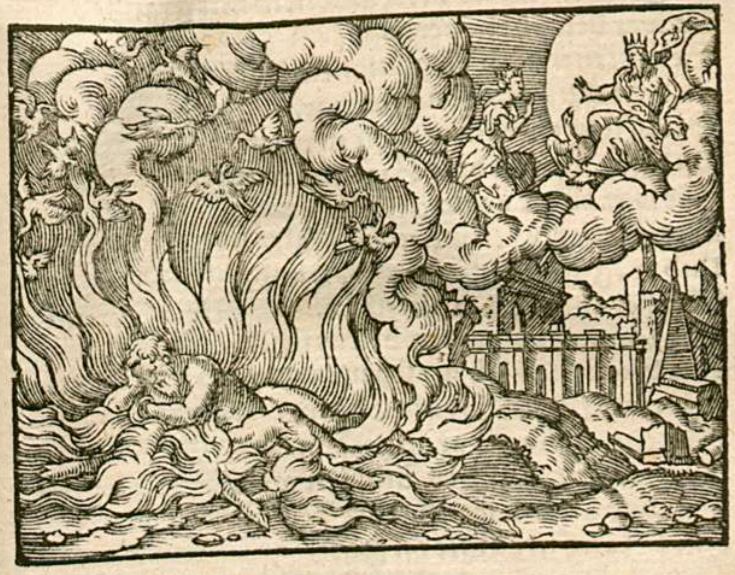
This engraving depicts Memnon, the son of the goddess Aurora, being burned in a funeral pyre after being killed by Achilles. Aurora, grieved by the death of her warrior son, goes to Jupiter to ask him to grant her son some kind of honour. Aurora is illustrated in the background of the engraving floating in the clouds speaking to Jupiter. While Memnon’s funeral pyre was blazing, a flock of birds emerged from the smoke. The birds split into two groups and began fighting each other to the death where they eventually fell into Memnon’s ashes. They are called the Memnonides. This event occurs every twelve years in honour of Memnon.
Sancho Panza, as governor and judge of Barataria Island, rules that twenty ducados be given back to the herder accused by a woman of having raped her. Sancho is flanked by the steward and the secretary, and sits on a throne beneath a canopy and a vaulted ceiling. Signed by D.-N. Chodowiecki (illustrator) and D. Berger (engraver), dated 1779. Plate 14. Part 2, ch. 45.
On the road to the cave of Montesinos, Don Quixote (middle), Sancho Panza (left) and the scholar (right) rest beneath a tree. Sancho Panza holds his pouch of water with both hands and takes a large swig. Meanwhile, Don Quixote clad in armor talks excitedly, gesticulating with his hands, to the squire who leans against a coil of rope with great interest. Quixote's lance, shield and sword all rest in the tree and Rocinante grazes in the background. The hats of all three men lie by their feet.

![[Quixote Sings a Romantic Ode He Has Written That Day]](https://collections.cemvc.ca/files/large/6825c588e6b50b4e3b38d153a243e217e1d0f90a.jpg)
![[Of How Don Quixote was Scratched by Cats]](https://collections.cemvc.ca/files/large/756521d0a30a2d9c7f5b308b0f4e3d20855aa831.jpg)
![[Don Quixote reads chivalric books in his library]](https://collections.cemvc.ca/files/large/5017bef3cfd302779b23702adb2f7000485589d5.jpg)
![[Master Peter Flatters Don Quixote]](https://collections.cemvc.ca/files/large/79097b8d70d5b266ae121552b93aa1e91ee7ac8d.jpg)
![[Invasion of Barataria Island]](https://collections.cemvc.ca/files/large/6b214ab47652a768c52e2173b67629114a900a83.jpg)
![[Casildea de Vandalia Standing with a Flag]](https://collections.cemvc.ca/files/large/f30663572b6a34ca5f22d513f442c1e84b6a315e.jpg)
![[Quixote and Sancho Return to the Duchess' Castle]](https://collections.cemvc.ca/files/large/1bbadd8434c5efda5085469ab4c196c99668533b.jpg)
![[Baked Bread Lies Next to Two Eggs and a Letter]](https://collections.cemvc.ca/files/large/6399928426086758b1ef1728c3ac37a92fab3a6f.jpg)
![[Sansón Carrasco defeats Don Quixote]](https://collections.cemvc.ca/files/large/814d842073d8d7c75b77da8457933949be95ca7d.jpg)
![[Fables from the Fifteenth Book]](https://collections.cemvc.ca/files/large/74c522a86fac9f5be1fc3e19082d49a3c9a2eedc.jpg)
![[Don Quixote Watches the Puppet Show]](https://collections.cemvc.ca/files/large/447603ec359277fa2a8af1c9372619275b9d1c09.jpg)
![[Sancho Panza as judge at Barataria Island]](https://collections.cemvc.ca/files/large/b1630f5a716bbf03147216bbe62618b15e928026.jpg)
![[Don Quixote Discusses Chivalry With the Scholar on the Road to the Cave of Montesinos]](https://collections.cemvc.ca/files/large/095cbe6fb41e8ecb2c679c68c10542efca4b86fa.jpg)