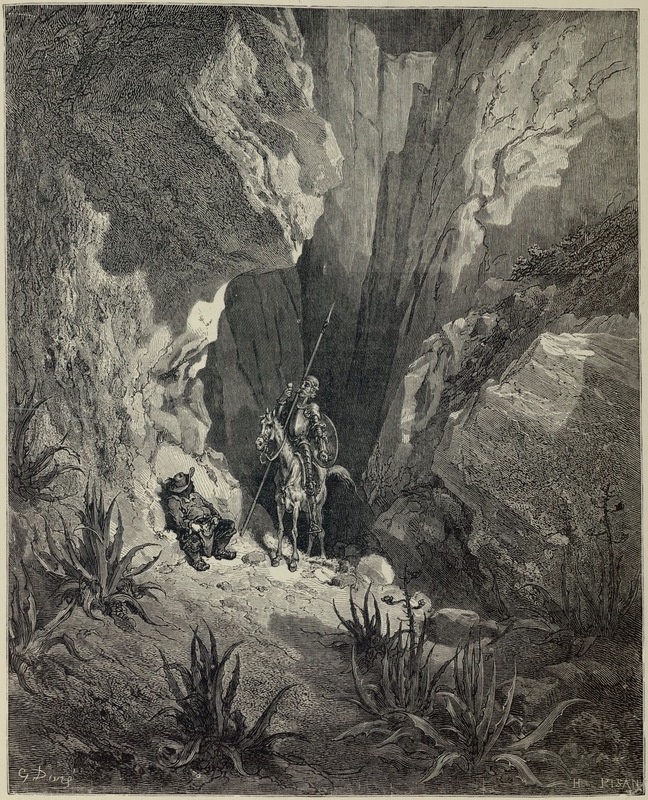
In Sierra Morena, Don Quixote and Sancho Panza find a travelling case, inside which are four shirts of fine cambric, a pile of gold escudos wrapped in a handkerchief, and a small, richly decorated diary. Opening the book, Don Quixote finds a sonnet written in a very fine hand. He reads it aloud so that Sancho can hear it. Signed by G. Doré (illustrator) and H.-J. Pisan (engraver). Part 1, ch. 23.
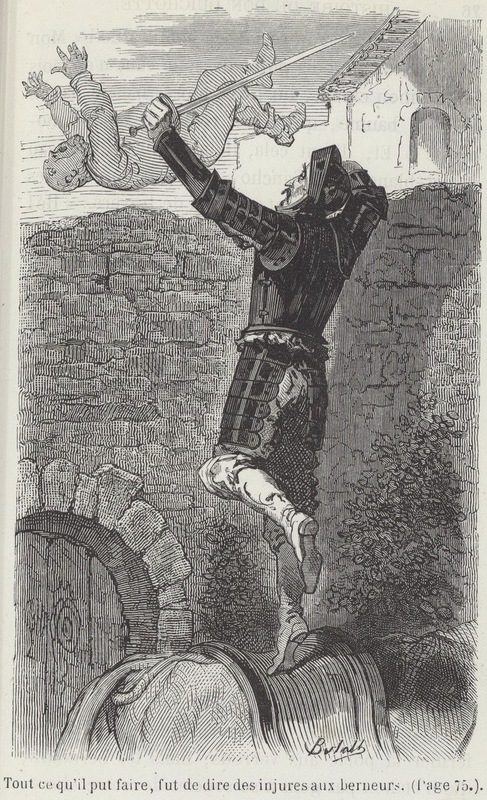
In the foreground, Don Quixote stands on Rocinante so that he can see over the wall of the inn. In the background, Sancho Panza is tossed into the air when he refuses to pay the innkeeper. Consequently, guests at the inn toss him in a blanket in the courtyard and make merry with him. Among the guests are four wool carders from Segovia, three needlemakers from El Potro in Córdoba, and two residents of La Feria in Sevilla. Signed by A. ‘Bertall’ d’Arnoux (illustrator). Part 1, ch. 17.
Don Quixote (left) clad in full armor and Sancho Panza (left) enter the town where Quiteria is to be wed and find a whole bullock spitted upon a large elm, heated by a fire composed of a little mountain of wood. Round the fire are placed three iron cauldrons in which sheep were sunk, cooked, and pulled out by chefs. On the left, hares, fowls, and venison were hung about upon the branches, in order to be placed in the cauldrons. In the foreground on the left there were also piles of bread, and to their right lies four wine skins, each of full of generous wines. The cooks number fifty all dressed in clean and diligent white.
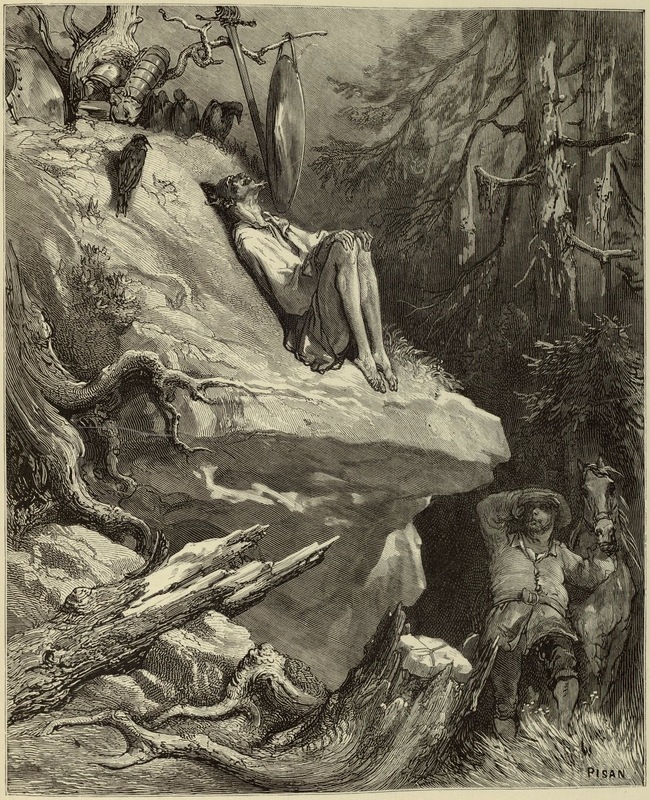
Sancho Panza, sent by the priest, finds Don Quixote naked except for his shirt, thin, yellow, famished, and sighing for his lady Dulcinea. Don Quixote refuses to leave Sierra Morena and go to El Toboso until he performs such feats as will render him deserving of her grace. Signed by G. Doré (illustrator) and H.-J. Pisan (engraver). Part 1, ch. 29.
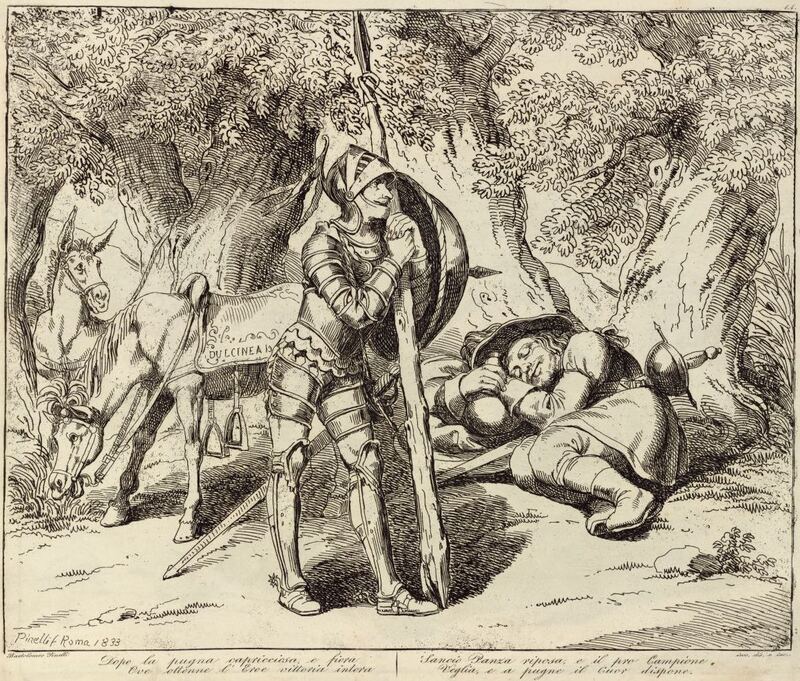
The night after the adventure with the windmills, Sancho Panza sleeps at the foot of a tree while Don Quixote keeps watch. The knight has fashioned a new lance from a branch to replace the one he broke. Rocinante and Sancho Panza’s donkey are pictured, grazing. Signed by Bartolomeo Pinelli (engraver and illustrator) and dated Rome, 1833. Plate 14. Part 1, ch. 8.
In talking to the curate while imprisoned in a cage under the pretense of enchantment, Quixote espouses the benefits of chivalrous books. In Quixote's impassioned diatribe he speaks at length about the admirable knight who finds delight in placing their eyes upon a vast lake of boiling black water, with a prodigious number of serpents, snakes, crocodiles, and divers other kinds of fierce and dreadful creatures, floating in it; and scarcely hearing the rewards for braving the lake, without further consideration, or reflection upon the danger, plunges headlong into the boiling pool without even taking off his cumbersome armor.
A man sits on a bench in a stable of an inn, a bucket of water in his left hand. On the left two halberds lean against the stable's wall. On the right a mule eyes the bucket in the man's hand.
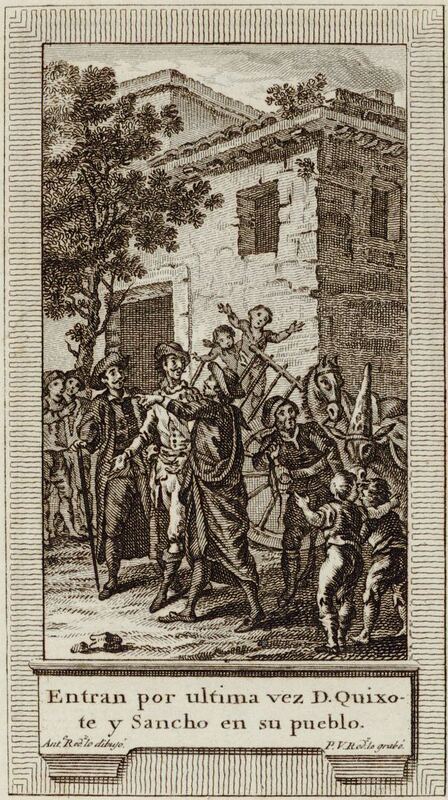
Don Quixote and Sancho Panza return to their village, and are welcomed by the priest, the barber, the housekeeper, Don Quixote’s niece, and Sancho’s family. Signed by A. Rodríguez (illustrator) and P. Rodríguez (engraver). Part 2, ch. 73.
Sancho Panza (middle) stands up straight in a dark pit with his hands intertwined over his waist and cries upwards for help. In the middle of the foreground, a donkey lies upon its side and looks at Sancho.
Don Quixote introduces himself before the members of the braying mayors’ squadron. Signed by T. Stothard (illustrator) and W. Angus (engraver). Plate IV. Part 2, ch. 27.
Five instruments lie on the ground, a galician gatia, a lute, a large tambourine, a pan flute, and a clarinet (from left to right). The image is occasioned by a parade of musicians celebrating Quiteria's wedding.
With his arms spread wide a bearded man wearing nothing but ivy over his groin walks forward. In the background a group of people and a house can be scarcely seen. The image is occasioned by Sancho Panza saying "In fine, naked I went into the government, and naked I am come out of it, and I can say, with a safe conscience, which is no small matter, ' Naked I was born, naked I am, I neither win nor lose" (Page 599).
Sancho Panza (left) dressed in a farmer's fashion, guuides the bachelor to Don Quixote (not pictured) with his left hand, his hat in his right hand. The bachelor follows in pace, dressed in black robes and a long curved hat. They are walking to Quixote's house to speak with him about knight-errantry.
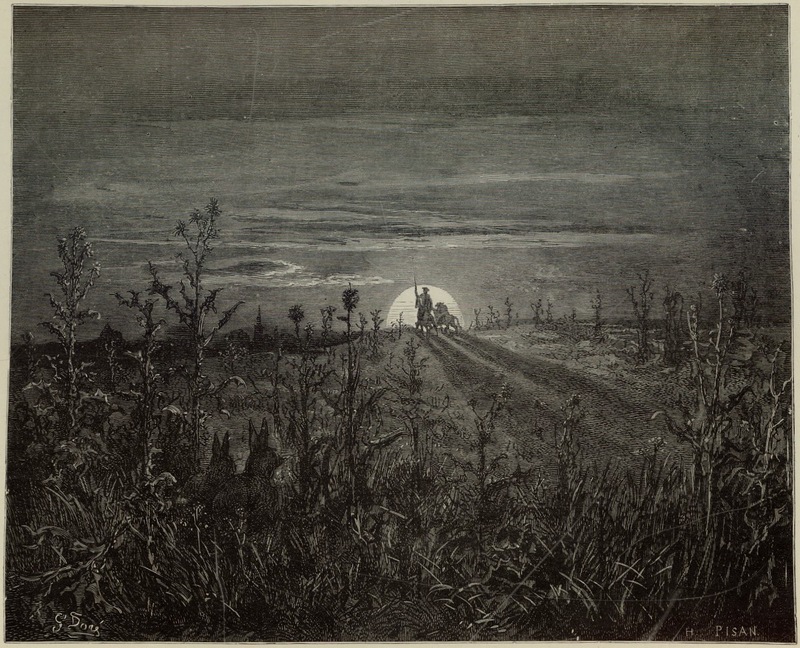
Night falls as Don Quixote and Sancho Panza make their way to El Toboso. In the foreground, thistles and rabbits are depicted. Signed by G. Doré (illustrator) and H.-J. Pisan (engraver). Part 2, ch. 8.
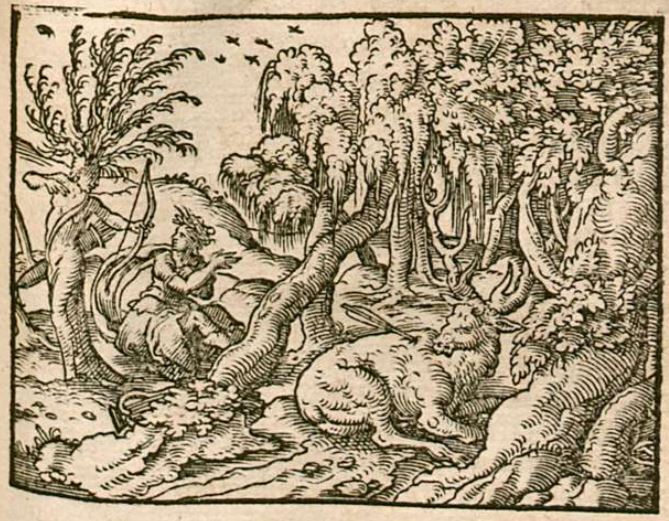
This engraving illustrates the origin story of the cypress tree. There was once a man named Cyparissus, who was incredibly fond of a giant stag that had bejeweled antlers and was friendly to all. Cyparissus and the stag were walking in the woods, when the stag decided to lay down in the grass and enjoy the breeze. By mistake, Cyparissus shot one of his arrows which had fatally wounded the stag. Grieved by his actions, Cyparissus begged the god, Apollo, to allow him to mourn for the stag forever. Apollo granted the request and transformed him into a cypress tree. Cyparissus is illustrated mid-transformation with his legs turning to a tree trunk with branches emerging from his head and his bow in his hands. The stag is illustrated on the ground with the spear plunged into his back, Apollo is depicted kneeling beside Cyparissus.
Don Quixote (pictured sitting upright in hisbed) is seized with a fever confining him to his bed for six days, during which he is constantly visited by the priest (background), the barber, the batchelor, and other friends. Sancho Panza (right of the priest) never left his master's bedside the whole six days. Every guest tried in their own way to revive Quixote's spirits, until a physician (to the right of Quixote, behind the headboard) was called to diagnose the severity of Don Quixote's illness. The physician felt Quixote's pulse and was saddened to state that he was in dangerously bad health. Don Quixote heard this with composure of mind, but his neice, house-keeper and squire all descended into tears.
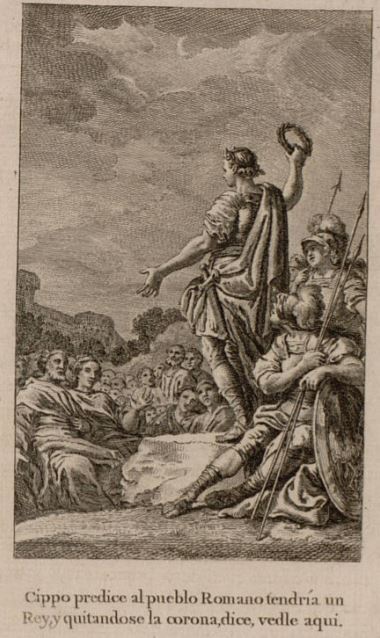
This image depicts Cipus, a Roman praetor, addressing a crowd of Roman citizens. Cipus was told by a prophecy that he could become the king of Rome. He did not want this responsibility, so he devised a plan to avoid becoming king. He told his fellow citizens that a man with horns on his head would become king and make slaves of them all. As depicted in the image, he reveals under a laurel wreath that he placed on his head that he has horns, and that he should be exiled. The people respected Cipus and gave him land to live off of in his exile.
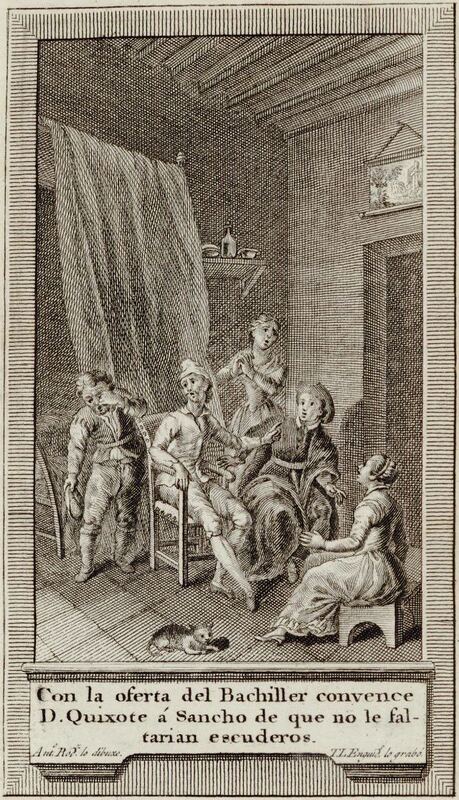
Sansón Carrasco offers to serve as Don Quixote’s squire. The errant knight informs Sancho Panza that if he does not wish to accompany him without pay, he has no lack of more obedient squires. This saddens Sancho, who had been certain that his master would not leave him for all the world’s riches. The actions of the characters are well represented in the illustration with gestures. The housekeeper and the niece are also pictured, although Cervantes makes no mention of them in the text. Signed by A. Rodríguez (illustrator) and T. Enguídanos (engraver). Part 2, ch. 7.
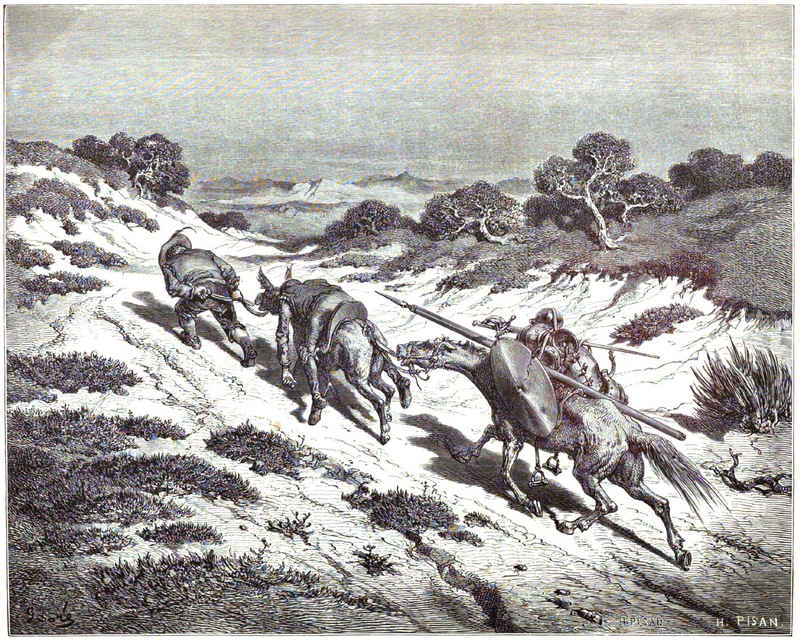
After the beating from the Yanguesans, Sancho Panza places the injured Don Quixote on the donkey, ties Rocinante to the donkey and leads both towards the main road. This scene can be found in Part I, Book 3, Chapter 1.
Don Quixote, clad in armor, and mounted upon his horse with spear in hand is accompanied by Sancho Panza upon his donkey at the top of a hill on the left, who look down a valley having heard a great noise of drums, trumpets, and guns. In the valley about two hundred men stand march forward, armed with various weapons, as spears, cross-bows, partizans, halberds, and pikes, and guns. They also carry banners pennants of white satin with a donkey on them.
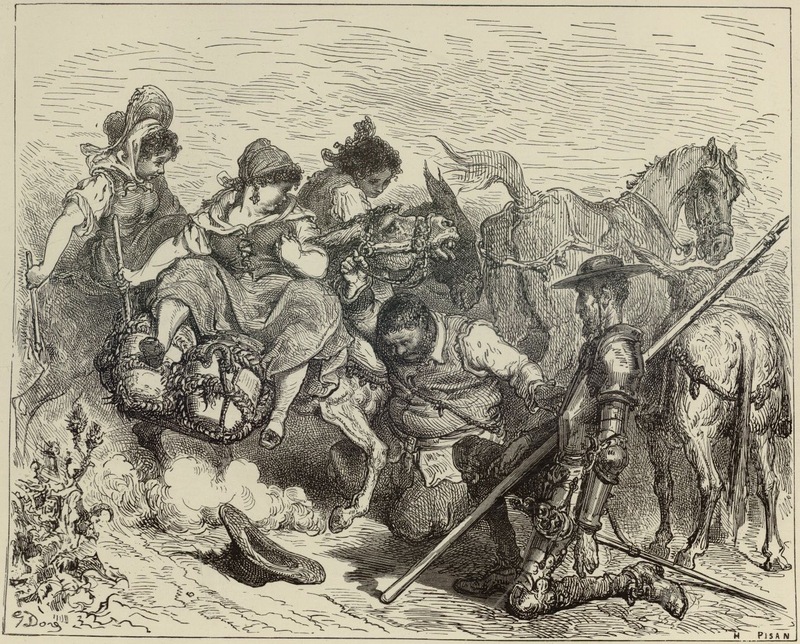
Don Quixote and Sancho Panza kneel before a peasant that Sancho introduces as the enchanted Dulcinea. The two other peasants are also pictured. Signed by G. Doré (illustrator) and H.-J. Pisan (engraver). Part 2, ch. 10.
A man dressed in full armor and mounted atop a white horse sits equipped with a lance and shield. He looks off to the right and clutches his chest with his left hand which holds the reins of his horse. On the left, a cherub with white angelic wings pierces the knight with a long arrow two yards across, penetrating the armor without touching it.
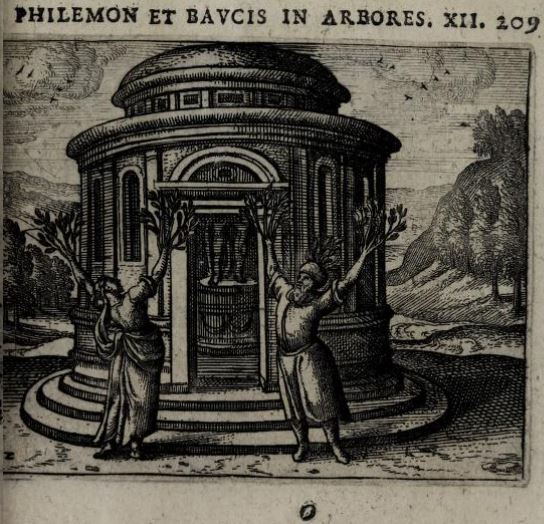
The Gods Jupiter and Mercury informed the couple Philemon and Baucis of their Godliness, and asked that they ascend the mountain to avoid a punishment destined for the rest of the city in return for their hospitality. As they reached the top of the mountain, they beheld their city sinking into mud, with their house alone still standing, having been transformed into a temple by the Gods. Jupiter and Mercury ask them what they desire most, and they ask to be priests to the Gods and to die at the same moment, so as never to be without each other. After serving years as priests, the two aged lovers were both transformed into trees near the front steps of the temple (as seen in this illustration).
Don Quixote, clad in armor and mounted upon Rocinante, nearly falls into a pit, and, getting a little nearer he peers into the dark chasm, the reins in his right hand and a lance in his left.

![[The Squire of the Woods' Detached Nose]](https://collections.cemvc.ca/files/large/1e4f6098e17768678291ac986c5691c8e95d9c87.jpg)
![[Don Quixote and Sancho Panza See a Roasted Bullock at Quiteria's Wedding]](https://collections.cemvc.ca/files/large/6888ecd85100fb2b90bec9f18d207b4b5be4d87c.jpg)
![[Of the Imaginary Knight who Jumps Headlong into the Boiling Pool]](https://collections.cemvc.ca/files/large/74b5eea1e33d44feae2e3448810891b7015c5bd5.jpg)
![[The Man of Halberds in the Stable with his Mule]](https://collections.cemvc.ca/files/large/38ceadd057338b6055a206e6462140bd731f9999.jpg)
![[Sancho Cries Out For Help From Within a Pit]](https://collections.cemvc.ca/files/large/e879d9d7b28f6f3a9df5202b00159195e71cf1e2.jpg)
![[Don Quixote and the braying mayors' squadron]](https://collections.cemvc.ca/files/large/11b956b2091043e1d6b000d07aac1508eb7f5733.jpg)
![[An Assortment of Instruments]](https://collections.cemvc.ca/files/large/6c77674e20b40f2fb3096bb54d6f149bcc139e15.jpg)
![[Sancho Panza Covered Only by Plants]](https://collections.cemvc.ca/files/large/1b0d99c2509b0be17c1bf91ede95672cf4fb4b46.jpg)
![[Sancho Fetches the Bachelor]](https://collections.cemvc.ca/files/large/9af160a7687fbb869b51ae874aeb692fa035bd7e.jpg)
![[Don Quixote Falls Sick in His Bed]](https://collections.cemvc.ca/files/large/3febc9a3efd4b09f5d1d6a72d13cfe282c3aec2d.jpg)
![[Of the Soldiers from the Braying Village]](https://collections.cemvc.ca/files/large/d999c4ca4f35af6be11004207ef4ab73d2604b3a.jpg)
![[The Lacquey Pierced By a Cherub's Point]](https://collections.cemvc.ca/files/large/5a26457985bc3fa66ff8ad29b30a7e46a30d2721.jpg)
![[Don Quixote Finds the Pit in Which Sancho Has Fallen]](https://collections.cemvc.ca/files/large/18b7739e3651a8ed768f299100044d9817c71835.jpg)