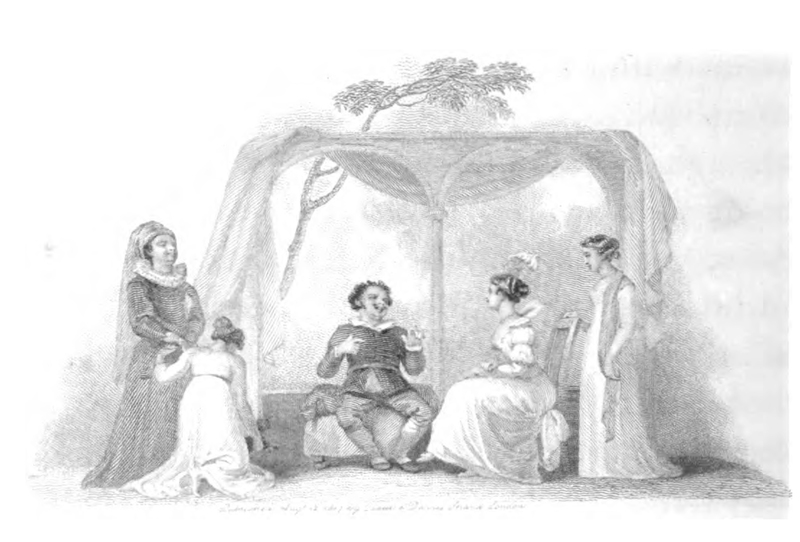
At the palace, Sancho Panza reveals the reality of Dulcinea’s enchantment to the duchess. Doña Rodríguez and several maidens surround them. Signed by T. Stothard (illustrator) and Walker (engraver). Plate VII. Part 2, ch. 33.
Sancho Panza (pictured sitting on the left) meets with the duchess (pictured sitting on the left), in a clothed gazebo. Being delighted to hear him talk, the duchess desired Sanchoto sit down by her on a stool. Sancho submitted, and placed himself close by the duchess, while all her damsels and duennas drew near and stood in silent attention to hear the conversation .
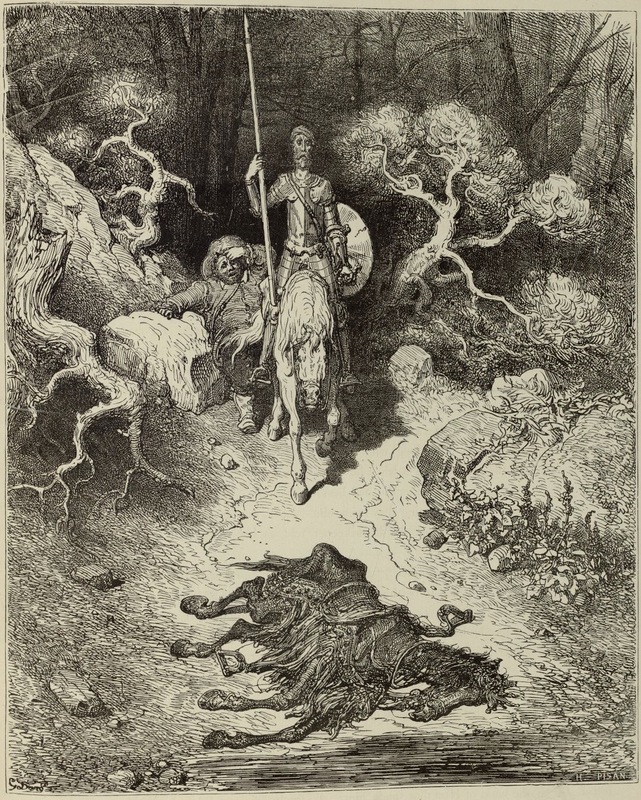
Don Quixote and Sancho Panza travel deeper into Sierra Morena to find the fleeing man (Cardenio). They discover a dead mule in a stream, half-eaten by dogs and pecked at by crows. The mule is saddled and bridled, which is confirmation of their suspicion that the fleeing man is the owner of both the mule and the saddle cushion. Signed by G. Doré (illustrator) and H.-J. Pisan (engraver). Part 1, ch. 23.
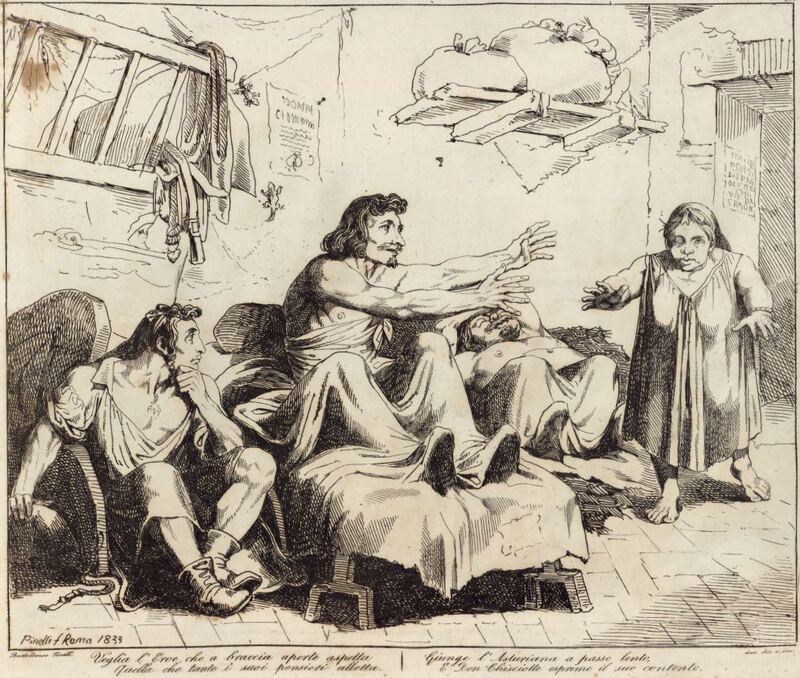
Having arranged to meet the muledriver late in the night, Maritornes enters the room where Don Quixote, Sancho Panza, and the muledriver are sleeping. She is barefoot, wears a chemise, and her hair is tied back in a cotton snood (all accurate to text). Don Quixote lies on a narrow bed made of rough boards, while Sancho Panza sleeps on a rush mat. Mistaking Maritornes for his fair damsel, Don Quixote extends his arms to welcome her. Signed by Bartolomeo Pinelli (engraver and illustrator) and dated Rome, 1833. Plate 21. Part 1, ch. 16.
Having brayed, one of the villagers (left) who stood close by Sancho Panza (right), believed he was making a mock of them, and lifted up a pole he had in his hand to give him a blow to the back of the head. Seeing the man positioned to hit him with his pole, Sancho tries to run, his arms forward and parallel with the ground.
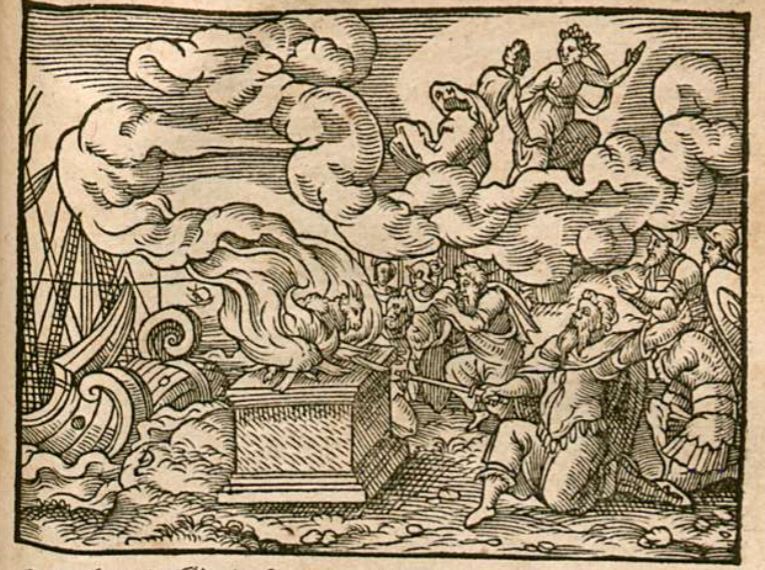
This image illustrates Agamemnon, the king of Mycenae, sacrificing his daughter Iphigenia to the goddess Diana. The Greeks, on their way to Troy, had to stop in the port of Aulis due to a storm. Agamemnon used his daughter as the ultimate sacrifice in the hopes that Diana would subside the storm and offer safe passage to Troy. The storm is illustrated on the left side of the engraving with waves crashing up against the shore and on the ships. Before burning Iphigenia alive, Diana saves her and replaces her with a female deer. The female deer is visible in the center of the engraving, laying on the stone table with the flames engulfing her. The Greeks are depicted surrounding and watching the sacrifice as smoke fills the air. Diana and Iphigenia are illustrated at the top of the engraving, with Diana looking towards Iphigenia as she points her towards safety.
Advancing from the left to the right comes a triumphal cart, drawn by six grey mules, caparisoned with white linen, and mounted upon each of them, a person clothed in white from head to toe, and bearing a great wax torch in their hand. Upon an elevated throne sat one person clad in a white robe and behind them another sits clad in completely black apparel. Behind them, more people of the light sit upon the carriage with torches in their hands in the same ghostly apparel.
In the cave of Montesinos, within an alabaster hall, Don Quixote, clad in armor, stands before a marble tomb and bows slightly, introducing himself to Durandarte, a living cavalier who lies upon the tomb. Durandarte's right hand is laid on the region of his heart. Montesinos, a venerable old man with a long beard kneels before Durandarte and introduces Don Quixote with a motion of his left hand, he also carries a rosary of beads in his right hand.
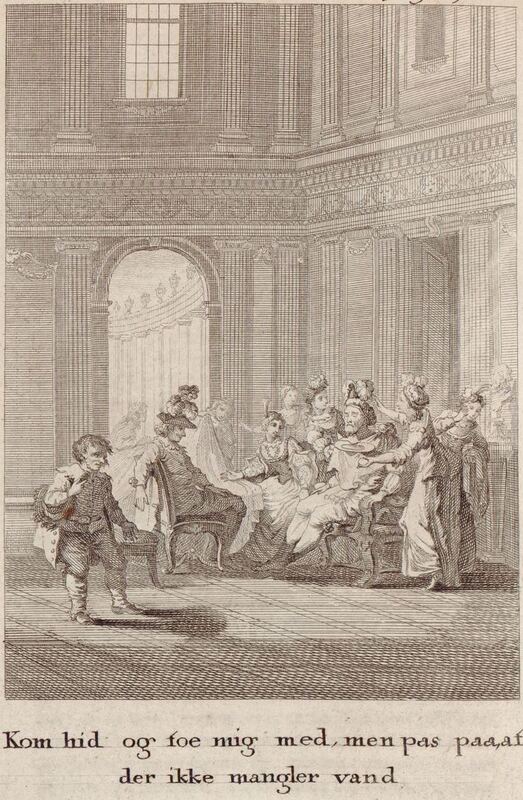
At the duke’s palace, the duchess’ maidens wash Don Quixote’s beard. After soaping his beard, one of the maidens pretends to fetch more water, leaving the knight covered in soap. The room’s architecture is finely detailed. Unsigned. Part 2, ch. 32.
Sancho Panza (middle) sits upon a mule before four men dressed in white robes who praise Sancho for his upcoming governance. On the left, all of Sancho's attendants follow with banners and horses, Dapple, Sancho Panza's donkey, among them in the foreground on the left. On the right, about a thousand inhabitants raise their hats and cheer for their new governor.
In the palace, the duchess’ maidens remove Don Quixote’s armour. Signed by A J.-J.-M. Devéria (illustrator) and A. J. Simonet, jeune (engraver). Part 2, ch. 31.
Don Quixote (lefts) stands upon a bed, wrapped from head to toe in a quilt of satin, a woollen cap on his head, and his face and mustachios bound up with bandages because of the scratches suffered at the paws of a cat. On the right, an elderly woman enters the room in a long white veil that covers her from head to foot. She carries between the fingers of her left hand a lighted candle, and holds her right hand over it to shade her face and keep the glare from her eyes, which are behind a huge pair of spectacles.
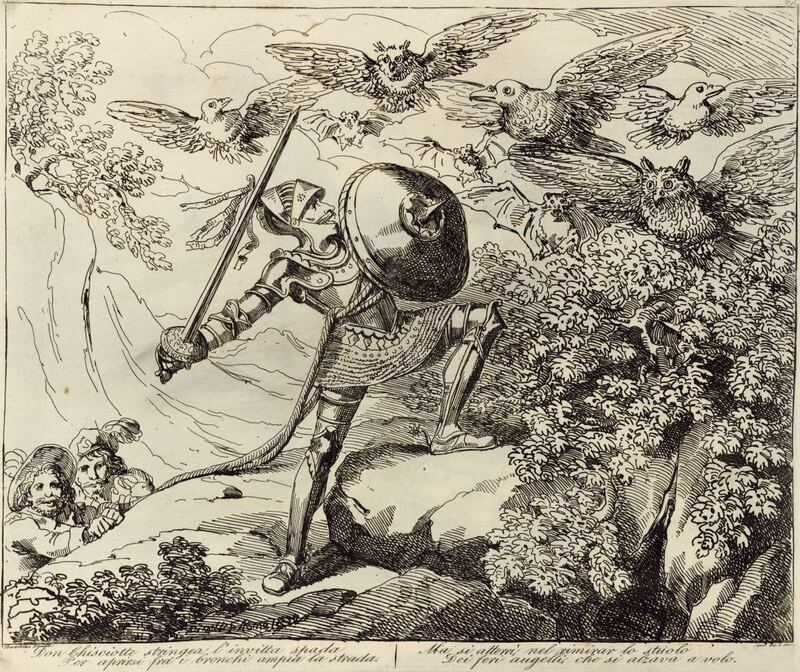
As Don Quixote tries to descend in Montesinos’ cave, a flock of birds surprises him. Sancho Panza and the bachelor’s cousin are pictured to the left, holding a rope that is tied to Don Quixote’s waist. Don Quixote holds his buckler and his sword. Signed by Bartolomeo Pinelli (engraver and illustrator) and dated Rome, 1833. Plate 47. Part 2, ch. 22.
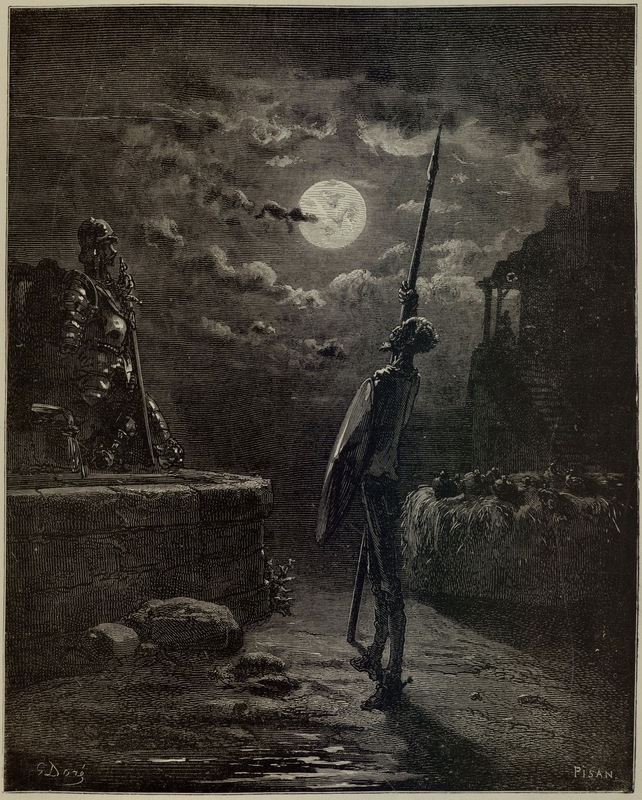
As night falls, Don Quixote gathers his armour and places it on a trough next to a well in a corral near the inn. Taking up his lance, he paces back and forth in front of the trough, standing vigil over his arms. The scene is illuminated by the light of a full moon. Signed by G. Doré (illustrator) and H.-J. Pisan (engraver). Part 1, ch. 3.
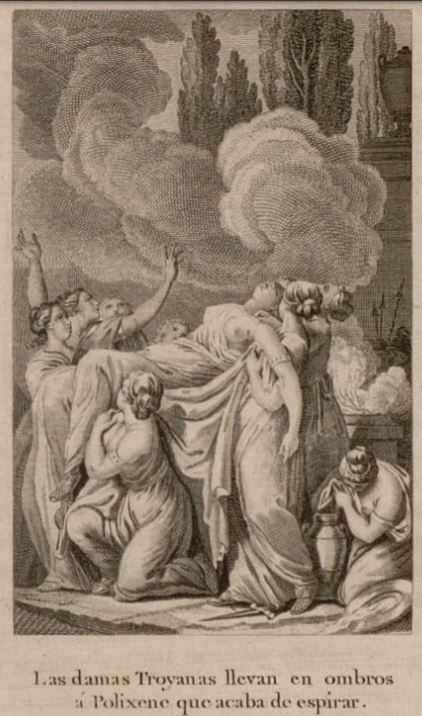
This image depicts a group of Trojan women carrying the dead body of Polyxena, the daughter of King Priam of Troy. Polyxena had been sacrificed by the Greeks to honour the bravery of Achilles. The women are depicted lifting the body of Polyxena as they mourn for her and for Troy.
Quiteria tends to Basilio, who stages his own suicide in the hopes of convincing her and the crowd that she should leave Camacho and return to him. While Don Quixote moves to stop him, Basilio stabs himself. To the right, Camacho prepares to draw his sword. The priest and other unnamed characters are pictured. Unsigned. Part 2, ch. 21.
Sancho Panza holds a fishing pole beneath the boughs of a tree and its shade, a wide brimmed hat upon his head and his feet hanging over the edge. The fishing hook rests gently near the shore with bait on its edge. In the foreground a pot and three fish lie on the ground. The illustrations portray the musings of Sancho, who says that "the unhappy wight to whose lot it falls must unavoidably undergo. It would be far better for us, who profess this cursed service, to retire home to our houses and pass our time there in more easy employments, such as hunting or fishing..."
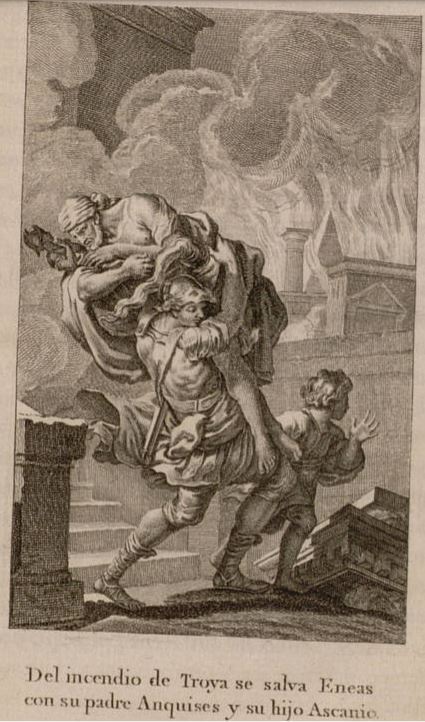
This image depicts the Trojan warrior, Aeneas, escaping the fall of Troy with his father Anchises on his shoulders and his son Ascanius by his side. The city of Troy is in the background of the engraving, engulfed in flames as it burns to the ground. Aeneas and his family escape by getting onto a ship that leads them to the island of Delos.
A pouch overflowing with coins sits on the floor, hanging open to the left. The image is occasioned by the Squire of the Wood's saying "'with the hopes weentertain of reward; for if the knight-errant whom the squire serves be not over and above unlucky, he must in a short time find himself recompensed, at least, with a handsome government of some island or some petty earldom." The pouch of coins pictured in this illustration is symbolic of this desire.
In the court garden, countess Trifaldi shows her beard, shocking Don Quixote and Sancho Panza. The illustration is not accurate to the text: Trifáldin holds a mace, while he should hold a scimitar. Signed by Bonard (illustrator), no given name, and L. Cars (engraver). Part 2, ch. 39.
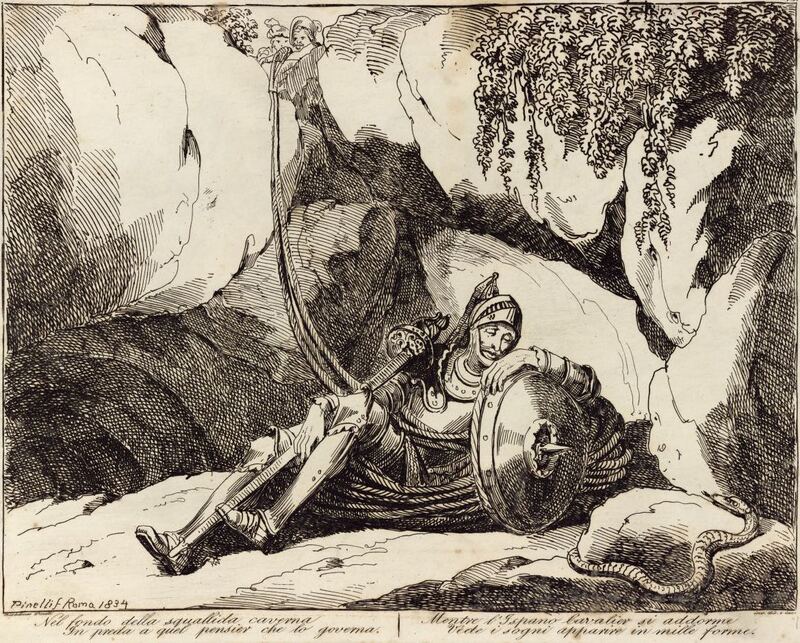
In the foreground, Don Quixote sleeps on a coil of rope in Montesinos’ cave. In the background, at the mouth of the cave, Sancho Panza and the bachelor’s cousin await his return. Signed by Bartolomeo Pinelli (engraver and illustrator) and dated Rome, 1833. Plate 48. Part 2, ch. 23.
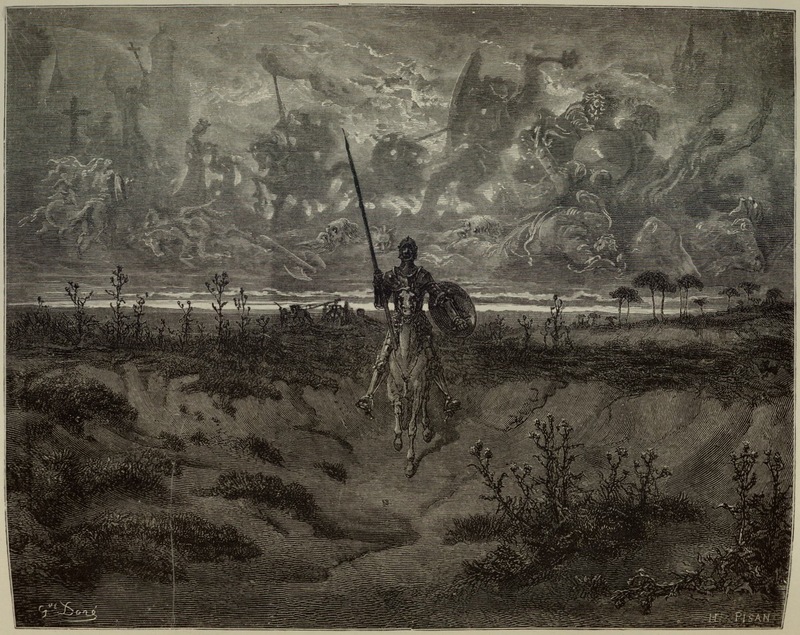
While Don Quixote sets out on his first sally with Rocinante through the dry and austere landscape of La Mancha, the sky behind him fills with shadows or ghosts of errant knights, maidens, dragons, castles, and giants. The illustration masterfully combines reality (Don Quixote riding Rocinante) and fantasy (adventures, knights, and all other figments of his imagination). Signed by G. Doré (illustrator) and H.-J. Pisan (engraver). Part 1, ch. 2.
Laying on the ground in the background is a a bust of an older bald man with the name 'HIPPOCRATES' written on the exterior while in the foreground lies a book with the title 'APHORISMS' on its spine. The image is occasioned by , Doctor Pedro Kecio Aguero de Tirteafuera promising that Sancho Panza shall eat all he likes, though it is contrary to all the aphorisms of Hippocrates.
Don Quixote (bottom) clad in armor, is raised from the black depths of the cave of Montesinos, sword equipped to his waist, arms limp by his side, head dipped slightly, pictured in deep slumber. Sancho Panza (top left) wearing a hat looks down into the pit and pulls up Quixote. Behind Sancho the scholar looks down upon Quixote also. In the background the silhouette of birds can be seen flying in the sky.
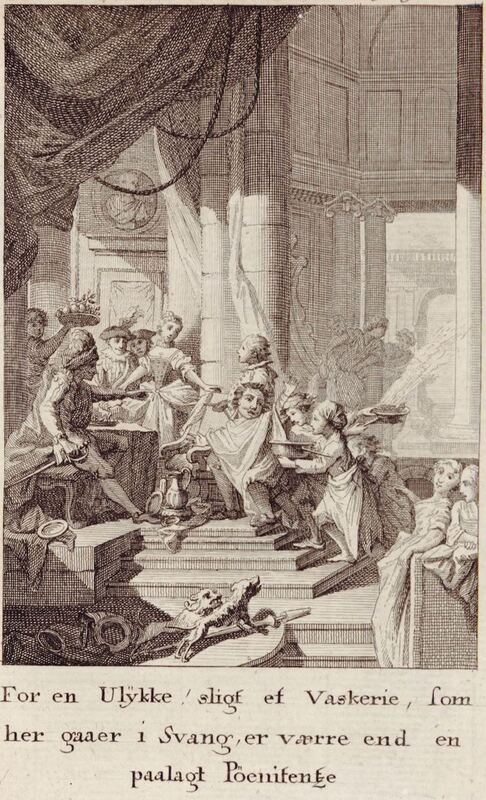
Sancho Panza (centre) appeals to the duchess and Don Quixote (left) for clean water and fresh towels. He refuses to let the servants (right) wash his beard otherwise. The illustration is richly detailed (statues, columns, draperies). Unsigned. Part 2, ch. 32.

![[Sancho Panza and the duchess]](https://collections.cemvc.ca/files/large/42bc73fe5d0bce4166c89d3612c9105940ea889b.jpg)
![[Of How a Villager Knocked Sancho with a Pole]](https://collections.cemvc.ca/files/large/ccabefd1a84d9953eaaf758904f2dac5859f270f.jpg)
![[The Procession of the Living and Dead]](https://collections.cemvc.ca/files/large/7a9304364d359aa8f865b0cf86353df6fdc12be8.jpg)
![[Of How Quixote Encountered Durandarte in the Cave of Montesinos]](https://collections.cemvc.ca/files/large/b6d91e0fab8e720d2b9aae40a7b8b3d9e0bcf7ed.jpg)
![[Sancho Reaches the Outskirts of Barataria]](https://collections.cemvc.ca/files/large/aa7527a14c38425ca8378f8caad845a3def40a5a.jpg)
![[Don Quixote served by the duchess' maidens]](https://collections.cemvc.ca/files/large/79895fd8edf693a9c4e27918078c1b9a3b2418e5.jpg)
![[Donna Rodriguez Enters Don Quixote's Room in the Dead of Night]](https://collections.cemvc.ca/files/large/bfad6a4a016faeb21e2c04889bc659eac977be9c.jpg)
![[Don Quixote defends Basilio before Camacho]](https://collections.cemvc.ca/files/large/10572a918e775c1baa9a4636b1130cddc76ca136.jpg)
![[Sancho Imagines Himself Fishing]](https://collections.cemvc.ca/files/large/5eb58c94fda73c725316ac3204e20315a161d0ba.jpg)
![[A Bag of Coins]](https://collections.cemvc.ca/files/large/eee525a960f5d6a4b91062f12799525bc7db73fb.jpg)
![[Countess Trifaldi shows her beard]](https://collections.cemvc.ca/files/large/bcae9b7e995b17cb5a6684f426084f7daea5e284.jpg)
![[A Bust and Book of Aphorisms of Hippocrates]](https://collections.cemvc.ca/files/large/c6a5abdba78696f719cfb04c8a4857be3d9122ea.jpg)
![[Of How Don Quixote was Lifted from the Cave of Montesinos]](https://collections.cemvc.ca/files/large/ed18ca907ac451d437f4a03d58d48a4746a45516.jpg)