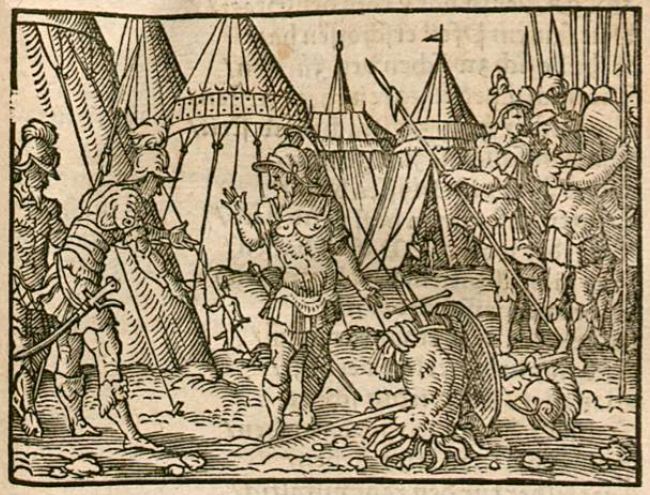
This engraving illustrates the Greek leaders of the Trojan war listening to a debate between Ajax and Ulysses. There is a contest between these two men to see who should be awarded the armor and weapons of the great Achilles. Achilles’ sword, a spear going through the chest plate, and his helmet are on the ground. Ajax and Ulysses are illustrated speaking to each other as they debate who is more worthy of receiving Achilles’ weapons. Ajax believes he should be the one to inherit Achilles’ things as he is related to him. Ulysses believes he should be the one to receive Achilles’ things as he is the one who got Achilles to participate in the Trojan war in the first place. The Greek leaders are depicted on the right side of the engraving engaging in whispered conversations as they decide who should be the recipient of the armor. It goes to Ulysses.
Two noblemen stand around a third and read over his shoulder from a large book. The nobleman in the middle sits on a stately chair and crosses his legs, holding open a large book in both hands across his lap. On the a second nobleman with long curly hair leans against the chair and looks over the first nobleman's shoulder at the contents of the book, his left hand against his waist with plumed hat in hand. On the left a third nobleman with a plumed hat in his right hand looks over the first nobleman's shoulder to see the contents of the book himself. The image is occasioned by the bachelor Sampson Carrasco saying "But none are so much addicted to reading it as your pages; there is not a nobleman's ante-chamber in which you will not find a Don Quixote. When one lays it down, another takes it up; one asks for it, another snatches it."
The Knight of the White Moon (Sansón Carrasco) defeats Don Quixote on the beach at Barcelona. Both wear bucklers and carry lances. Sancho Panza, Don Antonio Moreno, and the viceroy watch. In the background, the port of Barcelona and a galley are depicted. Signed by Bonard (illustrator), no given name, and L. Cars (engraver). Part 2, ch. 64.
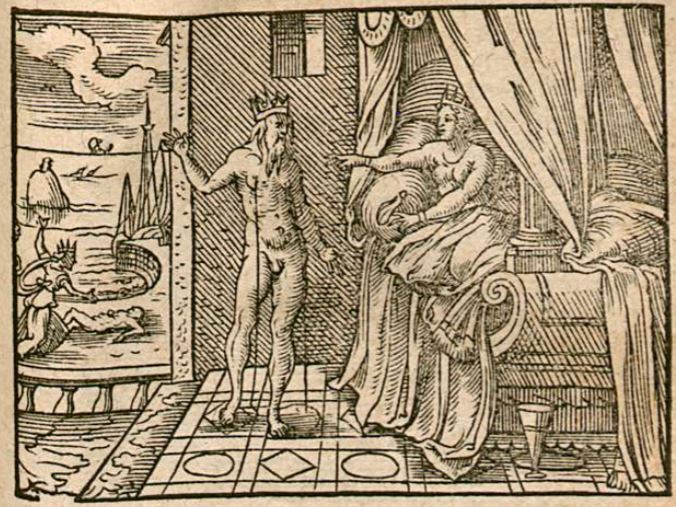
This engraving illustrates Morpheus, the son of the God of Sleep, appearing to Alcyone in a dream in the form of King Ceyx. Unbeknownst to Alcyone, her husband King Ceyx of Thessaly had died in a shipwreck. She constantly prayed to the goddess Juno for her husband’s safe return, however, Juno wanted to reveal to Alcyone that he was in fact dead. Juno sent her messenger, Iris, to the God of Sleep and told him to appear to Alcyone in a dream to reveal her husband’s death. The God of Sleep sent his son Morpheus to handle the task as he can shape shift into any human being. As depicted in the engraving, Morpheus took the form of a dead King Ceyx, and appeared to Alcyone to reveal his death. Alcyone is illustrated pointing at him as she is surprised by his appearance and grieved to know that he is dead. The background of the engraving illustrates Alcyone after she had woken from her dream. She walked along the shores and came across the washed-up body of King Ceyx on the beach. She is depicted with her arms in the air, about to throw herself onto the body of her husband.They were both then transformed into birds.
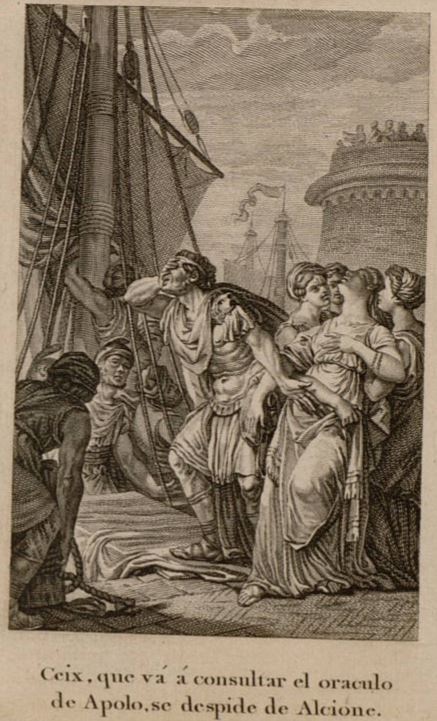
This image depicts King Ceyx boarding a ship as he says goodbye to his wife Alcyone. Alcyone is depicted on the right side of the image falling into the arms of her female companions as she weeps in grief as she will miss her husband. Ceyx is covering his eyes as he is sad to leave his wife behind. Ceyx is on his way to consult the oracle at Delphi.
In the garden of the duchess, Don Quixote, clad in armor, and Sancho Panza, clinging to the knight's breastplate, sit blindfolded upon the back of a wooden horse. Don Quixote, finding himself fixed at the front holding the peg. Behind the horse, several servants aim at the two with several huge bellows. Meanwhile near the head of the horse, several servants warm Quixote's faces by the use some flax set on fire at the end of long canes.
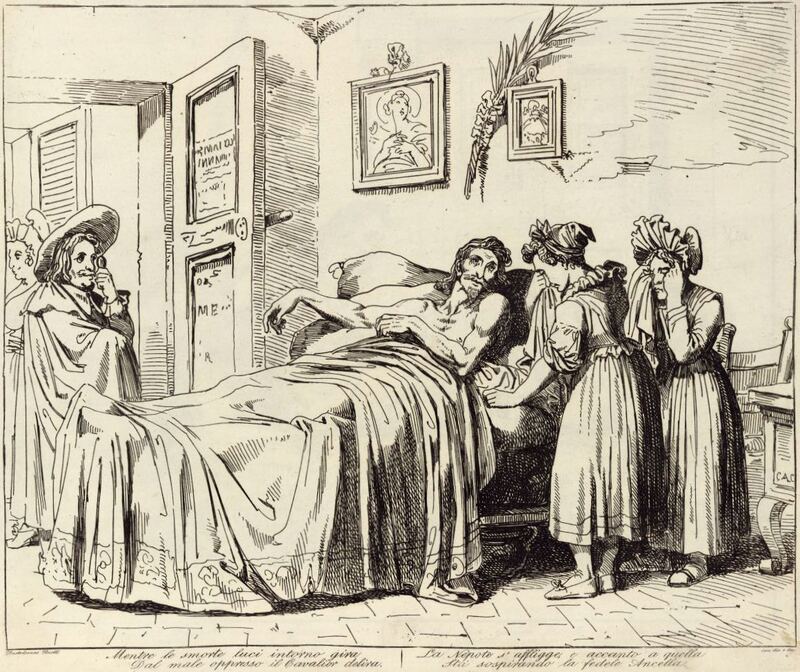
Don Quixote rests in bed after returning from his second sally. The housekeeper and the niece (pictured at his bedside, weeping) take care of him. The priest is also pictured. Signed by Bartolomeo Pinelli (engraver and illustrator) and dated Rome, 1833. Plate 36. Part 1, ch. 52.
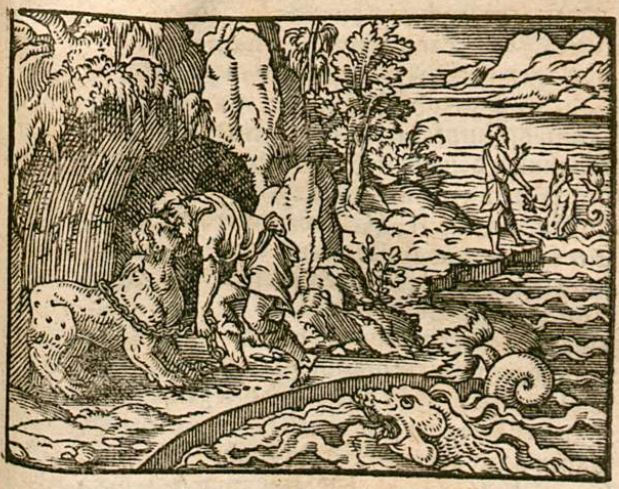
This engraving illustrates Peleus, Jupiter’s grandson, physically forcing himself upon the sea-goddess named Thetis. Thetis is a shapeshifter and changed forms every time Peleus attempted his advances on her. Peleus eventually sought the help of the sea-god Proteus as she continuously rejected him. Proteus is illustrated in the water in the background of the engraving, with Peleus standing on land speaking to him. Proteus suggested to wait until Thetis falls asleep, and then tie her up and hold her tightly until her shape-shifting returns her to her normal form. This is illustrated in the foreground of the engraving, as Thetis is depicted with her head in human form and her body in the shape of an animal with a chain wrapped around her body. Peleus is illustrated with his arm around her. Thetis eventually gives birth to the mighty Achilles.
An older man dressed in leather hood and black robes with small spectacles over his eyes sits at a table with a pestle in his right hand. On the table in front of him sits a copper basin used in the manner of a mortar. On the left there stands a small tincture filled with liquid and a tall rounded flask. The image is occasioned by Sancho Panza saying "this madam duenna should lay any stumbling-block in the way of my promised government ; for I have heard an apothecary of Toledo, who talked like a goldfinch, say that, where duennas have to do, no good thing can e'er ensue."
In the house of Sancho Panza (left), Don Quixote (right) sits casually in a wooden chair, right leg stuck out, left leg tucked behind the leg of the chair, with his right hand he postulates as if to promise Sancho many great things. Sancho Panza listens attentively, his left arm resting on a wooden table. In the background there is a window.
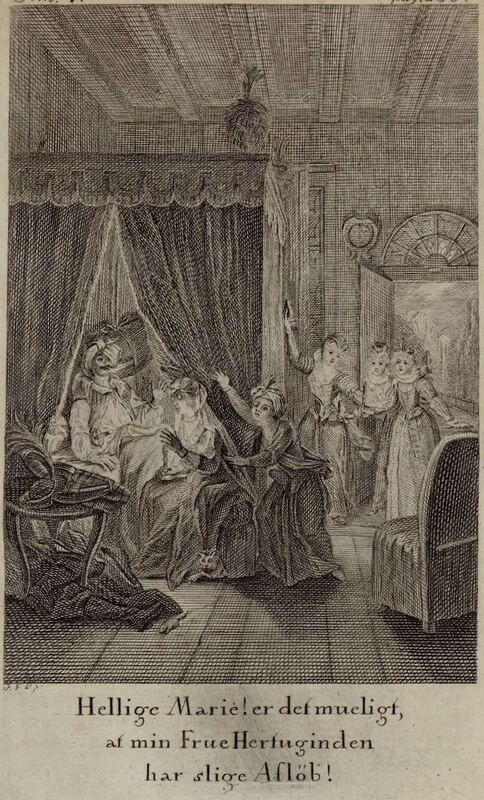
Don Quixote, his face bandaged and marked by the cat’s claws, lies sleepless in bed. Doña Rodríguez, duenna to the duchess, visits him in his room. She wears long and intricate white veils. Altisidora and the duchess’ other maidens watch from the door, holding their shoes. Signed by J. G. Preisler (engraver). Part 2, ch. 48.
Don Quixote prepares to fight the lion after the lion keeper opens the gate. However, the lion refuses to leave its cage. Don Quixote holds his sword in one hand and his buckler in the other. Signed by A J.-J.-M. Devéria (illustrator) and P. C. Touzé (engraver). Part 2, ch. 17.
In the crystal halls of the cave of Montesinos a procession, in two files, of beautiful damsels, all clad in mourning, with white turbans on their heads, walk down a spiral staircase, under tall arches and through a hall.
Sancho returns to his home in good spirits to the confusion of his wife Teresa who wishes to know why he is so happy. Sancho Panza responds that he is happy because he will be returning to the service of his master Don Quixote who will departing for his 3rd journey in search of adventure. Teresa tries to convince Sancho Panza that he should stay, but Panza is set in his decision to leave, convinced that he is on the verge of being given a governorship during the upcoming journey. Teresa tries to appeal to Sancho through his children, of whom he has two, one 15 year old son(left), and a daughter named Maria who wishes to be married (right). Nothing can sway Sancho's mind, he is unwilling to budge from his desire to seek a governorship with his master Don Quixote.
Sancho Panza (left) finds his master Don Quixote (right) naked to his shirt, weak, feeble, and half-dead, sighing for his lady Dulcinea. Quixote refuses to give up his penance, resting his chin on his hand defiantly and looking away from Sancho. With Rocinante in his right hand, Sancho uses his left hand to convince Quixote that his lady Dulcinea Del Toboso wishes for him to give up his penance.
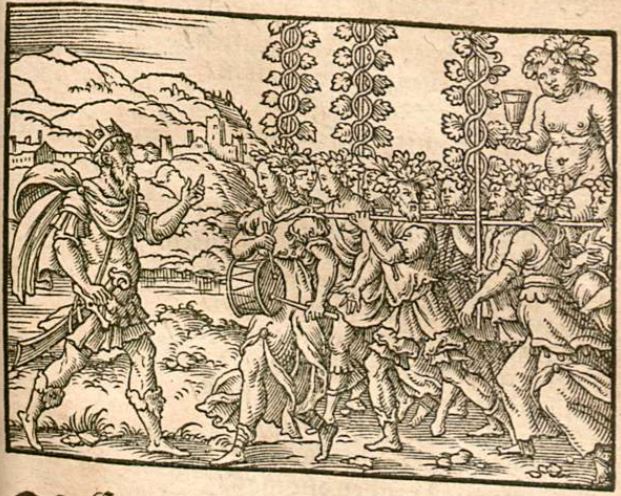
This engraving depicts the prince of Thebes, Pentheus, with the motion of his hand halting a crowd of men who are celebrating the festival of Bacchus, the god of Wine. Pentheus does not believe in the god Bacchus nor does he believe Bacchus is entitled to have a festival in his honour. The crowd of men are drinking wine and drumming while enjoying the festivities. Pentheus is illustrated with his arm in the air to try to get the men to stop, and he looks angry with their behaviour.
Having made at Sancho's striker with his lance; Quixote, clad entirely in armor, finds a shower of stones come upon him, and many cross-bows and guns presented in his direction by the angry mob from the Village of Brayers. So seeing, he he turned Rocinante (his horse) about, and, as fast as he could gallop, ran from his enemies.
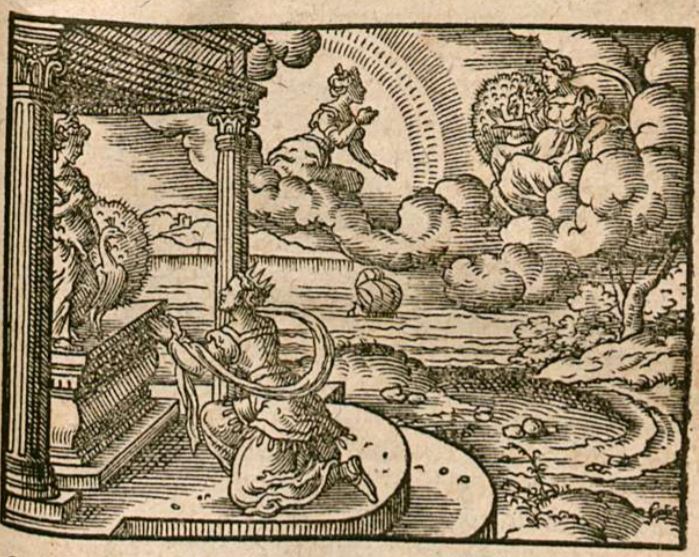
This engraving illustrates Alcyone, the wife of King Ceyx, kneeling at the temple of Juno praying for her husband’s return from sea. King Ceyx had traveled by sea to seek out the Oracle at Claros and ended up dying in a shipwreck due to a storm. Alcyone continuously prayed at the temple to Juno in the hopes that her husband would soon return. Juno is depicted at the altar with her sacred animal, the peacock, at her side. Juno decides to reveal to Alcyone that her husband is dead by sending Iris, the messenger of the gods, to the god of sleep to reveal Ceyx’s fate through a dream. Juno is depicted on a cloud in the background of the engraving giving these commands to Iris. There is a ship in the background to symbolize Ceyx at sea.
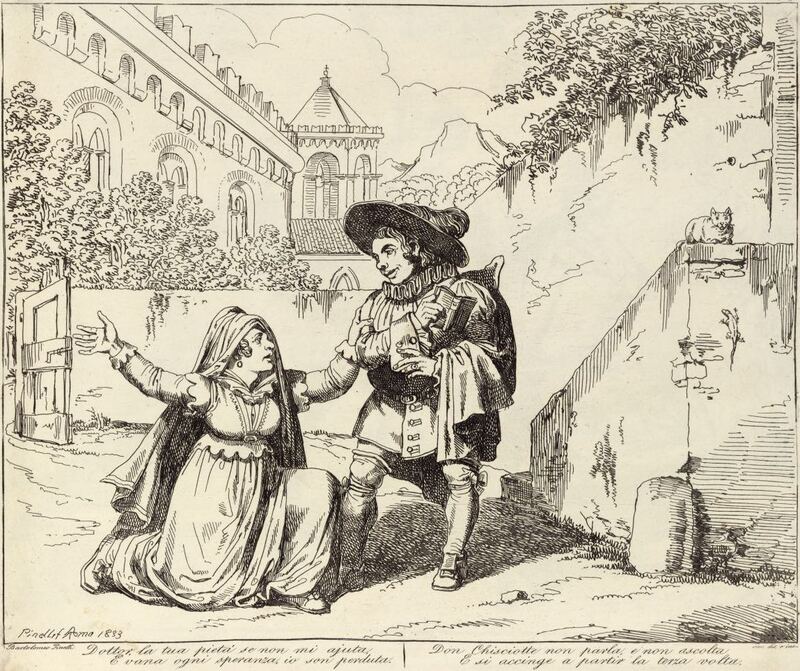
In the courtyard of the bachelor’s house, the housekeeper kneels before Sansón Carrasco and begs him to persuade Don Quixote from setting out on his third sally. Signed by Bartolomeo Pinelli (engraver and illustrator) and dated Rome, 1833. Plate 39. Part 2, ch. 7.
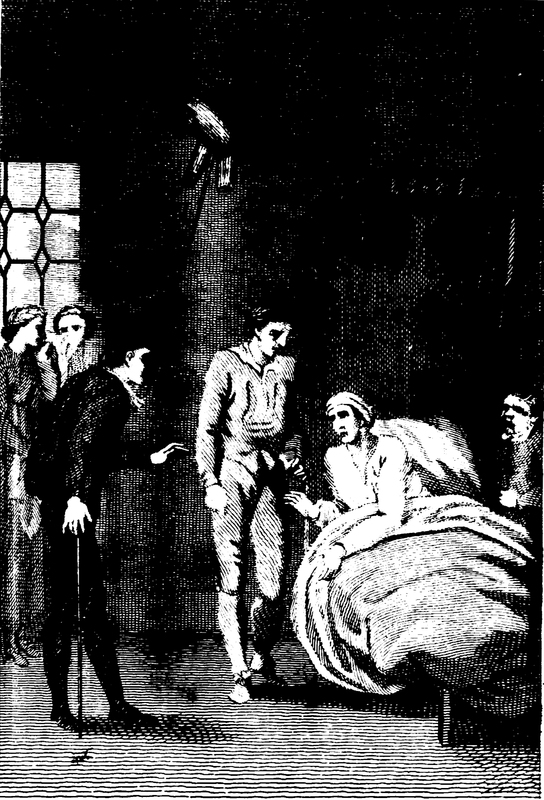
Lying in his bed, Don Quixote talks to the priest and the barber having regained his sanity. To his right, Sancho Panza waits patiently, and on the left the housekeeper and the niece worry for Quixote's health after a physician has diagnosed Quixote's health as poor. Don Quixote's armor and sword have been mounted on the wall in the background.
A giant bearded man, dressed for war and wearing a large turban upon his head jumps down from the sky and smoke while mounted on a wooden hobby horse. This is the giant Malambruno, a cruel enchanter. At his feet lie a monkey of brass, and a fearful crocodile, both of whom were formerly people. The monkey Antonomasia, and the crocodile Don Clavijo.
Mounted atop Rocinante (left) Don Quixote, clad in armour (except for a helmet) with a couched lance and steadied shield charges through flocks of sheep, flaying them under the illusion that they comprise the army of an evil enchanter. In the foreground Sancho Panza falls to his knees with his hands by his side crying out for his master to cease in his killing. Behind Sancho, his donkey, Dapple, stands by his side.
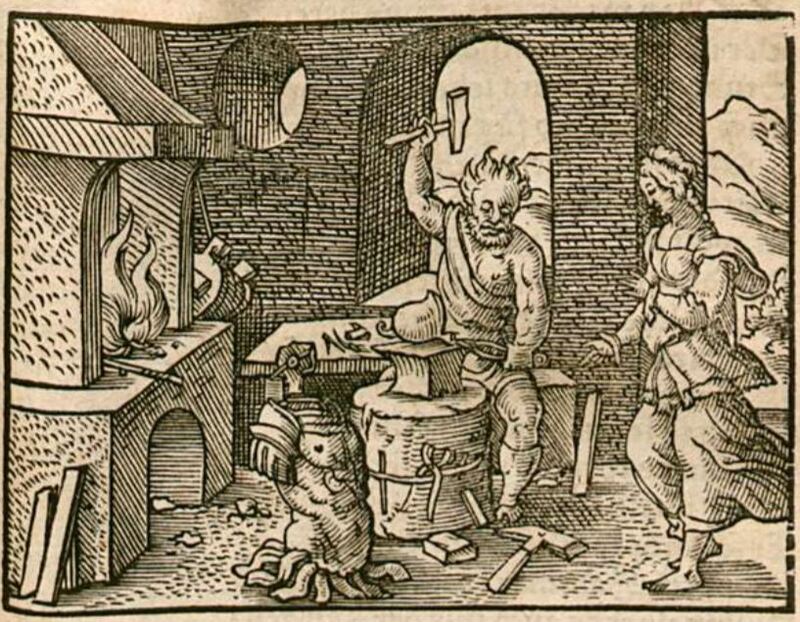
Thetis, the mother of Achilles, is depicted standing on the right side of the engraving as she approaches the blacksmith god, Vulcan. Thetis sought out Vulcan as she wanted him to forge special weapons and armour for Achilles to protect him in war. Vulcan is depicted forging a helmet as he sits at his workstation. There is a cuirass that had already been forged resting on the ground in front of Vulcan.
Alone in his chamber, Don Quixote sits in the corner of the room upon a tall chair and pulls off the stocking from his right foot. He is otherwise dressed in a thin and loose, white collared shirt that goes all the way down to his knees. In the bottom left his apparel has been thrown aside in a pile.
Don Quixote embraces his squire before Sancho Panza departs for Barataria Island. To the left, the duke. To the right, the duchess and her servants. In the background, the duke and duchess’ residence. Signed by Bonard (illustrator), no given name, and L. Cars (engraver). Part 2, ch. 44.

![[Noblemen Reading the History of Don Quixote]](https://collections.cemvc.ca/files/large/b87da3e270fa7cbdf92f9fc34ed08eb1317b3ab8.jpg)
![[Sansón Carrasco defeats Don Quixote]](https://collections.cemvc.ca/files/large/ddc7fbf3c6e0924494f4810d781d16ea0bcde4c4.jpg)
![[Don Quixote and Sancho Panza Ride the Wooden Horse Clavileno]](https://collections.cemvc.ca/files/large/9615ea92fc7a949395c5b31fc85a3e314b7594e2.jpg)
![[An Apothecary of Toledo]](https://collections.cemvc.ca/files/large/cb052119dca31b5a9a0f6df586cb61888dd90295.jpg)
![[Don Quixote Tampers with a Neighboring Laborer named Sancho Panza]](https://collections.cemvc.ca/files/large/fd2c95eba217bbb68005d2e456715bbb3bafa620.jpg)
![[Adventure of the lion]](https://collections.cemvc.ca/files/large/afd0ec7ab561e6b5e4da2e1575aa969e9e974323.jpg)
![[A Procession of Mourning Maidens in the Cave of Montesinos]](https://collections.cemvc.ca/files/large/6b02cf98eac22e898363ba75af615150a96bf984.jpg)
![[Of the Wise and Pleasant Discourse which Passed Between Sancho Panza and his Wife Teresa Panza]](https://collections.cemvc.ca/files/large/11c998ed2cf6058dd7f85d8b13f86f6ca482a265.jpg)
![[Sancho Finds Quixote at the End of his Penance]](https://collections.cemvc.ca/files/large/eb2cca10032c3ca1c3297e8c61d4c90508a23a84.jpg)
![[Don Quixote Retreats from those of the Braying Village]](https://collections.cemvc.ca/files/large/933de736fd56db8d724ae1d240ca37d2b41c522e.jpg)
![[The Giant Malumbruno Turns People into Monkeys and Crocodiles]](https://collections.cemvc.ca/files/large/856fcf134e2ae7afda924fc5372fc49964a8a658.jpg)
![[Don Quixote Mistakes Sheep for an Evil Army]](https://collections.cemvc.ca/files/large/58229e70a432a13ceeee89ba83ca9a1cd8e99d8d.jpg)
![[Don Quixote Pulls Off His Stockings]](https://collections.cemvc.ca/files/large/4e899dd79a5dd2553d57c5ea2d0157158a1124ce.jpg)
![[Sancho Panza departs for Barataria Island]](https://collections.cemvc.ca/files/large/d1dbc2c4d079168777c696854fc3b72824e3220e.jpg)