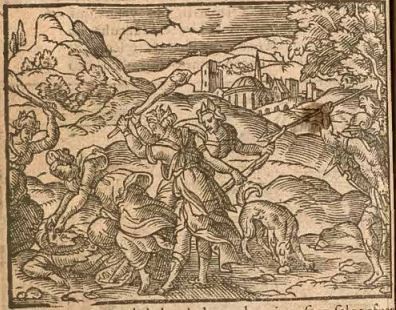
This engraving depicts Hecuba, the wife of King Priam of Troy, murdering King Polymestor. Hecuba is depicted sitting on top of Polymestor gouging his eyes out. His right eye has already been gouged in the image while Hecuba mutilates the other. Hecuba is surrounded by fellow Trojan women who have been taken captive by the Greeks. They are illustrated with large sticks as they bludgeon the king to death. Hecuba murders King Polymestor because he murdered her son, Polydorus. After killing the king, Hecuba is transformed into a hound. The transformed Hecuba is illustrated to the right of the group of the Trojan women.
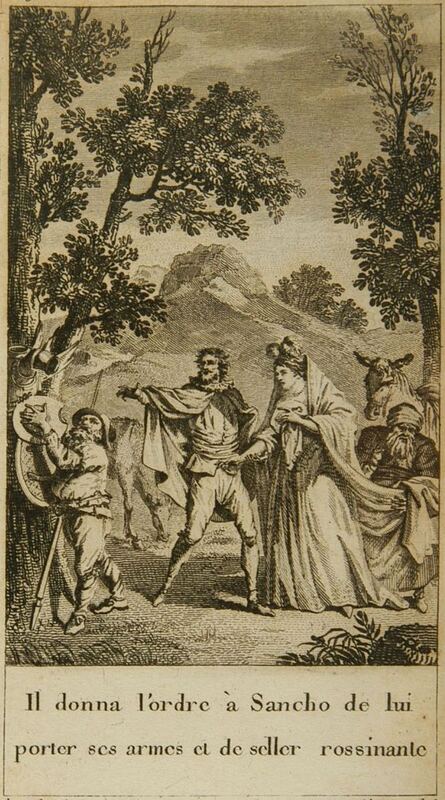
In Sierra Morena, princess Mimicona (Dorotea) kneels before Don Quixote and begs for his help. The barber is disguised as Dorotea’s page with a fake beard (an oxtail). Don Quixote orders Sancho Panza to bring him his arms and to saddle Rocinante. Signed by C. Lefebvre (illustrator) and L.-M. Halbou (engraver). Part 1, ch. 29.
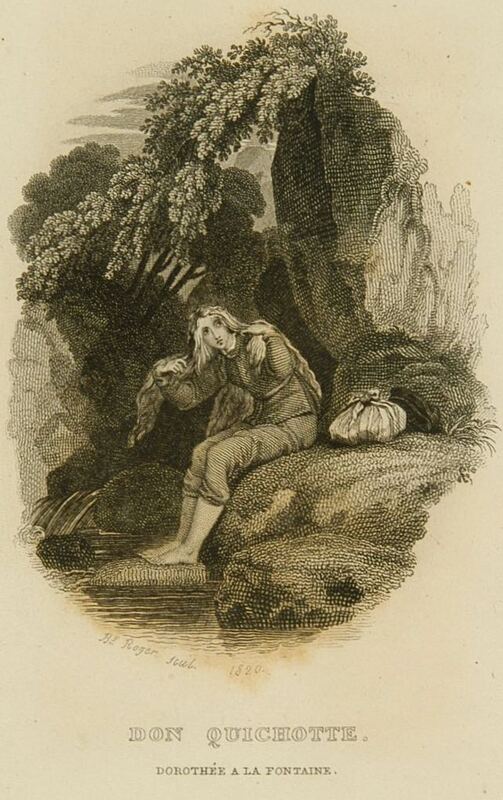
Dorotea washes her feet in the stream. The trees and shrubbery pictured in the illustration are well detailed. The barber, the priest, and Cardenio are not pictured but their arrival on the scene is indicated by Dorotea’s glance. Signed by B. J. F. Roger (engraver) and dated 1820. Part 1, ch. 2.
Having finished dinner, Don Quixote, his hands on his hip (leftmost) sits with the duchess, dressed in a white dress and medallion upon her neck, (left middle) and the duke (left) who wears a wide plumed hat. Their chairs all face towards the right where four damsels have entered and bow slightly before their masters, not daring to make eye contact.
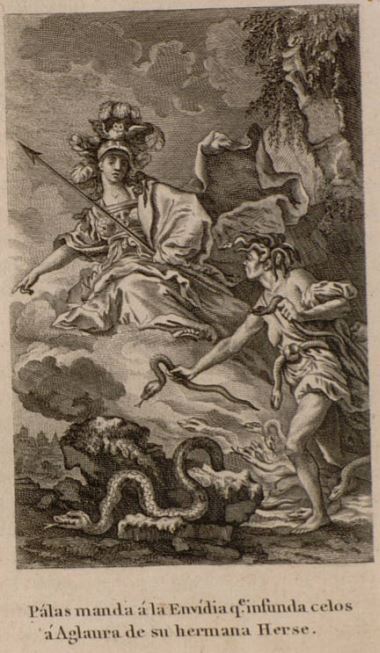
This image depicts Minerva hovering over the clouds as she approaches the home of Envy. Minerva is depicted with her spear and helmet and with an owl on her head. These items are common iconography linked to the goddess. Envy is depicted with snakes in her hair, in her hands, and by her feet as she looks up to Minerva. Minerva is seeking the help of Envy to make a woman named Aglauros jealous of her sister Herse. Aglauros is a woman from Athens who had betrayed Minverva in the past and has now made a pact with the god Mercury in order to receive riches from him. The greed and betrayal of Aglauros angers Minerva, and this is why she seeks Envy’s help to poison her.
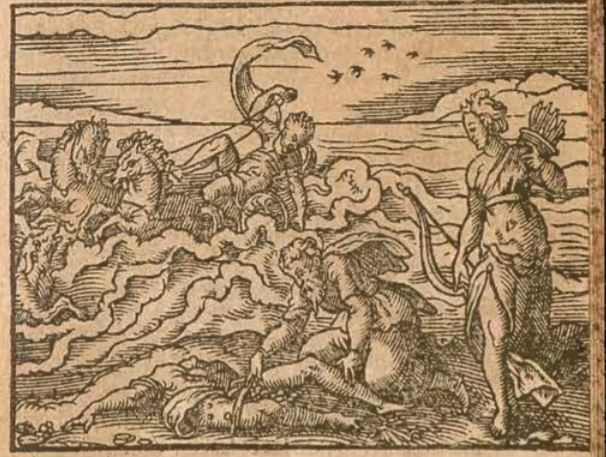
This engraving illustrates the death of Hippolytus, the son of Theseus. Hippolytus is illustrated in his horse-drawn chariot, being over taken by massive waves from the ocean. There is a bull coming out of the waves on the left-hand side of the engraving, directly in front of the horses. Hippolytus is depicted falling out of the chariot as he loses control of the horses. This accident kills Hippolytus. His mangled body is illustrated in the foreground of the engraving as he is being healed by the god Aesculapius. Standing beside Aesculapius is the goddess Diana, depicted with her bows and arrows. Ovid explains that Diana helped Hippolytus find a new life and home after he was healed.
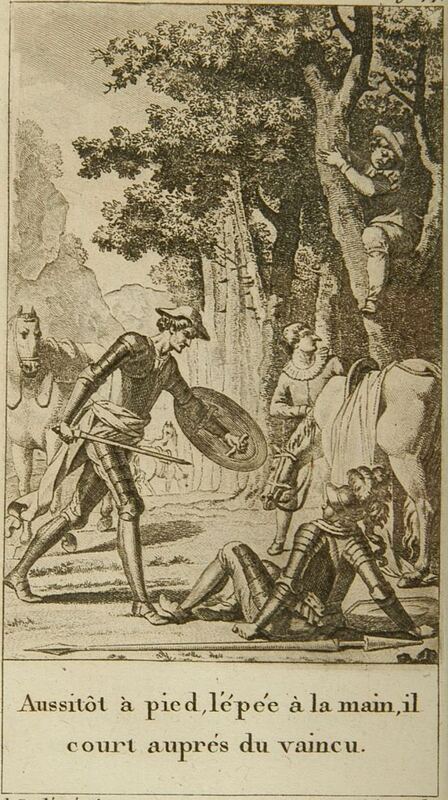
In the aftermath of their battle, Don Quixote, with a gesture of clemency, orders the Knight of the Mirrors (Sansón Carrasco in disguise) to present himself to Dulcinea in El Toboso on his behalf. Sancho Panza, startled by the big nose of the Knight of the Mirrors’ squire (Tomé Cecial), climbs into a tree. Signed by J.-J.-F. Le Barbier (illustrator) and C.-É. Gaucher (engraver). Part 2, ch. 14.
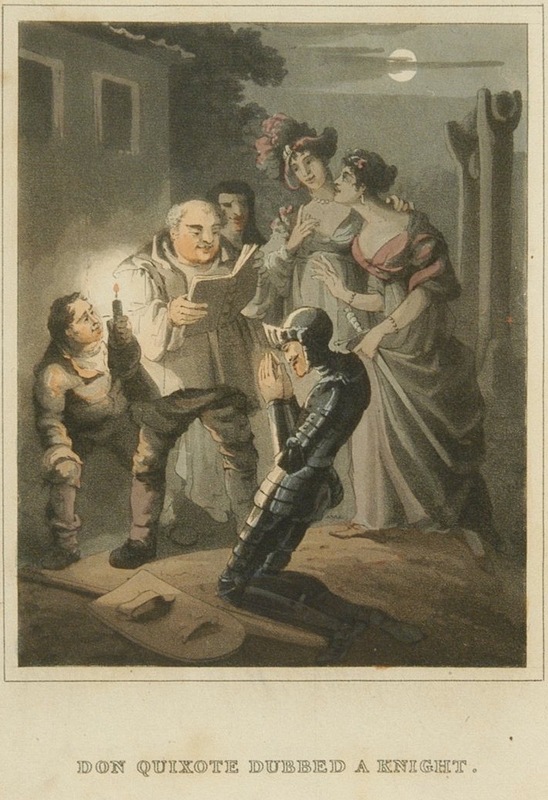
In the centre of the composition, the innkeeper knights Don Quixote, who kneels before him. The knight wears his armour and his helmet. Doña Molinera and Doña Tolosa (right) are also pictured, as is a boy holding a candle (left). Another figure, who does not appear in Cervantes’ text, watches the proceedings. The scene is accurately depicted at night: the characters are illuminated by the light of the boy’s candle and that of the moon, partially obscured by clouds. Unsigned. Part 1, ch. 3.
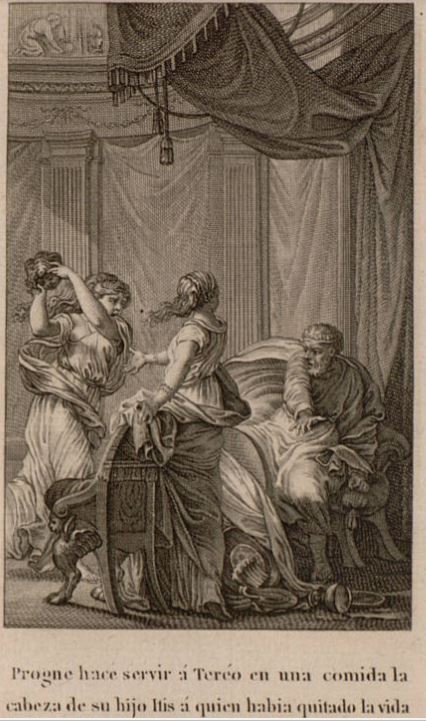
This image depicts Philomela presenting the head of her nephew to her brother-in-law Tereus. After being rescued by her sister Procne, Philomela and her sister conjured a plan to seek revenge on Tereus for keeping Philomela captive and mutilating her. Procne decided to kill her own son and feed him to her husband Tereus to avenge her sister. Tereus appears to be shocked as Philomela throws the head of her nephew Itys towards him.
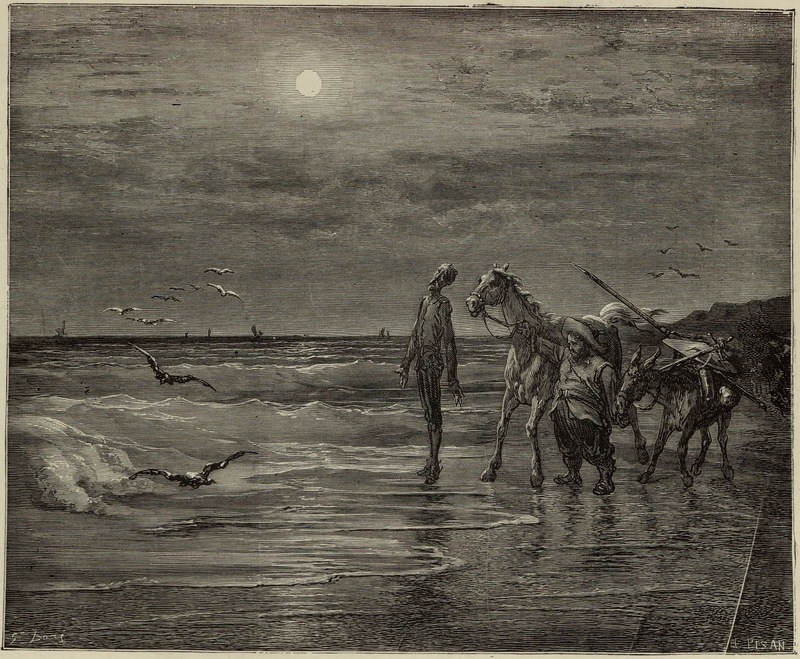
Accompanied by Sancho Panza, Don Quixote returns to the place where he was defeated by the Knight of the White Moon (Sansón Carrasco). Signed by G. Doré (illustrator) and H.-J. Pisan (engraver). Part 2, ch. 66.
Don Quixote (middle), clad in armor, enters into a large court-yard in the company of the duke, who stands behind him with only his back visible, and the duchess who turns her head in the direction of the duke. Two damsels come from the left with a large mantle of scarlet to throw over Don Quixote's shoulders.
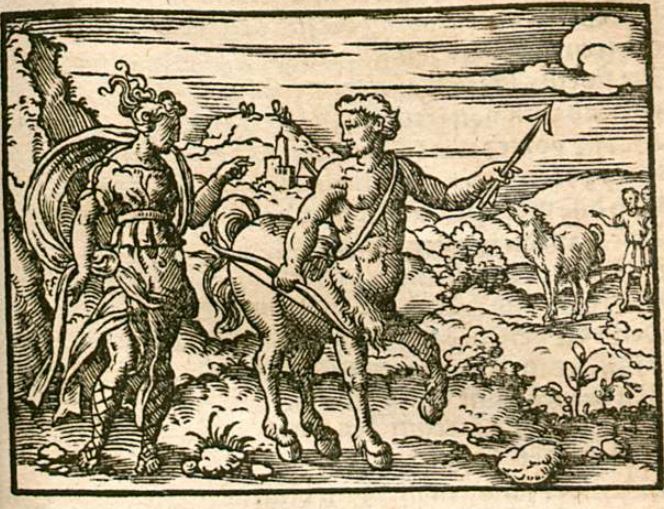
This engraving depicts the centaur named Chiron who had just agreed to look after the child of Coronis and the god Phoebus. Beside Chiron is his daughter Ocyrhoë, who is gifted with the power of prophecy. She is speaking to her father making a prophecy that this son of Phoebus and Coronis named Aesculapius will grow up to have the power of healing and raising people from the dead. She explains that this will anger Jupiter and result in Jupiter killing him with a thunderbolt, and in turn will result in raising his own self from the dead. Chiron is depicted looking at his daughter while holding a bow in his right hand and an arrow in his left. Ocyrhoë is depicted looking and pointing towards her father.
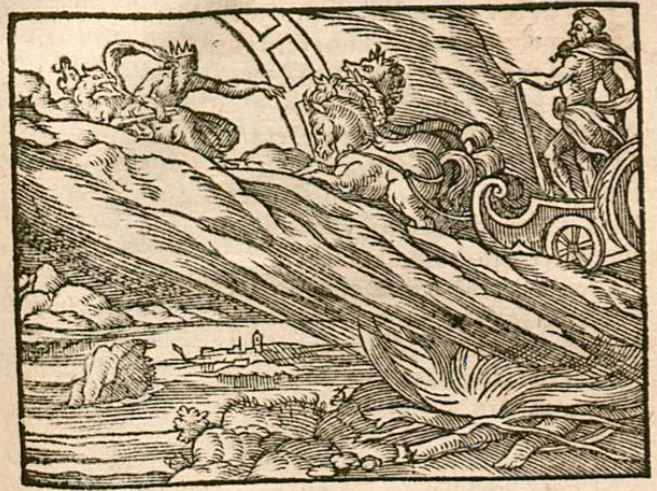
This engraving takes place after Hercules was burned in a funeral pyre. The mortal piece of him was burned to death, but since he is the son of Jupiter, the immortal being within Hercules survived. This illustration depicts Jupiter in the clouds, welcoming his son Hercules into the heavens as he rides on the horse-drawn chariot. Once Hercules rejoins his father, he is made into a constellation in the sky.
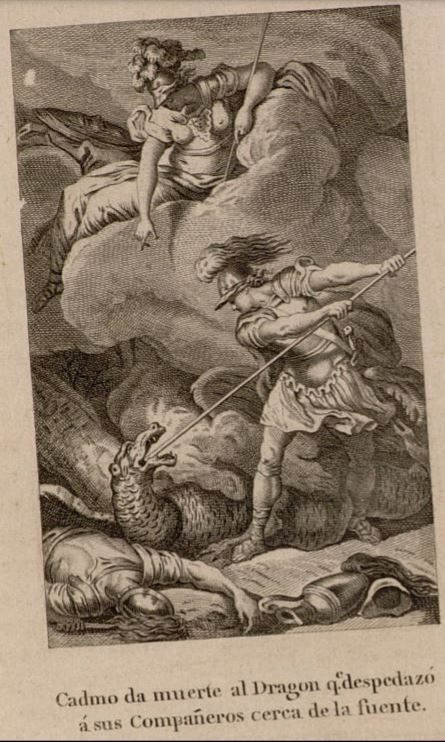
This image depicts Cadmus slaying the serpent sacred to the god Mars. After this serpent had killed his companions, Cadmus kills it for revenge. One of Cadmus’ companions is depicted lying dead next to the snake as he pierces the snake with a long spear through his mouth. The goddess Minerva (also known as Pallas) is illustrated floating on a bed of clouds above the scene. After Cadmus kills the snake, Minerva instructs Cadmus to take the teeth of the serpent and sow them into the ground. By doing this, the teeth will generate people. These people become the population of the newly formed city of Thebes.
Don Diego's village pictured in the afternoon at around two o'clock. A beaten path leads to a large archway and a rectangular wall surrounding a large building with many openings. The image is occasioned by Don Diego saying "But let us make haste, for it grows late, to my village and house, that you may repose and refresh yourself after your late toil, which, if not of the body, has been a labor of the mind, the fatigue of which usually affects the body too."
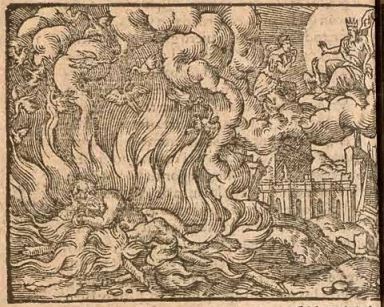
This engraving depicts Memnon, the son of the goddess Aurora, being burned in a funeral pyre after being killed by Achilles. Aurora, grieved by the death of her warrior son, goes to Jupiter to ask him to grant her son some kind of honour. Aurora is illustrated in the background of the engraving, floating in the clouds speaking to Jupiter. While Memnon’s funeral pyre was blazing, a flock of birds emerged from the smoke. The birds split into two groups and begin fighting each other to the death, where they eventually fall into Memnon’s ashes. They are called the Memnonides. The birds are illustrated in the smoke above Memnon’s body. This event occurs every twelve years in honour of Memnon.
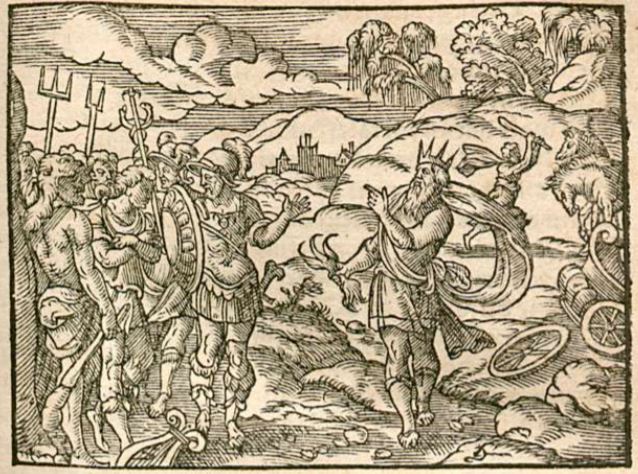
This engraving illustrates Jupiter in the foreground of the image speaking in front of a group of other gods, discussing the fact that killing Phaethon (the son of Phoebus) was necessary in order to save the earth from burning. Jupiter is wearing a crown to signify his status as king of the gods. Phoebus, the god of the sun, is depicted in the background behind Jupiter on the right side of the image. He is illustrated with his sword in the air, about to thrust it towards his horses. Phoebus is grieving for the death of his son Phaethon, and after blaming Jupiter for his death, he blames his horses and punishes them harshly.
Sancho Panza (right) kneels before the duchess, pictured as a gallant lady upon a palfrey, sitting sideways on her horse with a side-saddle of cloth of silver. For her attire she is dressed full of elegance and richness and on her right hand she carries a hawk. She is accompanied by a page (left) who holds the reins of her horse, and four moustachioed companions each with identical attire and plumed hats, who accompany her on the hunt.
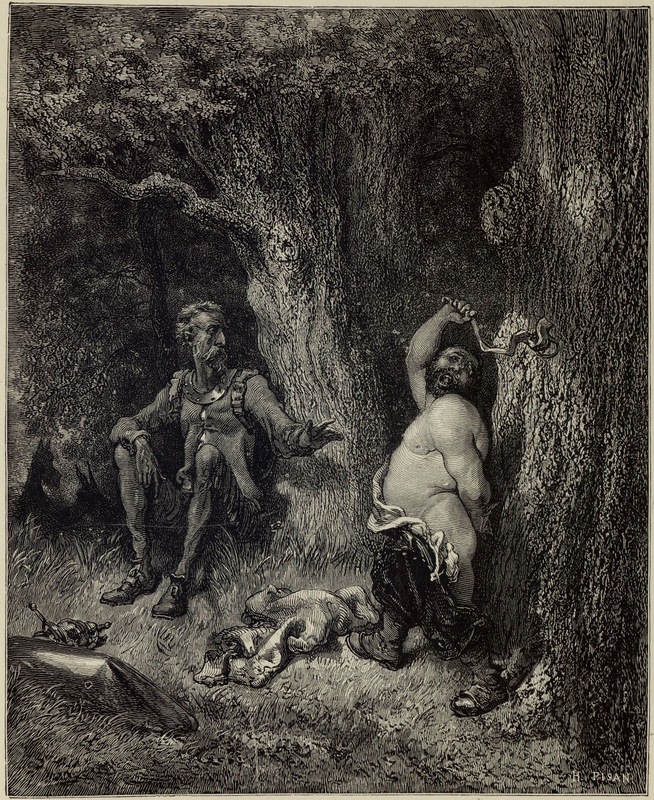
Sancho Panza pretends to give himself lashes to disenchant Dulcinea (he whips tree trunks) while Don Quixote counts the lashes using the beads of his rosary. Signed by G. Doré (illustrator) and H.-J. Pisan (engraver). Part 2, ch. 71.
This image depicts a love driven Scyla (Scylla), the daughter of King Niso (Nisus), on her knees with her hand raised in the air holding an offering. The offering she holds is a lock of purple hair from her father’s head. The purple hair is said to have protected the city of Megara and kept it safe against enemies. Scylla is overcome by love for the Cretan King Minos who is attempting to attack her own city. She betrays her father and pulls the lock of purple hair from her father's head and is shown in the image offering it to King Minos to display her love for him. King Minos is depicted with his crown among the group of soldiers, looking down on Scylla.
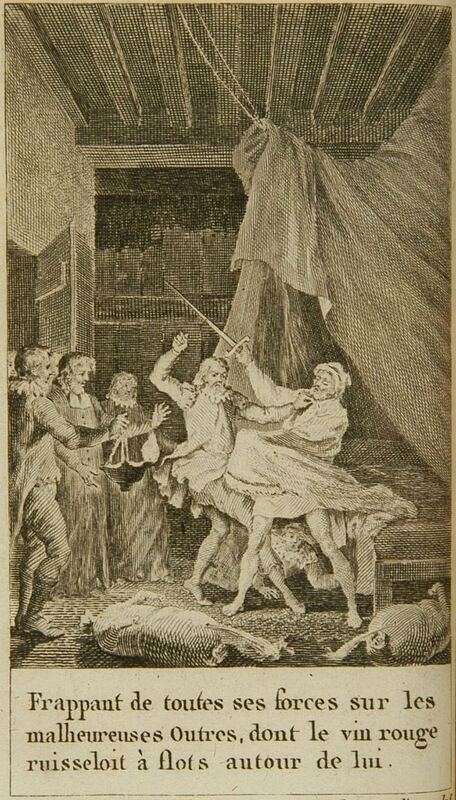
Don Quixote attacks the wineskins while sleepwalking, believing them to be the giant Pandafilando. He is half-dressed, has a blanket draped over his arm, and wields his sword. The innkeeper grabs him by the shoulder and clenches his fist, preparing to hit Don Quixote. The wine from a punctured wineskin spills onto the floor in the foreground. The barber, the priest, and Sancho Panza are also pictured. Signed by C. Lefebvre (illustrator) and L.-J. Masquelier (engraver). Part 1, ch. 35.
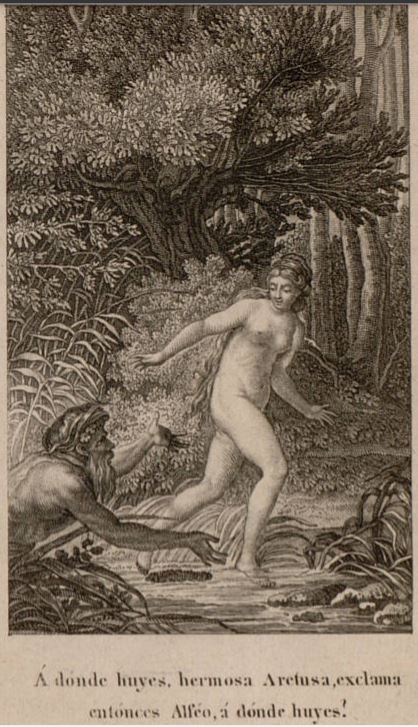
This image depicts the nymph Arethusa running away from her pursuer, Alpheus. Arethusa was one day bathing naked in a river when the river god Alpheus had called out to her and declared his love for her. Arethusa panicked and ran away as fast as she could with Alpheus chasing after her. They ran over vast distances when Arethusa began to slow down due to fatigue. She called out to the goddess Diana for protection. Diana was moved by Arethusa and granted her safety by producing a cloud of mist which made Arethusa invisible to Alpheus.
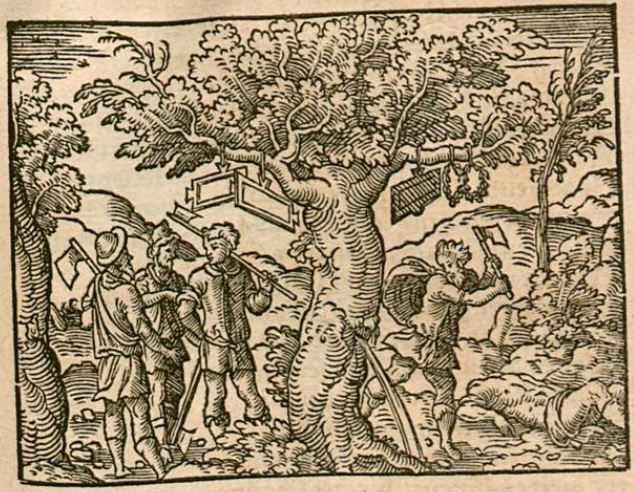
Erysichthon is depicted in this engraving holding an axe in his hands, swinging it against a giant oak tree that is sacred to the goddess Ceres. An impious man, Erysichthon commanded his companions to also cut down the tree, and when they rejected his command, he cut off the head of one of his peers. The decapitated man is illustrated by the feet of Erysichthon. While Erysichthon continues to chop down the sacred tree, blood begins to pour out of the tree trunk. A nymph which lived inside the tree warns Erysichthon that if he continues to cut down the tree, death will soon find him. Despite the warning, Erysichthon continues swinging his axe against the oak tree.
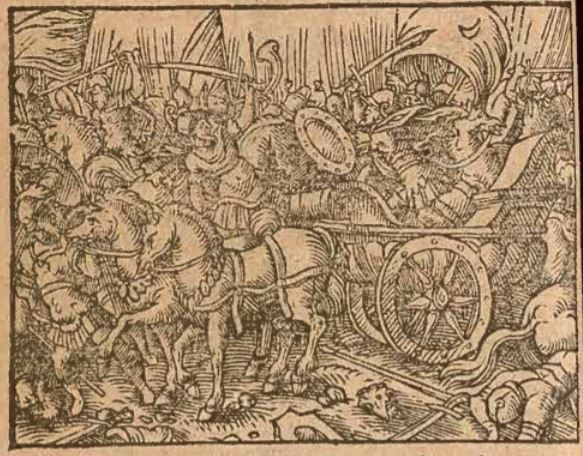
This engraving illustrates the first battle between the Greeks and the Trojans in the Trojan War. Amidst the chaos and fighting happening in the engraving, there are two soldiers depicted as the focal point in the center of the image. The soldier which has his shield and sword in hand, standing in the chariot is the great Achilles. Achilles is depicted fighting a man named Cycnus, who is depicted just to the left of Achilles, almost in the center of the engraving. Achilles continues to throw his spear at Cycnus, however, his spear bounces off Cycnus’ armour every time. Cycnus reveals that he is the son of Neptune and cannot be harmed. Achilles ends up choking Cycnus, but before he dies, Neptune transforms him into a swan.

![[Of How the Barber Damsels Introduced Themselves to Don Quixote]](https://collections.cemvc.ca/files/large/d4dc3bb60fcc9f938777d86ea5f0da3f8e1d5c81.jpg)
![[Of How Don Quixote Entered the Courtyard of the Duke and Duchess]](https://collections.cemvc.ca/files/large/66e3d91d876baa1c44aa467ae049d00843a276d0.jpg)
![[Don Diego's Village]](https://collections.cemvc.ca/files/large/211866e9ebcd2ef3a0369215f483a21a0ea90146.jpg)
![[Of How Sancho Panza Introduced his Master to the Duchess]](https://collections.cemvc.ca/files/large/e14b0d102bef18815fbba255a0f1c665883b5815.jpg)
![[Scylla Offers her Father’s Purple Locks to King Minos]](https://collections.cemvc.ca/files/large/718ab90e879d27262900bb7154393a2318ca26dd.jpg)