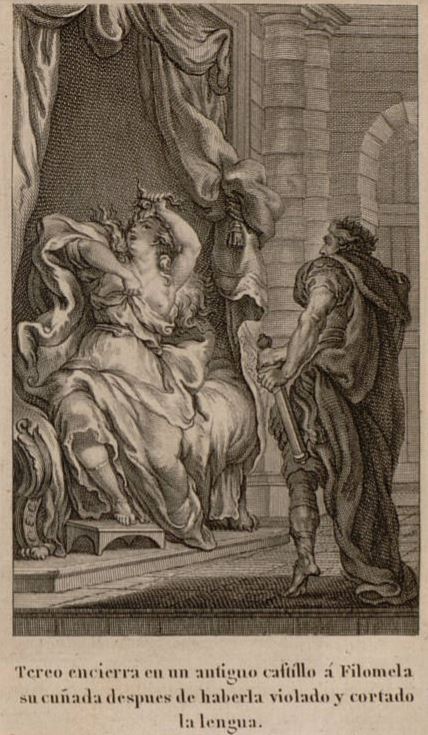
Tereus, a Thracian prince, had become infatuated with his wife Procne’s sister named Philomela. He abducted her and put her into an old building in the middle of the forest where he raped her. To prevent Philomela from screaming or asking for help, he cut out her tongue. Philomela is depicted sitting down in this image as she screams and pulls on her hair. Tereus is depicted pulling out his sword from his sheath to cut out her tongue.
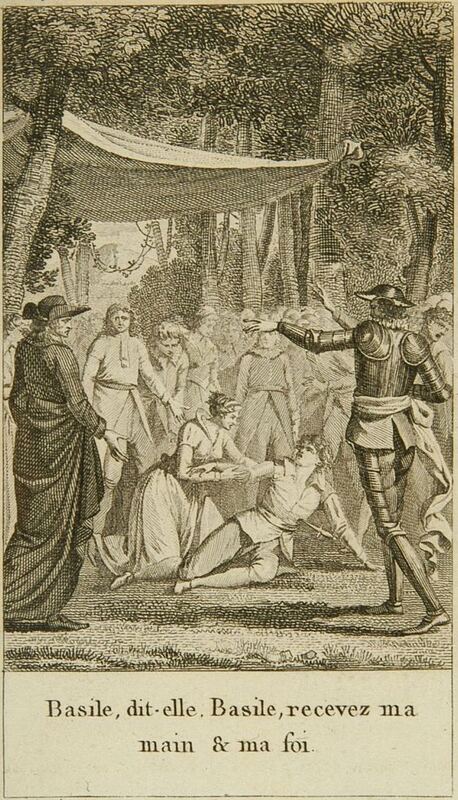
Basilio, pretending to have stabbed himself, is married to Quiteria. Don Quixote (right foreground), the priest (left foreground), and a number of wedding guests (background) are also pictured. Signed by J.-J.-F. Le Barbier (illustrator) and L.-M. Halbou (engraver). Part 2, ch. 21.
A leather sack lies open on the ground, slips of paper flying out from within with the word 'proverb' written on each slip. The image is occasioned by Don Quixote saying "This I might prevent, by letting the duke know what you are, telling him that all that paunch-gut and little carcase of thine is nothing but a sackful of proverbs and sly remarks" (Page 458).
A landscape of a city from the direction of its port, where many fishing boats sail to and fro. The city is made of stone and of an old spanish architecture with a wall built in its midst, the city also appears to have been build on a mountain or a hill. In the background on the right there are more, taller mountains. The image is occasioned by the bachelor Sampson Carrasco saying "that I verily believe that there are at this very day above twelve thousand books published of that history ; witness Lisbon, Barcelona, and Valencia, where they have been printed, and there is a rumour that it is now printing at Antwerp. For my part, I foresee that no nation nor language will be without a translation of it."
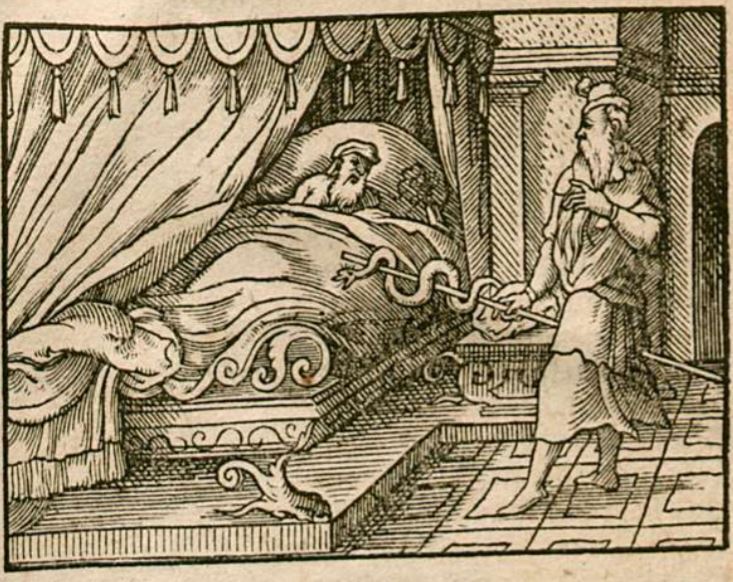
Aesculapius, the god of healing, is illustrated standing on the right side of the engraving holding a long staff in his hand with a snake coiled around it. Aesculapius is appearing in the dream of a Roman delegate, the man who is depicted sleeping in the bed. The Romans sought out Aesculapius’ help as their city was being ravaged by the plague. Aesculapius appears in this man’s dream to inform him that he will help the city and accompany the men on the journey back to Rome in the form of a snake.
The god of healing, Aesculapius, is illustrated standing on the right-hand side of the engraving holding a long staff in his right hand with a snake coiled around it. Aesculapius is appearing in the dream of a Roman delegate, the man who is depicted sleeping in the bed. The Romans, as told by Ovid, sought out Aesculapius’ help as their city was being ravaged by the plague. Aesculapius appears in this man’s dream to inform him that he will help the city and accompany the men on the journey back to Rome in the form of a snake.
Princess Micomicona (Dorotea) kneels before Don Quixote, while Sancho Panza explains who she is. The barber, disguised with a beard, appears as her squire. In the text, the priest and Cardenio are hidden from view, while in the illustration they are pictured in the scene. Plate no. 19, signed by J. Vanderbank (illustrator) and G. van der Gucht (engraver). Vol. 1, book 4, ch. 2.
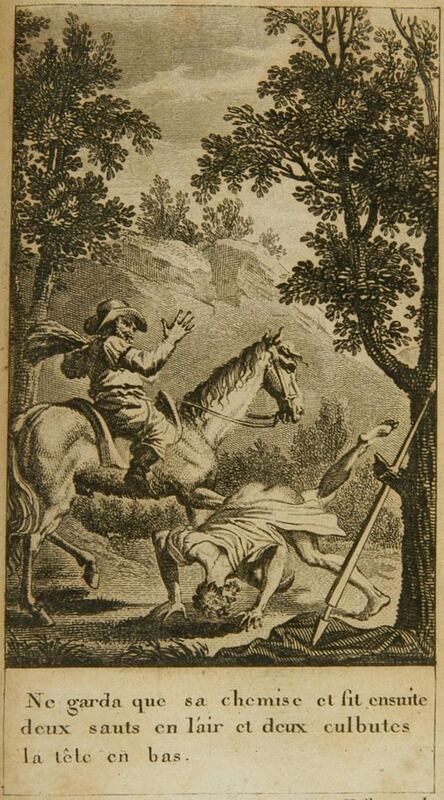
Sancho Panza, holding a bundle of broom stalks and mounted on Rocinante, leaves for El Toboso. Don Quixote stays in Sierra Morena and is pictured performing a somersault as penance. Don Quixote’s armour hangs on a nearby tree. Signed by C. Lefebvre (illustrator) and L.-M. Halbou (engraver). Part 1, ch. 25.
Sancho awakes and falls to the ground having been placed on a saddle propped up by four wooden stakes which had been placed by Gines De Pasamontes to imitate the feeling of sleeping upon his donkey.
In the early morning beneath a tree, Sancho Panza (left) falls onto his side and trembles, his eyes enlarge at the sight of the Squire of the Wood's gargantuan nose. The Squire of the Wood (right) is sitting with a bottle in his right hand and is wearing a tall cap. His nose is so large that it casts a shadow over his body. In front of the two squire's there is a plate.
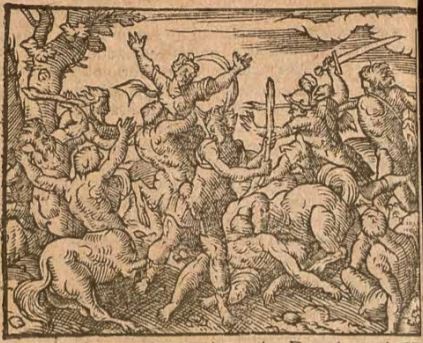
This engraving depicts a chaotic battle between centaurs and the Lapiths. The battle broke out due to one of the centaurs, Eurytus, stealing the bride of Pirithous, the king of the Lapiths. The centaurs were invited to the wedding ceremony, however, Eurytus betrayed Pirithous by being overtaken by Hippodame’s beauty and dragging her off. Eurytus is illustrated almost in the center of the engraving with Hippodame in his arms as he carries her away. Her arms are in the air as she pleads for help. Pirithous’ friend, Theseus, is illustrated to the right of Eurytus with a helmet on, and his sword behind his head, ready to swing at the centaur and save Hippodame.
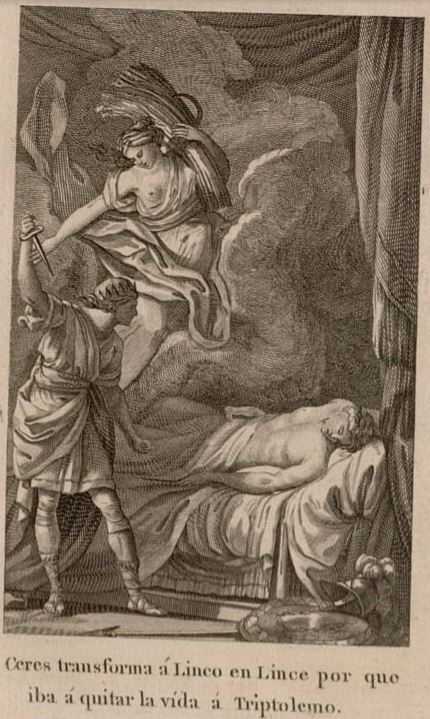
This image depicts the goddess Ceres floating on a bed of clouds as she stops King Lyncus from killing the sleeping Triptolemus. Ceres is depicted holding grain in her arm as she is the goddess of agriculture and the harvest. She had commanded Triptolemus to use her chariot to scatter seeds across the land, and when he came to Lyncus’ kingdom to rest, King Lyncus betrayed Triptolemus and tried to kill him. Ceres stops this from happening and transforms Lyncus into a lynx for his punishment.
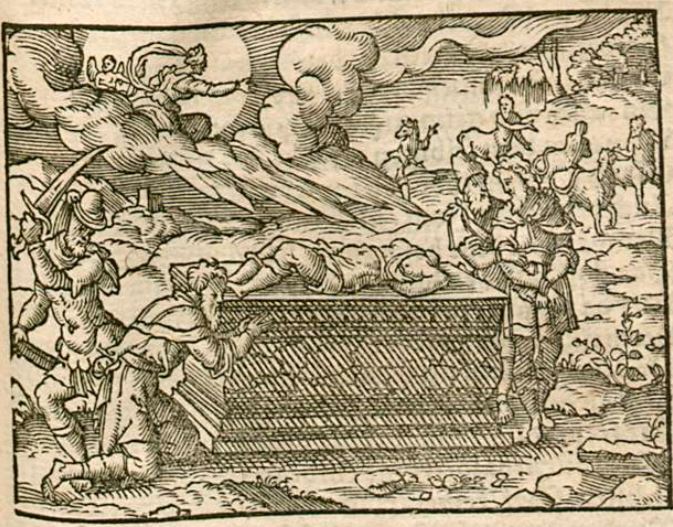
This engraving illustrates the human sacrifices that the Propoetides and Cerastae would perform on visitors to their city. There are men depicted surrounding the altar to Jupiter where the sacrifices would be conducted. One man is depicted decapitated with his body lying on the altar. The Propoetides were women from Cyprus and refused to believe that Venus was a goddess worth believing in. Angered by this and by their sacrifices, Venus (who is illustrated in the clouds in the top left corner of the engraving) punishes them by making them the first prostitutes and taking away their shame. Venus punishes the Cerastae, horned men from Cyprus, by transforming them into wild bullocks. They are illustrated in the background on the right side of the image.
Travelling under cloud of night, Sancho Panza and Don Quixote see 20 people on horseback, all of them dressed in white, each with a lighted flambeau in hand. Seeking to know the reason for these passing apparitions, Quixote stepped before one of the mourners, scaring the travelers mule who reared back and fell over knocking the mourner to the ground alongside it. Seizing the opportunity, Quixote couched his lance and placed his lance in the vicinity of the mourner's face. In the background a litter covered with black is followed by mounted cavaliers in deep mourning.
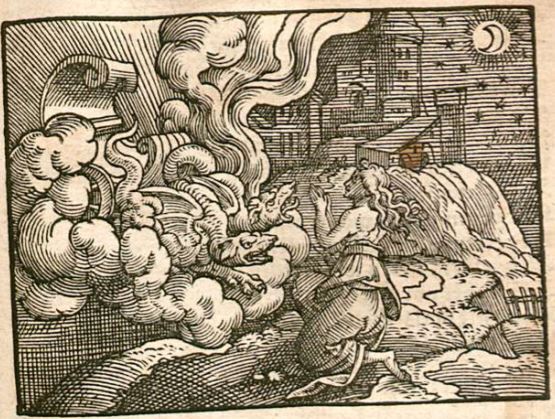
This engraving is difficult to make out, as it is purposefully drawn dark to symbolize that it is the middle of the night. This is also depicted through the moon and stars being drawn in the top right corner of the image. The woman illustrated in the engraving is Medea, the wife of Jason and daughter of King Aeetes of Colchis. She is depicted on her knees as she was praying to the goddess Hecate for help. She was praying for help because her husband Jason wished to prolong his father’s life. The goddess heard Medea and sent help by means of a chariot drawn by dragons. Medea uses the dragons to fly around the Earth for nine days and nine nights in order to find special herbs that will lengthen her father-in-law's life.
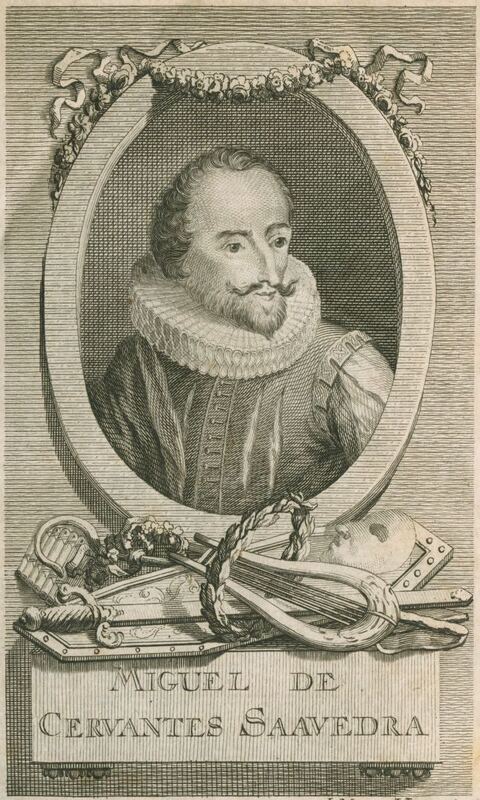
Portrait (bust) of Miguel de Cervantes Saavedra in an oval frame. Below the frame are a number of symbolic objects: a sword, a shield, a mask, a laurel wreath, a lyre, and a flute and crook. Signed by J. M. Haas (engraver).
Dorotea kneels before Don Fernando, while Luscinda confesses her love for Cardenio (left to right). The priest, the barber, and Sancho Panza are pictured in the background. Plate no. 22, signed by J. Vanderbank (illustrator) and G. van der Gucht (engraver). Vol. 1, book 4, ch. 9.
Finishing his dance at Quiteria's wedding, the man dressed as cupid (middle right) bent his bow at the battlements of the castle. He let fly an arrow at the top of the castle making the dancing damsels (bottom right) and the other guests flee. Don Quixote (left), clad in full armor with a lance in his hand stands on a hill and watches on stoically.
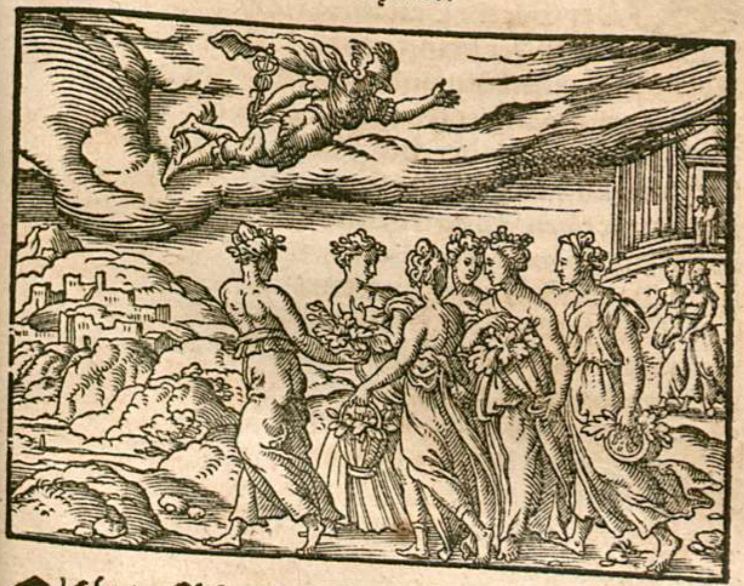
This engraving illustrates the god Mercury flying above the city of Athens during a festival dedicated to Minerva. Mercury is depicted with his winged ankles, helmet, and his caduceus. While flying above the festival, Mercury noticed one of the daughters of King Cecrops, Herse. Mercury is overcome by Herse’s beauty and fixes his hair and robes to look more presentable to her. Herse is one of the many women depicted in the crowd of festival goers.
Having taken his helmet and clapped it upon his head, the curds left within run down his face and beard. Don Quixote, clad in full armor and equipped with a lance upon his back appears surprised by the curds dripping down from his helmet onto his armor. With his left hand he he grabs a handful of the curds and observes them closely, pointing to his helmet as the origin of the mess. Quixote does not identify the material as curds, but rather mistakes it for his skull softening, his brains melting, or an arduous sweat from head to foot.
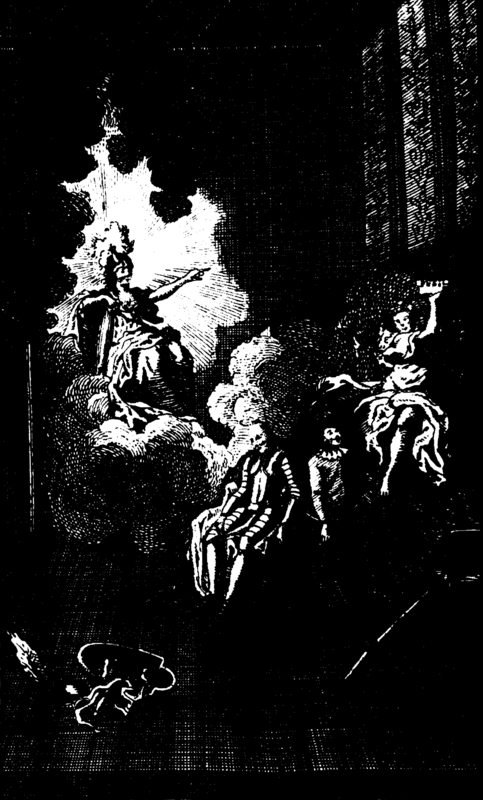
Having lost in a duel to the knight of the half-moon, Don Quixote returns La Mancha in defeat. Once returned, he is seized by a violent fever that confines him to his bed for six days. While sickened in bed he is gradually disillusioned of his madness, but his sadness is so profound nothing can lift his spirits. In this image, Don Quixote is portrayed as being cured of his chivalrous fantasy's by a woman clad in armour and a great feathered helmet who parts the clouds and offers the dejected Quixote some clarity. Meanwhile to his right, the apparition which was his version of Dulcinea del Toboso appears to be flying off into the distance as the real Dulcinea del Toboso has been disenchanted.
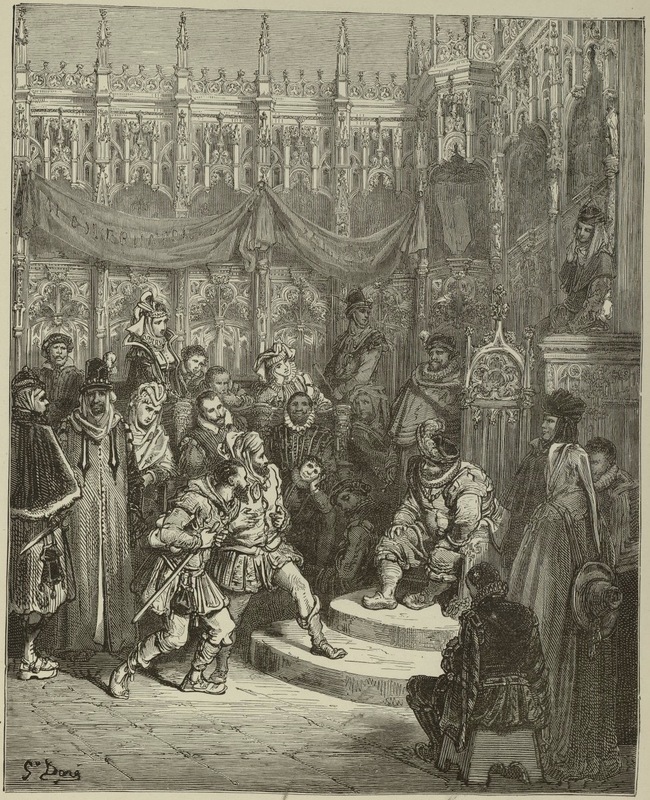
In Sancho Panza’s court at Barataria Island, the plaintiff accuses the defendant of withholding repayment of a loan. Sancho orders that the defendant’s staff be broken, spilling the coins that are hidden inside. In the background, a man and a woman await the next judgement. Signed by G. Doré (illustrator) and H.-J. Pisan (engraver). Part 2, ch. 45.
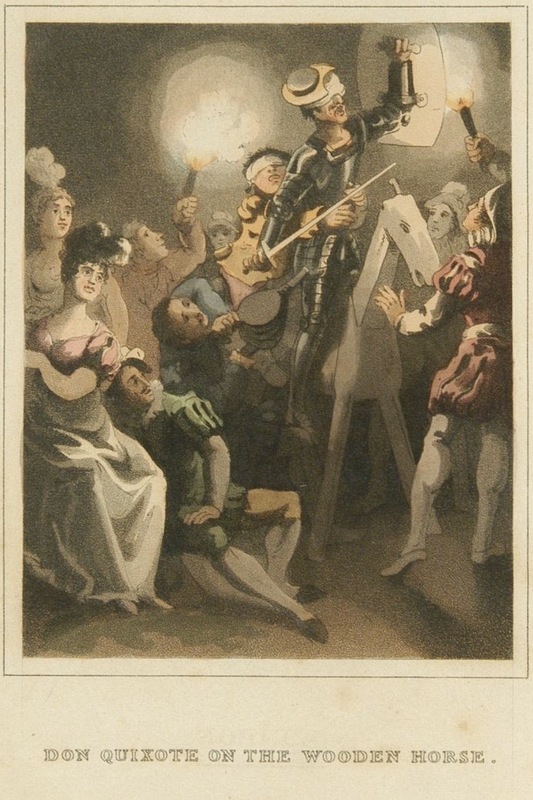
Don Quixote and Sancho Panza, both blindfolded, mount Clavileño while the duchess and duke’s servants simulate its flight with bellows and torches. The duke and the duchess look on. Unsigned. Part 1, ch. 3.
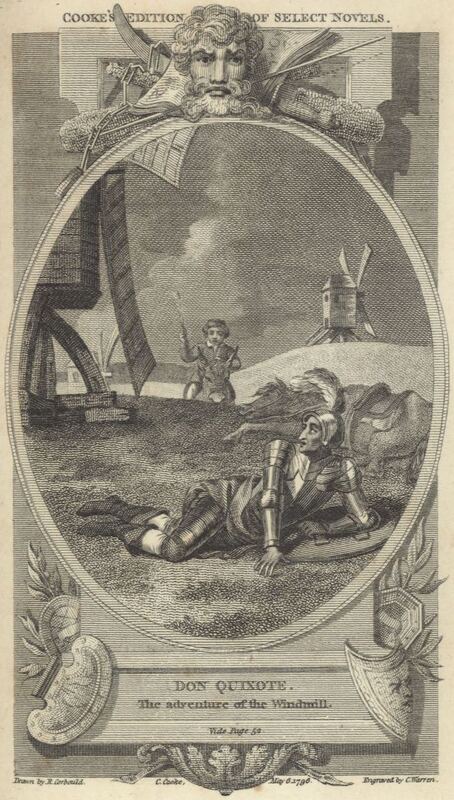
The illustration depicts the aftermath of Don Quixote’s adventure of the windmills. Don Quixote, mounted on Rocinante, charges a windmill that he mistakes for a giant despite Sancho Panza’s warning. The sail catches the wind, moving with so much force that it breaks his lance and picks up the horse and the knight, throwing them to the ground. The illustration is set in a decorative and architectural frame, complete with a giant’s head, his arms, and laurel branches. Signed by R. Corbould (illustrator) and C. Warren (engraver), dated 1796. Part 1, ch. 8.
Having left his home to prove his chivalry as a knight-errant, Don Quixote arrives at an inn. Mounted atop his horse Rocinante and clad in armor with his visor lifted, with Quixote carries a lance in his right hand and the reigns of his horse in his left hand. Quixote is welcomed to the inn by the innkeeper (middle) who stands just outside the entrance and lifts his arm to direct the knight into his establishment. Standing in the doorway are two women who look amusedly upon Quixote. in the background a man eats at a table.

![[A Sackful of Proverbs and Sly Remarks]](https://collections.cemvc.ca/files/large/89e462c3cb2630c0f54889d040e1dda7042be127.jpg)
![[A Landscape of Lisbon, Barcelona, Valencia, or Antwerp]](https://collections.cemvc.ca/files/large/32e6b9d447df002d7390ed7bbbbd9780251dbbdf.jpg)
![[Aesculapius Appears in the Dream of a Roman Delegate]](https://collections.cemvc.ca/files/large/a49740a8499f6f4a65478c3f5efba8378d0fa1d1.jpg)
![[Don Quixote meets princess Micomicona]](https://collections.cemvc.ca/files/large/f2c3b5965b74bde0e5df31d5fb58243a48761328.jpg)
![[Sancho Panza Falls From the Fake Donkey]](https://collections.cemvc.ca/files/large/526e9d5860f296981be8680940eea2f4be953cdc.jpg)
![[Sancho Panza Frightened by the Squire of the Wood's Gargantuan Nose]](https://collections.cemvc.ca/files/large/4a99ef9c9f371cb38f646ed9e563797f226fc292.jpg)
![[Don Quixote Attacks the Mourners]](https://collections.cemvc.ca/files/large/4b3ae61434459f4191d1496c4967498072205b0e.jpg)
![[Dorotea kneels before Don Fernando]](https://collections.cemvc.ca/files/large/e1a2df4aad9bea7f9e92244aedb1813299fd636c.jpg)
![[A Cupid Fires a Bow at Quiteria's Wedding]](https://collections.cemvc.ca/files/large/cf5c71ceeb3a5e648d80d2340db1c152bab46a0a.jpg)
![[Don Quixote Spills Curds Over his Head and Mistakes it for an Adventure]](https://collections.cemvc.ca/files/large/8d9c9ad02eee4744a313b4bbcf4d97ef56cfc419.jpg)
![[Don Quixote is Welcomed into the Inn Which he Mistakes for a Castle]](https://collections.cemvc.ca/files/large/38fbe20f8192df3517609a11d435e60d7daf8715.jpg)