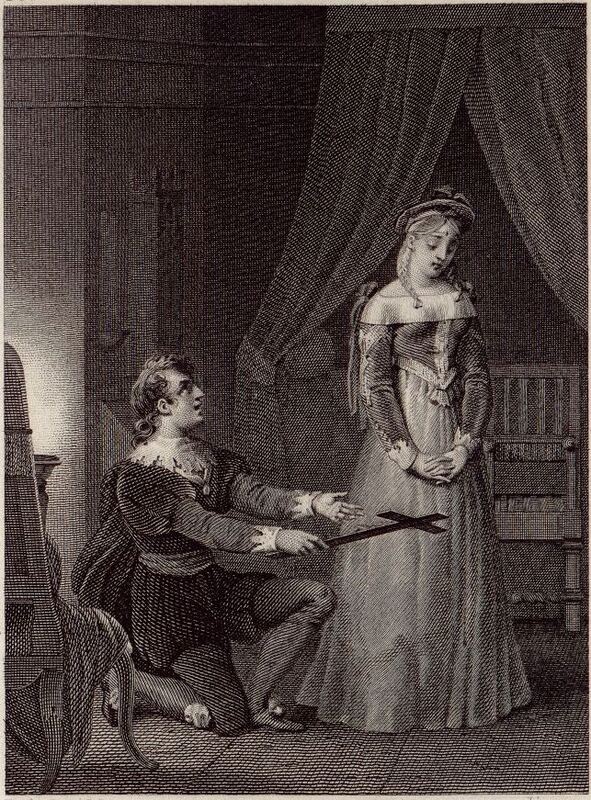
The illustration represents part of Dorotea’s story as she tells it to Cardenio, the priest, and the barber: Don Fernando, holding a crucifix, offers his hand as husband to Dorotea, invoking heaven and an image of Our Lady as witnesses. Signed by E. Lami (illustrator) and E. Lignon (engraver). Part 1, ch. 28.
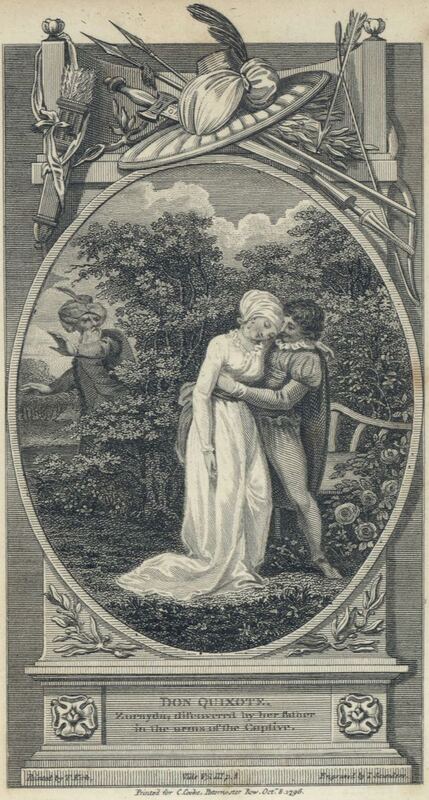
The illustration represents part of the captive’s tale: Zoraida pretends to faint when her father, Agi Morato, discovers her with the captive. The illustration is set in a decorative and architectural frame, complete with a lance, a shield, a sword, a quiver with arrows, and a bow. Signed by T. Kirk (illustrator) and J. Saunders (engraver), dated 1796. Part 1, ch. 41.
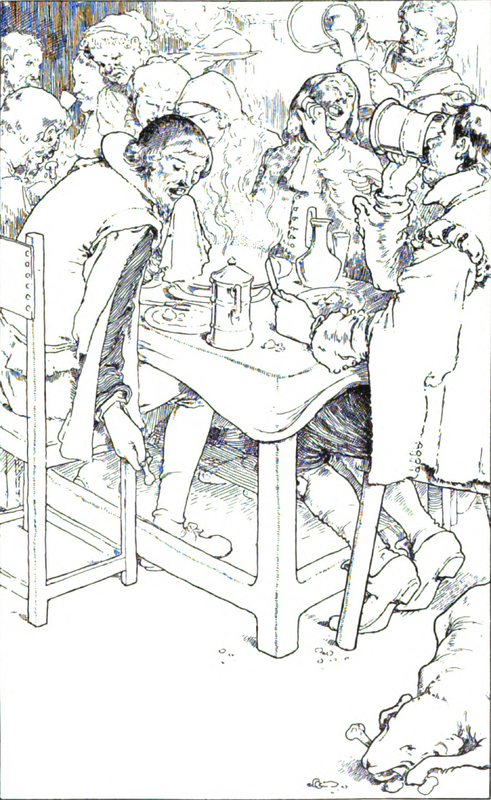
At around four in the afternoon Don Fernando orders the innkeeper to provide his company with a banquet. They all sat down at a long table, like those in great halls. On the upper end of the table sat Don Quixote (top left) and next to him sat princess Micomicona. Then on the opposite end of the table sat Don Fernando (drinking from a pint glass), Cardenio, and the rest of the gentlemen. And thus they banqueted, with the guests particularly enjoying the speeches of Don Quixote who had descended into intoxication.
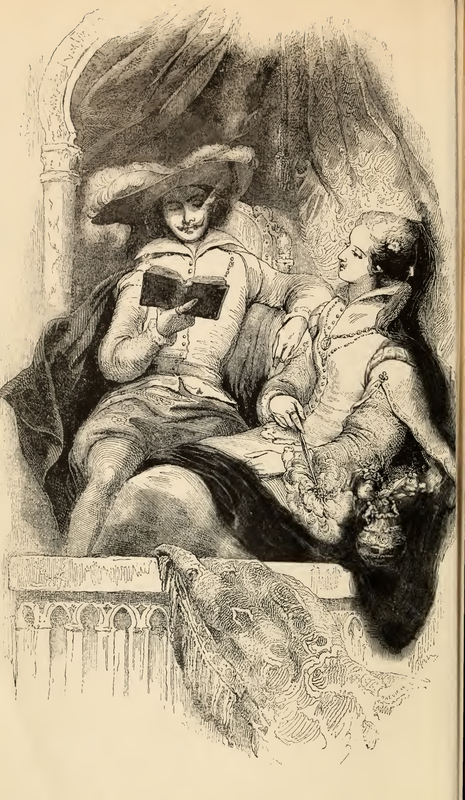
The duke (middle), in a fanciful chair sits reading a book in his right hand, a ring upon his index finger. The duchess (right) stares absent-mindedly into the distance, a feather duster in her right hand resting upon her lap. In the foreground, an expensive vase rests on a table filled with flowers. In the background hang some drapes. There are a lot of flowing cloth in the illustration.
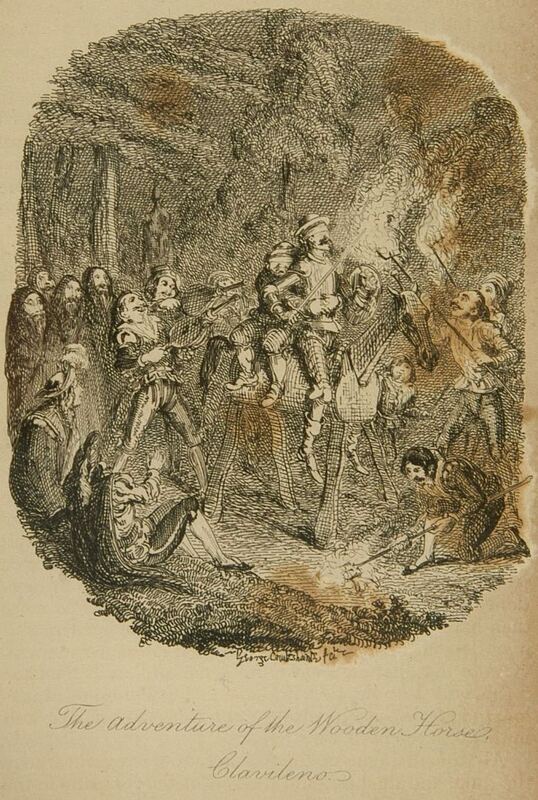
Don Quixote and Sancho Panza are blindfolded and mounted on Clavileño, the famed wooden horse. Servants simulate its flight with bellows and torches. The duke, the duchess, and a crowd of onlookers watch the spectacle. Signed by G. Cruikshank (illustrator and engraver). Part 2, ch. 41.
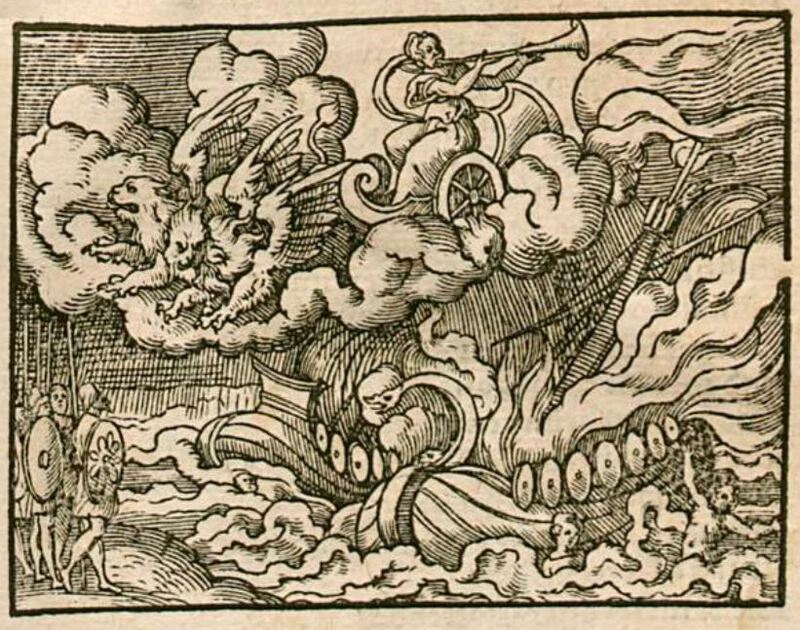
This engraving depicts a battle between Aeneas’ army and Turnus’ army. Turnus conjures a plan to attack by burning Aeneas’ ships. As depicted in the engraving, the ships are engulfed in flames. The goddess Cybele was furious as Aeneas’ ships were made from her favourite trees. Cybele interferes by riding past the battle in her lion-drawn chariot, as illustrated at the top of the engraving. She makes it rain enough to put the fires out and she transforms the ship into nymphs. There are nymphs depicted in the water beside the ships to illustrate the transformation.
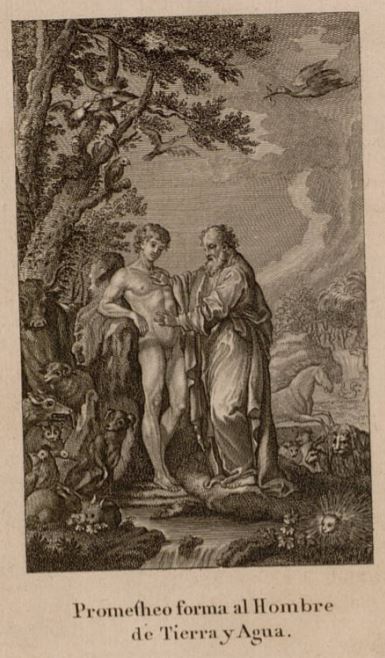
This image depicts the god Prometheus creating the first man. Ovid explains that humankind was formed to resemble the all-controlling Gods and Goddesses. He also explains that they were formed to stand upright apart from other animals so that they could look up to the skies and stars. The god is depicted as an older man with a balding head and a white beard. He is holding on to the stomach of the newly formed human who is illustrated in the nude. There are many animals such as a dog, horse and a crow surrounding the god and new human to demonstrate that they were also newly created.
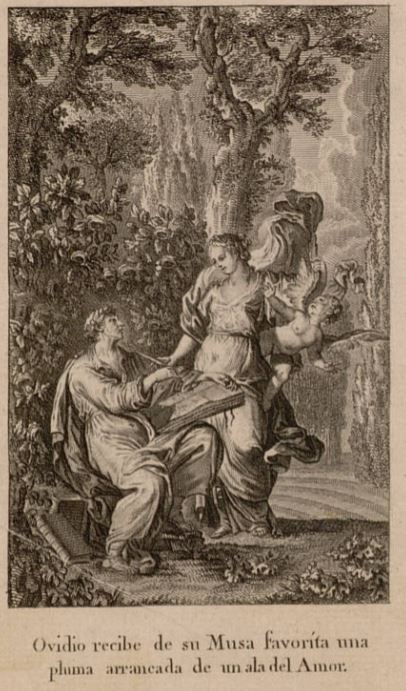
This image depicts the author of the book, Ovid, sitting on the left side of the image with a book and a feathered quill in his hand as he writes Metamorphoses. There is a muse standing in front of Ovid with Cupid, the god of love, flying behind her. They are sitting amidst a forrest as the muse and Ovid look at one another.
Don Quixote lies on a bed, having shut himself up in his chamber with Sancho Panza. Still roused with plans of knight-errantry and governorship, the two men discuss their reputation and newfound plans for another journey that will expose them to good fortune. Sancho is seated to the left on a wooden stool, having removed his cap and holding it in his left hand by his side. Quixote listens to his squire, lying on a low bed with covers and pillows that spill over onto the floor. In the background, a white tarp is hung from two wooden banisters. Quixote's knightly equipment also hang from these banisters, with his breastplate hanging on the left and his helmet and shield on the right. On the ground to the left of Sancho lies a jug of water and an empty glass.
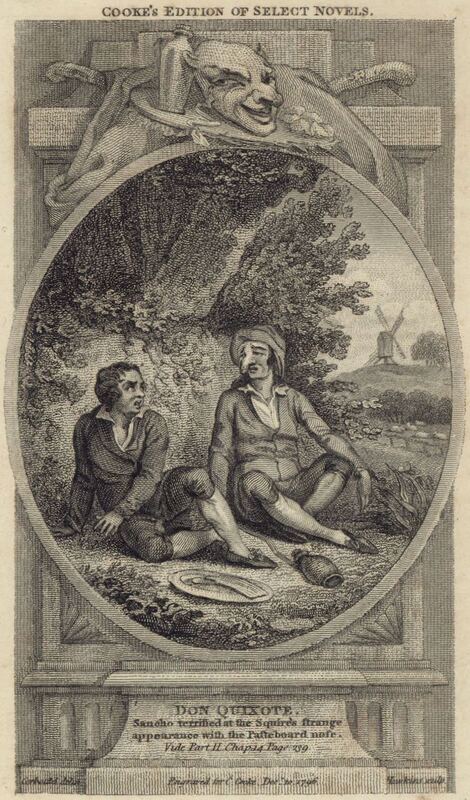
At dawn, Sancho Panza is frightened by Tomé Cecial’s ugly (and fake) nose. In the background, a windmill. The illustration is set in a decorative and architectural frame, complete with a mask. Signed by R. Corbould (illustrator) and W. Hawkins (engraver), dated 1796. Part 2, ch. 14.
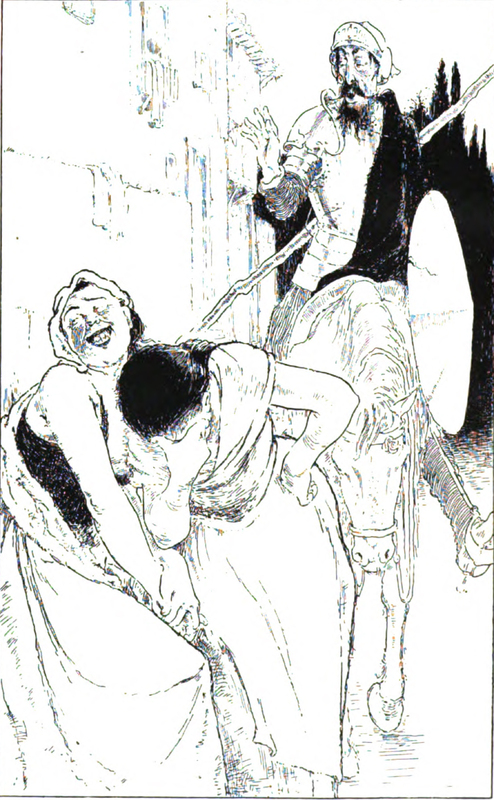
Don Quixote, mounted upon his horse Rocinante and clad in his full arsenal of equipment encounters two women and endeavors to ask them a question. Upon seeing his pathetic countenance and hearing his manner of speech neither can answer for both women cannot help but laugh. He is after all a skinny old man who thinks himself a chivalrous knight, an undoubtedly comical sight.
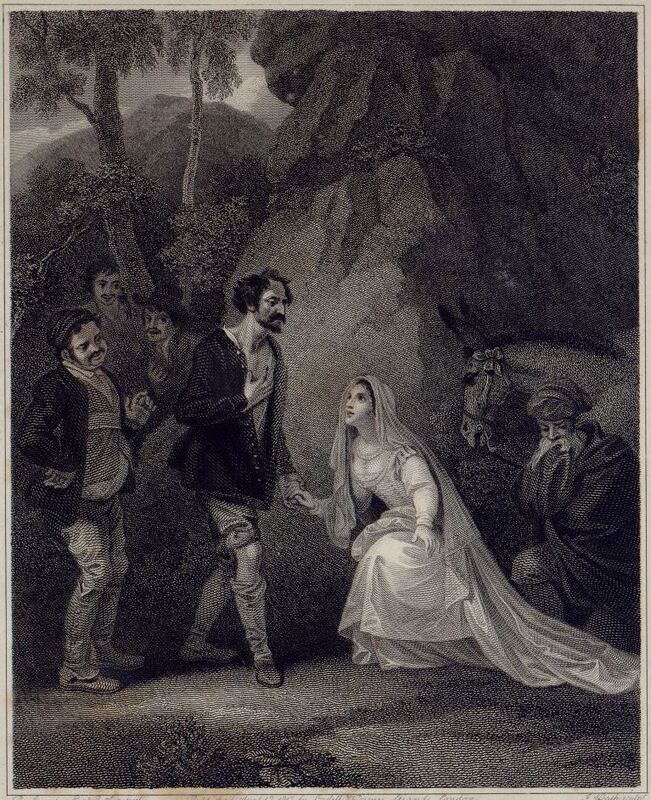
In Sierra Morena, princess Mimicona (Dorotea) kneels before Don Quixote and begs for his help. The barber is disguised as Dorotea’s page with a fake beard (an oxtail). In the background, the priest and Cardenio watch the scene, hidden behind some shrubs. Signed by R. Smirke (illustrator) and J. Heath (engraver). Part 1, ch. 29.
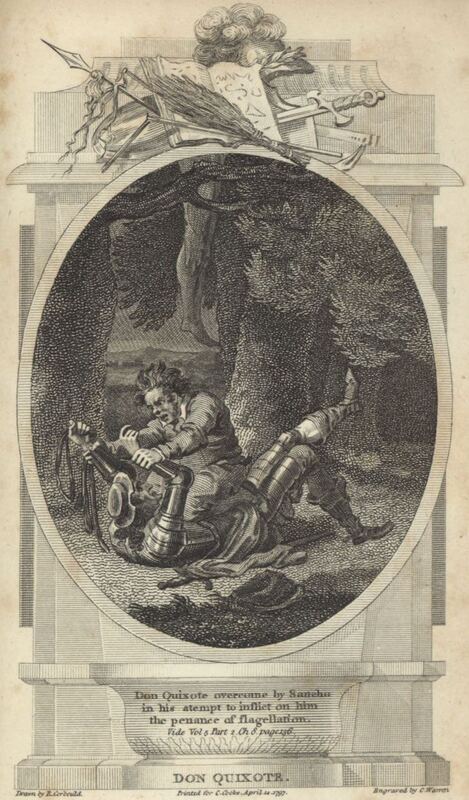
Don Quixote tries to give Sancho Panza two thousand lashes to discharge the debt that he had assumed. They struggle and Sancho gains the upper hand. He makes Don Quixote promise not to try to whip him. In the background, the bodies of outlaws and bandits hang from tree branches. The illustration is set in a decorative and architectural frame, complete with a number of objects: a sword, a helmet, a lance, a broken wand, and a book. Signed by R. Corbould (illustrator) and C. Warren (engraver), dated 1797. Part 2, ch. 60.
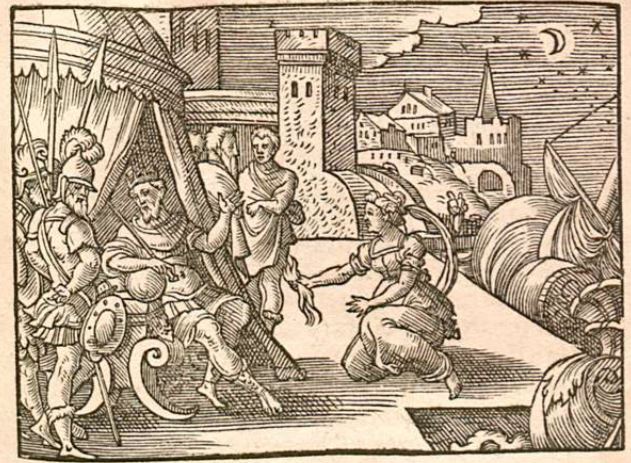
This engraving illustrates Scylla, the daughter of King Nisus of Megara, betraying her father by helping King Minos of Crete. While King Minos had been attacking the city of Megara, Scylla had fallen in love with him while watching the battles from afar. She decided her love for King Minos was worth betraying her father and her city. She cut off a piece of her father’s magical purple hair which kept him safe from harm and handed it over to King Minos. Scylla is depicted offering her father’s hair to King Minos, but King Minos’ face is turned away in disgust with his hand gesturing for her to leave him. Despite King Minos being the enemy of Megara, he found Scylla’s actions deplorable. The sky in the engraving shows a moon and stars to illustrate that Scylla brought the hair to Minos in the middle of the night.
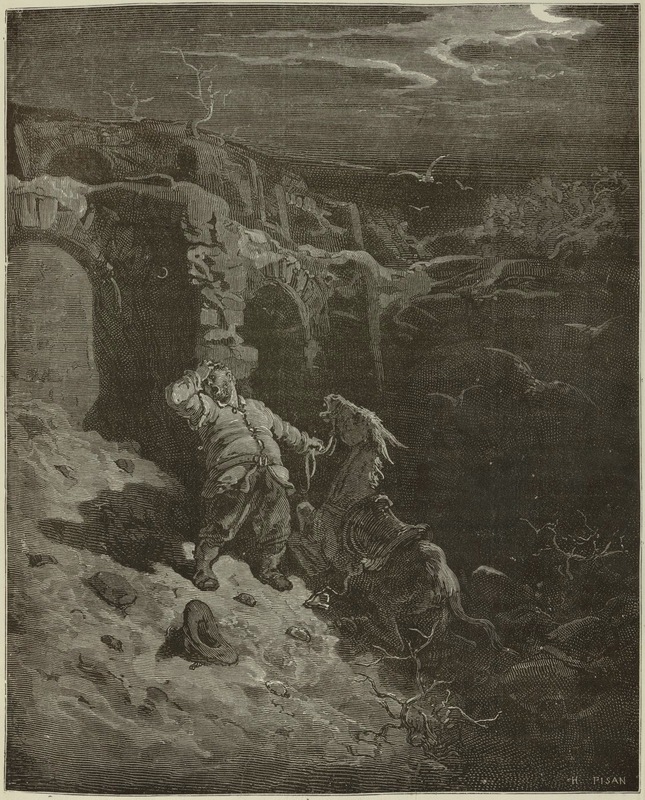
As night falls, Sancho Panza and his donkey fall into a deep and dark pit between some old buildings while returning to the duke’s palace. Signed by G. Doré (illustrator) and H.-J. Pisan (engraver). Part 2, ch. 55.
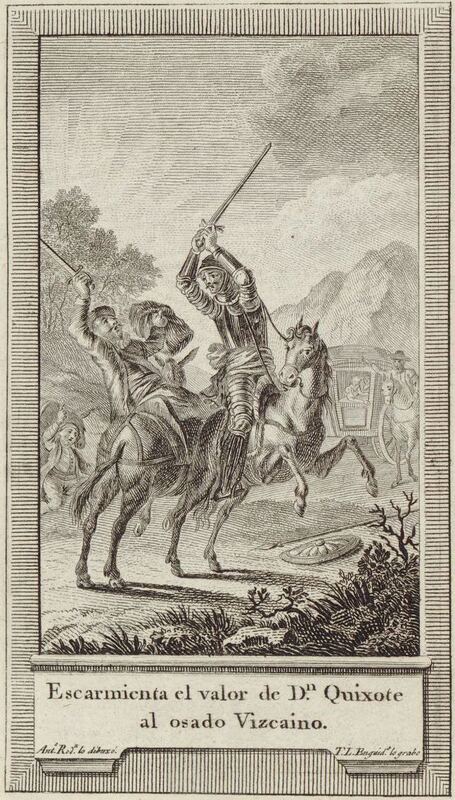
In the foreground, Don Quixote battles the Basque squire while the lady watches the fierce contest from the safety of her carriage (background). The illustration is accurate to Cervantes’ text: the Basque is pictured holding a pillow to defend himself. Signed by A. Rodríguez (illustrator) and T. Enguídados (engraver). Part 1, ch. 9.
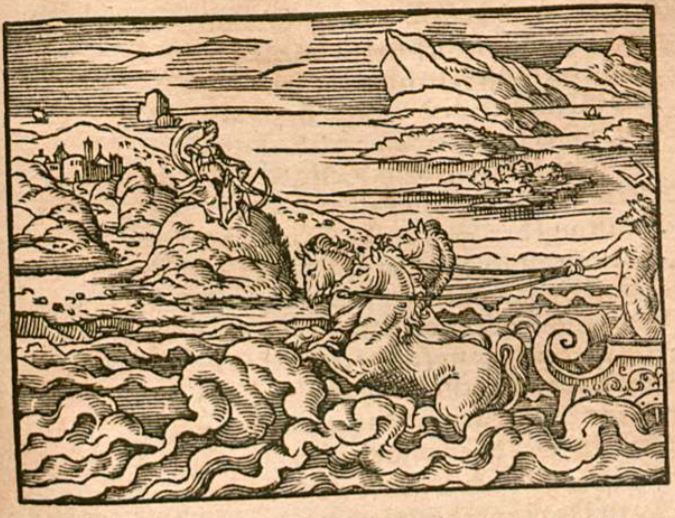
This image illustrates the god of the underworld, Pluto, riding on his chariot drawn by his black horses. He was riding around the Earth to ensure that there were no cracks within the Earth’s surface. While riding, Pluto was shot with an arrow of love by the god Cupid. Cupid is illustrated with his mother, Venus, standing on a hill in the background of the engraving. Venus instructed her son Cupid to do this so that Pluto will abduct Proserpina, the daughter of Ceres.
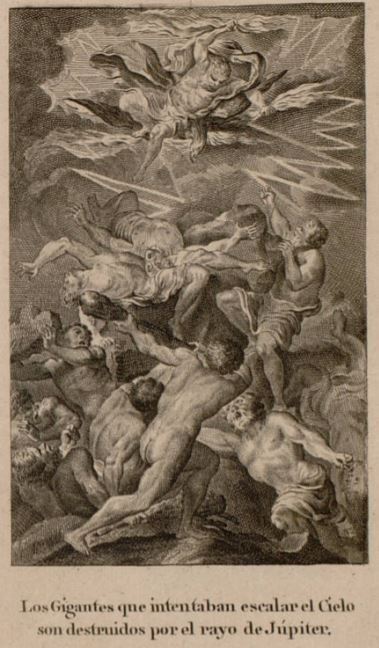
Attempting to escape the violence on the earth, the Giants attempted to climb up to Mount Olympus to take the Celestial kingdom from the Gods. They stacked mountain on top of mountain to be able to reach the top, only to be struck down by Jupiter’s lightning bolts before they could get there. The Giants in the image are illustrated holding clubs and rocks and falling down as Jupiter, above, strikes them down. Jupiter is illustrated holding lightning bolts in both of his hands.
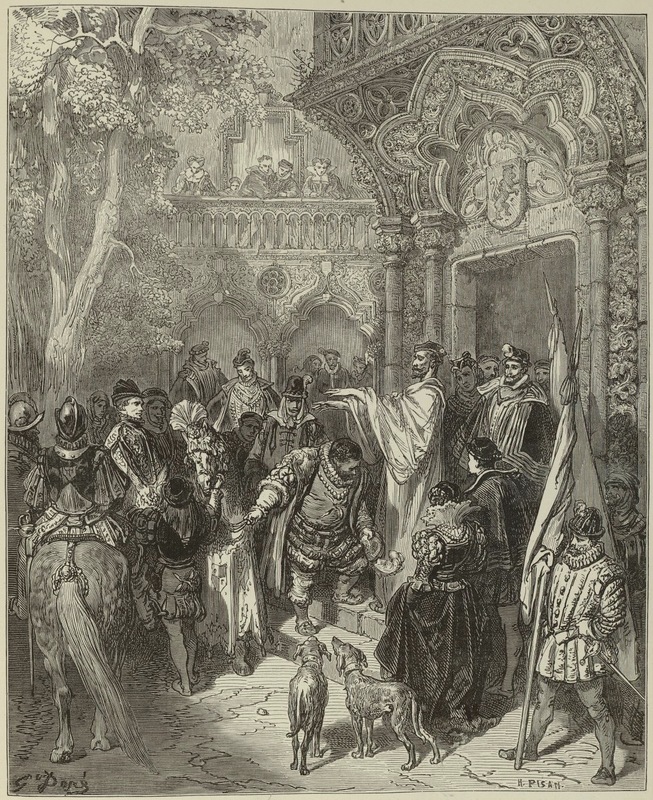
Before leaving for Barataria Island, Sancho Panza receives Don Quixote’s blessing. Also pictured in the palace courtyard are the duke, the duchess, and several of their servants. Signed by G. Doré (illustrator) and H.-J. Pisan (engraver). Part 2, ch. 44.
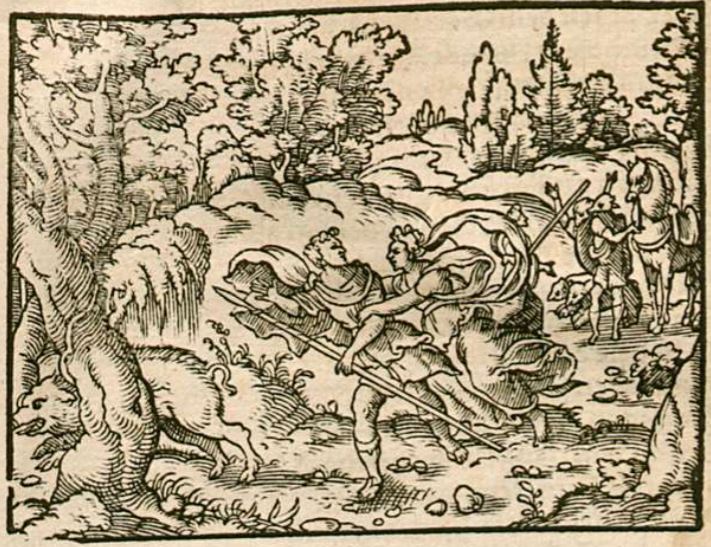
This engraving illustrates Picus, the King of Latium, chasing after a boar during a hunt. While on his hunt, the goddess Circe had caught sight of Picus and fell in love with him. He had been riding on his horse (illustrated in the background with his companions) and she could not catch up to him. Circe had conjured up an illusion of a pig which ran into the woods and it resulted in Picus getting off his horse to chase after it. The boar is pictured on the left side of the engraving running into the trees. Circe is depicted with her arms around Picus as she confesses her love to him. Unfortunately for Circe, Picus was in love with a nymph named Canens and rejected her advances. She ends up transforming Picus into a woodpecker and turns his companions into animals.
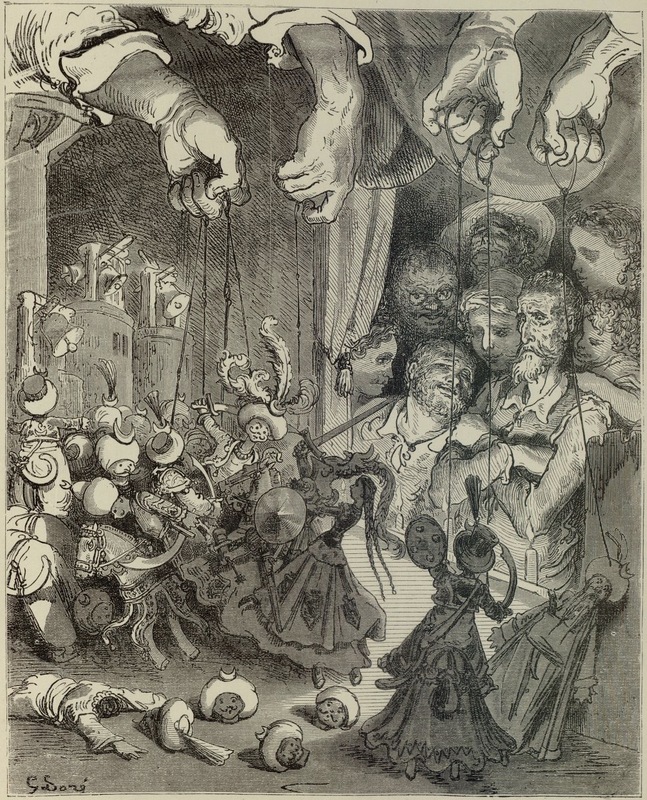
Don Quixote, Sancho Panza, and the gathered theatregoers watch Maese Pedro’s puppet show, which presents the true history of how Don Gaiferos freed his Melisendra, held captive in Spain. With great originality, Doré has placed the puppets in the foreground, as if the viewer was inside the theatre looking out toward the crowd. Signed by G. Doré (illustrator) and H.-J. Pisan (engraver). Part 2, ch. 26.
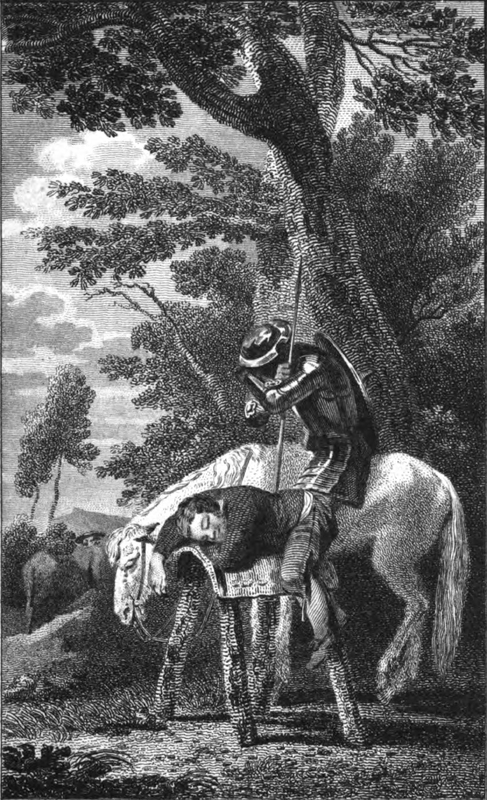
Whilst Don Quixote (pictured clad in full armour, leaning upon his lance) and Sancho Panza (pictured sleeping soundly upona wooden stave) sleep in the brown mountains of Sierra Morena, the infamous thief Gines De Passamonte, who Quixote had freed from slavery, steals Dapple from right under Sancho. The ungrateful thief replaces Dapple with a saddle held aloft by four wooden stakes, upon which Sancho sleeps soundly. In the bottom left corner of the image, Gines de Pasamonte can be seen making his escape with Dapple by his side.
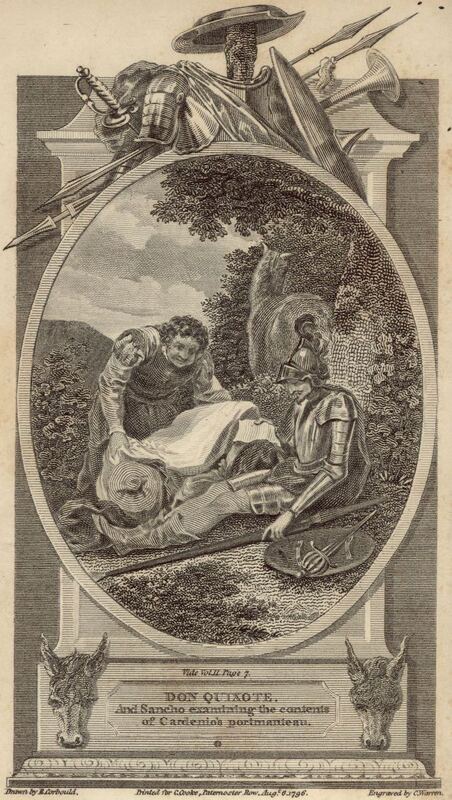
In Sierra Morena, Don Quixote and Sancho Panza find a travelling case, inside which are four shirts of fine cambric, a pile of gold escudos wrapped in a handkerchief, and a small, richly decorated diary. Opening the book, Don Quixote finds a sonnet written in a very fine hand. He reads it aloud so that Sancho can hear it. The illustration is set in a decorative and architectural frame, complete with the errant knight’s arms (lance, sword, helmet, and buckler) and donkey heads. Signed by R. Corbould (illustrator) and C. Warren (engraver), dated 1796. Part 1, ch. 23.

![[Of How Don Quixote shut himself up in his chamber with Sancho]](https://collections.cemvc.ca/files/large/b20d1314f05bf849ae1194cea21b1372a29785be.jpg)