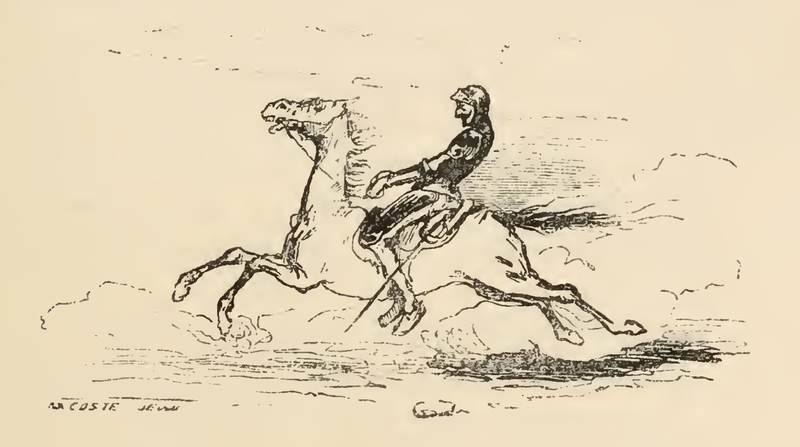
Rocinante, startled by the bells of the court jester, runs about the field at a great pace. Don Quixote, clad in full armor, holds the reins tightly and leans back precipitously, trying to stay on his horse.
On the dawn of Don Quixote's duel with the Knight of Mirrors, Sancho is surprised to see that the Squire of the Woods' nose has grown to an enormous size with plenty of pimples and warts, such that his hat falls off his head. Sitting on a rock, the Squire of the Woods appears unmoved by his own enlarged (fake) nose, his sword resting against his lap. In the background, Don Quixote chats cordially with the Knight of the Mirrors.
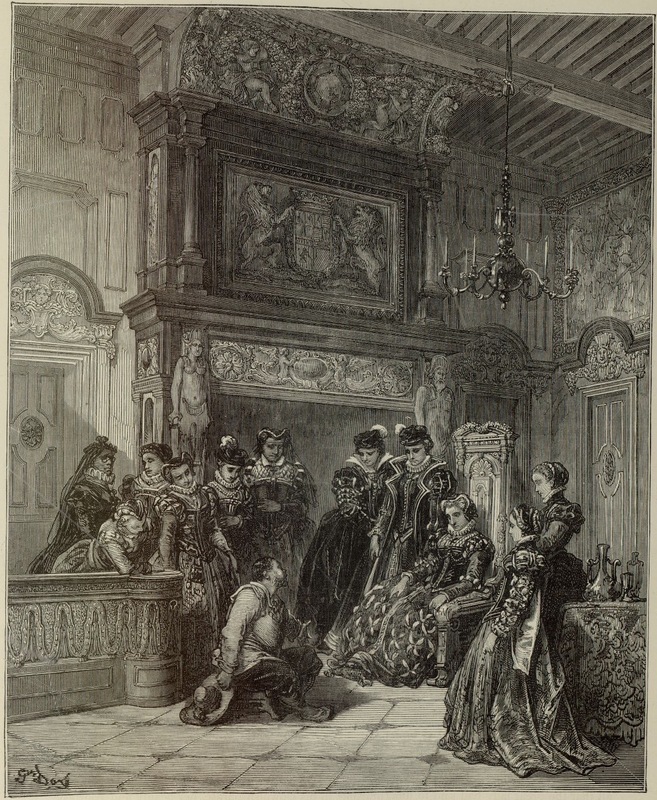
Sancho Panza reveals the reality of Dulcinea’s enchantment to the duchess. Doña Rodríguez and several maidens surround them. The Spanish coat of arms is pictured above the fireplace. Signed by G. Doré (illustrator) and H.-J. Pisan (engraver). Part 2, ch. 33.
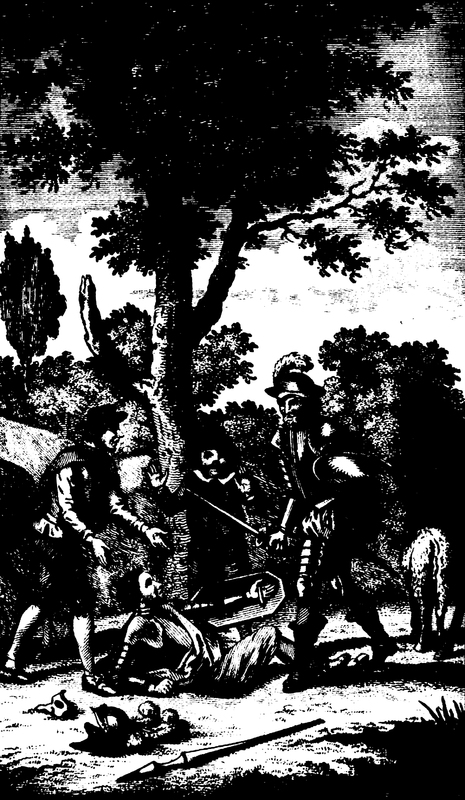
Don Quixote challenges the Knight of the Wood to a duel, which the Knight of the Wood agrees to once the sun rises. When the duel is set to take place, the Knight of the Wood wears such shiny armor that he is renamed the Knight of Mirrors. Right before both knights are set to charge, Quixote notices that the Knight of Woods' squire has an impossibly large nose, scaring both Quixote and Sancho. Sancho is so scared by this squire's nose that he asks for Quixote to help him up into a nearby tree. While Quixote was helping his squire up, the knight of the mirrors prepared himself for the duel, imagining that Don Quixote had done the like, and attacked with his horse's best speed. Seeing that Quixote was not prepared, he tried to stop himself mid-gallop and harshly tumbled to the off his steed. Seeing his adversary before him, Don Quixote began the attack, and soon brought the knight of the mirrors to the ground, where he lay for some time without the least appearance of life. Once the dust had settled, Quixote saw that the knight's helmet had come off, revealing him to be Samson Carrasco, but Quixote figured this to be an enchanter's trick and refused to believe this was his true identity. Before Quixote could deal any further damage, the Knight of the Wood's squire stepped between them, having flung his fake nose to the ground, and told Quixote to find the enchanters rather than kill his master. Inscribed beneath the image are the words "The bachelor Carasco's friendly view is as a friend, Don Quixote to subdue; but in the friendly plan, behold he fails for shining steel over brittle lilacs prevails".
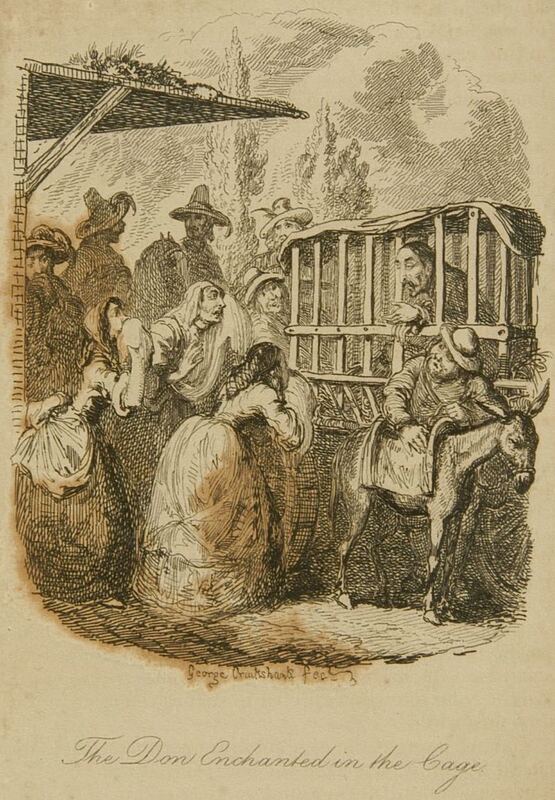
Don Quixote is enchanted and trapped in a cage on a cart. The innkeeper’s wife, her daughter, and Maritornes take their leave of Don Quixote, pretending to weep with sorrow at his misfortune. Sancho Panza and his donkey, the officers of justice, and others are also pictured. Signed by G. Cruikshank (illustrator and engraver). Part 1, ch. 47.
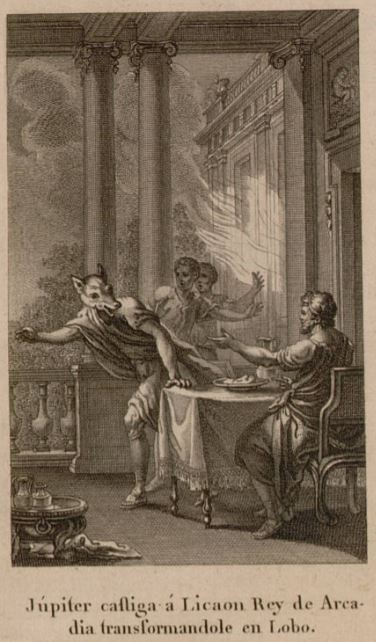
The god Jupiter is depicted sitting in front of a table on the right side of the image with his hand pointing towards Lycaon. The food that was served to Jupiter on the table in front of him is flesh of a human. King Lycaon of Arcadia did not believe that Jupiter was a deity, so he served the god a butchered man to test his immortality. In order to punish the Arcadian king for his hubris, Jupiter transformed him into a wolf. This is depicted in the engraving as Lycaon is shown with his head already transformed into a wolf. There are two people in the background who appear to be frightened at the transformation they are witnessing.
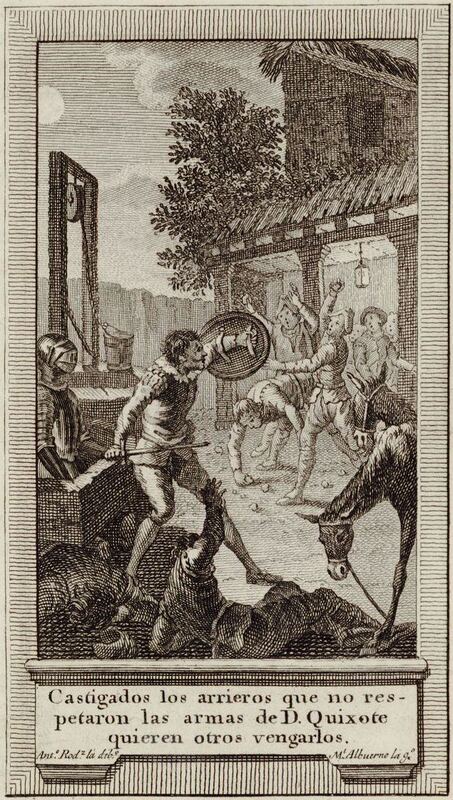
As night falls, Don Quixote gathers his armour and places it on a trough next to a well in a corral near the inn. Taking up his lance, he paces back and forth in front of the trough, standing vigil over his arms. The scene is illuminated by the light of a full moon. Approached by one of the muleteers, Don Quixote orders him not to touch his arms. When the muleteer ignores him, the errant knight knocks him to the ground. In response, the other muleteers stone him. Signed by A. Rodríguez (illustrator) and M. Albuerne (engraver). Part 1, ch. 3.
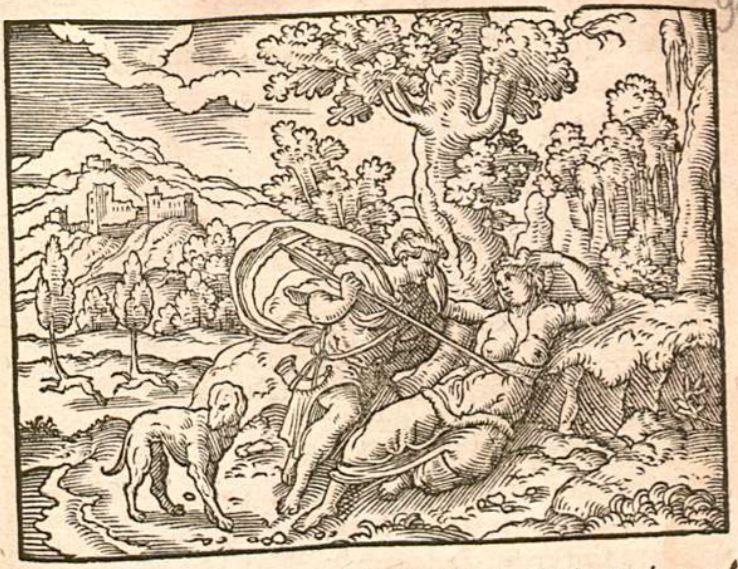
This engraving illustrates Cephalus, whose hunting trip went awry as he had accidentally shot his wife, Procris, with the spear that she had gifted him. Cephalus was hunting and when he heard movement in the trees, he threw his magical spear at the target. His spear is magic, and it never misses the target. While Cephalus was hunting, Procris was walking through the woods to discover if he was being unfaithful to her or not. Cephalus is depicted leaning over the body of his wife, as she is illustrated with the spear impaling her breast.
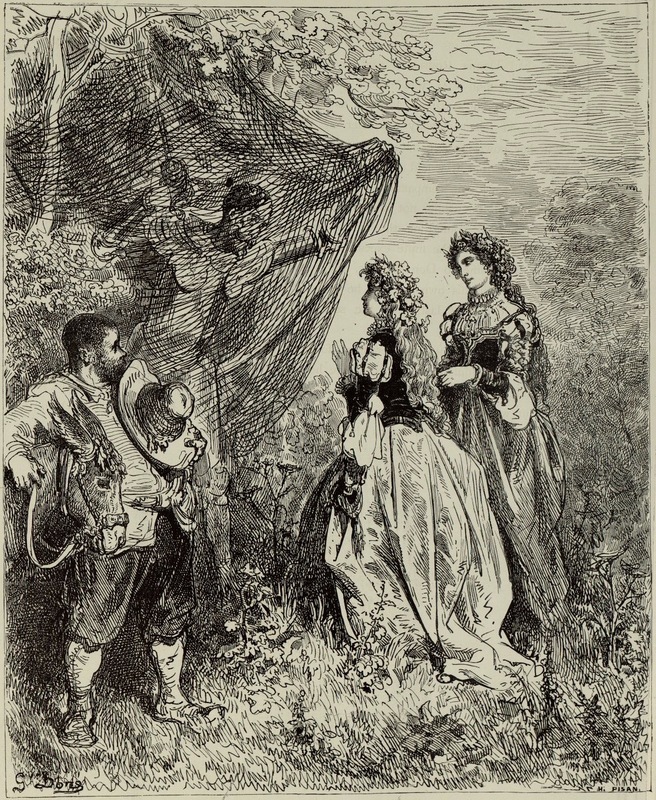
Don Quixote finds himself caught in nets of green string that are stretched between trees. Imagining that enchanters want to entangle him, he tries to break the nests when two shepherdesses appear before him and Sancho Panza. They are dressed in jackets and skirts made of fine brocade and rich moiré shot with gold. Signed by G. Doré (illustrator) and H.-J. Pisan (engraver). Part 2, ch. 58.
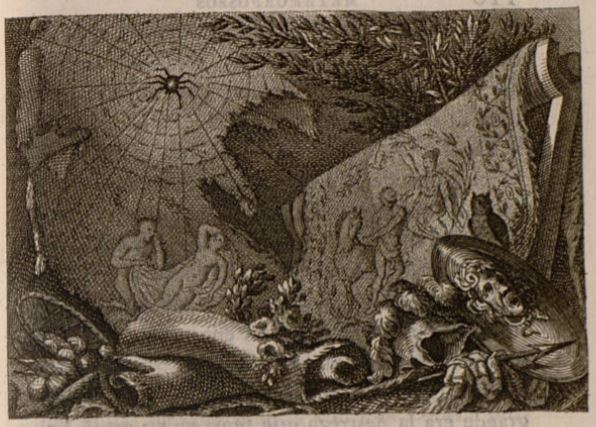
This image refers to the story of Arachne and Minerva. Arachne was a skilled weaver and she said that she was a better weaver than the goddess Minerva. Minerva, angered by the hubris spoken against her, challenged Arachne to a weaving contest. When Minerva won the contest, she transformed Arachne into a spider. This image depicts the transformed Arachne in the shape of a spider on a web. There are also cloths with embroideries on them to show the importance of weaving and spinning in this tale.
Three pigs are pictured in the mud, the middle pig in the foreground lies on its side while two others behind it stand passively. In the background a man with a hat leans against a fence with his stick by his side. The image is occasioned by Sancho Panza saying ""when I was a boy, I kept swine. Later, when I grew towards man, I looked after geese, and not after hogs" (Page 448).
Don Quixote rests in his deathbed having retired from knighthood he returned to his home in La Mancha. Quixote is pictured sitting up in bed dressed in a low collared shirt and a night cap on his head. Quixote is pictured speaking to the priest (left) with a cane in hand and the barber (center). On the right of Quixote's bed, Sancho Panza accompanies his master. In the background by the window, Quixote's niece and housekeeper talk amongst themselves about Quixote's ailing condition.
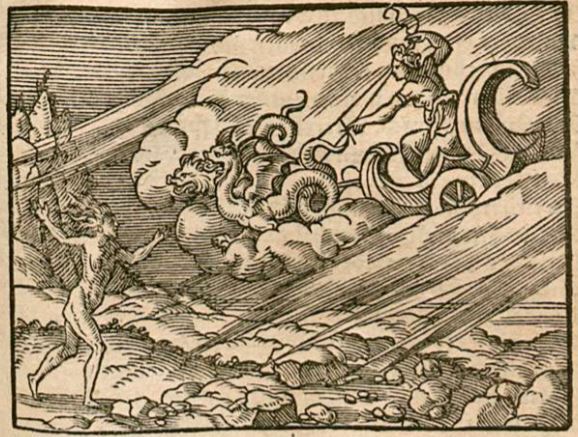
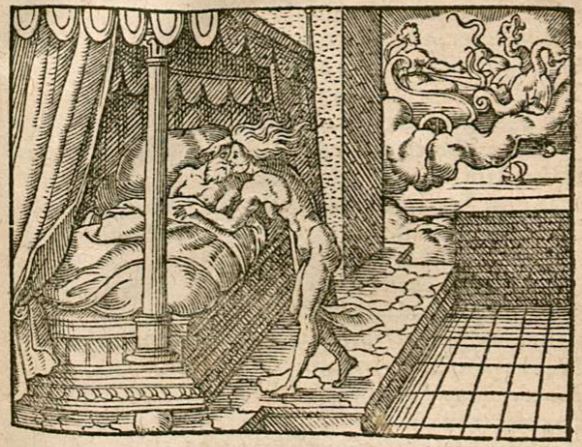
The personification of Famine is illustrated leaning over the bed of a sleeping Erysichthon. She is depicted breathing into his mouth to infect him with hunger as punishment for desecrating a tree sacred to the goddess Ceres. Ceres had asked an Oread to fetch Famine for her, as Ceres is destined to never be able to meet Famine. A chariot drawn by snakes is illustrated flying in the background of the engraving, which is being led by the Oread in Ceres’ place. Once Erysichthon awakens, he becomes infected with famine, and eventually ends up eating his own flesh.
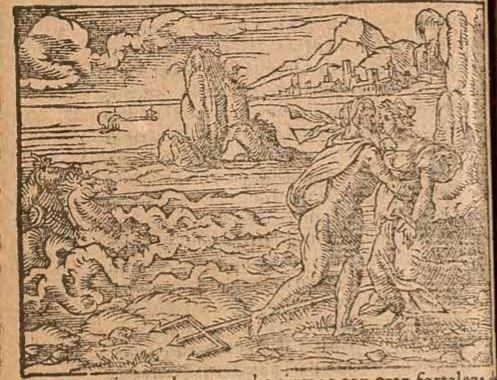
The woman depicted in this engraving is Caenis, a young virgin from Thessaly who had been the object of many suitors. She was walking along the beach when the sea-god Neptune noticed her beauty and took Caenis by force. Neptune’s trident is illustrated by his feet, and his sea-horse drawn chariot is visible on the left-hand side of the engraving in the water. After raping Caenis, Neptune grants her one wish. She asked to never be harmed or suffer any pain like that again, so Neptune transformed her into a man named Caeneus who would be protected from all wounds.
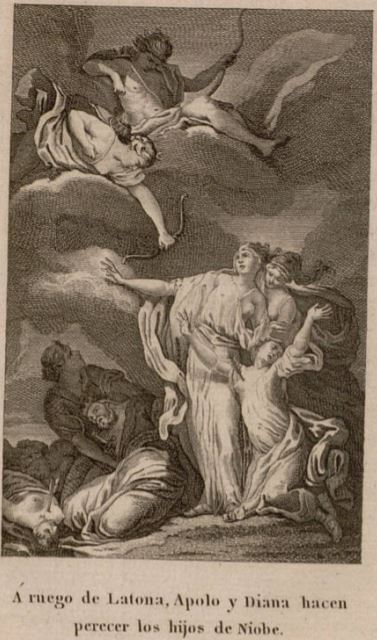
The goddess Diana and her twin brother Apollo are depicted in the top left corner of the image with bows in their hands as they shoot and kill Niobe’s children. They are killing Niobe’s children because Niobe had declared herself better than Latona, the daughter of Titans. Niobe boasted about having fourteen children as opposed to Niobe who only had two. Latona ordered her children Diana and Apollo to shoot down every single one of Niobe’s children as punishment for her hubris. Niobe is illustrated standing with the children who have not been shot yet, trying to protect them from the gods.
Don Quixote, mounted on Rocinante, orders the penitents to release the lady (a sculpture of the Virgin Mary) that they are holding captive. Sancho (right) tries to stop him. Plate no. 27, signed by J. Vanderbank (illustrator) and G. van der Gucht (engraver). Vol. 1, book 4, ch. 25.
Having intimidated the Keeper into opening the lion's cage Don Quixote (left) clad in full armor, readies his shield in front of his chest and prepares to strike with his sword at the lion's first attack. The male lion (right) of imposing size and extravagant mane, stretches its legs out of the confines of the cage and looks at Quixote, taking no notice of the knight's desire for combat. The cage where the lion is kept has two royal banners atop its roof, the doors to the cage opened wide.
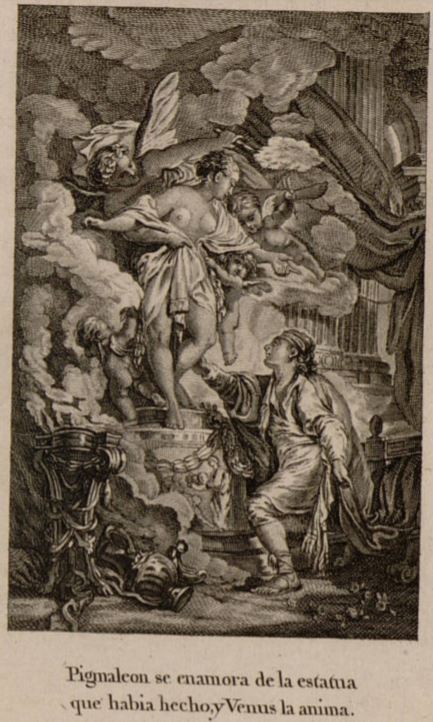
This engraving depicts the story of the sculptor Pygmalion. Instead of being with a real woman, Pygmalion sculpted a woman out of ivory who was almost perfectly lifelike. He is depicted caressing his sculpture on the right-hand side of the engraving. During a festival dedicated to Venus, Pygmalion prayed at her altar asking for a woman like his ivory sculpture. He is depicted kneeling and praying to Venus in the background of the engraving at her altar. Venus fulfilled his request, and she transformed his statue into a real woman.
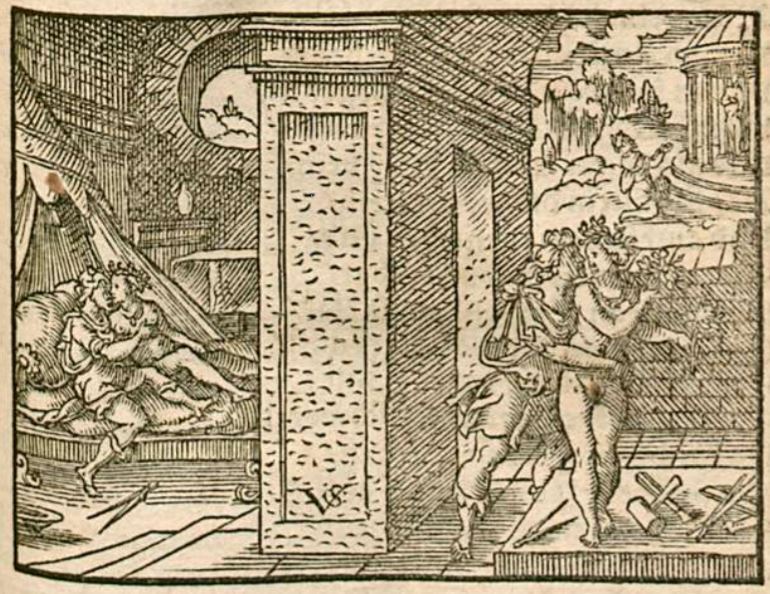
This engraving depicts the story of the famous sculptor, Pygmalion. Pygmalion decided to not take a wife, as he was disgusted by the actions of the Propoetides. The Propoetides were women who had performed human sacrifices and became the first prostitutes as punishment for their actions. Instead of being with a real woman, Pygmalion sculpted a woman out of ivory who was almost perfectly life-like. He is depicted caressing his sculpture on the right side of the engraving. During a festival dedicated to Venus, Pygmalion prayed at her altar asking for a woman like his ivory sculpture. He is depicted kneeling and praying to Venus in the background of the engraving at her altar. Venus fulfilled his request, and she transformed his statue into a real woman. Pygmalion is illustrated on the left side of the engraving in bed with his new wife.
On the dawn of Don Quixote's duel with the Knight of the Woods, both squires meet under a tree with morsels to see who of their masters is superior. The Squire of the Woods (left) sits against a rock with a loaf of bread by his head, he is wearing a feathered cap and standard squire apparel, but his (fake) nose is gargantuan, hanging equidistance with his mouth. Sancho Panza (right) is visibly repelled by the Squires nose, reaching out his right hand to shield himself from the Squire of the woods and resting his left hand against a tree to support him in his fright.
Don Quixote attacks the wineskins, while Dorotea averts her eyes. In the background, the priest, Cardenio, the innkeeper, and Sancho Panza (left to right) are pictured. Plate no. 21, signed by J. Vanderbank (illustrator) and G. van der Gucht (engraver). Vol. 1, book 4, ch. 8.
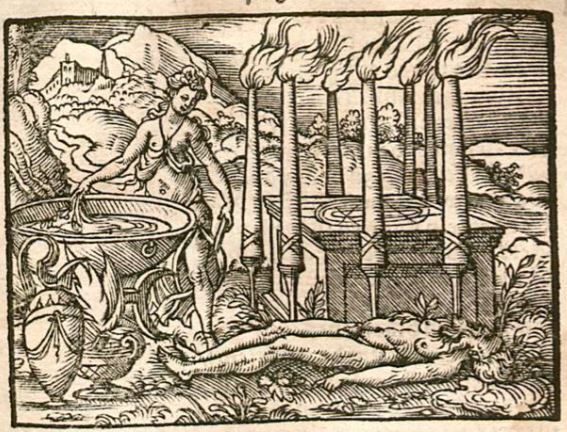
This engraving depicts Medea leaning over a large bronze cauldron filled with a potion full of herbs and items that will rejuvenate her father-in-law, Aeson. Aeson is depicted laying naked on the ground next to the altar dedicated to Hecate. Medea knows the potion is ready when the olive branch she stirs it with begins to sprout leaves. Medea must slit the throat of Aeson and drain his blood so that she can replace it with her potion. Once this is done, Aeson is rejuvenated by forty years.
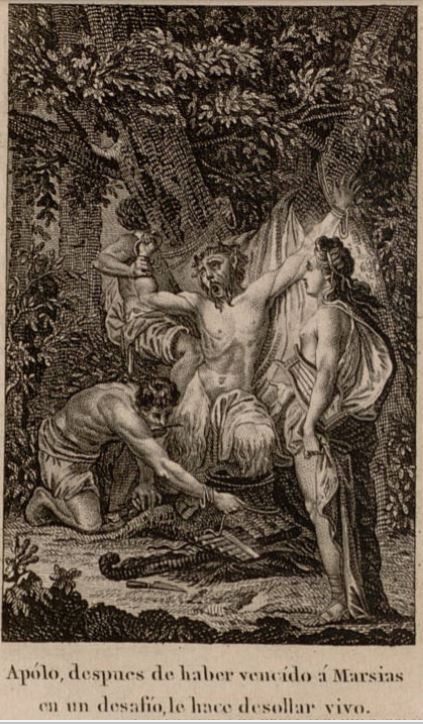
This engraving depicts the god Apollo skinning the satyr Marsyas alive. After entering a flute playing contest with Apollo, Marsyas was defeated by the God and as punishment for challenging him, Apollo skinned him alive. Apollo is depicted standing on the right side of the image with a musical instrument resting in his arm as he watches Marsyas scream for his life. There are two people tying Marsyas to a tree so that he cannot get away.
Ceres intends to punish Erysichthon, an impious man who had chopped down a tree sacred to the goddess herself. She plans to send the personification of Famine to Erysichthon so that he is penalized for his hubris. Ceres, however, is unable to meet Famine herself as they are antithetical to one another. Ceres commands an Oread to meet with Famine in her place. Ceres is illustrated in the engraving on her snake-drawn chariot in the sky, pointing at the Oread as she issues her command.
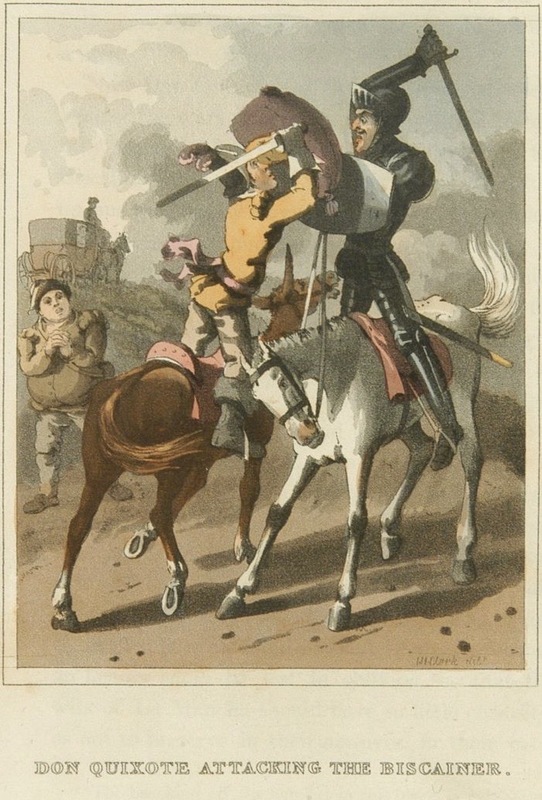
In the foreground, Don Quixote battles the Basque squire while the lady watches the fierce contest from the safety of her carriage (background). The illustration is accurate to Cervantes’ text: the Basque is pictured holding a pillow to defend himself. Unsigned. Part 1, ch. 3.

![[Of How Sancho Panza was Frightened by the Squire of the Wood's Humongous Nose]](https://collections.cemvc.ca/files/large/36516ee6c424bd30fa44b9dc0cc7ae5b88aae09b.jpg)
![[Pigs Under Watch of a Swineherd]](https://collections.cemvc.ca/files/large/091705e519fe5eb7728377611336463b95dd8e98.jpg)
![[Don Quixote in his Deathbed]](https://collections.cemvc.ca/files/large/b915d9877f030460d969df909c6bf20567225d12.jpg)
![[Encounter with penitents]](https://collections.cemvc.ca/files/large/b2a0f8d1f7f04b53bf2db15950f30937349ba88d.jpg)
![[Don Quixote Confronts the Lion]](https://collections.cemvc.ca/files/large/3a27e0045739311d194035989dbdb679e05b4890.jpg)
![[Of how Sancho was Surprised by the Squire of the Woods' Bulbous Nose]](https://collections.cemvc.ca/files/large/151748201e0a3e8917230858e9f6af1cfcedc5f3.jpg)
![[Don Quixote attacks the wineskins]](https://collections.cemvc.ca/files/large/79edb03f5068f4f786549c4dc7f75ead7f20c855.jpg)