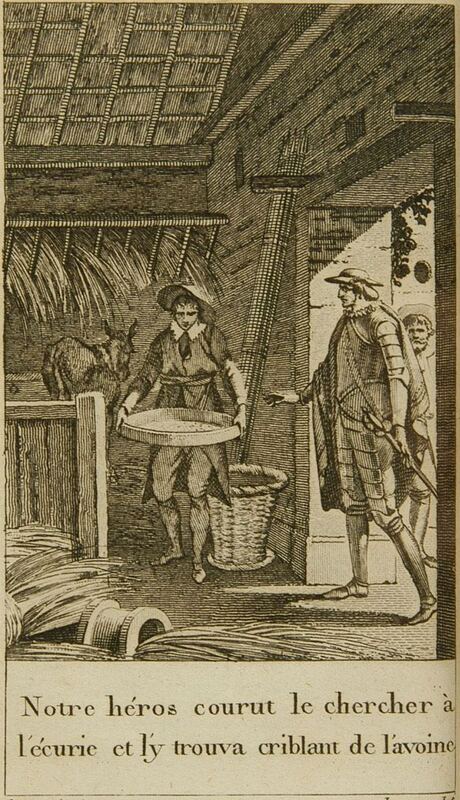
In the stable at the inn, Don Quixote and Sancho Panza encounter the man carrying the lances and the halberds they had seen on the road (one of the members of the braying mayors’ squadron). They find him tending to his mule. Signed by J.-J.-F. Le Barbier (illustrator) and J. Dambrun (engraver). Part 2, ch. 25.
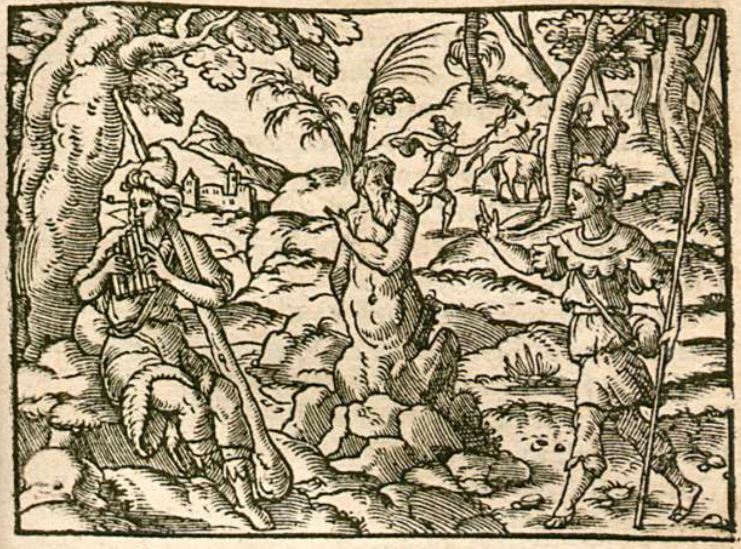
This engraving illustrates the story of Mercury and Battus. Mercury had stolen a herd of cattle from Phoebus, who is illustrated sitting on the left-hand side of the image playing his seven-reeded pipe. The only person to have witnessed the theft was old shepherd named Battus. Mercury had promised Battus a cow in exchange for his silence. Battus agreed to keep the theft a secret, however, Mercury tested Battus’ word by disguising himself and asking him about the robbery and promises him a cow and a bull for the information. Battus tells the stranger that Mercury had stolen the cattle, unknowing that the stranger is in fact Mercury. Mercury punishes Battus for betraying him and transforms him into touchstone. Battus is illustrated in the middle of the engraving with the lower half of his body already transformed into stone.
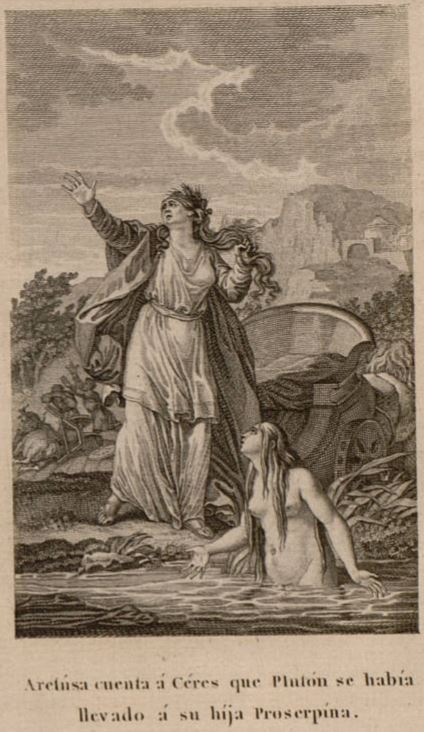
This image depicts the nymph Arethusa emerging out of the water to tell the goddess Ceres that her daughter had been abducted by Pluto. Ceres is holding out her right arm and using her left arm to pull on her hair as a sign of grief for her daughter. She unsuccessfully searches the world for her daughter and in her anger, she causes the world to become infertile and destroys agriculture.
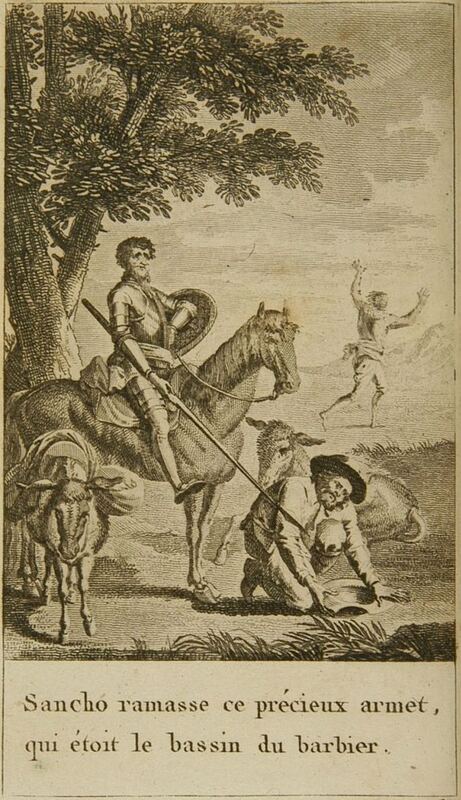
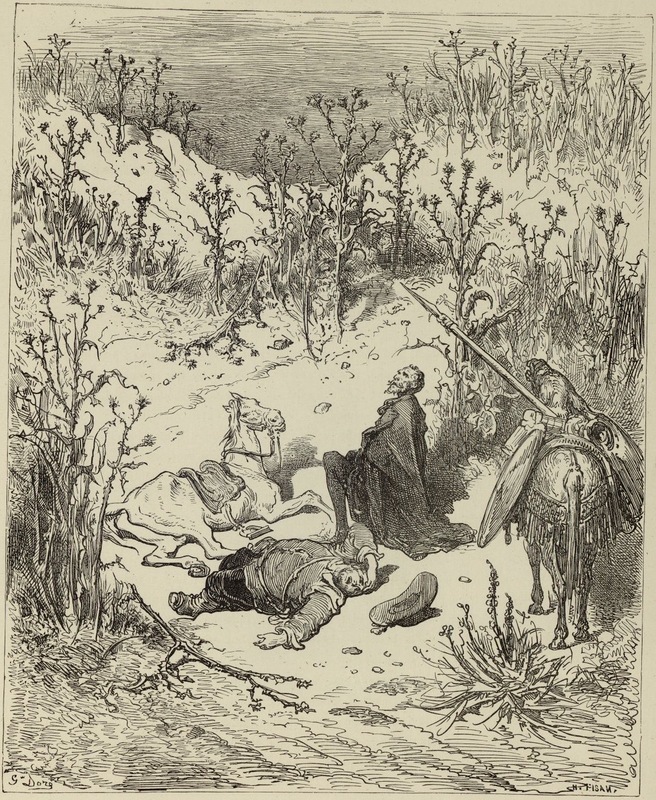
In the foreground, Sancho Panza contemplates the barber’s basin (which Don Quixote believes to be Mambrino’s enchanted helmet) before giving it to Don Quixote. In the background, the barber flees. Signed by C. Lefebvre (illustrator) and J.-J. Coiny (engraver). Part 1, ch. 21.
Camilla stabs herself while Lothario and Leonela try to stop her. Anselmo, her husband, is partially hidden behind a tapestry in the background. In the text, he remains hidden during the entire scene. Theatrical and dramatic scene well illustrated with movement. The tapestry is richly detailed. Plate no. 20, signed by J. Vanderbank (illustrator) and G. van der Gucht (engraver). Vol. 1, book 4, ch. 7.
The poetical scholar, Don Diego's son (left) and his mother, Donna Cristina come out to receive Don Quixote, who, clad in a breastplate with a sword by his waist, kisses the lady Donna Cristina's hand. With open arms Don Diego (right) introduces Quixote to his family and his abode.
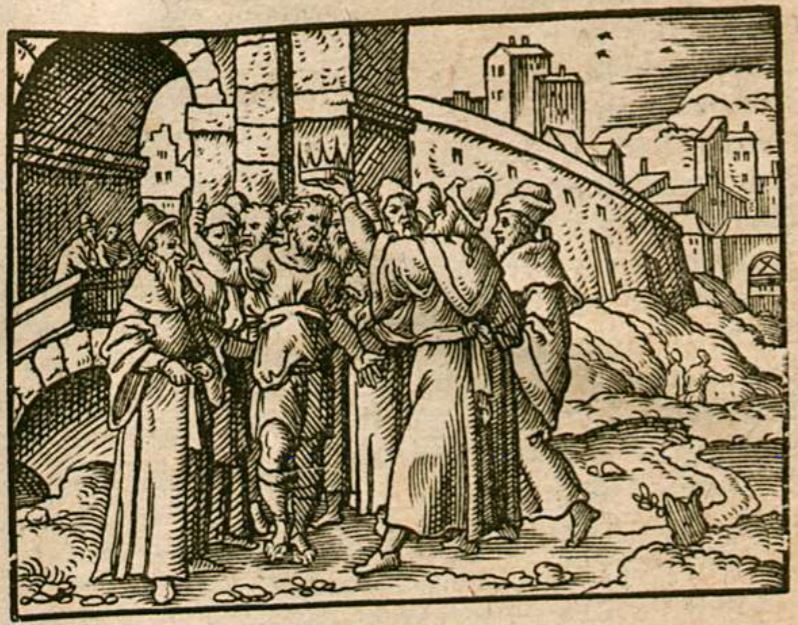
This engraving illustrates a crowd of people surrounding a humble farmer named Cipus. Cipus is depicted in the centre of this crowd with his arm in the air and a somewhat sad look on his face. A man is illustrated in front of Cipus holding a crown over his head. Cipus, as explained by Ovid, was told by a seer that his fate was to become the King of Rome, however, Cipus did not want the crown as he had horns on his head and Rome was already on its way to becoming a republic. Cipus is holding his arm up in the engraving to stop the crown being put on his head and tells them that they must banish him. The city depicted in the background of the engraving is Rome.
This engraving illustrates a crowd of people surrounding a humble farmer named Cipus. Cipus is depicted in the centre of this crowd with his arm in the air and a sad look on his face. A man is illustrated in front of Cipus holding a crown over his head. Cipus was told by a seer that his fate was to become the king of Rome, but Cipus did not want the crown and thought he would be better off in exile. One reason that Cipus did not want to be king was because he had recently grown horns on his forehead. Cipus is holding his arm up in the engraving to stop the crown being put on his head and tells them that they must banish him. The city depicted in the background of the engraving is Rome.
Having been offended by the ecclesiastic, Quixote, dressed in a white buttoned up shirt suddenly becomes seized with an anger and his head begins to tremble as if he had been seized with an epileptic fit. Quixote opens his mouth to lash out against his offender, his eyes beady and irate, his moustache standing on point and his hair only residing in tufts like moss on a stone.
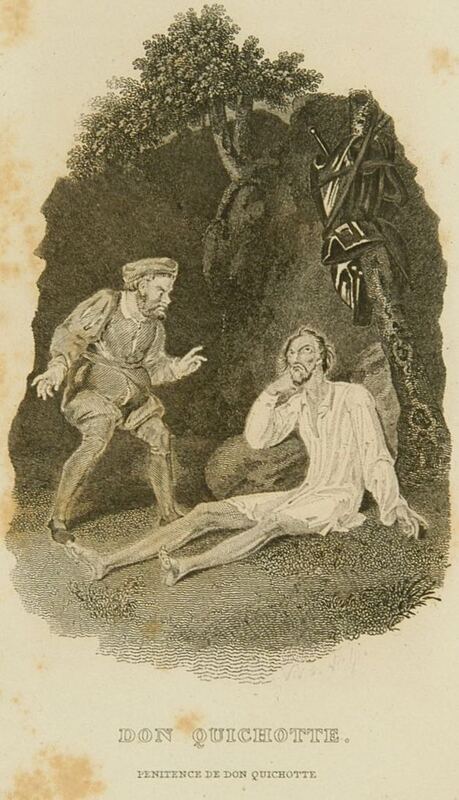
After performing acts of penance, Don Quixote sits, dazed and dressed only in his undergarments. Sancho Panza discovers him in this state; his face bears an expression of bewilderment and surprise. Signed by L. H. Sisco (engraver). Part 1, ch. 29.
Having fallen from her donkey, Dulcinea (middle) clasps the donkey behind with both hands in preparation to jump back on to the saddle. Don Quixote (right) clad in armor, alights to help Dulcinea back upon her palfrey, but is surprised to see that she is capable on her own. Sancho Panza having fallen to his knees, raises his hands and turns towards Dulcinea. In the background, one of Dulcinea's companions waits for her to remount with a stick raised in her right hand.
This engraving illustrates the Trojan warrior, Aeneas, escaping the fall of Troy with his father, Anchises on his shoulders. The city of Troy is in the background of the engraving, engulfed in flames as it burns to the ground. There are people depicted in the distance by the entrance of the city who follow Aeneas. Aeneas and his small company of people get in the ship that is illustrated on the water on the left-hand side of the engraving which leads them to the island of Delos.
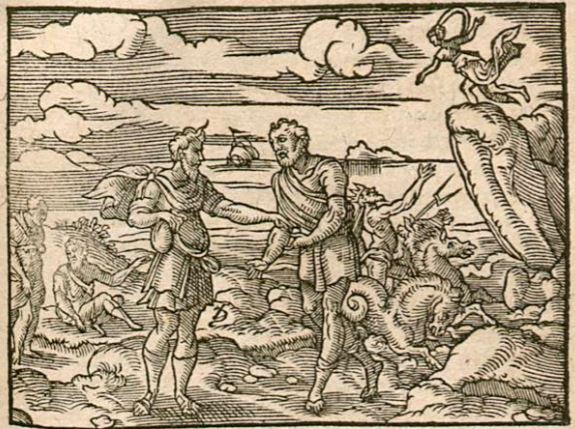
This engraving depicts the story of Mestra and her father, Erysichthon. Erysichthon was punished by Famine to have an endless hunger. He lost all his wealth to satisfy his hunger and cravings. When all was lost, he went so far as to sell his daughter. He is depicted in the centre of the image taking money from a man who had bought Mestra from him. Mestra is depicted on the right side of the image on top of a cliff looking down at the sea god, Neptune. She asks him for aid in return for him having stolen her virginity. Neptune helps her and offers her the gift of transforming herself into various animals. Once she is bought from the men that her father sold her to, she transforms herself in order to get away from them and get back to her father, only to repeat the process over again.
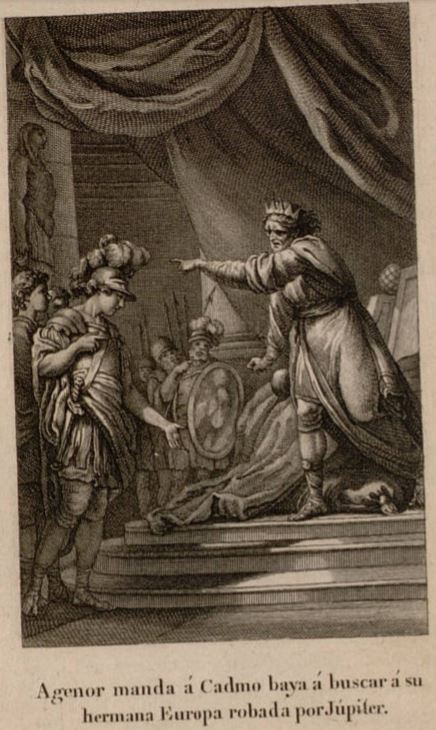
This image depicts Agenor, the father of Europa, sending his son Cadmus to find Europa. Europa had been abducted by Jupiter and taken away to the island of Crete. Agenor is illustrated on the right side of the image wearing a crown to symbolize his status of king. He is pointing towards Cadmus instructing him to go and find his sister. He warns Cadmus that exile is his punishment should he not obey. Cadmus is on the left side of the image dressed in armour with other soldiers standing behind him.
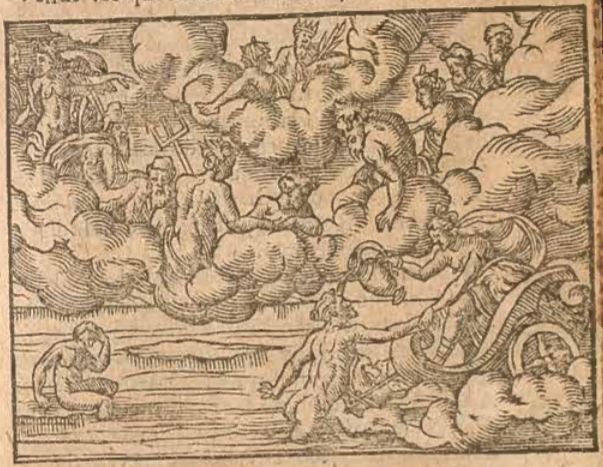
This engraving illustrates the deification of Aeneas. Aeneas’ mother, Venus, had begged her father Jupiter to grant Aeneas some form of divinity so that he will be able live freely with her as a god. Venus believes that Aeneas’ accomplishments makes him worthy of divinity. Jupiter grants Venus this request. Jupiter is illustrated at the top of the engraving sitting in the clouds watching over the ceremony. There are other gods illustrated in the engraving as well, one of them being Neptune, as his trident is illustrated amongst the gods. Venus is in the bottom right-hand corner sitting in her chariot as she pours a divine perfume over Aeneas’ body after he had been cleansed of his mortality in the river that he stands in (River Numicius). Aeneas is depicted reaching out to his mother, holding her hand as he accepts the deification. Aeneas then becomes the god named Indiges.
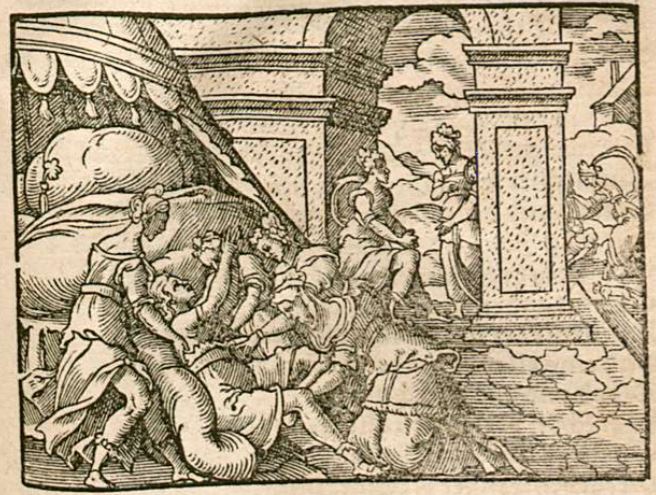
This engraving illustrates Alcmena surrounded by her handmaidens as she gives birth to the hero Hercules. Due to her jealousy, Juno schemed with Lucina, the goddess of childbirth, to prevent Alcmena from having a smooth delivery. Lucina is illustrated in the background of the engraving, sitting down between an archway with her hands locked together. One of Alcmena’s loyal handmaidens, Galanthis, is depicted speaking to Lucina. She had sensed that Juno was up to something, so she went over to Lucina and ordered her to congratulate Alcmena on the birth. Lucina was outraged at the order and stood up in defiance, but this ended up easing the birth and Hercules came into the world. Lucina was angry that she was tricked by Galanthis, so she transformed her into a weasel. The weasel can be seen on the far right-hand side of the engraving below a woman’s feet.
Don Diego's house with the arms of the family carved in rough stone over the great gates. A knight's helmet pictured at the top with the plumage cascading down the side of the coat, two shields are depicted on two corners of the shield with a white line cutting diagonally in the middle.
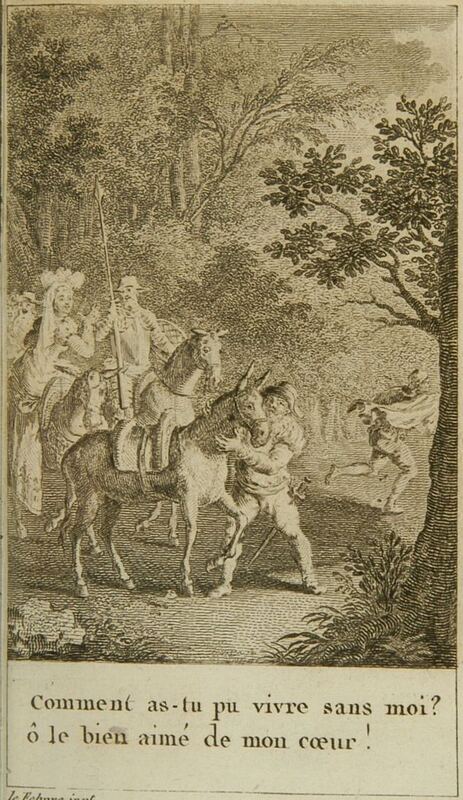
Sancho Panza, reunited with his donkey, embraces it while Ginés de Pasamonte runs away (right background). Don Quixote, Dorotea, the barber, and the priest look on. Signed by C. Lefebvre (illustrator) and L.-J. Masquelier (engraver). Part 1, ch. 30.
A male traveler (left) with a well-shaven beard, dressed in a loose cloth coat with short skirts, half sleeves, no collar, and a cap extends his right hand to show the way to his companion. On his right, a woman mounted on a donkey rides alongside him. The woman is wearing a brocade turban on her head and is dressed in Moorish attire. In the background on the left stands an inn. The man is leading her on the pathway to the inn.
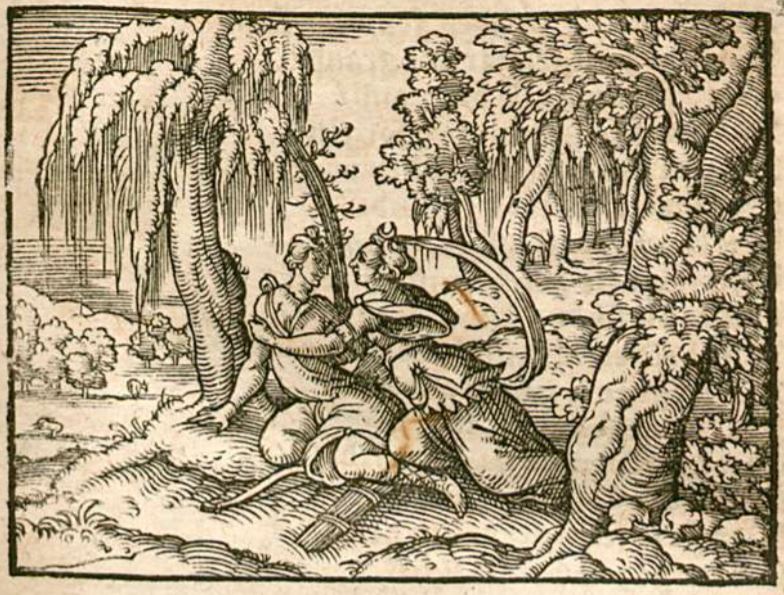
This image depicts Callisto, a virgin nymph loyal to the goddess Diana, sitting in the woods being seduced by what appears to be the goddess Diana herself. The goddess, however, is Jupiter in disguise. Jupiter was one day wandering through the forest when he spotted Callisto hunting and developed a burning passion for her. Knowing Callisto would not be able to resist her most beloved goddess, Jupiter disguises himself as Diana to seduce her. Callisto is depicted sitting by a large tree with her bow and quiver in front of her as she looks at Diana (Jupiter). Jupiter is illustrated wrapping his arms around Callisto and leaning towards her. Disguised as Diana, Jupiter then rapes Callisto.
A hawk stands facing the reader with a hunting hood upon its head in the middle of the illustration. On the right there is a water skin and on the left a wooden crossbow leaning against a wall next to a net. The image is occasioned by Don Quixote (not pictured) seeing the Duchess (not pictured) and her hawk.
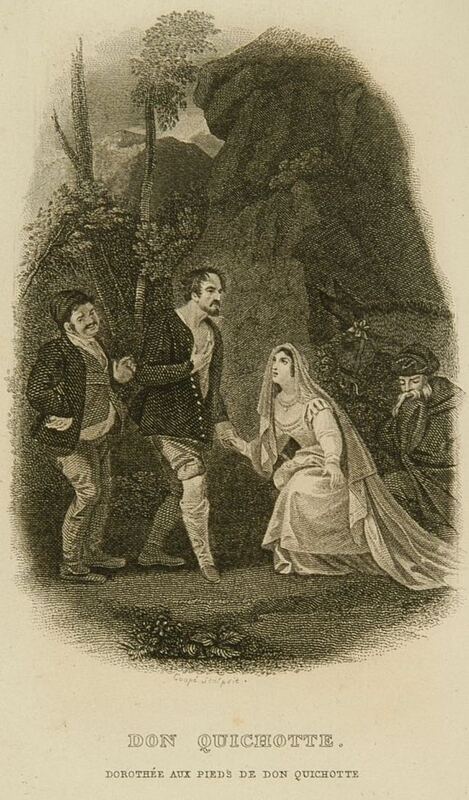
The princess Mimicona (Dorotea) kneels before Don Quixote. The barber accompanies her, disguised as her squire. Sancho is pictured to the left of Don Quixote, smiling. Signed by A.-J.-B. Coupé (engraver). Part 1, ch. 29.
The god Mars is depicted on the right-hand side of this engraving, holding his helmet in his left hand and a spear in his right. He is looking up towards his father, Jupiter, in a pleading manner. We know this is Jupiter as he is holding thunder bolts in his right hand. Mars is pleading to his father to allow his son, Romulus, to become a god. Jupiter grants this request, and Mars brings Romulus up into the sky in his chariot as they fly over Rome, as illustrated in the bottom left-hand corner of the engraving. Ovid explains that as Mars brings Romulus up into the sky, Romulus’ mortality dissolves while traveling through the atmosphere.
Sancho Panza (right) falls to his knees, his arms bent by his side, facing the Duke in preperation to kiss his feet for promising Sancho governance. The Duke (left) sits upon a regal chair with a tall backing, his legs crossed and his left harm extended amiably, with his right arm hanging comfortably on an armrest, his black cape draped behind him. Upon his neck he wears a golden medallion of sorts. In the background on the right there is a portrait of someone.

![[Camilla stabs herself]](https://collections.cemvc.ca/files/large/3215a7c220af44633cacff6d42b1abaa8c457d99.jpg)
![[Don Quixote Introduces Himself to Donna Cristina]](https://collections.cemvc.ca/files/large/9981391eb84709e41f13951c7e373ae049f37a1f.jpg)
![[Cipus Rejects Becoming the King of Rome]](https://collections.cemvc.ca/files/large/ebdddf90c5ecb0a7faf3e74c88c699ba3a5a0b98.jpg)
![[A Portrait Don Quixote's Choler and Rage]](https://collections.cemvc.ca/files/large/9a0ee6ba46089f07b8ab6267fbace35e87085e12.jpg)
![[Of how Dulcinea Mounted her Donkey with Swiftness and Dexterity]](https://collections.cemvc.ca/files/large/81b7327d81e96ba6c882090d0bb61f8cb3688187.jpg)
![[Aeneas Carried his Father Anchises on his Back]](https://collections.cemvc.ca/files/large/4565fc49ee346834835b957912021daa96a7a96a.jpg)
![[Don Diego's Coat of Arms]](https://collections.cemvc.ca/files/large/1a2a63ee3d4bbeaa427819c1626024bbd7bf326f.jpg)
![[The Captive leads a Moorish Woman]](https://collections.cemvc.ca/files/large/e262e2b4e098f0405d4687e870ea496be4c2467c.jpg)
![[A Hawk and Other Hunting Periphery]](https://collections.cemvc.ca/files/large/035ff1e555b62d078ed5fc8707706a3953b75ec3.jpg)
![[The Deification of Romulus]](https://collections.cemvc.ca/files/large/9d377ee8cdb38274134533a6af3dae39f229865f.jpg)
![[Of How Sancho Kissed the Duke's Feet]](https://collections.cemvc.ca/files/large/5388c04a1556b8fb848acad48c55de152966af6c.jpg)