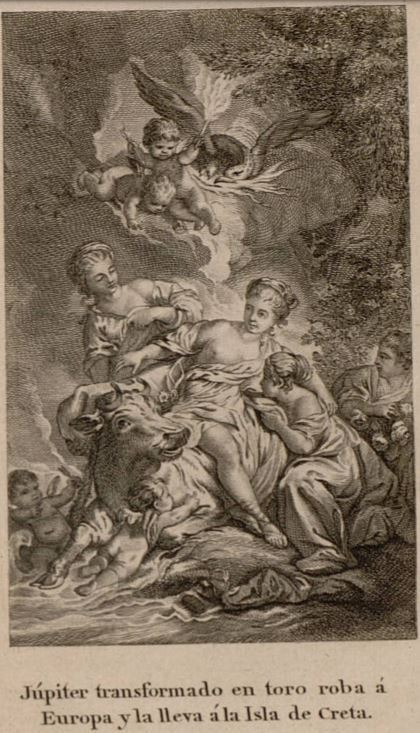
This image depicts the abduction of Europa. Jupiter had transformed himself into a bull and acted gentle so that the beautiful Europa would trust him. When she came to trust him, she sat on the bull’s back. Jupiter then runs into the ocean and carries her away to the island of Crete. In this image, Europa is illustrated sitting on the bull’s back, surrounded by small, winged cherubs. There are also other women in the image. These women are the Tyrian virgins, with whom Europa would often spend her time. An eagle is depicted flying above Europa and Jupiter next to a cherub. Jupiter is often linked with eagles in iconography as he is known in mythology to transform into eagles.
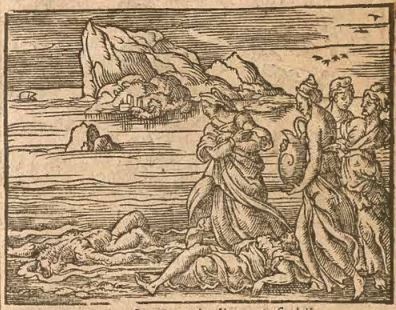
This engraving illustrates Hecuba, the wife of King Priam of Troy, mourning over the loss of her children who had been killed as a result of the Trojan War. She is illustrated standing above her daughter Polyxena’s body, with other Trojan women by her side. While lamenting about Polyxena’s death, a body washed up on the shore. The body is her son, Polydorus, who had been murdered by King Polymestor.
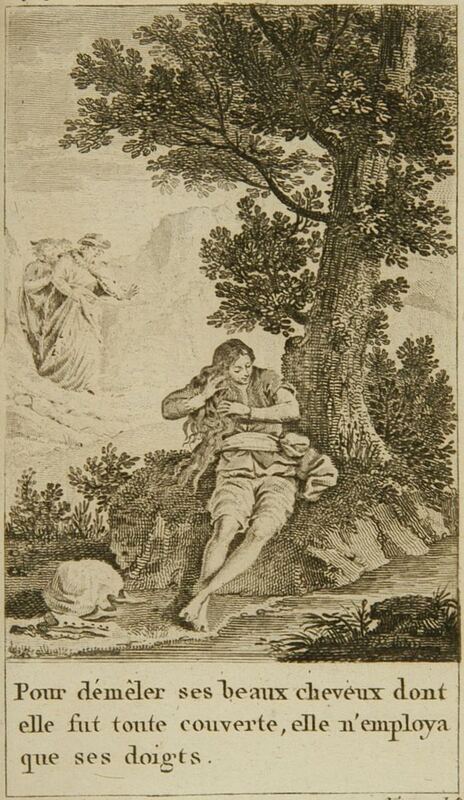
The priest, the barber, and Cardenio (background) encounter Dorotea, washing her feet in a stream and combing her hair. The priest is disguised with a fake beard and the barber with women’s clothes. Signed by C. Lefebvre (illustrator) and J.-J. Coiny (engraver). Part 1, ch. 28.
Having approached a reverend duenna to have his donkey put in a stable, Sancho Panza (right) makes a chide remark, his right hand in his vest and his left hand parallel with the ground. The duenna, visibly enflamed with rage, clenches her fists and stares daggers at Sancho, a deep frown on her wrinkled face.
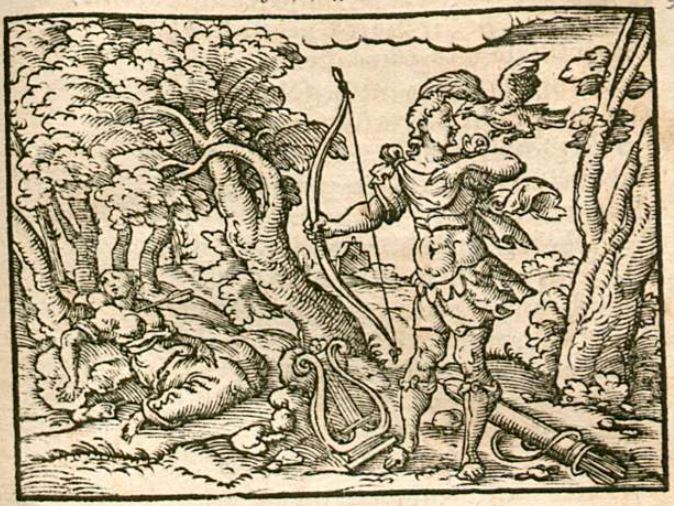
This engraving illustrates a raven resting on the shoulder of the god Phoebus and relaying information to him. Phoebus is the god of music which is why there is a lyre resting on the ground in front of him. The raven had seen the lover of Phoebus, Coronis, being unfaithful with another man. Anger had overcome Phoebus and he shot his lover Coronis in the chest with one of his arrows. Coronis is illustrated laying on the ground with the arrow in her chest. Phoebus becomes angry with the raven for relaying the information to him and he also becomes angry with himself for shooting the woman he loved. Coronis happened to be pregnant with their son Aesculapius whom Phoebus ends up saving from her womb.
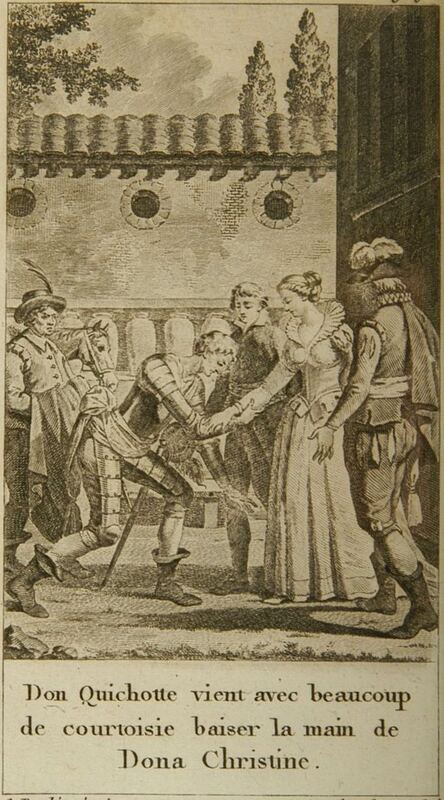
Don Quixote and Sancho Panza arrive at Don Diego de Miranda’s house, where they meet his son, Don Lorenzo, and his wife, Doña Cristina. In the courtyard, Don Quixote finds some tinajas (background) from El Toboso that remind him of Dulcinea. Signed by J.-J.-F. Le Barbier (illustrator) and C.-É. Gaucher (engraver). Part 2, ch. 18.
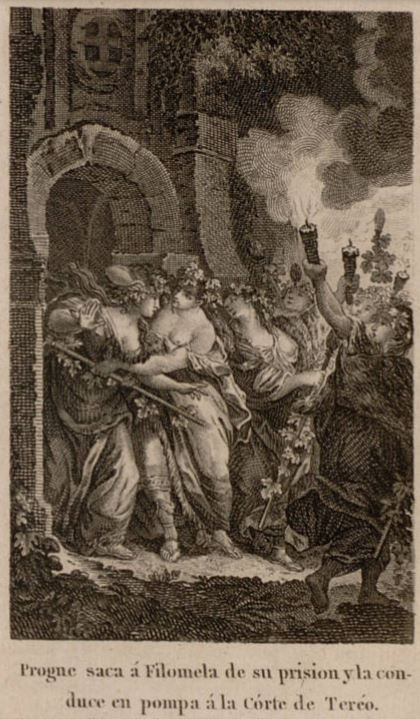
This image depicts the rescuing of Philomela by her sister Procne. Philomela had been abducted by Procne’s husband, Tereus, and he had cut her tongue out so that she could not cry out for help. Philomela weaved a message onto cloth and had a messenger bring it to Procne so that she could find her. Procne is depicted wrapping her arms around her sister as she takes her out of the house that she was being held prisoner in. The many other women in the image are Procne’s companions.
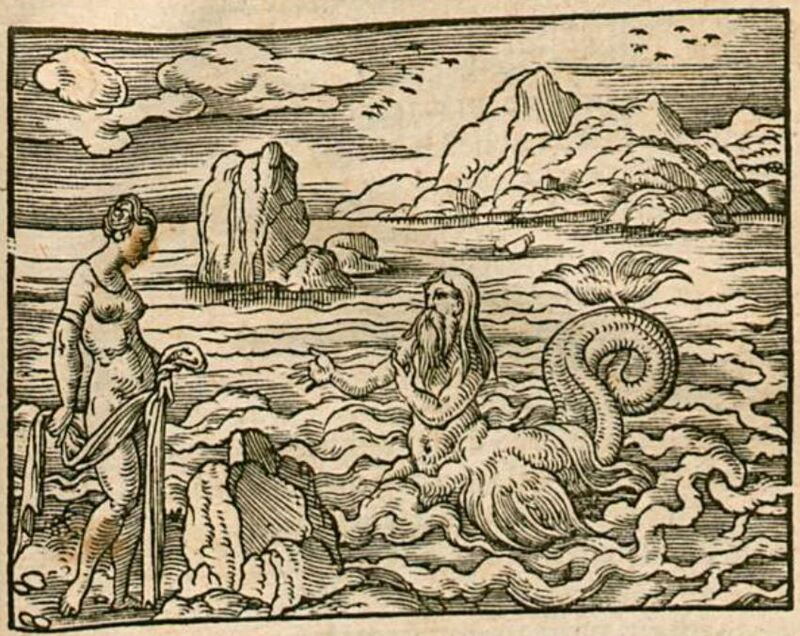
This image depicts the sea-god Glaucus emerging from the water as he speaks to the beautiful Scylla, who is depicted standing on land. Glaucus is depicted as half-man, half-fish, with the lower half of his body in fish form. Scylla was frightened by Glaucus’ appearance, so he assured her that he used to be a mortal fisherman but was transformed into a sea-god. While telling his story to Scylla, she was repulsed by his appearance and ran away from him. Glaucus was enraged at Scylla’s disgust towards him, so he went to seek out Circe for help in getting a love potion to give to Scylla.
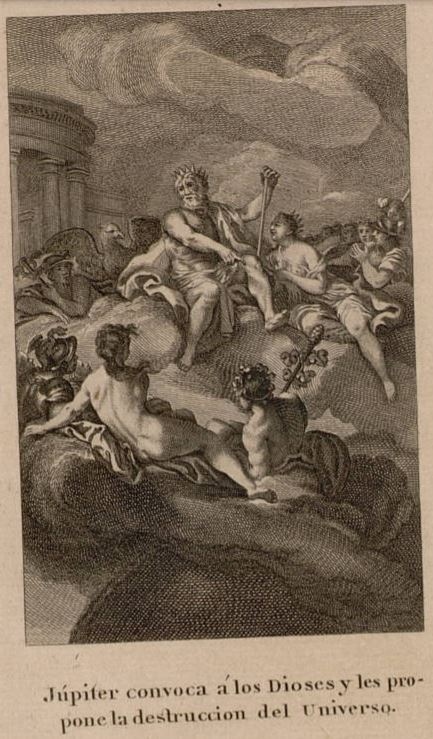
This image depicts the god Jupiter holding a council amongst the other gods of Olympus. Jupiter is depicted holding his arm up and wearing a crown to symbolize his status of king of the gods. The other gods are laying down as they listen to Jupiter. There is an eagle illustrated behind Jupiter as that is an animal Jupiter would often transform into. Jupiter is holding a council with the other gods to discuss whether or not they should destroy the world as humankind had become extremely violent.
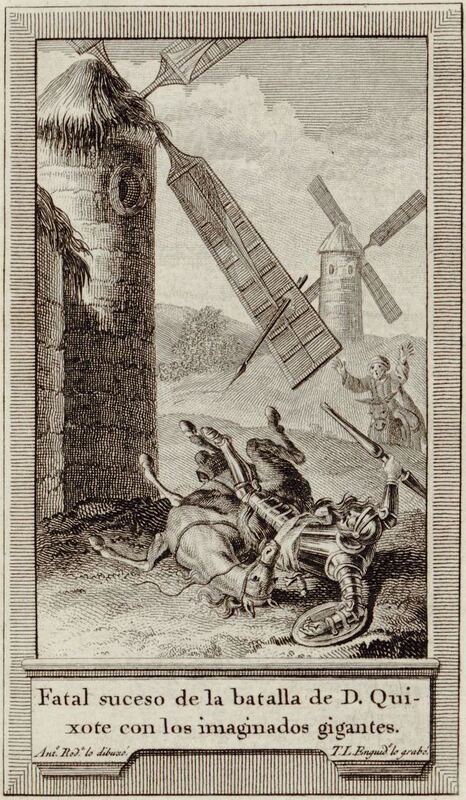
Don Quixote, mounted on Rocinante, charges a windmill that he mistakes for a giant despite Sancho Panza’s warning. The sail catches the wind, moving with so much force that it picks up the horse and the knight, then throwing them to the ground. Sancho comes to help them. Signed by A. Rodríguez (illustrator) and T. Enguídados (engraver). Part 1, ch. 8.
Don Quixote and his horse Rocinante lie defeated on the ground, while the Knight of the White Moon presses his foot on Quixote's breast plate and aims his sword at his head; Quixote's shattered lance lying by his side. On the right Sancho Panza clasps his hands together and calls out to his master. In the background, a crowd of people watch on in awe.
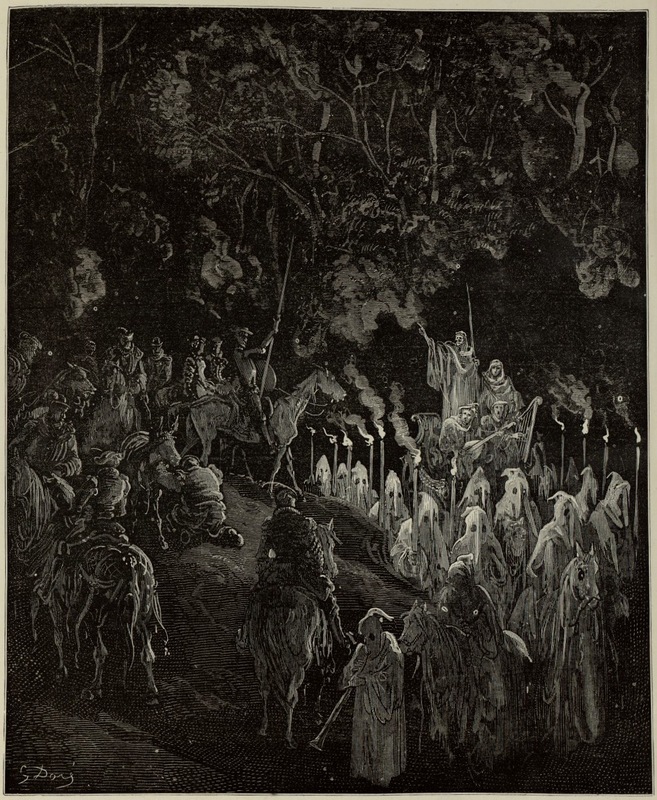
To the rhythm of music, a triumphal cart approaches Don Quixote, Sancho Panza, the duke, and the duchess, pulled by six gray mules caparisoned in white linen. The triumphal is surrounded on all sides by penitents dressed in white and holding large, burning wax torches. On a raised throne sits a nymph draped in a thousand veils of silver cloth with gold sequins. Her face is covered by a transparent and delicate sendal. Next to her is Merlin, dressed as the figure of Death. Signed by G. Doré (illustrator) and H.-J. Pisan (engraver). Part 2, ch. 35.
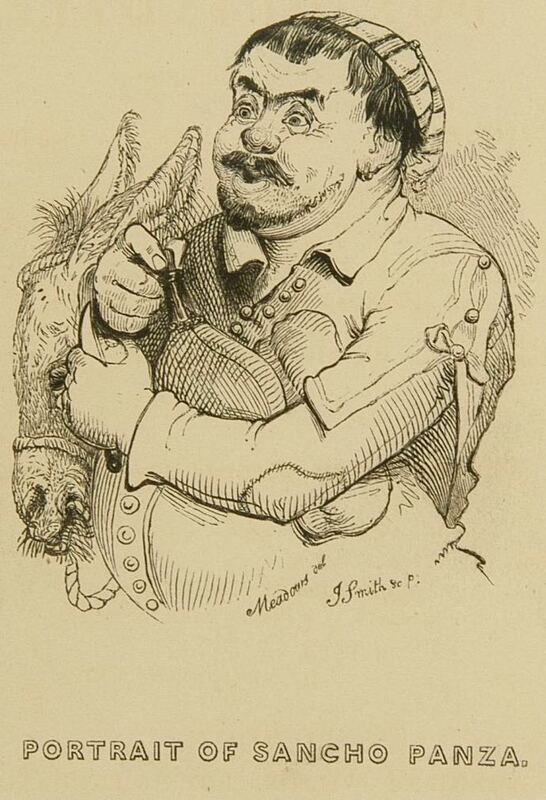
Portrait of Sancho Panza. He holds a package of food, a flask of wine, and is accompanied by his donkey. Signed by J. K. Meadows (illustrator) and J. Smith (engraver). Frontispiece.
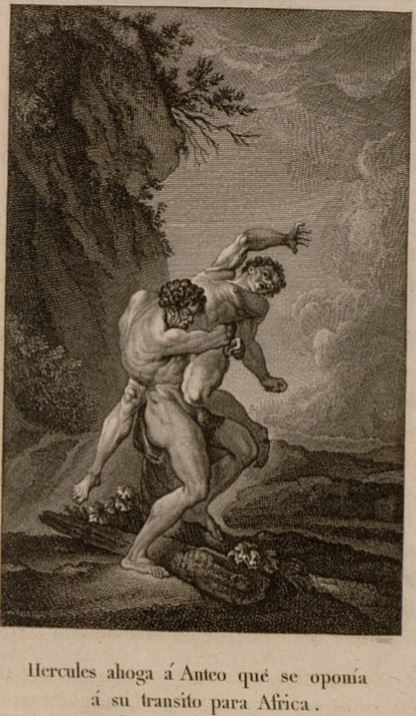
This image depicts Hercule fighting Antaeus. Hercules was on his way to complete his eleventh labour, and he came across Antaeus, the son of Gaia and Neptune. Antaeus challenged anyone who passed him to a wrestling match. Antaeus was invincible so long as he kept his feet touching the ground, so Hercules lifted him off the ground to beat him. This image depicts Hercules lifting Antaeus off the ground.
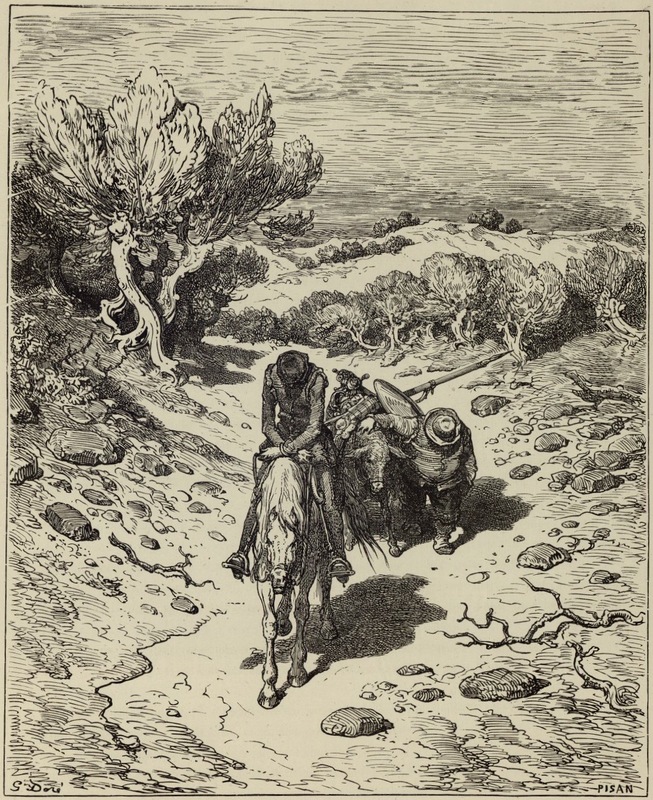
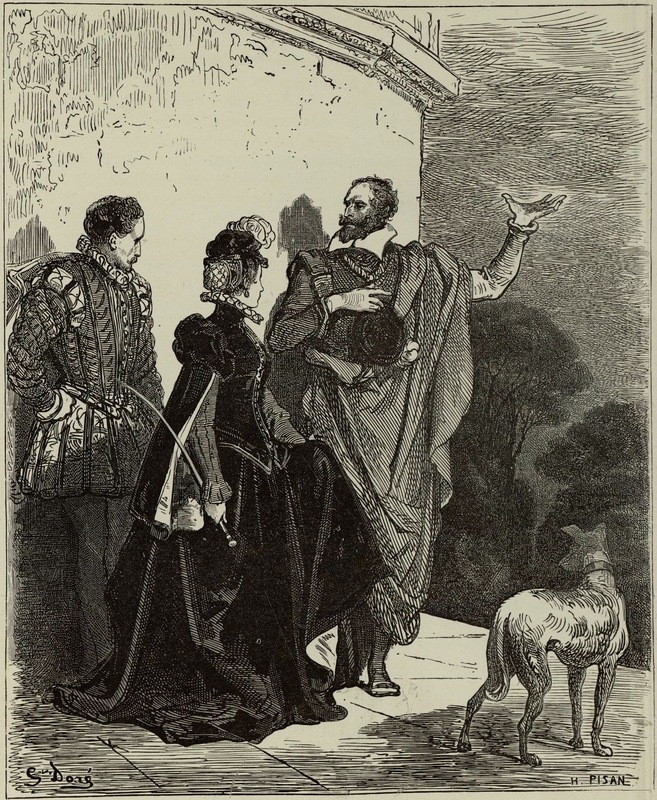
Seeking to abandon the idleness in which he had been living in the castle, Don Quixote asks the duke and duchess for permission to leave. They grant it, telling him that it grieves them deeply that he is going. Signed by G. Doré (illustrator) and H.-J. Pisan (engraver). Part 2, ch. 57.
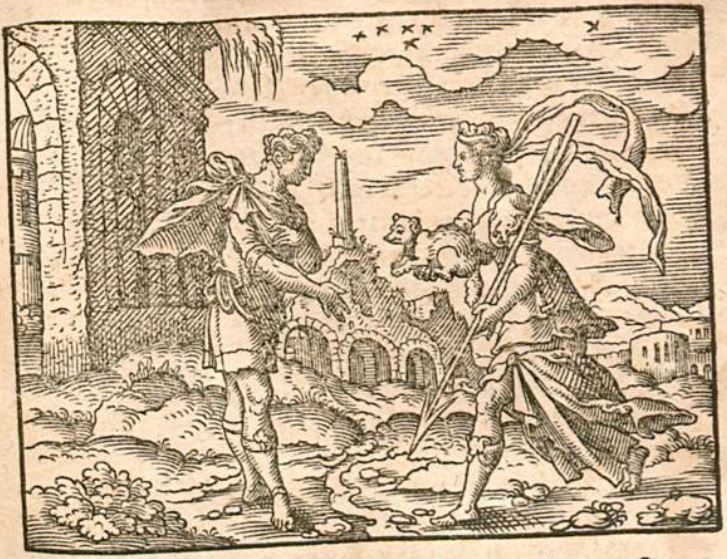
This engraving illustrates Cephalus with his arms outstretched towards his wife, Procris, as he asks for her forgiveness. Cephalus had accused Procris of being unfaithful to him, and she fled from their household in shame to live in the woods. Cephalus begged Procris to forgive him, and she did. Once she forgives him, she offers him two gifts, one of them being a magical spear that never misses its target, and the other being the fastest hound in the world named Laelaps. The spear and Laelaps are depicted in Procris’ arms in the engraving.
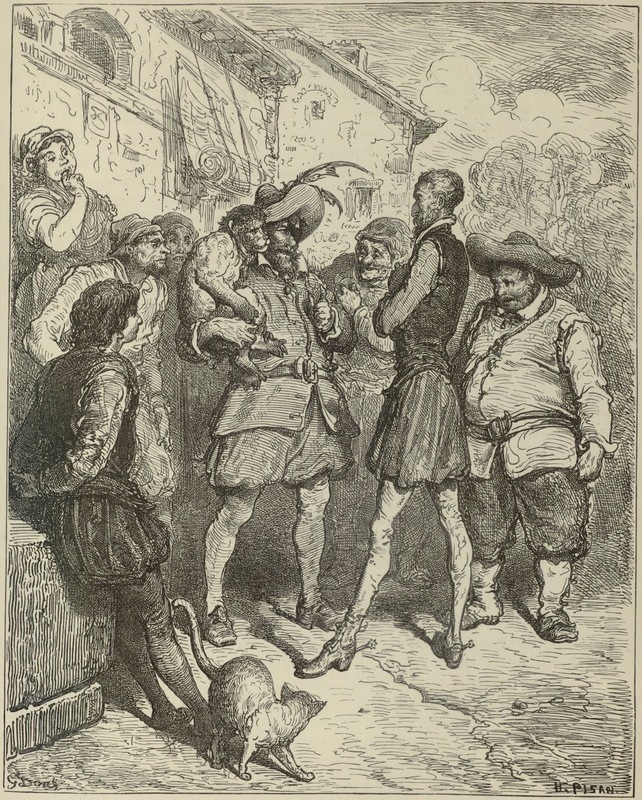
At the inn, Sancho Panza gives Maese Pedro two reales and asks the monkey to tell him what his wife Teresa is doing and how she is spending her time. The monkey leaps on the puppet master’s shoulder and clicks his teeth together, making as if he were whispering the answer to the question in his ear. Maese’s left eye is covered with a patch of green taffeta. Signed by G. Doré (illustrator) and H.-J. Pisan (engraver). Part 2, ch. 25.
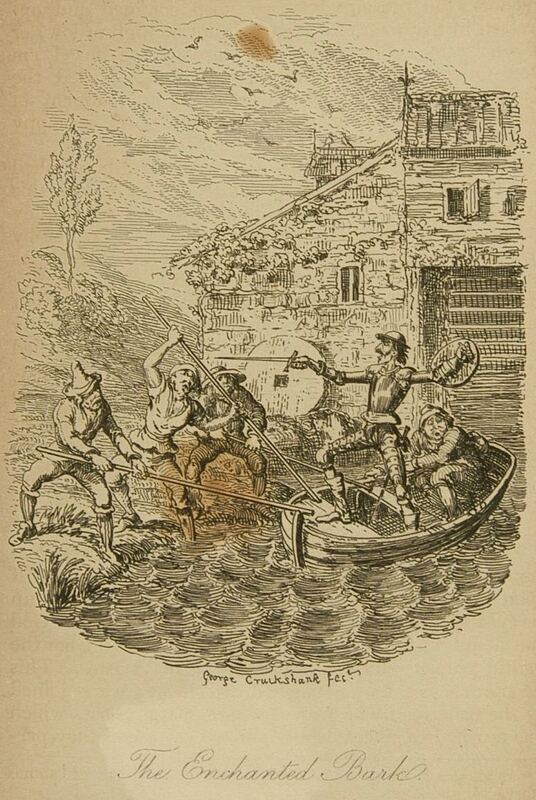
Don Quixote and Sancho Panza make their way down the Ebro River, and approach two water mills. The millers hurry out with long poles to prevent Don Quixote and Sancho Panza’s dory from being swallowed up in the torrent of the wheels. They are covered in dust from the flour. Don Quixote mistakes them for miscreants and scoundrels, and wields his sword against them. Signed by G. Cruikshank (illustrator and engraver). Part x, ch. 29.
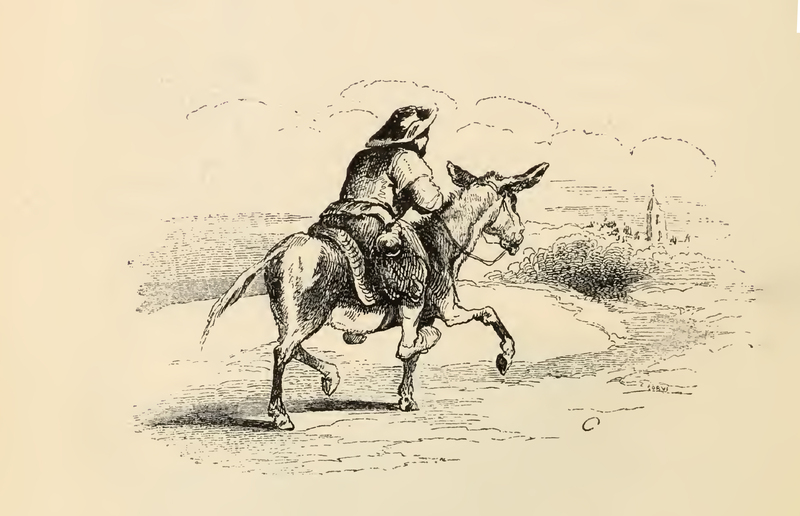
Having been tasked with delivering a letter to Dulcinea Del Toboso by Don Quixote who has taken up penance in the mountains, Sancho Panza rides his donkey towards the city of Toboso. Sancho is wearing a wide brimmed hat and has a water pouch by his hip. In the background on the right the city of Toboso can be seen.
The priest greets Don Quixote and Sancho Panza upon their return to the village, embracing Don Quixote. In the background, several houses of the village and a church steeple are pictured. Signed by D.-N. Chodowiecki (illustrator) and D. Berger (engraver), dated 1781. Plate C.IV. Part 2, ch. 73.
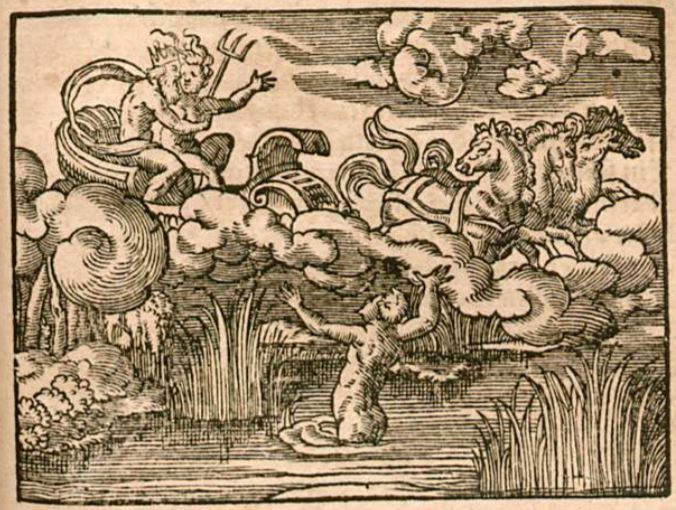
This engraving illustrates the god of the Underworld, Pluto, abducting Proserpina. After Pluto was shot with one of Cupid’s arrows, he fell in love with Proserpina, the daughter of Ceres. Proserpina is illustrated with her hand in the air and a panicked look on her face as she cries out to her friends and her mother to save her. While on his way back to the Underworld with Proserpina, Pluto rode past a lake that was presided over by a Sicilian Nymph named Cyane, who is illustrated in the water on the engraving. Cyane pleads to the god to let Proserpina go, but he ignores her and continues to the Underworld.
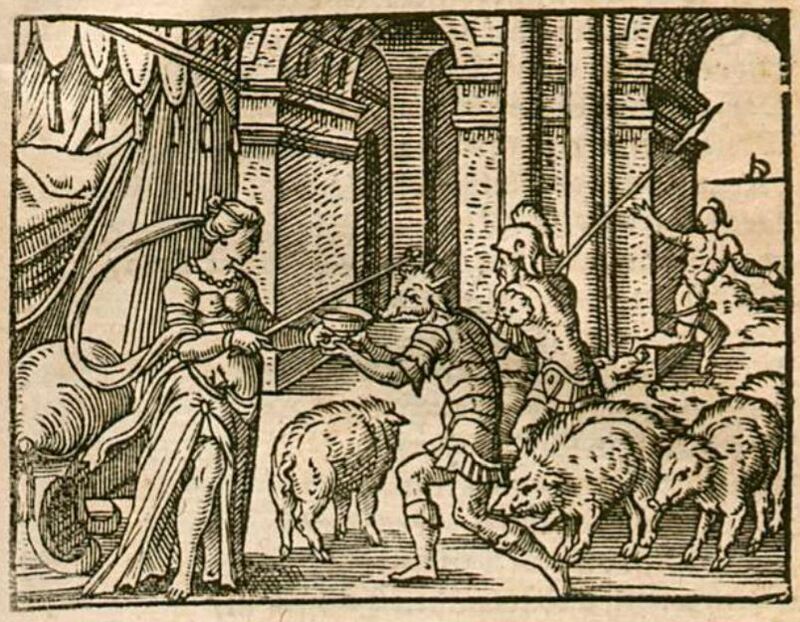
This engraving illustrates the companions of Ulysses being transformed into pigs. The companions of Ulysses had been welcomed into Circe’s courts until they realized that Circe had put a potion in their drinking vessels which turned them all into hogs. There is one man who is being touched on the head with Circe’s magic wand, and his head is already mid-transformation. There is one man in the engraving, Eurylochus, who is not transforming, as he did not drink anything. He was able to run back to Ulysses to explain what Circe had done.
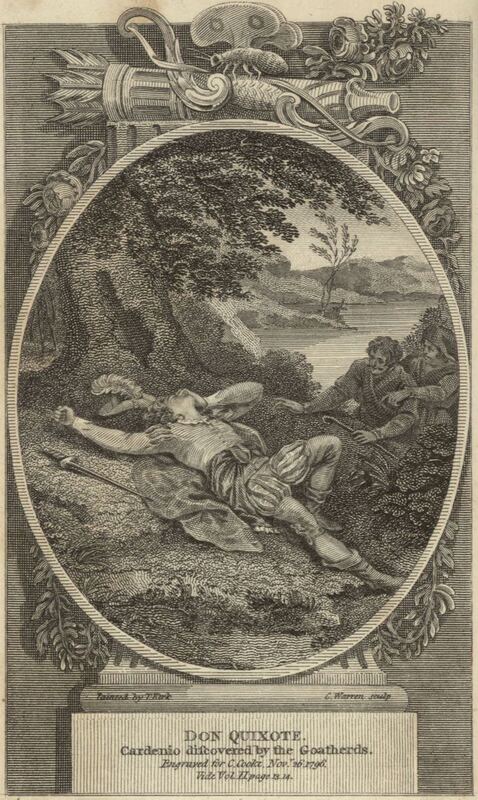
The illustration represents part of Cardenio’s story as told by the goatherds to Don Quixote and Sancho Panza. In Sierra Morena, the goatherds encounter Cardenio after searching for him for almost two days in the wildest part of the mountain range. They find him in the hollow of a huge old cork tree. The illustration is set in a decorative and architectural frame, complete with a bow and quiver with arrows (symbols of Cupid and by extension Cardenio’s love for Luscinda), a butterfly, and flowers. Signed by T. Kirk (illustrator) and C. Warren (engraver), dated 1796. Part 1, ch. 23.
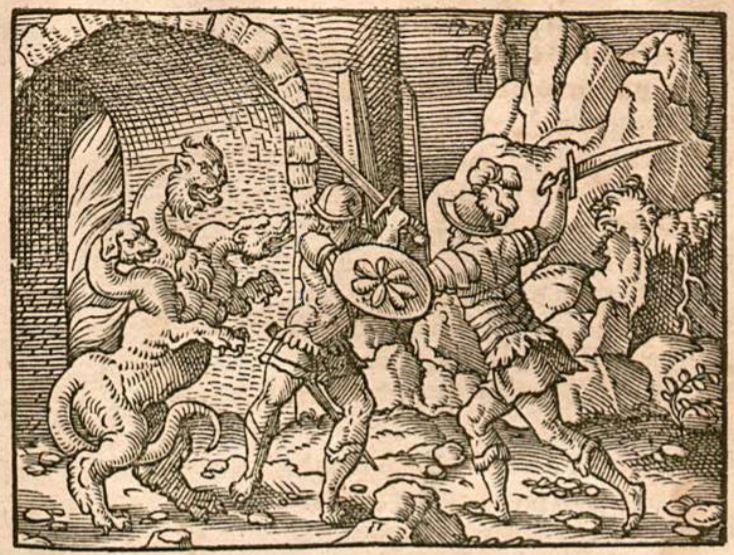
In order to poison her stepson Theseus, Medea planned to use a poisonous mixture of aconite. It is suggested that aconite came from the mouth of the three-headed beast named Cerberus, which guarded the Underworld. When Hercules had chained up Cerberus and brought him up from the Underworld, he started foaming at the mouth when he saw daylight, which turned into aconite when it touched the ground. The image illustrates Hercules, presumably fighting off Pluto, god of the Underworld, in order to chain up Cerberus and bring him above ground.

![[Of How Sancho Panza Offended Donna Rodriguez de Grijalva]](https://collections.cemvc.ca/files/large/cf05ff980085b943597841647cb039efff553f0d.jpg)
![[Of How Don Quixote was Defeated by the Knight of the White Moon]](https://collections.cemvc.ca/files/large/dc3b367bde739611b35d45759ea173d3d4b36979.jpg)
![[Don Quixote embraces the priest]](https://collections.cemvc.ca/files/large/18bfa025e0a83e00dc0e9f23856c2ff497588a19.jpg)