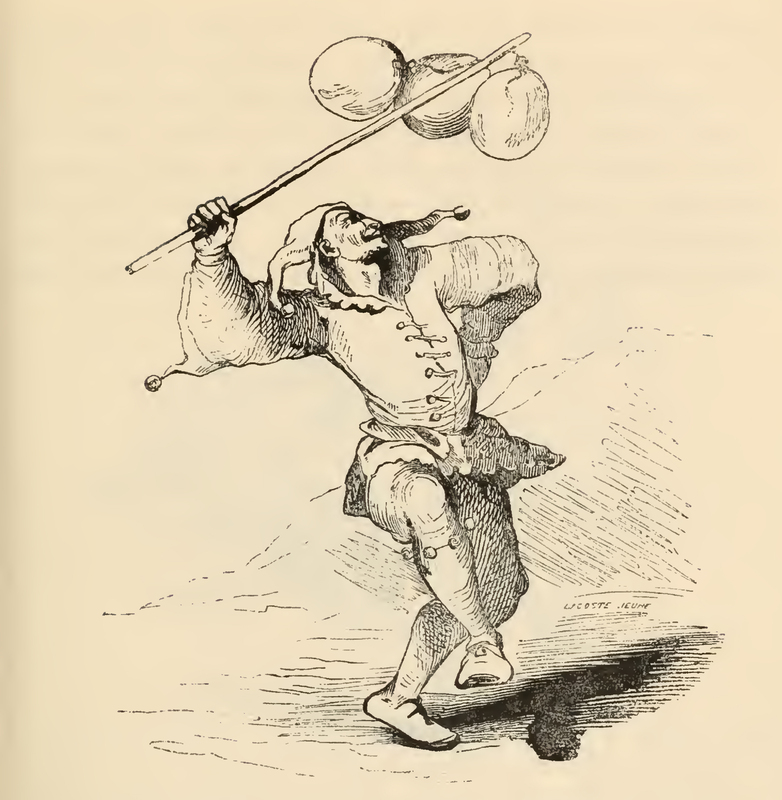
While Quixote converses with the players on their cart (not pictured), there came upon the company a court jester, his clothes being adorned with little bells, carrying at the end of a stick three blown ox bladders that he shook and danced around with.
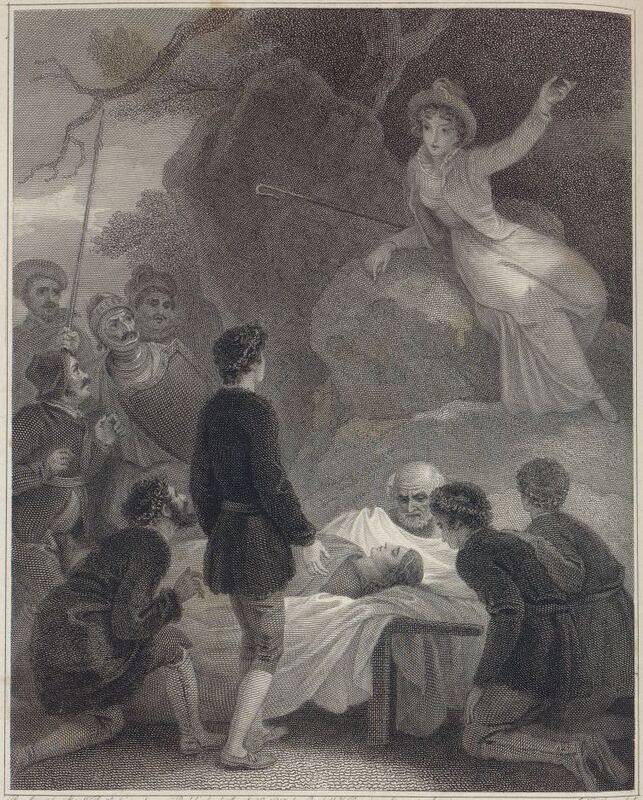
Marcela appears on a crag overlooking Grisóstomo’s burial. Ambrosio (centre), Grisóstomo’s friend, stands near his body, gesturing toward it. He accuses Marcela of causing his friend’s death. In the background, Don Quixote, Sancho Panza, and Vivaldo listen to the argument between Marcela and Ambrosio. Marcela’s figure and that of the old shepherd kneeling beside Grisóstomo’s body are idealized. Signed by R. Smirke (illustrator) and J. Heath (engraver). Part 1, ch. 14.
Don Quixote and Sancho Panza are forcefully returned to the Duke and Duchess' castle, having returned to La Mancha. Upon arriving, an officer forces Sancho Panza (right) to wear a black flaming frock which he then removes to find it pictured with devils, making him put it on again so as not to see the devils. Don Quixote (pictured on the left holding a sword) also steadfastly surveyed him, and in the midst of Sancho's befuddlement, could not help but smile at his strange figure .
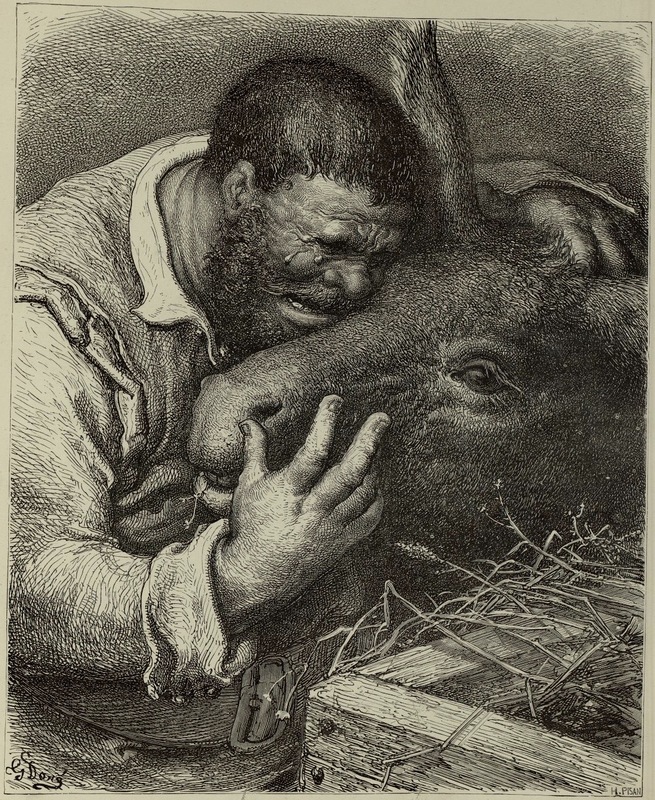
After deciding to leave Barataria Island, Sancho Panza reunites with his donkey. Signed by G. Doré (illustrator) and H.-J. Pisan (engraver). Part 2, ch. 53.
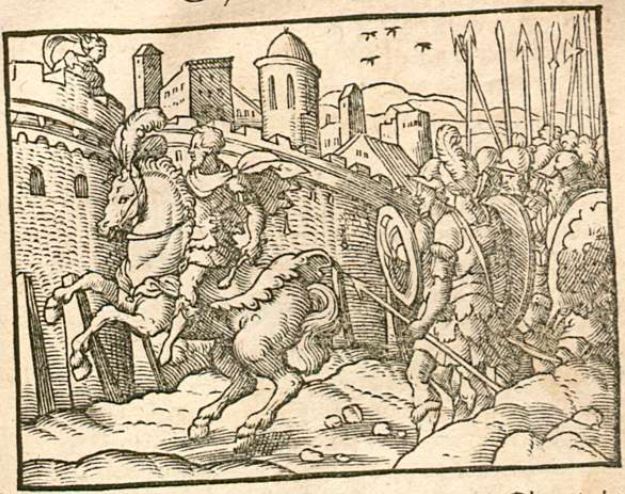
This engraving illustrates King Minos of Crete waging war on the city of Megara. He is illustrated riding his horse with his soldiers behind him. In the top left corner of the engraving, there is a woman illustrated looking over the battles. This woman is Scylla, the daughter of King Nisus of Megara. Scylla falls in love with King Minos as she watches him from her city walls and ends up betraying her father and city as her love for King Minos over-powers her.
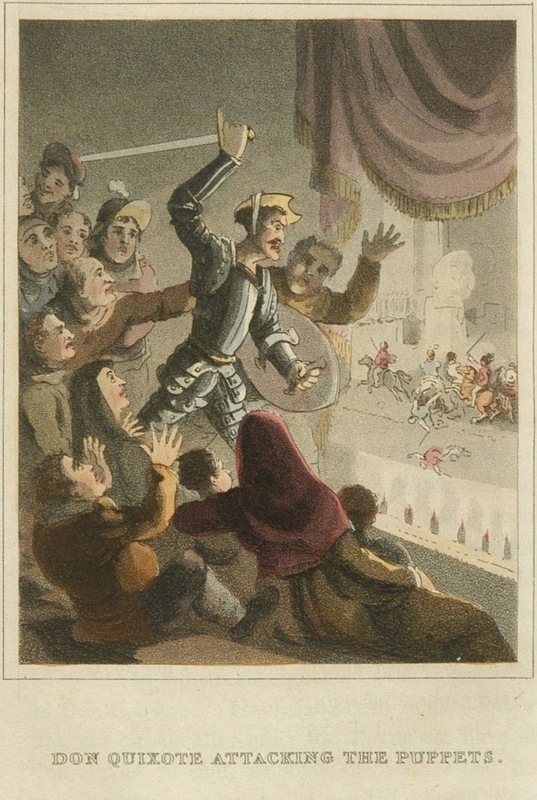
Don Quixote draws his sword before attacking the puppets of Maese Pedro’s theatre. The people in the crowd watch him, alarmed, while Sancho Panza tries to stop him. Excellent rendition of light and shadows.Unsigned. Part 1, ch. 3.
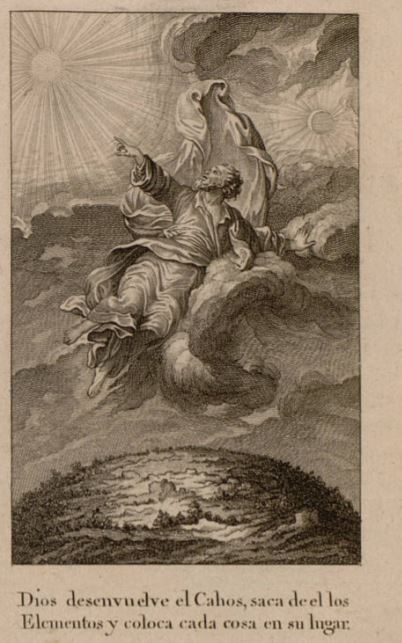
Ovid describes a world in which chaos reigned and everything was out of its place. A God of an unknown name that is depicted in this image, takes all the chaos in the world and organizes it into stability and peace. The God in the image is depicted flying in the centre of the page and pointing towards the sun. The world is illustrated beneath him as he separates the skies from the earth.
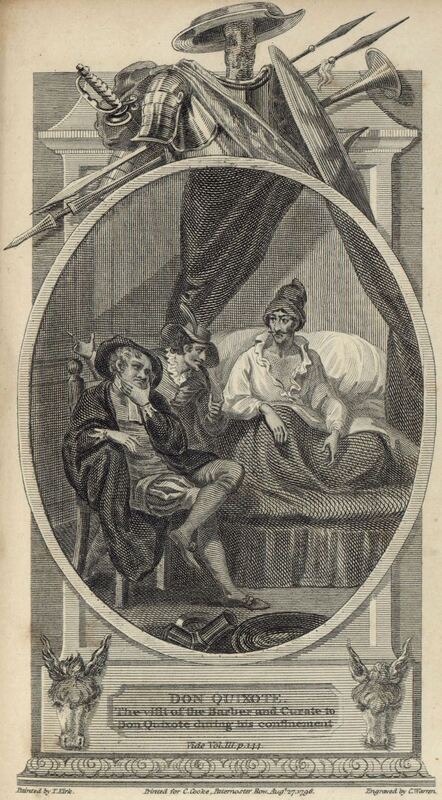
The priest and the barber visit Don Quixote to see his improvement, having heard from the niece and the housekeeper that he is giving signs of being in his right mind. The illustration is set in a decorative and architectural frame, complete with the errant knight’s arms (lance, sword, helmet, and buckler) and donkey heads. Signed by T. Kirk (illustrator) and C. Warren (engraver), dated 1796. Part 2, ch. 1.
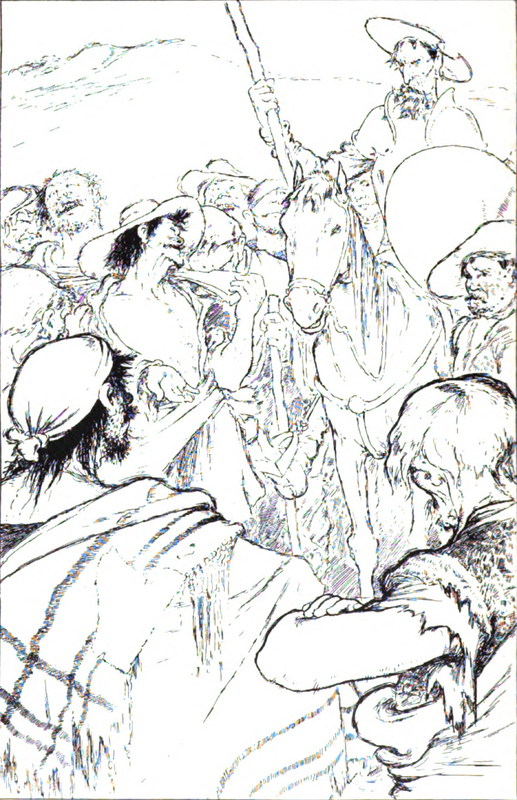
Don Quixote, upon seeing a procession of galley slaves attacks one of the guards, inciting a revolt from the slaves which is successful because they throw rocks at their captors and one of the slaves, Gines Passamonte picks up the fallen guard's musket. Having freed the Galley Slaves from their bondage, Don Quixote (on horseback) called all the fugitives together and they gathered in a ring about him to know his pleasure. Quixote tells the mass to present themselves to Dulcinea in the city of Toboso in order to show their gratitude. Gines de Passamonte, with the barrel of a gun slung over his shoulder, answers for all the slaves, and tells Quixote that his request is impossible for they all must hide from the Holy Brotherhood, who doubtlessly will now be hunting them.
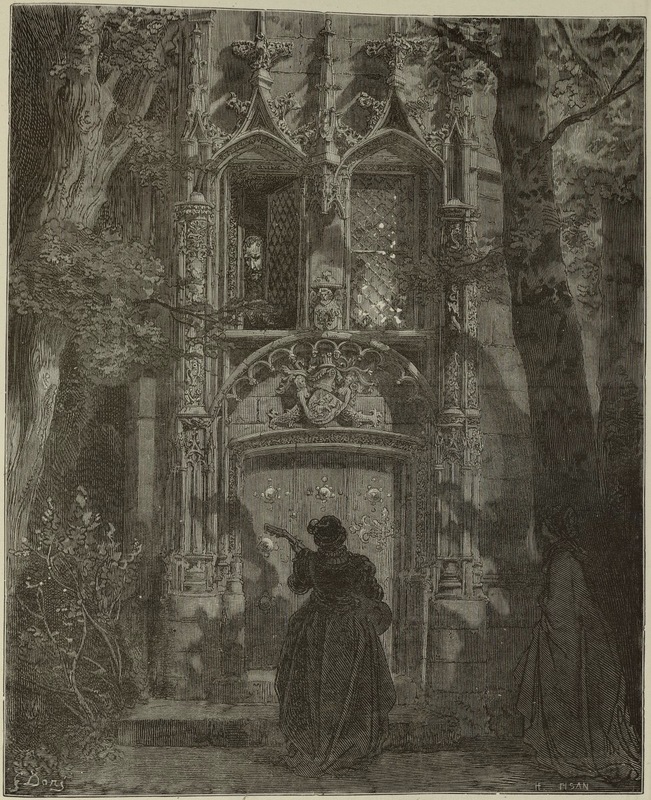
After Sancho Panza’s departure for Barataria Island, Don Quixote retires to his room in the palace. He has trouble sleeping and opens a jalousied window overlooking a beautiful garden. He hears Altisidora and Emerencia talking below. Emerencia hears his window open and urges Altisidora to play the harp and sing her song for the knight. Signed by G. Doré (illustrator) and H.-J. Pisan (engraver). Part 2, ch. 44.
Marcela appears on a crag overlooking Grisóstomo’s burial. Ambrosio, Grisóstomo’s friend, standing near his body (directly underneath Marcela), accuses Marcela of causing the death. Don Quixote interrupts them and defends Marcela before the gathered shepherds. Also pictured are Vivaldo and the gravediggers. Signed by A. Rodríguez (illustrator) and T. Enguídados (engraver). Part 1, ch. 14.
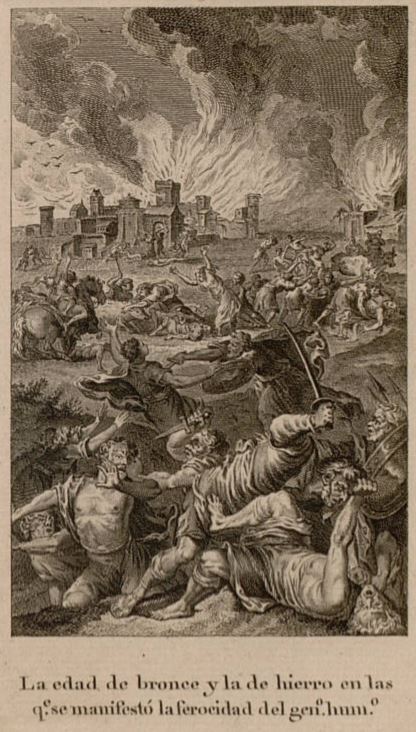
The Golden and Silver ages of civilization saw periods of peace, stability, and overall safety, whereas the Bronze and Iron ages saw the emergence of violence and war. This image depicts humanity when it entered into the Bronze and Iron ages. The image depicts a scene of chaos as everyone in the image is fighting and killing one another. The background of the image shows a city which is being burned by a massive fire and the sky being engulfed with smoke.
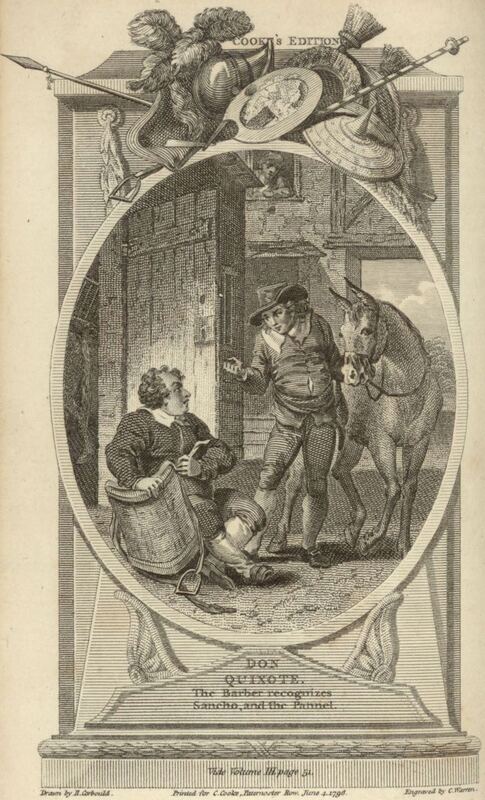
In the inn’s stable, the barber encounters Sancho Panza and demands that he return his packsaddle and basin. The illustration is set in a decorative and architectural frame, complete with a lance, an arrow, a shield, and a helmet. Signed by R. Corbould (illustrator) and C. Warren (engraver), dated 1796. Part 1, ch. 44.
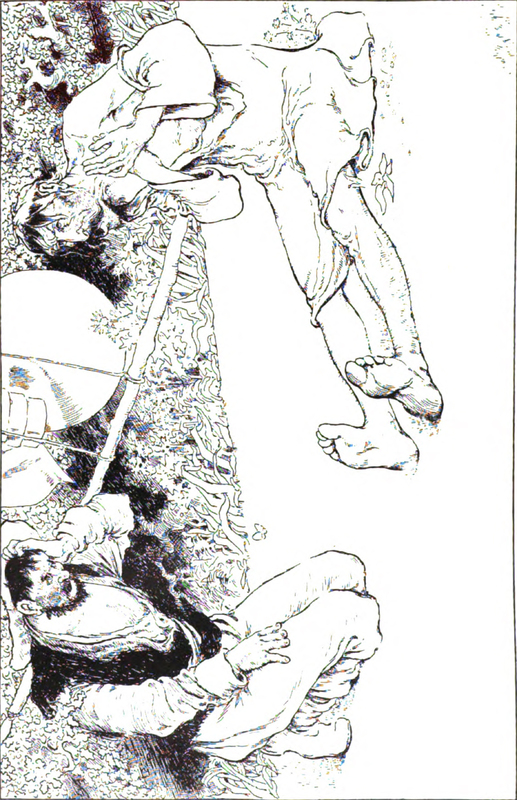
Sancho Panzo (left) returns to Don Quixote (right) having delivered the knight-errant's letter to Dulcinea in Toboso. Don Quixote is in a bad state, having partaken in penance for days on end living off of the herbs and berries scattered throughout the mountain. When Sancho Panza finds him, Quixote is half-dead from hunger and sighing about Dulcinea. Although Sancho Panza tries to convince Quixote to meet Dulcinea he responds that he must first make himself worthy of her presence.
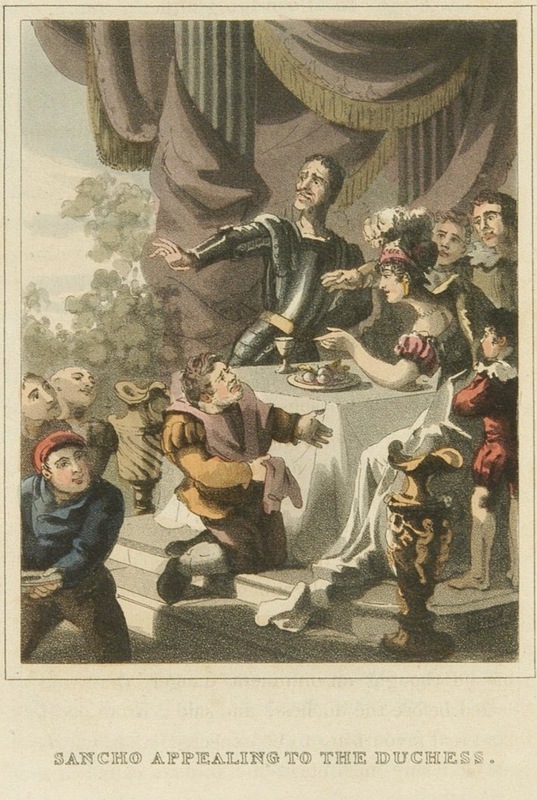
Sancho Panza (centre) appeals to the duchess and Don Quixote (right) for clean water and fresh towels. He refuses to let the servants (left) wash his beard otherwise. Unsigned. Part 1, ch. 3.
Having left his donkey to assist Don Quixote, the bladder-dancing jester mounts Sancho's donkey, Dapple, and thumping him with a stick to which is attached three blown ox bladders makes the donkey run towards the nearest town.
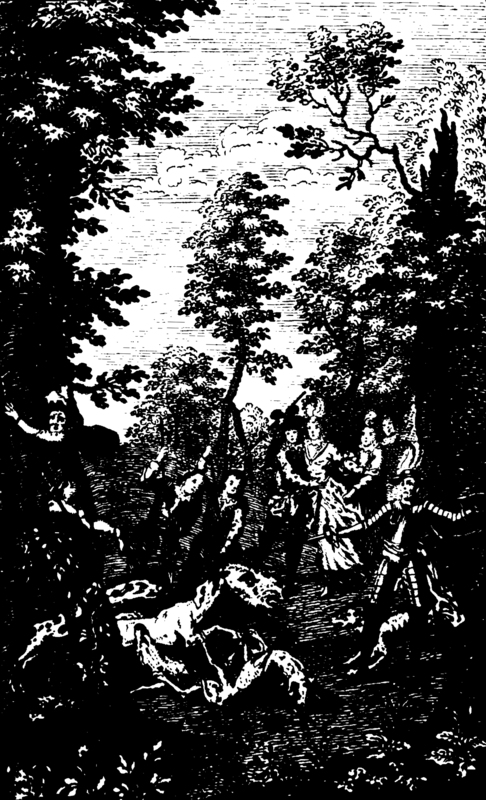
Don Quixote, Sancho Panza, the Duchess, the Duke and all their servants participate in a great hunt led by hunting dogs. They are met on their hunt by a large boar who mashed its teeth against its tusks and foamed at the mouth. Seeing the boar, Don Quixote (pictured pointing his sword at the felled boar) grasped his shield drew his sword and prepared to receive the boar head on alongside the Duke (pictured holding the duchess in the background). The Duchess was the most prepared of all of them, but the Duke insisted that she step back. Sancho Panza meanwhile resolved to run away, and leaving Dapple, he scuddled towards an oak, but fell while climbing and was caught by a snag. Suspended above the boar, Sancho yelled and bellowed as if he was being devoured until the tusky boar was laid to rest.
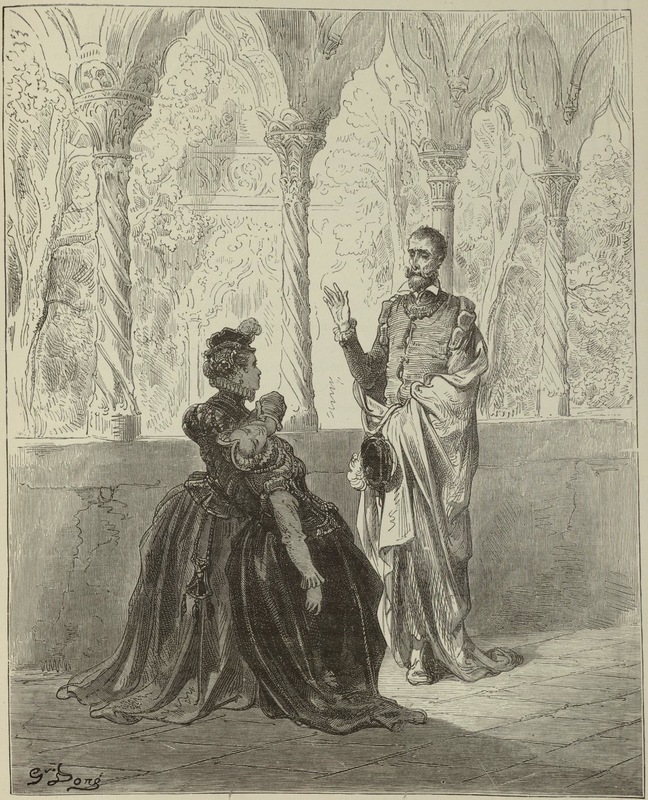
In the palace’s gallery, Altisodora pretends to faint in a maiden’s arms when she encounters Don Quixote. The maiden asks Don Quixote to leave, telling him that Altisodora will not regain consciousness as long as he is there. Signed by G. Doré (illustrator) and H.-J. Pisan (engraver). Part 2, ch. 46.
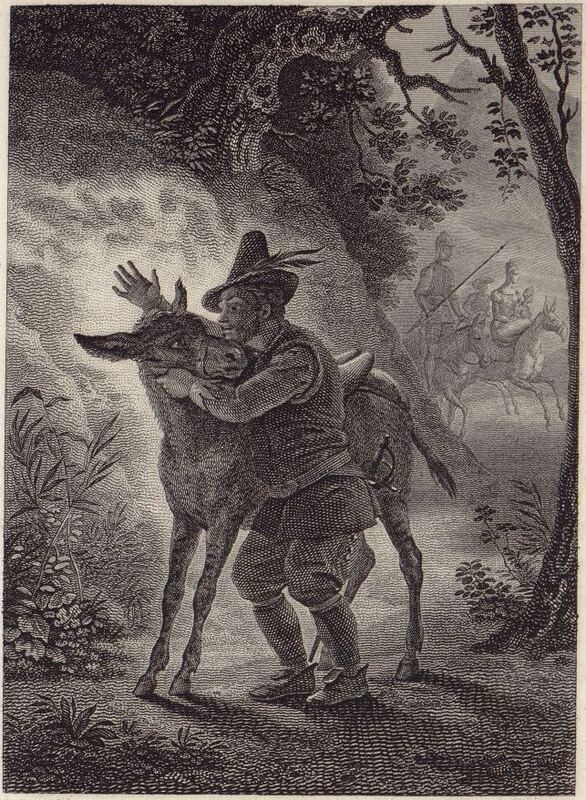
After leaving Sierra Morena, the travellers encounter Ginés de Pasamonte and Sancho Panza’s stolen donkey. Sancho, reunited with his donkey, embraces it while Ginés de Pasamonte runs away (not pictured). Don Quixote, Dorotea, the barber, and the priest look on (background). Signed by E. Vernet (illustrator) and E. Lignon (engraver). Part 1, ch. 30.
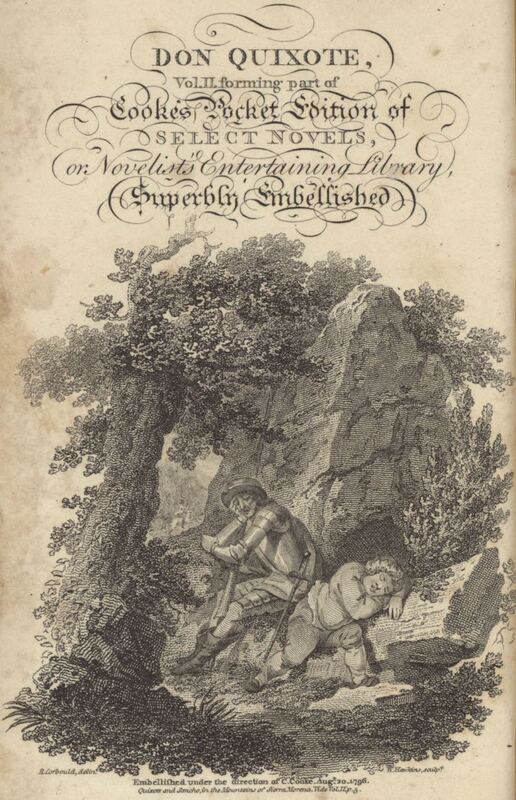
Vignette on title page. Don Quixote and Sancho Panza sleeping in Sierra Morena. Signed by R. Corbould (illustrator) and W. Hawkins (engraver), dated 1796. Part 1, ch. 23.
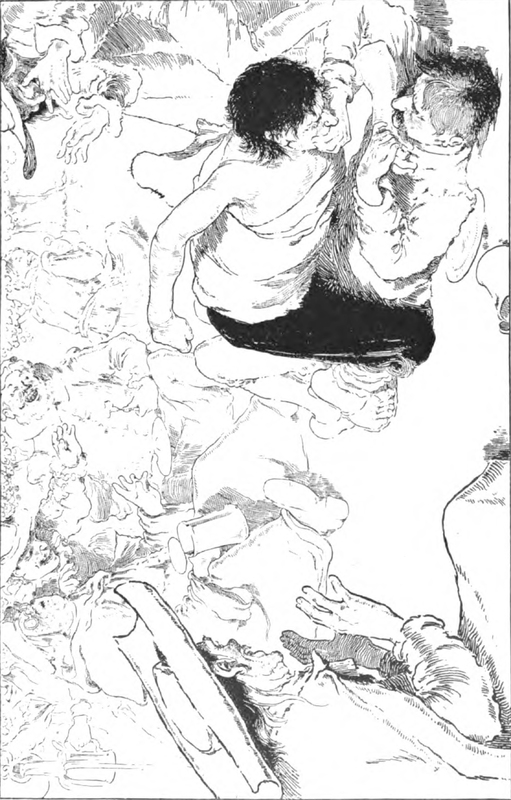
During their banquet, a goatherd wanders into the inn while chasing his goat. The company is amused by his mannerisms and invite him to join in the banquet. He tells the company a story as they feast, but Don Quixote interjects impudently. Eventually, the goatherd gets fed up and insults Don Quixote, Quixote throws a piece of bread at the goatherd and the two of them brawl on the floor next to the table as the company cheers them on, with the goatherd on the top strangling Don Quixote beneath him.
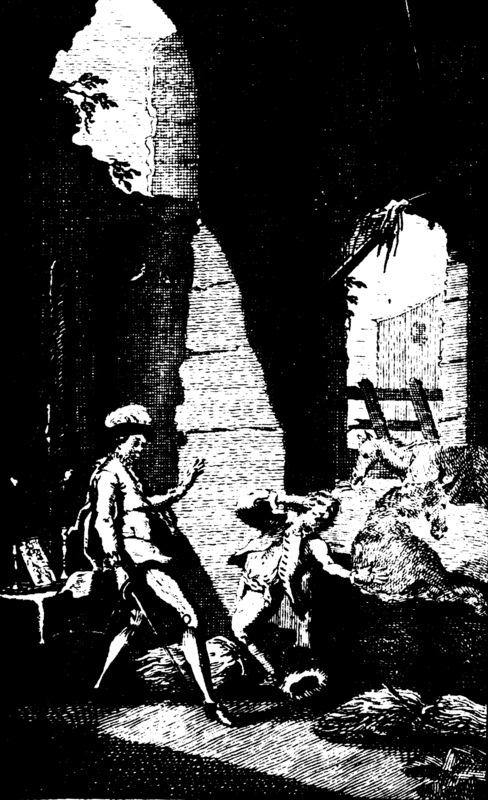
Insulted that the Courier (left) removed his armor from off the cistern pictured on the right and moved it to the foreground, Don Quixote (right), clad in armor, lifts his lance in his right hand to deliver a blow upon the courier who he mistakes for a knight. The courier falls onto the ground in fright, trying to scuttle away from Quixote.
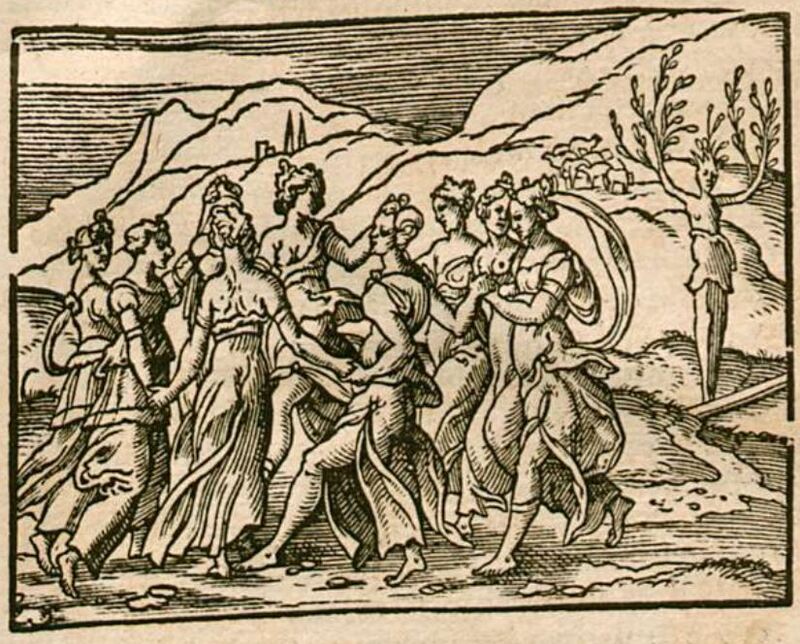
This engraving depicts a group of nymphs gathered in a circle, dancing and skipping. The nymphs had been approached by a shepherd from Apulia had come across the nymphs and began to mock them by imitating their dancing and cursing at them. As punishment, the nymphs transformed him into an olive tree. The shepherd in his transformed state is illustrated in the background of the engraving on the right-hand side of the image. The nymphs continued to dance and enjoy themselves after the transformation of the shepherd.
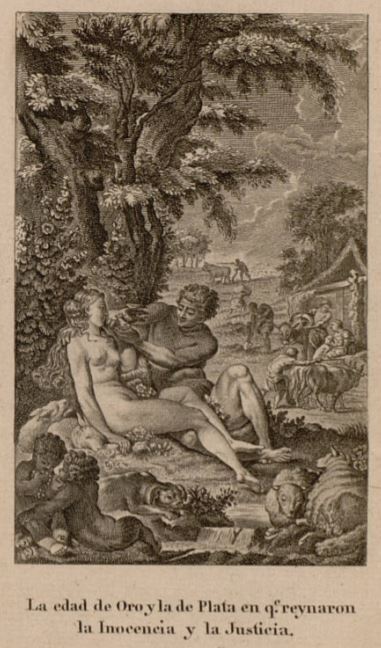
This image represents what Ovid describes as the Golden and Silver ages. The Golden and Silver ages were times of relative peace and stability. There were no threats of war or violence and people lived their lives free of worry. The four seasons were created during this time and the earth was able to be cultivated to provide an abundance of food and security. The image depicts a variety of animals laying down as they relax. There is a naked man and woman in the foreground of the image sitting together. The background of the image shows people working with cattle in front of their houses.
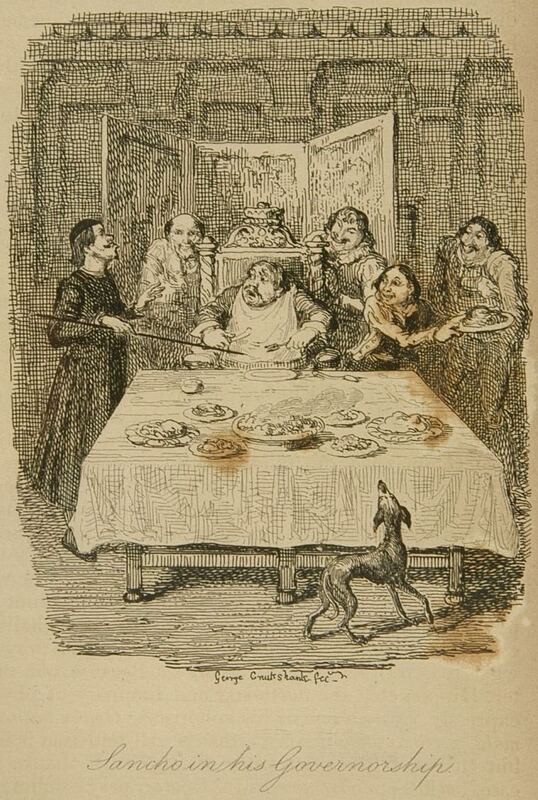
Sancho Panza is taken from the courtroom to a sumptuous palace, where, in a large hall, a royal table is set. Plates of food are placed before Sancho, but at the request of the physician Pedro Recio (left, holding a rod), they are taken away. Signed by G. Cruikshank (illustrator and engraver). Part 2, ch. 47.


![[The Court Jester Steals Dapple]](https://collections.cemvc.ca/files/large/55a912e1d03cfc30e0a79fffa664c57eea686869.jpg)
![[Don Quixote Beats the Courier]](https://collections.cemvc.ca/files/large/54c0a4a2aff07511e80c2d53cc5bd96dc5a18a80.jpg)