This image is a satire on the licking ceremony at the court of Luggnagg. The image is of the body of a person with the head of a dog licking the ground. This is showing the subservience that was expected of courtiers. This subservience was also expected in European courts and thus serves as a satire on European monarchies. The same image appears in the 1843 Krabbe edition.
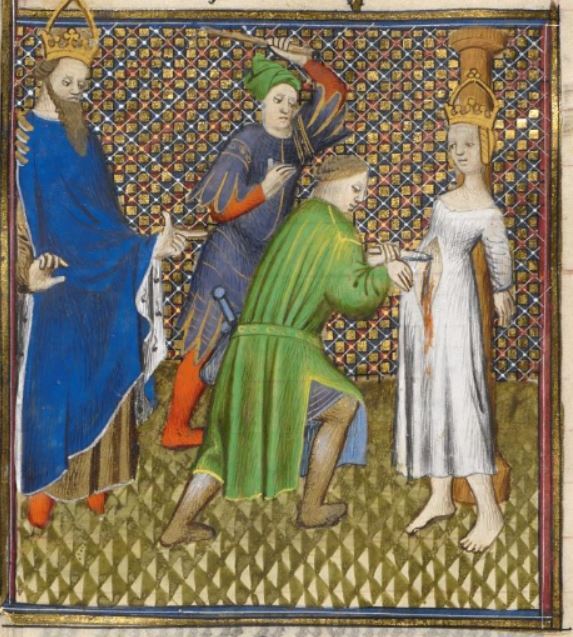
This illumination depicts Agrippina, the mother of Emperor Nero, being murdered. She is illustrated in a white dress as a man cuts through her abdomen. There is another man swinging a club above his head. Emperor Nero is illustrated on the left side of the image pointing his finger towards the men, which symbolizes his orders to have his mother killed.
A mermaid with long hair and a thin twisting tail floats near some rocks, mostly out of the water. She is playing a small harp beneath the full moon, which forms the letter O from “Our”.
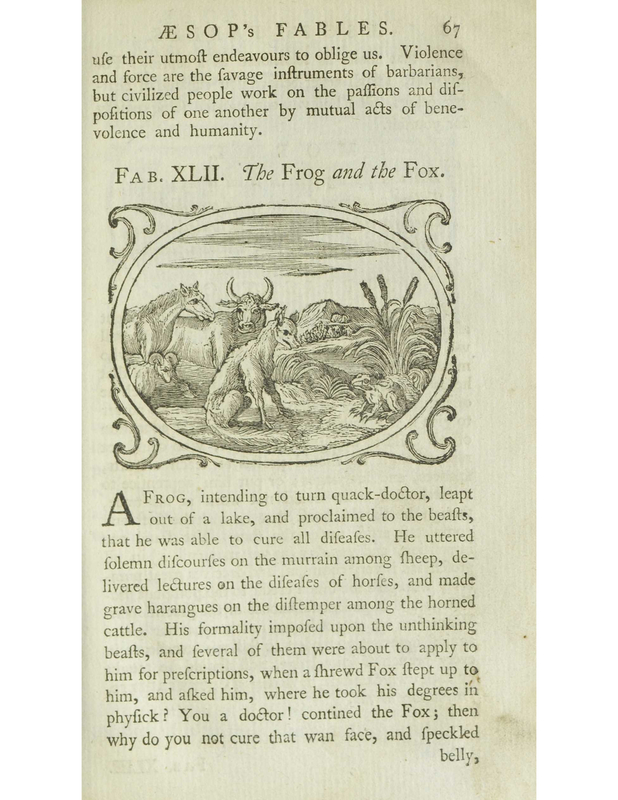
On the right side of the image, a horse, bull, goat, and fox stand before a frog, who stands on the right side of the image. The bull looks forward, while the rest of the animals look at the frog. In the background, there are cattails, grassy areas, and mountains.
Captain MacMurdo lies in bed in his room, surrounded by boxing, sporting, and dancing pictures. Rawdon Crawley sits backwards in a wooden chair next to his bed, looking gloomy. He has come to ask Captain MacMurdo to act as his second for a duel with Lord Steyne.
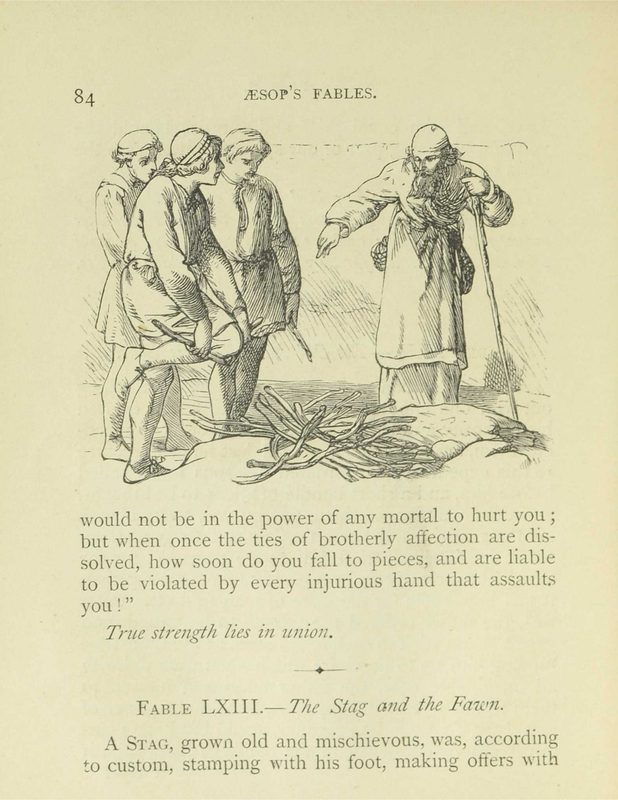
To the right an elderly man stands leaning on a walking stick. He points to a bundle of loosely assemble sticks on the ground. To the left, 3 young boys stand in a group, the closest one is breaking a single stick against his knee. The other just behind him, holds his own half-broken stick.
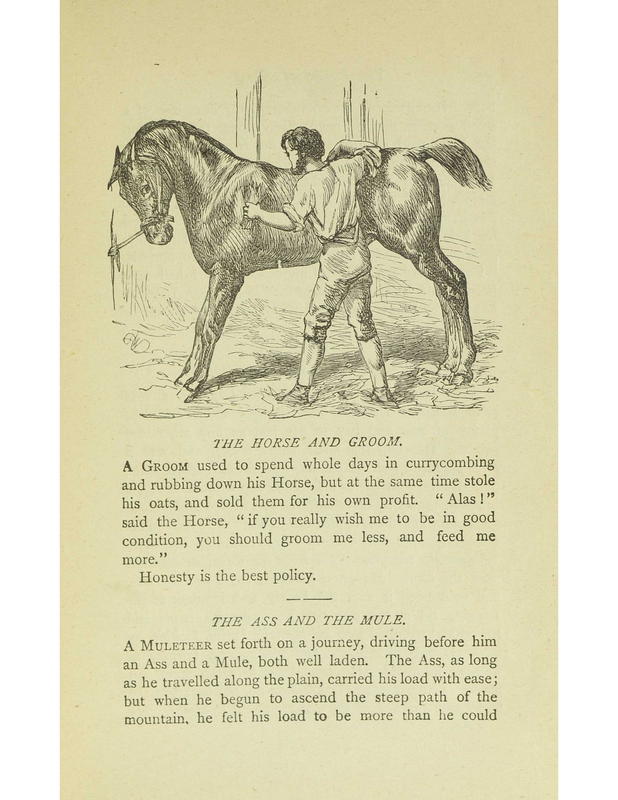
A horse is tied in the stables. Its front legs are slightly stretched out as the horse looks a bit behind itself towards the tall man that is grooming it. The man, wearing stables-worthy clothing, has curly hair and a beard, and is standing with its back to the reader. He has his right arm over the back of the horse as it grooms it with his left hand.
People of Laputa noticed Gulliver in Balnibarbi and invited him to come to their country. They constructed a pulley system to bring Gulliver up to the floating island. The system was attached to a board for Gulliver to sit on.
Lord Steyne, the scar on his forehead visible from when Rawdon Crawley threw his diamond back at him, drinks from a wine glass at Prince Polonia’s ball. He is standing next to a taller man, who is reaching out to take a glass from the tray a nearby serving man holds.
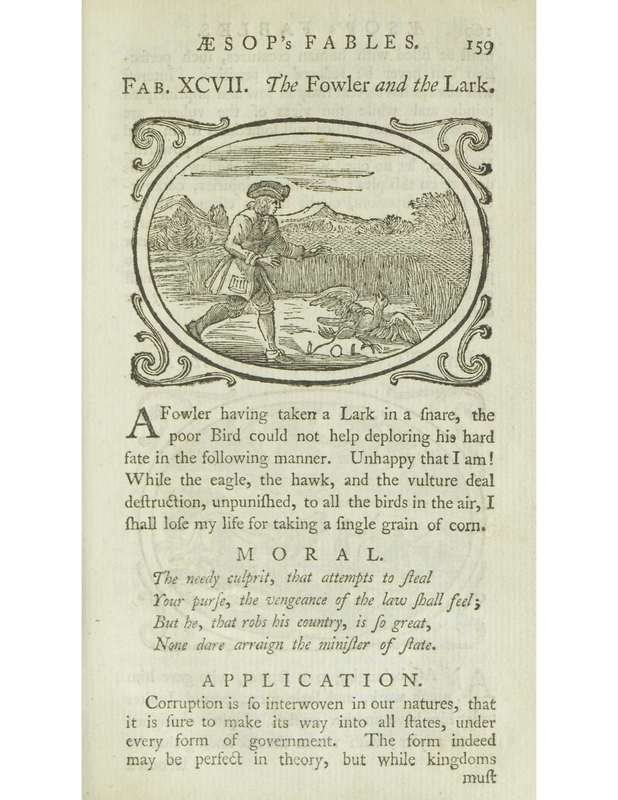
A man in a hat and coat approaches a lark who has gotten its leg caught in a snare by a corn field. There are mountains and trees in the background and the bird appears to be in distress.
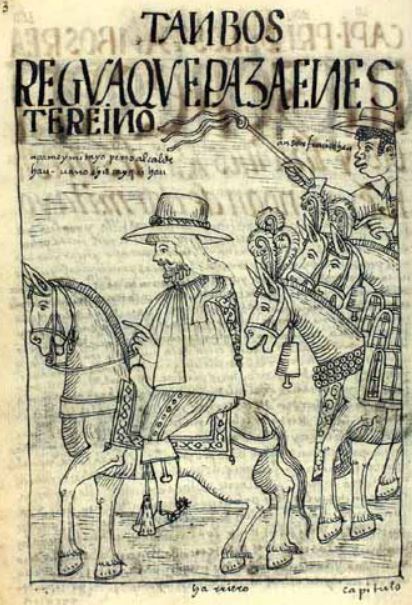
This image depicts a Spanish traveler riding horseback in colonial Peru to a royal inn called a tambo. He is illustrated covering his head, neck, and upper body with clothing to protect himself from the hot Andean sun. He is sitting on an embroidered blanket on the horse’s back. The Spaniard’s African slave is riding behind him performing his duties as his muleteer. He is illustrated holding a whip in his right hand as he guides three mules to walk behind the Spanish master. The animals are decorated in feathers and bells. There is dialogue written above the Spaniard which reads “Apamoy mitayo, perro alcalde. Hau! Uanochiscayqui. Hau!” [Bring it on mayor, you dog. Haw! I’m going to kill you. Haw!]. The African slave has dialogue written above his head as well which reads “Andar, Francico, hau!” [Come on, Francisco, haw!].
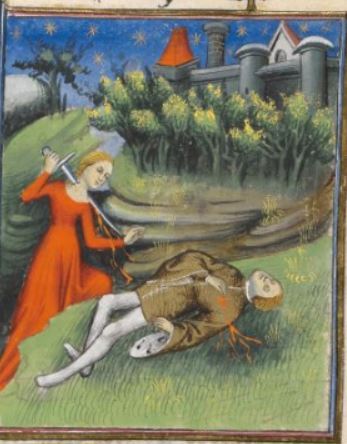
This illumination depicts a young maiden named Thisbe finding her lover, Pyramus, dead in the forest. The lovers were meant to meet at a fountain in the woods where they would run away together. Boccaccio explains that when Thisbe arrived at the fountain, a lioness appeared, and she ran into the trees to hide. She left behind a cloak which the lioness picked up in her already blood-stained mouth. When Pyramus arrived, the lioness was gone, however she left the blood-stained cloak of Thisbe. Pyramus believed Thisbe to be dead, so he plunged his sword into his chest. There is a wound visible on his chest in the image as he lies on the ground. Thisbe is illustrated using Pyramus’ sword to plunge it into her neck.
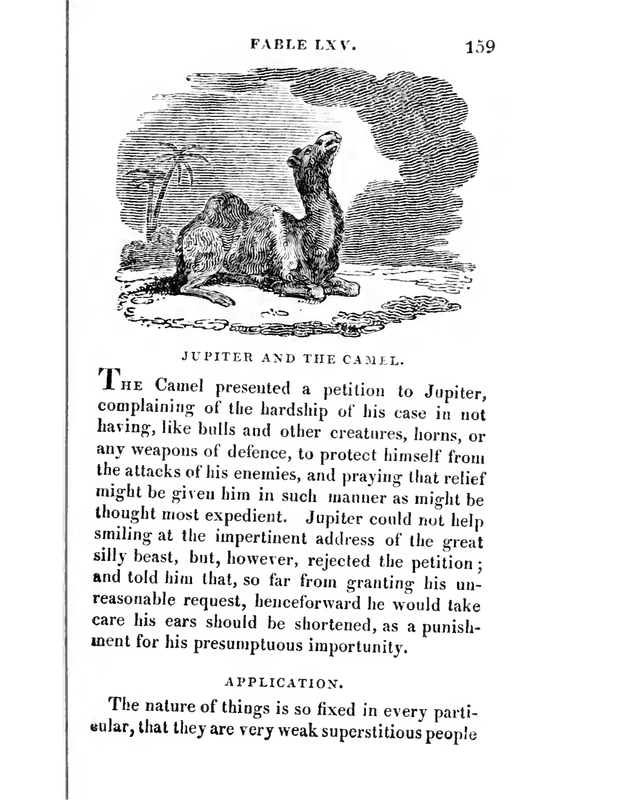
A camel lays down in the sand of what seems to be a desert. The sky is filled with dark clouds. In the background on the left-hand side we see two palm trees. The camel looks up at the sky. Its legs tucked under itself.
A boy in a tall hat, carrying a stack of books, is looking yearningly upon the items at a street-side vendor. In the background is a coach labelled with the number six, a man standing next to a tall signpost, and, in the top right corner of the image, the letter T from “The”.
Here Gulliver sails on a boat made for him after telling the queen about his travels. The queen had a boat and a trough built for Gulliver to sail on and entertain the court. The trough is surrounded by the women of the court, all wearing long embroidered dresses with caps and veils. Some of the women hold fans, which was customary of court life in the eighteenth century. On the left-hand side, we see the queen’s dwarf, looking angrily at Gulliver, resentful of all the attention Gulliver was getting. The same image appears in the 1839 Krabbe edition.
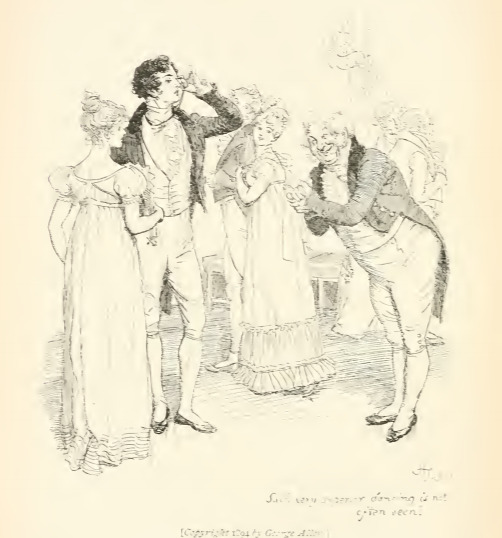
In this image Sir William Collins bows to Elizabeth as Darcy stands by. Sir William had been dancing with Elizabeth, and upon finishing the dance, Sir William complemented Elizabeth’s skill. He then implied Mr. Darcy should see her talent for himself and dance with her. This scene occurs in chapter 18. The characters are shown in the traditional regency style. The women wear regency style dresses with empire waistlines and their hair tied up. The women hold fans that were used at balls to communicate with other people from across the room. The men wear waistcoats and tailcoats with cravats. The regency period dated to the early nineteenth century (1811-1820) when George, Prince of Wales, later George IV (r. 1820-1830), reigned as regent for his mentally ill father, King George III (r. 1760-1820). The regency period is associated with the rise of neoclassicism in art and fashion.
While Gulliver was walking through the garden the gardener's dog picked up Gulliver in his mouth, before the gardener returned and rescued Gulliver. In the image we see Gulliver lying between the dog’s teeth. The same image appears in both the 1839 and 1843 Krabbe editions.
The illustration depicts a scene which might have been a part of the story if it was written in a different style. In the foreground, the Black Vizard, masked, points two pistols at a woman (likely the cook or housekeeper) kneeling on the ground with her hands clasped before her in entreaty. In the background are two men with tall hats carrying rifles.
Four Indigenous Brazilians, likely two male and two female, stand together in a forest. All are nude. The women’s hair is very long, hanging to their knees, while the men wear their hair about shoulder length. The men each hold a weapon, one a bow and one a long club. The man standing center right has an adornment on his cheek, possibly paint or a face stone.
Here we see one of the great European kings with their ancestors. Much to Gulliver’s surprise, many kings had ancestors who were not royal. Some families had fiddlers, courtiers, barbers, and prelates as ancestors, rather than a line of royalty. Gulliver amused himself by tracing different features through family lines, both physical attributes and characteristics of one’s personality. The same image appears in the 1843 Krabbe edition.
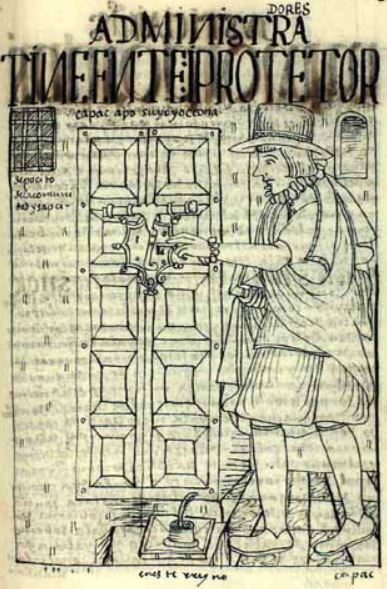
This image depicts the author of the book, Felipe Guaman Poma de Ayala, standing in front of a door as he inserts a key into the lock with his left hand while he holds a book with his right. There is a container of ink with a feathered plum resting on a book at the bottom of the image. The author explains that he was an administrator protector and lieutenant general of his province in Lucanas and Soras and was responsible for the well-fare of the people in his province and ensuring the community was well fed and supplied. The caption below the window in the top right corner of the image reads, “depocito de la comunidad y sapci” [deposit of the community]. The caption at the bottom of the image reads, “en este rreyno” [in this kingdom].

![[a satire of the licking ceremony on Luggnag]](https://collections.cemvc.ca/files/large/601f010651d158687812c0502dad239ca6426486.jpg)
![[Vanity Fair Vol. II Chapter XLIV Inhabited Initial]](https://collections.cemvc.ca/files/large/a70f5dfb2154e72bfceb6cce72e8080a1c70b16b.jpg)
![[Captain MacMurdo]](https://collections.cemvc.ca/files/large/5cb17bed06c13128278ed14538c7eef61f8eb565.jpg)
![[Gulliver is brought up to Laputa using a pulley system]](https://collections.cemvc.ca/files/large/cc98e07ceb411e8690e58a0956f19011e4dd6b0a.jpg)
![[Lord Steyne at Prince Polonia’s Ball]](https://collections.cemvc.ca/files/large/41b903c88e995c791f1fb0165019a01d1f357028.jpg)
![[Vanity Fair Volume II. Chapter XXIV Inhabited Initial, T]](https://collections.cemvc.ca/files/large/3b8f3da25b1788c25857a1aab577cffab00a8602.jpg)

![[Gulliver sails in the Court of Brobdingnag]](https://collections.cemvc.ca/files/large/a226625a58a76d53671eec44ecb0462892fb1506.jpg)
![[Gulliver is caught by a dog]](https://collections.cemvc.ca/files/large/5fe54f99527c5888d7192e469eb8a158d0bdd596.jpg)
![[A Thrilling Alternate Style]](https://collections.cemvc.ca/files/large/395a150efd6570975de6fea2e1686b526a2429b7.jpg)
![[Indigenous Brazilians stand in a forest, some holding weapons]](https://collections.cemvc.ca/files/large/014557f0411aceeef7c303edec59ff82a5304411.jpg)
![[Gulliver sees great kings and their ancestors]](https://collections.cemvc.ca/files/large/f2b0eac912d019626165e0f59c76c4c3078cc7a6.jpg)