A group of Indigenous Brazilians engage in cannibalism. A man on the right uses a hatchet to dismember a human body. Several limbs and torsos lie scattered on the ground around the group. A wooden frame has been erected over a fire, and an arm sits on the frame to roast over the fire. There is a structure on the right, and a dismembered head mounted on a long pole sticks out the window. This image is identical to one found on page 946 of Paris, 1575 (l’Huillier), and in Thevet’s Les Singularitez de la France Antarctique (page 77 of Paris, 1557 and page 77, a loose page tucked into the back cover of Paris, 1558).
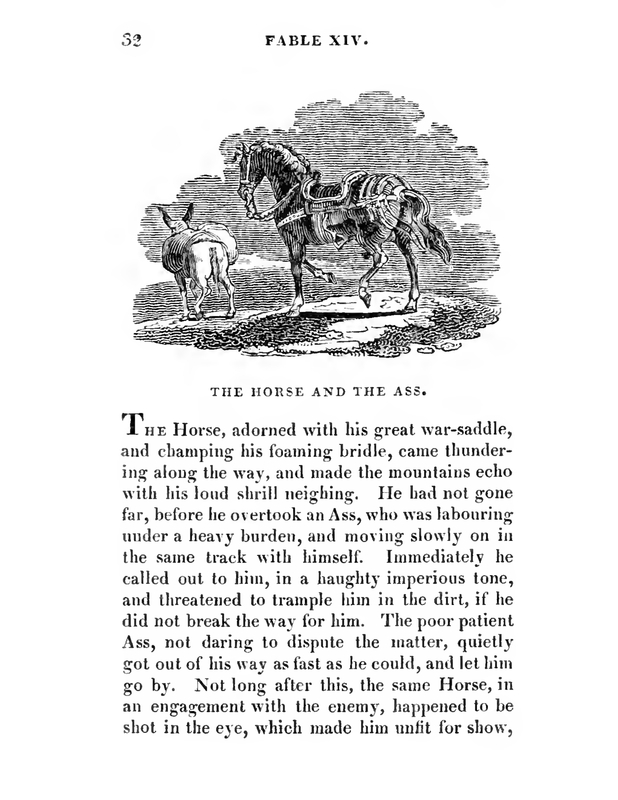
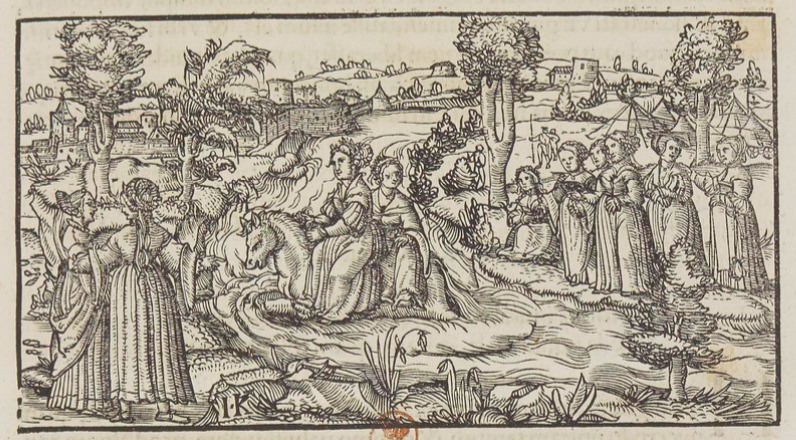
The two characters were on a mountain. In the middle of the illustration, a Horse,adorned with his great war-saddle and champing his foaming bridle,thundered forward. In front of him, an Ass was labouring under a heavy burden. The Horse had not intension to slow down as he approached the Ass.
Every four years a representative council of the Houyhnhnms meets in a large plain about twenty miles from the house where Gulliver was staying. They discuss the conditions of the different districts of the country. This includes anything that a district is lacking, including hay or oats, as well as the regulation of children. The same image appears in the 1843 Krabbe edition.
Three Indigenous Brazilians, a man, woman, and child, are shown under a tall tree with large fruit. The woman sits on a tree stump holding one of the fruits from the tree while the child stands nearby, also holding a large fruit. The man has placed one of the fruits on a nearby stump and stands bent over it.
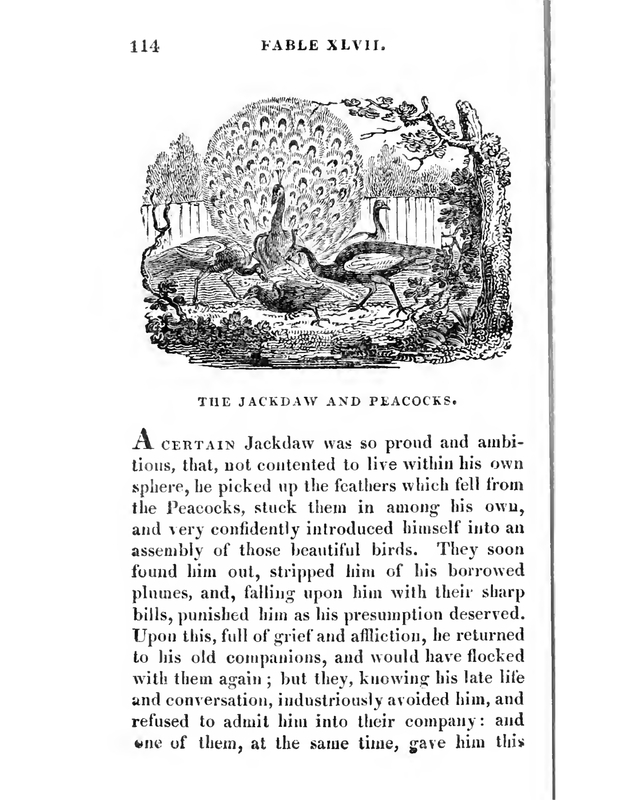
There are four peacocks standing around a jackdaw. The second peacock from the left is in the centre facing the viewer with its tail feathers up. The first peacock is facing the jackdaw, the third is facing slightly to the right of the image, and the fourth is facing the jackdaw. There are three stray feathers surrounding the jackdaw. There is a fence in the background and the surrounding area is trees.
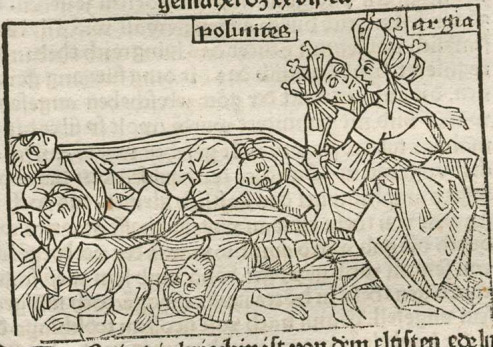
Argia, the daughter of King Adrastus of Argos is depicted on the right side of the engraving holding the body of her husband, king Polynices of Thebes. We know that these figures are Argia and Polynices as the creator engraved their names above their bodies. Boccaccio explains that Polynices had fought in a war against his brother Eteocles and died on the battlefield. Argia snuck herself onto the battlefield after the war to see her husband’s body. She is depicted holding his lifeless body and kissing him on the lips. Behind Polynices are the other men who had fought and died in this war.
In this image Mr. Donovan tells Mrs. Jennings that Lucy Steele and Edward Ferrars’ engagement had been announced and sent Fanny Dashwood into hysterics upon hearing the news. Mr. Donovan was the apothecary and Mrs. Jennings encountered him while visiting her daughter, Mrs. Palmer, who called Mr. Donovan because her newborn was ill. Mr. Donovan had been to see Fanny Dashwood earlier that day, and told Mrs. Jennings to pass on the news to Elinor and Marianne. This scene occurs in chapter 37. The characters are shown in the traditional regency style, as Mrs. Jennings wears regency style dresses with an empire waistline. She has a bonnet and a shawl wrapped around her shoulders. Mr. Donovan wears a waistcoat and tailcoat, with breeches and holds a top hat. Edward wears a waistcoat and tailcoat with breeches. The regency period dated to the early nineteenth century (1811-1820) when George, Prince of Wales, later George IV (r. 1820-1830), reigned as regent for his mentally ill father, King George III (r. 1760-1820). The regency period is associated with the rise of neoclassicism in art and fashion.
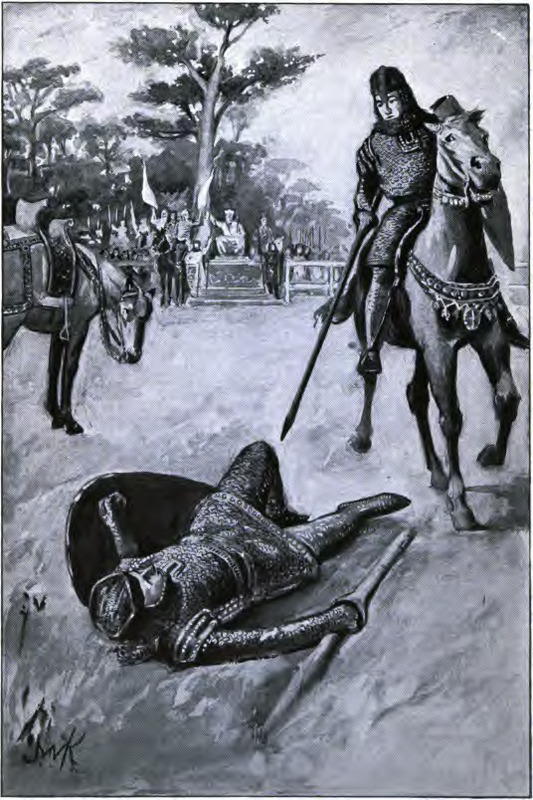
Due to the cruelty of the Infantes against their wives, the Cid’s daughters, the King has them fight six of the Cid’s knights in a trial by combat. Suero, the Infantes’ uncle, is included in this fight, and he fights Muno Ansures. Muno decisively defeats him, and forces Suero to verbally surrender to show that he has been vanquished.
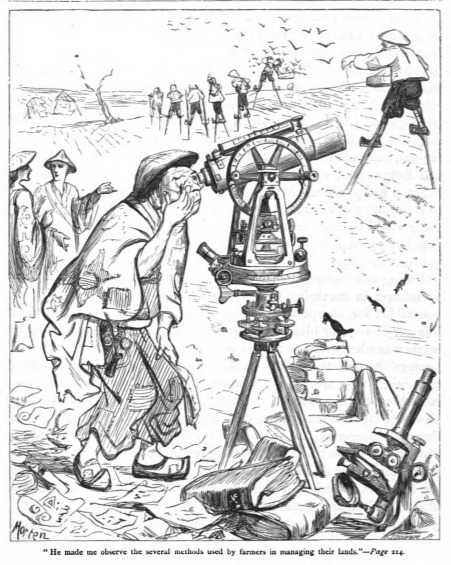
Gulliver visited the Academy of Balnibarbi, where scholars worked on the latest innovations. Here we see farmers coming up with new methods of planting using stilts. In the foreground we see a scholar looking through a telescope, using the stars to predict the best time for farming.
An Indigenous village is shown, full of fantastical creatures. In the center of the scene an Indigenous person speaks with two European men. A large hairy creature stands to the left of the three. In the foreground on the left an individual holding a bow emerges from a building. In the center another person lays on the ground with a horned, humanoid creature leaning over them. To the right two more individuals run from another of the horned creatures. There is a ship and a large creature in the water near the coast on the right, and further up the coast a person chases after a large winged creature. There are several structures in the background.
Here we see the Farmer from Brobdingnag just before discovering Gulliver. The farmer holds a scythe and stands in a field of wheat. Gulliver is seen in the foreground, running away from the giant. This image shows the height difference between Gulliver and the Giants on Brobdingnag.
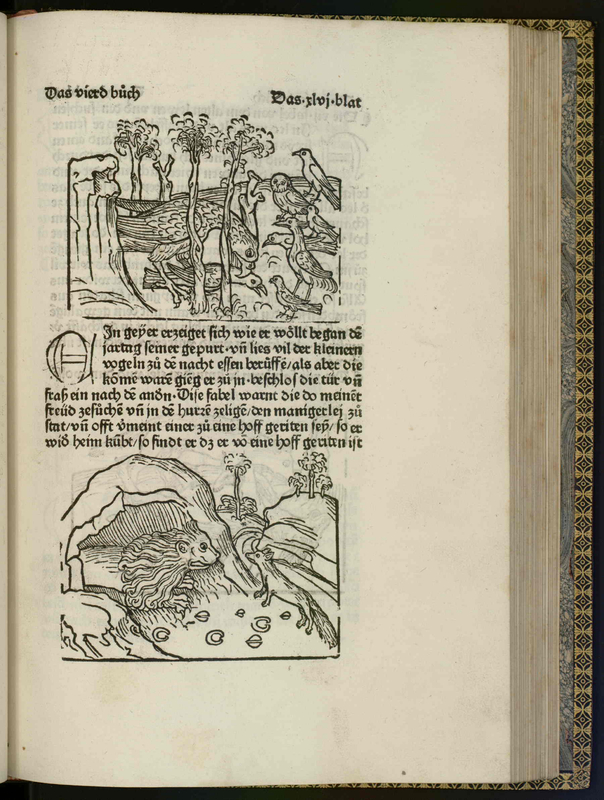
On the left side of the image there is a hedge hog at the entry of a cave. On the right side of the image there is a fox curiously looking at the hedge hog and the cave. Behind it there are hills with trees on top of them.
Celestina, Elicia, Sempronio, Areusa, and Pármeno (in clockwise order, starting from leftmost figure) are gathered around a table at Celestina’s house for dinner. While the two pairs of lovers dine, Celestina drinks her wine. Sempronio starts praising the beauty and virtue of Melibea, which enrages Elicia and causes her to become jealous. (She is standing with her back hunched over, and Sempronio has his left hand open, both of which signal an argument.) Celestina manages to calm her, and the two lovers reconcile. Lucrecia arrives shortly thereafter, and she tells Celestina that Melibea has asked to have her girdle returned. More importantly, Lucrecia informs Celestina that Melibea has an illness of the heart and has requested her presence.
After surviving the shipwreck, Gulliver swims to the shore on Lilliput where he passes out. He is discovered by the Lilliputians and they tie him up. When Gulliver wakes up, he finds his arms and legs tied to the ground, seen here. He is surrounded by Lilliputians, many of whom hold spears to defend themselves against Gulliver. The Lilliputians were one twelfth of Gulliver’s size. The landscape of Lilliput is visible in the background with the sea and the mountains.
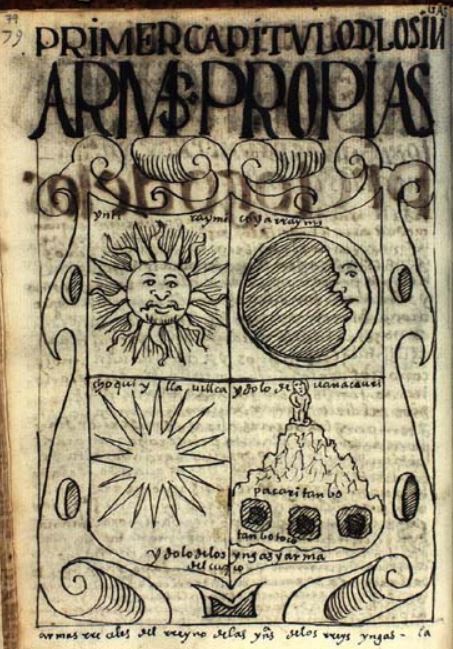
This illustration depicts the coat of arms of Cuzco. It represents the four symbols of the Incas. The script at the very bottom of the image reads, “armas reales del reyno de las yndias de los reys yngas” which translates to “royal arms of the kindgom of the Indies of the Inca Kings.” Above this inscription, there are words written at the base of the coat of arms which reads, “ydolo de los yngas y arma del cuzco” which translates to “idols of the Incas and coat of arms of Cuzco.” The top left symbol in the coat of arms depicts a sun and has the words “Ynti Raymi” written above it. This translates to “festival of the sun.” The top right symbol in the coat of arms depicts a moon which has the words “coya raymi” written above it, which means “festival of the queen.” The bottom left symbol is a star, which says “choqui ylla uillca” which means “sacred lightning” or “gold-flashing” which refers to Venus, the morning-star. The bottom right symbol is a reference to the idol Wanacauri or “uana cauri” as written in the illustration. The words “Pacari Tanbo” [Paqariq Tampu] are written on the mountain in the illustration, which, according to the author, is a cave where the first Inca emerged from. The author believes that the first Inca emerged from this cave and declared that the sun was his father, the moon was his mother, the morning-star is his sister, and Wanacauri is his idol, which is why all four are depicted in the coat of arms.
One wolf is sitting in its cave looking out seeing two men and another wolf run away from the den. One of the men has a large axe while the other is glancing back behind him down the hill. The man with the large axe also has a large knife in his pocket and is pointing in front of him.
Cloelia, a Roman virgin, is in the center of the photo riding a horse. The horse she rides is helping herself and other hostages to flee to safety from Porsenna, their captor, on the other side of the Tiber river. The women on either side of the river are other captive virgins, including children. The woman on the horse behind Cloelia is a fellow captive virgin.
Here we see Gulliver speaking with Pedro de Mendez, the captain of the ship that found Gulliver in New Holland. Pedro de Mendez asked Gulliver to explain his situation, however Gulliver remained quiet, wanting to return to his boat and get away from other people. Pedro de Mendez gave Gulliver food and a bed on the ship. Gulliver would not get undressed, and simply lay on top of the bed. Gulliver had planned to jump ship and swim back to his boat, however a crew member found out about his plan, and Gulliver was chained in the cabin. The same image appears in the 1839 Krabbe edition.
This illumination depicts the wives of the Minyans, who were companions to Jason. The wives of the Minyans had devised a plan to save their husbands from execution. They had gone into the jail cell where their husbands were kept, and quickly swapped clothing with them so that their husbands were dressed in womens clothing. The men walked out to freedom, and the wives took the place of their husbands in execution. Boccaccio wrote on these women to highlight their devotion to their husbands, and their courage for condemning themselves to save their loved ones.

![Comme les Sauuages rotisse[n]t leurs ennemis.](https://collections.cemvc.ca/files/large/efb95e42898bbb366be9dff1c6460aada221bc5a.jpg)

![[the meeting of the Houyhnhnms]](https://collections.cemvc.ca/files/large/54d611fcd68483aa71ff9cb62d2d0881b207a75a.jpg)
![[Indigenous Brazilian man, woman, and child under a tree]](https://collections.cemvc.ca/files/large/1c13ed200b2ef2ab7d3211ab13afb010709f6964.jpg)

![[Fantastical scene of an Indigenous village]](https://collections.cemvc.ca/files/large/28e09993ae7e9bd8618884882df90c44ec27ff84.jpg)
![[The Farmer giant from Brobdingnag and Gulliver]](https://collections.cemvc.ca/files/large/48374f641799f11ed7a7236bf89a82fcb6616dee.jpg)
![[Act IX – Celestina, Elicia, Sempronio, Areusa, and Pármeno Share a Meal]](https://collections.cemvc.ca/files/large/35f41c74b2285478b408428742d9d8a5b9274d71.jpg)
![[Gulliver wakes up on Lilliput, finding himself tied down]](https://collections.cemvc.ca/files/large/5b7f6535d5223fd810a007a8abdfa43f9b944794.jpg)
![[The Two Men and Wolves]](https://collections.cemvc.ca/files/large/12fcd9cf7cd5dadf9e1291035d939a7409979986.jpg)
![[Gulliver speaks with the captain of the ship]](https://collections.cemvc.ca/files/large/1d84e373f36e9f2d95d1de017cf58a26429bbb9b.jpg)