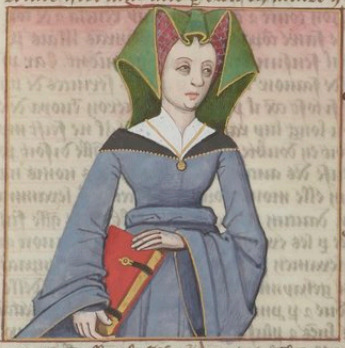
This illumination depicts a portrait of a woman named Pompeia Paulina, who was the wife of Lucius Annaeus Seneca. Seneca was the tutor of Emperor Nero, and when Seneca was wrongfully suspected of being involved in the Pisonian Conspiracy, he was forced to commit suicide. Pompeia Paulina was so devoted to her husband, that she attempted suicide along with him. She survived the attempt and lived out the rest of her days as a widow in honour of her husband.
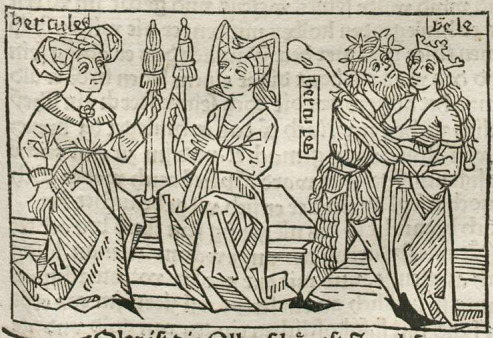
This engraving depicts the marriage between Iole, daughter of King Eurytus of Aetolia, and Hercules. The right side of the engraving illustrates Hercules embracing Iole with affection. Iole is not reciprocating the embrace. We know that these figures are Iole and Hercules as their names are engraved beside their bodies. Boccaccio explains that Iole is not in love with Hercules because he killed her father after he did not give Hercules permission to marry Iole. In order to seek her revenge on her husband for the murder of her father, Iole allowed Hercules to fall madly in love with her. By doing this, Iole was able to convince Hercules to do whatever she asked. She stripped him of his pride by getting him to dress as a woman and spin wool, which is depicted on the left side of the engraving. As Hercules is unrecognizable in women’s clothing, the creator engraved Hercules’ name above his head to differentiate between him and Iole.
This illustration (the publisher’s mark) depicts a galley with six rowers sailing on the water. The leftmost figure on the ship, an older bearded man, is directing the rowers. He has a pole-like object in his right hand, perhaps a cane, walking stick, or scepter of some sort. Directly above him, there is what looks like an angel playing a horn. The rightmost figure is also playing a horn; unlike the other horn player, however, he does not have wings, and as such is not intended to represent an angel. The publisher’s crest or emblem can be seen in the center of the ship’s hull. The main part of this emblem is shield-shaped and contains the letters ‘G – D – P’ for Galliot Du Pré. Emerging from the top of the shield is a patriarchal cross, a version of the Cross of Lorraine.
Two groups of Indigenous Brazilians prepare to engage in conflict. Members of both groups are armed with bows and arrows and clubs, and some carry shields. Several individuals blow into long instruments resembling a type of horn, and at least one person blows into a conch shell. On the ground in the space between the groups, two men fight. There are two structures visible in the background, one of which is on fire. This image is identical to one found on page 943 verso of Paris, 1575 (l’Huillier), and in Thevet’s Les Singularitez de la France Antarctique (page 73 verso of Paris, 1557 and page 73 verso of Paris, 1558).
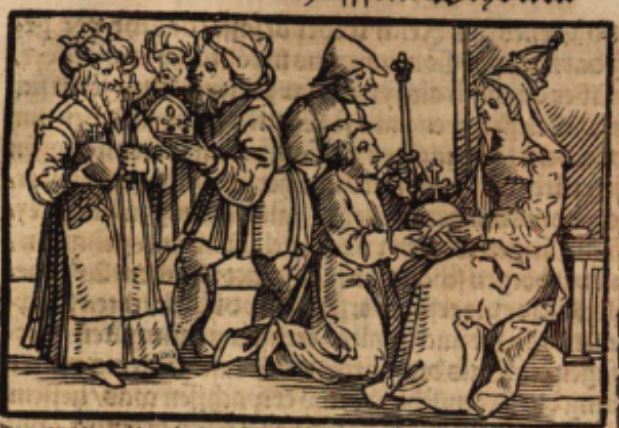
The right side of the engraving depicts Empress Irene of the Eastern Roman Empire sitting on her throne. There is a man kneeling in front of her presenting her with the globus cruciger to demonstrate her authority. The left side of the image depicts the pope crowning Charlemagne as emperor. The pope did not recognize Irene’s rule as she was a woman, which led him to coronate Charlemagne as emperor.
At the Council of the Houyhnhnms, the council discussed the possibility of exterminating yahoos. Some of the reasons for the possible extermination of the yahoos were that they drank directly from cow’s udders, trample on oats and wheat, and would kill and eat their cats. The same image appears in the 1843 Krabbe edition.
Here we see the Grand Academy of Lagado in Balnibarbi. Here scholars gather to work on problems and innovate. Gulliver visits the Academy and sees first-hand the experiment that the scholars are working on. The same image appears in the 1843 Krabbe edition.
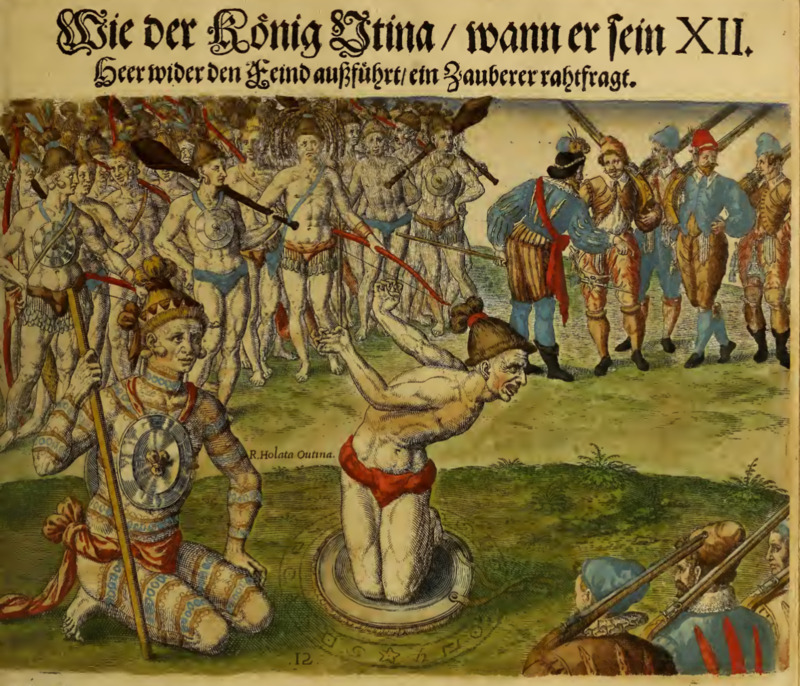
Two Indigenous men are shown in the foreground. One is on his knees on top of a disc on the ground, which is surrounded by symbols in the dirt. His upper body is twisted, bent at the midriff with his arms unnaturally stuck out behind him. The other man kneels beside him and watches him. This man has tattoos all over his body, he holds a wooden staff, and around his neck hangs a decorative plate. In the background a large group of Indigenous people stand and watch the two men. They all hold various weapons, including bows and arrows and clubs. To the right stands a group of colonists. This illustration is identical to the one found on page 59 of Frankfurt 1591, but colored.
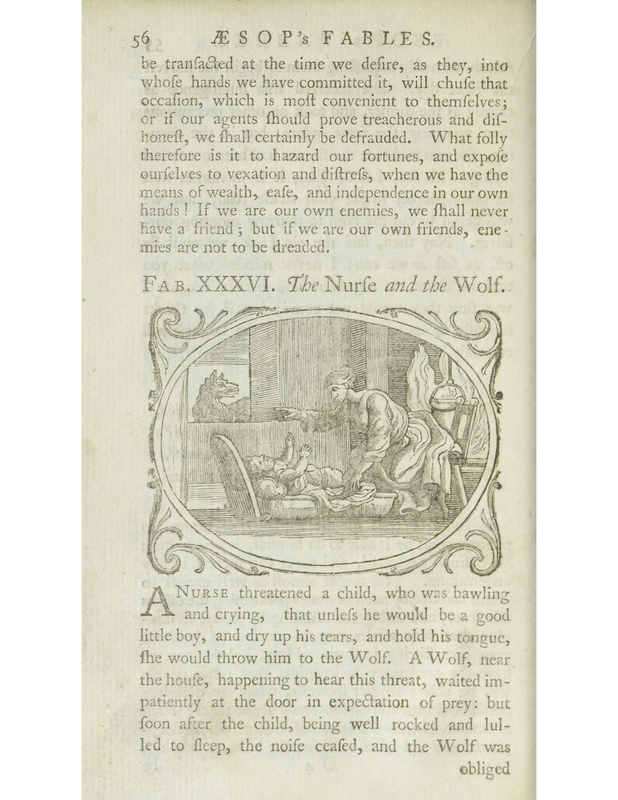
A woman sits on a chair on the right side of the image, hovering above a child on a small bed. She points outside to a wolf who is peeking through the window. She appears angry, while the child seems to be in distress, with their arms held in the air. In the background, a fire rolls with a large pot hanging above.
Here we see the Queen of Brobdingnag’s dwarf shaking an apple tree to drop apples on Gulliver. Gulliver was walking through the garden when the dwarf saw him and began to shake the tree, dropping apples on Gulliver to torment him. In the image, Gulliver is lying underneath four apples with only his head and arms sticking out. The dwarf shakes the tree. The same image appears in both the 1839 and 1843 Krabbe editions.
Joseph Sedley, in his dressing gown, stands at his dresser with one hand pressed to his temple, looking pained. In the background to his left is a table with a washbasin and a bottle on it.
Two groups of Indigenous Brazilians face each other in preparation for combat. All are nude, and members of both groups hold bows and arrows aimed at the opposing group.
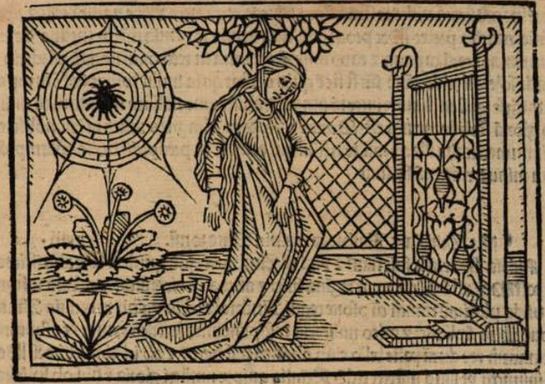
This engraving depicts Arachne hanging herself. There is a loom on the right side of the engraving and a net to the left of the loom. Boccaccio explains that Arachne is known by ancient writers as being the one who discovered the uses of woven wool and the first to make nets. Arachne became too confident in her wool work and challenged Minerva to a weaving competition. After the goddess had won, Arachne hung herself as depicted in the engraving. There is a spider on a spider-web on the left side of the engraving as Arachne is said to have been transformed into a spider after killing herself.
Amelia Sedley kneels by her father’s bedside, holding his hand while they pray together as he dies. Two other men, possibly the doctor and the butler, also stand in the room, but a few steps back from the bed next to a table with a candlestick.
Two Tupinambá people – a man and a woman – and a European man are shown. The woman has long hair twisted into two braids and is nude. She crouches on the ground with her hands over her face, seemingly in emotional distress. The European man sits in a hammock, also holding a hand over his face in a display of emotion. There is a bucket on the ground under the hammock. Behind the two, the Tupinambá man balances a bow and arrow in one hand and holds a knife against the end of the arrow in his other hand.
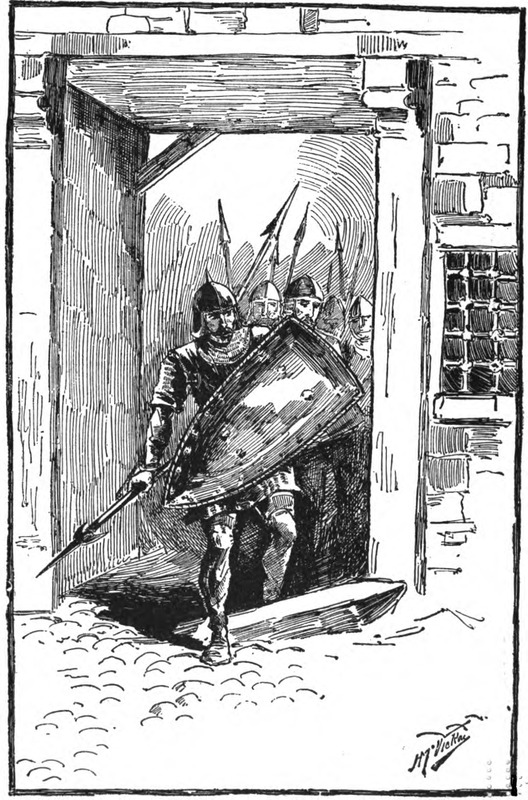
Prior to his death, the Cid had received a vision of St. Peter, who told him that once he died his body’s presence would cause the Valencians to win their battle against King Bucar. After he died, Valencia was indeed besieged by Bucar, and after several days of siege the inhabitants crept out of the city and fled to Castile while the army, under the command of Alvar Fañez and with the Cid’s body mounted on his horse, attacked Bucar’s army. They decisively defeated him, driving them back to their ships. Despite their victory the Spanish inhabitants still abandoned Valencia and left for Castile, as Valencia was deemed to be too indefensible.
Here we see the Queen of Brobdingnag’s dwarf tormenting Gulliver. The dwarf holds Gulliver between his fingers as Gulliver leans away from him. The dwarf wears a pointed cap with bells. The letter “J” is on his cap, as it is the first letter of the chapter. The same image appears in the 1839 Krabbe edition.
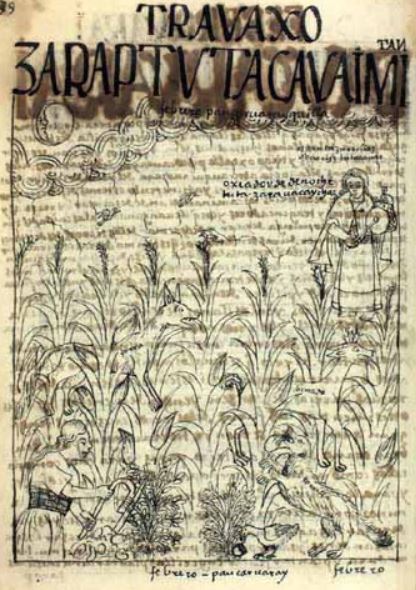
This image is reflected in the final chapter of Ayala’s chronicle where he provides a description of labours and festivals that occur in the rural areas of the Spanish colonial Andes during each month of the Inca calendar year. This image depicts the month of February, which was an important month for ensuring the safety of corn fields from hungry animals. There is an indigenous woman on the right side of the image standing behind the corn field holding a drum in her left hand and a stick to beat the drum with in her right. She is using the drum to scare animals away from the corn field at night. The moon in the top left corner reflects that it is night in the image. The writing above and beside the indigenous woman reads “espanta zurrillas de noche, oxeador de de noche, tuta zara uacaychac” [scares skunks at night, scouts and protects the corn at night]. In the corn field, there is an animal identified as a “zorra” [fox], “benado” [deer], and in the bottom right corner, a “zorrilla” [skunk]. There is an unidentified bird next to the skunk. There is an indigenous woman in the bottom left corner of the image harvesting the corn with an agricultural device in her hands. The caption at the bottom of the image reads “febrero, paucar uaray” [february, third month].
This illuminated image depicts Marpesia (also known as Martesia) and Lampedo, sister queens of the Amazons. They are wearing crowns to demonstrate their royal status. One sister is on the left side of the image and the other is on the right side. There are armed amazon women on the right side of the image in the background. The Amazon women are known to have lived their lives dedicated to war and military pursuits. Boccaccio explains that after all the Amazon women were all widowed, they took up arms to avenge their husbands, and continued to thrive off battle. Marpesia and Lampedo were elected by their fellow Amazons to become queens.

![[Publisher’s Mark (Galliot du Pré)]](https://collections.cemvc.ca/files/large/bb78dabaab59be8dec52a123704dd0880d299d13.jpg)
![Contenance des Sauuages devant que venir au co[m]bat.](https://collections.cemvc.ca/files/large/2fbbdc274ce01b40d7bc03b2a441461e14a5fee5.jpg)
![[a yahoo kills its cat while another drinks from the udder of a cow]](https://collections.cemvc.ca/files/large/fd1970eb834a3514e9f01f51e4f562a496057f8e.jpg)
![[the Grand Academy of Lagado]](https://collections.cemvc.ca/files/large/9f2b3aed2fb73bce6f8baeefea76e4b5c92d82bf.jpg)
![[The Queen of Brobdingnag’s dwarf shakes a tree, causing fruit to drop on Gulliver]](https://collections.cemvc.ca/files/large/27de0e4697519ec0f75b10178ebedadefc00d2fc.jpg)
![[Mr. Joseph’s Hangover]](https://collections.cemvc.ca/files/large/bfb7d731d67baf8c629d4788e0956dee7d9de059.jpg)
![[Conflict between Indigenous Brazilians]](https://collections.cemvc.ca/files/large/204b85fcfaf644019d449325a2e27a3d9658c377.jpg)

![[Amelia at her Father’s Bedside]](https://collections.cemvc.ca/files/large/9dc3c99d51858f4fffa6196f78c3621ea3fecbb7.jpg)
![[A European man and a Tupinambá woman weep into their hands while a Tupinambá man stands behind them]](https://collections.cemvc.ca/files/large/b85b8e58bd7c03cb5c0d302e4b8d45d99c5e0edd.jpg)

![[The Queen of Brobdingnag’s dwarf torments Gulliver]](https://collections.cemvc.ca/files/large/ad8dfd317c8cf5e1cfefd5e07de002f7b3fb839d.jpg)