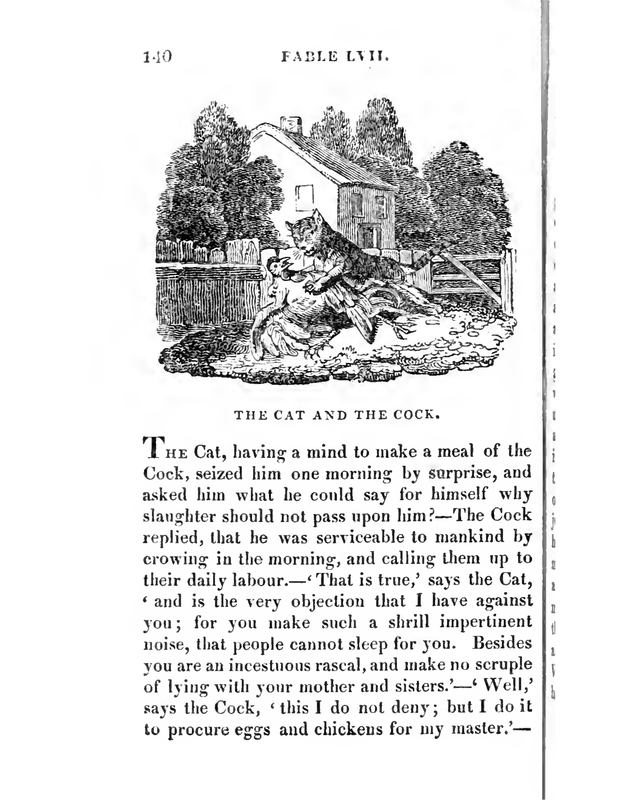
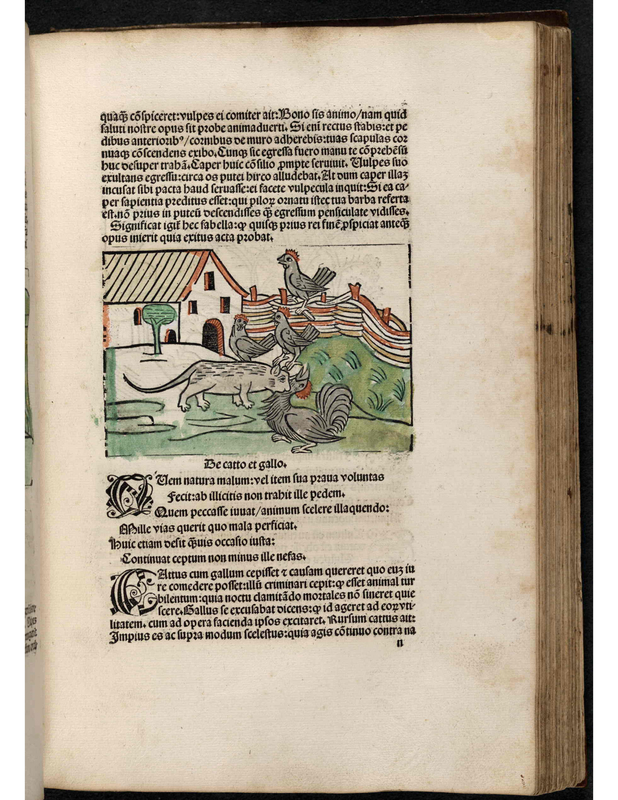
In a pen made from a wooden fence, in the centre of the image, a striped cat leans over a cock. The cat has a menacing expression and has its paw, with claws outstretched over the cock's breast. The cock has a fearful expression, beak slightly agape. In the background, there is a house between a bunch of leafy trees.
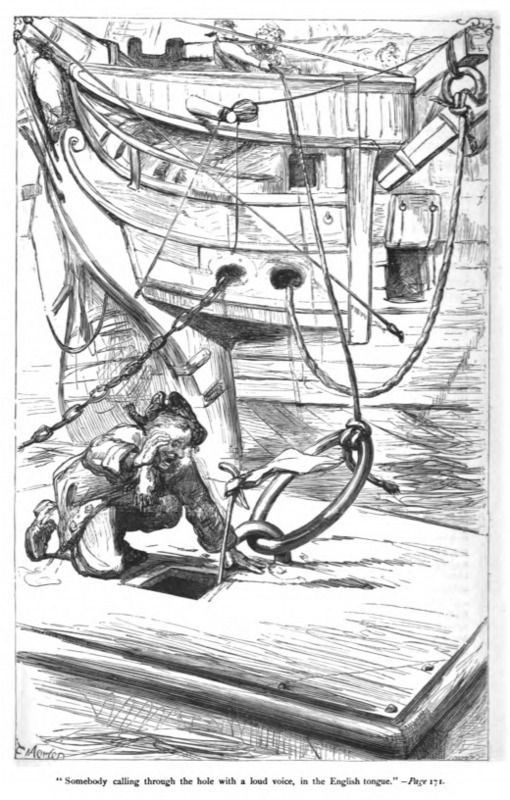
After being dropped by the eagle over the water, a ship saw Gulliver’s house floating in the ocean. Gulliver made a white flag and flew it through the sunroof to signal that he needed help. A team of crew members went out to Gulliver’s house and pulled it back to the ship and rescued Gulliver. Here we see a crew member kneeling on top of the house speaking to Gulliver.
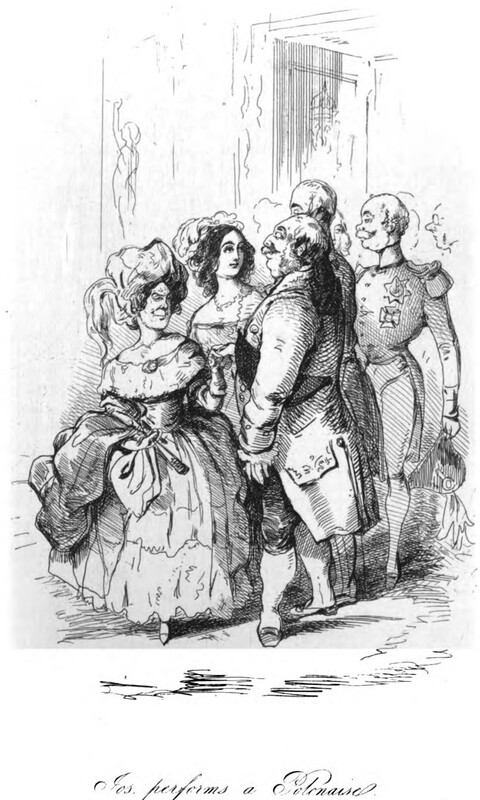
Joseph Sedley stands opposite the Countess of Schlüsselback, holding her hand as they walk a Polonaise at a Court-ball. Behind them in the row are Major Dobbin and Amelia Osborne, with another decorated officer in the pair after. Below the illustration is printed in cursive its title, “Jos performs a Polonaise”.
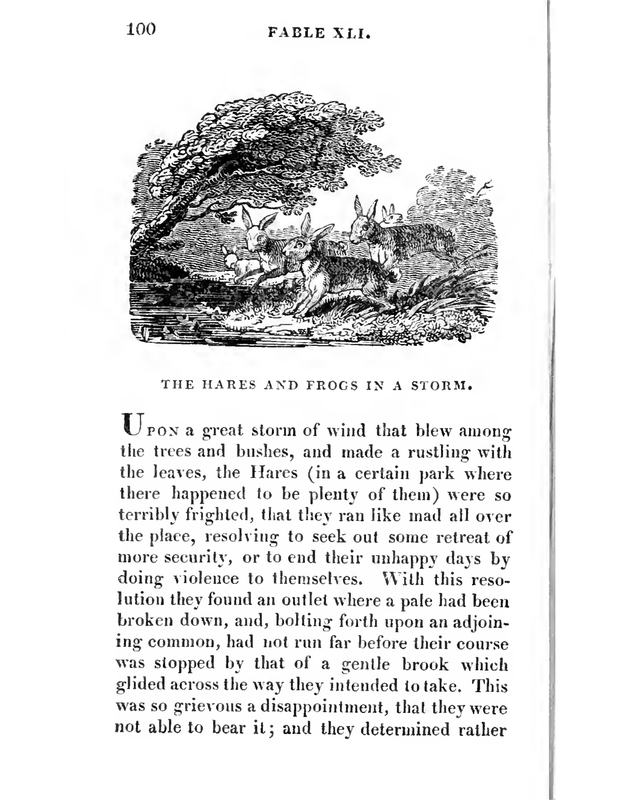
There is a small section of water in the bottom left corner, and the rest of the space is land. On the land there are five hares. Three of the hares are in the foreground, and they are jumping towards the left. One hare in the background is facing away from the viewer and is on the left side of the three main hares, and the other background hare is just a head above the main hare that is farthest to the right. There is a tree extending out of the left of the image and reaching halfway over the top. The rest of the ground is covered in reeds. There are many frogs in the water, though it is hard to tell how many.
A tall man is seated on a chair, holding his hat in his hands. A young girl, also holding a hat, leans against his side. In the top right of the image is the letter B, from “Becky”.
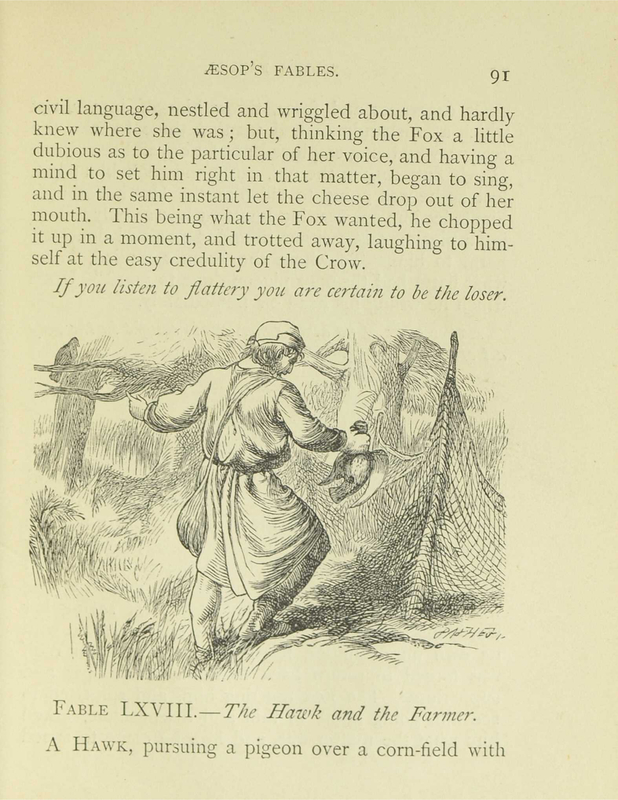
In a forest, a man carries a hawk by its neck in his right hand. He stands next to a net structure, pointing in the opposite direction with his left hand.
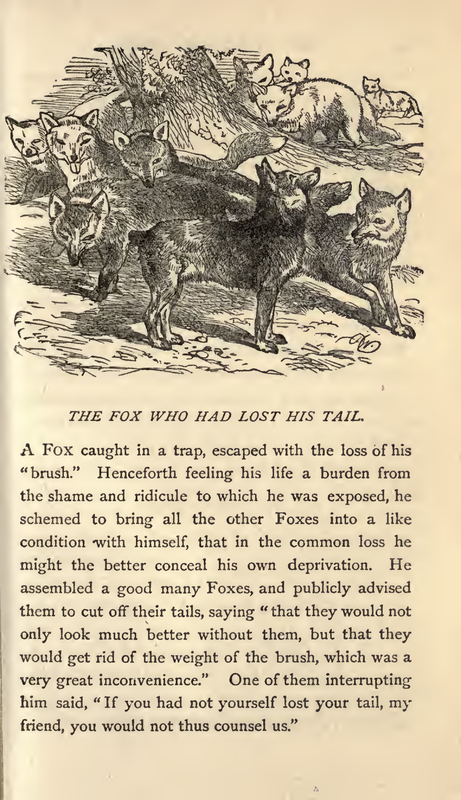
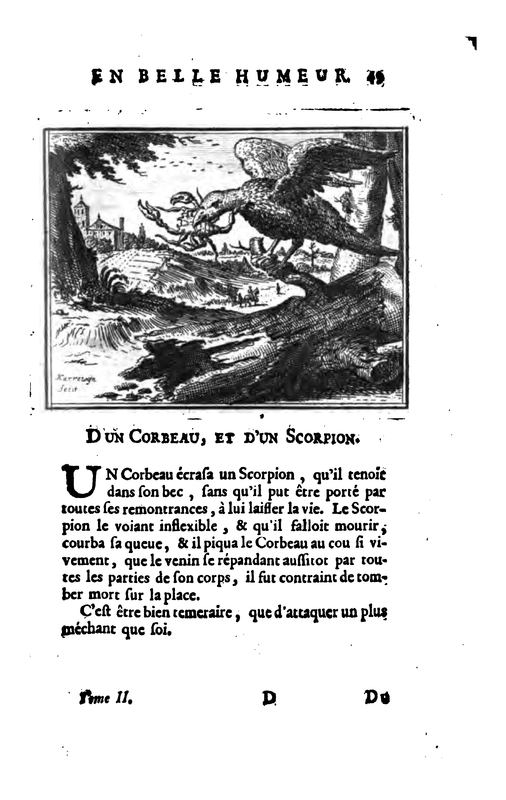
A Raven crushes a Scorpion, which it holds in its beak, without being able to kill it. The Scorpion, seeing that he was unyielding, and that he had to die, bent his tail, and stung the Raven in the neck so sharply, that the venom spread at once through all the parts of his body, and he was forced to fall dead on the spot.
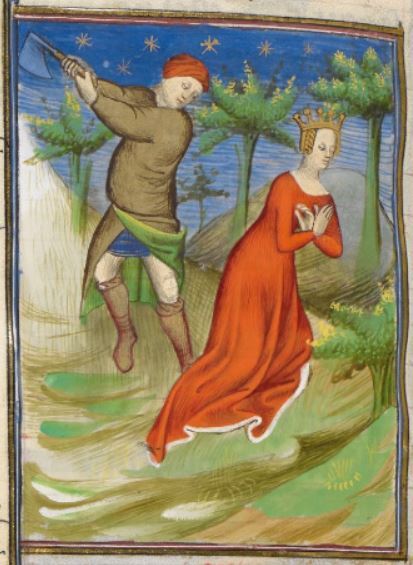
This illumination depicts Mariamne, the queen of Judaea, standing on the right side of the image wearing a red dress and a crown. Mariamne was renowned for her incredible beauty, and for having been the wife of the jealous King Herod. Boccaccio explains that King Herod was so jealous and protective of Mariamne, that he did not want her to outlive him. He devised a plan for someone to murder Mariamne if he were to die before her, so that no one else could have her. The assassin is illustrated on the left side of the image swinging an axe above his head to kill Mariamne.
A figure in a winged cap sits with his elbows on his knees and his face in his hands. A sword with a thick, rounded handle leans against the wall, point up. Above his head is the moon, which forms the letter O from “Our”.
A sleeping giant lies on the ground, large enough that only his head and the upper half of his torso are visible in the picture. A man in glasses stands on the giant’s chest, observing his face. Another man, carrying a mallet, leans against the side of the giant’s face. Above their heads is the letter A, from “After”.
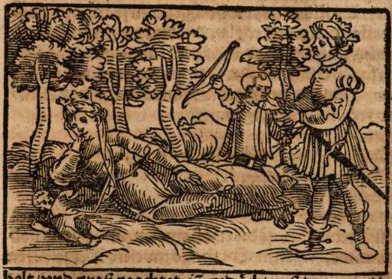
This engraving depicts Lavinia, the wife of Aeneas and queen of Laurentum, hiding in the forest with her baby in fear of her stepson, Ascanius. She is illustrated lying on her side and resting her head into her hand as she looks down at her child. Boccaccio explains that after Aeneas died, Lavinia fled to the forest as she was afraid that her stepson would kill her and her newborn son, Silvius. Lavinia was wrong, and Ascanius voluntarily gave the kingdom of Laurentum back to her and helped raise Silvius. Ascanius is pictured on the right side of the engraving with his hand touching a young Silvius’ face with brotherly affection. Silvius is illustrated holding a bow in the air.
This engraving depicts Arachne killing herself by means of hanging. We know that this is Arachne as her name is engraved beside her body. There is a loom on the right-hand side of the engraving and a net to the left of the loom. Boccaccio explains in his story that Arachne is known by ancient writers as being the one who discovered the uses of woven wool and the first to make nets. Arachne became too confident in her wool work and challenged Minerva to a weaving competition. After the goddess had won, Arachne hung herself, as depicted in the engraving. There is a spider on a spider-web on the left side of the engraving, as Arachne is said to have been transformed into a spider after this event.
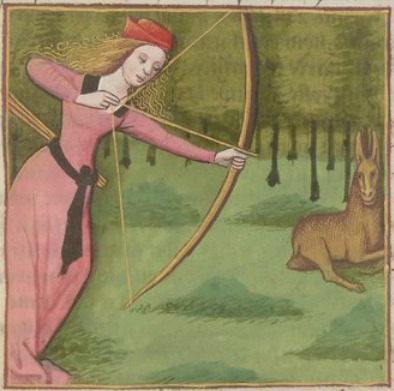
This illumination depicts Zenobia, the queen of Palmyra, with a bow and arrow about to shoot an animal. Boccaccio explains that Zenobia was famous for her bravery, as she had cast aside womanly duties and practices and was incredibly strong and independent. She often spent her time in the woods where she would hunt animals. Zenobia had such strength that when her husband went to war, she hid under her armor and fought alongside him.
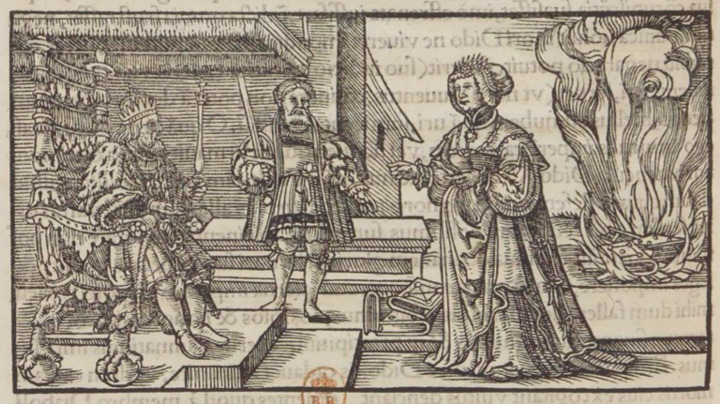
Nicaula was a woman born from barbarousness, but grew to be extremely respectable. She was known for her especially good conduct. When Nicaula heard of the wisdom of Solomon, she decided to cross the known world to meet him. The image depicts Nicaula meeting Solomon, before asking him many difficult questions and offering him splended gifts. Books burn in the background as Nicaula said that Solomons vast knowledge was a gift from God rather than something gained from study.
After the ship arrived in Lisbon, the captain Don Pedro covered Gulliver in his cloak and brought Gulliver to his house. Don Pedro covered Gulliver in his cloak so that no one would notice him. Gulliver asked Don Pedro not to tell anyone to about what he told him about the Houyhnhnms for fear that he would be considered insane, and subjected to the Spanish Inquisition. The same image appears in the 1839 Krabbe edition.
A lion and wolf stand on a rock calling out into the distance while a bunny and two foxes run past them. There is a single standing tree in the background and a couple hills of grass.
Sempronio (figure with his sword raised) and Pármeno (rightmost figure) go to Celestina’s house. They ask Celestina (figure lying on the ground) to fulfill her promise and give them a share of the gold chain given to her by Calisto. She refuses, making up countless excuses and lies in order to escape her obligation. Sempronio draws his sword and threatens her, but she refuses to forfeit part of her reward and calls on Elicia (figure between Sempronio and Pármeno) for help. Sempronio begins striking her, and both she and Elicia scream in horror, calling for the alguacil’s men (the soldiers in the left panel of the illustration). Sempronio and Pármeno hear the men approaching the door and flee upstairs to the third storey. Realizing they have no other recourse for escape, they jump from the window.
Here we see Gulliver sitting at a table reading a book. The image appears at the beginning of chapter twelve, where he reflects on writing his book. The book Gulliver is holding is likely an early edition of the book he wrote. His daughter is seen over his shoulder. The same image appears in the 1839 Krabbe edition.
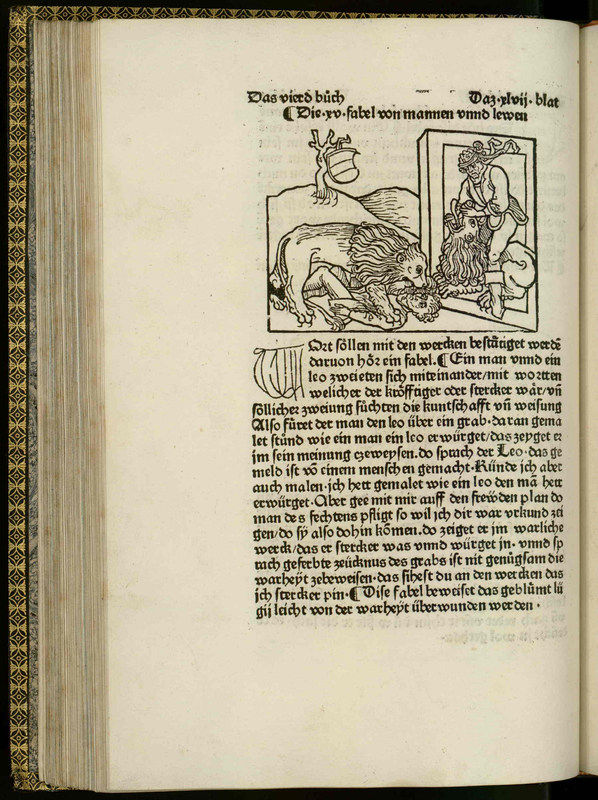
On the left side, there is a shield hanging on a tree. Below that there is a lion attacking a human. On the right side, there is a man fighting a lion in a box.

![[Vanity Fair Chapter LV Inhabited Initial]](https://collections.cemvc.ca/files/large/edcf19a8924666f674f25c30f70682e820bc64c2.jpg)
![[Vanity Fair Vol. II Chapter XLVI Inhabited Initial]](https://collections.cemvc.ca/files/large/d0273d091818285d24b40f549773b6439a621ded.jpg)
![[Vanity Fair Volume II. Chapter XVI Inhabited Initial, A]](https://collections.cemvc.ca/files/large/f4c823763112264c678c143b7da40facb10047ec.jpg)
![[Arachne Hangs Herself After a Weaving Competition with Minerva]](https://collections.cemvc.ca/files/large/ba883edae75cfca968988a4a349e56df83a0aa90.jpg)
![[Gulliver’s arrival in Lisbon]](https://collections.cemvc.ca/files/large/af4508773ea9d2cc25e523d439307fcdd067d4e3.jpg)

![[The Lion and Wolf]](https://collections.cemvc.ca/files/large/eb19b9e70d16b9b2971499f70f62627ca142509c.jpg)
![[Act XII (Second Illustration) – The Alguacil’s Men Knock on the Door as Sempronio Murders Celestina]](https://collections.cemvc.ca/files/large/10da9959864aa8b81ad2d047b45d9ae84d3db23f.jpg)
![[Gulliver reading in England]](https://collections.cemvc.ca/files/large/74d7ad9f6717df37cc630b61b635b430802fb953.jpg)