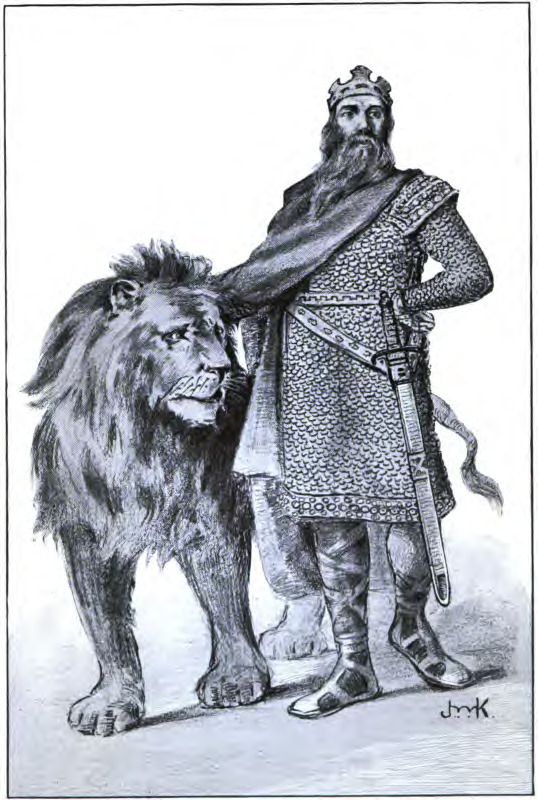
The Cid takes control of a lion which escaped from its keepers. It broke into the palace and came into the room where he was sleeping, and upon waking up the lion instantly and miraculously obeyed him. This incident led to strife with his sons-in-law the Infantes, as they fled out of fear when the lion came in while others did not. The Cid did not fault them for this, but their shame cause them to resent him.
A group of Indigenous Tupinambá people is shown preparing to execute a captive man. The captive man is restrained by a rope tied around his waist, with two men holding either end of the rope, and his hand is raised in a gesture of protest against his impending death. Another man swings a club above the head of the captive. To the left a man lays on the ground with a woman kneeling next to him. To the right, a man stands holding a bow with one hand and gesturing with the other. A crowd of Indigenous people holding bows stands in the background.
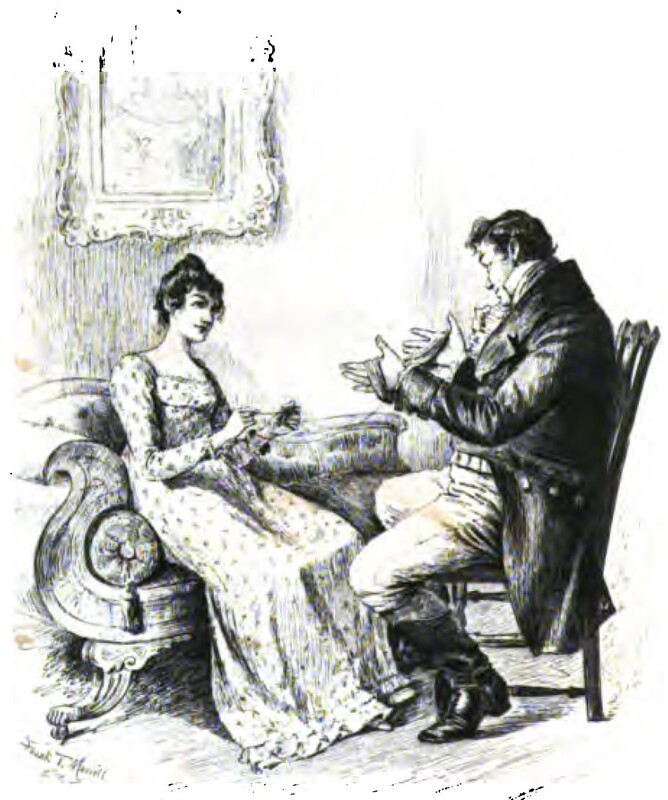
The image depicts a scene from Chapter IV in which Joseph Sedley is helping Rebecca Sharp make a green silk purse. Rebecca Sharp is seated on a lounge chaise holding a string which winds around the hands of Joseph Sedley, who is seated opposite her on a wooden chair. A faded portrait hangs on the wall behind the chaise.
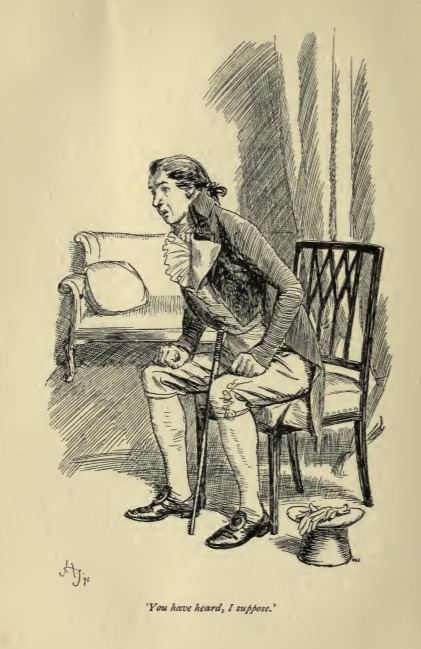
In this image John Dashwood visits Elinor and Marianne at Mrs. Jenning’s London home. He came to call on them the day after the news of Edward Ferrars’ engagement to Lucy Steele was announced. He was distressed at this news, seen here by his body language. This scene occurs in chapter 37. The characters are shown in the traditional regency style. John Dashwood wears a waistcoat and tailcoat with breeches and a cravat. His top hat and gloves are sitting on the floor next to him, and his walking stick leans on his knee. The regency period dated to the early nineteenth century (1811-1820) when George, Prince of Wales, later George IV (r. 1820-1830), reigned as regent for his mentally ill father, King George III (r. 1760-1820). The regency period is associated with the rise of neoclassicism in art and fashion.
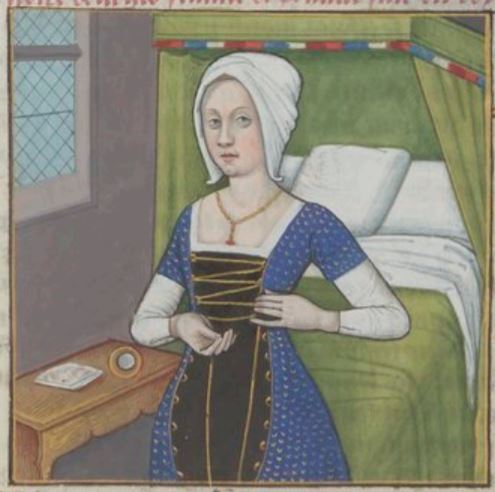
This illumination depicts a portrait of a woman named Argia, who was the wife of Polynices of Thebes. After Polynices was defeated in a battle against his brother, Eteocles, he was left unburied and left without a proper burial. Argia, mourning the loss of her husband, snuck herself onto the enemy's battlefield to find her husband’s body to cremate him. She risked her life doing so, and Boccaccio wrote on her as he believed this to be worthy of remembrance.
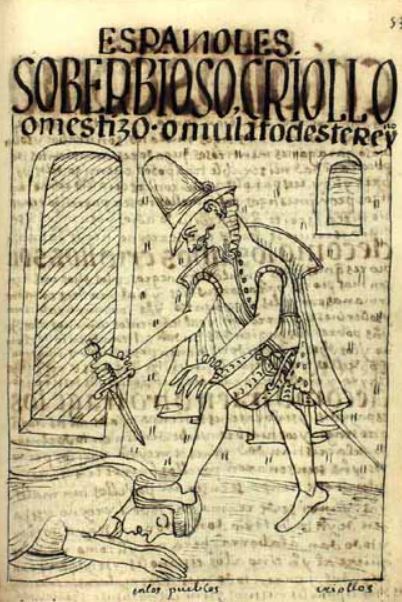
This image is illustrated in a chapter that discusses and criticizes the government and society in Spanish conquered Peru. This image depicts a Criollo man dressed in Spanish attire pressing hit foot on the head of a native man lying on the ground. He is also holding a knife over his head. The author criticizes the Criollo men and women, claiming that they are wicked and assault and rob indigenous peoples while they travel on highways. The caption at the bottom of the image reads, “en los pueblos” [in the pueblos].
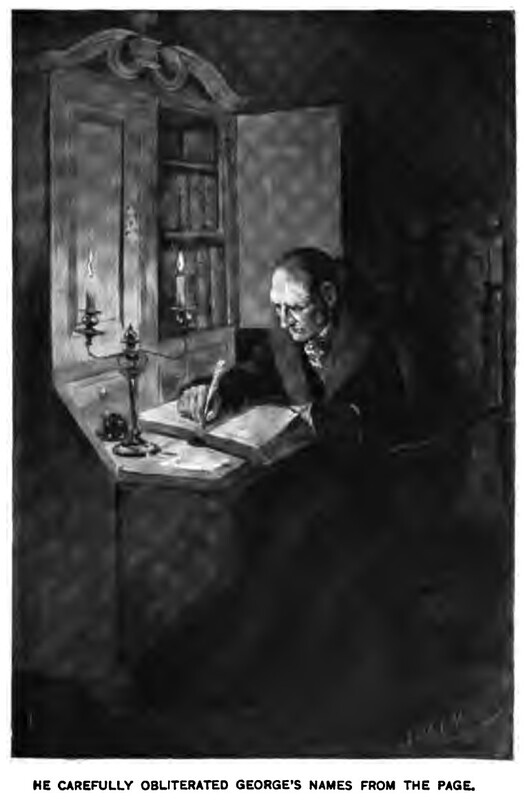
The image depicts a scene from page 223, in which John Osborne removes his son George from the family Bible after his unapproved marriage to Amelia Sedley. John Osborne is depicted sitting at a desk, holding a pen with which he is blacking out George‘s names from the open Bible. On the desk is a candelabra with two lit candles, and one of the doors is open to reveal three shelves of books.
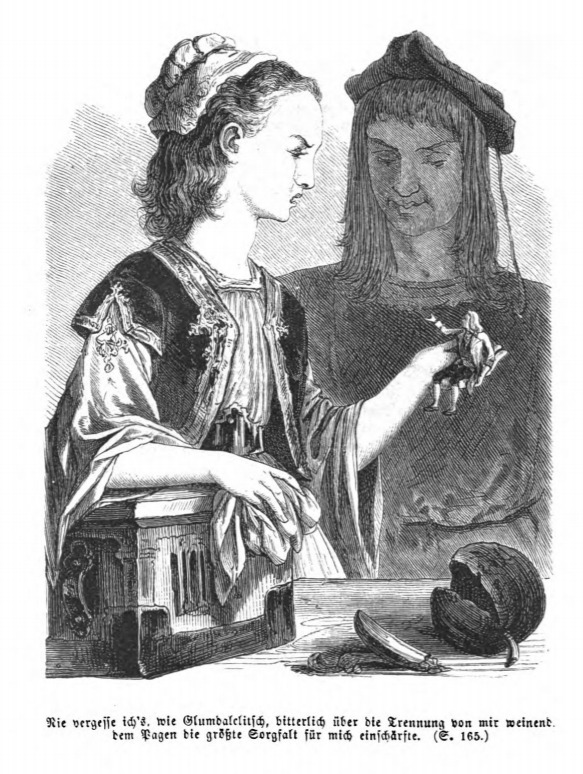
Glumdalclitch holds Gulliver in her hand, with her arm resting on Gulliver’s house. She says goodbye to Gulliver before he goes on a walk with a royal page. This scene occurs when Gulliver and Glumdalclitch accompany the King and Queen of Brobdingnag to the country. The party stopped near the water and Gulliver wanted to visit the ocean, however, Glumdalclitch was ill and could not take him. This was the last time Gulliver saw Glumdalclitch, as his house was picked up by an eagle and dropped over the water.
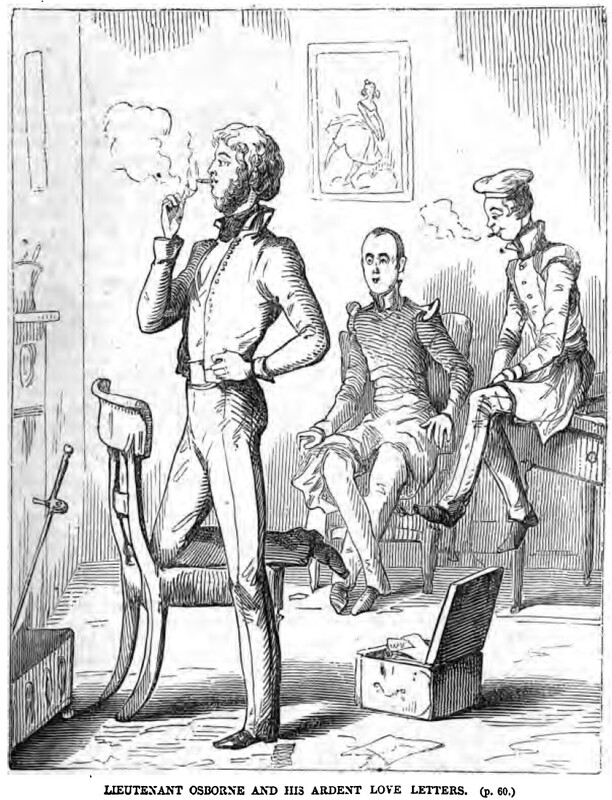
George Osborne stands facing the fireplace with one leg resting on a wooden chair, smoking a cigar which he has lit using a love letter. At the base of the chair is an open chest, filled with letters from Amelia Sedley. Two other officers are seated in the background. One is sitting on the edge of the desk, also smoking. The other is Dobbin, seated in an armchair over which a portrait of a woman hangs, looking startled. Below the illustration is printed its title and location in the story, “LIEUTENANT OSBONE AND HIS ARDENT LOVE-LETTERS. (p. 60.)".
Here we see Gulliver sitting in front of the King of Brobdingnag’s cavalry. Gulliver is seated on a table with the back to the viewer. He faces four men riding horses, two of whom have spears. All the men have facial hair and wear pointed caps. There are several other rows of cavalry men in the background. The same image appears in the 1839 Krabbe edition.
Here we see the custom of stepping on a crucifix to renounce Christianity in Japan. This was a way of rejecting European colonization and influence in Japan. The only European permitted to trade in Japan were the Dutch. Luggnagg and Japan were political allies and so the King of Luggnagg requested Japan grant Gulliver passage to Europe, and to absolve Gulliver from performing this ritual.
After the ship arrived in Lisbon, the captain Don Pedro covered Gulliver in his cloak and brought Gulliver to his house. Don Pedro covered Gulliver in his cloak so that no one would notice him. Gulliver asked Don Pedro not to tell anyone to about what he told him about the Houyhnhnms for fear that he would be considered insane, and subjected to the Spanish Inquisition. The same image appears in the 1843 Krabbe edition.
This engraving depicts Soaemias, a Greek woman, sitting in the middle of a meeting of the Roman senate with her son, Emperor Elagabalus. They are depicted sitting in a circle, with everyone looking at Elagabalus, who is illustrated wearing a crown and holding a scepter. Elagabalus would not have become emperor without his mother’s help, so he granted her the ability to have authority and did nothing without her consent. This image is highly significant as she was, as Boccaccio explains, the first woman to have a seat among the Roman senate and discuss her opinions and views on what must be done. The left side of the engraving depicts Soaemias kissing a man to represent her life as a prostitute before becoming mother to the emperor.
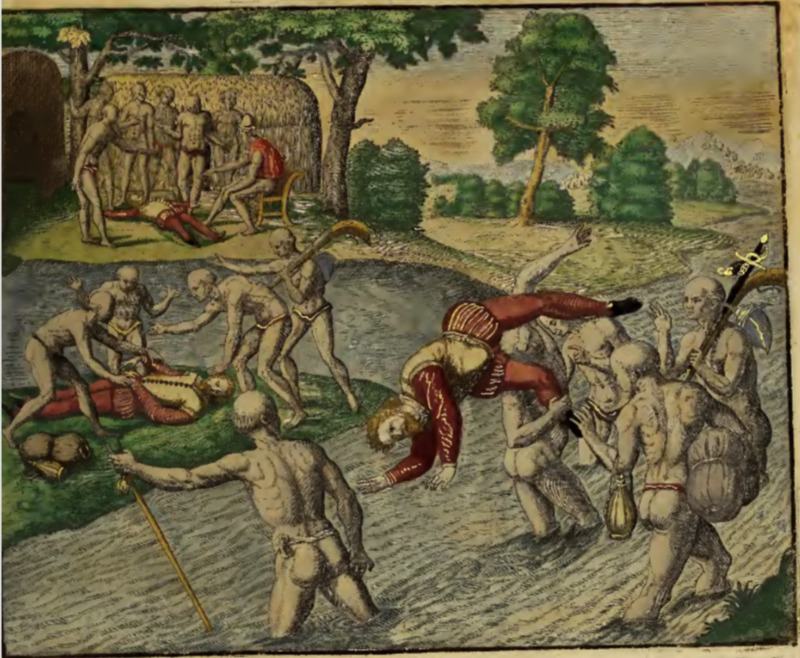
A group of Indigenous men stand knee-deep in a river. One of the men carries a Spanish man over his shoulders and throws him into the water. Another of the men holds the musket and helmet of the Spaniard. On the far bank, four Indigenous men are now gathered around the Spanish man who lies on the ground, deceased. In the background there are two structures. The group of Indigenous men stands in front of them, gesturing at the deceased Spanish man who lies on the ground at their feet. This image is identical to one found on page 165 of Frankfurt, 1594, but colored.
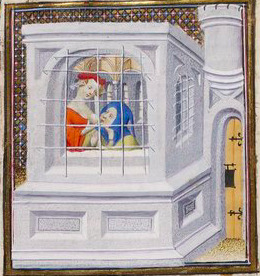
A Roman woman of low status is represented in her heroic act with her mother. Her name is unknown, but she gained immense respect from her community. When her mother was condemned to death for an unknown reason, she was placed in jail to starve to death. Her daughter was allowed to visit her but only without any food or drink on her. When the guards noticed that the mother was not withering away from starvation as they suspected she would, they began to spy on the daughter's visits. As it turned out, the daughter, who had very recently given birth, was breastfeeding her mother during her visits. She was saving her life by feeding her in the only way she could. It was decided that both women were deserving of honor and great awards for this commendable act. In the image, the young woman, wearing a red gown, breastfeeds her mother in the prison cell.
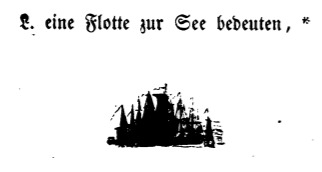
Here we see the letter “L” with a castle. The letter “L” using a method of coding developed by scholars at the Grand Academy on Balnibarbi signifies the phrase “fleet at sea”. This image comes in a description of a conspiracy found by a professor from the Grand Academy on Balnibarbi. This conspiracy is thought to be an allusion to the trial of Francis Atterbury, the bishop of Rochester for allegedly plotting with the Jacobites. Atterbury was charged with treason in 1722 and was exiled to France. The same image appears in the 1843 Krabbe edition.
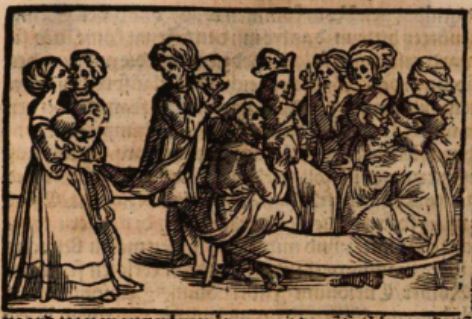
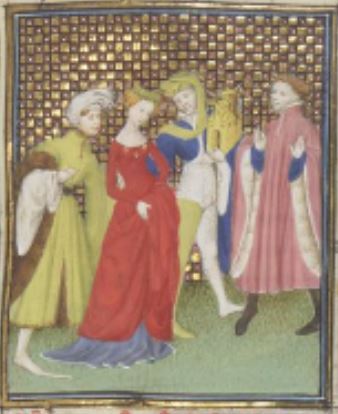
This illumination depicts the young woman named Megullia Dotata on the left side of the image wearing a red dress as she is being given away for marriage. The two figures standing beside her appear to be her mother and father. Megullia Dotata is known for having a dowry so massive that it was unheard of during her time. Her father is depicted giving the dowry to her new husband who is standing on the right of the image.
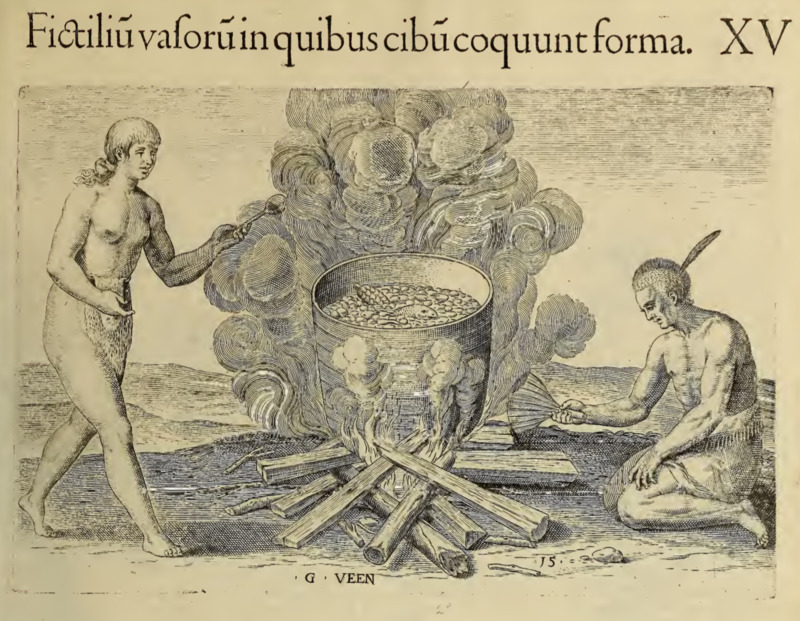
An Indigenous man and woman cook food in a large earthen pot over a fire. The woman holds a ladle, and the man kneels on the ground and fans the flames under the pot. Inside the pot a fish is identifiable, amongst other foods. Both individuals wear a fringed garment tied around their waist, and the man has a single feather in his hair.

![[A group of Tupinambá people take a man captive]](https://collections.cemvc.ca/files/large/db6c2d3e6011066db8097aeb8d8ff48489ea7564.jpg)
![[The cavalry of Brobdingnag]](https://collections.cemvc.ca/files/large/f8297d67cd663713f9dd8c2d817e53826fc02db9.jpg)
![[Lord Gaunt’s Children]](https://collections.cemvc.ca/files/large/5aeddbe4b92f6bd1ec48a0603576e349180dd945.jpg)
![[The custom of stepping on a crucifix]](https://collections.cemvc.ca/files/large/e0c31aa9218b4a7bee183ce1b4b4a7483f9f58a4.jpg)

![[Gulliver’s arrival in Lisbon]](https://collections.cemvc.ca/files/large/1e9b95a70d79b32f12ebb8f27686e0f7475d6897.jpg)

![[Vanity Fair Chapter XLII Inhabited Initial]](https://collections.cemvc.ca/files/large/58b10afbf6bb06585e0883e7d371c927ac72c8c6.jpg)