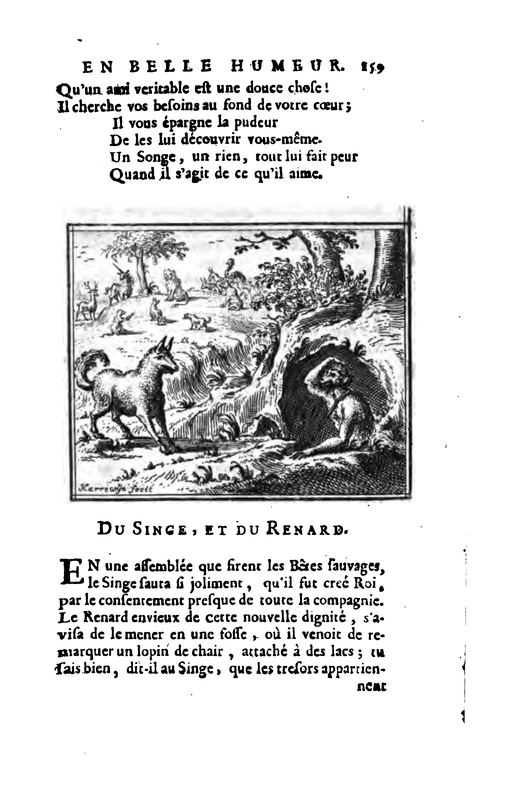
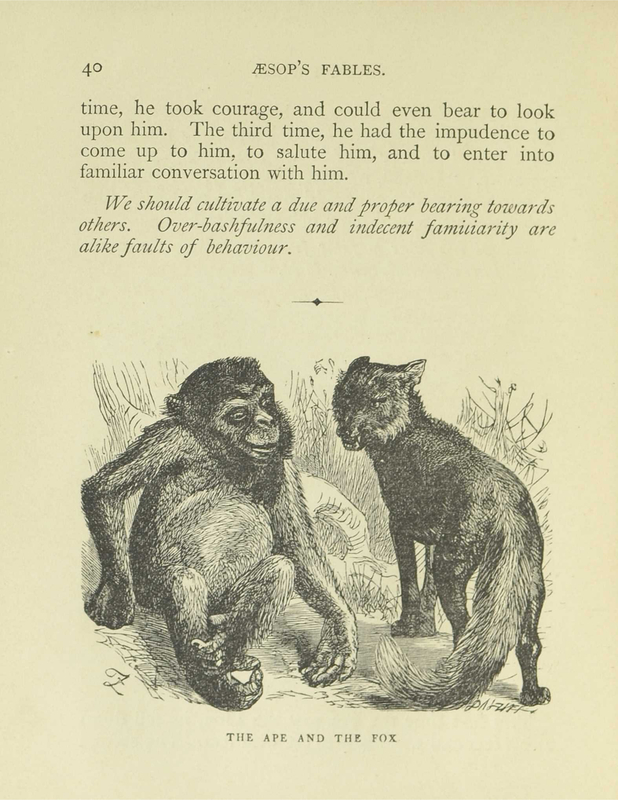
At a meeting of the animals, to elect a new ruler, the monkey was asked to dance. He did this so well that the animals elected him as their king. The fox did not vote for the monkey and was very disgusted by the election of an unworthy ruler. One day he found a trap with a bit of meat in it. He hurried to the king monkey and told him he found a rich treasure. The greedy Monkey followed the fox to the trap, and as soon as he saw the meat he grabbed it, only to be caught in the trap. The fox laughed and said: "You pretend to be our king but cannot even take care of yourself." Shortly after another election was held.
This image contains two scenes from Gulliver’s time as a captive at the castle in Lilliput. On the left, we see Gulliver speaking to the Emperor. The Emperor of Lilliput climbed down from the tower and threw himself onto his horse, startling the horse. The horse reared however the Emperor was a skilled horseman and stayed on the horse. Gulliver bows to the Emperor, seen in front of Gulliver with a cape blowing in the wind. On the right side we see Gulliver holding a Lilliputian and holds a knife in his hand. The guards were shooting arrows at Gulliver while he ate, and Gulliver pick one up in retaliation and threatened him with his knife.
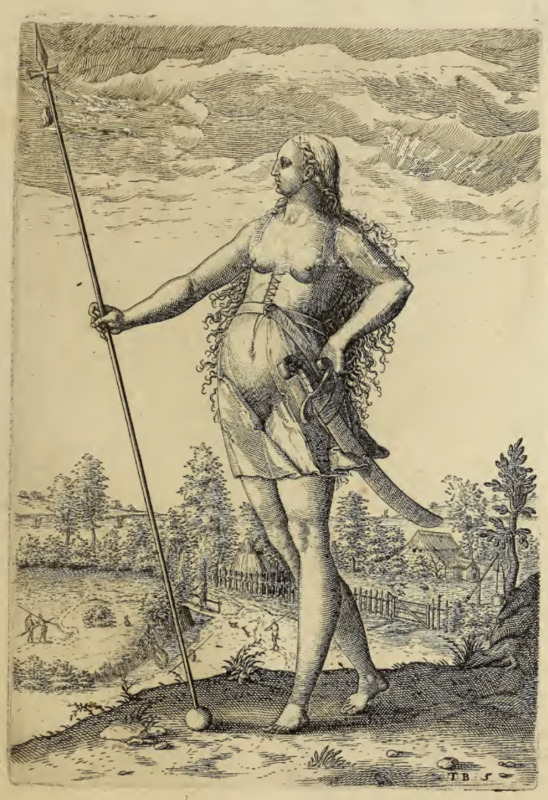
An Indigenous woman is shown from the front. She carries a spear with a ball on the end in her right hand. She wears a belted tunic that is open chested and laces under the breasts. A sword with a curved blade hangs from the belt around her waist. This woman is described as belonging to an Indigenous group that lived near the Picts. The Picts were an Indigenous group who lived in Britain long before the author’s time. Images of Picts were included in this book so that readers could compare their customs to those of the Indigenous people living in Virginia.
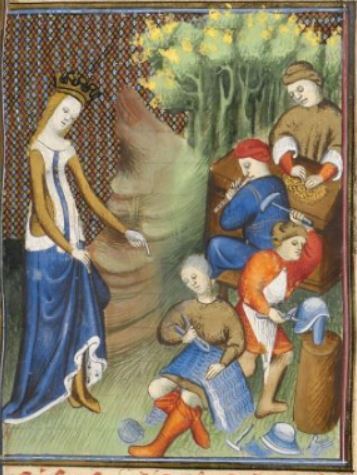
This illumination depicts the goddess Minerva standing on the left side of the image. The people in front of Minerva represents the inventions and discoveries Minerva introduced to the world. There is one man wearing a blue tunic and a red head garb playing a flute, and another man beside him creating iron weapons, which are both creations of Minerva. There is a person sitting on the ground who is spinning wool with their fingers, which is something Minerva discovered and showed men how to do. There is a man sitting at a desk at the back of the image who appears to be counting objects, which would signify Minerva’s discovery of numbers,
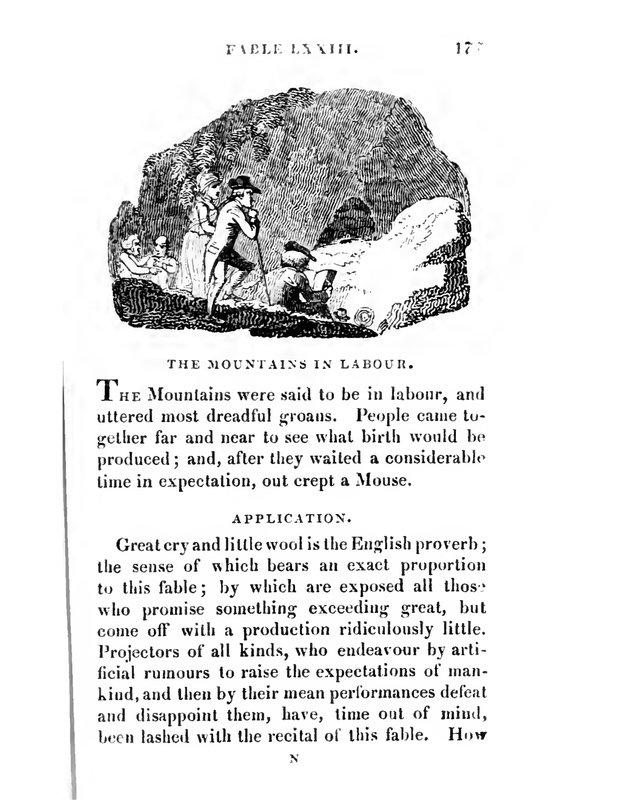
Several people gather at the base of a mountain. One person sits down with a book. Two people stand behind them, one wears what seems to be a head covering and a skirt and the other has a hat, trousers, and some sort of tool with a long handle. Two more figures sit in the background, they make hand gestures and they look at each other, as if in conversation. On the right-hand side of the image, there is a mountain. At the base of the mountain, there is a small hole with what appears to be a mouse inside of it.
Here we see a collage of several Laputan scholars working. Some work on astronomy, while another plays music. This image appears at the beginning of chapter four, with the letter “A” in the top corner because the first word of the chapter is “although”.
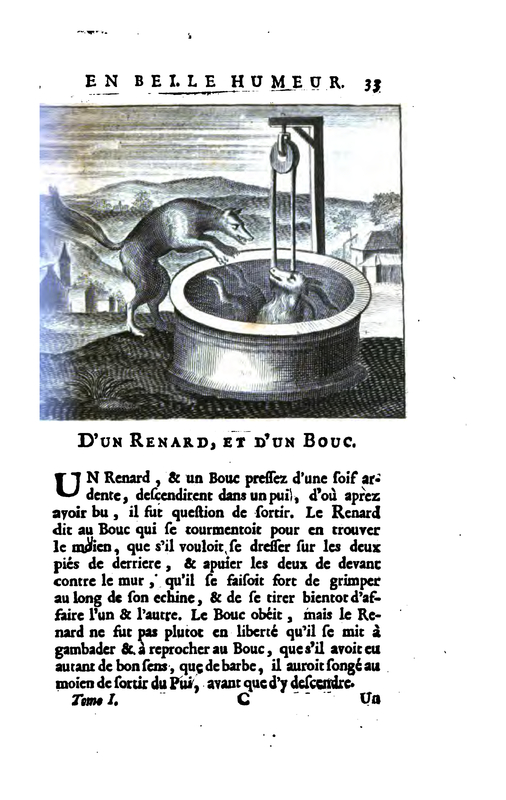
The majority of the image is a large well with a pulli attached to it. Inside the well there is a goat falling down, and reaching for help. Outside the well there is a fox reaching his hand inside the well. In the vast distance there are houses and a mountain range with trees.
Here we see one of the inflated bladders used by Flappers on Laputa. These bladders were filled with peas or pebbles and were used to communicate. Laputan scholars would become so involved in their work they could not speak, hear, or see what was in front of them. It was the role of the Flapper to tap the scholar gently on either the mouth, ear, or eyes to communicate information to them, and distract them from their work. In this image we see the bladder with astronomical and musical motifs, and the stick that it was attached to. The Flapper would stand or walk behind the scholar and carry the bladder, often holding the bladder over the shoulder of the scholar. The same image appears in the 1843 Krabbe edition.
Gulliver’s master explained various aspects of the Yahoos that lived in the Country of the Houyhnhnms. He told Gulliver that when a foreign female yahoo approached, she would be surrounded by other female yahoos who would examine her and speak with her, often expressing their contempt or disdain. The same image appears in the 1839 Krabbe edition.
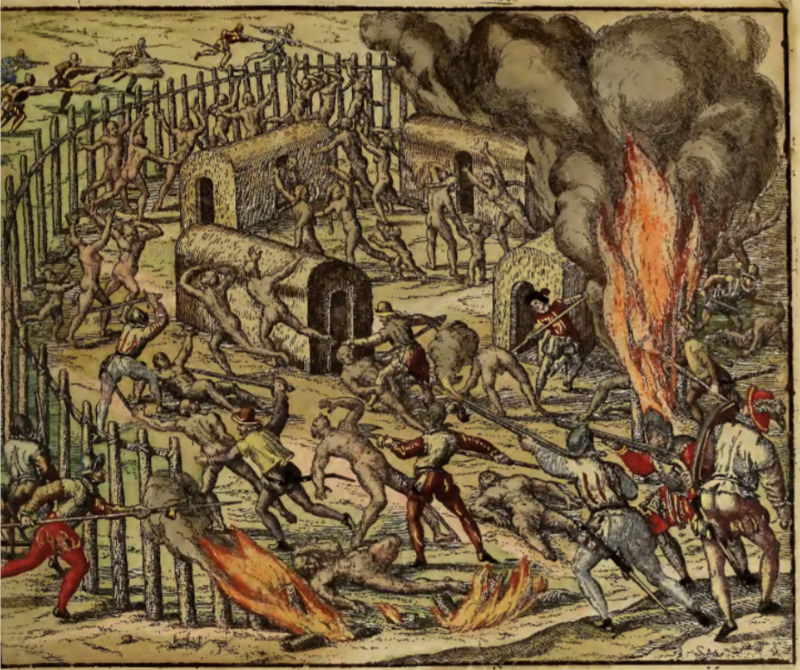
A group of Spanish soldiers attack an Indigenous village, killing the inhabitants with swords, spears, and muskets, and setting fire to the village. The Spaniards have surrounded the village and attack from all side with their assorted weapons. The Indigenous men, women and children are trapped in the village, several have already been killed and those alive have no escape. The fire, set against the fence encircling the village, is burning around the fence and has caught two of the four dwelling that make up the village. This image is identical to one found on page 183 of Frankfurt, 1594, but colored.
Here we have an ape or orangutang sitting on the left side of the image with its left arm outstretched and looking intrigued at the sight of a fox on the right of the image. It appears to glance at the tail of the fox almost as if it is about to reach out and touch the tail. The fox on the other hand looks very unimpressed as it is baring its teeth at the ape. The setting is appeared to be a clearing with some foliage surrounding the two animals.
After Areusa gets information from Sosia about the encounters between Calisto and Melibea, she and Elicia pay Centurio a visit. He acts arrogantly at first, but Areusa pretends that she is still upset with him, causing him to become submissive. She then asks him to avenge the deaths of Pármeno, Sempronio, and Celestina by murdering Calisto. He agrees, but he immediately tries to find some way of escaping his duty. He decides to send Thraso and his companions to fulfill this promise.
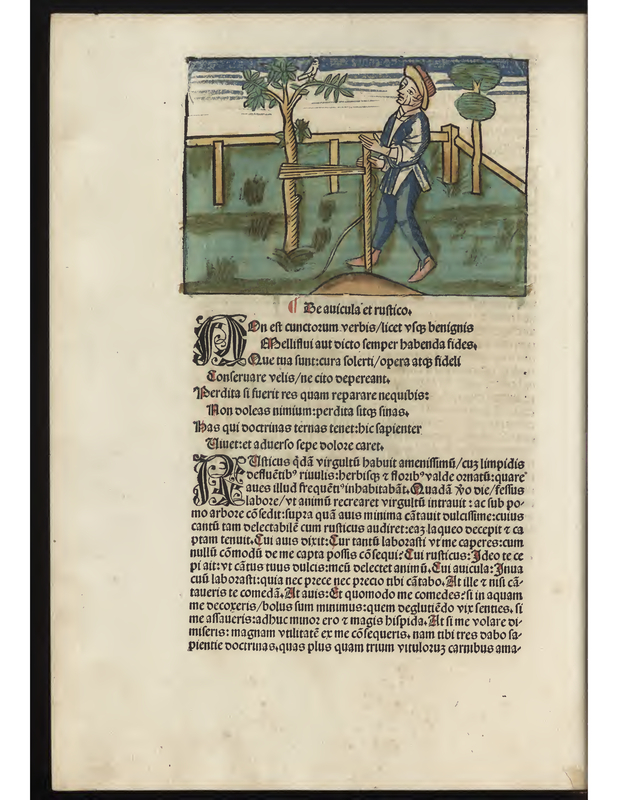
A farmer is outside on his farm putting a pole in the ground. He is wearing basic clothes and what appears to be a straw hat. There is a fence and trees in the background.
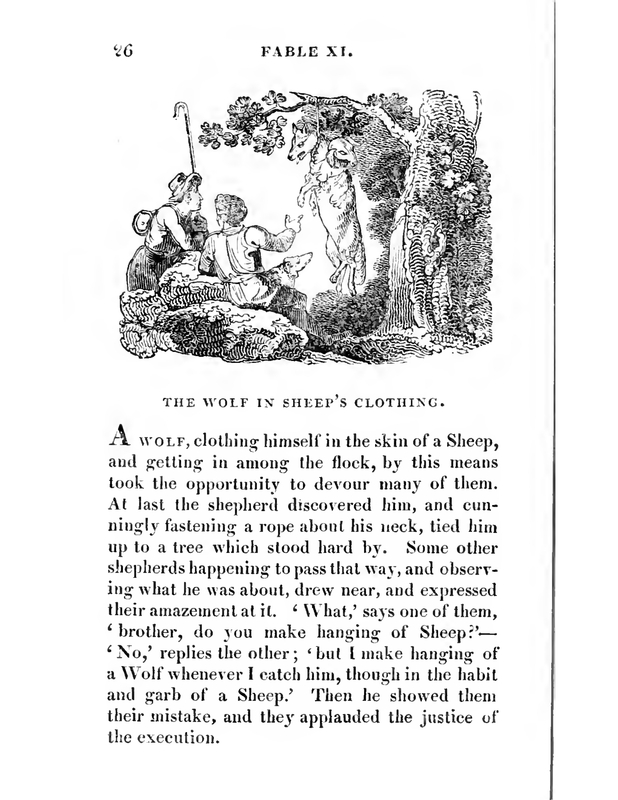
On the left of the illustration was two shepherds sitting on a rock. One of them was accompanied by their sheep pointing towards the opposite direction while the one on the left was holding a crook. They were laughing at the wolf hung from the tree. The wolf was wear the skin of a sheep with his real face exposed.
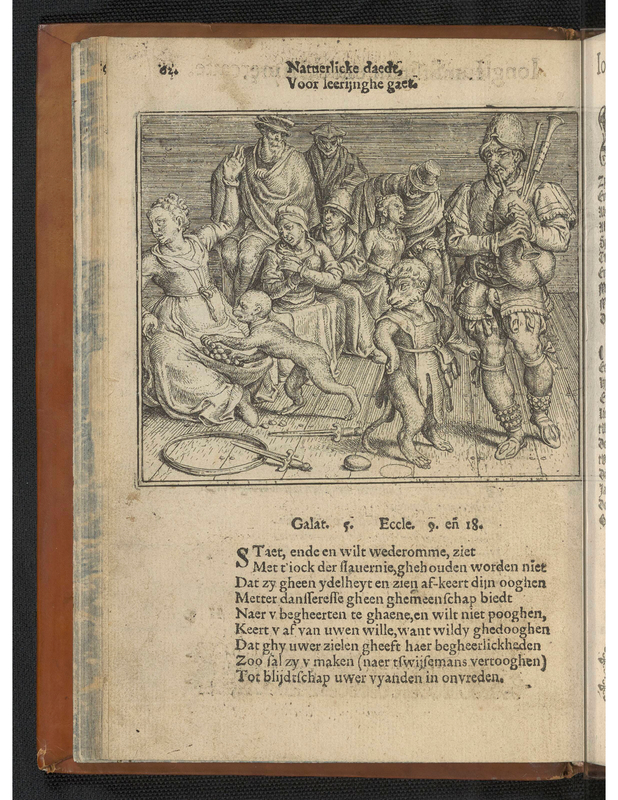
In a room sit three women and a man. Three men stand behind those sitting. In front of those seated, monkeys stand. A man stands playing the bagpipes. The woman sitting furthest left, raises a hand as a monkey reaches out a handful of grapes.
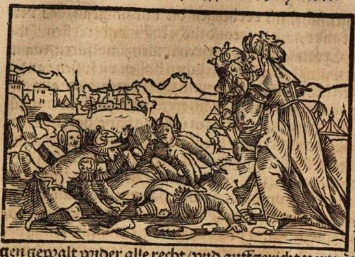
Argia, the daughter of King Adrastus of Argos, is depicted on the right side of the engraving holding the dead body of her husband, King Polynices of Thebes. Boccaccio explains that Polynices had fought in a war against his brother Eteocles and died on the battlefield. Argia snuck herself onto the battlefield after the war to see her husband’s body. She is depicted holding up his lifeless body and hugging it. The left side of the image depicts the other men who had fought and died in this war. There is one man who is presumably wounded and is crawling on his hands and knees. There is a camp with tents set up in the background on the right side and the city of Thebes on the left. Boccaccio believes her to be praiseworthy as it took courage to risk her life in order to find her husband on the battlefield.
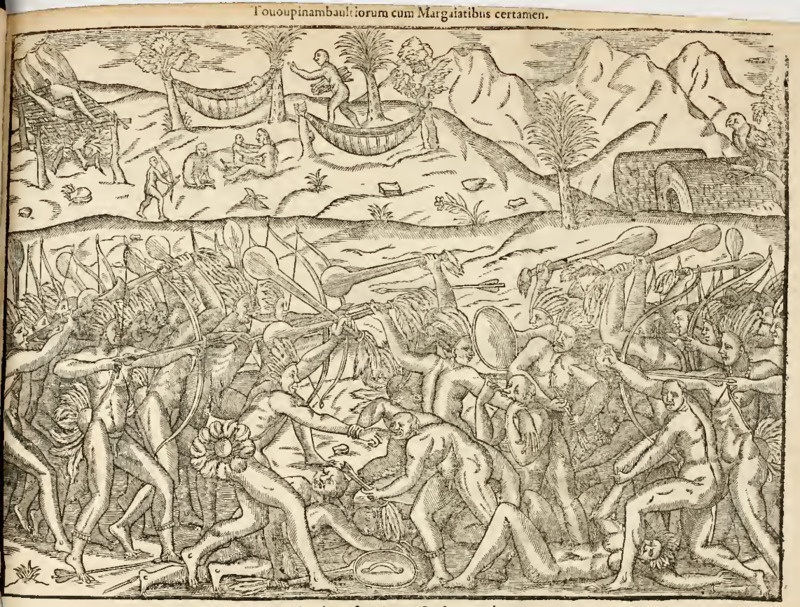
Two groups of Indigenous people are shown engaged in conflict. Individuals on both sides wield a combination of bows and arrows and clubs as weapons. A few people also carry small shields. Members of both groups wear feathered headdresses and feathered adornments slung around their shoulders and hanging at their backs. In the background behind the warring groups there is an Indigenous village with several people going about their lives. There are two long structures on the right and two hammocks strung between trees. One person lounges in a hammock, another carries firewood. A woman sits on the ground with a child while another child carrying a small bow walks nearby. A monkey also sits near the group. To the left, a rack with several human limbs on it sits over a large fire.
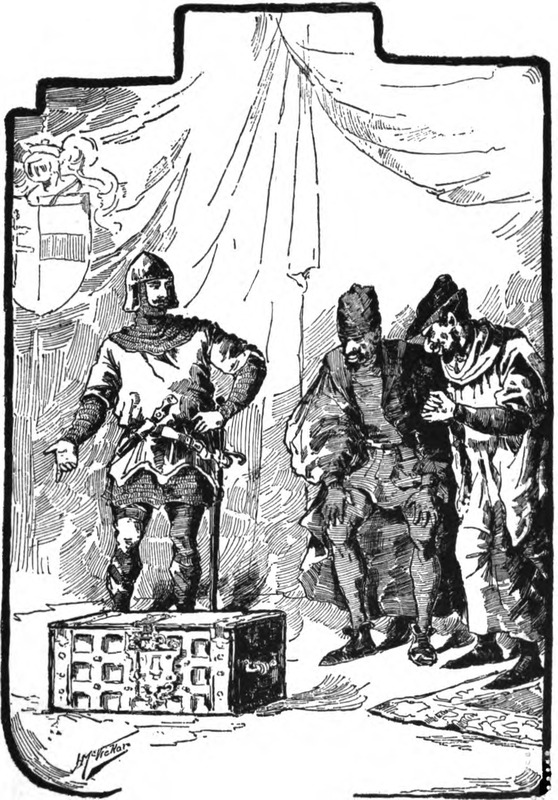
After being exiled from Castile by King Don Alfonso, the Cid meets up with two Jewish merchants to whom he had often sold his spoils of war. He had very little money due to his exile, as most of his wealth came from his land, and so he somewhat reluctantly came up with a scheme to get enough money to sustain himself. He traded the merchants two large chests of “treasure” as collateral for 600 marks, on the condition that they not open them for a year. The chests were in fact filled with sand, but the Cid correctly gambled that he would be able to make up the money and pay them back before they noticed.
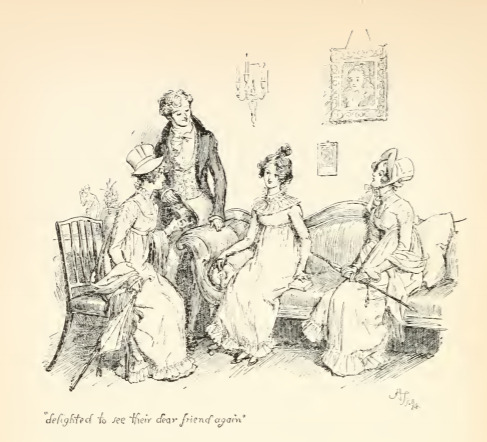
In this image Mr. Bingley, Caroline Bingley, and Mrs. Hurst come to Longbourn to invite Jane to a ball they will be hosting at Netherfield. This was the first reunion of Jane with the Bingleys after her illness that kept her at Netherfield. She was happy to see them again and gladly accepted their invitation. This scene occurs in chapter 17. The characters are shown in the traditional regency style. Jane, Caroline Bingley, and Mrs. Hurst wear regency style dresses with empire waistlines and their hair tied up. Mr. Bingley wears a waistcoat and tailcoat with a cravat. The regency period dated to the early nineteenth century (1811-1820) when George, Prince of Wales, later George IV (r. 1820-1830), reigned as regent for his mentally ill father, King George III (r. 1760-1820). The regency period is associated with the rise of neoclassicism in art and fashion.
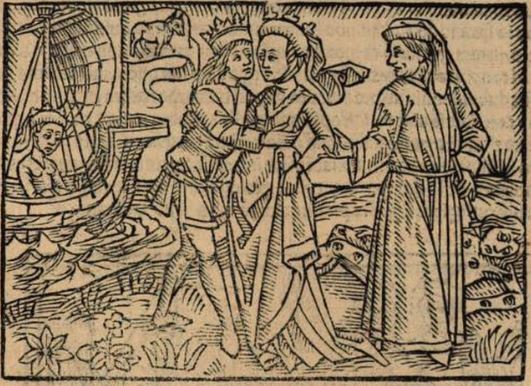
This engraving illustrates the story of Isis and Jupiter. Jupiter is depicted in the center of the engraving with his arms wrapped around Isis as he shows his affection for her. Boccaccio explains that Jupiter transformed her into a cow and gave her as a gift to Juno in order to hide his crime of raping her. Mercury saved Isis by killing Argus, Isis’ 100 eyed guardian. Mercury is on the right side of the engraving piercing the body of Argus with his sword. Isis is visible in the background of the engraving sitting on a ship. She sailed to Egypt after being transformed back into her human form. The sail on the ship has a heifer emblem to signify her transformation into a cow.

![[Gulliver speaks with the Emperor of Lilliput and defends himself against guards shooting at him]](https://collections.cemvc.ca/files/large/aec38e93936ac644a379075c0d7baf18ebc42405.jpg)
![[Several Laputan scholars working]](https://collections.cemvc.ca/files/large/5f3317688ed64aa5231506bdbb6798e14c37460e.jpg)
![[an inflated bladder used by Flappers on Laputa]](https://collections.cemvc.ca/files/large/bcf9f9e16d6c262739a01ed251dc0bff6a6b9aa4.jpg)
![[a group of female yahoos]](https://collections.cemvc.ca/files/large/407935734c974f58cc0be60653ff9fc6fea192f0.jpg)
![[Act XVIII – Elicia and Areusa Talking to Centurio]](https://collections.cemvc.ca/files/large/662889e8d1c90a1ceeb029459a61e5988b206afd.jpg)