Two men dressed in robes can be seen standing side-by-side on hills of grass outdoors. They are observing a statue of a robed man atop a pillar. The men are copying the pose of the statue.
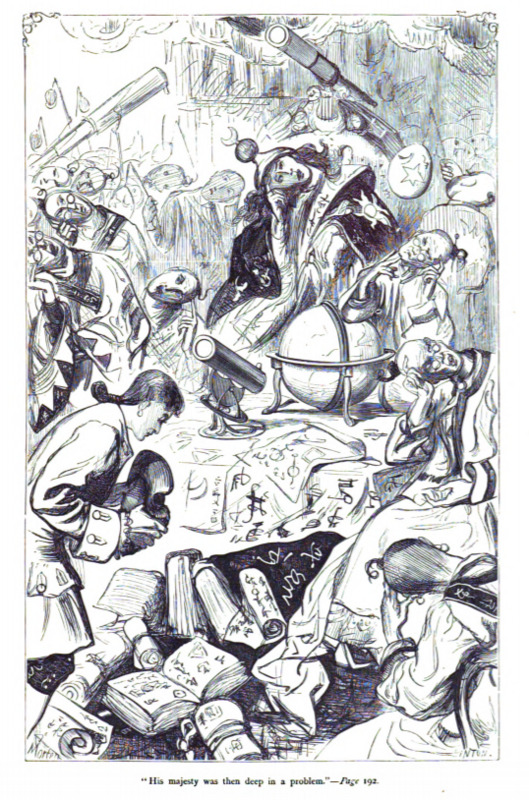
Upon his arrival in Laputa, Gulliver was brought to the palace to meet the King of Laputa. When Gulliver arrived, however, the King was working on a problem and Gulliver had to wait an hour. The scholars on Laputa were focused on mathematics, astronomy, and music, and the King is surrounded by astronomical instruments.
Two Tupinambá men are shown. One of the men stands in front of the other. He wears a feathered adornment at his back, attached to his body with a strap over one shoulder, ruffled adornments around both calves, and is otherwise nude. He bends down with one hand outstretched towards a monkey that sits on the ground beside him. The man standing behind him wears a feathered headdress and an adornment on his chin and is otherwise nude. He holds a rattle or an ornament in one hand, and stares at a parrot on a perch to his left.
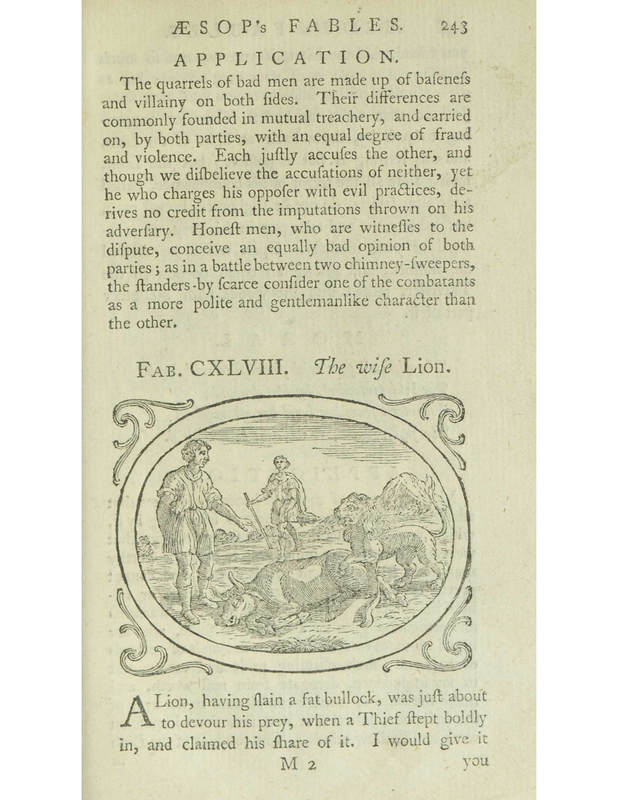
The scene is taken place outside, 2 men and a lion and deceased bull that was slain by the lion, one man is pointing at the bull and another man with a walking stick/cane is approaching behind in the distant. The scene seems to be taken outside as you can see the sky, plants and other vegetation. The man is looking to take a share of the bull from the lion, but the lion will not let him because he was being rude. The other man however received half of the bull from the lion because of his modesty.
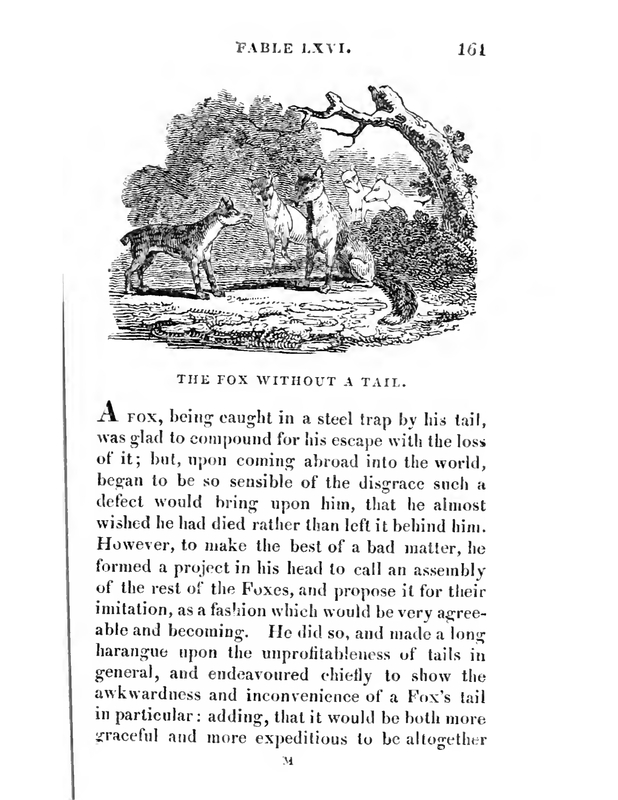
Five foxes gather in a forest. Four of them are on the right-hand side, they have their tails. The two in the background stand and look at each other as if conversing. The two in the front sit and look at the fox on the left-hand side. The fox on the left-hand side stands and looks at the other foxes. Its tail has been cut off.
Here we see a sailor kneeling on top of Gulliver’s box-house. The crew member leans over the latch of Gulliver’s house speaking to him. The house is attached to the ship with ropes. The same image appears in the 1843 Krabbe edition.
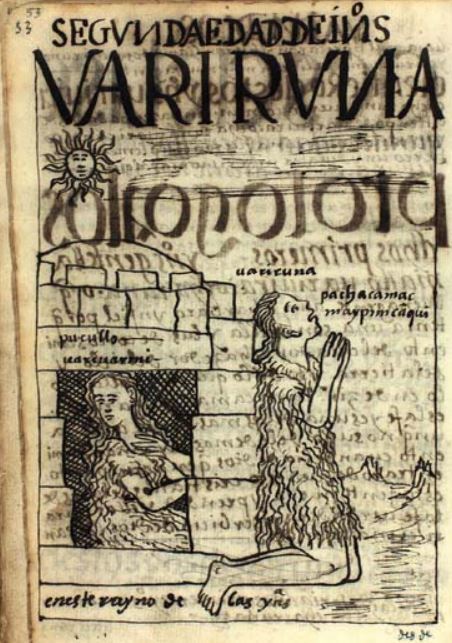
This illustration depicts the second age of the indigenous people of Peru, who the author calls the Wari Runa. The author stresses that these people are different than their ancestors as they began to build stone huts as opposed to living in caves and under cliffs. Therefore, there is a depiction of a small stone hut house in the image. The word “pucullo” is written on the house, which translates to “small house.” There is a man pictured kneeling with his hands together in prayer and looking up to the sky. There are words above his head which read “pacha camac maypim canqui,” which translates to “where are you father?” There are words at the bottom of the image by the man’s feet which reads, “en este reyno de las Yndias” and that translates to “in this kingdom of the Indians.”
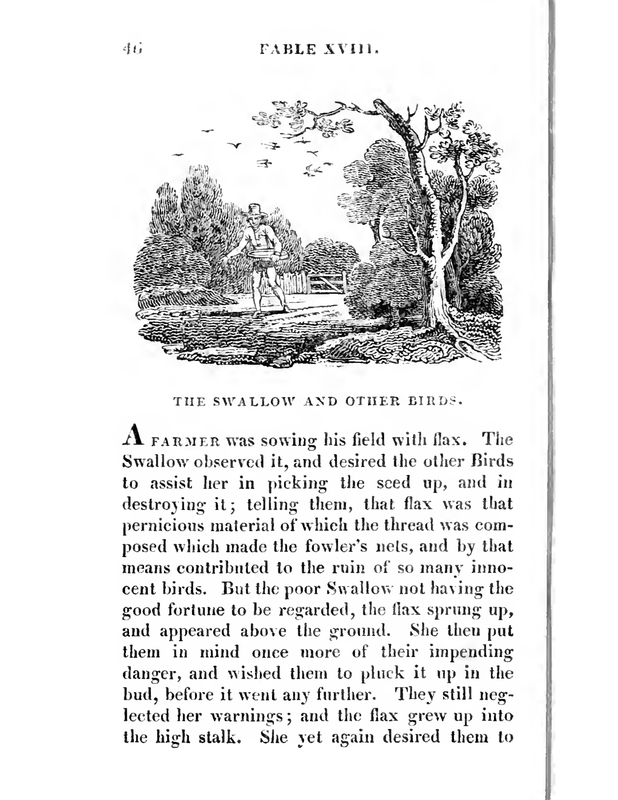
On the left side of the illustration, a farmer was sowing his field with flax. He spreaded the flex using his left hand while holding the bamboo sieve using his right. His farm was neatly organized. It was indicated by flat field inside the gate contrasting the crowding plantations outside. A flock of birds were circling in the air just above the farmer and his field.
Laputan scholars spent much of their time observing the stars, seen here. Two scholars sit looking through a telescope and using a compass to plot the position of the stars over the globe. The Laputans focused most of their time on either astronomy, mathematics, or music.
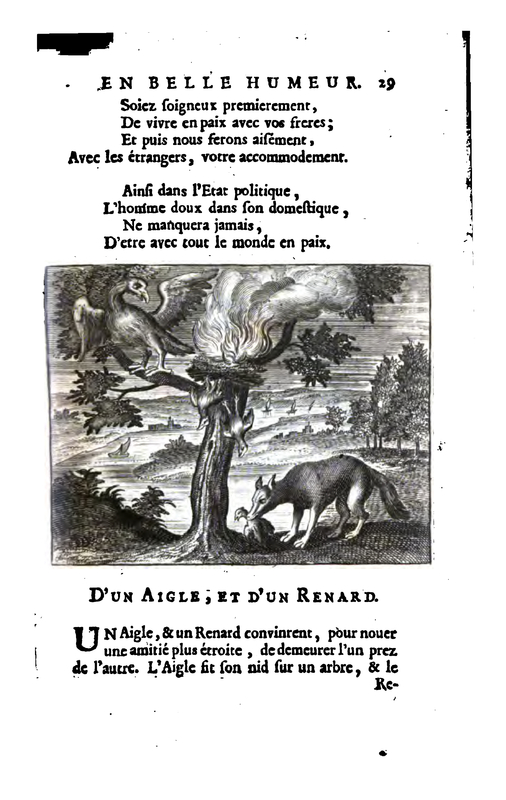
There is a large tree in the middle of the image. Under the tree, there is a fox eating a bird which appears to be a eagle. In the branches of the tree there are two more brids or eagles falling down. Right about them there is a nest which is on fire, the smoke engolfs the tree. The mother eagle expresses shock and angry, the eagle is ready to take off from the tree. In the horison there is a river and boats. There are also trees in the far distance.
A group of Indigenous people are in the process of burying the body of a deceased man. The body has been bound with rope about the arms and wrists and has been placed into the grave in a kneeling position. Two men kneel on either side of the grave each gripping one of the deceased man’s arms and holding a basket over his head. Two different men shovel dirt into the grave, and a third stands at the head of the grave holding a rattle or ornament and wearing a feathered headdress. Three women, one with a child by her side, crouch around the grave with their hands over their faces in distress, and there are bows and a club on the ground near their feet, perhaps to be buried with the deceased.
This image depicts the first encounter Calisto (figure to the left) has with Melibea (figure to the right). While practicing his falconry, Calisto follows his bird (top-left corner) into Melibea’s garden, where he first lays eyes upon her. He is struck by her beauty and instantly falls in love. In addition to these figures, there is a horse behind Melibea.
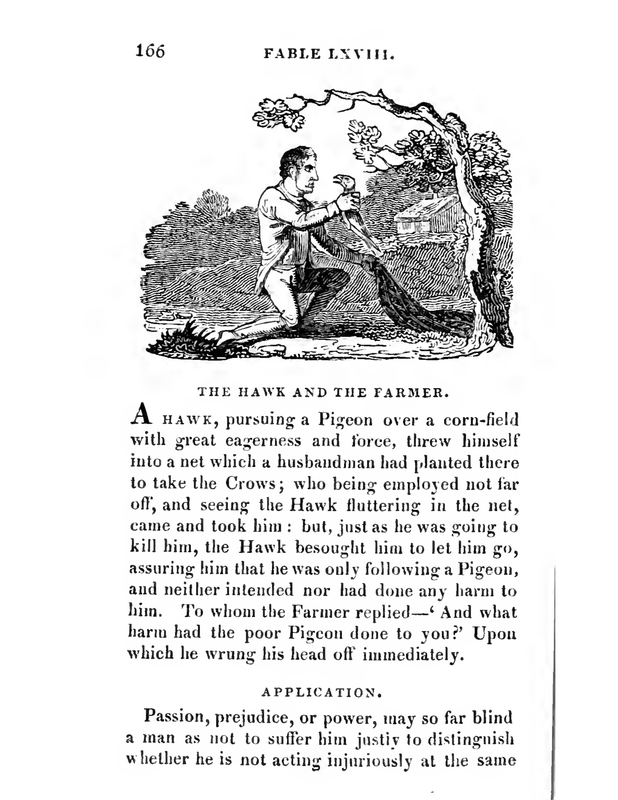
A farmer kneels on the ground. In his left hand he holds a net, in his right hand he holds a hawk. The man has a very stern expression on his face. The hawk has its beak open and seems to be in distress. In the background on the right-hand side of the image we see a house.
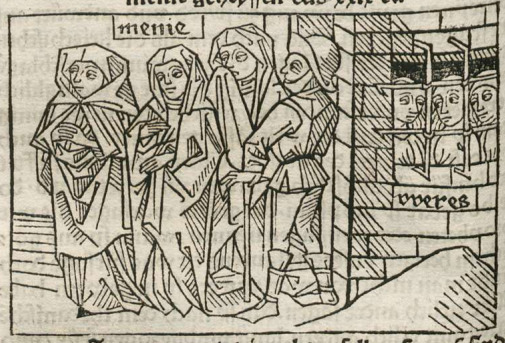
The engraving depicts a man guarding a jail, with three figures standing behind the bars of the jail and three figures leaving the jail wearing heavy garments. The three figures leaving the jail are Minyan men who had been sentenced to death for their crimes against their city. Boccaccio explains that the Minyans wives had gone into the jail and swapped clothing with their husbands and switched places with them. The men in disguises slipped past the guards unnoticed and into freedom, while their wives were executed in their place. Boccaccio explains that he chose to write on these women to demonstrate that there is no greater love than a wife’s love for her husband.
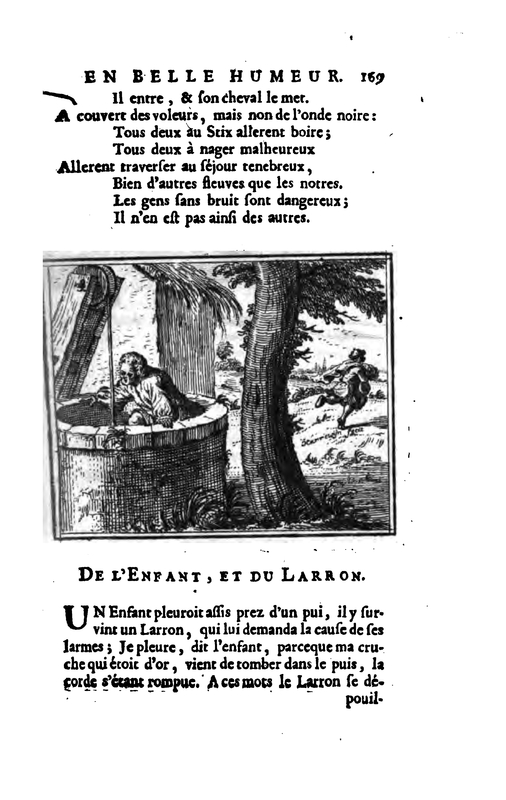
A child was crying near a well, and a thief came and asked him for the reason for his tears; "I am crying," said the child, "because my jug, which was made of gold, has just fallen into the well, the string having broken. At these words the thief went into the well to fetch the jug.
An idol carved of wood is pictured. It is shaped like a human man in a seated position and sits inside a hut-like structure. The idol bears a hat, strands of beads around its neck, a fringed skirt around its waist, strands of beads around each of its thighs, and decorated cuffs around each of its calves.
This image depicts a large castle in which Helen and Paris of Troy can be seen embracing each other through a window. Because the city is surrounded by a large wall, it is presumably the city of Troy and not Sparta, as Troy was a walled city and Sparta was not. Within the city walls there are two ships depicted floating on the water. This image marks the beginning of the Trojan War, as it began due to Helen, the wife of King Menelaus of Sparta, going to Troy with Prince Paris.
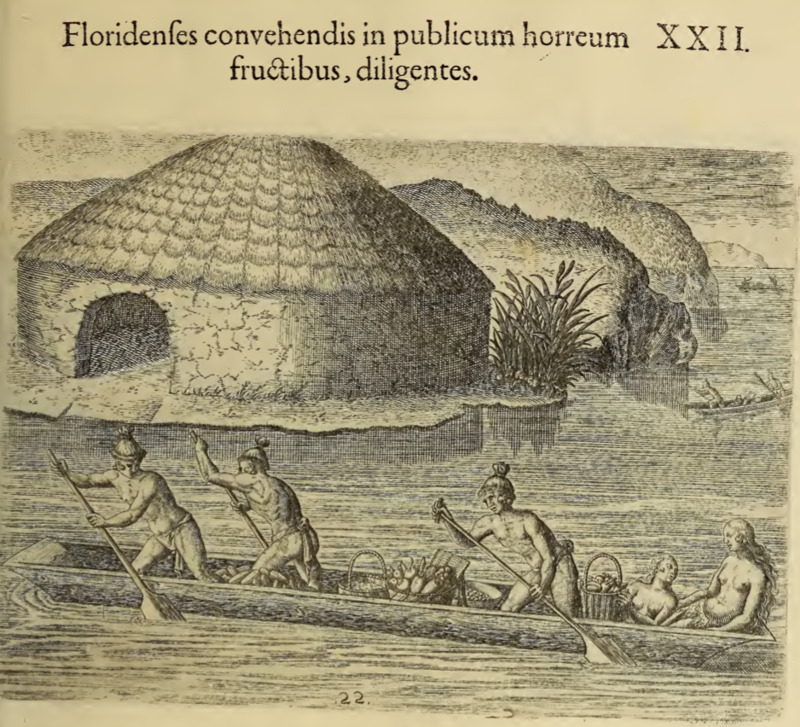
Several Indigenous people bring crops by canoe to a large storehouse. There are baskets of various types of produce in the canoe, three men stand to paddle while a woman and young person sit in the rear. The storehouse is a large round structure on the bank of the river.
After his return to England, Gulliver bought two uncastrated stallions. Gulliver spent most of his time with these horses, as he found their company preferable to human company, and reminded him of his time with the Houyhnhnms. Gulliver says he spends at least four hours each day speaking with the horses. The same image appears in the 1843 Krabbe edition.
William Dobbin sits in a wooden chair at his desk, reading the first of his letters. It is from Amelia Osborne, congratulating him on what she believes to be his engagement. The other letters are bundled on his desk.

![[Men standing in front of statue]](https://collections.cemvc.ca/files/large/ea6b9fc717c07ee7cdc7e949bd8ed51dee7f9c14.jpg)
![[Two Tupinambá men with a parrot and a monkey]](https://collections.cemvc.ca/files/large/2667c058da84ab885edcb05adbe0386594d79859.jpg)
![[A crew member opens the lid of Gulliver’s box-house]](https://collections.cemvc.ca/files/large/01cdab822fb6ae04666eebe84fdc49230549bebb.jpg)

![[Laputan scholars look at the stars]](https://collections.cemvc.ca/files/large/fe515e1966795fed035acfd23d192400d9947180.jpg)
![[Funeral and burial customs of an Indigenous Brazilian group]](https://collections.cemvc.ca/files/large/fc6d0a30c788c882dcabbdd80142f9d040ba6157.jpg)
![[Act I (First Illustration) – Calisto Encounters Melibea]](https://collections.cemvc.ca/files/large/ce772f7cc92eb6a4ac0a6f9e06738af7514bd435.jpg)



![[Dobbin’s Letters]](https://collections.cemvc.ca/files/large/b1651a2f5b9f1a68b7afe2c0cd917276a2900b9d.jpg)