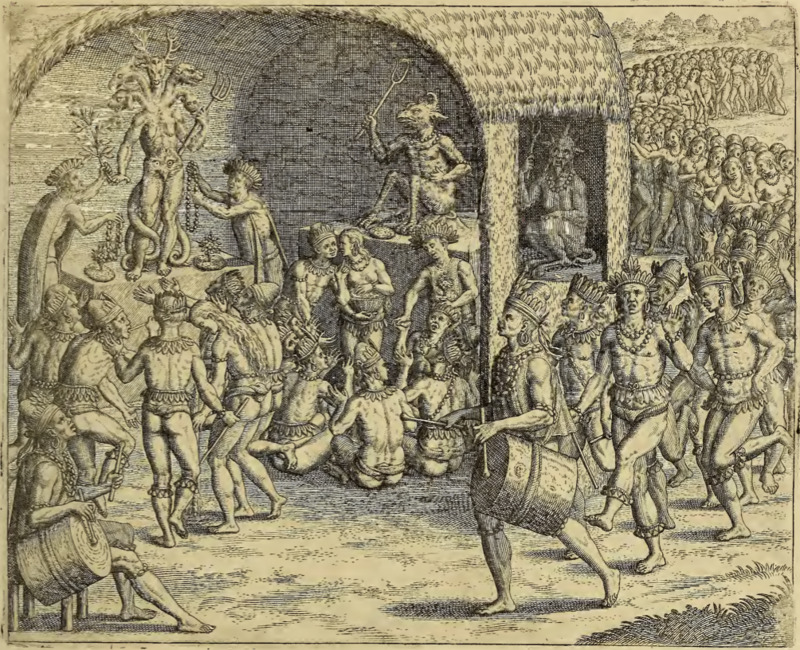
A large group of Indigenous people conduct a religious ceremony. One individual, dressed to reflect several different animals including an owl, snakes, a stag and wildcats, stands on a platform or altar inside a dwelling on the left. Two people offer strands of beads and a branch to this individual. Two other people wearing animal heads sit on altars further inside the building. Some of the Indigenous people sit on the ground inside the dwelling, some dance near the first altar, two play drums, and others arrive at the site in a long, dancing procession. Most of the individuals wear feathered headdresses, beaded jewelry, and other feathered adornments around their necks and waists.
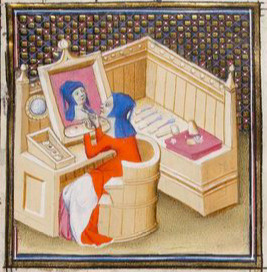
Marcia was known for her incredible talent at painting and sculpture. She was especially known for her self-portrait, which she created using a mirror. The portrait was so accurate that there was no doubt it was her. This image depicts Marcia at her desk, painting her self-portrait with a mirror to her left, and her paint brushes to the right.
A group of colonists is shown. They are in the process of building a fortress on an island in the middle of the river. The stronghold is triangular and is being built of wood. This illustration is identical to the one found on page 53 of Frankfurt 1591, but colored.
After arriving in Lisbon, Gulliver stayed with the captain of the ship that brought him from New Holland to Portugal, Don Pedro. Gulliver refused to go outside in Lisbon, so after arriving at Don Pedro’s house, he would look out the window, trying to readjust to life in Europe. Eventually Gulliver would go downstairs into the doorway, and eventually out into the street. The same image appears in the 1843 Krabbe edition.
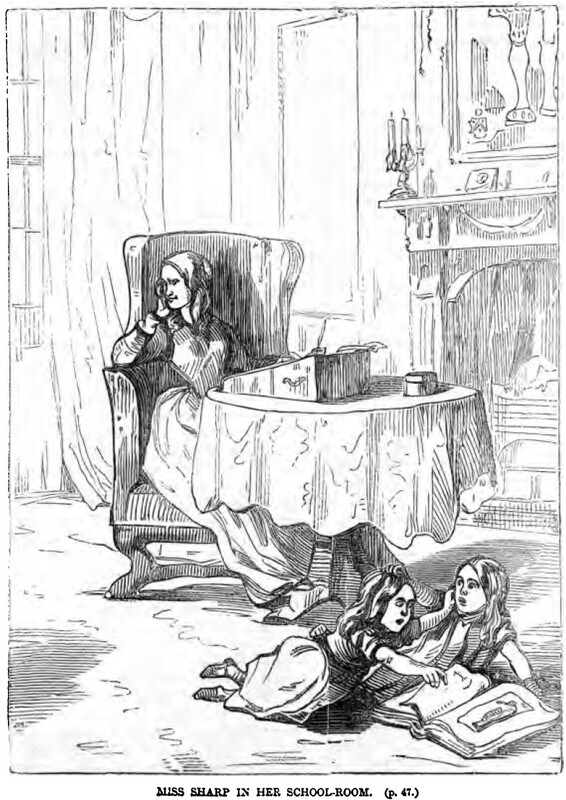
Rebecca Sharp sits in an armchair at a round table with her back to the window, looking irritated. Her table holds a writing desk and round dish. It is next to an ornate fireplace, on the mantle of which are a candelabra and clock, and above which hangs a painting. On the opposite side of the table Rosalind and Violet Crawley are on the floor, fighting over a very large open book. Violet is pulling on a page from the book and pushing her sister away, while Rose has grabbed her sister by the hair and looks somewhat shocked. Below the illustration is printed its title and location in the story, “MISS SHARP IN HER SCHOOL-ROOM. (p. 47.)".
In this image we see Gulliver eating with the Queen of Brobdingnag. She eats a drumstick while Gulliver sits on the table next to her. The queen wears lizard earrings. Gulliver sits at a smaller table underneath the queen’s arm. He has his own plate of food and looks up at the queen as she eats. The same image appears in the 1839 Krabbe edition.
Georgy Osborne in a top hat and suit, holds onto his aunt Jane Osborne’s hand, and is turned to face the boy who has come up behind him. The boy is a young sweep, barefoot and with ragged clothes, begging for money. The footman, carrying the church books, is behind the sweep, trying to drive him away with a cane. In the background is Amelia Osborne, who was going for a walk on the cross-street to the one the others are taking to church, watching proudly as her son gives money to the sweep. Below the illustration is printed in cursive its title, “Georgy goes to church genteelly”.
Here we see Gulliver looking out at the water before preparing to set sail on his fourth and final journey. This image appears at the beginning of Part Four, at the beginning of chapter one. The letter “I” appears in the top corner as it is the first word of the chapter.
Three Indigenous people, two men and a woman, pick bananas from a tree and place the fruit in a basket that the woman carries on her back. Two birds swoop down and take fruit from the tree, and a third bird has been shot with an arrow. A bow and arrows rests on the ground behind the man standing on the right and the two men wear feathered headdresses. Bananas were introduced to Brazil by the Portuguese in the early 16th century.
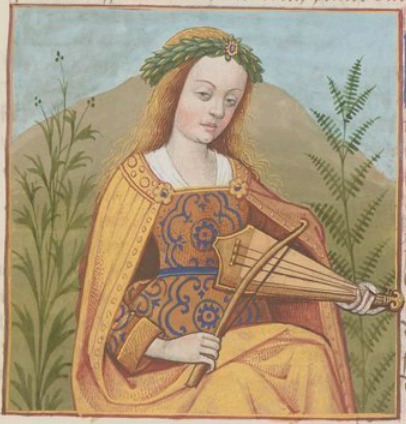
This illuminated image depicts a woman named Medusa in her human form. Prior to being transformed into a monster by the goddess Minerva, Medusa was a beautiful woman who captured every man’s heart who happened to look upon her. She is depicted wearing a wreath and playing the lyre in this image.
This illumination depicts Irene sitting on a throne as she looks down at her young son, Constantine. She is illustrated wearing a crown and holding a scepter to signify her royal status. Irene and her son, Constantine, compete for the throne multiple times throughout their lives. Irene eventually blinds her son, and after he fell ill and died, she took the throne back. Irene was famous for her fierce reign as empress of Constantinople.
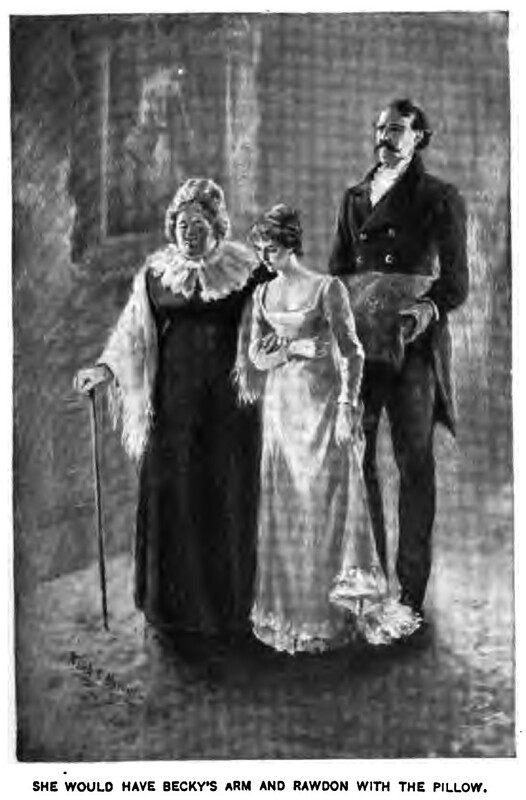
The image depicts a scene from page 95, in which Miss Matilda Crawley directs Rebecca Sharp and Rawdon Crawley to walk her in to dinner. Miss Crawley is shown in a black dress with a white collar and shawl, holding onto Rebecca Sharp’s arm with one hand and using a cane with the other. Behind them stands Rawdon Crawley in a black suit with two rows of buttons, holding in both hands a cushion for Miss Crawley to sit on. A portrait hangs in the background.
Here we see a depiction of the corruption of the English legal system. The image shows a desk with bribes on top of the verdict. A framed picture of a lawyer is in the back. We see a rabbit and several bottles, likely of expensive goods, and a coin purse with coins spilling out on top of a stack of papers, with the word “verdict” written on it. Gulliver tells the King about diplomacy, religion, the justice system, the arts, the financial system, and the nobility, then debated these issues with the king. This image comes when Gulliver is discussing the corrupt legal system, speaking to how the wealthy could buy their desired outcome. The same image appears in both the 1839 and 1843 Krabbe editions.
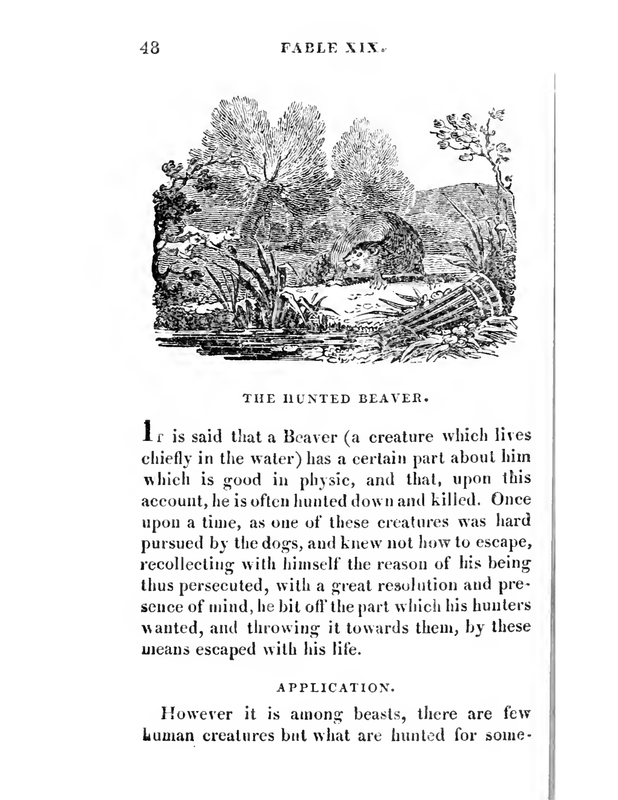
The event took place at the lido. A Beaver in the center of the illustration was preyed by two foxes on the left edge of the illustration. They were approching from a distance. The Beaver's face was toward the incoming direction with determination to fight back.
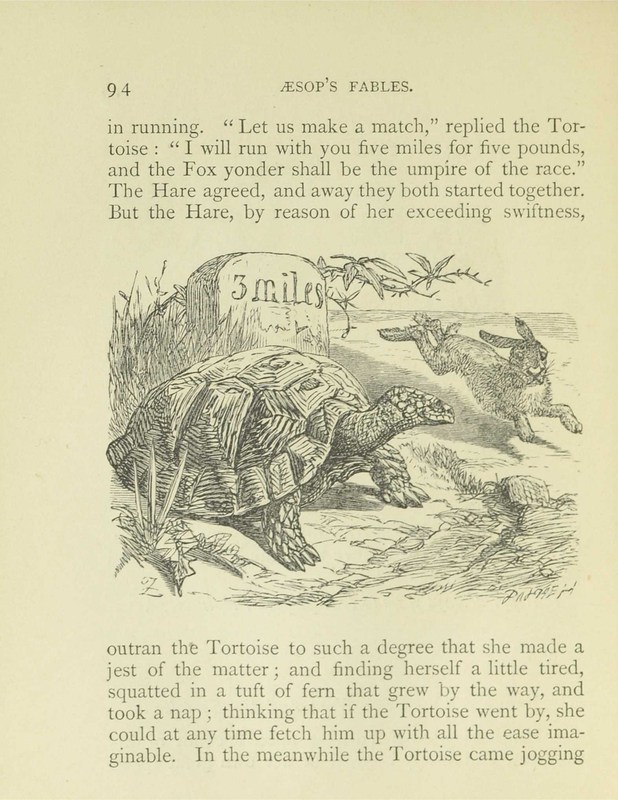
On a dirt path a tortoise stands in front of a mile marker reading “3 miles”. Next to it, a smaller hare is seen running towards the tortoise, looking at it unpleased.
Here Gulliver’s house is rescued by sailors after he was dropped into the ocean by an eagle. We see a rowboat with five men pulling in Gulliver’s house. In the background we see the large sailing ship that brought Gulliver back to England. Gulliver had a difficult time adjusting to interacting with humans his own size. The same image appears in the 1843 Krabbe edition.
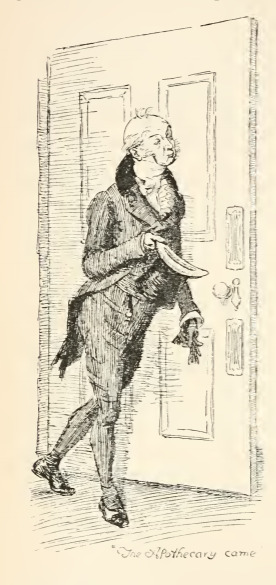
In this image the apothecary comes to Netherfield Park to examine Jane, who became ill after getting caught in the rain while going from Longbourn to Netherfield. After a letter arrives at Longbourn from Caroline Bingley inviting her to visit Netherfield Park, Mrs. Bennet decides to send Jane on horseback, even though it will rain so that Jane will have to spend the night at Netherfield. It started to rain while Jane was riding to Netherfield and she caught a cold from the rain. Jane then had to stay at Netherfield until she recovered enough to be able to travel. This scene occurs in chapter 7. The characters are shown in the traditional regency style. The apothecary wears a waistcoat and tailcoat with a cravat. The regency period dated to the early nineteenth century (1811-1820) when George, Prince of Wales, later George IV (r. 1820-1830), reigned as regent for his mentally ill father, King George III (r. 1760-1820). The regency period is associated with the rise of neoclassicism in art and fashion.
Two Tupinambá men are shown, each holding a different weapon. One man stands in front of the other, holding a club with feathers on the end in one hand. The man standing behind him points a bow and arrow at something beyond the right edge of the image. Both men are nude and have an adornment on their chin. The man in front has marks (tattoos or paint) on his chest, biceps and thighs. The head of another man from an enemy group lays on the ground behind the men.
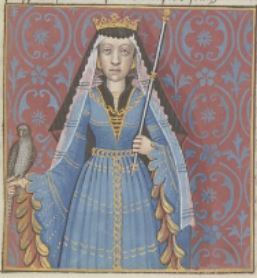
This illumination depicts a portrait of Olympias, the queen of Macedon. She is illustrated in royal clothing with a scepter in her left hand and a bird perched on her right hand. Olympias was the wife of King Philip II of Macedon, and mother of Alexander the Great.
An illustration of a lady and officer, attired as they would accurately be at the time of the story. The lady wears a long, thin dress and elongated bonnet, while the officer wears a coat with tails and oversized, pointed hat, and carries a very thin cane. In the background are many small figures and what appears to be an elaborate bridge.


![[Gulliver’s looks out the window at Lisbon]](https://collections.cemvc.ca/files/large/c85b46a4ef28f1df3b0d92e8b060e2671a0818ae.jpg)
![[Gulliver dines with the Queen of Brobdingnag]](https://collections.cemvc.ca/files/large/5cdbcea8ad3777d65ac5dfe973cd2e368525a1a9.jpg)

![[Gulliver looks out at the water]](https://collections.cemvc.ca/files/large/0cea65ac30d9c6a035b9e35d74a443d50f9472ff.jpg)
![[Indigenous Brazilians pick bananas from a tree]](https://collections.cemvc.ca/files/large/8e47083dacb4fd50d871306e12f8d1174f53f4b9.jpg)
![[Empress Irene Looking at her Son Constantine]](https://collections.cemvc.ca/files/large/a03854d46aedee580a82cf6464cc508f79e20695.jpg)
![[items representing the corruption of the English legal system]](https://collections.cemvc.ca/files/large/93593daaf6f8828683eda6741b435eb0352c5cbf.jpg)
![[Gulliver’s house is rescued by sailors after he was dropped into the ocean by an eagle off of Brobdingnag]](https://collections.cemvc.ca/files/large/1eca4b89f22912424c3dd5f12250870293b347bc.jpg)
![[Men walking together]](https://collections.cemvc.ca/files/large/9809e498988a1fab3c56e8362f45972bee4f5d1d.jpg)
![[Two Tupinambá men with weapons]](https://collections.cemvc.ca/files/large/61910e3826d112b7949e029da915a2bad7a1e710.jpg)
![[Accurate Costuming]](https://collections.cemvc.ca/files/large/bc94389b60188947f7929c55487646b71e73fbda.jpg)