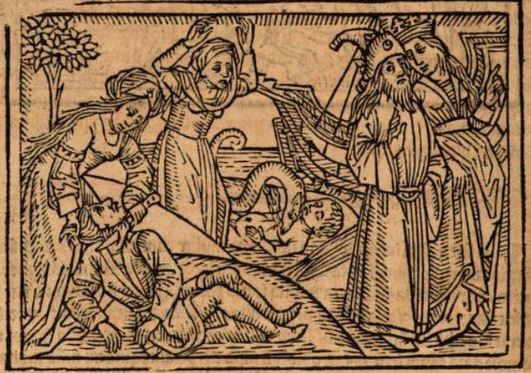
Hypsipyle and her father King Thaos of Lemnos are depicted on the right side of the engraving. Hypsipyle is depicted speaking with her father as she tells him that the women of Lemnos are planning to turn on all the men of the city and kill them. Boccaccio explains that Hypsipyle warns her father of the crime so that she can help him escape. There is a woman on the left side of the engraving with a sword in her left hand and a man’s head in her right as she carries out the plan to kill the men of the city. Later in life, Hypsipyle has a ward named Archemorus. He is depicted in the background of the engraving, lying on the ground with a snake biting into his chest. This kills the child, and Hypsipyle is illustrated with her hands in the air as she grieves for him.
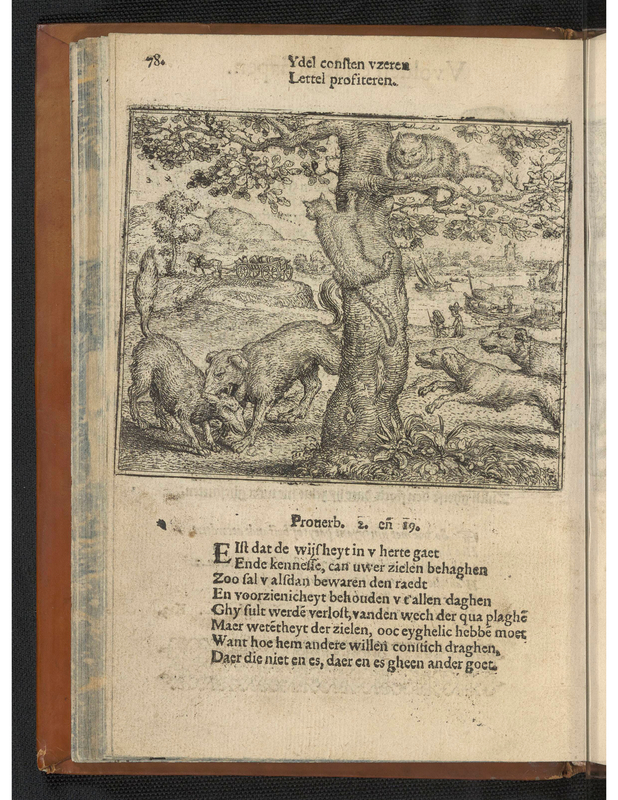
In the foreground, two cats are in a tree. Around the base of the tree, four dogs circle. To the right of the tree, two of the dogs are running toward the tree. On the right, a dog is biting the neck of the fourth dog. In the background, people fish and sail. A horse a wagon moves along the road, next to the waterway.
Georgy Osborne sits on top of his family’s carriage after climbing across the others, holding onto a rope with one hand. On the deck next to the railing below him are three workers; the one furthest to the left is Mr. Kirsch, the courier, who is lifting his hat in greeting to Georgy.
The leftmost side of the illustration features a mildly decorative border, the only location in this edition to feature such a border. The left panel depicts Celestina dressed in a robe and a veil. The choice to use this panel to depict Celestina is rather odd, since the figure appears substantially younger than other depictions of Celestina in this edition (and younger than we would expect her to look). To the right, we see Calisto wearing a hat and holding a long item of some sort, perhaps a cane/walking stick. Both figures are placed outside.The left panel does not appear again in this edition, although an exact replicate can be found on pages 69 and 221 (of the text) in the 1529 Paris edition. The right panel is identical to those found on pages 12, 60, 225, and 235, and nearly identical to the one found on page 317 (where it is labeled ‘Centurio’).
An Indigenous village is shown, full of fantastical creatures. In the center of the scene an Indigenous person speaks with two European men. A large hairy creature stands to the left of the three. In the foreground on the left an individual holding a bow emerges from a building. In the center another person lays on the ground with a horned, humanoid creature leaning over them. To the right two more individuals run from another of the horned creatures. There is a ship and a large creature in the water near the coast on the right, and further up the coast a person chases after a large winged creature. There are several structures in the background.
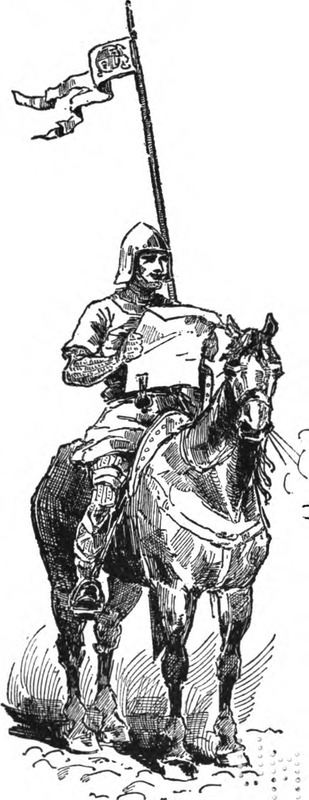
This image shows the arrival of a messenger holding a scroll, presumably announcing the arrival of the heirs of Aragon and Navarre to Valencia. They are coming to marry the Cid’s daughters, who are by this point no longer married to the Infantes of Carrion. The messenger sits on a horse and holds a flag showing a coat of arms.
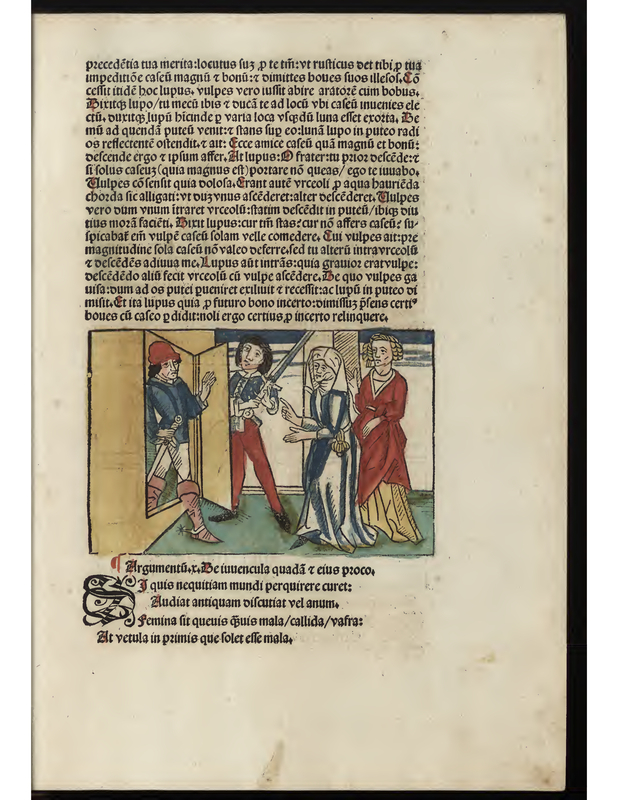
A men with a sword on his belt and spur boots walks out of his door while another man with his sword drawn stands behind it. Two women in robes are present and talking to the man walking outside of his door.
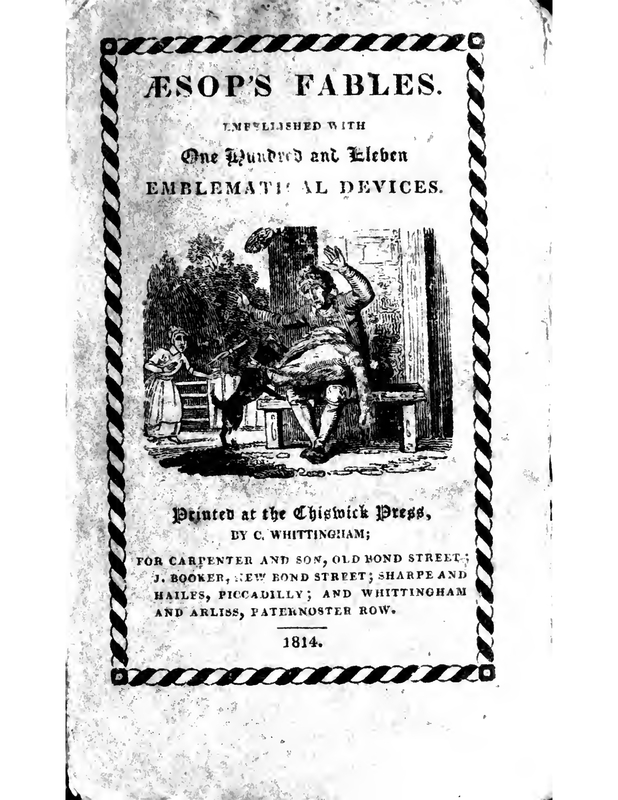
This is the book cover of the Aesop's Fables. The illlustration is a man sitting on a bench outside the barn reing scared by a black dog. A woman witnessed the scene in a terrificed manner. Under the illustration, names of this book being dedicated to were listed.
Leaving the city of Lagado, Gulliver and his guide arrive at a large estate in the countryside, which functioned as the academy for scholars. In contrast with the city which seemed to be crumbling, the house in the country was large, built in the style of ancient architecture. Gulliver describes the landscape with fountains, walks, groves, gardens, and avenues, all well-kept. This image shows the view from one of the walks, through the trees looking towards the academy. The same image appears in the 1843 Krabbe edition.
Here we see Gulliver attempting to hold a yahoo child who appeared to need help. However, the child squirmed and got free. The child was three years old and was playing with other children and fell. In this image we see Gulliver holding the child, with others chasing each other in the background on the right, and a Houyhnhnm on the left. The same image appears in the 1839 Krabbe edition.
Here we see Gulliver’s luggage. This image appears at the beginning of the ninth chapter, as Gulliver prepares to leave Glubbdubdrib and return to Luggnagg, and from there he will sail to Japan, then finally home to England. In the third part of the story, Gulliver travels more frequently than in any other part. In this chapter we see Gulliver’s trunk, hat, walking stick, shoes, and book. There is a letter “L” on the book because it is the first letter of the chapter. The same image appears in the 1843 Krabbe edition.
This illustration is interesting, seeing as no characters embrace during the seventeenth act. Areusa does manipulate Sosia into revealing when and where Calisto meets with Melibea, but Sosia does not describe in any detail the nature of their encounters.
Here we see a politician bribing a voter. The politician is on the right and hands the man on the left a piece of paper that reads “vote … B”, and a small bag of money. In this chapter Gulliver talks with the King of Brobdingnag about English traditions. Gulliver tells the King about diplomacy, religion, the justice system, the arts, the financial system, and the nobility, then debated these issues with the king. This image comes when Gulliver is discussing the corrupt political atmosphere and the election of officials. The same image appears in the 1843 Krabbe edition.
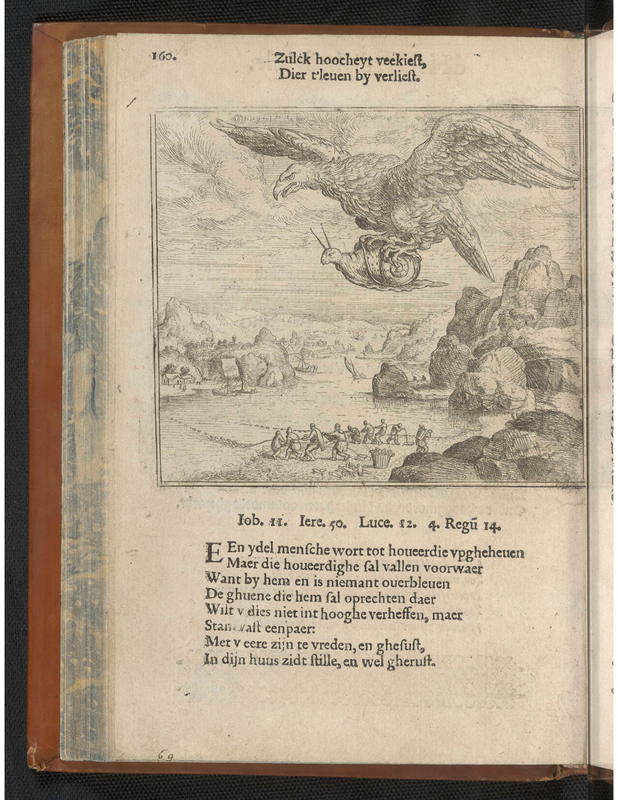
"On the left side of the image there is a den of foxes. on the right side of the page a crow sits on top of a tree, with another animal inside of its talons. One of the foxes is at the base of the tree, and is seen placing a bunch of wheat down."
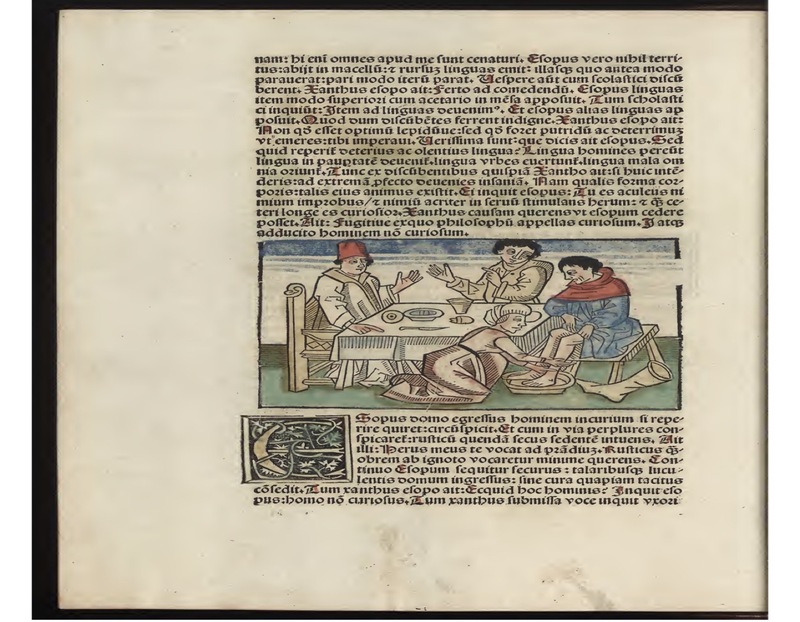
Four people are outside surrounding a table. Two men sit at benches and the other man sits on an elaborately decorated chair, all in discussion. A woman kneels below them cleaning the feet of one of the men sitting on the bench, in a small circular tub filled with water.
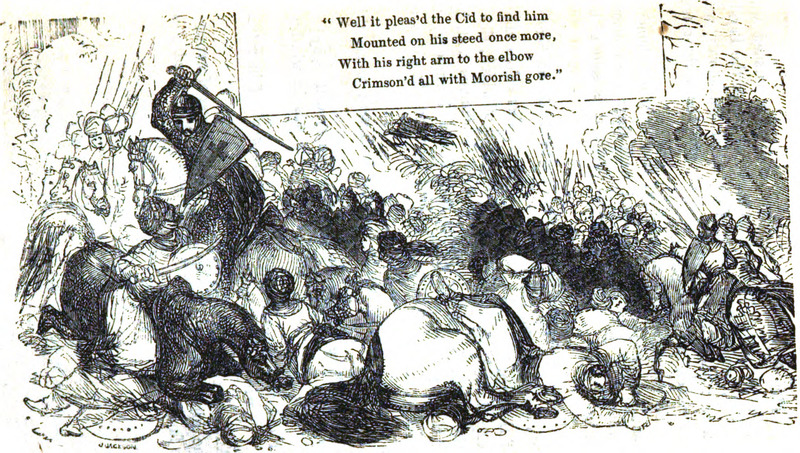
The Cid leads his army in the battle against the Tunisians besieging Valencia. He can be seen on the left, holding his sword above his head and bearing a shield with a cross. The Castilian army had been in danger of being surrounded before the Cid began a charge, which led to a resounding Castilian victory.
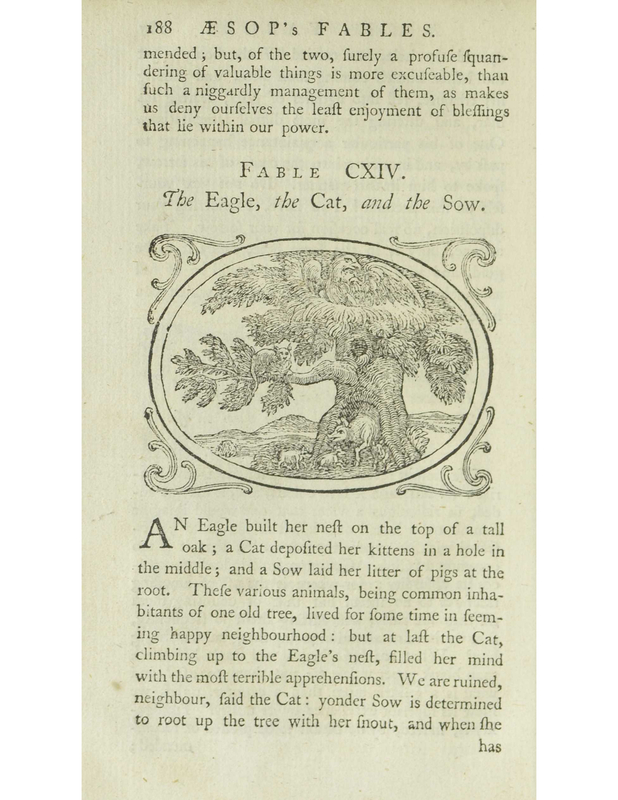
There is a large tree with a wide stump. At the base of the stump there is a hole with a mother pig coming out of it. Surrounding the mother pig are three piglets going into the hole. Above the hole in the stump is a branch that sticks out to the left of the tree, and a cat sits on top of it. Above the base of the branch is a hollow in the tree. At the top of the tree there is a large nest with an eagle in it. The eagle is spreading out its wings and facing the right.
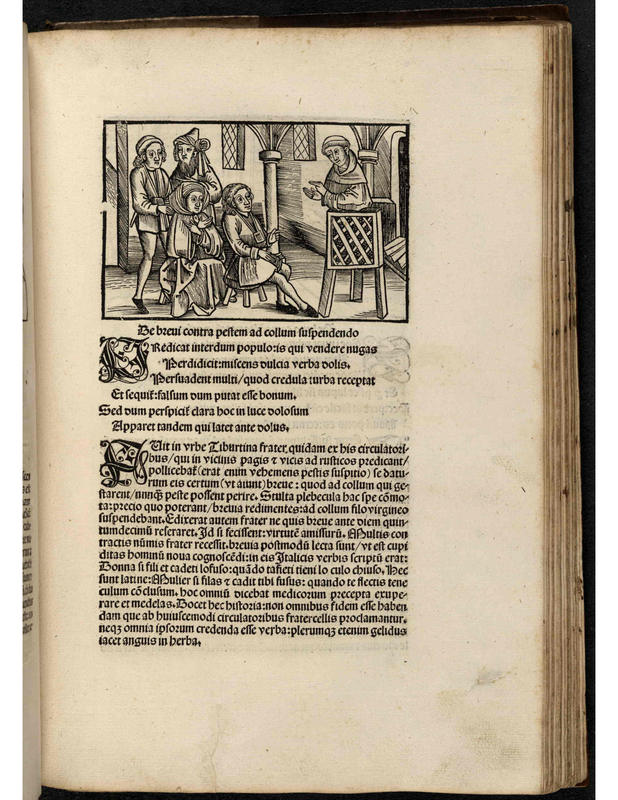
Five people are in an open room with pillars. Four of them are to the left, two sitting. The man on the right stands behind a box elevated by three legs. The people are having a discussion.
While Calisto lies in bed (to the left of the image), his servant Tristan spies Sosia, another of his servants, walking toward the house in tears (to the right of the image). Demanding the cause of his sorrow, Sosia explains that Sempronio and Pármeno have been executed in the street by the justice’s (the alguacil’s) men.To the left, we can see Calisto sleeping. His bed appears luxurious, with drapery hanging from above. A chair is situated in the foreground. To the right we see Tristan and Sosia. Sosia is presumably the rightmost figure, since he is just arriving at the house in this illustration. His appearance is slightly odd, since there are no lines allowing us to distinguish his hair and beard from his face. His hands are held in a clasped position, but I am uncertain of what this is intended to signify. Further, he has a sword mounted on his belt. Tristan is shown with his hand over his chest and a hung head, saddened by the news that Sempronio and Pármeno have died. He is wearing a hat as well.


![[Georgy on the Boat]](https://collections.cemvc.ca/files/large/0a3dbead881edc52a834225c0fa62f372aa93342.jpg)
![[Act VI – Celestina and Calisto]](https://collections.cemvc.ca/files/large/614562d02c012465a9103231d2b53a6c983e4df7.jpg)
![[Fantastical scene of an Indigenous village]](https://collections.cemvc.ca/files/large/7f8ec7efed11ed3dd310b2894c3b5f392463c1af.jpg)

![[the academy for scholars on Balnibarbi]](https://collections.cemvc.ca/files/large/d2b89827b6d6c00aadb6c6163b6f8792283c11c6.jpg)
![[Gulliver tries to help a yahoo child]](https://collections.cemvc.ca/files/large/1d498d4162f47fdae6a72d04795f400b8bd7f928.jpg)
![[Gulliver’s luggage as he prepares to leave Glubbdubdrib]](https://collections.cemvc.ca/files/large/02e2cbf12f51498f981c9e4f29bf8861ec9768b0.jpg)
![[Act XVII – Calisto and Melibea (?) Locked in Embrace]](https://collections.cemvc.ca/files/large/8aa7509b0094ef85133f03b9b5b21c187d27a975.jpg)
![[A politician bribes a voter]](https://collections.cemvc.ca/files/large/04671bada5663c5ae40a9cfa5df95d9d0a33e8d4.jpg)
![[A Crow and Foxes]](https://collections.cemvc.ca/files/large/03c6ebcd6630d13b9e8e42785bbeecedba002848.jpg)
![[Act XIII] Calisto.](https://collections.cemvc.ca/files/large/e516a4fc92e58b3601ffd8cbb8e7cee6d18d1116.jpg)