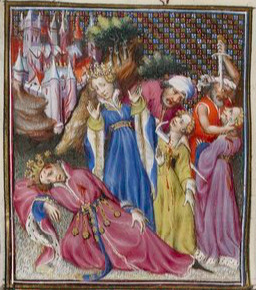
Hecuba, in the blue gown, is surrounded by a few of the many horrible things that she has seen through her life. In the pink robe is her husband, Priam, dead at her feet. The top left corner shows Troy burning, and the right side of the image shows the death of some of her children.
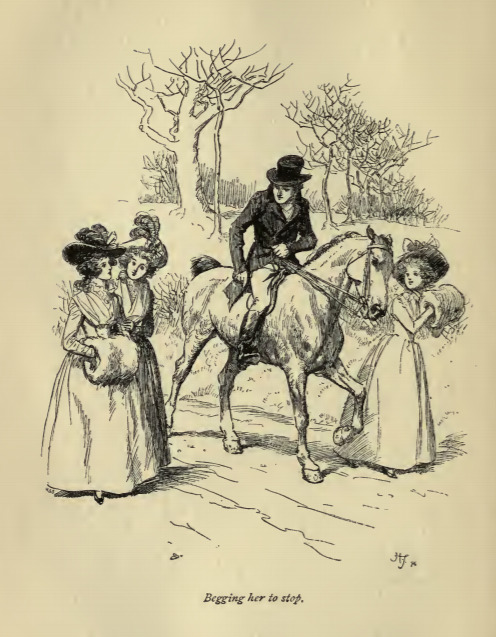
In this image Edward Ferrars is on horseback, meeting Elinor, Marianne, and Margaret out for a walk. When they saw Edward in the distance, Marianne was convinced it was Willoughby and sped up. When she realized that it was not Willoughby, she began to turn back to go home, but her sisters and then Mr. Ferrars joined together in begging her to stop and continue on with them. This scene occurs in chapter 16. The characters are shown in the traditional regency style, as Marianne, Elinor, and Margaret wear the regency style dress with an empire waist. Elinor, Mrs. Dashwood, and Margaret wear bonnets, and carry muffs. Edward Ferrars a waistcoat and tailcoat with breeches and a top hat. The regency period dated to the early nineteenth century (1811-1820) when George, Prince of Wales, later George IV (r. 1820-1830), reigned as regent for his mentally ill father, King George III (r. 1760-1820). The regency period is associated with the rise of neoclassicism in art and fashion.
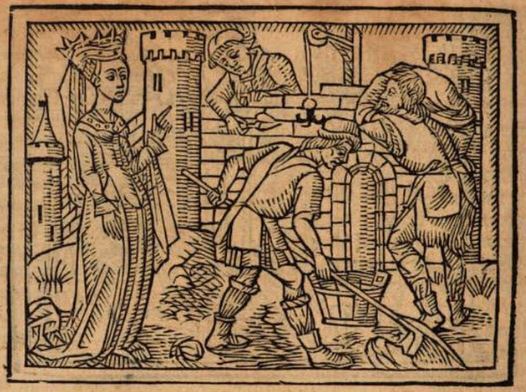
This engraving depicts Elissa, who was later called Dido, standing at the foreground of the engraving watching people build the city of Carthage. She is illustrated with her hands pointing at the city and men as she over sees the construction. Boccaccio explains that Dido had stolen her brother’s treasure in retaliation of him murdering her husband. After fleeing with her brother’s treasure, she made her way to Africa where she established Carthage and became queen of the city.
Here we see a human grooming a horse in a stable. The Houyhnhnms asks about the horses in Europe and how they live. Gulliver explains that humans or yahoos govern the country and care for the horses or Houyhnhnms, including brushing the horse. The same image appears in both the 1839 and 1843 Krabbe editions.
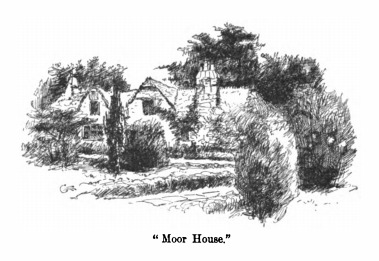
Here we see Moor House. This is the parsonage in Morton, where Mr. Rivers and his sisters lived, assisted by their housekeeper Hannah. Jane arrived here after running away from Thornton and was taken in by Mr. Rivers. Jane stayed there for several months before returning to Mr. Rochester.
This illustration depicts Julia, daughter of Julius Caesar, looking grieved after seeing the blood-stained cloak in front of her which is being held by a servant. The blood-stained cloak belongs to her husband, Pompey the Great. After seeing the blood on the cloak, Julia believed her husband must have been violently murdered. Pompey was sacrificing an animal, and when his clothes got stained by the animal's blood, a servant took his dirty clothes away to get new ones. The servant happened to pass by Julia while holding the cloak stained with animal blood. Before the servant can explain that it is not her husband’s blood, Julia falls to the ground and dies.
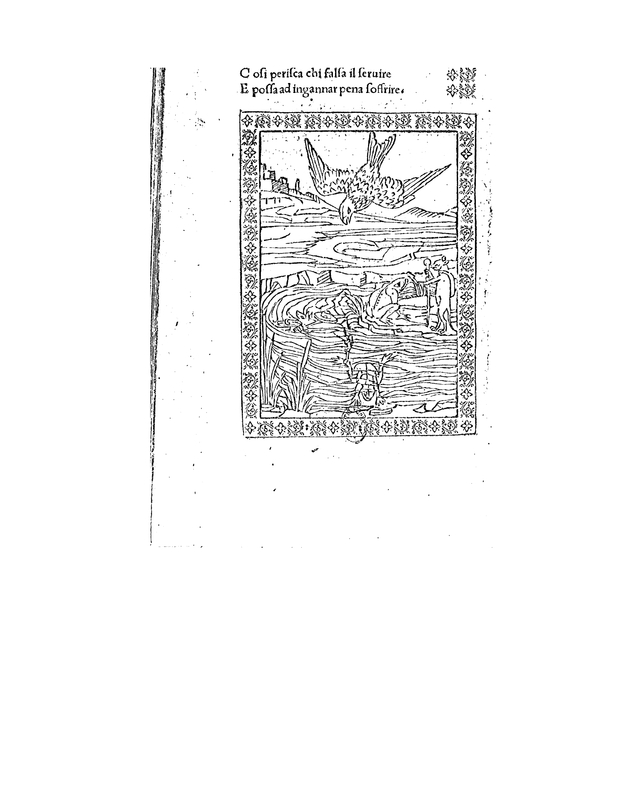
On the right side of the image we see a frog talking to a mouse that seems to be exploring on the shore of the pond. On the left we see the frog and mouse tied together, the frog is swimming downwards while the mouse struggles to stay afloat. At the top of teh image we see a bird that has presumably spotted the situation and is diving to grab both of them.
Here we see the face of Gulliver’s master, who is surprised at the things Gulliver tells him about humanity. Gulliver explains the concepts of power, malice, envy, lust, and riches. His master was shocked by these things, as they do not exist for the Houyhnhnms. The same image appears in the 1839 Krabbe edition.
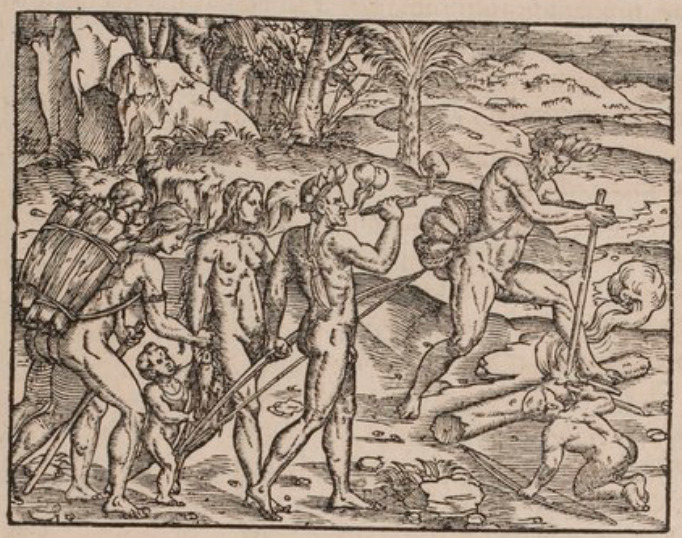
An Indigenous man wearing a feathered headdress and ornament at his back starts a fire by twirling a long stick against a log on the ground. Another man, also wearing a feathered headdress and carrying a bow, watches and smokes a cigar (or similar item). Several women and children are also amongst the group, including a small child carried in a basket on a woman’s back and another child who carries a miniature bow and kneels on the ground to watch the fire starting. This image is identical to one found on page 938 of Paris, 1575 (l’Huillier), and in Thevet’s Les Singularitez de la France Antarctique (page 101 of Paris, 1557 and page 101 of Paris, 1558).
This is a bust of Robert Walpole. The image is a part of Swift’s biography which precedes Part One of Gulliver’s Travels, in which the biographer is describing the political climate of the early eighteenth century to provide readers with context for the story. The same image appears in the 1839 Krabbe edition.
After visiting Melibea, Celestina returns home to find Sempronio waiting. She tells him she has good news, though she refuses to tell him anything more until they are with Calisto. Thus, they depart for Calisto’s house. Pármeno spots them as they approach, and Calisto tells him to let them in.The three male figures are all depicted wearing hats, while Pármeno and Sempronio (two central figures) have swords mounted on their belts. Celestina is depicted wearing a robe and veil, with a rosary in her right hand.[The central left figure is the only figure in this illustration that does not appear elsewhere in the edition. The three remaining figures appear in multiple other illustrations.]
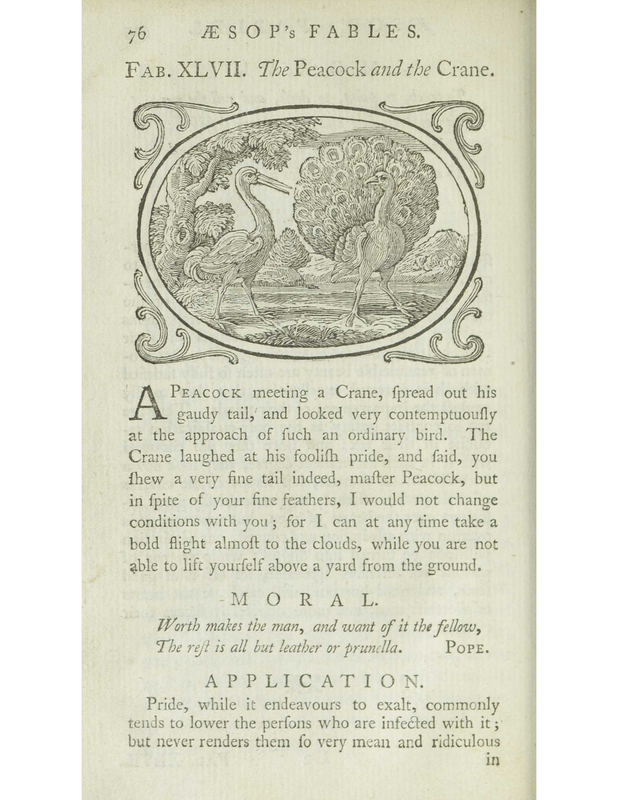
A crane stands to the left side of the image, looking at a peacock who looks back at the crane with his train spread out. Hills and greenery line the background of the picture with a cloud in the sky.
Joseph Sedley puts on his coat with help from Isidor, his valet. He is intending to go out to discover for himself whether the rumors of Napoleon’s victory are true. Jos is standing next to a chair over which another coat is draped, and on the wall behind Isidor hangs a large painting.
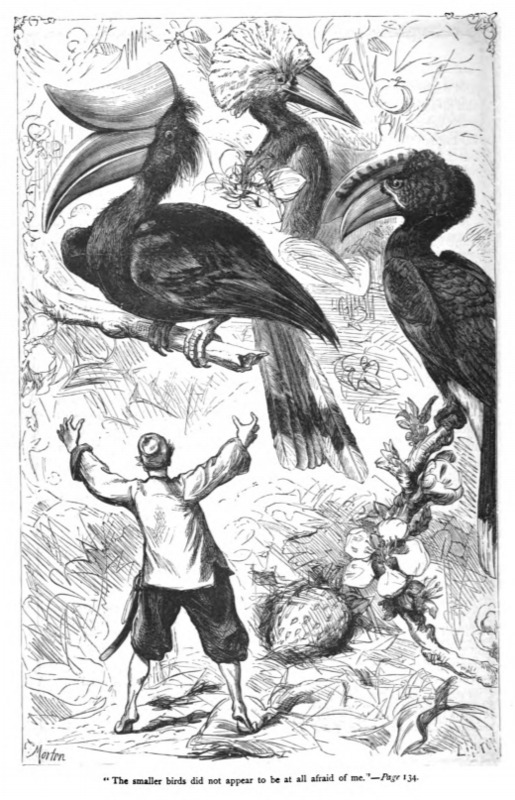
Here Gulliver stands in front of some giant birds from Brobdingnag. Some of them would even approach Gulliver to see if he had any food. This image appears in chapter five when Gulliver discusses the various aspects of being tiny in the land of giants.
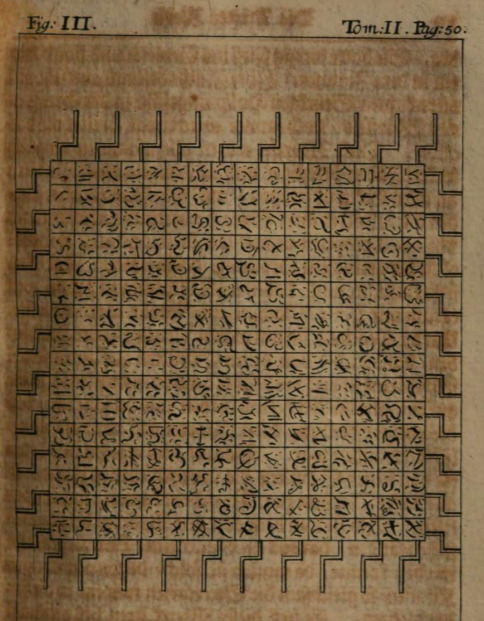
This image depicts an invention created by Laputan Projectors. The invention is to rework the Laputan language. On each of the squares is a symbol representing a phrase in the Laputan language. There are handles which would be turned to create different phrases which would then be analyzed. This image also appears in the 1739 von Wiering edition.
"A man and woman are engaged on the right side of the image, while an older man is engaged with the sun. The older man is wearing a hat and a robe, while the woman is wearing a dress with her hair in a bun, and the younger man has longer hair and a headband."
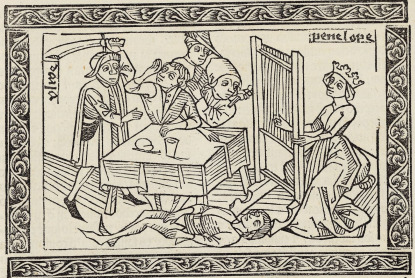
This image depicts Penelope, the wife of Ulysses, weaving on the right-hand side of the engraving as she waits for her husband to return from the Trojan War. We know that this is Penelope as her name is engraved above her head. Penelope had many suitors over the 20 years that she waited for Ulysses to return home; however, Boccaccio explains in his story that Penelope remained entirely faithful over the duration of his absence. Penelope told the suitors that she would continue to wait for her husband to return until she was done weaving a cloth, which is why she is depicted weaving in this engraving. Each night, she would undo all the weaving she had done that day so she could continue waiting for Ulysses. When Ulysses finally returned home, he had slain every suitor in his palace. Ulysses is depicted on the left side of the engraving, disguised in peasant clothing with a sword in his hand as he kills the suitors. His name is engraved behind his head in order to identify him.
Three figures are seen on a ship. The nearest is a man, sleeping on a bench with a cloth over his face and a cup and flask beside him. In the background are a tall man and a smaller woman, facing each other. Overlapping with the sail is the letter T from “The”.
This image is illustrated in a chapter that discusses the Christian priests in the colonial government in Peru. This image depicts the first sacrament, holy matrimony. There is a Spanish priest in the centre of the image performing a marriage between an indigenous man and woman. The priest is adorned in ecclesiastic ceremonial garb and is joining the right hands of the couple with his left. The indigenous man is wrapped in a cloak and the woman is wearing a headdress and a long dress with designs on the bottom.
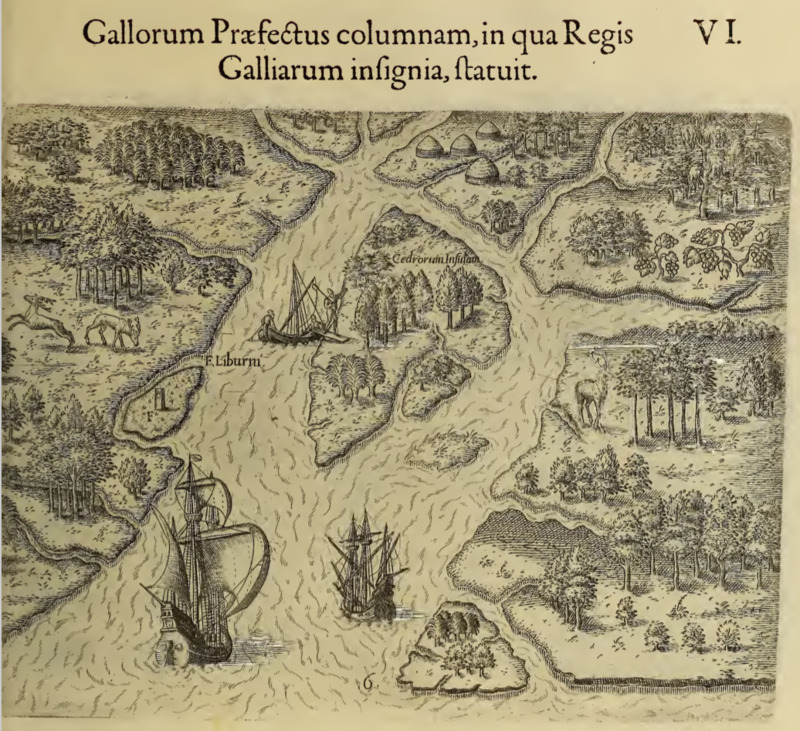
Three ships are pictured, one large and two small. Two sit at the mouth of the river, while one is further upstream. A colonist is disembarking the small boat upstream and stepping onto an island in the middle of the river. Further upstream several small round structures sit on the bank of the river. The monument mentioned in the image title can be seen on the left of the image in the middle. It was erected by Jean Ribault in 1562, during the first French voyage to Florida.
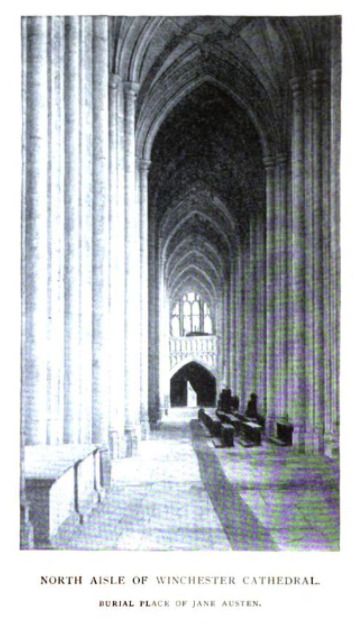
Here we see the north aisle of Winchester Cathedral. Jane Austen was buried in this cathedral after her death on 18 July 1817. The cathedral is in Winchester, Hampshire where Austen spent most of her life. The current cathedral is a Gothic cathedral. The first cathedral on this site was begun ca. 1079, but the major renovations that rejuvenated it in the gothic style took place between the fourteenth and sixteenth centuries. Austen’s grave is under the floor of the north aisle of the nave, with a simple gravestone which records her personal virtues and stoicism but does not mention her writing. In 1872 a brass plaque was put up on the north side aisle, and an illustrated exhibition detailing Austen’s life and work is displayed beside her grave. By 1900 a public subscription was begun to pay for a memorial window above the brass plaque.
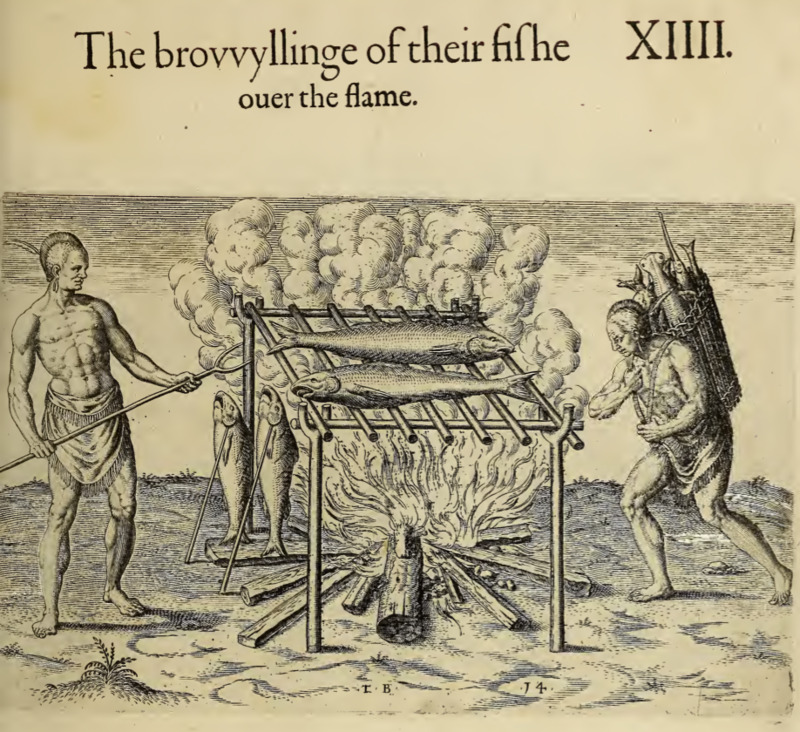
Two Indigenous men are shown cooking fish over a fire. Two fish are laid out on a rack over the flames, two others are propped up with sticks tail-down on the ground by the fire. The rack is composed of four forked sticks propped vertically on the ground, with four others forming a square horizontal to the ground, and five more laid across the the square forming a rack. One of the men holds a forked stick, the other carries a basket of fish slung across his back. Both men wear fringed garments tied around their waists and have a single feather in their hair.

![[a European grooms a horse]](https://collections.cemvc.ca/files/large/2a7e50cbb3fd75d4adab8fe1cba1590c4bf441cb.jpg)

![[a Houyhnhnm’s head]](https://collections.cemvc.ca/files/large/e5dcb55e598ca206be113105885cd367584e8e7d.jpg)

![[Robert Walpole]](https://collections.cemvc.ca/files/large/741047f1ec9f869146ac364e6dcd31dd2346e7a1.jpg)
![[Act V – Calisto Talks to Pármeno While Sempronio Talks to Celestina]](https://collections.cemvc.ca/files/large/d5b88480c63b9af8a15a1c4d5cff929b2ad1bb4d.jpg)
![[Isidor and Joseph]](https://collections.cemvc.ca/files/large/7a9760a025513b087062568cba40ab964e5f346a.jpg)

![[Three Individuals and the Sun]](https://collections.cemvc.ca/files/large/e0f9574e6788178f1227fe262f9b65e5e849ddfb.jpg)
![[Vanity Fair Chapter LXII Inhabited Initial]](https://collections.cemvc.ca/files/large/d2f38d599044d52a7efc8bcc48dfd0c0bd043cdf.jpg)
![Sacramento del Ma[trimoni]o](https://collections.cemvc.ca/files/large/b45d9da2f81ec884a8e810debfc4c0800e24e7eb.jpg)