Here we see Gulliver next to a hazelnut on Brobdingnag. During one of Gulliver’s performances a young boy threw a hazelnut at and Gulliver and it only narrowly missed him. After this incident Glumdalclitch became Gulliver’s only caregiver. Gulliver leans back in surprise and the hazelnut is almost the size of Gulliver. The same image appears in the 1843 Krabbe edition.
On the left side of the image, we see Melibea and Celestina having a private conversation. Melibea tells her about the pain in her heart, and how she’s facing a conflict between her feelings of love and the need to keep her honour and purity. She expresses hope that Celestina will be able to alleviate her suffering. However, Celestina tells her that the only cure to her pain is Calisto, and that she cannot be helped unless she concedes her deep passion for him. Melibea resists greatly but eventually relents, and Celestina makes arrangements for the two lovers to meet outside the door of Melibea's house at midnight. Melibea’s mother Alisa (seen to the right of the image, with her sister's page/servant) arrives shortly after Celestina leaves and warns her about the dangers of the old woman.
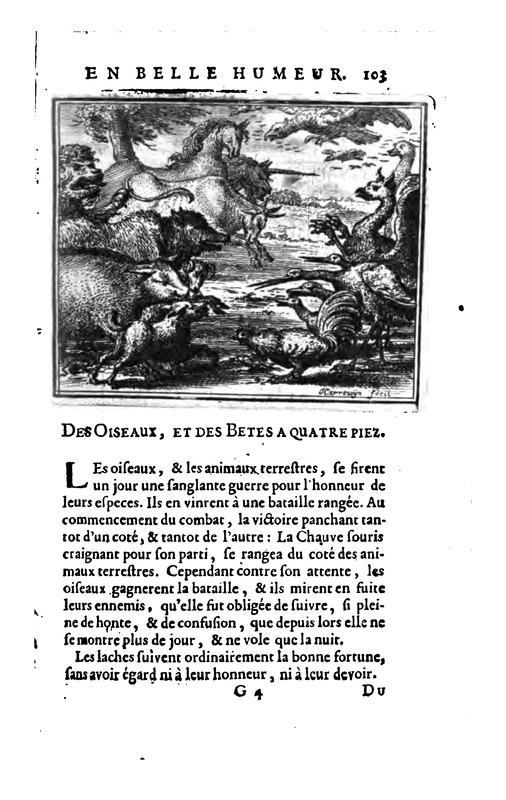
The image depicts a battle between all the birds and all the land animals. The land animals are lined up on the left of the image and the birds are facing them lined up on the right side.
Four artists watch Rebecca Sharp performing a caricature with her two dolls, Miss Pinkerton and Miss Jemmy. Rebecca is seated upon a large cushion and leaning back against a table upon which there is a statue. One of the artists is seated backwards on a chair next to her with another standing behind him; the other two stand across from her, one leaning on a table with a bottle upon it, the other beneath a bust on the wall.
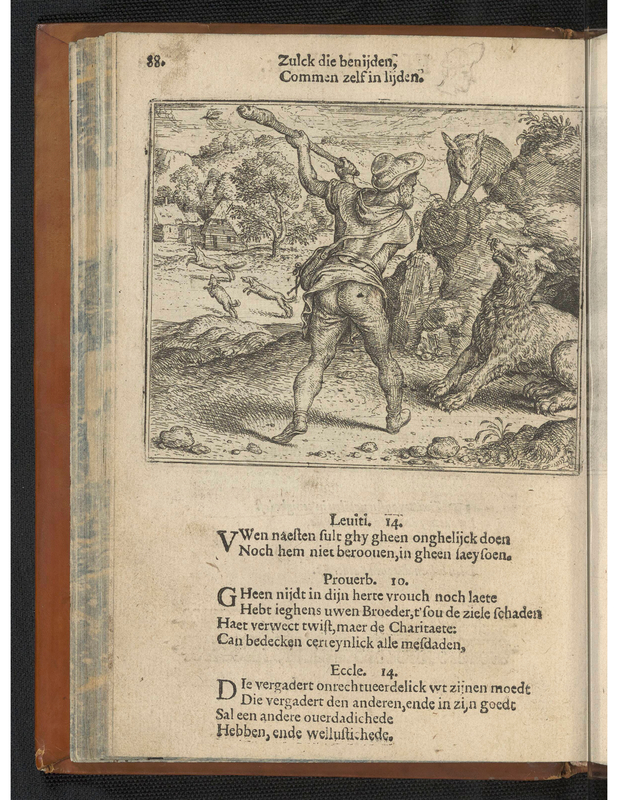
A man raises a club toward a wolf, that leans away from him. On a rock ledge, a second wolf watches. In the background, three wolves run toward a village.
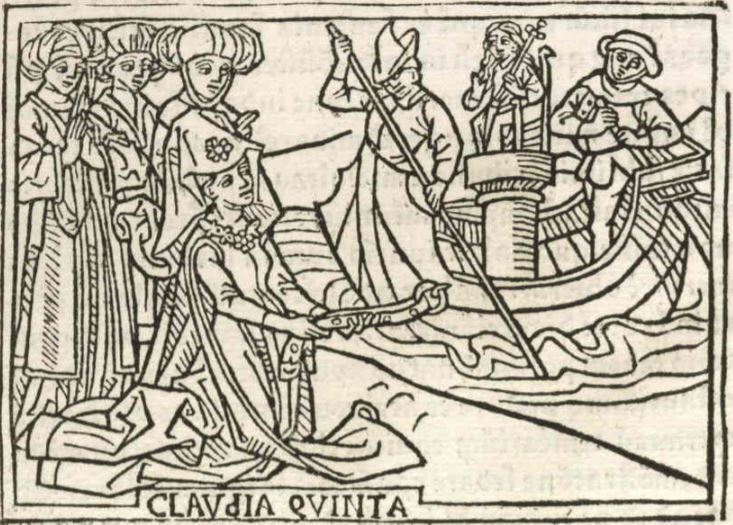
This engraving depicts Claudia Quinta, a Roman woman, standing on land as she pulls a ship to shore. Boccaccio explains that after Claudia Quinta was accused by other matrons of not being chaste, she prayed to the goddess Ceres to help prove her virtue. After a ship that contained a statue of Ceres had gotten stuck on a sandbar, Ceres gave Claudia Quinta the power to pull the ship to shore as proof of her chastity. The women who accused Claudia Quinta of being unchaste are standing behind her in the engraving as they watch her pull the ship to shore. The statue of the goddess is illustrated on top of a platform on the ship. Claudia Quinta’s name is engraved below her body to identify her.
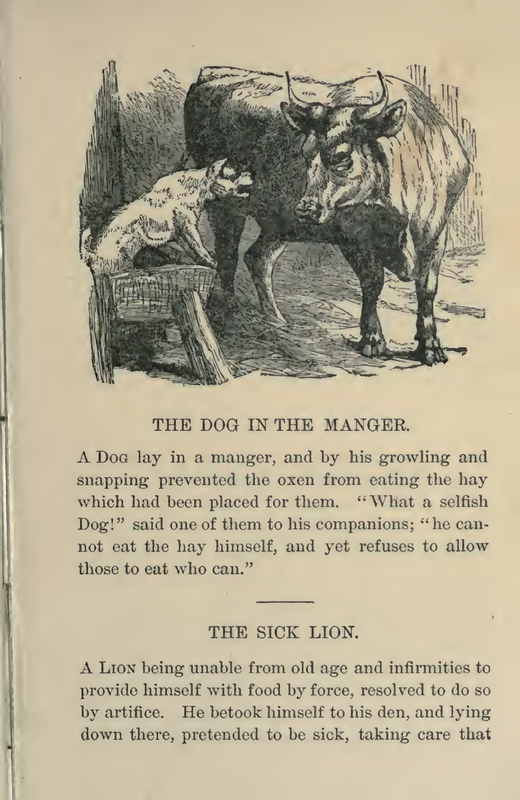
Inside a manger, a dog stands with its two front paws perched on the side of it. With its mouth opened and looking angrily at the bull in front of him. The bull is very big, and looking at the dog with an annoyed expression.
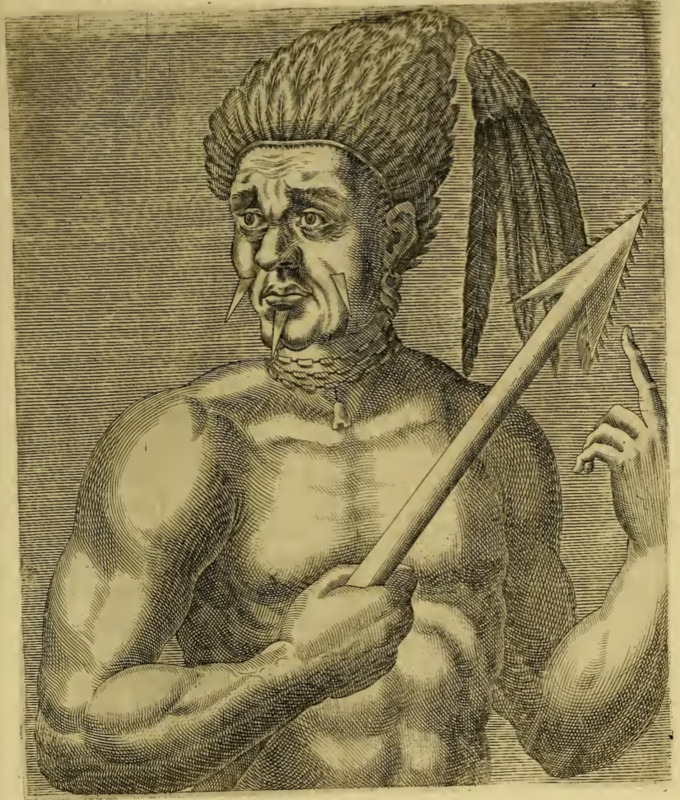
Nacolabsou (Nacol-Absou) is shown in portrait from the waist up, with his torso angled slightly to his left and his gaze directed into the distance to his right. He wears a large headdress constructed mostly of layered feathers, with a tassel of several long feathers hanging from the peak of the headdress. He has three pointed face stones, one in each cheek and one in his chin. Nacol-Absou wears earrings and a beaded multi-strand necklace, but no clothing on his torso. He holds a spear in his right hand and points at the sharp tip of it with his left. Not much is known about Nacol-Absou or the Promontory of Cannibals (although it is suggested to be near the present-day Guianas in South America). Thevet describes him in derogatory terms as savage, beastly, and cruel. Thevet’s biography suggests that Nacol-Absou died in the attempt to capture a Spanish fort near a river.
Gulliver explains the various medicines used in England to treat disease. In this image we see a man holding a cup of medicine that is steaming. He looks disgusted as the medicines often smelled and tasted horrible. Gulliver explains that the man vomits because of the foul taste of the medicine which included ingredients such as reptile skins, bones, excrements, insects, herbs, minerals, gums, oils, and juices. The same image appears in the 1843 Krabbe edition.
Here we see Gateshead Hall, where Jane Eyre lived with her aunt and three cousins for the first ten years of her life. After her parents died, Jane was sent to live with her aunt and uncle. Her uncle died shortly thereafter, but before he died, he made his wife vow to take care of Jane. Her aunt did not like her and neglected her. When Jane was ten years old, she was sent to Lowood School where she stayed for the next eight years. Jane only returned once after leaving, when her aunt died.
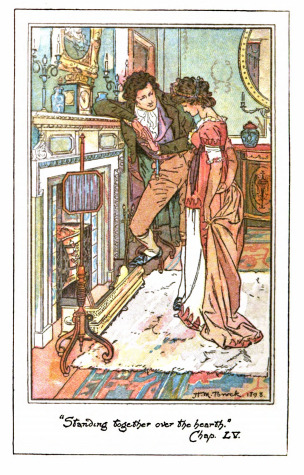
Here we see Jane and Mr. Bingley standing together near the fire. This scene occurs after Mr. Bingley returns from a day hunting with Mr. Bennet. He meets Jane alone and tells her that he is planning on asking Mr. Bennet for Jane’s hand in marriage. Jane was ecstatic. Bingley leans on the mantle looking at Jane, who looks into the fire. To the left of the hearth, we see a fire screen, a piece of furniture that would typically be placed between a woman and the fire to protect her from the heat. This saved the woman from blushing from the heat, as the fashion of the day was to have pale skin. A clock, vase, and two candle holders are on the mantle, with a painting hanging above it. This scene occurs in chapter 55 as noted underneath the title of this image. The characters are shown in the traditional regency style, with Mr. Bingley wearing waistcoat, tailcoat, and knickers that stopped at the knee. Jane wears the regency style dress with an empire waist. Their hair is worn tied up, as was tradition for women after their “coming out” before the queen, signaling her entrance into society. The regency period dated to the early nineteenth century (1811-1820) when George, Prince of Wales, later George IV (r. 1820-1830), reigned as regent for his mentally ill father, King George III (r. 1760-1820). The regency period is associated with the rise of neoclassicism in art and fashion.
At the political school at the Grand Academy on Balnibarbi, scholars work on new methods of choosing ministers and the monarch’s favourites. These methods were based on merit, intelligence, and virtue, and capacity for doing what is best for the public, rather than the old method of nepotism and bribery. These scholars, however, were largely unsuccessful. This is a commentary on the political atmosphere of England and other European countries at this time. The same image appears in the 1843 Krabbe edition.
This image illustrates a greek woman named Hippo, throwing herself off of a ship. She is the only woman in the image, and the other figures on the ship are men. She is depicted going head first into the water. Boccaccio explains that Hippo had been captured by enemy sailors, and to prevent any of them violating her chastity, she throws herself off the ship.
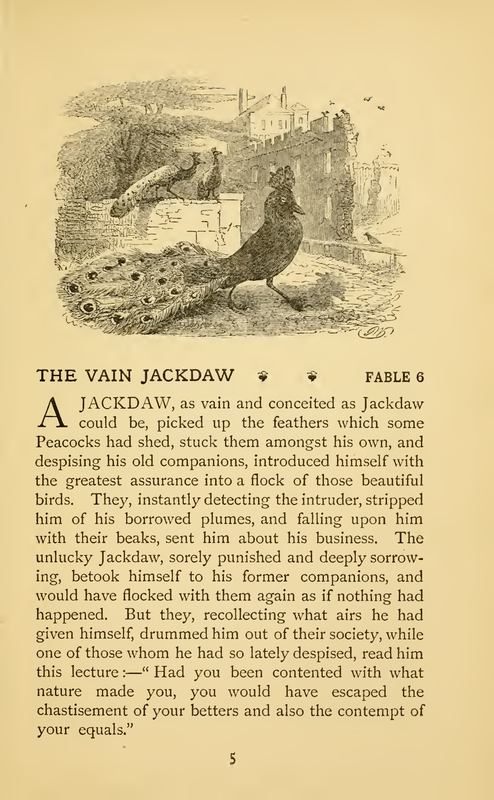
A jackdaw with peacock feathers is strutting on a block stone floor. Two peacocks are in the background perched upon a wall. In the distance, there seems to be a castle, or a house surrounded by stone monuments and walls. Birds are flying over the residence.
When Celestina (second figure from the right) and Sempronio (one of the figures to the left) arrive at Calisto’s house, Celestina tells Calisto (rightmost figure) about her meeting with Melibea. Calisto experiences impassioned mood swings with every sentence that Celestina speaks, and Pármeno (one of the figures to the left) starts chiding both him and Celestina. Sempronio grows impatient with Pármeno and tells him that his words are harming the happiness of all. Celestina eventually shows Calisto the girdle (presumably the scene depicted here), and he is overjoyed. When the time comes for Celestina to depart, Calisto asks Pármeno to accompany her and ensure that she arrives home safely.
This image depicts a noble indigenous man giving alms to a poor indigenous man in Spanish colonial Peru. The author explains that Christians in the kingdom should give alms to the poor and disabled as they have no means to support themselves. The native noble on the left side of the image is dressed in an unku [tunic] with a shawl draped over one of his shoulders. He is holding a bag in his left hand as he gives money out with his right. The poor man on the right side of the image is illustrated holding a cane to help himself walk and is depicted with wrinkles to demonstrate his older age. His right hand is outstretched to take the money from the noble. The noble says, “caymi diosrayco, uaccha” [here, for the poor, take this, by God]. The old man replies, “dios pagarasunqui, yaya” [God will reward you, sir]. The caption at the bottom of the image reads, “obra de misericordia, runa cuyapayay” [work of mercy, sympathize with people].
This is a portrait of Swift as a young man. This image appears in the biography of Swift, before the text of Gulliver’s Travels. The same image appears in the 1839 Krabbe edition.
This illustration depicts a woman named Proba leaning over a podium as she reads a book. Proba is renowned for her intellect and intensive knowledge of literature, including works from Virgil. Proba had taken lines from the "Aeneid", "Bucolics", and the "Georgics" and transformed them into a cento focusing on the Old and New Testaments. There are many books depicted in this image, which are most likely representative of the works of Virgil, Homer and other famous authors of which she composed her cento from.
Here we see a portrait of Niccolò Machiavelli, the early sixteenth century Italian humanist who became famous for his book The Prince, in which Machiavelli describes the characteristics that make a successful Renaissance Prince. These characteristics often tended to be rather violent. The image is recalling Machiavelli’s ruthlessness while Gulliver describes gunpowder to the king of Brobdingnag. Machiavelli holds a book with “Machiavel” written on it the French version of ‘Machiavelli’. The term “Machiavel” in English is used to reference someone who shares the same values as Machiavelli, often meaning to value efficiency and personal advantage over morality. The king of Brobdingnag sees Gulliver and his description of European war and politics as Machiavellian. The same image appears in the 1839 Krabbe edition.
In this image, Gulliver speaks with Captain William Prichard, who convinced Gulliver to travel with him to the South Sea on the ship called the Antelope, which is visible in the background. The two men discuss their voyage on the land, with several barrels behind them. Other members of the crew can be seen in walking and talking on the dock, behind Gulliver and Prichard, with two other men in a small boat, loading cargo from the dock to take to the ship. An anchor is in the water behind the men. A small sailing boat is next to the larger ship. The men can be identified by their clothing, with Prichard wearing a captain’s tricorne hat and fine coat, while Gulliver wears a flat brimmed top hat and carries a cane. The same image appears in the 1843 Krabbe edition.
Gulliver explains the various medicines used in England to treat disease. In this image we see a man vomiting after taking medicines. Gulliver explains that the man vomits because of the foul taste of the medicine which included ingredients such as reptile skins, bones, excrements, insects, herbs, minerals, gums, oils, and juices. The same image appears in the 1843 Krabbe edition.

![[Gulliver next to a hazelnut on Brobdingnag]](https://collections.cemvc.ca/files/large/4030afb668a02be74e4702b99e60481cb0b47039.jpg)
![[Act X - Melibea Reveals to Celestina Her Love for Calisto]](https://collections.cemvc.ca/files/large/b405fc044009255f02809c94b869684f668758b3.jpg)
![[Rebecca’s Puppets]](https://collections.cemvc.ca/files/large/7d71a65f71f4cc508778c59f40959f40cb287123.jpg)

![[a sick man holds a cup of medicine]](https://collections.cemvc.ca/files/large/28c1c5187087dab57f8aea976b130c00c21f0a25.jpg)

![[political scholars from The Grand Academy on Balnibarbi attempt to persuade monarchs on new ways of selecting ministers]](https://collections.cemvc.ca/files/large/33b49d03909e79443df27fe9b236093c69e28f42.jpg)
![[Hippo Throws Herself off a Ship to Protect her Chastity]](https://collections.cemvc.ca/files/large/cd67275d08286d441e03f790c6bbb178917b3a9e.jpg)
![[Act VI – Celestina Talks to Calisto While Sempronio Chastises Pármeno for His Snide Remarks]](https://collections.cemvc.ca/files/large/ba0c5694580686d709ba11af0872d847faf91c3f.jpg)
![S[an]ta Obra I Limosna Q[ve] an de Hazer los Cristianos en Este Mundo Mas en Este Rreyno los Yndios](https://collections.cemvc.ca/files/large/a6dd37d92be8292192633528357fe03d2eb07bcf.jpg)
![[Swift as a young man]](https://collections.cemvc.ca/files/large/a3fd93748901fcb3ad450d188af0136e9dca5cbe.jpg)



![[Portrait of Niccolò Machiavelli]](https://collections.cemvc.ca/files/large/0f96fd4804456bcdae757423bbbfdfcea9034071.jpg)
![[Gulliver in conversation with Captain William Prichard]](https://collections.cemvc.ca/files/large/88b94f8e3550bc70a89db12da52460715784d285.jpg)
![[a man vomits]](https://collections.cemvc.ca/files/large/65d6c8550f691cb4f6f16cfe90e3b5d8ee5775fb.jpg)