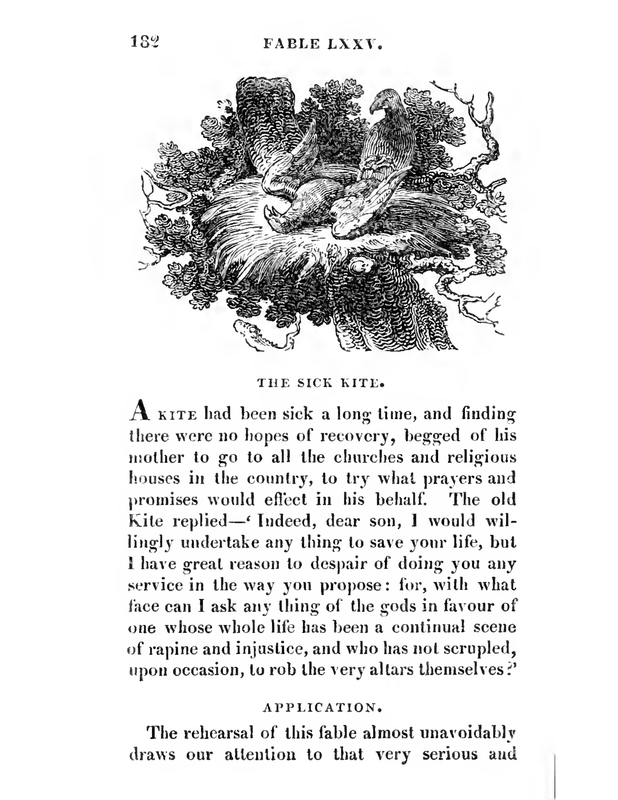
Two kite birds can be seen in the middle of the image, on a nest. One is sitting upward behind the other kite bird which is laying down. Around the nest there are many trees, bushes, and plants.
Here Gulliver sits next to a snail shell on Brobdingnag. This image appears at the beginning of chapter five in which Gulliver describes some of the problems he encountered during his time on Brobdingnag due his size. These problems include getting lost during a hailstorm and getting picked up by a dog.
This image is a depiction of a Yahoo and a Houyhnhnm (horse). The Yahoo is a form of human who lives in the Country of the Houyhnhnms and serve as a foil to the Houyhnhnms who are the epitome of virtue. The image is a part of Swift’s Biography which precedes Part One of Gulliver’s Travels. The purpose of this illustration in the biography is to provide context for the political atmosphere and insight into Swift’s satirical writings, as the Fourth part of the story serves as a commentary on the socio-political atmosphere of the eighteenth century. The same image appears in the 1839 Krabbe edition.
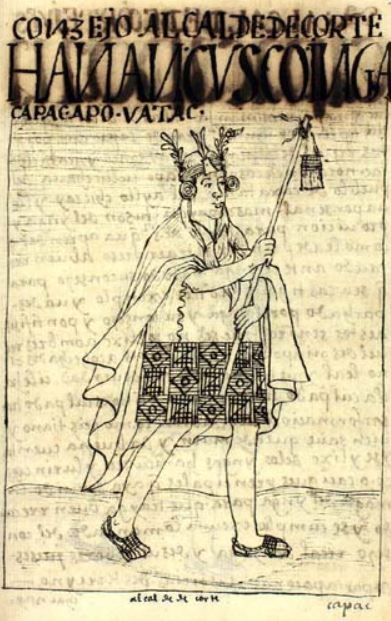
This chapter discusses the system of administrative officials in the Inca Empire. This image depicts an official in the Inca’s council named Apo Cullic Chaua. He was responsible for arresting lords who rebelled or committed crimes against the Inca. He is illustrated walking in an open area wearing a mascapaycha [imperial crown] to demonstrate his authority over the lords that he would arrest. The caption at the bottom of the image reads "alcalde de corte" [mayor of the court].
From left to right, this illustration depicts: Celestina knocking on the door to Melibea’s house with either a spool of yarn of Melibea’s girdle in her left hand, Lucrecia observing Melibea and Calisto as they meet for the first time, and an unknown male figure riding a horse. The figures of Celestina, Lucrecia, Melibea and Calisto are labelled.
This is a bust of Jane Waring, Swift’s muse. The image is a part of Swift’s biography which precedes Part One of Gulliver’s Travels. The same image appears in the 1839 Krabbe edition.
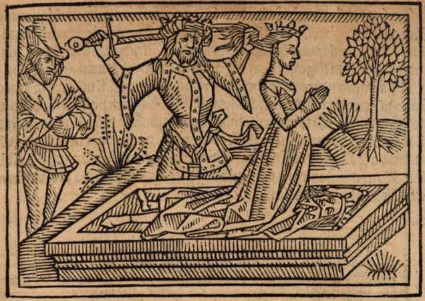
This engraving depicts Polyxena, the daughter of king Priam of Troy, getting executed on top of Achilles’ tomb. Polyxena is illustrated kneeling on the tomb of Achilles with her hands crossed while looking up to the sky as she accepts her fate. The man about to execute Polyxena is Neoptolemus, the son of Achilles. He is depicted holding Polyxena’s hair back to expose her neck. He is executing her because she had lured Achilles into the temple of Apollo, where Paris shot and killed Achilles with his arrow. She had done this through her mother’s instructions. Neoptolemus is the one to execute her as she is the one who is partly responsible for killing his father. There is a man on the left side of the engraving who is crossing his arms, as he and many others were moved by Polyxena’s willingness to accept her fate. Boccaccio explains that he wrote on Polyxena due to her fearlessness before her execution.
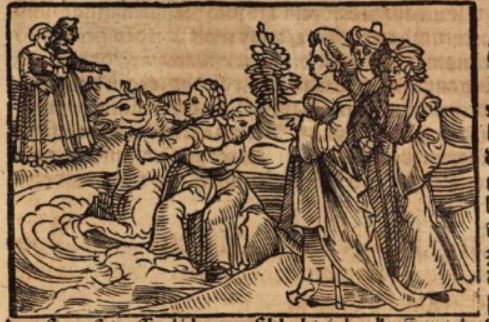
This engraving depicts Cloelia, a young Roman woman, riding a horse through a deep river with many women looking at her. Boccaccio explains that Cloelia was given to a foreign king as a hostage, and when she escaped, she took many other hostages with her back to Rome. While escaping, she came across a river that was too treacherous to pass. She found a horse, and despite never having ridden one, she got herself and the other women across safely by means of this horse. This image depicts her taking the other women across the river one by one as there is only one other female on the horse with Cloelia. There are women on each side of the shore.
In this image we see Gulliver swimming for his life after his shipwreck. We can see the ship faintly in the background as it sinks. Gulliver swims to the shores of Lilliput. His hand is reaching out of the rough waves. He still wears his hat which can be seen in the first image in the text of Gulliver and Prichard. The same image appears in the 1843 Krabbe edition.
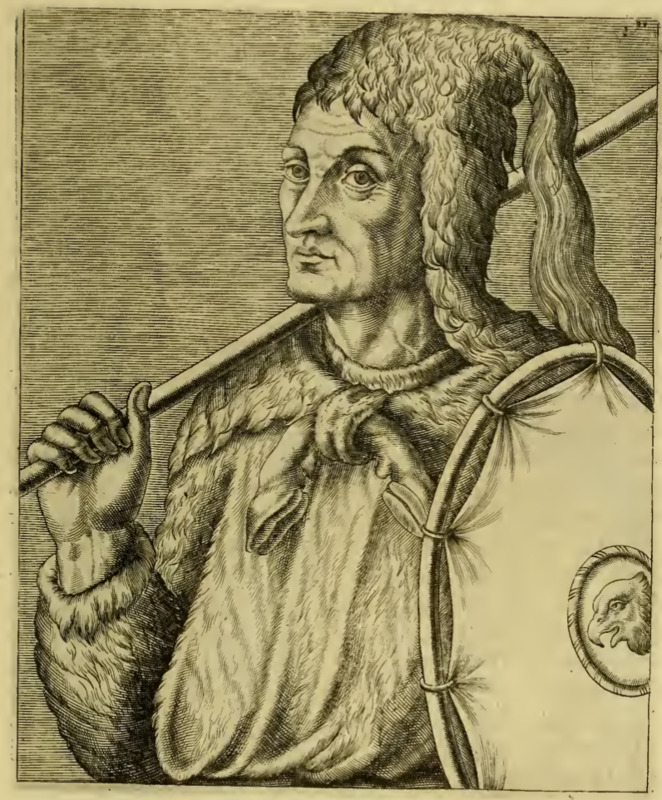
Paracoussi is shown in portrait from the waist up. His torso is angled to his right and he gazes at the viewer. He wears a cap made from fur or feathers with an animal tail hanging from the top. Paracoussi also wears a thick tunic made from fur and a cloak tied at his neck. He carries a spear in his right hand and a circular shield decorated with the image of an eagle’s head in his left. Little is known about Paracoussi (Paracoussi may not even be this man’s name, but rather a title meaning chief or ruler), but he is believed to have ruled in the Patagonia region of South America, possibly up to the Rio de la Plata in the present-day Pampas region of Argentina.
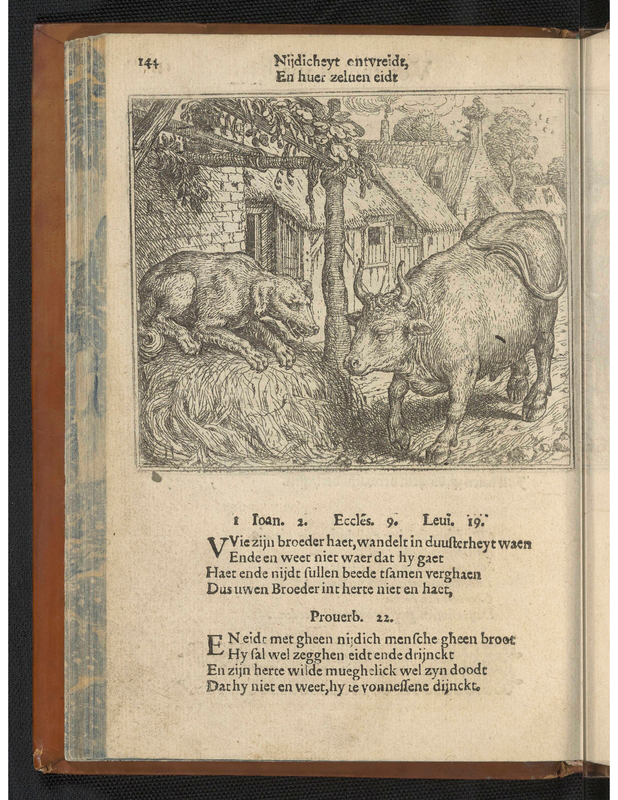
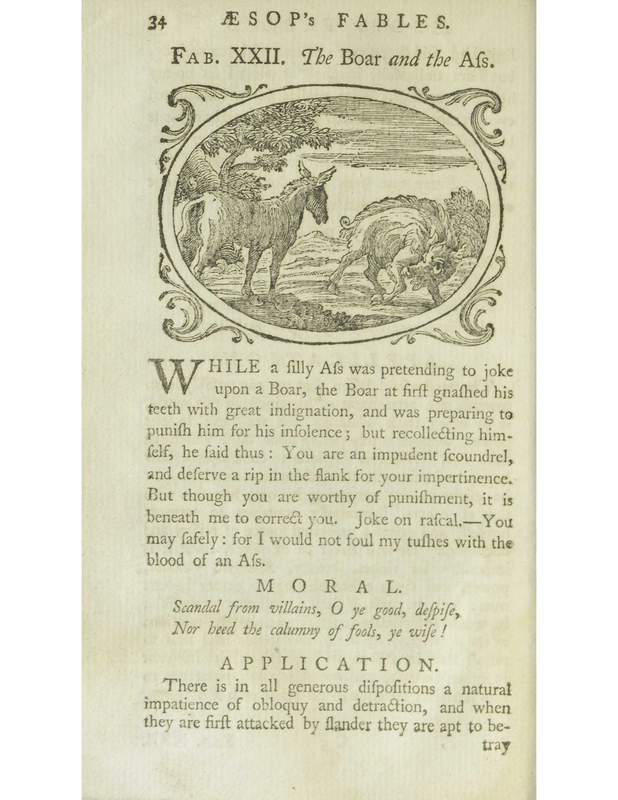
There is an ass to the center, left of the screen, with a tree and some foliage on the tree on the background. To the center, right of the image, there is a boar that can be seen, who appears to be scowling at the ass. Behind the boar, there are some small shrubs. The boar’s fur appears to be raised and its back arched. The ass appears to be looking at the boar.
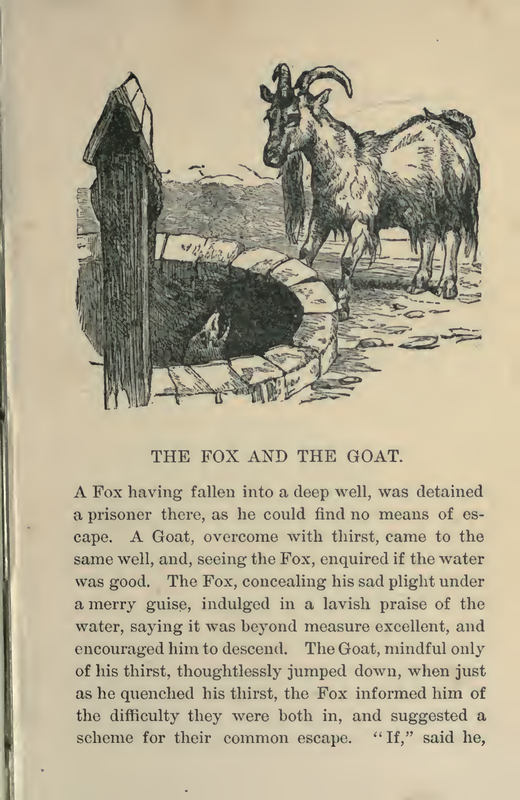
A goat stands near a well on the right-hand side of the image. The goat has long, curly horns, and with a long beard reaching its knees. Down in the well, the head of a fox is sticking out, its mouth open while it looks up at the goat with a pleading expression.
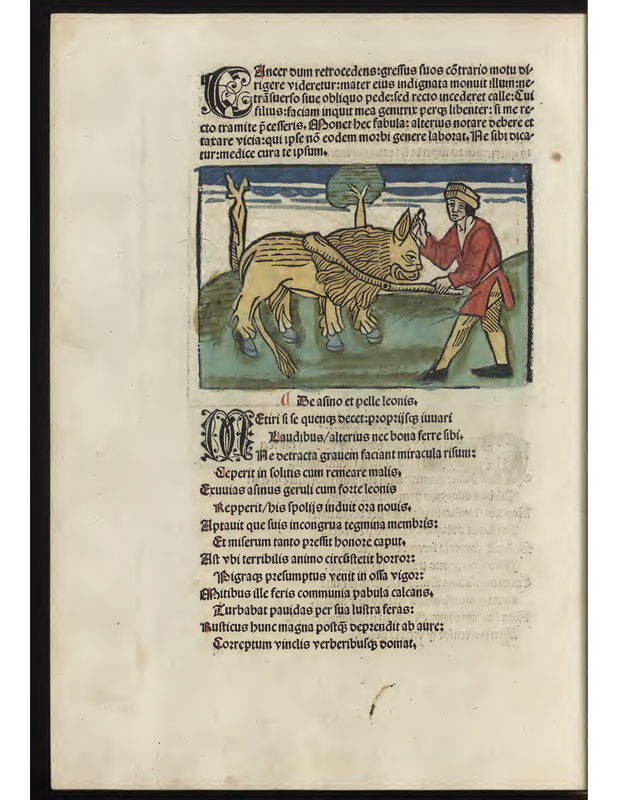
A man and donkey are interacting outside. The man is carrying a large stick and holding on to the donkey’s ear. The donkey appears to be wearing the skin of a lion as disguise. They are outside amongst trees and a clear blue sky.
Here we see a depiction of the winemaking process in Europe. In the foreground we see the grapes and other fruits, and in the background, we see men working a mill to crush the grapes. This image appears when Gulliver explains the culture surrounding wine in Europe, including its effects on people and their behaviour, both the short-term drunkenness followed by hangovers, and the longer-term effects on one’s health. The image also reflects Gulliver’s account of the rich man benefiting off of the poor man’s labour. The same image appears in the 1839 Krabbe edition.
Celestina (leftmost figure) arrives at Melibea’s house, where she is greeted by Lucrecia, Melibea’s servant. As an old friend of Melibea’s mother Alisa (possibly the rightmost figure), Celestina gains entry under the false pretense of paying her a visit and selling yarn. The servant of Alisa’s dying sister arrives and informs Alisa that her sister has requested her presence. Alisa departs, leaving Celestina alone with Melibea (central figure) and Lucrecia (possibly the rightmost figure). She talks for a while with Melibea and eventually reveals that she is there on behalf of Calisto, which sends Melibea into a fit of rage. Celestina manages to quell her rage with a lie, telling her that Calisto’s cure requires only her girdle and a handwritten charm/spell (in this illustration, Melibea can be seen handing the girdle to Celestina). Melibea gives Celestina her girdle, and she asks Celestina to return the following morning to retrieve the spell.
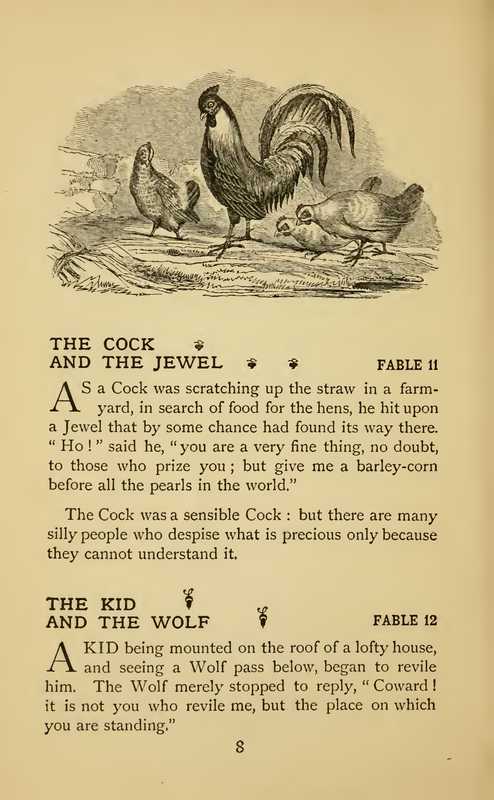
A cock is seen in the centre, surrounded by two hens behind him who are scratching up the straw and one hen next to him which is looking at the ground.
"A roosters head is in the mouth of a wolf. The wolf is on the left side of the image and the rooster is on the right side. There are two trees in the background. The wolf has an angry expression."
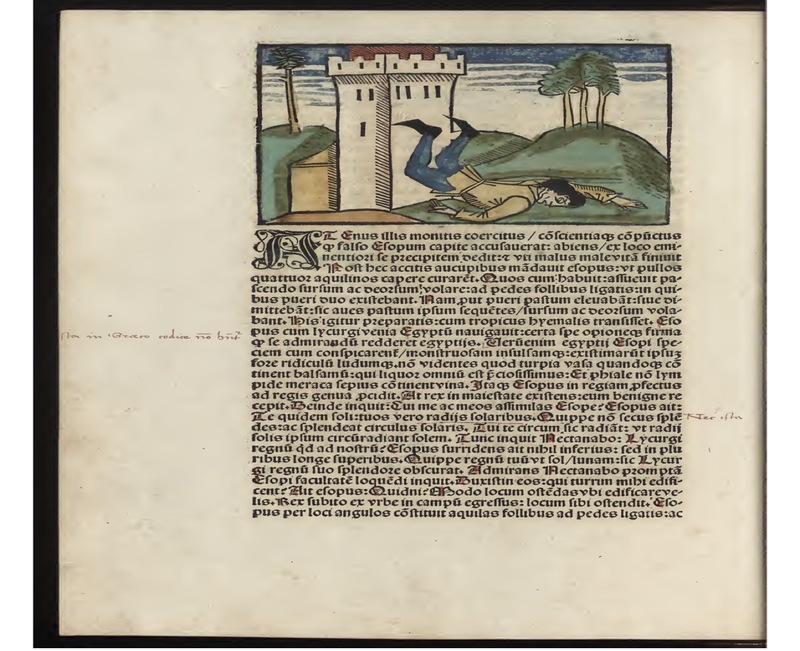
A man lays at the bottom of a tower in the hills. Deceased, his body lays face down in the grass after jumping from the top of the tower. In the background stand trees on the hills.
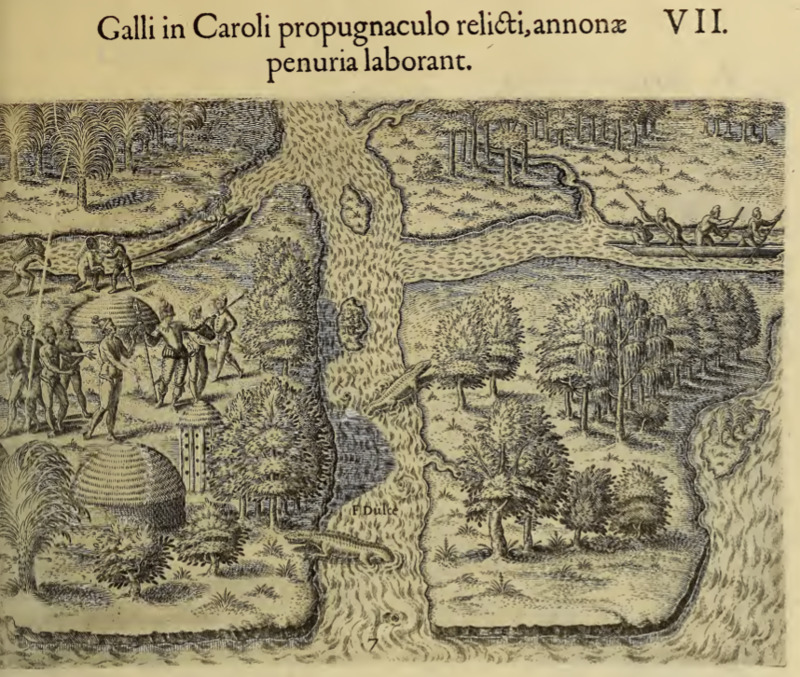
A network of rivers and canals is pictured. On the right side of the image four Indigenous people row a dugout canoe. On the bank of the river on the left side of the image there are several round structures, a group of Indigenous people on land, and another canoe in the water. Some of the individuals hold long spears, some carry large baskets on their backs. In the caption, Charlesfort refers to the first French settlement in Florida in 1562.
Here we see Gulliver performing for a crowd of Giants. The Farmer sold tickets to other giants to see Gulliver. On the front right, we see Glumdalclitch speaking to Gulliver and giving him instructions, while an older woman leans over her shoulder. Two other children stand in front of the table watching Gulliver. Behind the children are their parents. There are two more rows of giants in shadow. Gulliver stands on a table holding a piece of straw as though it was a fencing sword. The same image appears in the 1843 Krabbe edition.
Once in Calisto’s house, Celestina begins telling him about her visit with Melibea (as depicted by the two leftmost figures). As she recounts Melibea’s rage and her return to calm, Calisto experiences intense mood swings and repeatedly interrupts her. Pármeno and Sempronio stand aside from them (as depicted by the two rightmost figures). Pármeno insults both Celestina and Calisto under his breath, and Sempronio grows frustrated with his comments, informing him that his opposition is hurting everyone involved. Celestina reveals Melibea’s girdle and tells Calisto that Melibea asked her to return the following day, bringing him great joy. As Celestina departs, Calisto tells Pármeno to accompany her and ensure her safe passage home. The three male figures are depicted wearing hats, while Pármeno and Sempronio also have swords mounted on their belts. Celestina is depicted wearing a robe and veil, with a rosary in her right hand.[The figures in this illustration are used in multiple other illustrations throughout this edition.]
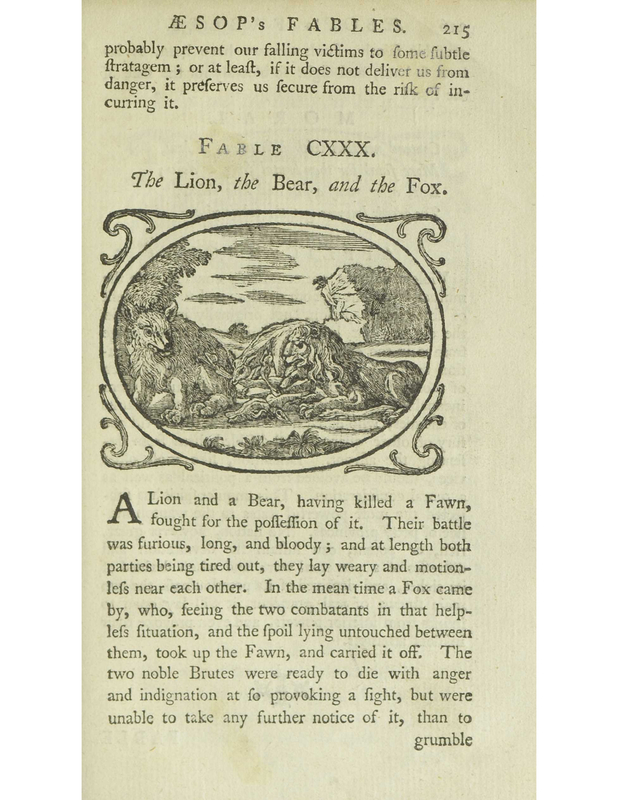
The scene is taken place outside in a field with plants and bushes around, a Lion and a Bear had just killed a Fawn and had fought for the possession of it. The battle was long and furious and they now lay tired and motionless near eachother while the Fawn still lays in between them. In the meantime a Fox comes by and sees the two combatants in their helpless situation and takes advantage of their tiredness and takes the Fawn for himself.
Rebecca Crawley sleeping alone in her bed after waving goodbye to her husband. She has a sleeping cap on and looks peaceful and content, not at all concerned about the regiment’s departure to the battlefront.

![[Gulliver sits next to a snail shell Brobdingnag]](https://collections.cemvc.ca/files/large/13084898d26aafcfd19e595fc256acf4ce692ea9.jpg)
![[A Yahoo and a Houyhnhnm]](https://collections.cemvc.ca/files/large/268d7c481559acf92a4902e5c710e2f43f4550a1.jpg)
![[Title Page – Celestina, Lucrecia, Melibea, Calisto, and an Unknown Fourth Figure]](https://collections.cemvc.ca/files/large/df8b74602325cd8e350a81aaa702ea4d16a93b11.jpg)
![[Jane Waring]](https://collections.cemvc.ca/files/large/c590aa8d249648aa219bdaece635f1f88d728ae6.jpg)
![[Gulliver swimming to shore after the shipwreck]](https://collections.cemvc.ca/files/large/cc0307c17dfd2a424062e9c446bb885e81d721e9.jpg)
![[Winemaking in Europe]](https://collections.cemvc.ca/files/large/b46e8eb1e226647bc4fec12d45edeb5fabe70ce5.jpg)
![[Act IV – Celestina Talks to Melibea While Another Female Figure (Either Alisa or Lucrecia) Faces Away]](https://collections.cemvc.ca/files/large/1f9480d3f9b3ba8c6297b38a585ea2802c0c0107.jpg)
![[Roosters Head in a Wolfs Mouth]](https://collections.cemvc.ca/files/large/ecd6a87379d71245e158019d3db6de5cdeb0ebf0.jpg)
![[A crowd of giants watches Gulliver perform on Brobdingnag]](https://collections.cemvc.ca/files/large/34456faebef769933e750cf05436b465c8f4db08.jpg)
![[Act VI – Calisto Talks to Celestina While Pármeno Chides Them to Sempronio]](https://collections.cemvc.ca/files/large/3db7a4e6a954869c294e2ea4e9a0ca9d4d9ae12c.jpg)
![[Rebecca Crawley Asleep]](https://collections.cemvc.ca/files/large/bb1c961c28bc95dd606ae01fb95af3b75f3bb0a4.jpg)