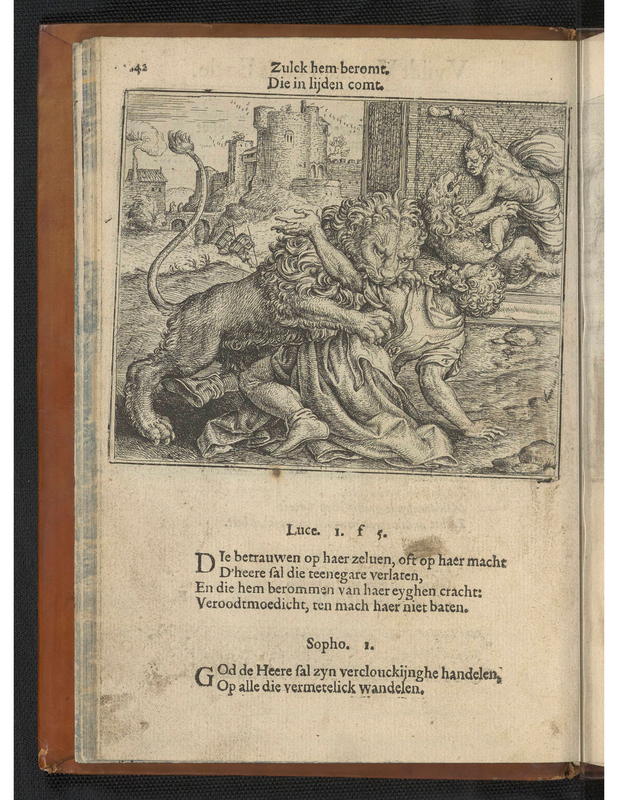
A man and a lion fight in a field. The lion’s jaws close around the shoulder of the man as he falls back. A statue of a man defeating a lion stands behind the battle. A castle can be seen in the distance.
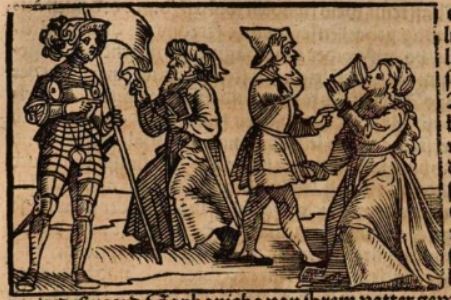
Masinissa, the king of Numidia is depicted on the left side of the engraving speaking with a man named Laelius. Laelius is depicted pointing at Masinissa as he reproaches him for marrying a captive of the Romans. Not able to disobey Laelius, Masinissa ordered a servant to give Sophonisba, his wife, a cup of diluted poison. Sophonisba is depicted on the right side of the engraving willingly drinking the poison. The servant in front of Sophonisba looks astonished at how willingly she drank the poison.
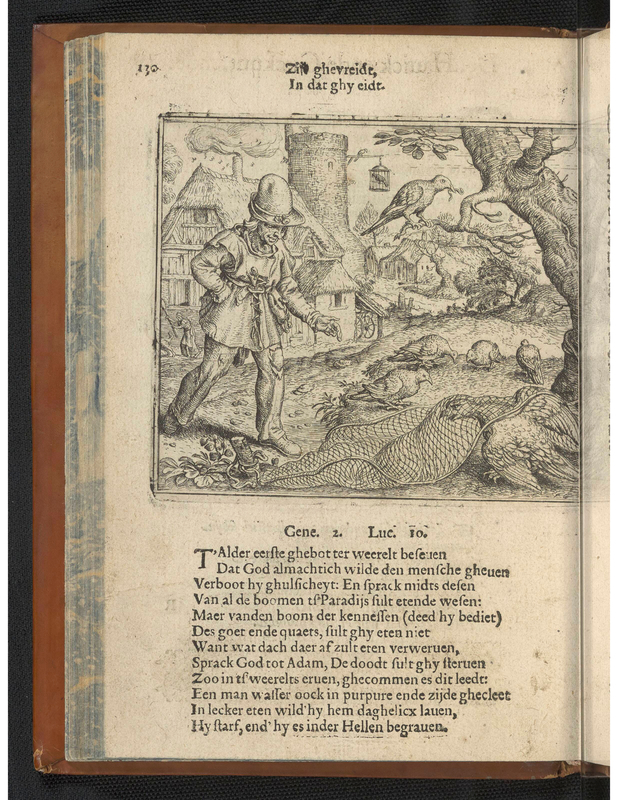
A man standing at left looking at a hawk in a net at right; a group of other birds stand in the background in front of a little village; Dutch letterpress on verso; illustration to Eduwaert de Dene's edition of Aesop's Fables, "De Warachtighe Fabulen der Dieren" (Pieter de Clerck, Bruges: 1567). c.1567
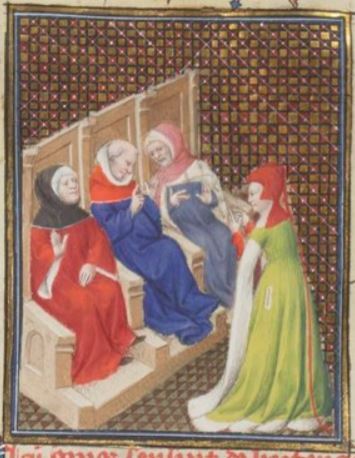
This illustration depicts Hortensia, the daughter of famous orator Quintus Hortensius, speaking in front of the triumvirs. Hortensia inherited the gift of oration from her father, and when the triumvirs raised taxes unbearably high, she spoke so eloquently to them that they revoked the taxes. The triumvirs have pleasantly surprised looks on their faces as they are impressed with Hortensia’s abilities. Hortensia appears to look confident as she speaks to them.
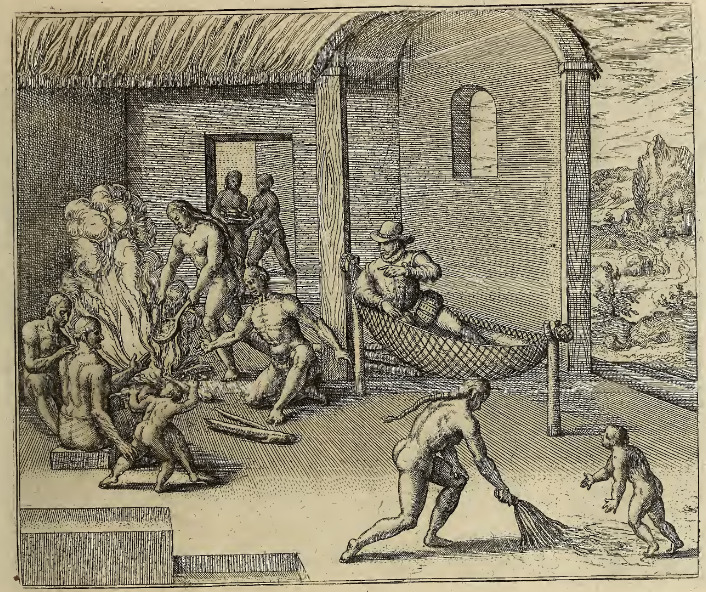
A Spanish man (Girolamo Benzoni) lounges in a hammock inside an Indigenous structure, in conversation with a Nicaraguan Indigenous leader (a Cacique). In the foreground an Indigenous woman sweeps the floor while a child frolics around her. Beside Benzoni’s hammock, a group of Indigenous men and women tend a fire and prepare food. The Cacique sits on a block close to the fire and holds onto the leg of a child while he converses with Benzoni. In the background, two women enter the room with a platter of food.
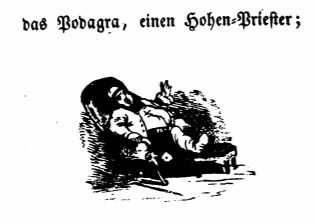
This image is of a high priest sitting in a chair with gout. Gout was the code word for the high priest. This image comes in a description of a conspiracy found by a professor from the Grand Academy on Balnibarbi. This idea is representing code word for terms in the conspiracy that Swift is satirizing. The professor advises that those named in the conspiracy papers be closely monitored at all times, naming specifically while they were using the bathroom, as this is when men were most thoughtful. This conspiracy is thought to be an allusion to the trial of Francis Atterbury, the bishop of Rochester for allegedly plotting with the Jacobites. Atterbury was charged with treason in 1722 and was exiled to France. The same image appears in the 1843 Krabbe edition.
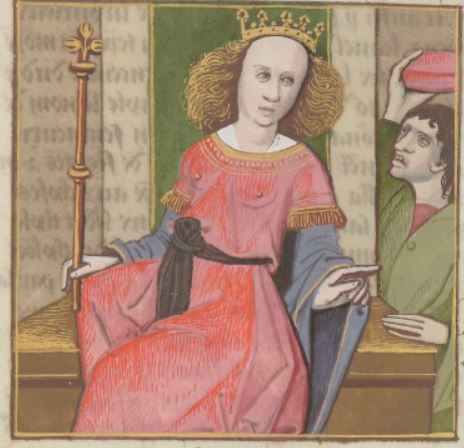
This illumination depicts Queen Cleopatra of Egypt sitting on a throne wearing a crown and holding a scepter in her right hand. She is pointing her finger towards a man on the right side of the image, appearing to be giving orders to him. Cleopatra and her lover, Mark Antony, both killed themselves to avoid dying at the hands of Octavian. Boccaccio believes that Cleopatra killed herself by cutting her wrists and putting asps (vipers) at the wounds to poison herself.
In chapter six, Gulliver explains several aspects of society in England. Here we see a stack of coins with the lion of Great Britain. Gulliver explains finances and the English fiscal system and Treasury to his Master on the Country of the Houyhnhnms. The same image appears in the 1843 Krabbe edition.
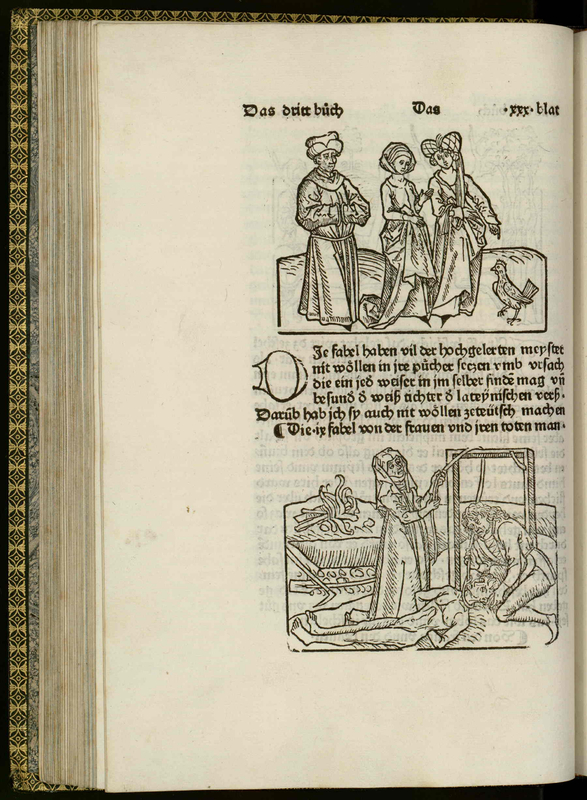
A man has passed away from a noose around his neck, while he lays unconscious on the ground a man is trying to untie the rope from his neck and a woman is making the other end of the rope which is more loose. There’s a fire in the background with a couple pickaxes in the background
A dragon is standing on its curled tail inside a kitchen. It is holding a long tool prickly with a handle in its mouth, and it is putting it inside a bag. In front of the dragon are ovens and stoves. In the right-hand corner, the door is open and is giving the view of the rest of the village, possibly a castle.
This image is illustrated in a chapter that discusses the Christian priests in the colonial government in Peru. This image depicts a Spanish priest on the right side of the illustration and a poor Spanish soldier on the left as they draw swords against one another. Both the soldier and priest are also depicted holding a blanket in their hands help with the impact of the sword fight. The author criticizes the priest for his sinful actions in engaging in a sword fight.
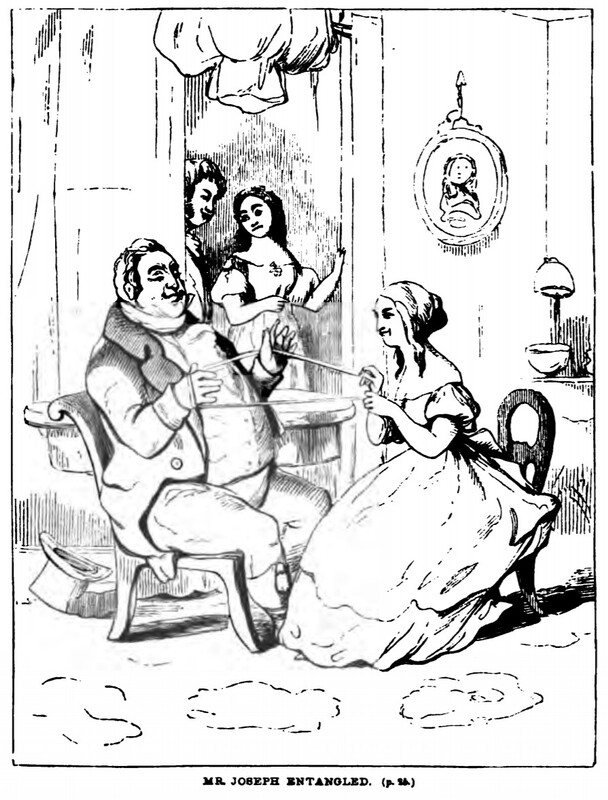
Joseph Sedley and Rebecca Sharp sit at two chairs in front of a round table; she holds both ends of a string of silk which is wound around his hands. Beneath the table is Joseph’s hat, and in the background, another table with a lamp and bowl and a portrait upon the wall. Amelia Sedley and George Osborne are entering through the doorway behind the round table at which the others sit. Below the illustration is printed its title and location in the story, “MR. JOSEPH ENTANGLED. (p. 25.)”.
Here we see a Laputan scholar about to run into a post because he is so deep in thought he becomes unaware of his surroundings. His Flapper gently taps his eyes with a blown bladder filled with peas or pebbles to warn him that he will hit the post. The Laputans wear clothes with astronomical and musical motifs. On the post there are mathematical and geometric motifs. The Flapper walks behind the scholar and holds the bladder over one shoulder. In the background of this image we see another scholar with his Flapper. The Laputans’ faces were not symmetrical, with their heads tilting to one side, and one eye turning inwards and the other looking straight up. The same image appears in the 1839 Krabbe edition.
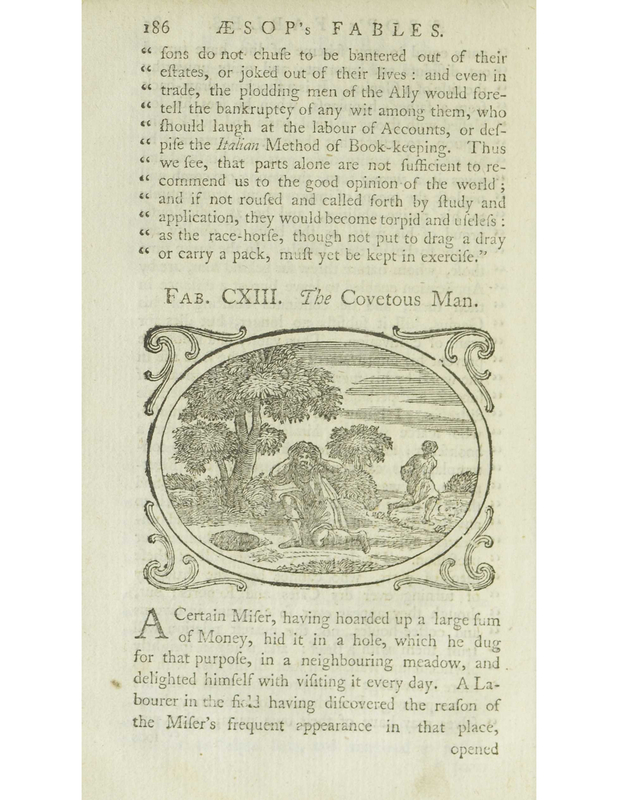
A man kneels on the ground with his hands on the sides of his head, seemingly panicked. In front of the man is an empty hole in the ground. In the background, another man is running away with his back facing the viewer, and is carrying something under his left arm. There are trees and bushes around the loacation.
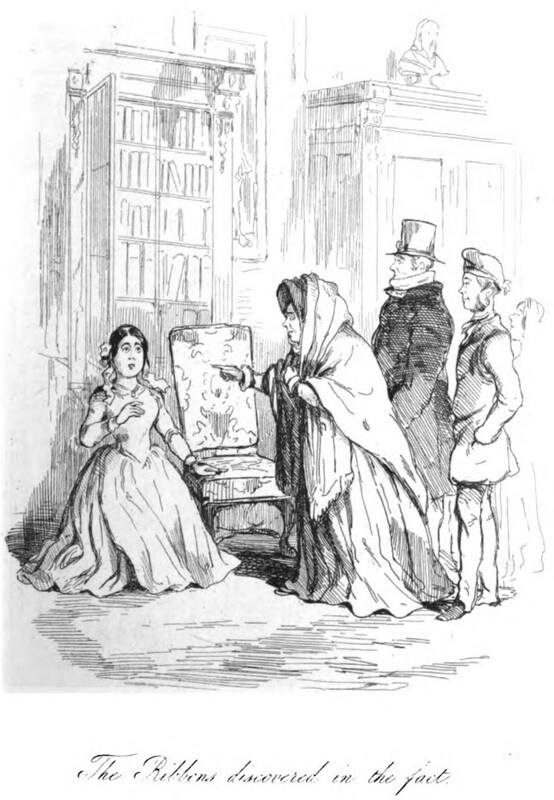
Miss Betsy Horrocks, with large ribbons in her hair, kneels in shock next to a chair in Sir Pitt Crawley’s study. Mrs. Martha Crawley, who has just caught Miss Horrocks trying a stolen set of keys on the locked drawers in the room, points an accusing finger at her. Behind her are Reverend Bute Crawley, her husband, and James Crawley, their son, who have both also witness the robbery. Below the illustration is printed in cursive its title, “The Ribbons discovered in the fact”.
Lucrecia (right-central figure) brings Celestina (left-central figure) to Melibea’s house. There, Melibea (leftmost figure) tells Celestina of her love for Calisto. Alisa (rightmost figure) overhears Melibea and Celestina talking. Celestina walks past Alisa on her way out, and Alisa asks her the purpose of the visit. Celestina claims that she was short on yarn the day before and felt she had to return to make up the deficit. Alisa then asks Melibea the same question, and Melibea answers that Celestina sold her sublimated mercury. Suspicious of the difference in answers, she warns Melibea against dealing with Celestina again, citing her immoral and dishonest ways, as well as the ill that befalls those who entertain her presence.[The figures in this illustration are used in multiple other illustrations throughout this edition.]
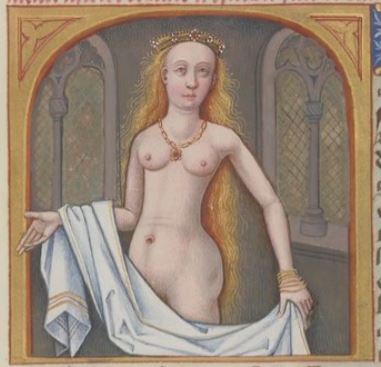
This illuminated image depicts a statue of the goddess Juno in the nude while holding a cloth to cover her legs. Statues of Juno were put up in Samos, as well as Rome to honour the goddess. Juno grew up in the city of Samos before she was wed to her brother, Jupiter. A statue of Juno was erected in a temple dedicated to Juno to honour her significance to the city of Samos, which is presumably the statue depicted in the image.
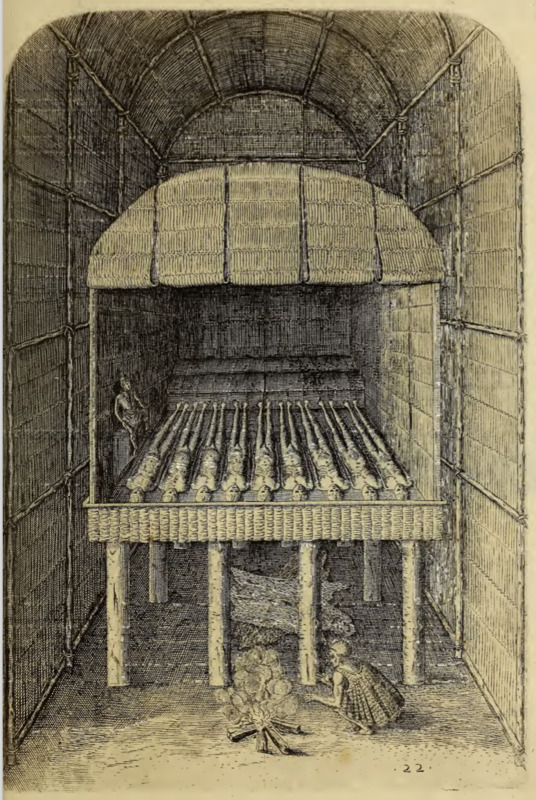
A tomb is shown, where the chiefs of this Indigenous group are laid to rest. The tomb sits inside a larger structure. It is set on thick logs that elevate it off the ground. The bodies of the chiefs are laid out side by side on a platform on top of the poles. Walls and ceiling enclose the bodies. At the base of the tomb a man crouches beside a fire.
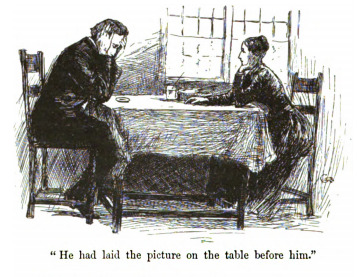
Here we see Mr. Rivers and Jane Eyre sitting across from each other at a table. He looks down at a drawing Jane had done of a landscape. He then tried to convince Jane to join him on a missionary trip to India, but she refused. He argued that she could draw different landscapes in India for inspiration.
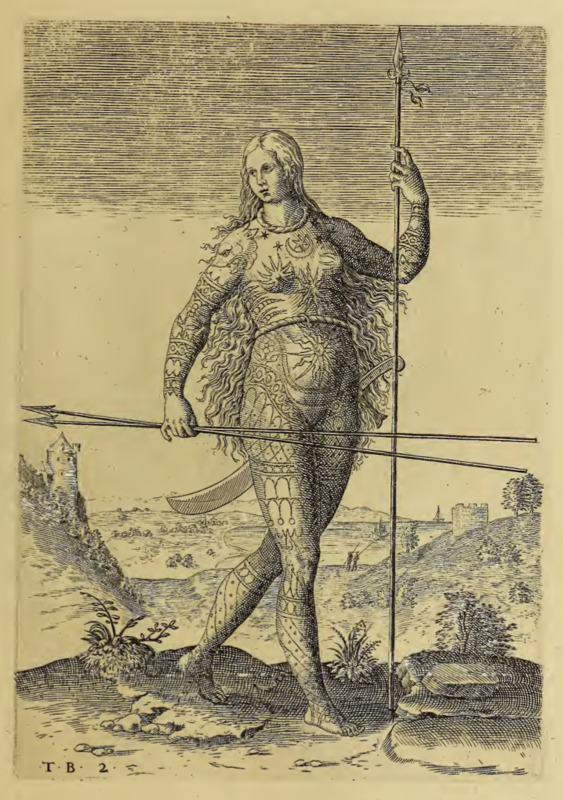
An Indigenous woman is shown from the front. She carries a spear in her left hand and two in her right. Her hair is long, she wears a twisted cord around her neck, and a sword with a curved blade hangs from another cord around her waist. She is nude, and her body is covered in painted designs. The Picts were an Indigenous group who lived in Britain long before the author’s time. Images of Picts were included in this book so that readers could compare their customs to those of the Indigenous people living in Virginia.
![[stack of coins]](https://collections.cemvc.ca/files/large/45bbfe74b148b42bb8c1f6817359a2c9ed5fed35.jpg)
![[The Dragon Tidying Up the Kitchen]](https://collections.cemvc.ca/files/large/1a10ebd5a5f9914ccc685b0661c7a39ad9a4c982.jpg)
![Soberbioso P[adr]e, Colerico Espanol](https://collections.cemvc.ca/files/large/85f86f60dc6dbe588a43ff34858a63064afc4418.jpg)

![[Laputan scholar with his flappers]](https://collections.cemvc.ca/files/large/355534351bb3ddf80a59416b37333bbaacd62972.jpg)
![[Act X – Melibea, Celestina, Lucrecia, and Alisa]](https://collections.cemvc.ca/files/large/72fa4285b1c5964318ec2d1bc5c49dad26aab257.jpg)