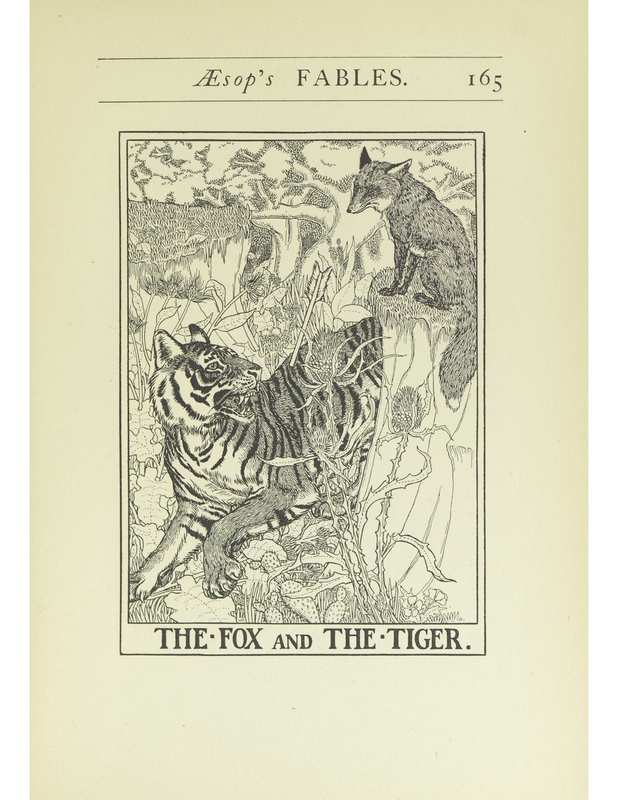
The tiger is in a ravine, he is wounded, there is an arrow in his back. He is surrounded by weeds and cactus plants, while the fox is sitting on top of the ravine on some grass staying away from the tiger and watching.
Don Quixote sits in a wooden chair with a beaded necklace slung over his left wrist, looking indignantly towards the robed figure at his feet. Pictured to the left at Quixote's feet, the robed figure kneels on both legs and begs for Quixote to fulfill their request. On the left, a second robed figured stands with their hands grasped together. On the right the Duke and Duchess (pictured in rich and fanciful apparel) look at these robed figures, as do their servants. In the center of the background one of the servants is delivering chicken to the Duke.
The innkeeper (holding Don Quixote’s hand), her daughter (behind her mother), and Maritornes (holding the torch) take care of Don Quixote and make him a bed in the garret. Sancho Panza is pictured holding his arm with an expression of pain. Plate no. 10, signed by J. Vanderbank (illustrator) and G. van der Gucht (engraver). Vol. 1, book 3, ch. 2.
This image appears at the beginning of the tenth book. There are many elements in the image that are reflective of the stories and fables that appear in this book. The musical instrument in the centre of the image is a lyre which represents the story of the musician Orpheus which appears in this book. There is an eagle in the top left corner which is a symbol of Jupiter, as he often transforms into an eagle. The peacock on the right side of the image represents the goddess Juno. The snake below the lyre represents the serpent that killed Orpheus’ wife Eurydice. The stag on the left side of the image is the stag sacred to the Carthaean nymphs. The heifer in the bottom right corner represents sacrifices to the goddess Venus.
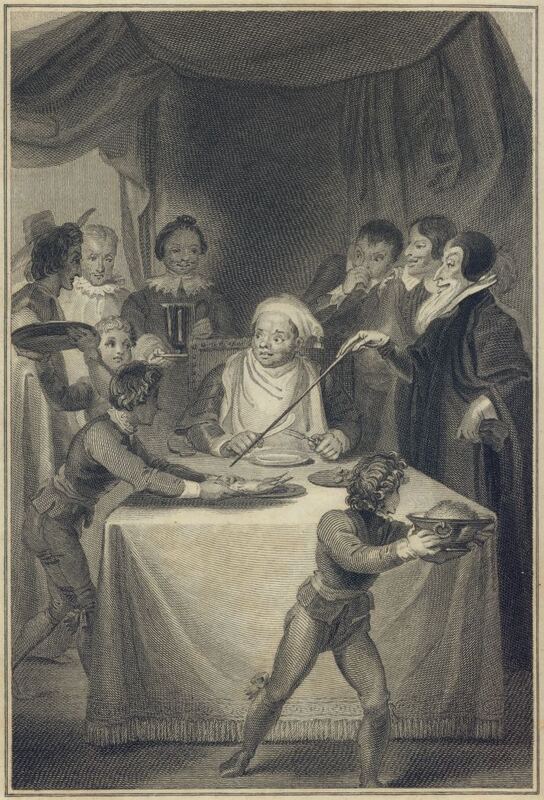
Sancho Panza is taken from the courtroom to a sumptuous palace, where, in a large hall, a royal table is set. Plates of food are placed before Sancho, but at the request of the physician Pedro Recio (right, holding a rod), they are taken away. Signed by T. Stothard (illustrator) and J. Fittler (engraver). Part 2, ch. 47.
Sancho rushed into the hall in a sprint, eyes filled with fear and arms stretched out like wings in flight, with a dish-clout pinned round his neck instead of a napkin. He is followed by a gaggle of kitchen-boys and scullions, one of them carrying a tray full of water, and the rest of them raising their pots like pitchforks.
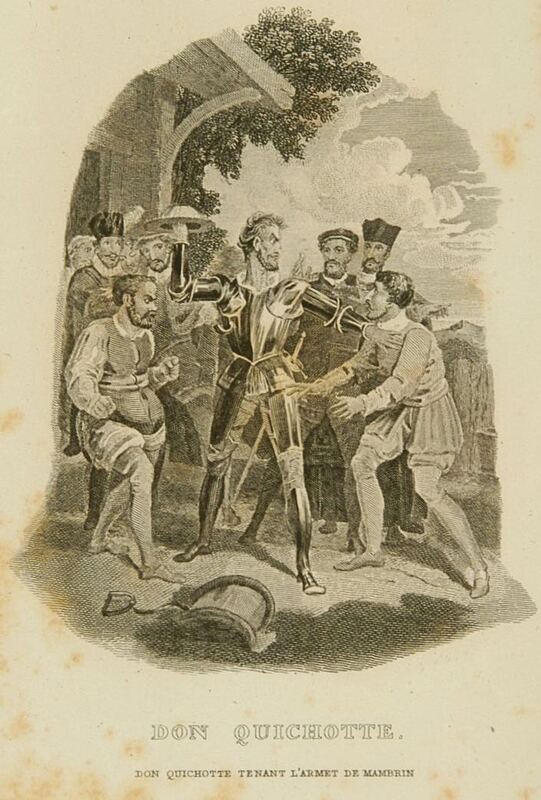
Don Quixote holds the Mambrino’s helmet (the barber’s basin) aloft while trying to make peace between Sancho Panza and the barber. The latter are fighting over the packsaddle, which is pictured on the ground between them. A crowd, including Don Fernando, the barber Nicolás, and the priest, watches. Unsigned. Part 1, ch. 45.
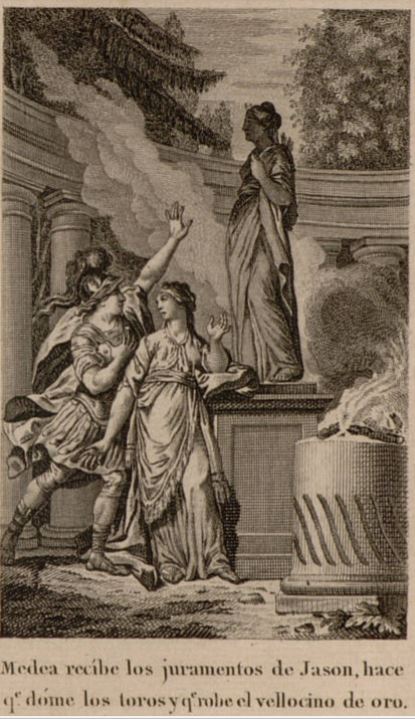
This image depicts Medea, the daughter of King Aeetes, looking passionately at Jason, the leader of the Argonauts. Jason is on a mission to retrieve the Golden Fleece, which King Aeetes currently has. King Aeetes has given Jason a challenge to complete in order to receive the Golden Fleece from him. Medea is completely infatuated with Jason and decides that she will betray her father in order to help him. In return for Medea’s assistance, Jason promises to marry her. Jason and Medea are depicted standing at a temple dedicated to Hecate. There is a large statue of Hecate in this image with a burning fire directly beside it.
Dorotea sits on a rock, dipping her right foot and wiping her hair with water from the rivulet having rolled up her pants and let her hair down. She looks over her shoulder thinking herself watched. On the left by her side sit a pair of shoes, a bag filled with her belongings and a hat. In the top left, the priest covers his mouth in thought, the barber looks down at the girl with a walking stick in hand, and Cardenio's face can be seen on the right side of the tree.
Resting upon a surface lies a piece of bread on the left, two heads of garlic on the right and a knife in the foreground. The image is oddly occasioned by Don Quixote saying "Sancho can live as well upon bread and onions as governor Sancho can upon capon and partridge" (Page 458).
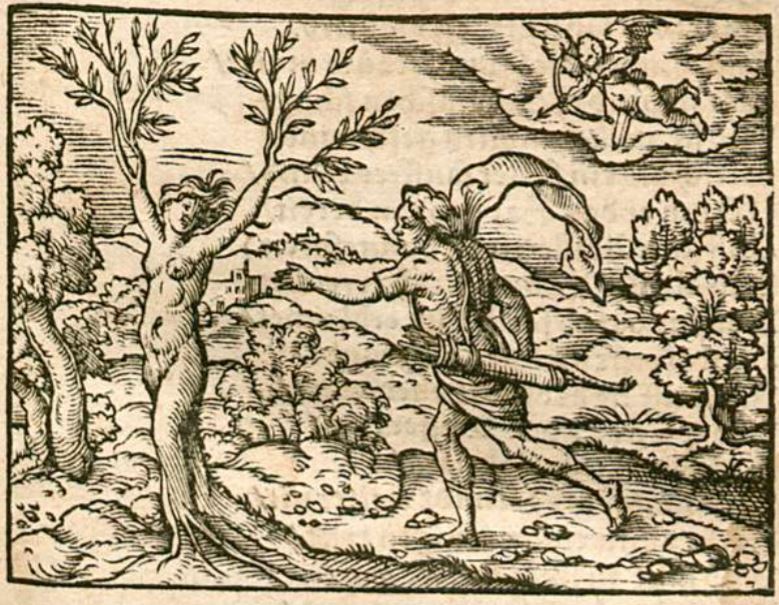
This image depicts Phoebus, the archer god, in pursuit of Daphne, the daughter of the river god Peneus. Cupid, who is depicted flying above Phoebus and Daphne, had struck the two with arrows. The arrow that struck Phoebus made him fall in love with Daphne, and the arrow that hit Daphne made her dispel the love of Phoebus and flee from him. Daphne calls out to her father for help, as she wishes nothing more than to evade Phoebus and his desire for her. Daphne’s father, Peneus, answers her cries for help and transforms her into a laurel tree. This is illustrated in the engraving as her legs are turning into the roots of the tree, and her arms begin to change into the branches of the tree. Phoebus is depicted with his arms stretched outwards as he was just about to catch Daphne before she transformed.
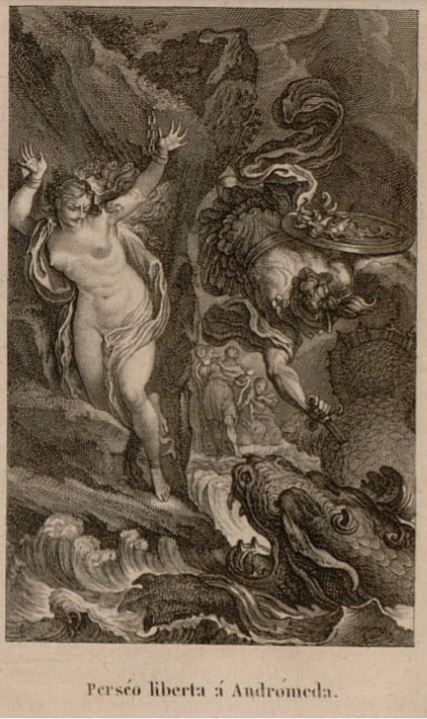
This image depicts Andromeda, the daughter of King Cephus, chained to a rock amidst the sea. Andromeda was placed here to pay the penalty for something her mother had said. Perseus had been flying in the sky when he happened upon this scene and spotted the beauty of Andromeda. Perseus asked Andromeda who she was and where she came from, yet, before she could finish speaking, a great serpent had emerged from the sea. Andromeda’s parents agreed that they would allow Perseus to take Andromeda’s hand in marriage in exchange for killing the serpent and saving their daughter. Perseus is depicted coming down from the sky and piercing the chest of the serpent on the right side of the image.
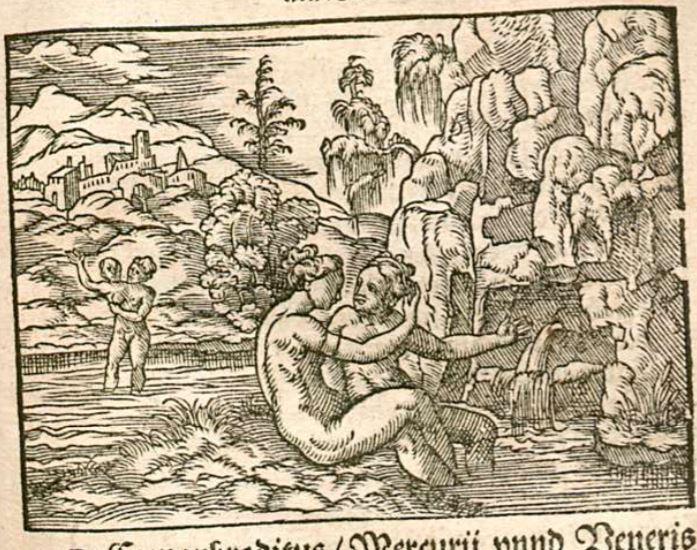
This engraving illustrates the story of Hermaphroditus and Salmacis. Salmacis is a water nymph that occupies a pool of fresh water and falls in love with Hermaphroditus when he finds her pool. The pool is illustrated behind the pair who are depicted at the forefront of the engraving. Hermaphroditus is the son of Mercury and Venus, and the beauty of his appearance captivates the Naiad. She is overcome with passion and cannot restrain herself from pursuing Hermaphroditus despite his rejection of her. Salmacis, with her arms thrown around Hermaphroditus’ neck, asks the gods to never be separated from him. The gods oblige and merge their two bodies together, creating the first Hermaphrodite. They are depicted as one body in the background of the engraving standing in the pool.
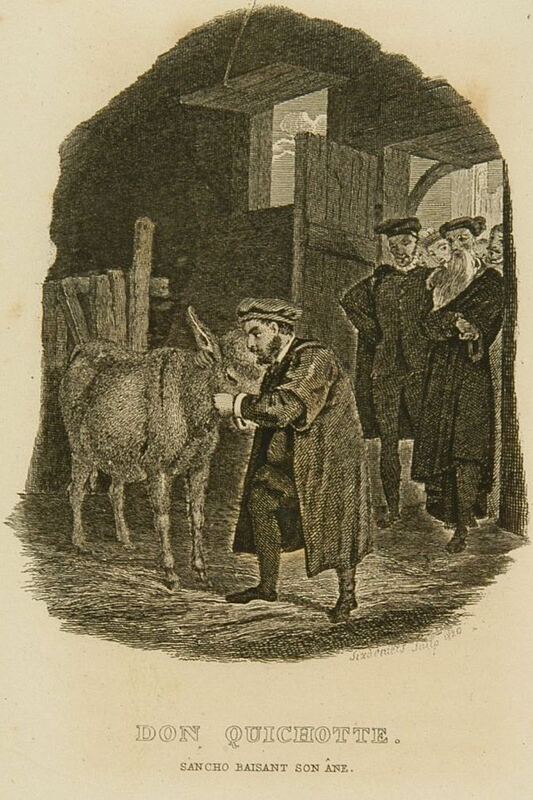
In the stable, Sancho Panza reunites with his donkey and embraces it before leaving Barataria Island. From the door, the secretary, the steward, the majordomo, and Pedro Recio observe him. The engraving is well detailed, especially the figure of the donkey. Signed by A. V. Sixdeniers (engraver). Part 2, ch. 53.
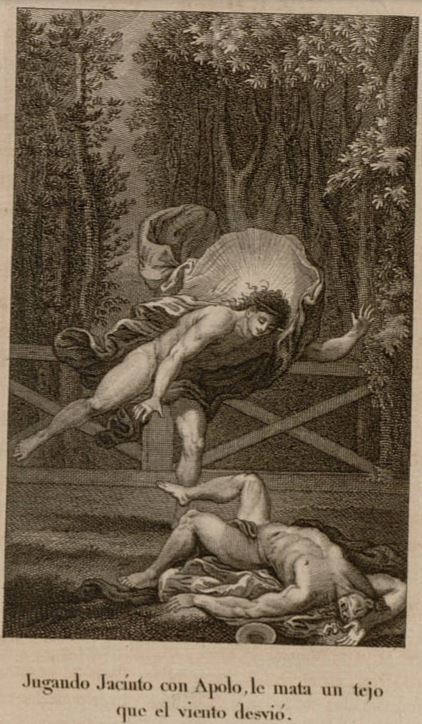
This image depicts the love story and tragedy of the god Apollo and his lover Hyacinthus. The two would often engage in physical activities together, and one day they decided to have a disc throwing contest. Apollo threw the discus, which cut through the heavens and the skies. As it was falling back to Earth, Hyacinthus wanted to impress Apollo by catching it, however, he got too close as it hit the ground. When the discus rebounded off the ground, it fatally hit Hyacinthus in the head. Apollo is running over to his lover who is lying dead on the ground. In order to be with Hyacinthus forever, he transforms him into the Hyacinth flower, which blooms every year.
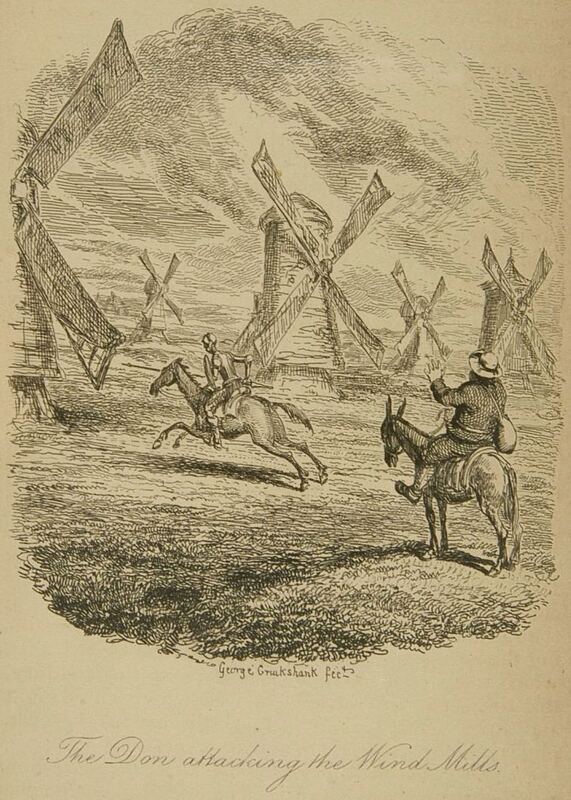
Don Quixote, mounted on Rocinante, charges the windmills, which he mistakes for giants. Sancho Panza tries to warn him in vain. Signed by G. Cruikshank (illustrator and engraver). Part 1, ch. 8.
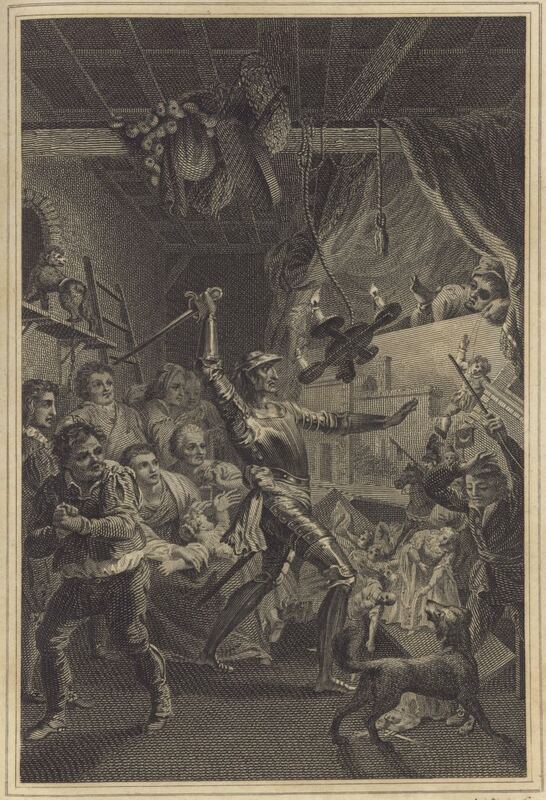
Don Quixote attacks the puppets while several astonished theatregoers and Maese Pedro watch him. Details of the illustration are accurate to Cervantes’ text: Maese’s eyepatch and monkey without tail. Signed by C. Armstrong (engraver). Part 2, ch. 26.
Don Quixote (center), clad in armor, unsheathes his sword and plants himself in front of the castelet (left). The puppets in the castelet depict a Moorish cavalry pursuing two catholic lovers. Two men next to the castelet look upon the puppets in horror, while Sancho Panza, pictured in the background behind Quixote, see's his master rise and poise to assault the castelet. The rest of the crowd watching the puppet show turn their attention to Quixote in confusion, who has risen and drawn his sword.
Marcela appears on a crag overlooking Grisóstomo’s burial (centre of the composition). Ambrosio, Grisóstomo’s friend, stands near his body, gesturing toward it. He accuses Marcela of causing the death. The narrative diagonal joins these three characters: from Marcela, through Ambrosio’s arm, to Grisóstomo. The figures of a gravedigger to the left and Don Quixote to the right form two verticals to balance the diagonal. The scene is observed by Sancho Panza and several goatherds. Plate no. 9, signed by J. Vanderbank (illustrator) and G. van der Gucht (engraver). Vol. 1, book 2, ch. 6.
Having destroyed the fishing boat, two fishermen seek reparations. At the order of Quixote, Sancho compounds the fishermen, and pays them gold reals for the boat, which Sancho disbursed into the cupped hands of the fishermen who walk barefoot. The man in between the two fishermen holds a wooden pole in his hand.
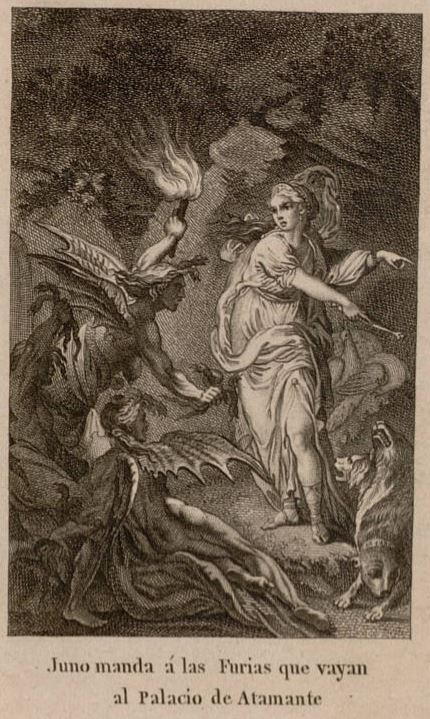
This image depicts the goddess Juno in the Underworld. Juno went to the underworld to seek help from the Furies in order to cause pain to a mortal named Athamas. The Furies are depicted as monsters with wings and snakes in their hands on the left side of the image. The three-headed beast named Cerberus is also depicted in this image as it guards the gates to the Underworld.
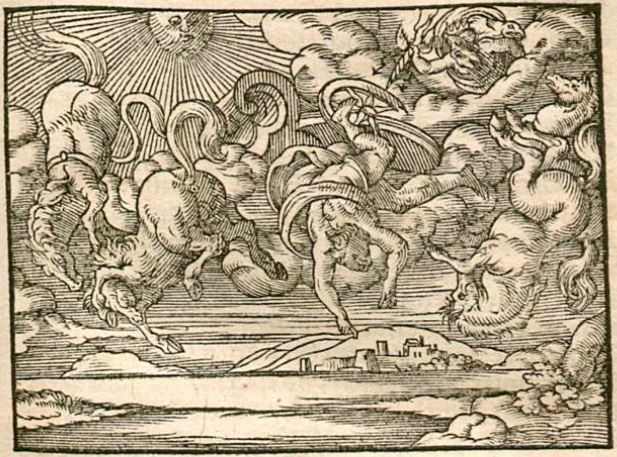
This engraving illustrates the chaos that Phaethon has created by ill-advisedly driving the chariot of his father, the sun god Phoebus. Phoebus had warned him that the horses were difficult to control and advised him to fly in between the skies and the earth at a happy medium. Phaethon, however, did not listen. Phaethon panicked as he got too close to the skies and accidentally let go of the reins. Once the horses felt the reins loosened, they flew off course and ran around unchecked. As the horses ran off, they caused a great fire everywhere they went. As seen in the engraving, the horses are illustrated in all different positions to signify the chaos of their course. Jupiter saw the world being engulfed by flames and came to the rescue. Jupiter is depicted in the engraving in the top right corner with a thunderbolt in his hand as he is about to throw it at Phaethon to end him and the madness. Phaethon is depicted falling head-first out of the chariot.
On the left, a man dressed in distinguished apparel with black cape and large feathered hat with sword by his waist, raises his left hand and places his right hand on his waist. On the right, Sancho Panza removes his hat and bows before the duke, thanking him for the governance he has been given.

![[Aesop and the Animals]](https://collections.cemvc.ca/files/large/08ac46ce17d0cf06d8ce3f08b246ade2080e960b.jpg)
![[Of How Don Quixote Received Donna Rodriguez' Request]](https://collections.cemvc.ca/files/large/e6292d0eb3b734e84312bb6148139c3172aa24ae.jpg)
![[The innkeeper, her daughter, and Maritornes take care of Don Quixote]](https://collections.cemvc.ca/files/large/2d782865bebc57c87a3356b864a0a0b94af5c752.jpg)
![[Symbols of the Tenth Book]](https://collections.cemvc.ca/files/large/e80224b4f527f48a77a2cb5bef2964bffa06bd42.jpg)
![[Of How Sancho Rushed to the Hall When He Was Chased by Kitchen Servants]](https://collections.cemvc.ca/files/large/d6e96ebf08b5db5d73b7cb221f8a4bfbc9c0b6ee.jpg)
![[The Priest Spies Dorotea Washing her Hair]](https://collections.cemvc.ca/files/large/e43f4f4b02ebebc023a8160e3b021d4c0a258807.jpg)
![[Bread and Onion]](https://collections.cemvc.ca/files/large/6916b0f829e536dd5740e04e5f72f5b454f1aa3a.jpg)
![[Don Quixote Incensed by the Puppet Show]](https://collections.cemvc.ca/files/large/0e2fba8f33a5fd9d96ee4270d93286f3ef69a5c9.jpg)
![[Grisóstomo's burial and Marcela's appearance]](https://collections.cemvc.ca/files/large/966f13a5a727408671ecd3b02eff0654c9fa2b5b.jpg)
![[Sancho Pays the Fishermen for the Boat]](https://collections.cemvc.ca/files/large/26ab53bba292fd87581b037d6feeb4fb99ba259d.jpg)
![[The Duke Bids Sancho Prepare for Governance]](https://collections.cemvc.ca/files/large/27a4abe3c0894e17d4f471b865c0eb98422d95db.jpg)