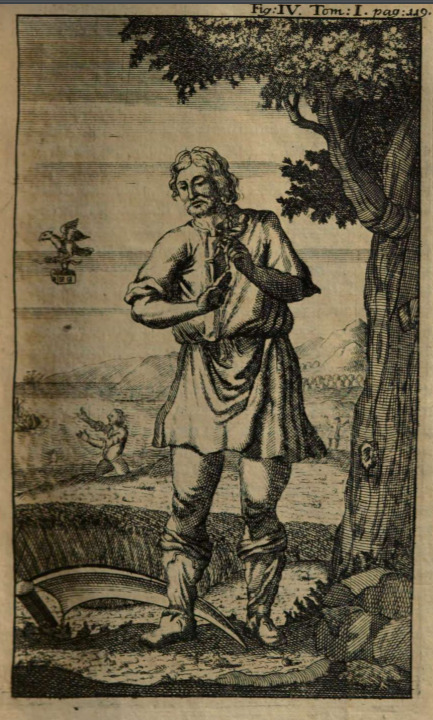
This image represents Gulliver’s adventures in Brobdingnag. The central figure is the farmer who first discovered Gulliver, standing under a tree. The Giant holds Gulliver in his hand, showing the reader the difference in size between Gulliver, and the Giants of Brobdingnag. In the background, we see an eagle carrying a box, depicting the episode in which Gulliver left Brobdingnag, as the box in which he lived and travelled was picked up by an eagle, and carried over the open water, before the eagle dropped Gulliver into the ocean, later to be discovered by a ship. We see another giant in the background, close to the water, presumably the page who left Gulliver’s box unattended, thus allowing it to be picked up by the eagle.
Here we see Gulliver’s tutor from Laputa. He was charged with teaching Gulliver the language and showing him around the island. Gulliver’s tutor showed him the schools and the research in philosophy and astronomy that was being conducted. The image shows how the Laputans had their head tilted to one side and had one eye facing inwards while the other looks upwards. The tutor wears a headpiece that has a “J” on it because it is the first letter of the chapter. The same image appears in the 1839 Krabbe edition.
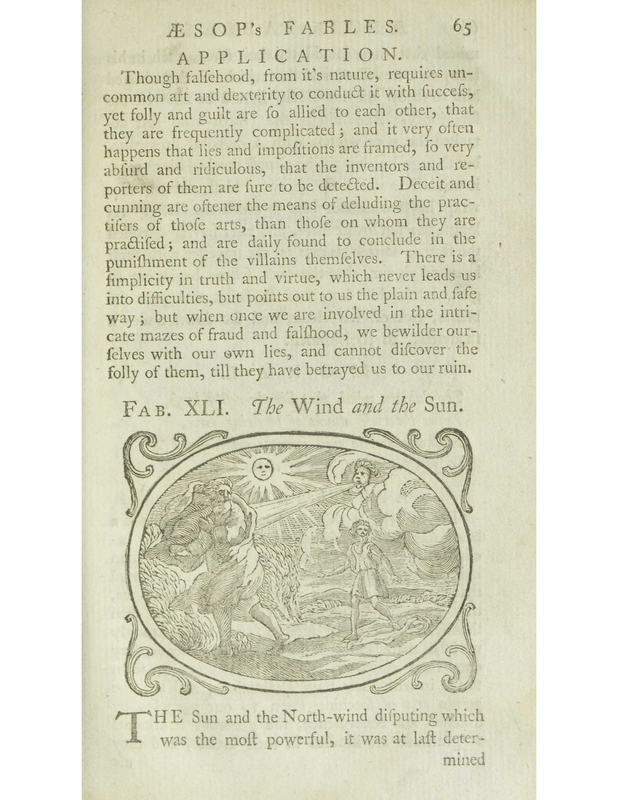
The top of the image shows a sun with a face, shining down on three other figures in the picture. On the left side is a man in a robe with a worried expression, running away from the wild being blown at him. The wind is blown by an angel on top of a cloud on the right side. Standing underneath the clouds is one other man, who stands away from the other man noted, looking up at the clouds. In the background stands some rolling hills and greenery.
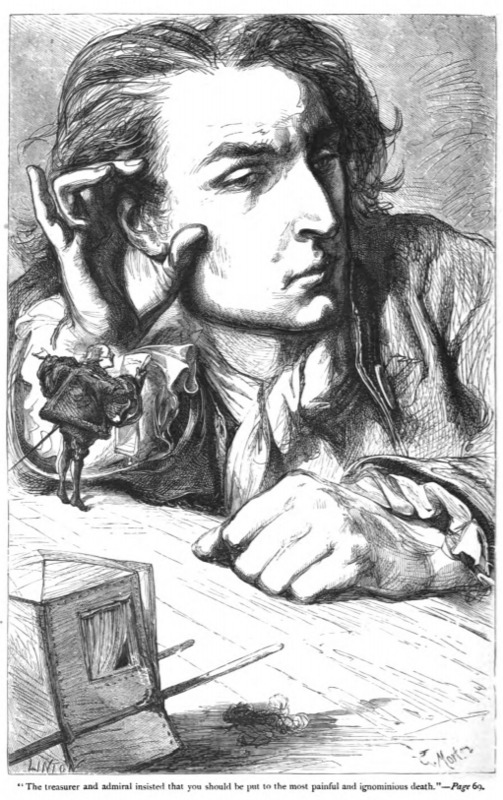
Here a member of the Emperor’s court informs Gulliver that he was being charged with treason and that he would be put to death. Gulliver leans forward to the Lilliputian and cups his ear to hear him better. The sedan chair is visible in the bottom left corner.
Now accompanied by Sosia and Tristan instead of Sempronio and Pármeno, Calisto goes to visit Melibea as promised. He ascends the high wall surrounding Melibea’s garden while Sosia and Tristan stand guard (as seen in this illustration). He returns home after spending the night with Melibea, and laments how quickly the night had passed. To the left of the illustration, we see Calisto with a sword mounted on his belt, climbing a ladder to enter Melibea’s garden. Sosia and Tristan stand behind him with swords and shields. To the right we see Melibea and Lucrecia looking out from a window. Each of them is wearing a robe and a veil. They seem to be making eye contract with Calisto, although it seems perspective would make this impossible. The entire image is identical to the one found on page 255 of the text.
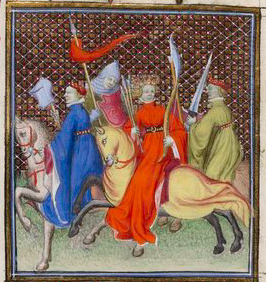
Penthisilea heard of the Trojan Hector and without ever seeing or meeting him, fell in love with him. She desperately wanted to have children born to him and decided to gather many of her people to help Hector in his campaign against the Greeks. The image portrays Penthesilea, in the center wearing a red gown, leading her people that surround her on horseback toward Troy.
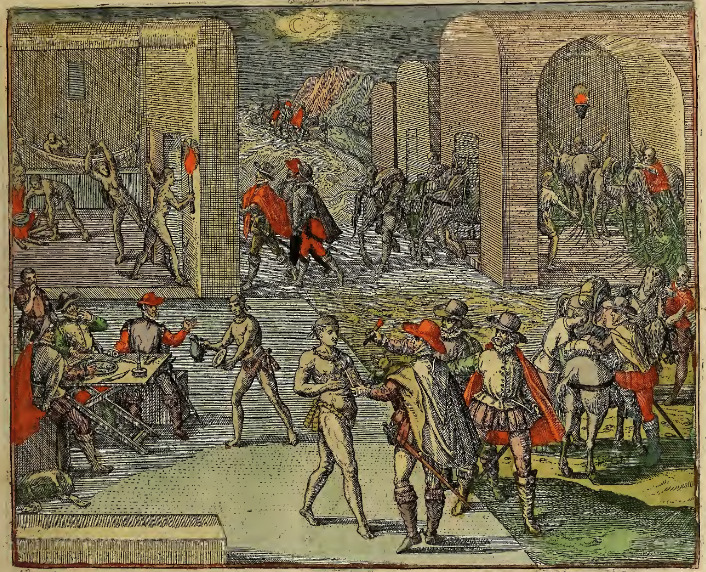
A group of Spanish merchants, including Girolamo Benzoni, ran out of food while crossing part of Panama and were forced to seek help from a group of Indigenous people they encountered, and stayed a night in their village. The Indigenous people were very hospitable to the Spaniards. Their horses and mules are stabled in a structure on the right, while several Spaniards are shown to sleeping quarters with hammocks and a fire on the left. Three Spaniards are served food and drink at a table on the left, and nearby an Indigenous man converses with several more Spaniards. The text indicates that, out of gratitude to the Spaniards for not enslaving them, the Indigenous people provided the group with fish, fruit, bread and meat for the rest of their journey. This image is identical to one found on page 141 of Frankfurt, 1595, but colored.
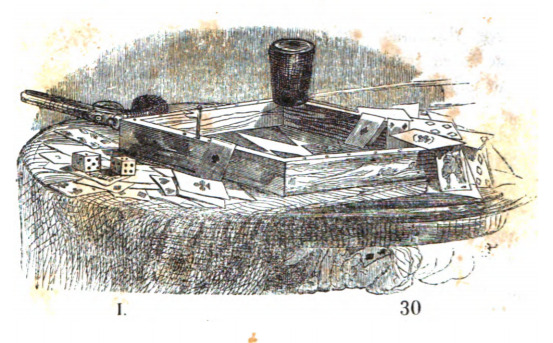
Here we see a games table with cards and dice spread over it. A cup, likely representing alcohol and a gun are also on the table. In this chapter Gulliver tells the King of Luggnagg about diplomacy, religion, the justice system, the arts, the financial system, and the nobility, then debated these issues with the king. This image comes when Gulliver is discussing gambling in England. The same image appears in the 1843 Krabbe edition.
"On the left side of the image there is a lion and on the right side of the image there is a donkey. Both are facing each other and seem to be angry. There are two tress in the background."
Joseph Sedley sits in a large chair with a sword leaning against his leg and a pitcher in his hand. Rebecca Crawley, dressed in a witch’s hat, leans over him, stroking his arm and his chin. Above her head is the letter T from “The”.
Joseph Sedley sits on the roof of the cabin on the boat from England to Belgium. Beside him on the bench are a cup and bottle of beer. He is dressed in his military coat, holding a long pipe, and looks very comfortable and relaxed.
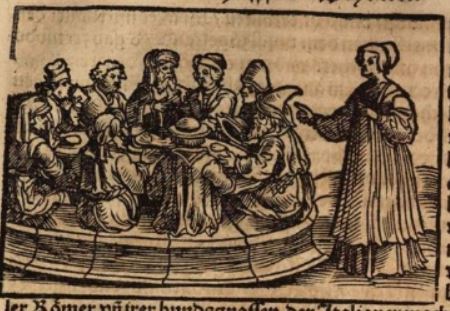
This engraving depicts a woman named Busa on the right side of the image looking at the group of people in front of her. Boccaccio explains that after a city called Cannae was attacked by Hannibal the Carthaginian, the people fled to Canusium. Busa opened her home graciously to the people who fled the danger of war and provided them with hospitality and food. These are the people who are depicted sitting around Busa’s table.
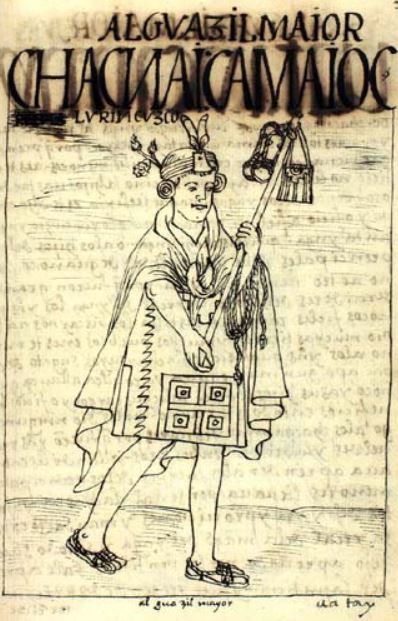
This chapter discusses the system of administrative officials in the Inca Empire. This image depicts a young law enforcement official who is illustrated holding a stick that carries a chuspa [small bag] and ojotas [sandals]. These two items were used as a form of identification. These two items were used as a form of identification while enforcing law and justice in the kingdom. This official’s title was uatay camayoc [major constable].
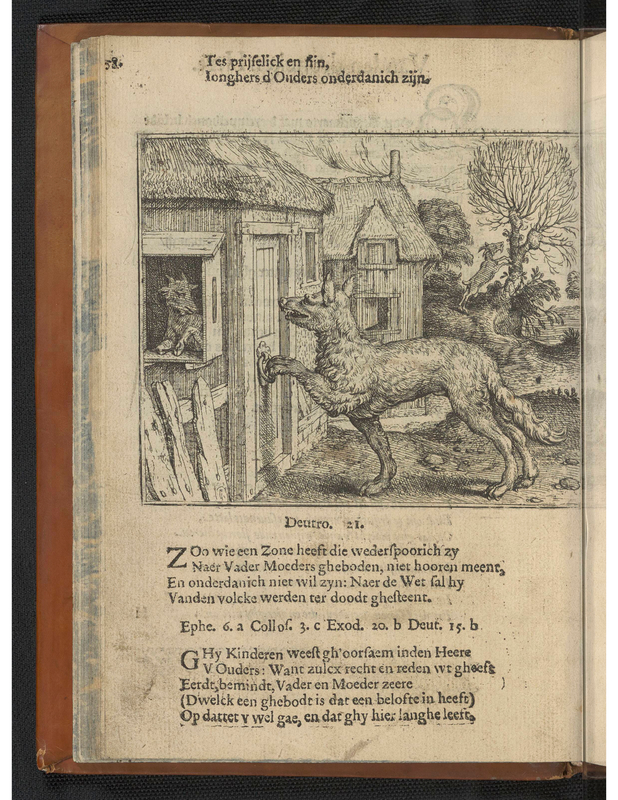
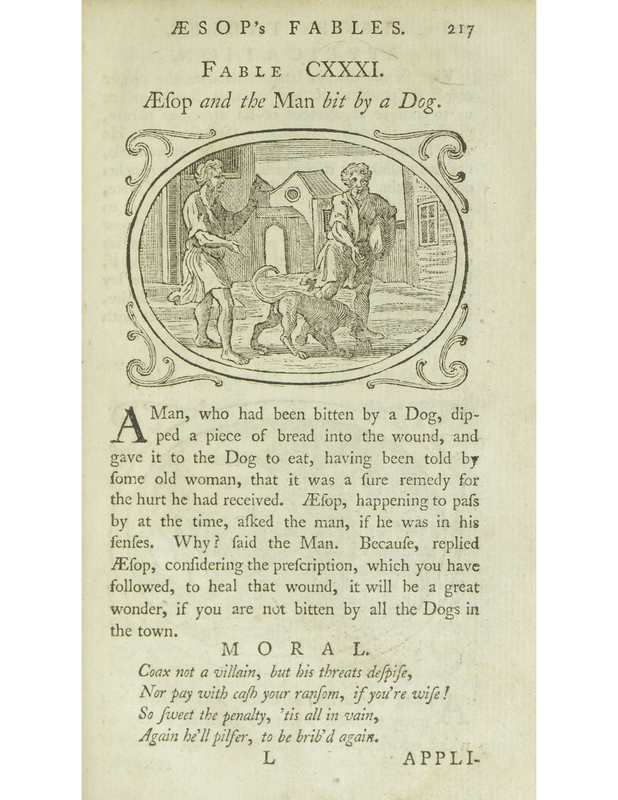
The scene is taken place outside. There are multiple buildings in the background. A man who had been bitten by a Dog, dipped a piece of bread into the wound and gave it to the Dog to eat. Aesop, happening to pass by at the same time, asks the man if he was 'in his senses'.
In this image we see a giant rat moving towards Gulliver and prepares to attack Gulliver. The rat is roughly the same size as Gulliver. Gulliver is seating, leaning against an intricately carved post with his sword in his hand preparing to defend himself. Gulliver ultimately ends up killing the rat after it attacked him. Fabric comes down on either side of the post, making the image look as though it were taking place on a stage. Gulliver’s hat is on the bottom left side of the image. The same image appears in the 1843 Krabbe edition.
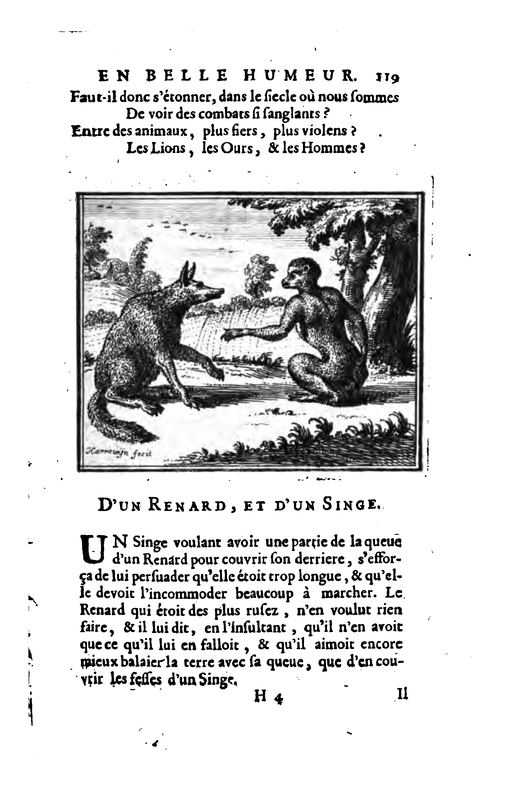
In the image there is a fox with one paw raised towards a monkey who is sitting with on hand raise towards the fox. The fox is on the right of the monkey who is on the left.
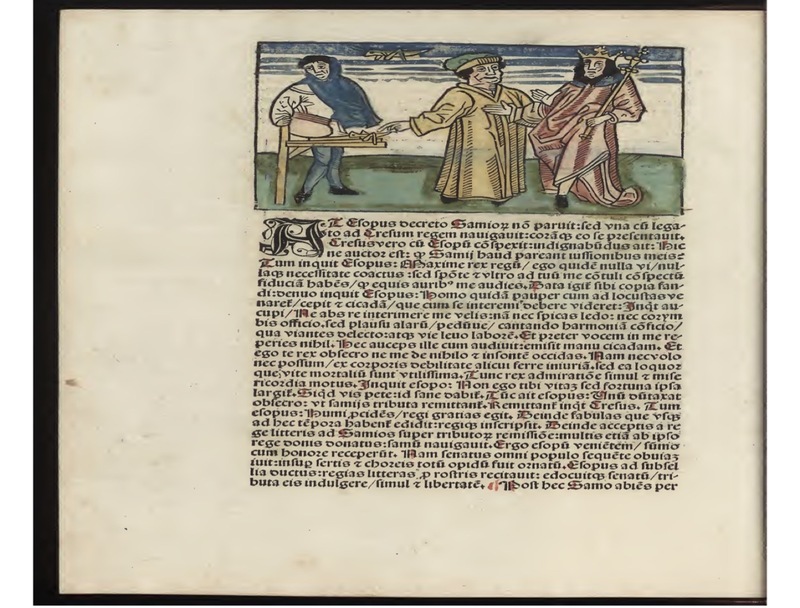
Three men stand outside, one of which is a King. Above their heads floats a grasshopper. One of the men offers to the king an object which rests on a stand, to which he declines.
Rebecca Crawley sits on a sofa next to Milor Noodle in her private room. She is flirting with him in order to get money, as she wins regularly against him at écarté.
Gulliver explains the various medicines used in England to treat disease. In this image we see a doctor holding a large needle. The image represents a doctor giving a patient an enema. We also see a chamber pot on the floor next to the doctor. The same image appears in the 1839 Krabbe edition.

![[Gulliver’s tutor on Laputa]](https://collections.cemvc.ca/files/large/10248bda9c70078d631e7c674a00d32d178c2d12.jpg)

![[Act XIV – Calisto, Guarded by Sosia and Tristán, Climbs Melibea’s Garden Wall While Melibea and Lucrecia Watch from a Window]](https://collections.cemvc.ca/files/large/ea16d0791394fbb0cf91392bbc5da5365a3cad53.jpg)
![[Human leading Animals]](https://collections.cemvc.ca/files/large/df50fc9a955a75c53d2597e1682ee631f976e965.jpg)
![[Lion and a Donkey]](https://collections.cemvc.ca/files/large/cb4b7a04822dbf713193b2f7409ab636ae826fea.jpg)
![[Vanity Fair Chapter LXV Historiated Initial]](https://collections.cemvc.ca/files/large/44de2df112e225710c4f553586e62e05fb2a58ae.jpg)
![[Joseph on the Boat]](https://collections.cemvc.ca/files/large/92bc577811aa56baf364b495bc44b3de50e4764d.jpg)
![[A giant rat attacks Gulliver and he defends himself with his sword on Brobdingnag]](https://collections.cemvc.ca/files/large/014eee21726201c1aa3dbdc9ecf5f245a9425335.jpg)
![[Becky and Milor Noodle]](https://collections.cemvc.ca/files/large/20932a5de5d8a95e210051443bd8df37917b41e0.jpg)
![[a doctor holds a needle]](https://collections.cemvc.ca/files/large/7a302747e322dc91250bd715f30f2f609e4c3f51.jpg)