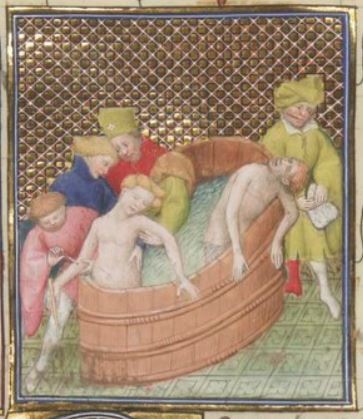
This illumination depicts Seneca and his wife Pompeia Paulina committing suicide in a bathtub. After Emperor Nero found out that Seneca (his tutor) was involved in the conspiracy to assassinate him, he forced a centurion to command Seneca to commit suicide. Not wanting to live without her husband, Pompeia Paulina got into the tub along with Seneca and slit her arm to die with him. Seneca is depicted dead in the image; however, servants are illustrated saving Paulina by tying a rope around her arm to stop the flow of the blood. Emperor Nero did not want Pompeia Paulina to die as he had nothing against her, which is why the servant saved her life.
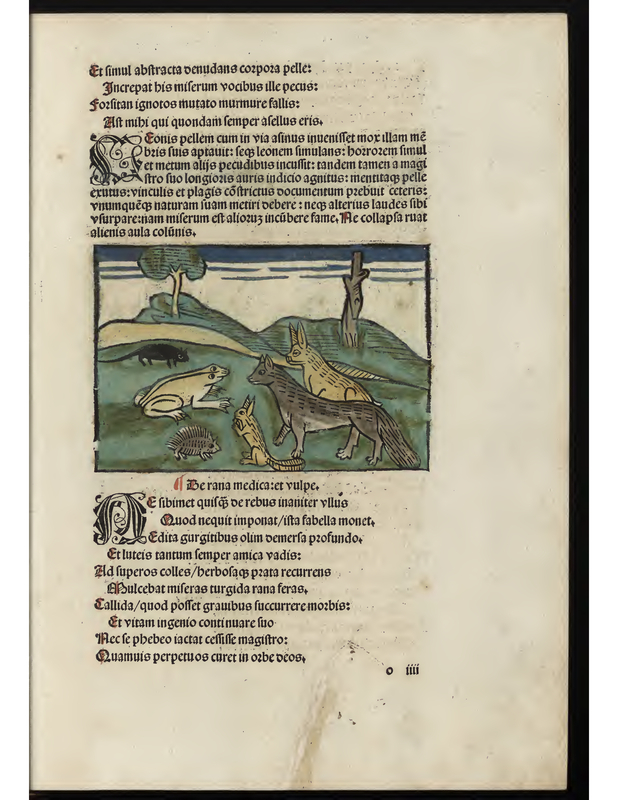
A group of animals; a cat, a hedgehog, a squirrel, a rabbit, and a fox are gathered around a frog. There are trees in the background, green grass, and blue sky above the animals. The animals are interested in what the frog is saying.
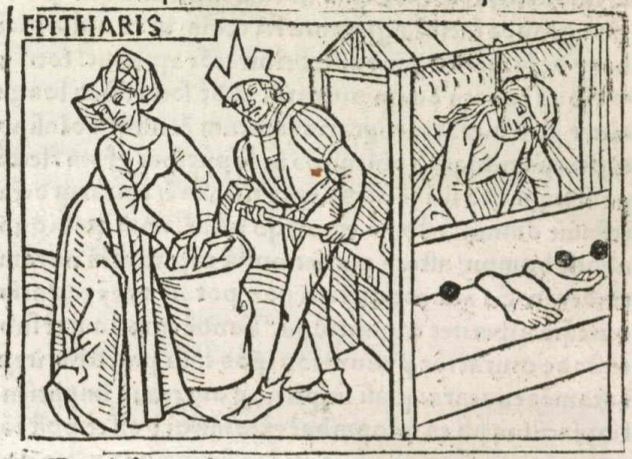
This engraving depicts the freedwoman, Epicharis, being tortured for information regarding a conspiracy to kill emperor Nero. Epicharis is depicted on the left side of the engraving with her hands in some form of torturing device as a man with a hammer tortures her. Her name, written as “Epitharis” is engraved above her head to identify her. Epicharis is also depicted on the right side of the image with her feet restrained in a stock. Epicharis had heard the details of the conspiracy to assassinate emperor Nero, and when she put her faith in the wrong person, they told emperor Nero that she was involved in the plan. They tortured her many times; however, she did not reveal the names of anyone involved in the conspiracy. She ended up killing herself to avoid revealing the details to the emperor.
Gulliver’s master explained various aspects of the Yahoos that lived in the Country of the Houyhnhnms. He explained that the Yahoos would eat anything, including herbs, berries, roots, and the flesh of other animals, seen here. He also said that they would kiss each other, seen in the background, a concept that disgusted him. The same image appears in the 1843 Krabbe edition.
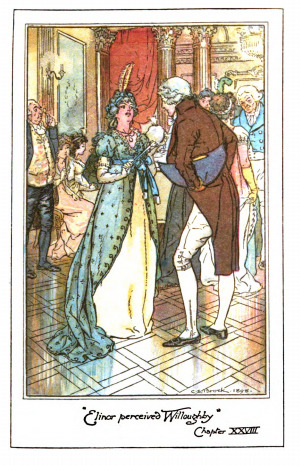
Here we see Willoughby speaking with Miss Grey at a party. Elinor is visible sitting on the left of the image looking at Willoughby. Marianne sits next to Elinor, not yet noticing Willoughby, and Sir John stands next to them. Marianne wrote to Willoughby after arriving in London, hoping to see him but he ignored her letters. At a party Elinor noticed Willoughby speaking with a woman. He came over to the sisters and spoke to Elinor briefly, ignoring Marianne. Outraged, Marianne asked Willoughby if he had received her letters, to which he said he had, and then hurried away. Marianne was heartbroken and the sisters left the party early and Marianne spent the rest of her time in London miserable. It was later revealed that the woman Willoughby was speaking to at the party, shown in this image, was Miss Grey, a wealthy heiress. Willoughby was not rich and liked to live beyond his means, and hence wanted to marry rich to support his lifestyle. Miss Grey did not approve of Marianne’s letters, and dictated Willoughby’s letter to Marianne in which he said he never loved her. This scene appears in chapter 28 as indicated underneath the image. The characters are shown in the traditional regency style. Miss Grey wears the regency style dress with an empire waist. Because it was an evening party, she wears short sleeves and gloves that come above her elbows. She holds a fan in her hand. A fan in this era was often used to signal to communicate with others at the party. Using the fan, a woman could signal if she was married, single, or engaged, that she was being watched by a chaperone, that she loved another man, among other things. Her hair is worn tied up, as was tradition for women after their “coming out” before the queen, signaling her entrance into society. Willoughby wears a waistcoat, tailcoat and knickers that stopped at the knee, and holds a bicorn hat under his arm. The regency period dated to the early nineteenth century (1811-1820) when George, Prince of Wales, later George IV (r. 1820-1830), reigned as regent for his mentally ill father, King George III (r. 1760-1820). The regency period is associated with the rise of neoclassicism in art and fashion.
The left panel of this illustration depicts Areusa, one of Celestina’s prostitutes. She is wearing a veil, a robe, and a necklace of some sort. The right panel depicts Celestina’s other prostitute Elicia, who is in a seated position and seems to be dressed in nun-like attire. In her left hand she is holding what appears to be a piece of paper, while in her right she is holding what is likely a girdle cord. Because this figure was originally used to represent Celestina (on page 88), both of these items relate to Celestina’s encounters with Melibea and have nothing to do with Elicia.The left panel is identical to those found on pages 125 and 229. The right panel is nearly identical to those found on pages 61 (where it is labeled ‘Celestina’) and 88 (where it is labeled ‘Celestina’ and some lines have been added to extend her robe, apparently done by hand at a later date).
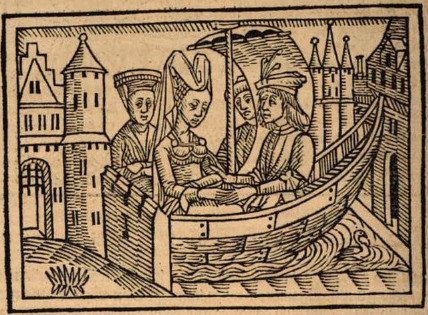
This engraving depicts prince Paris of Troy leaving the shores of Lacedaemon on a ship that carries queen Helen, wife of King Menelaus. Boccaccio explains that Paris had fallen in love with Helen while he was a guest in King Menelaus’ home. It is debated whether Helen’s feelings towards Paris were mutual and she willingly went with him, or if he had taken her by force. This image depicts Paris sitting on the right side of the ship and Helen sitting on the left side. Lacedaemon is illustrated on the left side of the engraving, while the city of Troy is on the right side. The ship is pointing towards Troy as that is their destination. Paris and Helen going to Troy is the cause of one of the greatest wars of all time: The Trojan War.
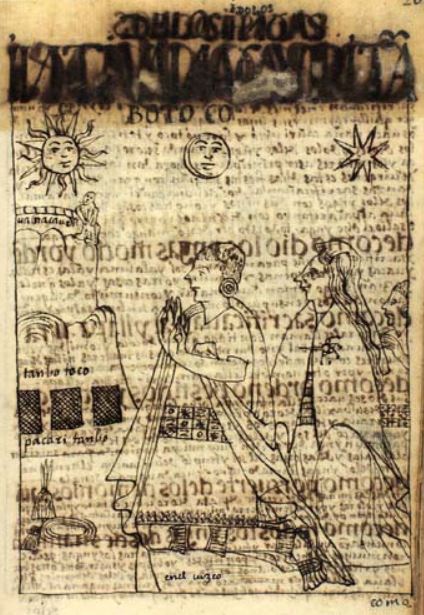
This chapter is dedicated to describing the idols and gods of the Incas. This image depicts the Inca Emperor kneeling before their major deities, uana cauri [Huanacauri], tanbo toco [Tambotoco], and pacari tanbo [Pacaritambo]. Huanacauri is a mountain and Pacaritambo is a cave where the first Incas allegedly originated from. The Tambotoco were three niches in the cave. The three niches are depicted at the base of Huanacauri. The author explains that when the Inca is crowned as king, he must honour the deities and make sacrifices to them, which is what this image depicts. His wife and child are standing behind him to help perform the sacrifices to honour the idols. There is a sun, moon and star illustrated at the top of the image, which the Incas also venerated. The words “en el cuzco” are written at the bottom of the image which translates to “in Cusco.”
"A dog is barking at a wolf that is standing outside of its house. The dog is nursing a puppy, and other puppies can be seen in the house. The wolf looks surprised, with their tail curled upwards and ear straight up. The wold is on the right Sid eof the image and the doghouse is on the left side. There are two trees in the background."
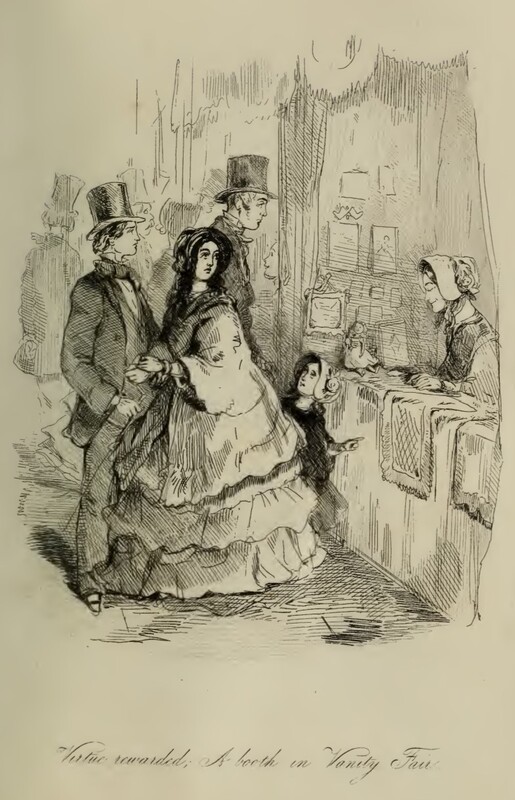
Rebecca Crawley sits behind the counter of a stall at the fair in London, selling items for charity. In front of the booth, Amelia Dobbin, holding onto the arm of her son George, is turning away upon seeing her. Behind them, William Dobbin is reaching out to pick up Janey, their daughter, who is looking up at him in puzzlement. Below the illustration is printed in cursive its title, “Virtue rewarded; A booth in Vanity Fair”.
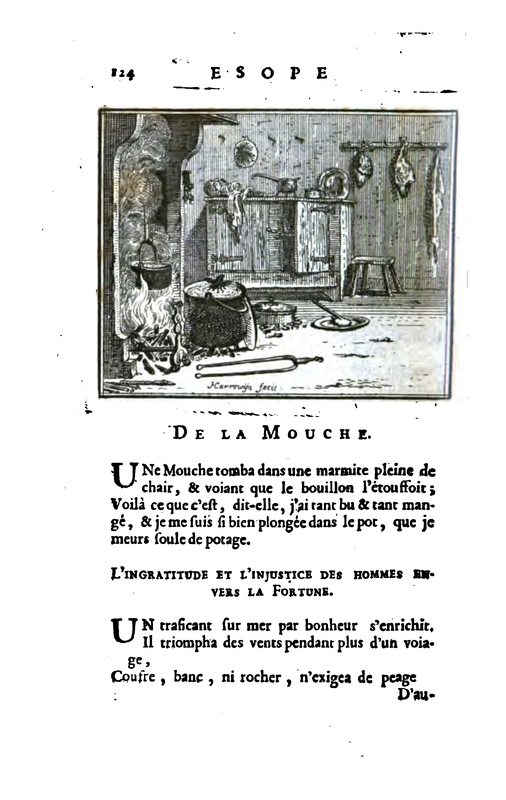
A fly falls into a pot of meat stew, and starts to drown in the broth; the fly says, "I drank and ate so much, that I fully fell in the pot, and I will die full of stew. Ungratefullness and injustice leads to misfortune.
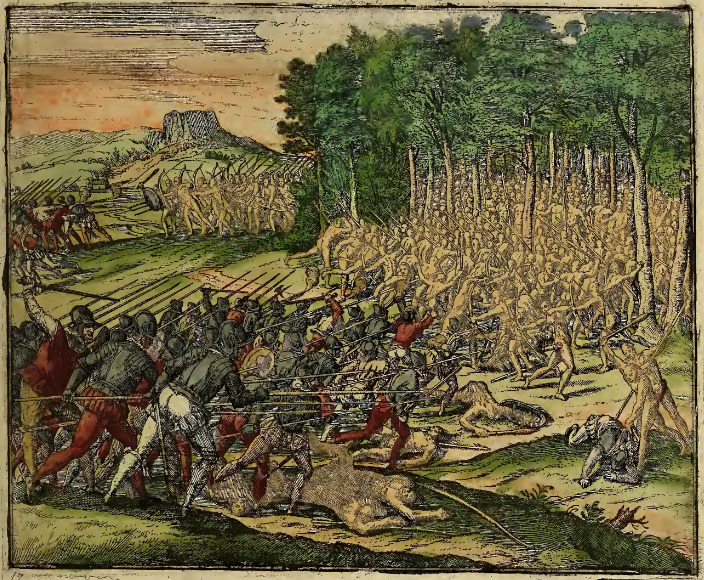
A large battle takes place between the Indigenous peoples of Costa Rica and the Spanish occupiers. Diego Guttierez, the Spanish governor of Costa Rica, is killed in the battle. Spaniards, mostly armed with spears but with some swords and muskets, chase Indigenous people away from the battle into a nearby forest, stepping over the bodies of fallen Indigenous people as they go. The Indigenous people, mostly armed with bows and arrows but with some spears, clubs, and shields, flee the Spanish. Some turn to fire arrows at the oncoming Spaniards. In the right corner, two Indigenous people kill a Spanish man with a spear and a club. In the background, a second group of Indigenous warriors engage the Spanish, appearing to drive them back. This image is identical to one found on page 149 of Frankfurt, 1595, but colored.
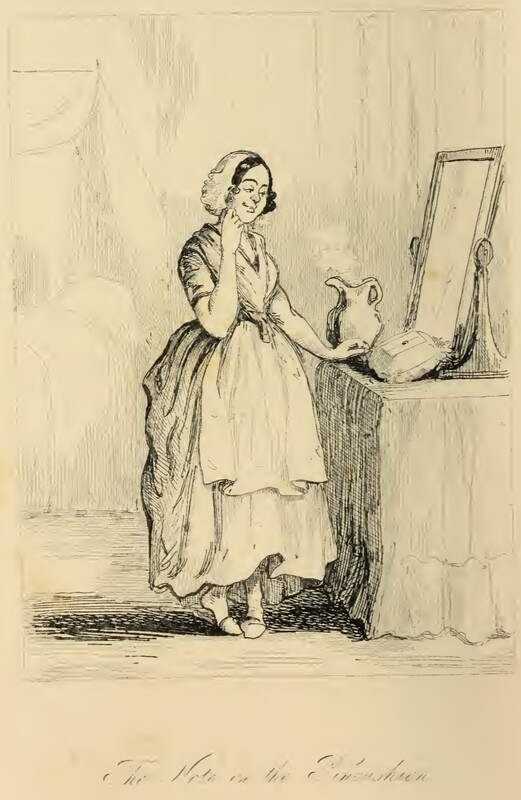
The image depicts a scene from Chapter XVI. Betty Martin, Miss Crawley’s upstairs maid, smiles as she sees the note left by Rebecca Sharp for Miss Briggs. The note itself is on a pincushion on the table by the window, along with a standing mirror and a pitcher. In the background, the bed, neat and unslept-in, can faintly be seen. Below the illustration is printed in cursive its title, “The Note on the Pincushion”.
a man holds a piece of wood over his head in his right hand. In his left hand he holds the arm of a broken and cracked statue of a man. In front of them there is a statue of a man standing on a pedestal.
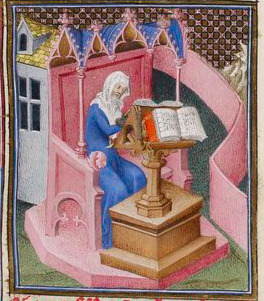
Deiphobe, or Amalthea, was a sibyl in the Campania region of Italy. She was powerful in that she maintained her virginity, and would not sell books at a price lower than asked – in fact, she would burn them if not given the fee. She is seen seated at her desk which was situated in her temple on the Baian shore near Lake Avernus.
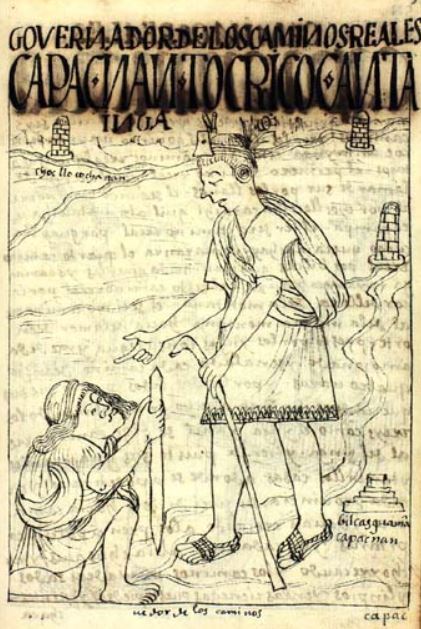
This chapter discusses the system of administrative officials in the Inca Empire. This image depicts a scene in which a royal road inspector is being helped by an assistant to physically mark off distances in the road. The author explains that there were six royal roads in the Inca Empire, and they were always governed by an inspector. The inspector is depicted standing in the foreground of the image holding a walking stick in his left hand and pointing to his assistant with his right hand. His assistant is illustrated kneeling in the bottom left corner of the image and holding a stake which is used to determine the width of the roads. There are other royal roads depicted in the background of the image and are marked by large Inca stone structures. One of the roads is identified in the top left corner as “Chocllo Cocha nan.” There is a small structure at the bottom right corner and has a caption that reads “Bilcas Guaman Capac Nan” [royal road of Bilcas Guaman]. The caption at the bottom of the image outside of the border reads “uedor de los caminos” [of the road].
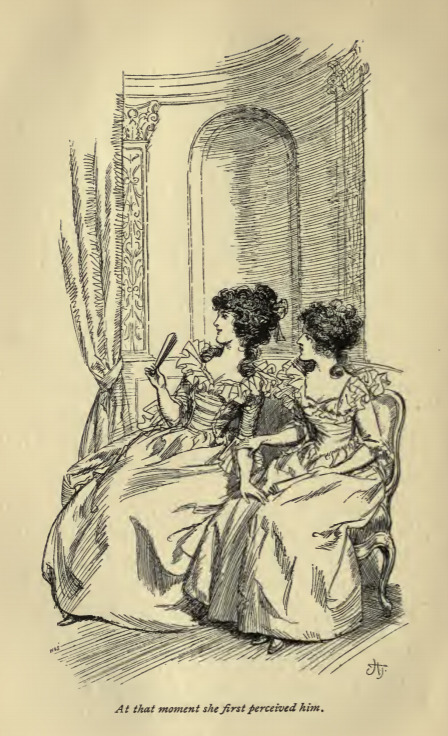
In this image Elinor and Marianne sit together at a party in London where Willoughby was present. Marianne wrote to Willoughby after arriving in London, hoping to see him but he ignored her letters. At a party Elinor noticed Willoughby speaking with a woman. He came over to the sisters and spoke to Elinor briefly, ignoring Marianne. Outraged, Marianne asked Willoughby if he had received her letters, to which he said he had, and then hurried away. Marianne was heartbroken and the sisters left the party early and Marianne spent the rest of her time in London miserable. It was later revealed that the woman Willoughby was speaking to at the party, was Miss Grey, a wealthy heiress. Willoughby was not rich and liked to live beyond his means, and hence wanted to marry rich to support his lifestyle. Miss Grey did not approve of Marianne’s letters, and dictated Willoughby’s letter to Marianne in which he said he never loved her. This scene occurs in chapter 28. The characters are shown in the traditional regency style, as Marianne and Elinor wear the regency style dress with an empire waist. The regency period dated to the early nineteenth century (1811-1820) when George, Prince of Wales, later George IV (r. 1820-1830), reigned as regent for his mentally ill father, King George III (r. 1760-1820). The regency period is associated with the rise of neoclassicism in art and fashion.
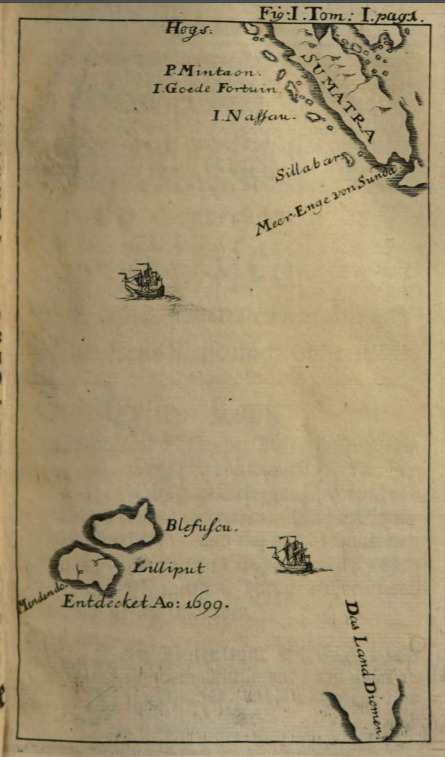
A map of depicting the fictional lands of Lilliput and Blefuscu that Gulliver visited in the first part of the story. Under the fictional lands is written “Entdecket Ao: 1699”, meaning “discovered in 1699”. The map also depicts the lands of “Diemen” and “Sumatra”. Two ships – likely the “man-of-war" type ships which were popular in the eighteenth century and are mentioned in the text – are shown.
Here we see a variety of mathematical instruments that were used on Laputa. This image comes at the beginning of chapter four, in which Gulliver leaves Laputa to travel to Balnibarbi, because the only things that the Laputans were interested in was mathematics and music, neither of which Gulliver was particularly interested nor skilled in. The same image appears in the 1839 Krabbe edition.


![[Yahoos eating]](https://collections.cemvc.ca/files/large/b32deed381f4ea063b6911962c265bf4a421ebd7.jpg)

![[Act XV – Areusa and Elicia]](https://collections.cemvc.ca/files/large/8b09f67d80ce4c9c3e66a842ccc9d641ffcc5903.jpg)
![[Wolf Outside a Doghouse]](https://collections.cemvc.ca/files/large/774bddb41c09f9bebc7d492ba269658d34ba4dbf.jpg)

![[Man breaks statue]](https://collections.cemvc.ca/files/large/a78a59863112b80afdd0b7f1b076088197a34f51.jpg)
![[Scientific instruments from Laputa]](https://collections.cemvc.ca/files/large/4cc39b40607abcdab214895986e1c39f463e8c6f.jpg)