Here we see two Lilliputian men carrying a sedan chair – a type of chair used my elites in the eighteenth century. Inside the sedan chair was a member of the Emperor’s court who was sent to inform Gulliver that he was being charged with treason. This charge was because he urinated on the imperial palace to put out the fire. Furthermore, it was becoming too expensive to pay to feed and clothe Gulliver.
As Celestina (left-central figure) travels home from Melibea’s house, she sees Sempronio (central figure) and Pármeno (right-central figure) on their way to visit Calisto (leftmost figure) at Saint Mary Magdalene’s church. Sempronio and Pármeno enter first, and Celestina enters as they begin talking with Calisto. She tells Calisto that she has good news, and the four of them go to Calisto’s house for more privacy. Celestina tells him that Melibea has revealed her love for him, and informs him that she has requested to meet at midnight. Overjoyed, Calisto praises Celestina for her work, but Sempronio and Pármeno express skepticism at Melibea’s dramatic change of heart. Calisto tells everyone he is going to take some rest before midnight arrives, and Celestina returns home, where she is greeted by Elicia (rightmost figure). [The figures in this illustration are used in multiple other illustrations throughout this edition.]
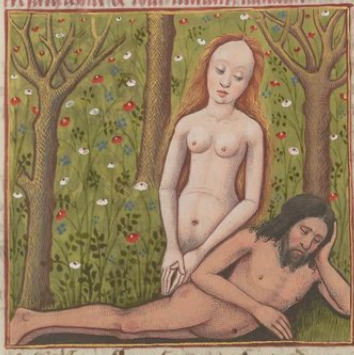
This illuminated image depicts Adam and Eve. Adam is illustrated laying on the ground while resting his head in his left hand as he sleeps. While Adam was asleep, God created Eve and placed her next to him as he slept. Eve is illustrated watching Adam as he sleeps. They are both depicted naked, and Eve is illustrated very pale and with red hair. Boccaccio explains that as Eve was the world’s first mother, she is worthy of remembrance. There are trees illustrated in the background to represent that Adam and Eve are in the garden of Eden in this image.
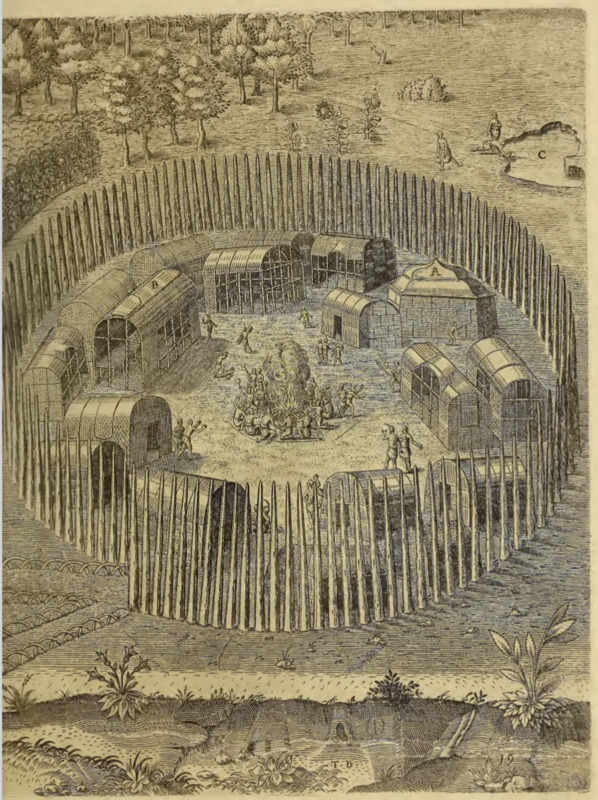
The Indigenous town of Pomeiooc is shown. Multiple structures are arranged in a circle. At the centre of the circle is a large bonfire, and surrounding the structures is a fence of tall poles stuck into the ground. There is one gap in the poles that serves as an entrance. There is a cornfield to the left of the village.
Here we see Gulliver sitting on a rock with a Houyhnhnm who sits on his haunches. In the background we see the Houyhnhnm’s house. The Houyhnhnm teaches Gulliver their language, which Gulliver learns and is able to converse with the Houyhnhnms. The same image appears in both the 1839 and 1843 Krabbe editions.
Gulliver describes Laputan clothing as having a motif that combined suns, moons, and stars, with various musical instruments, including violins, flutes, harps, trumpets, guitars, as well as other instruments that were not played in Europe. This image is a detail of that pattern. In the centre is the letter “A”, because it is the first letter of the word “Als” - the first word of the second chapter. The same image appears in the 1839 Krabbe edition.
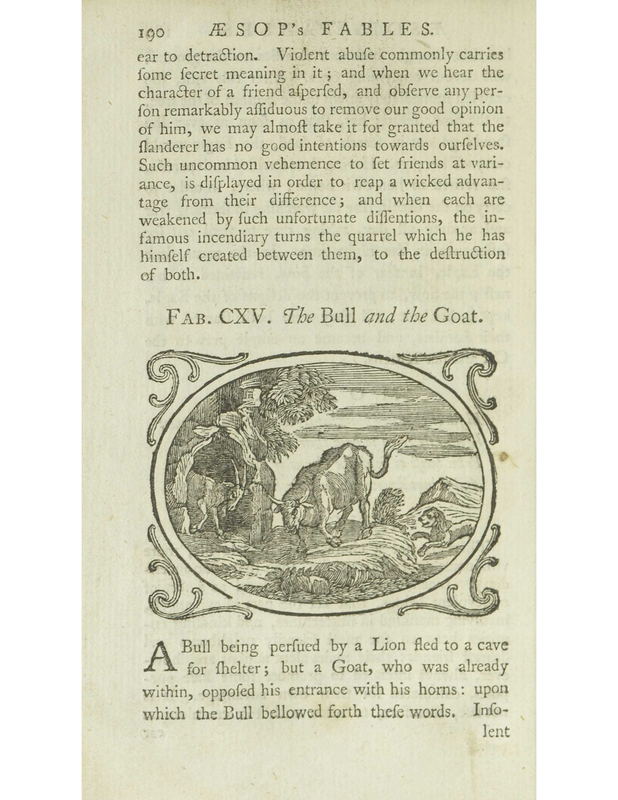
The front half of a goat it seen emerging from a cave entrance. Outside of the cave, a bull approaches from the right. Behind the bull in the distance is a lion running towards it.
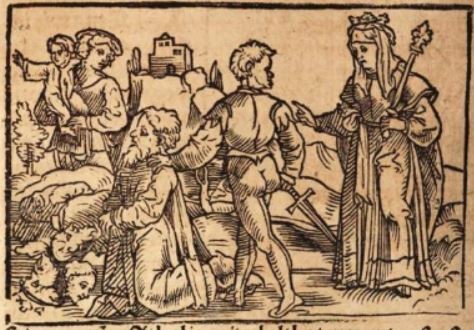
This engraving depicts Athaliah, queen of Jerusalem, executing the descendants of David. Athaliah is depicted on the right side of the engraving holding a scepter and pointing towards a man. Boccaccio explains that Athaliah’s father was the king of Israel, and her husband was the king of Jerusalem. When her husband died, and her son (who succeeded his father) died, she seized power and slaughtered the descendants of David to avoid anyone taking her power and throne. There is a man depicted with a sword about to execute a man, under Athaliah’s orders. There are other people illustrated on the ground who had already been slain. There is a person on the left side of the image carrying a child named Jehoash. This child is Athaliah’s grandson who escaped her executions.
Rebecca Crawley stands at her dressing-table with her hair loose, waving a piece of paper in the air. Next to her, Rawdon Crawley stands looking puzzled, still holding the tray with the pitcher of chocolate and cup that he brought her for breakfast along with the letter. The letter is from his brother, now Sir Pitt Crawley after their father’s death, inviting them to the funeral at the estate.
Gulliver explains the various medicines used in England to treat disease. Gulliver explains to the Houyhnhnms various aspects of English society, including disease and medicine. In this image we see a bowl with medicines and various vials with other pharmaceuticals. The same image appears in the 1843 Krabbe edition.
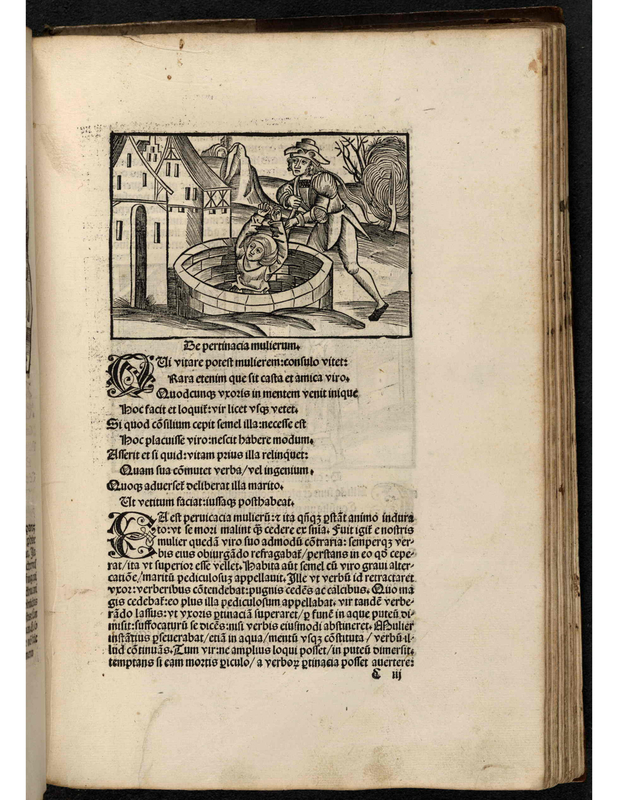
In front of a tall brick house, an old man is holding down another elder by the waist of his trousers with his right hand. With his left hand, he lifts a flock high in the air. The old man with the flock is punishing the kneeling man. Another elder is standing to the right, his arms crossed across his chest, looking down at the man being punished.
A group of Indigenous men, women, and children gather around two large pots, one sitting on the ground and one resting on a fire. The group cooks and eats meat and fish. Two individuals sit in a large hammock while the rest sit and stand on the ground around the pots. One structure is visible in the background. This image is identical to one found on page 930 verso of Paris, 1575 (l’Huillier), and in Thevet’s Les Singularitez de la France Antarctique (page 57 of Paris, 1557 and page 57 of Paris, 1558).
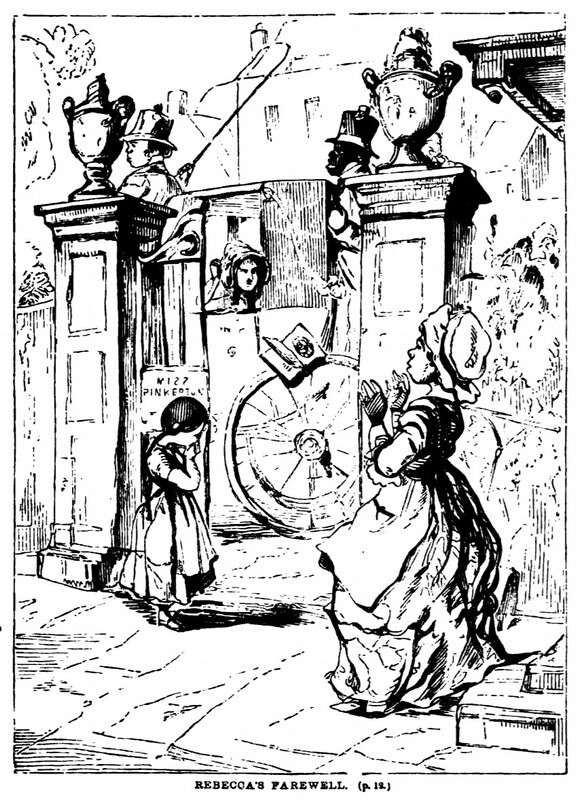
The image depicts two pillars topped with cups, between which is an open gate with a plate reading “Miss Pinkerton”. The pillars frame a carriage with very large wheels, at the front of which sits the coachman, holding his whip, and at the back of which stands Sambo. Rebecca Sharp’s face can be seen from the window of the carriage as she flings a book at the surprised Miss Jemima, who stands on the right side of the image at the bottom of the stairs. Next to the left pillar is a young girl with long braids, possibly Laura Martin, crying and covering her face with her hands. Below the illustration is printed its title and location in the story, “REBECCA’S FAREWELL. (p. 12.)”.
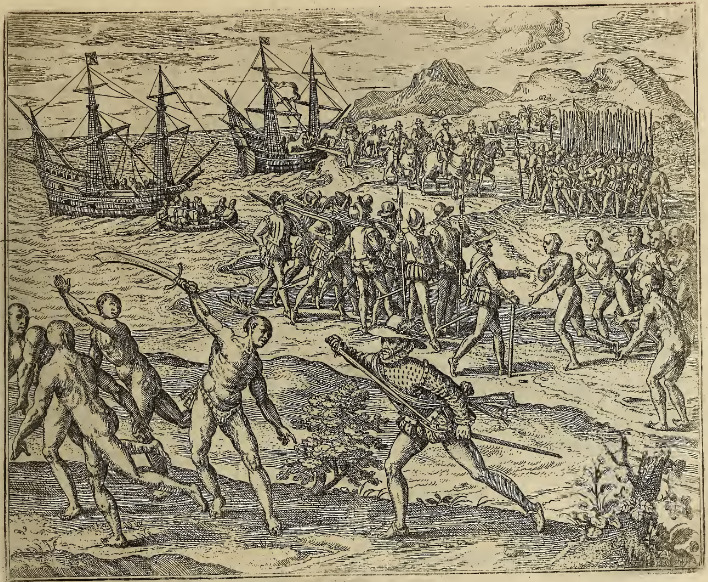
Near the coast along the Bay of Mexico in the Mexican province of Yucatán, an Indigenous man wearing a loincloth swings a sword in the direction of a Spanish man (Hernando de Motejo), who lunges forward while drawing his own sword. Three other Indigenous men move away from the two swordsmen. In the background another group of unarmed Indigenous people greet a group of Spaniards who have come ashore in rowboats from their ships. The Spaniards carry muskets, swords, and pikes. A second group of Spanish soldiers mass further away, some of whom ride horses that are unloaded from one of the two ships anchored near the coast.
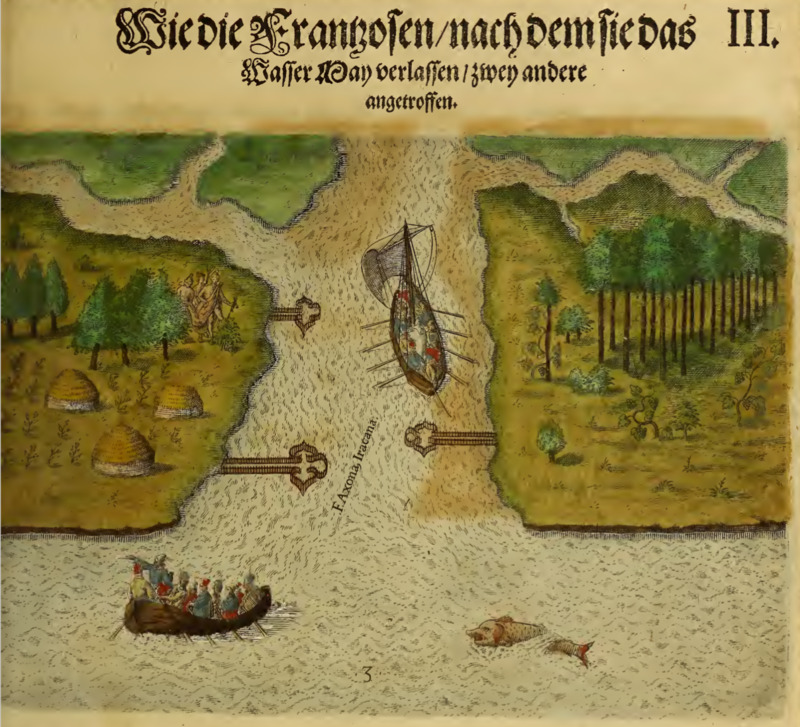
Two rowing boats filled with colonists are shown entering the mouth of a river. Three round structures sit on the left bank of the river. Three Indigenous figures also stand on the left bank; however, their figures are indistinct. This illustration is identical to the one found on page 41 of Frankfurt 1591, but colored.
In chapter six, Gulliver explains several aspects of society in England. Here we see a stack of coins with the lion of Great Britain. Gulliver explains finances and the English fiscal system and Treasury to his Master on the Country of the Houyhnhnms. The same image appears in the 1839 Krabbe edition.
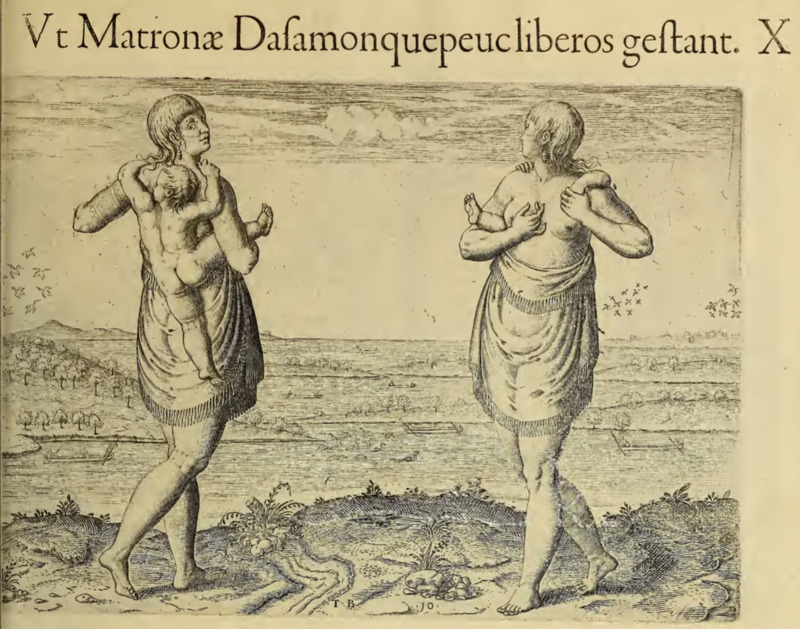
An Indigenous woman is pictured from the front and from behind standing on the bank of a river. She wears a fringed skirt around her waist, her hair is unbound, and she is topless and shoeless. She holds a young child on her back, with the child’s left arm over her shoulder and their left hand in hers, and their right leg tucked under her right arm against her hip. Behind them, other Indigenous people are seen in canoes.
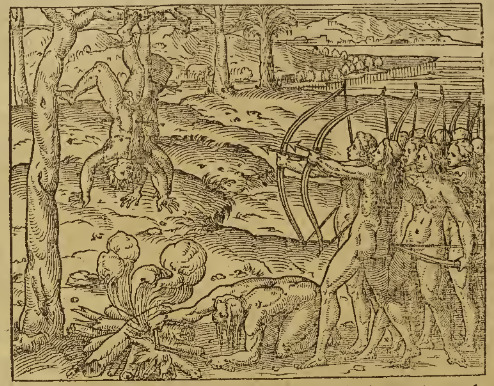
Two men have been captured by the Indigenous Brazilian warrior women, a group which the author calls ‘Amazons’. The men have been hung upside down by one ankle from a tree, and a fire has been lit beneath them. The women shoot arrows at the hanging men. This image is identical to one found on page 960 verso of Paris, 1575 (Chaudière), and in Thevet’s Les Singularitez de la France Antarctique (page 126 verso of Paris, 1557 and page 126 verso of Paris, 1558).

![[Lilliputians carry a sedan chair]](https://collections.cemvc.ca/files/large/094260905098d57b96d643c9cc055ff2de2e529f.jpg)
![[Act XI – Calisto, Celestina, Pármeno, Sempronio, and Elicia]](https://collections.cemvc.ca/files/large/4834f0b4a339b5e0ddb42c9ae3e8f60355936b3c.jpg)
![[Gulliver learns the language of the Houyhnhnms]](https://collections.cemvc.ca/files/large/12a552205fec64fcdf41323adcfe34f953ccaa7a.jpg)
![[Detail of Laputan clothing]](https://collections.cemvc.ca/files/large/6dc7e120f0585f08b7b6ac2c98dba1abaee65ca9.jpg)
![[Rawdon and Rebecca Receive a Letter]](https://collections.cemvc.ca/files/large/fdf2df500193d9fbdcc87897b7b65e8d8fb41b49.jpg)
![[various medicines]](https://collections.cemvc.ca/files/large/910ef0b0ff6ec8c7193768ab7dfdf01ec7fc53b0.jpg)
![[The Two Old Men Punishing Their Fellow Elder]](https://collections.cemvc.ca/files/large/7c10db25e6a447dcf1b2b418934716d3a374ea92.jpg)
![Comme[n]t les Sauuages boivent & mangent.](https://collections.cemvc.ca/files/large/e0a9de8b18bcca1eb7a44b20cd9ff02f294e9772.jpg)
![[stack of coins]](https://collections.cemvc.ca/files/large/2c4b3852a7375076a3084b6bec3a027627331319.jpg)