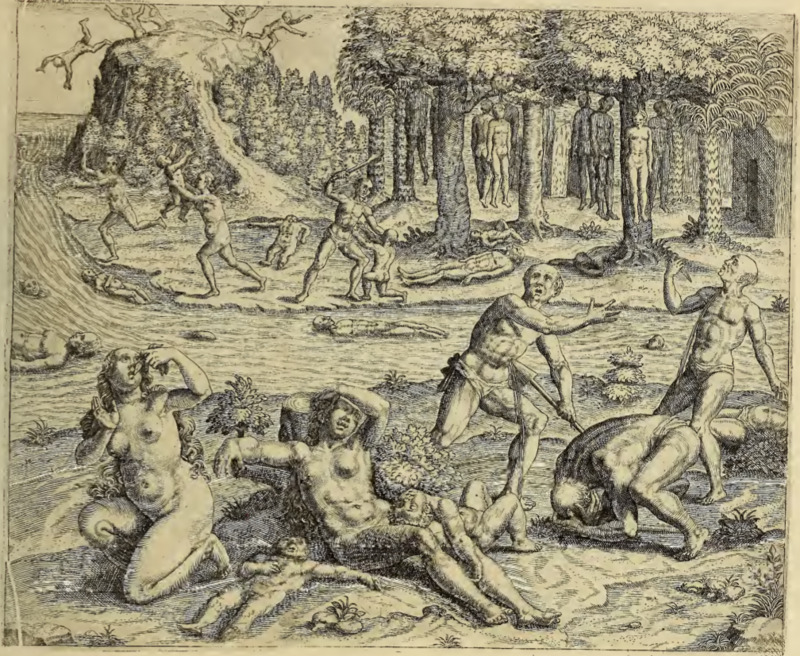
A group of Indigenous people commit suicide to escape the brutality of the Spanish colonists. Men and women hang themselves by the neck from trees, leap off a high cliff, stab themselves with spears and knives, drown themselves in the river, and ingest poison. Mothers and fathers also kill their children.
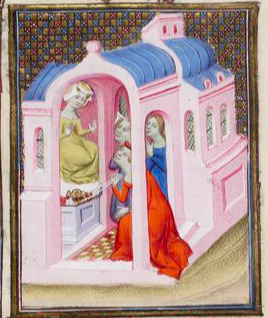
When it was ordered that a temple dedicated to Venus Verticordia be consecrated, it was made a rule that it must be made by the most chaste of Roman women. Among these women was Sulpicia. She was also nominated as the single most chaste Roman woman – a huge honour. Sulpicia is seen sitting in the temple to Venus wearing a yellow gown. She is surrounded by other women who pray and leave offerings.
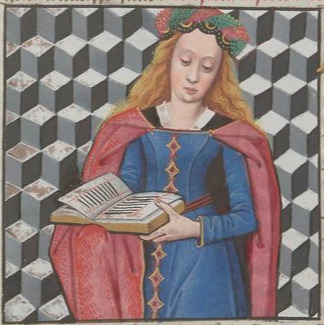
This illumination depicts a portrait of Engeldruda, a Florentine maiden, looking down at a book that she is holding in her hands. Engeldruda is famous for having spoken up against her father to protect her chastity. Boccaccio explains that Emperor Otho IV had gone to Florence for a festival, and when he noticed the beauty of Engeldruda, he asked her father who she was. Engeldruda’s father had offered her up to the emperor as if her chastity meant nothing to him. She rose up and spoke against her father for having done this. The emperor was so impressed with Engeldruda, he offered a nobleman named Guido to be her husband.
A group of Indigenous men, women, and children gather around two large pots, one sitting on the ground and one resting on a fire. The group cooks and eats meat and fish. Two individuals sit in a large hammock while the rest sit and stand on the ground around the pots. One structure is visible in the background.
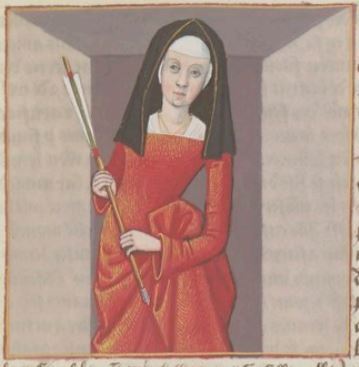
This illuminated image depicts a portrait of a woman named Iole holding a scepter in her hands. Boccaccio explains that he wrote on Iole due to her ingenious plan to humiliate her husband, Hercules, after he murdered her father. Hercules had murdered her father after he rejected Hercules’ request to marry Iole. When Iole married Hercules, she made Hercules dress as a woman and showed him how to spin wool to humiliate him. He willingly did this as he was in love with Iole.
In this image we see Gulliver standing on a ladder, reading texts on Brobdingnag. The texts are written on scrolls, in a calligraphic style. Gulliver compares the writing style to that of Chinese script. Gulliver was given access to the royal library, and he read the texts while climbing on a ladder to see the text. Gulliver tells us that there are relatively few texts in the library. The same image appears in both the 1839 and 1843 Krabbe editions.
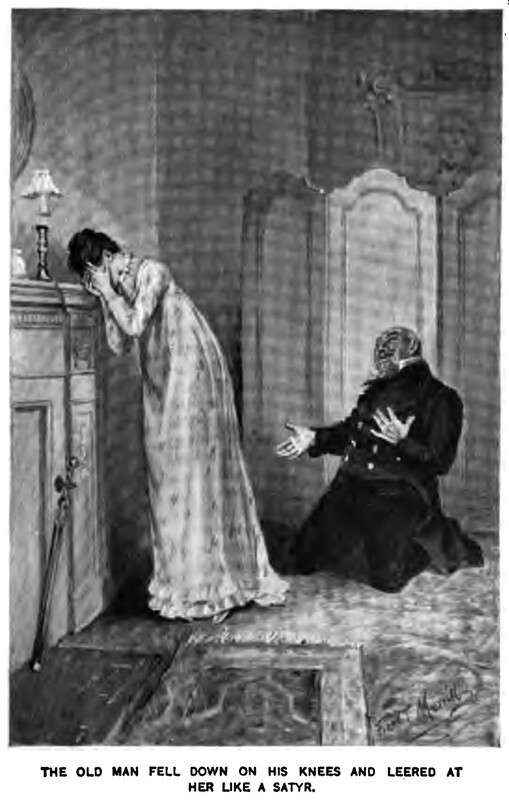
The image depicts a scene from page 136, in which Sir Pitt Crawley proposes to Rebecca Sharp. Sir Pitt is on both knees with one hand extended and the other pressed to his chest, leaning back. In front of him is Rebecca Sharp, turned away with her hands over her face as she leans on the mantle, crying.
In this image Gulliver floats in a bowl of milk. Glumdalclitch is seen behind the bowl as is the queen’s dwarf, who threw Gulliver into the milk out of jealousy. A piece of bread and a spoon sit next to the bowl. The same image appears in the 1839 Krabbe edition.
Here we see a street in England. The houses are built in the Tudor half-timbered style. Two men carry a sedan chair down the street. This image appears at the end of Part Three, when Gulliver has returned home to his family in England following his travels to Laputa, Balnibarbi, Glubbdubdrib, Luggnagg, and Japan.
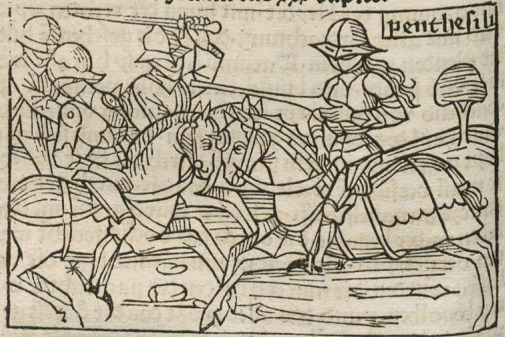
This engraving depicts Penthesilea, the queen of the Amazons, riding a horse into battle with her lance pointed towards her enemies. We know that this figure is Penthesilea as her name is engraved to beside her head. We also know that this is a woman as her long hair is sticking out from underneath her helmet. Penthesilea, as Boccaccio describes, was a great warrior. She wanted to secure a strong heir for the Amazons, so she sought out Hector of Troy to provide her with an heir. She fought in a battle against the Greeks to prove herself worthy of bearing Hectors child. The enemies she is fighting against in the image are the Greek soldiers in the Trojan War.
In the centre of the image there is a tree. A fox sits at the base of the tree staring up at the crow sitting in the tree. The crow holds something in its beak. In the background, to the right of the tree there is a cottage among the trees and bushes.
An Indigenous man has been taken captive by another Indigenous group and is about to be executed. He is restrained by a rope tied around his waist, with each end of the rope held taut. The captive wears a feathered headdress and a necklace. Another man stands beside him holding a club raised over his head, poised to swing. There is a body lying on the ground behind the man with the club. Groups of people stand on either side of the captive to watch the execution, most of the men hold bows or clubs and at least one woman has a small child in a sling against her chest. Another woman crouches beside the prisoner with her hands over her face in distress. Several structures are visible in the background.
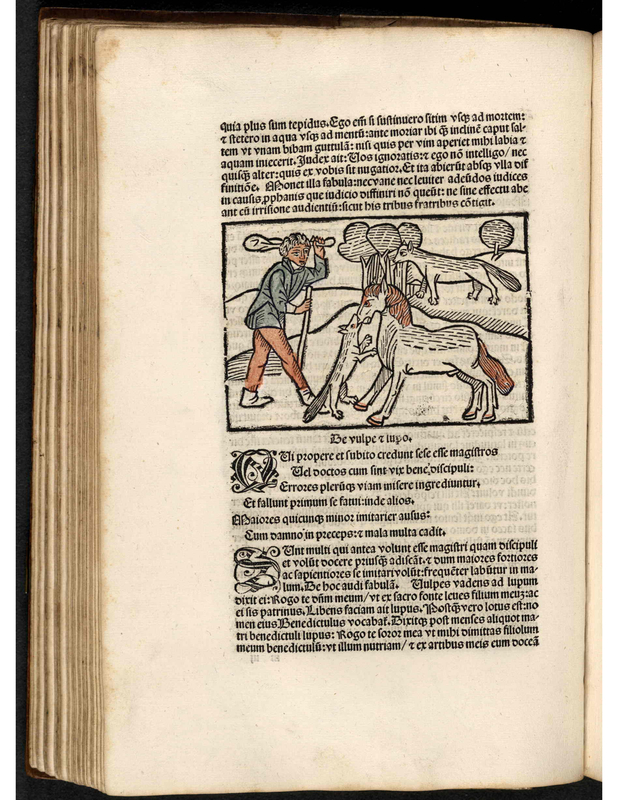
A Shepard stands with a club raised in the position to hit a fox, that is biting a horse’s nose on its hind legs. Another fox watches from the background.
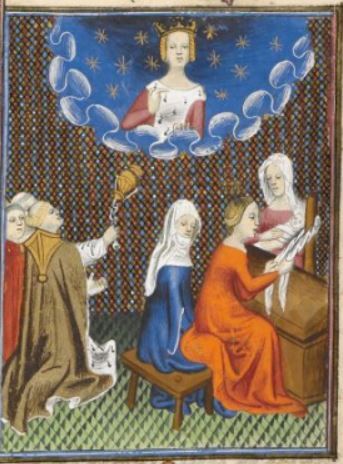
Juno, the goddess of childbirth and marriage is depicted at the top of this illumination appearing to be in the sky. There are women on the right side of the image below Juno to signify Juno’s protection over the women. There is one woman holding a baby, as Juno is the goddess of childbirth. There are religious men standing on the left side of the image, with one man holding a censer and swinging it up to the sky in honour of Juno.
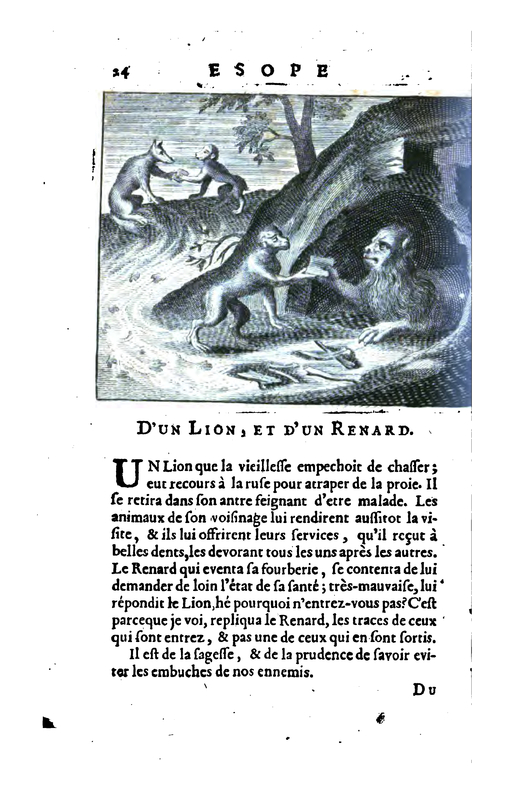
In the front of the image there is a lion's den where a lion is getting something handed over by a monkey. The lion is sitting down. Behind the den there is a tree and another monkey handing off a block of something to wolf. Both of monkeys look a like. In front of the lion's den there are residual bones from the lion's meal and they are covered embedded in the soil.
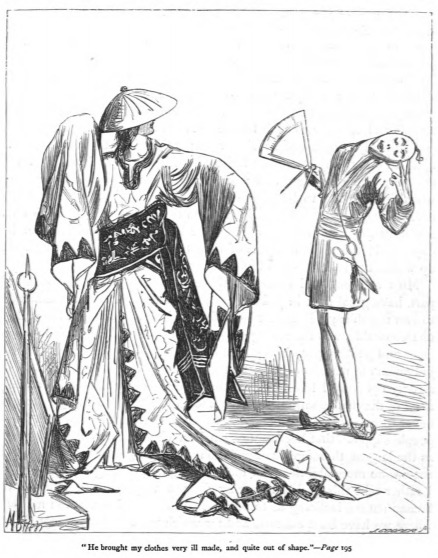
Gulliver was allowed to stay at the palace with the King of Laputa, and the King ordered new clothes for Gulliver. The clothes however, because of the Laputan's lack of attentiveness surrounding the world, were of poor quality and did not fit Gulliver. In this image we see Gulliver trying on his clothes which were much too large, while a tailor stands next to him, holding scissors, a compass, and protractor.
Here we see Gulliver sitting at a table reading a book. The image appears at the beginning of chapter twelve, where he reflects on writing his book. The book Gulliver is holding is likely an early edition of the book he wrote. His daughter is seen over his shoulder. The same image appears in the 1843 Krabbe edition.
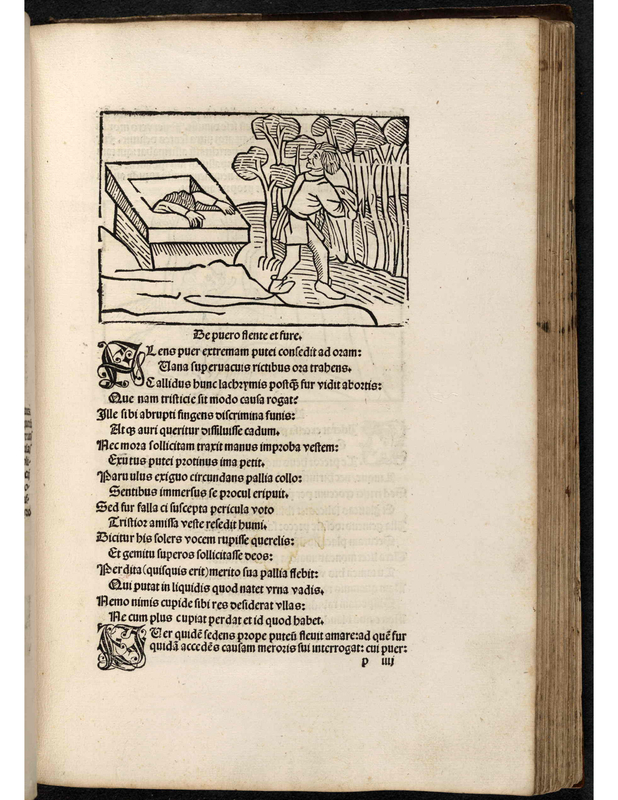
There is a man climbing out of a chimney on the left side of the image. On the right side of the image, there is a man running into the forest while looking at the man in the chimney
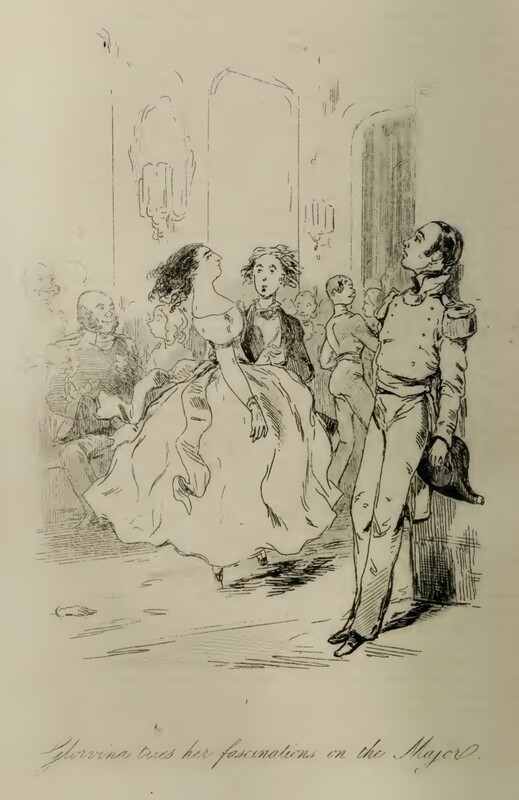
Miss Glorvina O’Dowd dances past Major William Dobbin, trying to get his attention at the King’s Regiment ball. He is leaning against the wall, holding his hat in his hand, and paying no attention. In the background are assorted other officers and their ladies. Below the illustration is printed in cursive its title, “Glorvina tries her fascinations on the Major”.


![[Indigenous Brazilians cook and eat a meal]](https://collections.cemvc.ca/files/large/ed38dda206af987cdd9453fe45f5c47bf785e23d.jpg)
![[Gulliver reads in the library on Brobdingnag]](https://collections.cemvc.ca/files/large/ccd09147e8e87479e1e0c9ee674298a9aa8ecb23.jpg)
![[Gulliver floating in a bowl of milk]](https://collections.cemvc.ca/files/large/b194ac7274d28d0403bf3a83b06d206915210aeb.jpg)

![[Vanity Fair Volume II. Chapter XV Inhabited Initial, T]](https://collections.cemvc.ca/files/large/3e1870751a444c89a2e4c8860f1f185bd65a76b2.jpg)
![[Gulliver arrives home in England]](https://collections.cemvc.ca/files/large/f4b7822ea5e2b4900c1e605b3ea9d7db582b9441.jpg)
![[Execution of a prisoner in an Indigenous Brazilian village]](https://collections.cemvc.ca/files/large/48fc2213150aea8479bf707d205bc43ef7c1afae.jpg)

![[Gulliver reading in England]](https://collections.cemvc.ca/files/large/b10d30732f57458688aede5d18c55c9735eb9aee.jpg)