After the death of Sempronio and Pármeno, Calisto asks Sosia and Tristan (the two figures in the foreground) to accompany him to Melibea’s house. When they arrive at her house, they place a ladder on the high wall surrounding the garden (in this illustration it is depicted inside the garden, in the background to the left), and Calisto climbs over. He spends the night with Melibea (in the background to the left), and based on the dialogue, we can assume he takes her virginity. However, daylight begins its approach too quickly, occasioning his departure. He, Sosia, and Tristan return to his house, and he ascends to his bedroom to get some sleep. When he is alone, he laments the shortness of his visit with Melibea.This illustration is quite similar to the one found on page 14 of the text, in terms of composition.
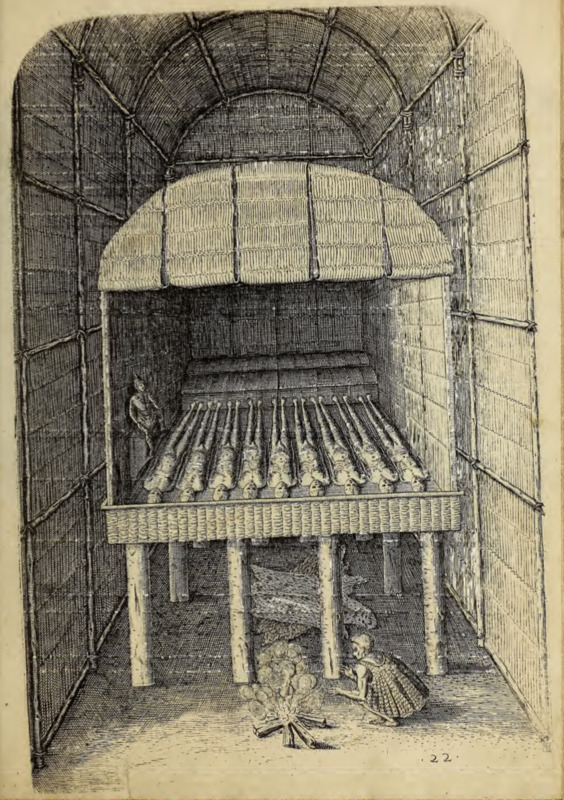
A tomb is shown, where the chiefs of this Indigenous group are laid to rest. The tomb sits inside a larger structure. It is set on thick logs that elevate it off the ground. The bodies of the chiefs are laid out side by side on a platform on top of the poles. Walls and ceiling enclose the bodies. At the base of the tomb a man crouches beside a fire.
The left panel depicts Celestina standing outside. She is wearing a robe and a veil, with what appears to be a rosary hanging from her waist. To the right we see Calisto’s servant Sempronio standing outside, wearing a hat. He has a sword mounted on his belt, which is partially concealed by his coat.The entire image is identical to the one found on page 70. The left panel is identical to the panel found on the title page, and on pages 146, 208, and 225 of the text. The right panel is nearly identical to those found on pages 187 (where it is labeled ‘Sepronio’ [likely a printing error]), 263 (labeled ‘Calisto’), 271 (labeled ‘Calisto’), 326 (labeled ‘Tristan’), and 350 (labeled ‘Pleberio’).
Two Tupinambá men are shown. One of the men stands in front of the other. He wears a feathered adornment at his back, attached to his body with a strap over one shoulder, ruffled adornments around both calves, and is otherwise nude. He bends down with one hand outstretched towards a monkey that sits on the ground beside him. The man standing behind him wears a feathered headdress and an adornment on his chin and is otherwise nude. He holds a rattle or an ornament in one hand, and stares at a parrot on a perch to his left.
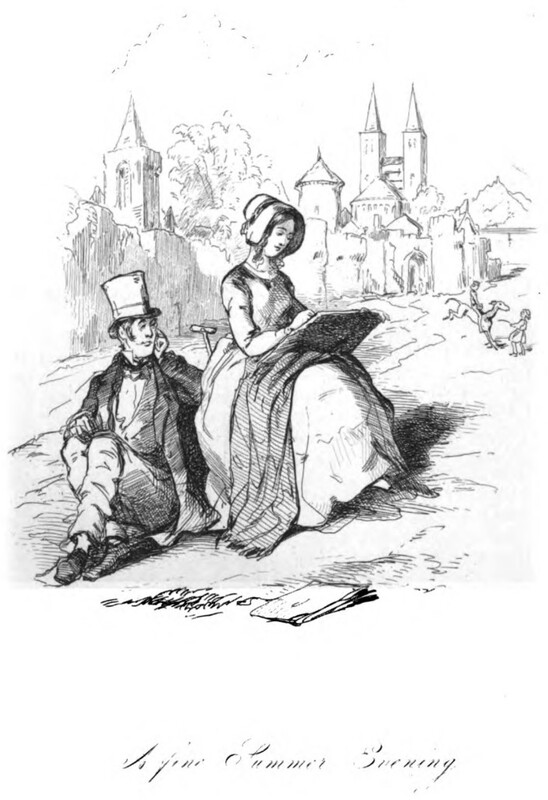
Amelia Osborne sits on a stool on the beach, drawing in her sketchbook. William Dobbin sits on the sand next to her, watching her with an expression of bliss. Further down the shore, a boy is riding a kicking donkey whose lead rope is held by a girl. In the background is a castle and tower on a cliff. Below the illustration is printed in cursive its title, “A fine Summer Evening”.
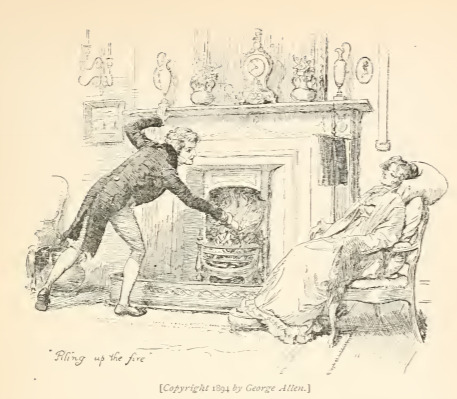
In this image Mr. Bingley adds wood to the fire that Jane sits by. Jane was recovering from a bad cold she caught while on her way to Netherfield. She was not well enough to go home to Longbourn so she remained at Netherfield. Here, Jane has recovered enough to sit downstairs by the fire, where she relaxes with a pillow behind her head. Mr. Bingley, wanting to make sure she is comfortable, adds fuel to the fire so she does not get cold. This scene occurs in chapter 11. The characters are shown in the traditional regency style. Jane wears a regency style dress with an empire waistline. Mr. Bingley wears a waistcoat and tailcoat with a top hat. The regency period dated to the early nineteenth century (1811-1820) when George, Prince of Wales, later George IV (r. 1820-1830), reigned as regent for his mentally ill father, King George III (r. 1760-1820). The regency period is associated with the rise of neoclassicism in art and fashion.
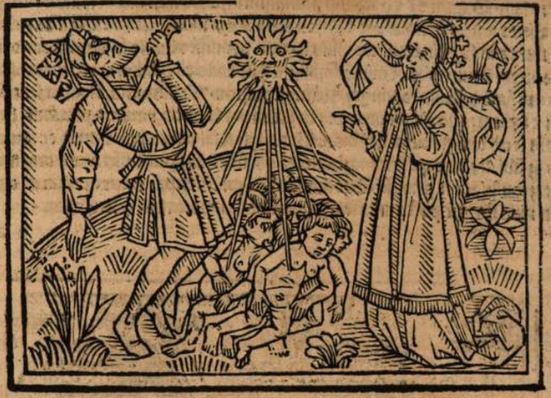
This engraving depicts Niobe, the daughter of King Tantalus of Phrygia, on the right side of the engraving wearing a crown. Niobe became proud of the fact that she had more children than Latona, the mother of Diana and Apollo. As punishment for her hubris against the goddess, all of Niobe’s children had been killed by the plague. Her children are depicted dead in the centre of the engraving. Grieved by the loss of all their children, Niobe’s husband, King Amphion of Thebes, killed himself with a knife. Amphion is depicted on the left side of the engraving as he pierces his body with the knife.
Queen Elizabeth I is depicted standing on a raised dais to the left of the image, drinking from a pitcher of beer she holds in both hands. In front of her is the ancestor of Pitt Crawley, a man with a pointed beard, kneeling and holding the platter from which the beer was taken. A slight figure of a guard can be seen behind the queen, and in the top right of the picture, the letter A from “Among” is seen through a window.
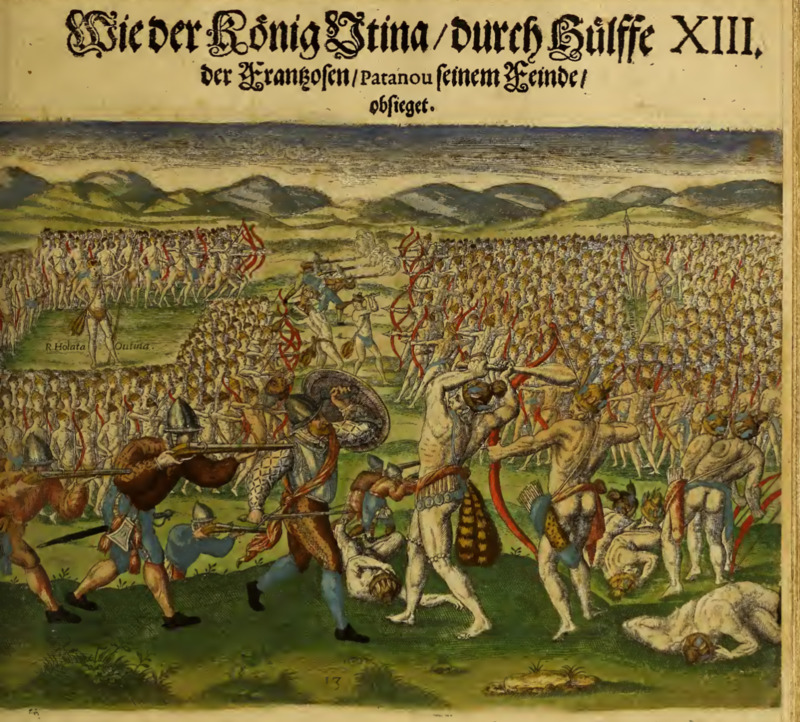
A battle is shown between two groups of Indigenous people. The groups are armed with bows and arrows, clubs, and spears. The group on the left stands in a square formation with a gap in the middle. The French colonists fight on the side of Chief Outina (pictured in the middle of the group on the left). In the foreground, colonists shoot at Indigenous men on the opposing side with rifles. This illustration is identical to the one found on page 61 of Frankfurt 1591, but colored.
Gulliver left the floating island of Laputa to go to Balnibarbi. He arrives and goes into the city of Lagado. He says it is about the size of London, however, most of the buildings had fallen into disrepair. The people often wore rags, walking quickly through the streets. There was also a distinct lack of agriculture despite the good quality of the land. In this image we see some of the locals of Balnibarbi walking through the streets. In the background we see houses that are falling apart. For example, on the right hand side we see a house whose walls are not straight, but are bowing out, and rubble underneath the window. The same image appears in the 1843 Krabbe edition.
Here we see a phrenology bust. The image appears at the beginning of the eighth chapter, in which Gulliver and his master discuss various aspects of the lives of the Yahoos on the Country of the Houyhnhnms, including exercise and education if their children. The same image appears in the 1839 Krabbe edition.
Melibea (presumably the right-central figure, since her robe appears ornate and she is wearing multiple necklaces) overhears Pleberio (left-central figure) and Alisa (leftmost figure), her parents, talking about the prospect of giving her away in marriage. They discuss the mistaken fact that she is still a virgin, and Alisa points out that she has probably never considered having a male companion. Melibea grows frustrated with their presumption that she is ignorant, and she orders Lucrecia (rightmost figure) to interrupt the conversation.
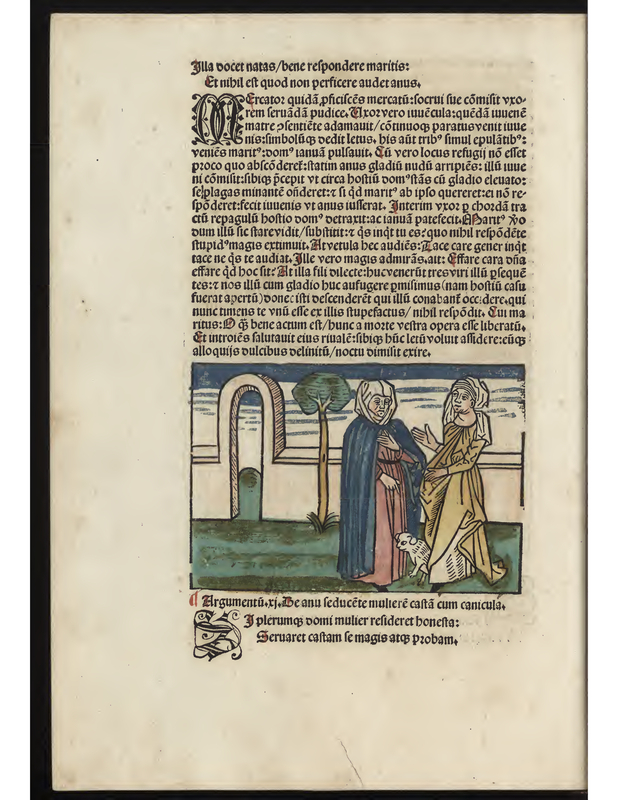
Two woman in robes are outdoors in front of a low stone wall and a tree. One woman who is wearing a cape points down at a small white dog that is standing in between their feet while the other woman who is in yellow gestures towards the other woman.
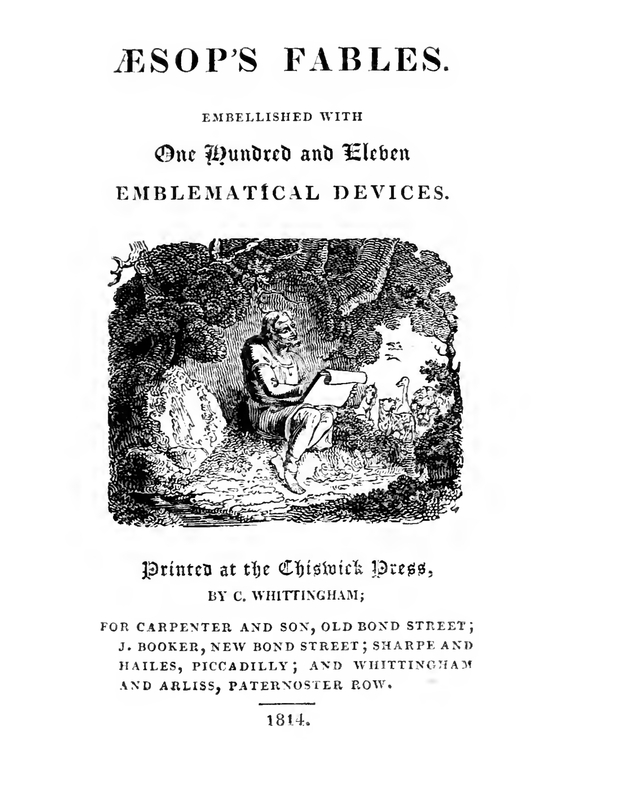
This is the frontispiece of the Aesop's Fables. In the illustration, a old man was sitting on a rock writing. He was in a forest, surrounded by trees and greenery. In the background, animals were gathering behind him.
Here Gulliver’s house is rescued by sailors after he was dropped into the ocean by an eagle. We see a rowboat with five men pulling in Gulliver’s house. In the background we see the large sailing ship that brought Gulliver back to England. Gulliver had a difficult time adjusting to interacting with humans his own size. The same image appears in the 1843 Krabbe edition.
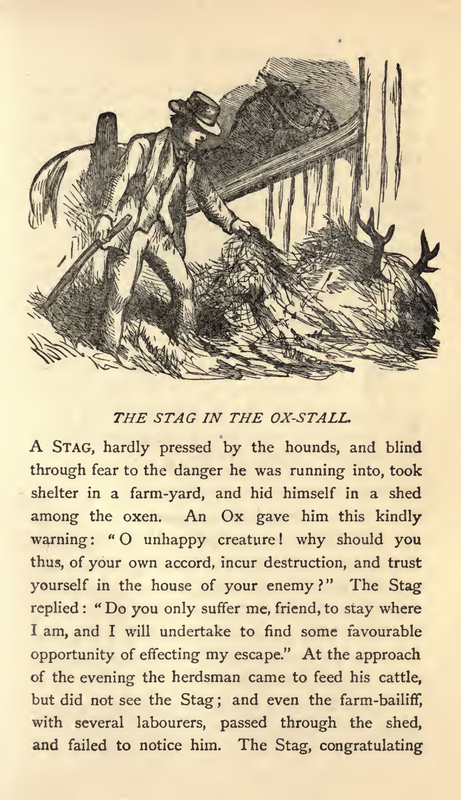
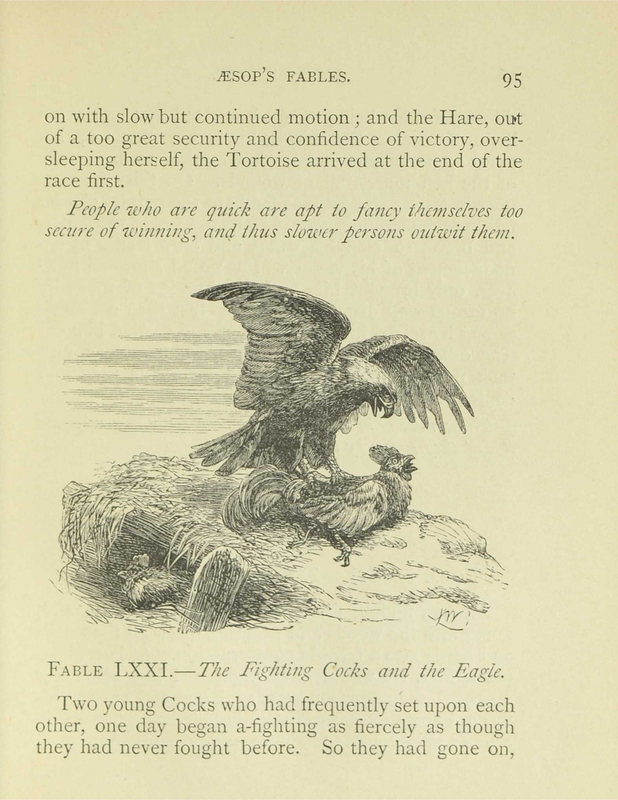
A rooster lays on the rocky outer surface of a small grotto, pinned to the ground by a large hawk. Its facial expression indicating surprise and fear. The hawk’s talons gripping the rooster firmly, its wings expanded about to take flight.
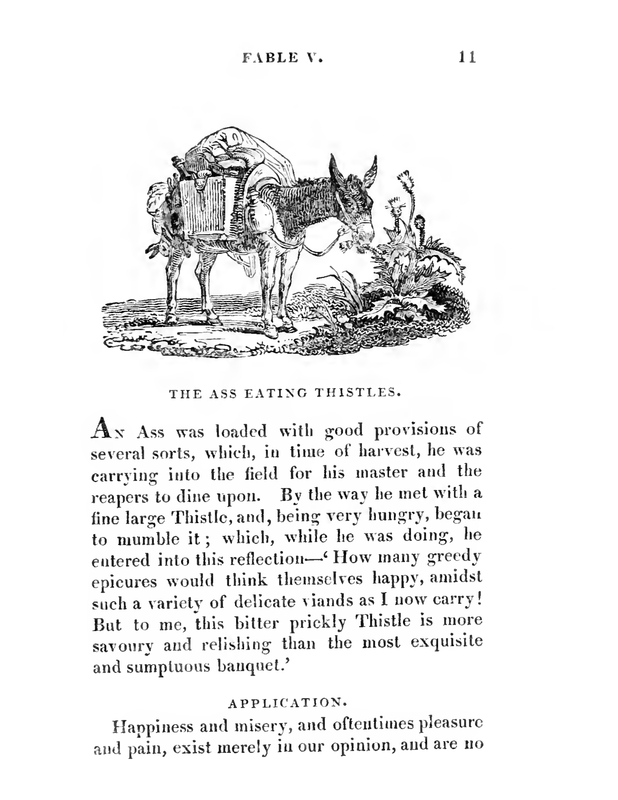
A Ass was the solo character on the illustration. His back was loaded with many provision of all sorts. He was mumbling on a fine large Thistle in front of him.
A group of Indigenous Tupinambá people is shown preparing to execute a captive man. The captive man is restrained by a rope tied around his waist, with two men holding either end of the rope, and his hand is raised in a gesture of protest against his impending death. Another man swings a club above the head of the captive. To the left a man lays on the ground with a woman kneeling next to him. To the right, a man stands holding a bow with one hand and gesturing with the other. A crowd of Indigenous people holding bows stands in the background.

![[Act XIV – Melibea and Calisto Embrace, Sosia and Tristan Stand Guard, and Lucrecia Waits at a Distance]](https://collections.cemvc.ca/files/large/bdd805353c3a72ba2c1b81fe022dfc890b3501dd.jpg)
![[Act V – Celestina and Sempronio (Repeated)]](https://collections.cemvc.ca/files/large/4b2aeeb51f3406275c579a6feafccb2e99545808.jpg)
![[Two Tupinambá men with a parrot and a monkey]](https://collections.cemvc.ca/files/large/544af6bd5ba3996382b33b3e800b44a4b36dbe61.jpg)

![[Vanity Fair Chapter VII Historiated Initial]](https://collections.cemvc.ca/files/large/22b81649df97e4bad695bdadc99757d43b8d4949.jpg)
![[Gulliver arrives in the city of Lagado in Balnibarbi]](https://collections.cemvc.ca/files/large/229adf850e21d57e6f5dea1f5722293d5488a2dc.jpg)
![[phrenology bust]](https://collections.cemvc.ca/files/large/bfd4c6dbecd7f99c3dc8dca79396141ed42dce89.jpg)
![[Act XVI – Melibea and Lucrecia Overhear Pleberio and Alisa Talking About Finding a Husband for Melibea]](https://collections.cemvc.ca/files/large/c35fc29a5bec92b1b277532fbf1705b6a7a63945.jpg)

![[Gulliver’s house is rescued by sailors after he was dropped into the ocean by an eagle]](https://collections.cemvc.ca/files/large/4cda02f02f200cb59d3c02341be02dd04d1091f1.jpg)
![[A group of Tupinambá people take a man captive]](https://collections.cemvc.ca/files/large/f50f34cb6b6250f1a8e919bdb3a71a7fbaa6572d.jpg)
![[Man sitting on platform]](https://collections.cemvc.ca/files/large/0d0df3212726a3d1e25c93efdb0f4ce9fcd4a6a7.jpg)