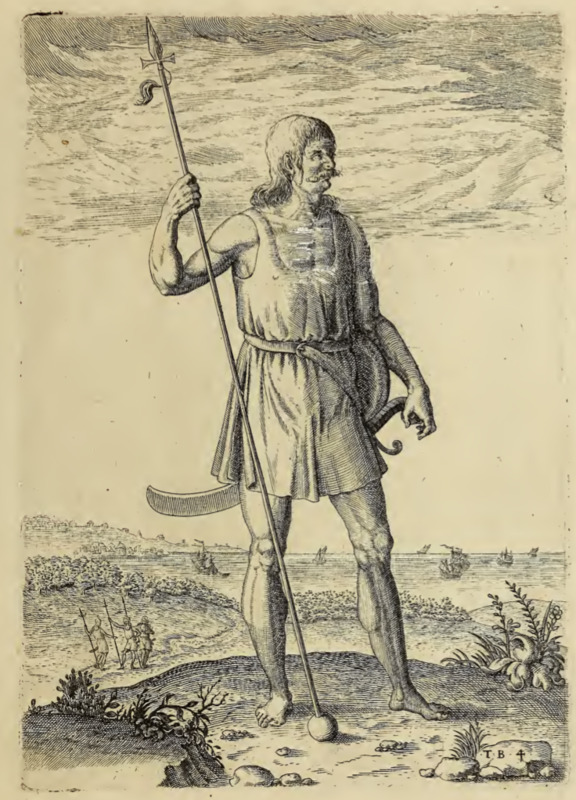
An Indigenous man is shown from the front. He carries a spear with a ball on the end in his right hand. He wears a belted tunic, and both a round shield and a sword with a curved blade hangs from the belt around his waist. This man is described as belonging to an Indigenous group that lived near the Picts. The Picts were an Indigenous group who lived in Britain long before the author’s time. Images of Picts were included in this book so that readers could compare their customs to those of the Indigenous people living in Virginia.
Here Gulliver is transported to the capital of Lilliput on a large gurney. The Emperor of Lilliput wanted Gulliver to be moved from the shore to the capital city and he asked for a large gurney to be built. The gurney was built to be seven feet long, four feet wide, and three inches thick, with twenty-two wheels. The gurney was attached to eighty ropes pulled by fifteen-hundred horses. Gulliver was given medicine to make him sleep while they made the journey from the shore to the capital. They reached the capital after a day and a half of marching – stopping overnight. During the night, five-thousand men stood guard.
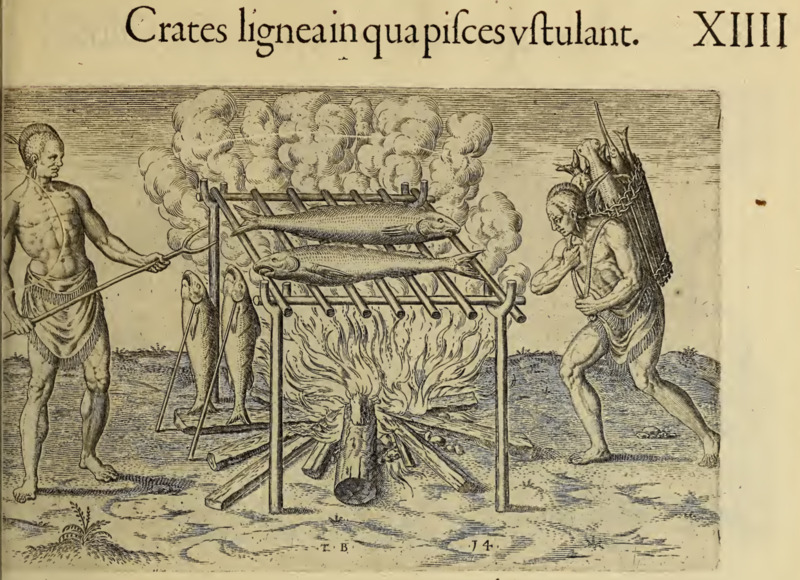
Two Indigenous men are shown cooking fish over a fire. Two fish are laid out on a rack over the flames, two others are propped up with sticks tail-down on the ground by the fire. The rack is composed of four forked sticks propped vertically on the ground, with four others forming a square horizontal to the ground, and five more laid across the the square forming a rack. One of the men holds a forked stick, the other carries a basket of fish slung across his back. Both men wear fringed garments tied around their waists and have a single feather in their hair.
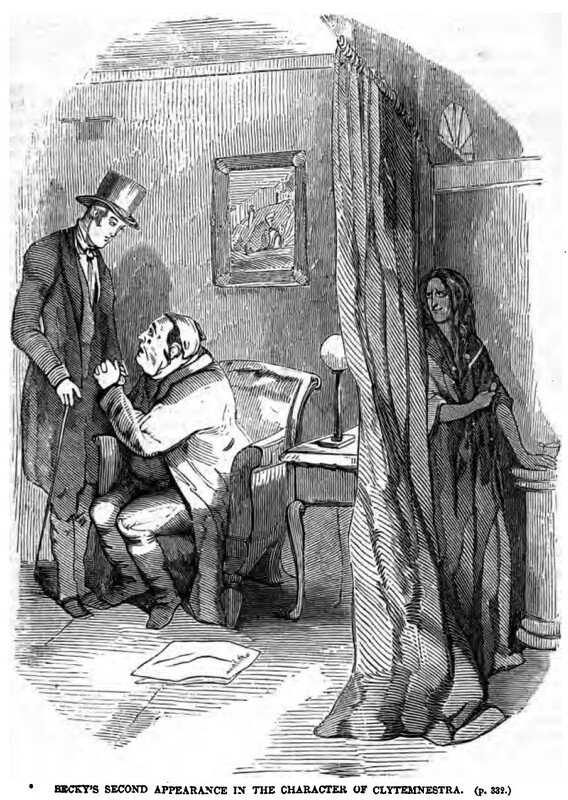
Joseph Sedley sits in a chair, begging William Dobbin, now his brother-in-law, to come and live near him, or else help him escape to India without Becky finding out. Dobbin was sent there by Amelia, who is worried about her brother after finding out that he has purchased a large life insurance policy. Behind a curtain on the far side of the room is Rebecca Crawley, listening in and holding a dagger in one hand. Below the illustration is printed its title and location in the story, “BECKY’S SECOND APPEARANCE IN THE CHARACTER OF CLYTEMNESTA. (p. 332.)”.
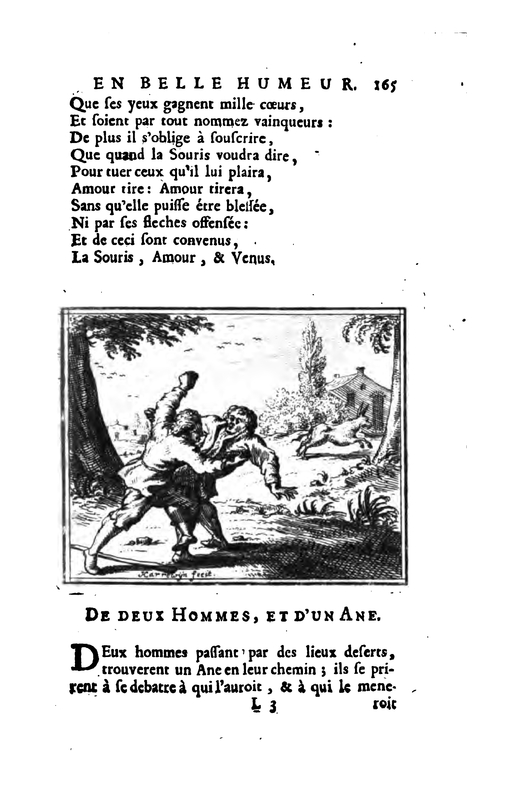
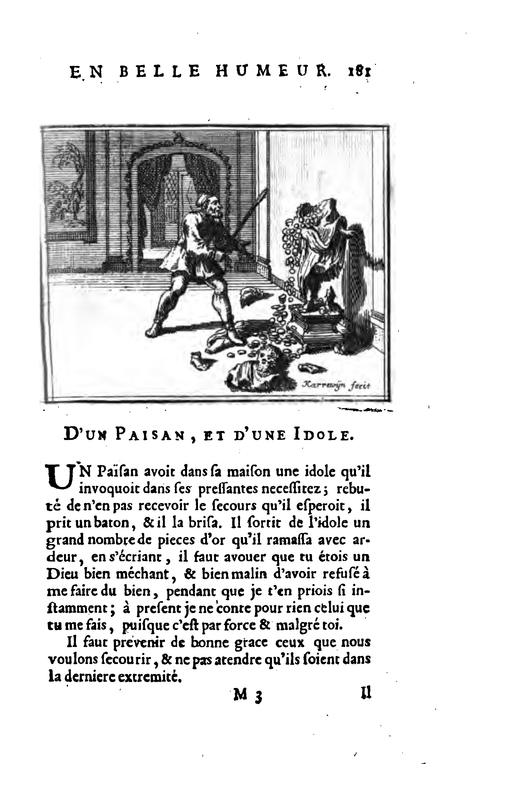
There is a man with a pole attacking a mannequin with gold coins. The gold coins are pouring out on the floor along with the head of the mannequin. There is a text written in the image "Karrewyn fecit".
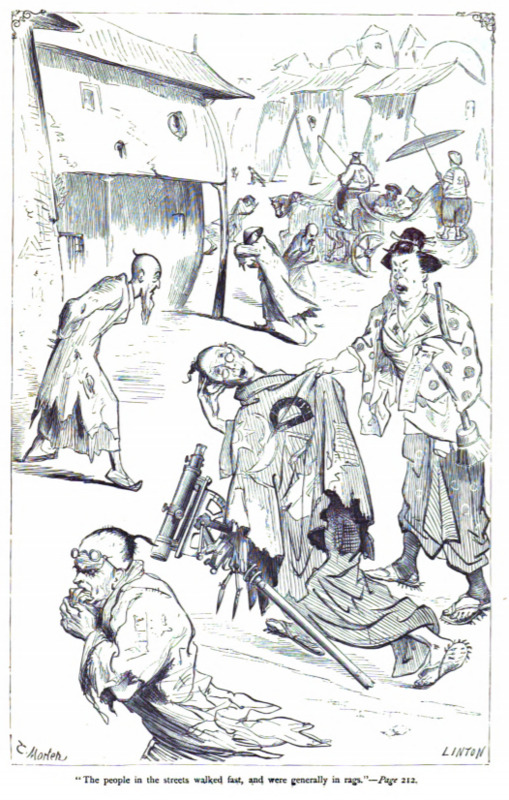
Here we see people in the city of Lagado in Balnibarbi. Gulliver tells the reader that the city was in ruins, as the buildings were crumbling, and the citizens wore rags. In this image we see a citizen carrying mathematical instruments through town.
An Indigenous man wearing a feathered headdress and ornament at his back starts a fire by twirling a long stick against a log on the ground. Another man, also wearing a feathered headdress and carrying a bow, watches and smokes a cigar (or similar item). Several women and children are also amongst the group, including a small child carried in a basket on a woman’s back and another child who carries a miniature bow and kneels on the ground to watch the fire starting.
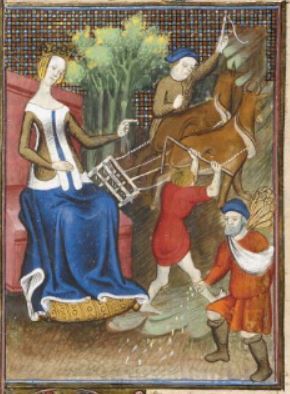
The goddess of agriculture, Ceres, is depicted on the left side of the image wearing a crown and a blue dress. She is pointing towards the men on the right side of the image. Boccaccio explains that after discovering agriculture, Ceres had tamed oxen and trained them to yoke, and taught men how to do this. She also discovered planting seeds and then taught men how to harvest them once they matured. There is one person depicted plowing the fields with oxen, and another man wearing red who is husking grain with a flail. The man at the foreground of the image on the far-right side is depicted spreading seeds on the ground. Ceres also taught men how to turn flour into an edible fare. Ceres wears the crown and scepter to signify her importance linked to agriculture and harvest.
Here we see the great temple of Brobdingnag. The temple is built in the gothic architectural style of many European cathedrals. There is a large tower and two naves. In the foreground we see two giant couples walking among trees. The giants appear very small next to the church, showing the size and scale of the building. There are several large trees in the foreground. The same image appears in the 1839 Krabbe edition.
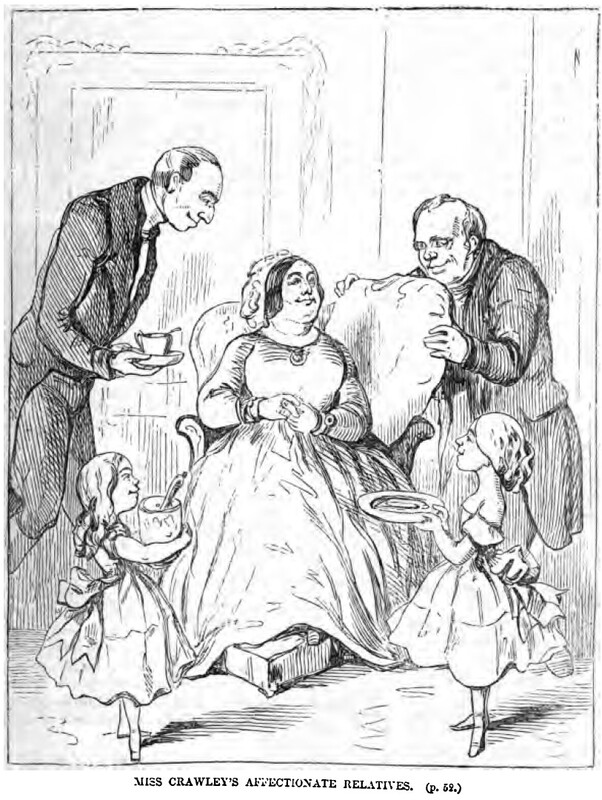
Miss Matilda Crawley is seated in a large, comfortable armchair. She is looking to the right of the image at one of her brothers, Sir Pitt Crawley, who is adjusting one of her cushions. To the left is her other brother, Reverend Bute Crawley, who is bringing her a cup and saucer with a spoon. At her feet are Violet, holding a tall jar or vase, and Rose, holding a plate, both attired in fancy dresses. Below the illustration is printed its title and location in the story, “MISS CRAWLEY’S AFFECTIONATE RELATIVES (p. 52.)”.
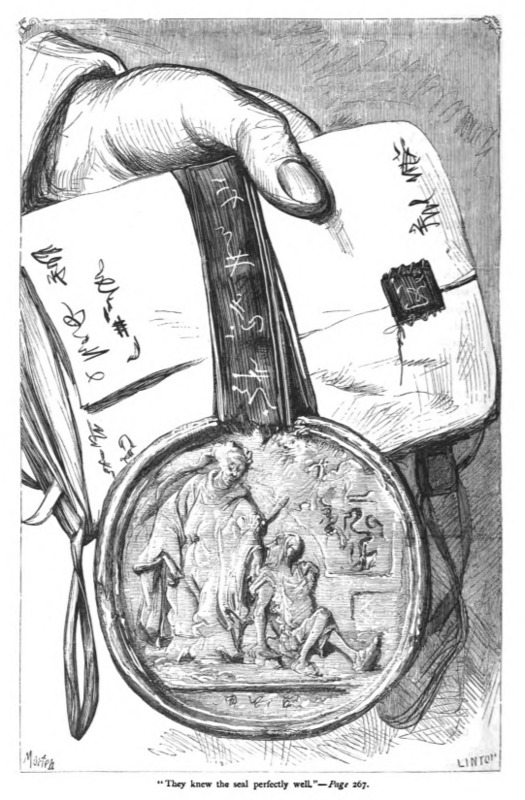
Here we see the seal of the King of Luggnagg on the letter asking the Emperor of Japan to grant Gulliver passage. On the seal is the King of Luggnagg helping a beggar. Luggnagg and Japan were allies, and the Emperor granted Gulliver passage to Europe.
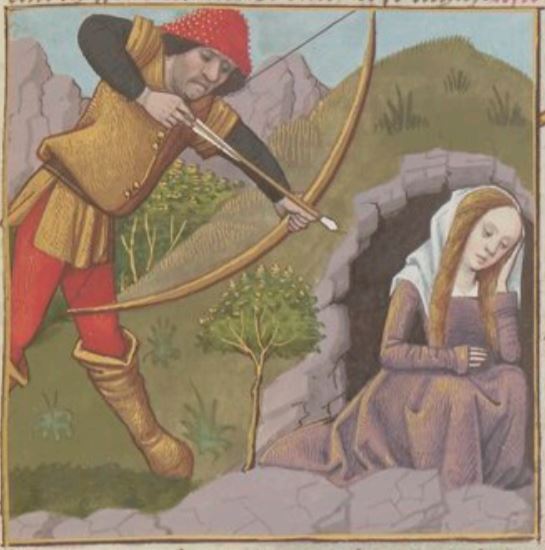
This illumination depicts Cephalus on the left side of the image and his wife, Procris, on the right side of the image. Procris is depicted sitting down with her head resting on her head as she looks solemnly at the ground. Cephalus has a bow and arrow pointed directly at his wife. Procris had gone to live in the woods after she had betrayed her husband for treasures and riches. Cephalus pardoned her for her actions and took her back home. Procris then began wondering if his husband would betray her for what she had done to him, so she began secretly following him on his hunts in the forest. Mistaking her for an animal, Cephalus accidentally shot his wife with his bow and arrow, which is what this image depicts.
Four Indigenous women crouch around large pots on the ground. They chew roots (manioc/cassava) and then spit them into the vats, after which the concoction is boiled and strained. A woman holding a small child stands nearby watching. A man holding a bow and arrow also peers over the shoulders of the women. In the background two people tend to a large pot set over a fire, while another individual passes by carrying a large basket on their back. Several structures are also visible on the left and right.
Here Gulliver stands on a stack of military regalia of the army of Brobdingnag. We see a sword, axe, circular shield, helmet, and chest plate. The armour is highly decorated with engraving and gemstones, particularly on the chest plate and the sword. The same image appears in both the 1839 and 1843 Krabbe editions.
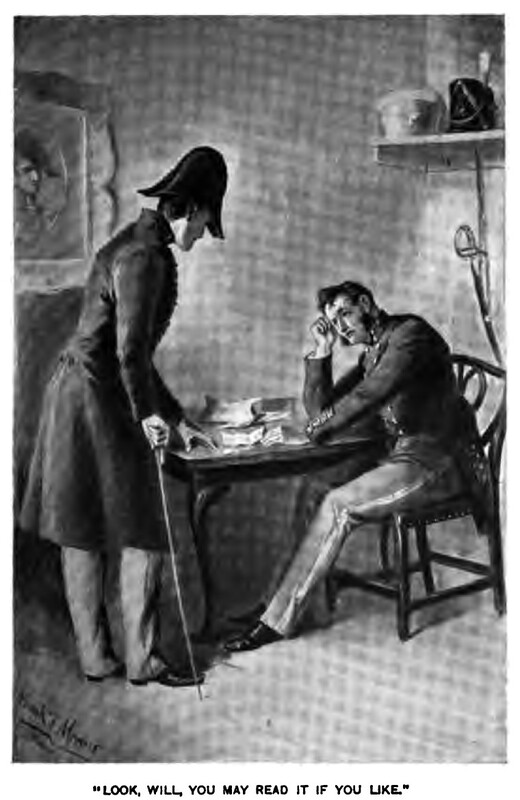
The image depicts a scene from page 170 in Chapter XVIII, in which George Osborne receives a package of the trinkets he gifted to Amelia Sedley. George Osborne is sitting in a wooden chair with his head in his right hand. In front of his is a table, piled with the papers and trinkets Amelia returned when her family went bankrupt. William Dobbin stands on the other side of the table, with one hand on it and the other holding his cane. Both men are dressed in their military uniforms, but only Dobbin is wearing a bicorn hat. In the background, a portrait of a man hangs on one wall. George’s sword hangs on the other wall, below a shelf holding his hat and a pot.

![[Gulliver is transported to the capital city of Lilliput on a gurney]](https://collections.cemvc.ca/files/large/6c171478d7dea756b26743bb3d608faf361b59fd.jpg)
![[Vanity Fair Chapter XLIII Inhabited Initial]](https://collections.cemvc.ca/files/large/4561bd8fcc465e05a9927f434b26720a6412b957.jpg)
![[Animal Stalking its Prey]](https://collections.cemvc.ca/files/large/5e8849f02ffb0137650548f3927b903a8318b2e1.jpg)
![[Method of starting a fire of the Indigenous Brazilians]](https://collections.cemvc.ca/files/large/c92ca5a76b42e3ca3c73498395644bc693b06ff8.jpg)

![[Great temple of Brobdingnag]](https://collections.cemvc.ca/files/large/a90ef6ebbf86abfebd985ba1c6de3453854683fb.jpg)
![[Vanity Fair Volume II. Chapter XIII Inhabited Initial, A]](https://collections.cemvc.ca/files/large/308b03b6094896da329afa2f07b86dba3870985f.jpg)
![[Indigenous Brazilians prepare an alcoholic beverage]](https://collections.cemvc.ca/files/large/8ff8d07c3d7b555cba80896431afb1e16460415b.jpg)
![[Gulliver with military regalia from Brobdingnag]](https://collections.cemvc.ca/files/large/3ff14fdf7bf2bf5ec899bef238b4c2aa677396e9.jpg)