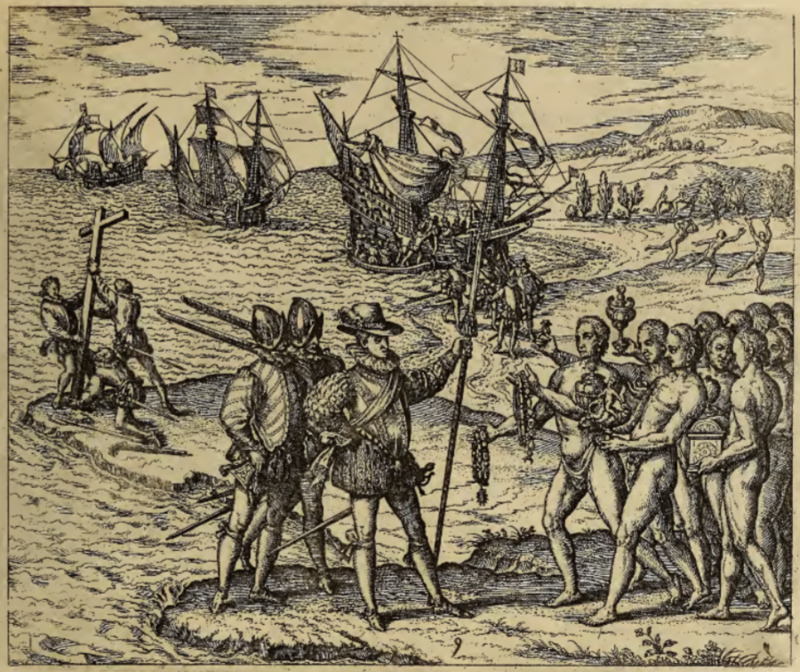
Christopher Columbus is shown standing on the shore of Hispaniola upon his first arrival there. A man, likely Columbus, stands arrogantly in front of two other Spaniards with his spear planted into the ground and one hand on his hip as he gazes at the people in front of him. A group of the island’s Indigenous inhabitants have approached him to offer gifts of jewelry and other treasures. On a spit of land behind Columbus, three Spaniards erect a large cross. Large Spanish ships are anchored along the coast in the background, with Spaniards coming ashore in rowboats. Several Indigenous people flee from the ships. This image is identical to one found on page 165 of Frankfurt, 1594.
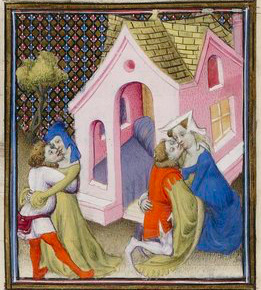
Flora was believed to have acquired her wealth by working as a prostitute in brothels. She was also believed to have slept with Hercules, and received payment from the next man she saw, who she wound up falling in love with and became his heir when he died. The image depicts Flora, on the right in a blue gown, courting a man in front of a brothel. To the left of the image, another woman does the same with another man.
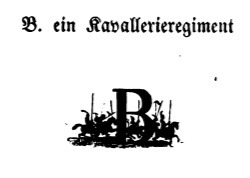
Here we see the letter “B” with cavalry surrounding it. The letter “B” using a method of coding developed by scholars at the Grand Academy on Balnibarbi signifies the word “cavalry”. This image comes in a description of a conspiracy found by a professor from the Grand Academy on Balnibarbi. This conspiracy is thought to be an allusion to the trial of Francis Atterbury, the bishop of Rochester for allegedly plotting with the Jacobites. Atterbury was charged with treason in 1722 and was exiled to France. The same image appears in the 1843 Krabbe edition.
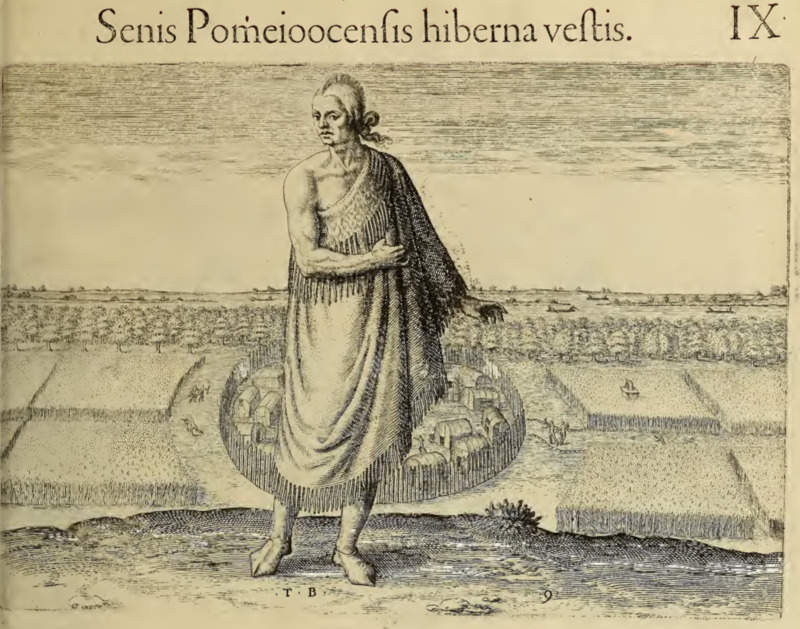
An old man stands on a hilltop. He wears a fringed garment draped around his body and over one shoulder. His hair is spiked down the middle of his head from forehead to nape of neck, where it is gathered into a knot. On his feet are slippers. Behind him on the ground below the hill, cultivated fields surround a village – a small group of dwellings with a fence around them.
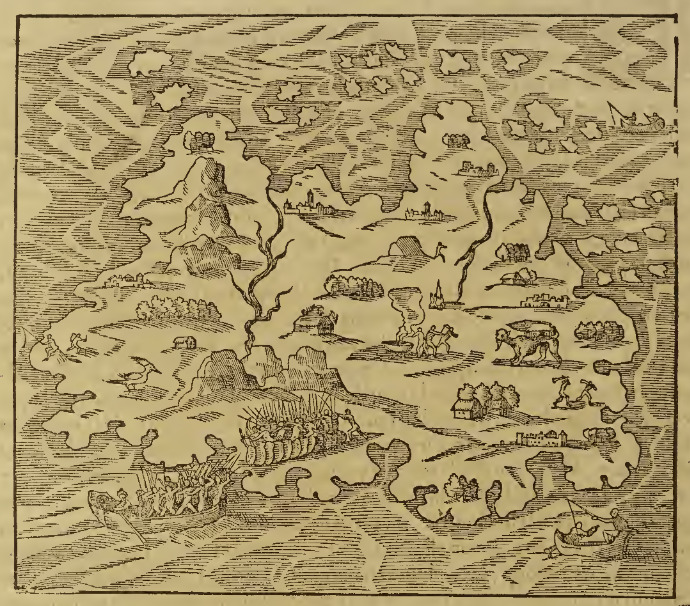
An aerial view of an island is shown, identified as Ile de la Trinité by the author (today known as the island Trinidad, of Trinidad and Tobago). Near the ‘bottom’ of the island there are two groups of Indigenous people engaged in conflict. One group stands on land defending themselves with spears, bows and arrows and shields, while the other group attacks from a rowboat or canoe on the water, also with bows and arrows and spears. Two pairs of people fish from canoes in the bottom and top right corners. Across the island, another pair of individuals fish on the left side, two others spar together on the right, and others cook around a large pot in the middle. There are several structures scattered over the island. This image is identical to one found on page 961 verso of Paris, 1575 (Chaudière).
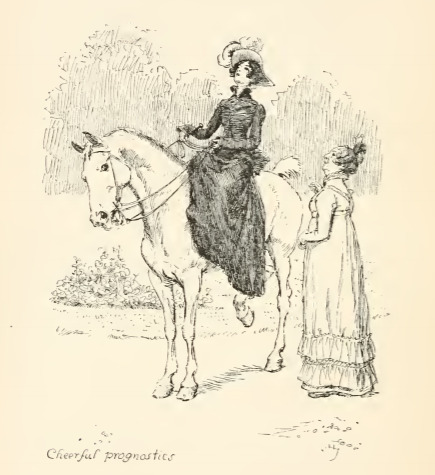
In this image Jane sits on a horse preparing to go to dine at Netherfield Park. Mrs. Bennet stands next to the horse. A letter arrives at Longbourn from Caroline Bingley inviting her to visit Netherfield Park, and Mrs. Bennet decides to send Jane on horseback, even though it will rain so that Jane will have to spend the night at Netherfield. This scene occurs in chapter 7. The characters are shown in the traditional regency style. Jane and Mrs. Bingley wear regency style dresses with empire waistlines. Jane wears a bonnet and a riding habit over her dress. The regency period dated to the early nineteenth century (1811-1820) when George, Prince of Wales, later George IV (r. 1820-1830), reigned as regent for his mentally ill father, King George III (r. 1760-1820). The regency period is associated with the rise of neoclassicism in art and fashion.
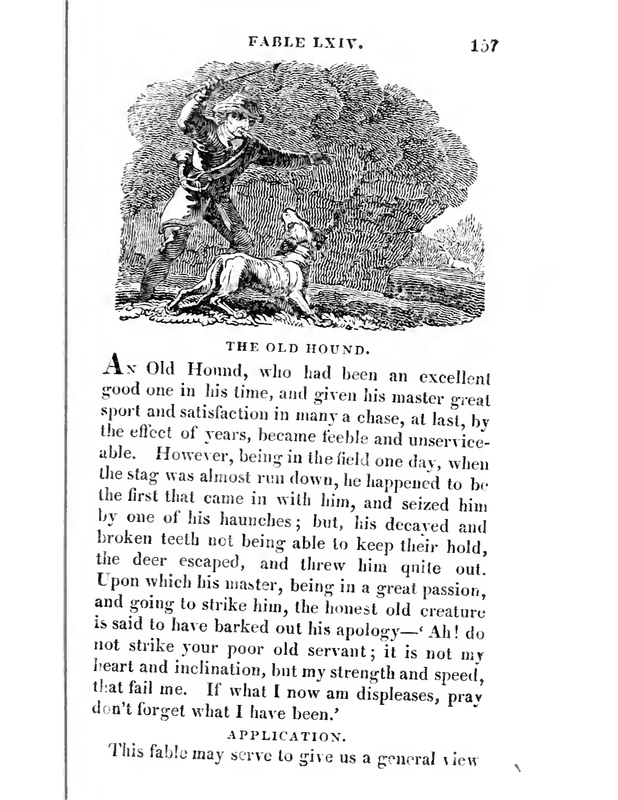
A man stands over his dog. He wields what seems to be either a cane, a stick, or a whip. He seems to be preparing to strike his dog with it. He has a horn slung around his shoulder. The dog looks up at the man, it seems to be bracing itself. In the distance, on the right-hand side of the image there is a stag running away.
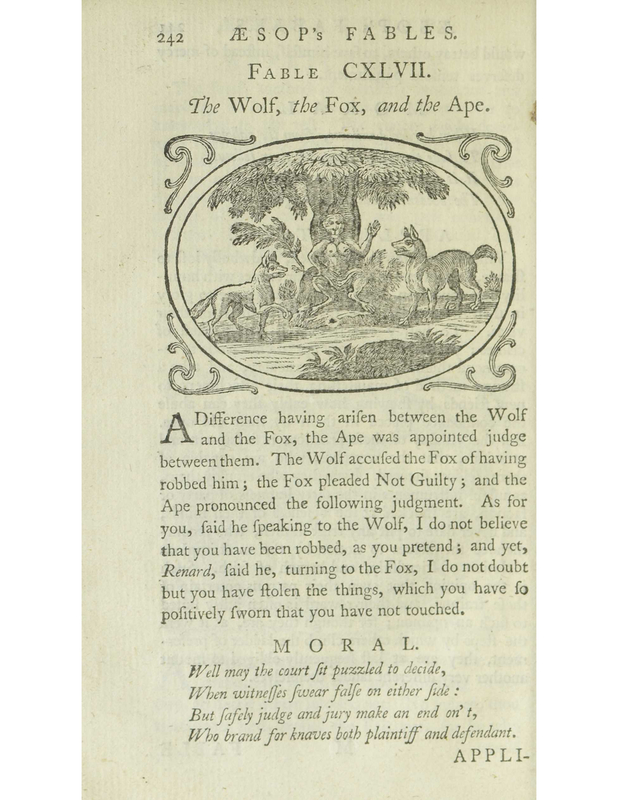
There are 3 animals, a wolf, fox and a ape. The fox and the wolf are facing eachother, while the ape is sat down leaned up against a tree, along with other plants scattered around. A difference has arisen between the fox and the wolf and the ape is the judge between them. The wolf accused the fox of stealing from him and the fox pleaded not guilty. The ape disbelieves the accusations of neither.
An Indigenous village is shown, full of fantastical creatures. In the center of the scene an Indigenous person speaks with two European men. A large hairy creature stands to the left of the three. In the foreground on the left an individual holding a bow emerges from a building. In the center another person lays on the ground with a horned, humanoid creature leaning over them. To the right two more individuals run from another of the horned creatures. There is a ship and a large creature in the water near the coast on the right, and further up the coast a person chases after a large winged creature. There are several structures in the background.
The inhabitants of Laputa were scholars who became so wrapped up in their work that they would lose consciousness of their surroundings. They hired ‘flappers’ to follow them around and hit them with inflated bladders to help them navigate the world, and communicate with each other. In this image we see a scholar who is about to walk off a cliff because he was too wrapped up in thought to pay attention to his surroundings.
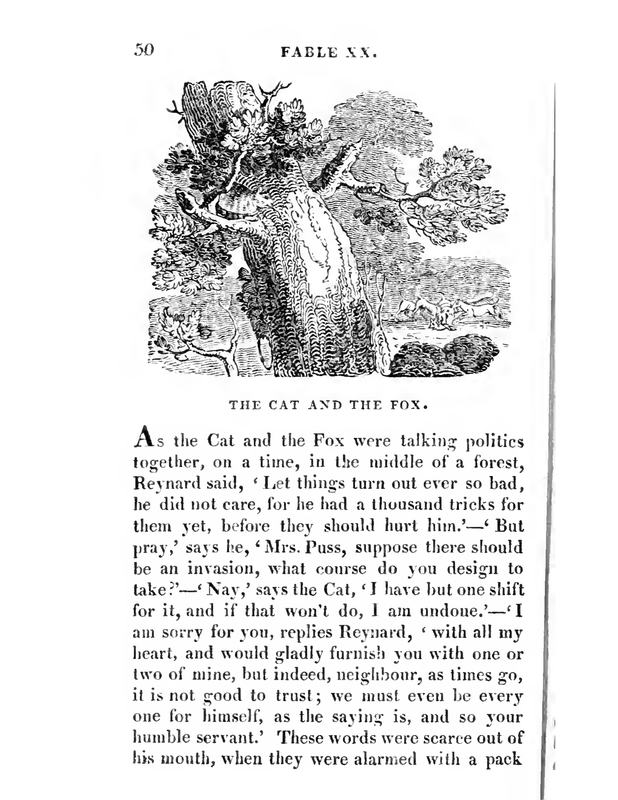
The most prominent image in the illustation was a gigantic tree,which only the middle truck was showed. There was one branch on either side of the truck. A squirrel was on standing on the left one, head looking towards the ground from a distance on the right. In the backgrounds, animals were in fighting to feed on the corpse beneath them.
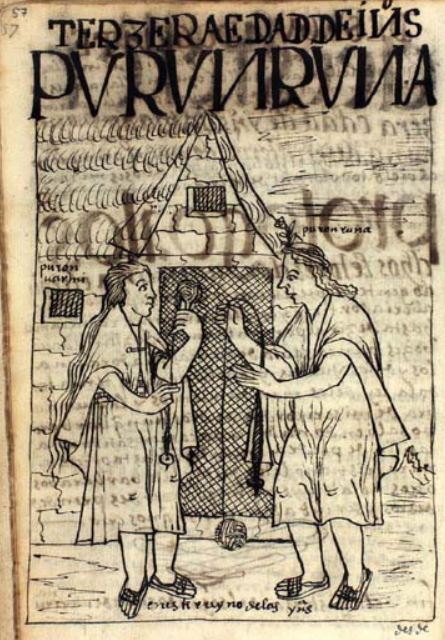
This image depicts the third age of the indigenous people of Peru, whom the author calls the Purun Runa. He explains that they were a simple people and did not involve themselves in much but were devout to God. The person on the left side of the illustration is identified as “puron uarmi,” which translates to “purun woman” and the man on the right side of the image is identified as “puron runa” which means “purun man.” There are words written by their feet which reads “en este reyno de las yndias,” which translates to “in this kingdom of the Indians.”
Here Gulliver eats with the Captain of the ship who rescued him from his box from Brobdingnag. Gulliver tells the captain about his time in Brobdingnag, much to the disbelief of the captain. He tells Gulliver how they found him, much farther from land than Gulliver imagined because he felt he was only in the water for a few hours. The same image appears in the 1843 Krabbe edition.
A pack of wolf and a flock of sheep were in a middle of a brutal fight. The wolves were at a higher position, vice versa. They were in a stagnant pharse with similar level causalities. Wolves attracked with their sharp teeth while sheeps utilized their tough horns. There was body of sheep on the bottom of th illustration. On the other hand, there was wolf hounding, buried underneath them.
Here we see Gulliver’s tutor from Laputa. He was charged with teaching Gulliver the language and showing him around the island. Gulliver’s tutor showed him the schools and the research in philosophy and astronomy that was being conducted. The image shows how the Laputans had their head tilted to one side and had one eye facing inwards while the other looks upwards. The tutor wears a headpiece that has a “J” on it because it is the first letter of the chapter. The same image appears in the 1843 Krabbe edition.
Gulliver’s master explained various aspects of the Yahoos that lived in the Country of the Houyhnhnms. This image is a bust of an important yahoo teacher. The same image appears in the 1839 Krabbe edition.
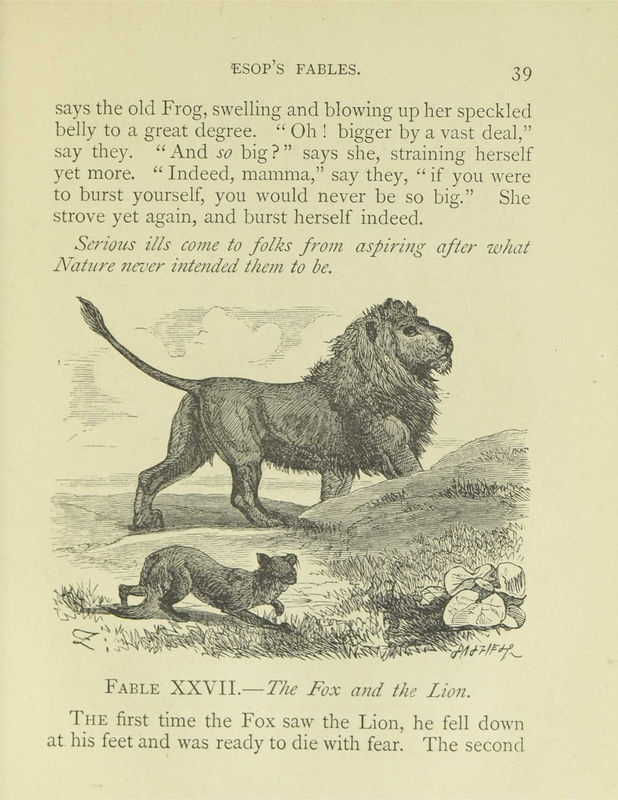
In the background a lion struts through a field with its head held high among some small hills, a fox also struts through the field in the foreground through the grass, there is a small plant on the right side in the front as well.
When midnight approaches yet again, Calisto visits Melibea while Sosia and Tristan stand guard. As he and Melibea talk, he hears a scuffle in the street. Tristan informs him that it is just Thraso and his companions, and that Sosia has managed to scare them off. Regardless, Calisto climbs the high garden wall and, descending the outside ladder too quickly, falls to his death. To avoid exposing him to dishonour, Sosia and Tristan carry him away (as seen in this illustration). Meanwhile, Melibea laments the tragic loss of her lover.
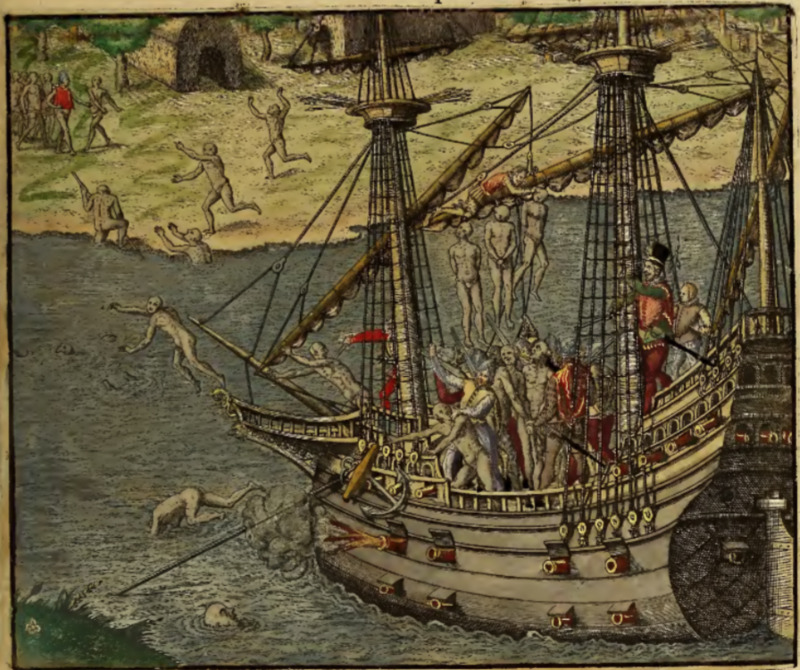
A large number of Indigenous people have been lured onto a Spanish ship by Diego d’Ocampo and his soldiers, in retaliation for an uprising against Spanish colonization in Venezuela. At least three Indigenous people have been hung from the mast of the ship. Several have escaped the ship by jumping overboard and swimming for shore, and some have reached the shore where they then flee the ship. The ship’s cannon is used to fire at those escaping. Two dwellings are visible near the shore. This image is identical to one found on page 181 of Frankfurt, 1594, but colored.
In this image a group of men and women dance at the ball held at Netherfield Park. Mr. Bingley hosted a ball for the upper classes of Meryton. Some dance together while others talk. This scene occurs in chapter 18. The characters are shown in the traditional regency style. The women wear regency style dresses with empire waistlines and their hair tied up. The women hold fans that were used at balls to communicate with other people from across the room. The men wear waistcoats and tailcoats with cravats. The regency period dated to the early nineteenth century (1811-1820) when George, Prince of Wales, later George IV (r. 1820-1830), reigned as regent for his mentally ill father, King George III (r. 1760-1820). The regency period is associated with the rise of neoclassicism in art and fashion.
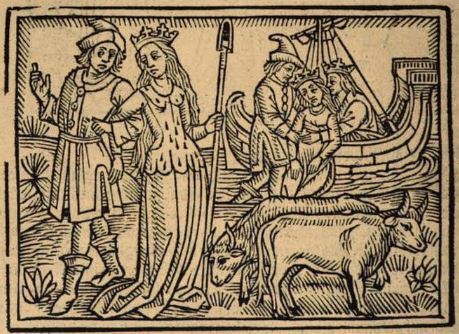
This engraving illustrates the beautiful Europa being kidnapped by Jupiter. Europa is depicted in the foreground of the engraving with a crown on her head and a long staff in her left hand. Boccaccio explains that Europa was following her father's heard of cattle to the shores of Phoenicia because a panderer had convinced her to do so. The panderer is depicted with his arm linked around Europa’s right arm while guiding her to the shore. The cattle are clustered around Europa’s feet. The background of the engraving depicts the kidnapping. The panderer lead Europa to a ship which carried Jupiter. Jupiter’s arms are depicted around the waist of Europa as he is lifting her onto the ship to take her to Crete.
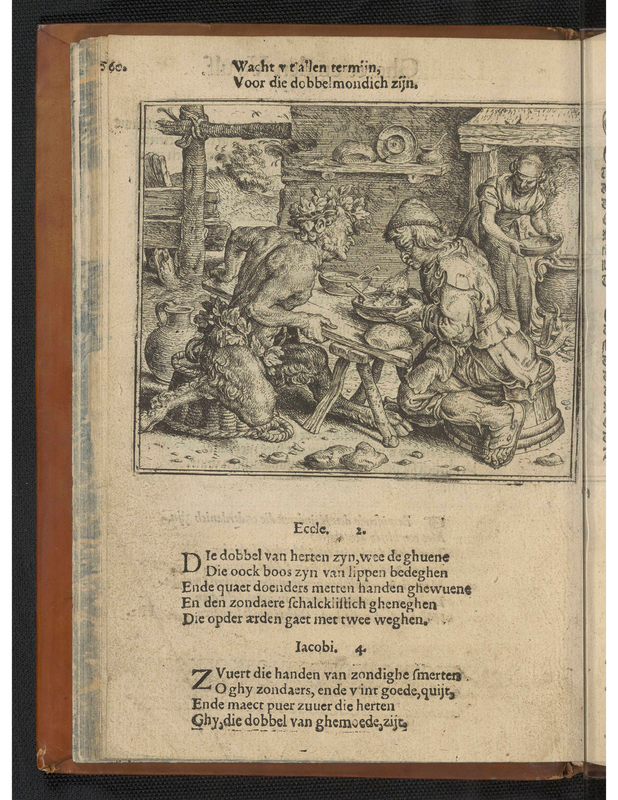
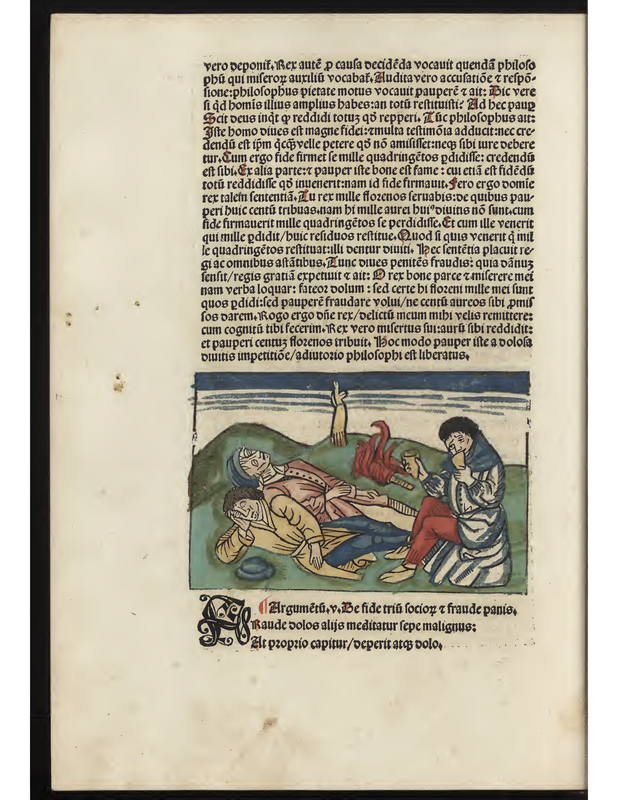
In the middle of a room, a men and a satyr sit at a table. On the table sit several bowls. A man stands in the background at the fireplace, filling another bowl from the cauldron sitting in the fire.

![[Fantastical scene of an Indigenous village]](https://collections.cemvc.ca/files/large/58bffd981154b03be36189024190f29d90d38913.jpg)
![[A Laputan scholar is about to walk off a cliff]](https://collections.cemvc.ca/files/large/308ea422c626c376434240e1ac025e847f1cd60e.jpg)
![[Gulliver eats with the Captain of the ship]](https://collections.cemvc.ca/files/large/cf9a11017ab172d6ba3ba33e0f3b7f1401f49cd4.jpg)

![[Gulliver's Laputan tutor]](https://collections.cemvc.ca/files/large/37e3f5aa7f6b56234dc8be59332aaab82363abbd.jpg)
![[bust of a yahoo]](https://collections.cemvc.ca/files/large/2c24b3b88cd4eae00ebed5d51e21a7fae757ed81.jpg)
![[Act XIX – Sosia and Tristan Lifting Calisto After He Has Fallen to His Death]](https://collections.cemvc.ca/files/large/b0aec7d637f808c684f1cb25f18cba0f105884e2.jpg)
![[Men and Women dancing at the Netherfield Ball]](https://collections.cemvc.ca/files/large/35a50ec1d23703793e37fca0239597b84428fb3c.jpg)