Here we see Gulliver's master seated before the Council of the Houyhnhnms, where represented his district. Every four years a representative council of the Houyhnhnms meets in a large plain about twenty miles from the house where Gulliver was staying. They discuss the conditions of the different districts of the country. This image appears at the beginning of chapter nine, and the letter “U” appears on the back of the chair because it is the first letter of the chapter. The same image appears in the 1843 Krabbe edition.
A group of Tupinambá people – four women and a man – gather around a deceased man who lays in a hammock. Two women crouch beside the hammock with their hands over their faces in distress. Behind the hammock, two more women hold each other by the shoulders as they mourn, and a man stands behind them holding a rattle or ornament with one hand and wiping his face with the other. Both the deceased and living man have a facial adornment on their chin.
Three figures are seen on a ship. The nearest is a man, sleeping on a bench with a cloth over his face and a cup and flask on the shelf beside him. In the background are a tall man and a smaller woman, facing each other. Overlapping with the sail is the letter T from “The”.
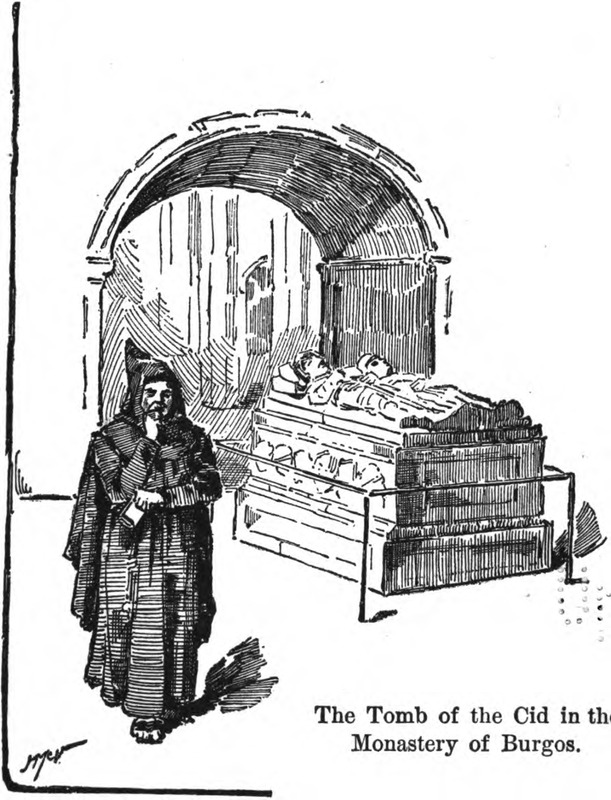
This image shows the tomb of the Cid in his hometown of Burgos. Prior to being entombed, his body had sat embalmed in a chair next to the altar of the church, and had apparently performed several miracles. A figure dressed in black stands on the left of the tomb, which is surrounded by a rail.
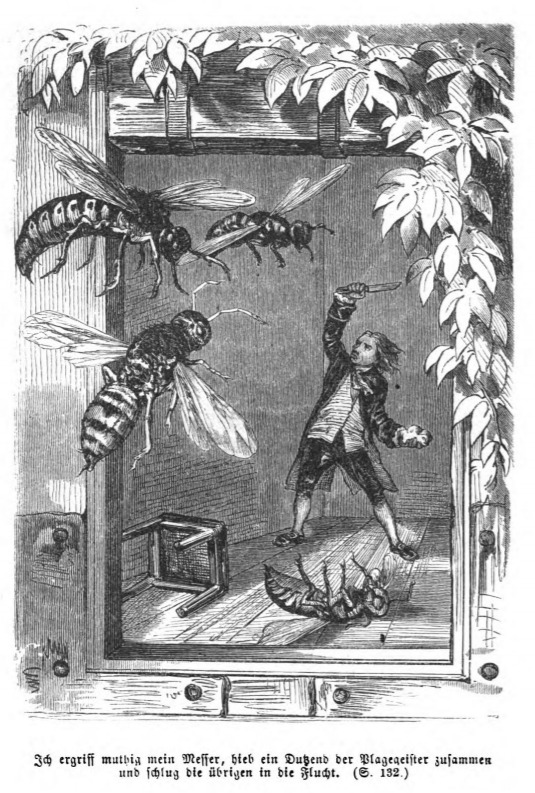
In this image we see Gulliver fighting off three giant wasps on Brobdingnag. The wasps got into Gulliver’s house when the window was left open. One wasp is dead on the ground, while the other three fly around Gulliver. He brought the wasps’ stingers home with him, as curiosities of the lands he visited.
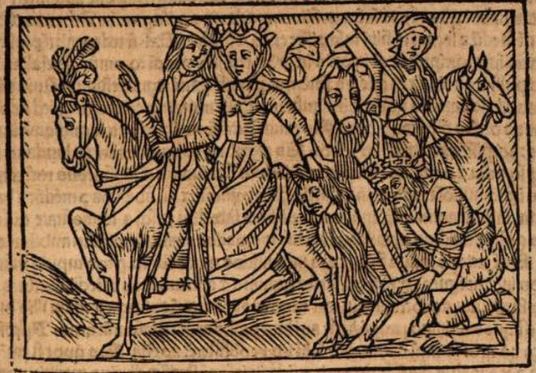
Jason of Thessaly and Medea of Colchis are illustrated riding on a horse together as they flee from Medea’s father, King Aeetes. Boccaccio explains that Medea betrayed her father by helping Jason with his task of finding the Golden Fleece. Jason is seated at the front of the horse and Medea is riding behind him. Medea is depicted holding a severed head in her left hand, which is the head of her brother Aegialeus. Medea had dismembered her own brother and scattered his limbs around the road behind her and Jason in order to distract her father from pursuing them. King Aeetes is illustrated on the right side of the engraving picking up his son’s limbs. One of his servants is illustrated behind him on horseback.
Sambo, standing on the right, presents a platter on which rests a letter for Miss Amelia Sedley from her brother. Amelia, who is reaching for the letter, sits on the sofa next to Rebecca Sharp. Both look concerned. On the wall behind them is a portrait of the man in question atop an elephant, and on the table to the left of the illustration lies an open book and inkwell with a pen and quill.
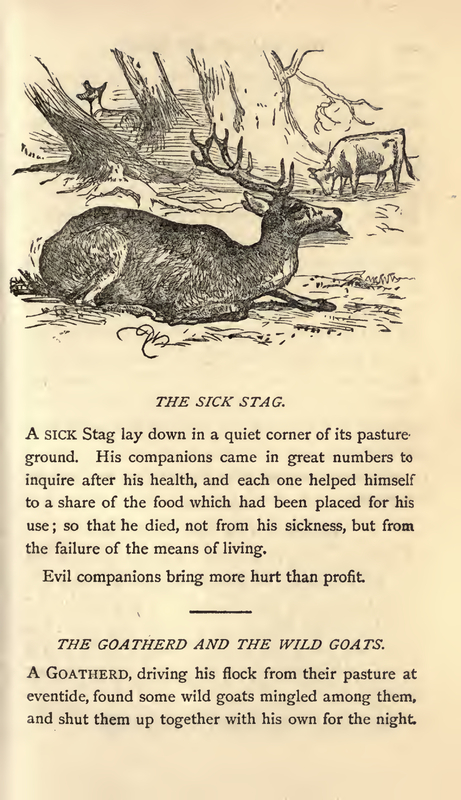
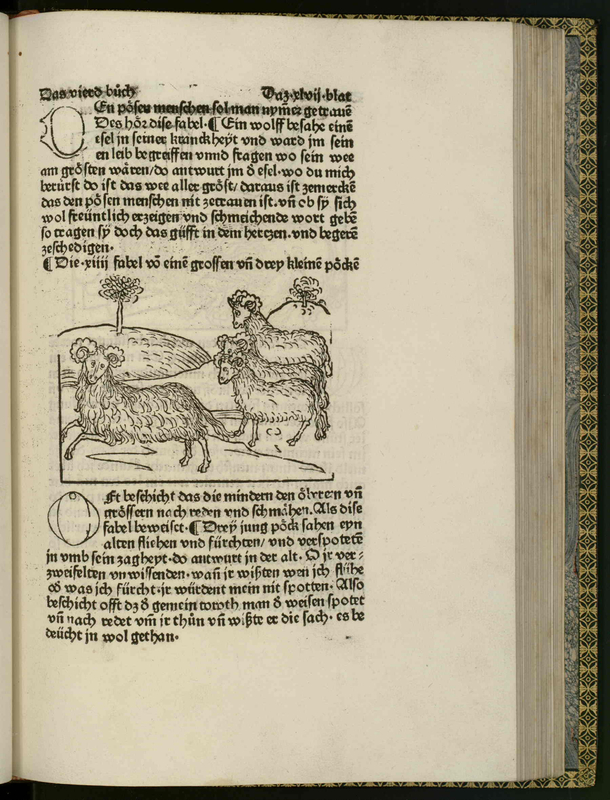
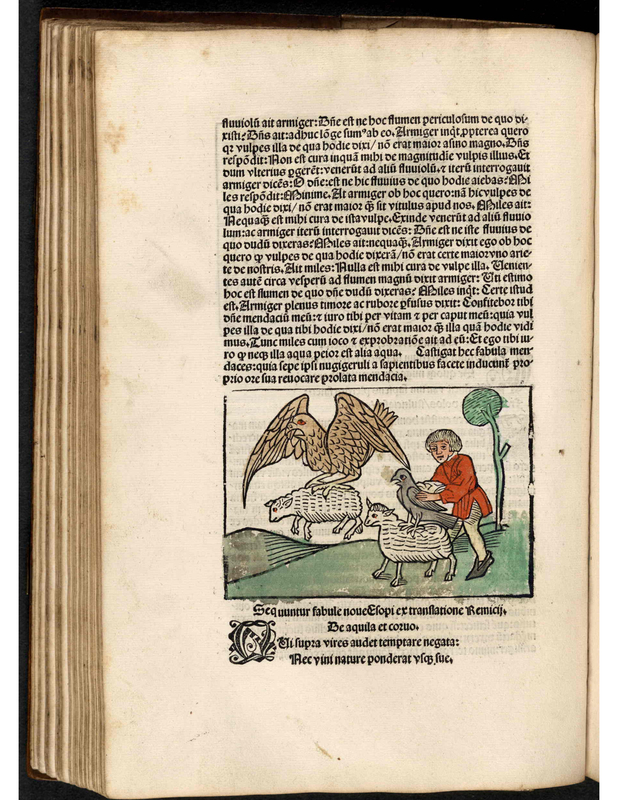
There are four sheeps at the bottom of a hill. On the left-hand side a sheep is starting to run away. On the right side three sheeps are looking in the direction of the running sheep.
After murdering Celestina, Pármeno (lying dead on the stretcher) and Sempronio (on his knees in the foreground) jump from a third storey window in her house and are captured by the alguacil’s (justice’s) men. The justice then sentences them to execution by public decapitation. Crowds gather to witness the proceedings (as seen in this illustration). Sosia, one of Calisto’s servants, witnesses the event and rushes to inform his master. Tristan, another of Calisto’s servants, sees Sosia walking toward the house in tears and asks him the nature of his sorrow. Sosia explains the events that had unfolded. They ascend to Calisto’s bedroom and inform him of the tragic news, and he becomes melancholic. When he asks the cause of their execution, Sosia explains that they murdered Celestina because she would not give them their share of Calisto’s gold chain. Calisto blames the unfortunate circumstances on Celestina’s treacherous and deceptive ways.
Here we see a hanging incense burner with a depiction of virtue and humans. Virtue is represented by a woman, with a Houyhnhnm on her helmet. She holds a mirror up to a man. While the man is dressed like an upper class European, in the reflection of the mirror we see a yahoo from the Country of the Houyhnhnms. This represents Gulliver’s disdain for humans, feeling that all humans lack the virtue of the Houyhnhnms, and are made of vice. The same image appears in the 1839 Krabbe edition.
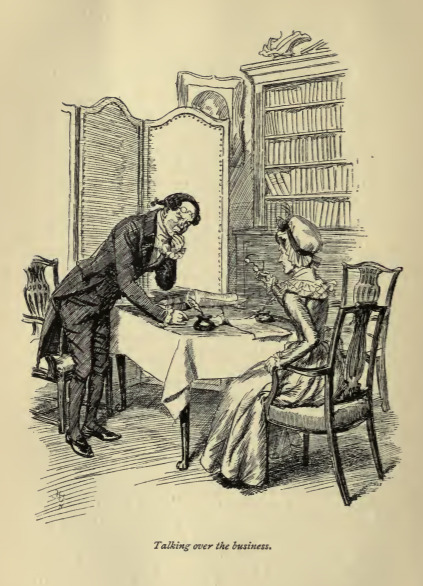
In this image Mrs. Ferrars discusses Edward’s engagement with Robert Ferrars, Edward’s younger brother. After announcing his engagement, his mother disowned him, reallocating his inheritance to his brother Robert. Typically, the largest portion of the inheritance would go to the eldest son following the custom of primogeniture, but Mrs. Ferrars decided against this following the scandal. This scene occurs in chapter 37. The characters are shown in the traditional regency style. Robert Ferrars wears a waistcoat and tailcoat with breeches and a cravat. Mrs. Ferrars wears a regency style dress with an empire waistline and wears a mop cap. The regency period dated to the early nineteenth century (1811-1820) when George, Prince of Wales, later George IV (r. 1820-1830), reigned as regent for his mentally ill father, King George III (r. 1760-1820). The regency period is associated with the rise of neoclassicism in art and fashion.
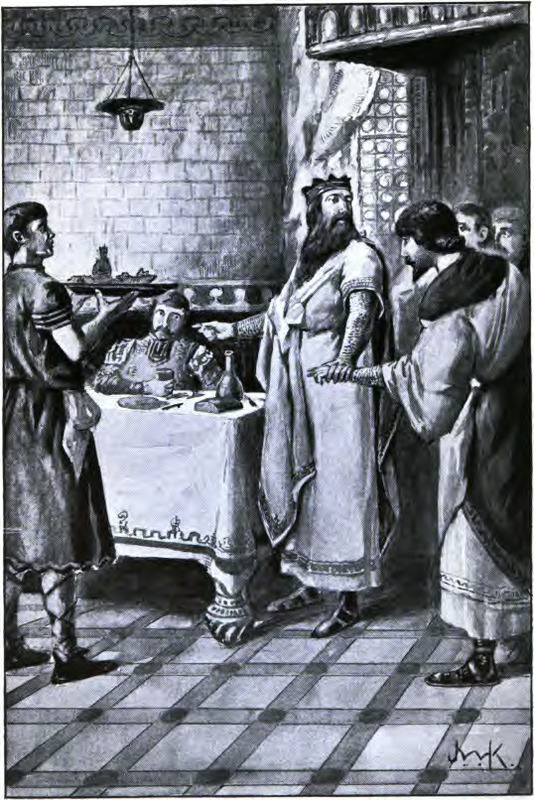
The Cid honours Martin Pelaez after a battle in which he performed bravely, telling him that now he will be allowed to sit with the other knights to eat and that he is now a good knight. The Cid stands in the middle with a crown, holding Martin by the hand and pointing at the table.
Two Tupinambá men are shown, each holding a different weapon. One man stands in front of the other, holding a club with feathers on the end in one hand. The man standing behind him points a bow and arrow at something beyond the right edge of the image. Both men are nude and have an adornment on their chin. The man in front has marks (tattoos or paint) on his chest, biceps and thighs. The head of another man from an enemy group lays on the ground behind the men.
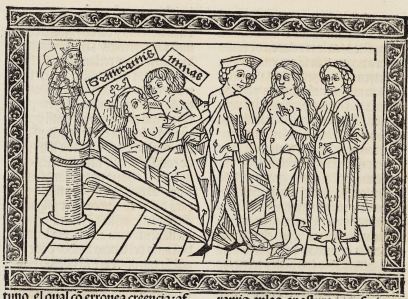
This engraving illustrates Queen Semiramis of the Assyrians lying in bed while having sexual relations with her son, Ninyas. We know that these figures are Semiramis and her son, as the creator engraved their names above their heads to identify them. There is a statue sitting on a platform on the left side of the engraving which appears to be a king. The statue is in fact Semiramis, who had a substantial military career and took part in many battles. The three almost naked women that are illustrated in front of the bed represent the women who Semiramis was afraid of. She was afraid that they would desire her son and take her away from him. Semiramis is said to have invented the chastity belt to avoid anyone having sexual relations with her son. The women are illustrated with undergarments on, which is suggested to be the chastity belts.
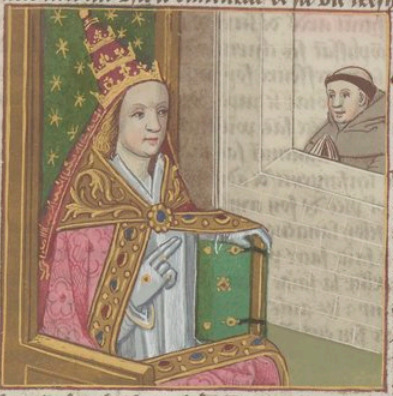
In order to follow her lover to England while he attended school, a maiden named Joan disguised herself as a man and went to school to be with her lover. Joan had excelled in academics and became incredibly knowledgeable. Continuing to dress as a man, Joan rose through the church and was eventually elected to succeed as Pope, known as Pope John. Pope John (Joan) is illustrated on the left side of the image dressed as a man while wearing papal regalia and the triregnum on her head. There is a man on the right side of the image looking at Pope Joan. She eventually exposed herself by giving birth in a public procession.
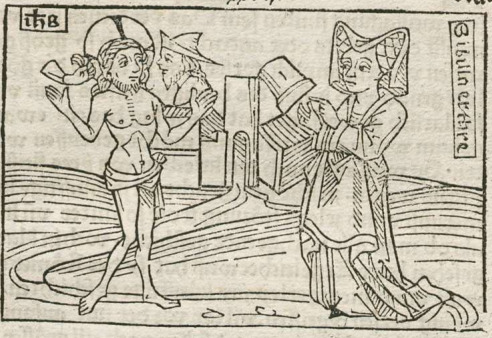
This engraving depicts the sibyl named Erythraea on the right side of the engraving with her fingers pointing to the man on the left side of the engraving. We know that this is the sibyl Erythraea as her name is engraved directly beside her body. The man she is pointing to is the son of God, Jesus. His name is engraved beside his head. Boccaccio explains that Erythraea was so intelligent that her prophecies were taken as Gospel rather than fortune-telling. She even prophesized the entire events from the life and death of Jesus, which is why he is depicted in this engraving. Boccaccio explains that Erythraea had also prophesized the fall of Troy, which is assumed to be the city in the background of the engraving. There is an unidentified man’s head engraved beside Jesus.

![[Gulliver’s master at the Council of the Houyhnhnms]](https://collections.cemvc.ca/files/large/4a000e0bd4afaf20d7822c4a6c86c9f36ebfb5ce.jpg)

![[Tupinambá men and women mourn a deceased man]](https://collections.cemvc.ca/files/large/0514c6a5eba8d66a38e4765abb169139e828690e.jpg)
![[Vanity Fair Volume II. Chapter XXVII Historiated Initial, T]](https://collections.cemvc.ca/files/large/85c0eb927aa50614f462aea80ea9dd9445683829.jpg)

![[The Letter from Mr. Jos]](https://collections.cemvc.ca/files/large/4e527e16330209d2b17e2e9882afbcd742aabc60.jpg)
![[Act XIII – Many Bystanders Observe as Sempronio Is Executed After Pármeno, Who Lies Dead Behind Him]](https://collections.cemvc.ca/files/large/d8d69445fd9fa759863b3158e762b0e58f5f96bf.jpg)

![[a hanging incense burner with a depiction of virtue]](https://collections.cemvc.ca/files/large/9c9fc30fc85f725feda557340ac601eb2a2959f7.jpg)


![[Two Tupinambá men with weapons]](https://collections.cemvc.ca/files/large/0222442187be3fe63a984e6d1171afaf83c3e3c4.jpg)
![[Amelia Osborne]](https://collections.cemvc.ca/files/large/ddb6cdda21925c442a870f836a533876762837ea.jpg)