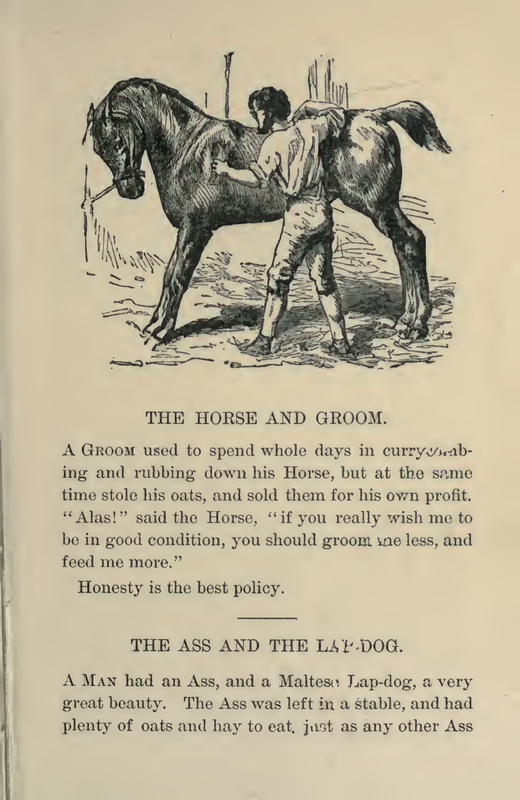
A man is grooming a horse, with his right arm perched over the horse’s back, and burshing it with using his left hand. The horse’s head is slightly bent to look at the groom, looking impatient. The horse’s stance seems as though it is irritated and does not wish to be groomed.
There is a man on a sitting horse, the man carries a sword in his left hand and is holding onto the horse with his right hand. There is a deer running in the background behind a large rock and there’s three trees also on hills in the back.
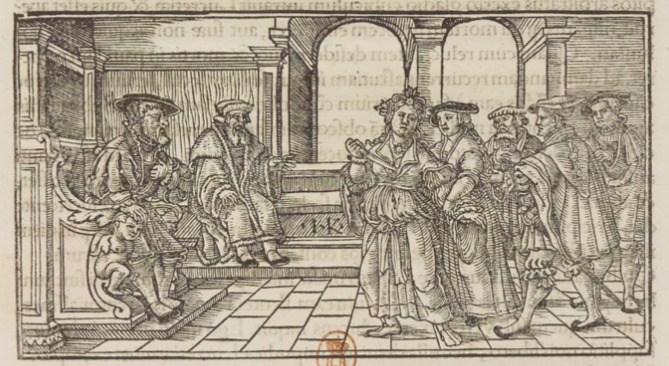
Lucretia was deemed an the most honorable wife of Roman men, but when her husband entertained the guests that helped make this decision, one of his men made a dishonorable decision. He decided that he would rape her in the night, and used blackmail to get his way. When she agreed to die instead of of fulfilling his desire, he decided to then force her to have intercourse with him by saying he would kill a servant and blame it on her. She agreed to be with him rather than have an innocent man killed. In the morning, she fetched her family and confessed the sin, but then ended her life for committing what she considered to be a dishonorable act. In the image, she is seen stabbing herself in the breast in front of her family, husband and friends, ending her life.
After arriving in Lisbon, Gulliver stayed with the captain of the ship that brought him from New Holland to Portugal, Don Pedro. Gulliver refused to go outside in Lisbon, so after arriving at Don Pedro’s house, he would look out the window, trying to readjust to life in Europe. Eventually Gulliver would go downstairs into the doorway, and eventually out into the street. The same image appears in the 1839 Krabbe edition.
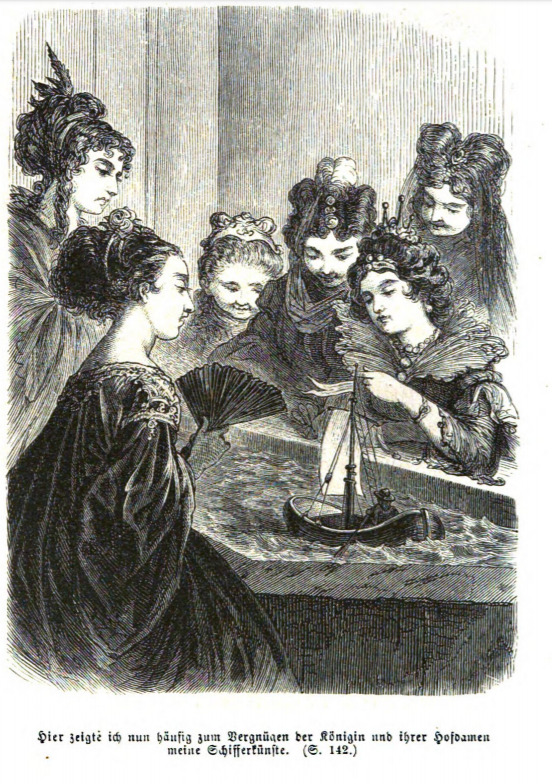
Here we see Gulliver demonstrating his boat and how he sails. The Queen of Brobdingnag and her courtiers watch Gulliver. The Queen built a tub in the court after Gulliver told her about sailing and his arrival on Brobdingnag. The Queen is in the front on the right, identified by her collar and crown.
In this image Mr. Collins proposes to Elizabeth. Mr. Collins asked to be given some time alone with Elizabeth where they were left in the drawing room. Elizabeth then rejected Mr. Collins’ proposal saying she could never marry him. This scene occurs in chapter 19. The characters are shown in the traditional regency style. Elizabeth wears a regency style dress with an empire waistline. Mr. Collins wears a waistcoat and tailcoat with a cravat. The regency period dated to the early nineteenth century (1811-1820) when George, Prince of Wales, later George IV (r. 1820-1830), reigned as regent for his mentally ill father, King George III (r. 1760-1820). The regency period is associated with the rise of neoclassicism in art and fashion.
The narrator is depicted as a piper, standing beneath a tree on a hill and playing his pipe for the small dog that sits in front of him, looking up. In the distance are the silhouettes of the buildings of a town. In the top right of the image is the letter I.
This title page image shows two Indigenous Brazilians and three Europeans. The Indigenous people, a male and a female, are nude and the male carries a bow. Of the three Europeans, two are male and one female. They are all clothed in flowing garments and the female wears a head covering resembling a wimple.
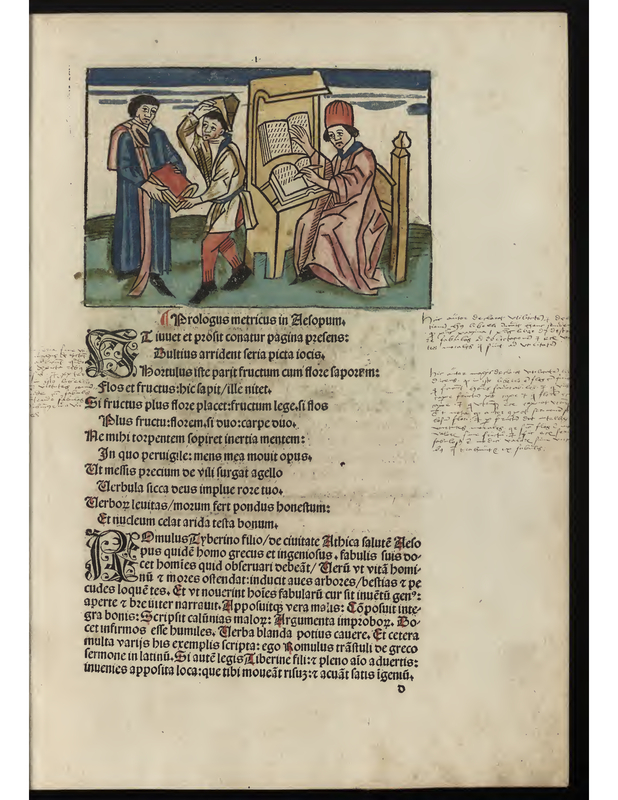
On the right-hand side of the image, a man in a robe sits at a desk, and is writing in a book. To the left stands two men, one man handing a book to the other.
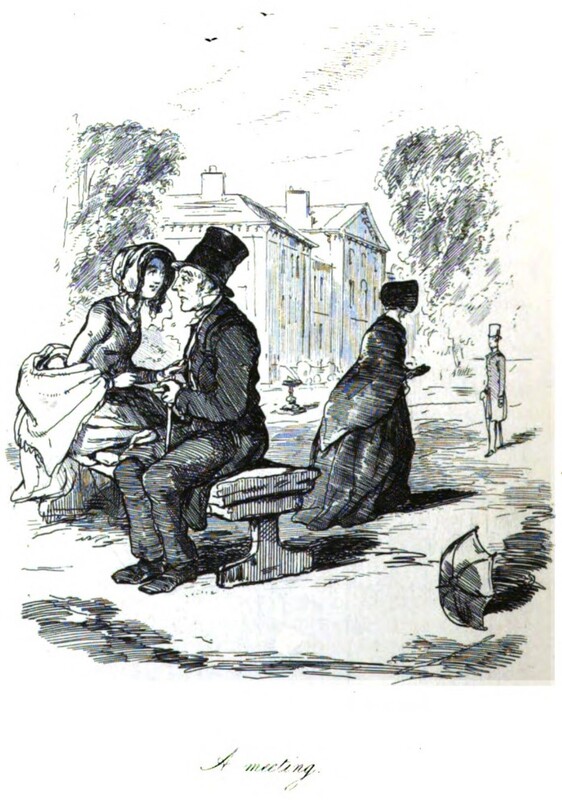
John Sedley sits on a bench in the park, holding onto his cane. Next to him is his daughter, Amelia Osborne, holding onto his arm. Mary Clapp, also in a shawl and bonnet, is standing facing away from them. In front of her is William Dobbin, who she has brought to meet the pair. On the ground near the bench is a small, open parasol or umbrella, and in the background two houses are behind a fountain and between some trees. Below the illustration is printed in cursive its title, “A meeting”.
Here Gulliver meets a frog who accidentally got into the trough in which Gulliver sailed for the entertainment of the court of Brobdingnag. The trough was built so that Gulliver could sail and entertain the courtiers, and the water was changed every three days. The frog got in when the water was being changed and climbed into Gulliver’s boat. In the image we see the frog’s head comes out of the water, and Gulliver fends him off with a stick while in the ship. The same image appears in the 1839 Krabbe edition.
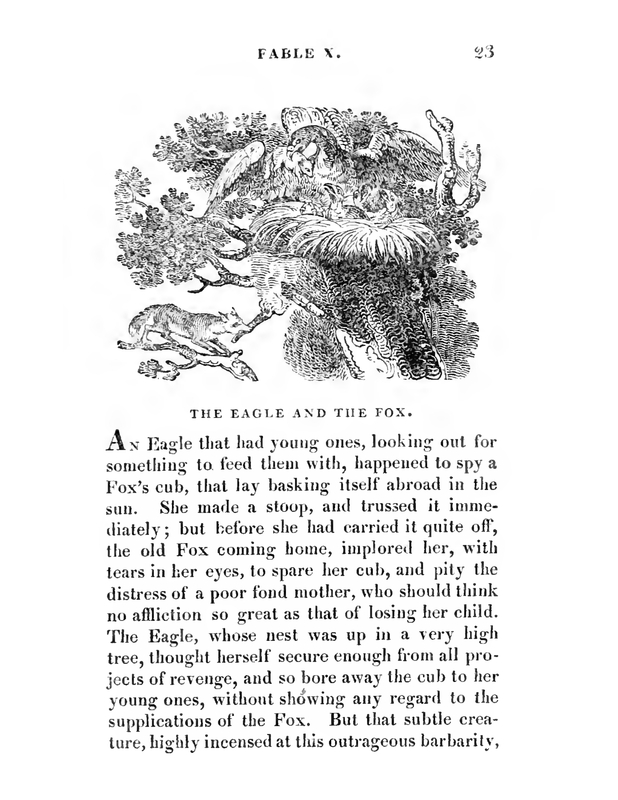
The main image concentrated at the right side of the illustration. On the left, there was a tree with the Eagle's net and her young ones. The Mother Eagle peaked a young fox to feed her ravenous youths. Their had their beak wide-openned and eagle to eat. At the bottom of the illustration, The Fox approached the tree for revenge, holding a lit torch.
Here we see a child of the Houyhnhnms. Every four years a representative council of the Houyhnhnms meets in a large plain about twenty miles from the house where Gulliver was staying. They discuss the conditions of the different districts of the country. One of the issues discussed at these meetings are the regulations of children. This includes their redistribution between parents. For example, if one couple had two boys, and another had two girls, then the couples would switch one child, so each couple had one boy and one girl. Another example is when a child died, if the mother could no longer bear children, then another couple in the community will have a child to replace the deceased. The same image appears in the 1843 Krabbe edition.
After spending several days speaking with different historical figures, Gulliver became disgusted with how history was portrayed, specifically that of the Princes and Kings in history. He found that the writers of history had misled the story leading to corruption and falsehoods. In this image we see some of the corruption of the courts. The King stand in the front of the line with his courtiers behind him. The Queen is next in line holding the hand of the friar behind her, representing the corruption of the church, and the infidelity of women, a theme seen again in this image, as a courtier kiss the hand of a woman who is standing with her husband. The same image appears in the 1843 Krabbe edition.
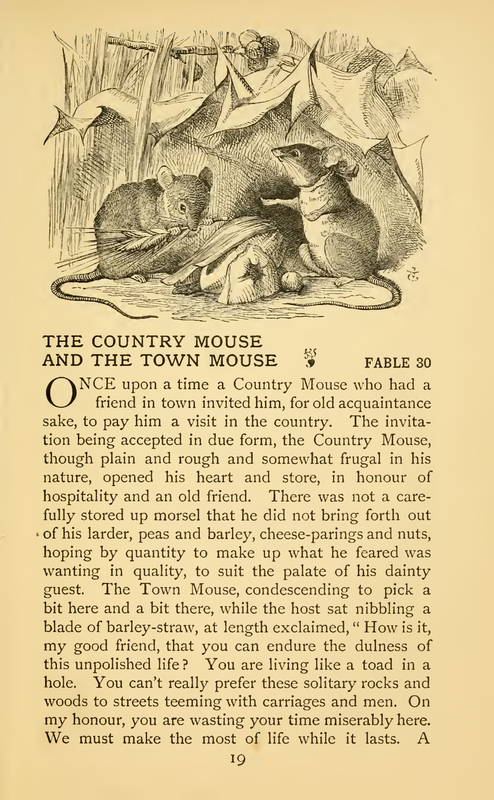
Two mice are hiding under a tent made of leaves and berry branches. One is eating off of a branch while the other mouse seems to have something around its neck and is looking at the other mouse.
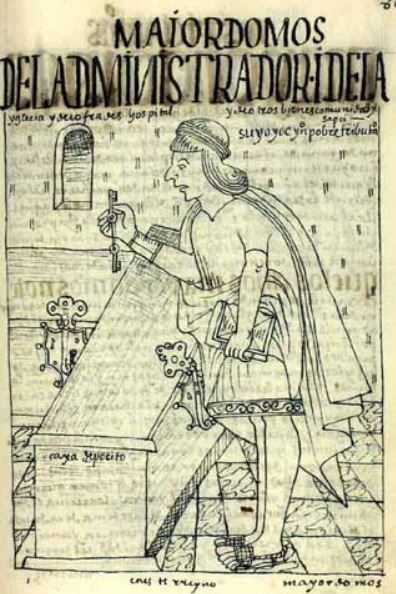
This image depicts a church administrator holding a key ring with two keys on it in his right hand and a book in his left. He is standing in front of large chests that have key holes on it. They are labelled as, “caxa, depocito” [box, deposit]. The official is dressed in an embroidered unku [tunic] and has a cloak draped over his shoulder. The author explains that this official was responsible for community well-fare, safekeeping the church’s depositories, confraternities and hospitals. The caption at the bottom of the image reads, “en este rreyno” [in this kingdom].
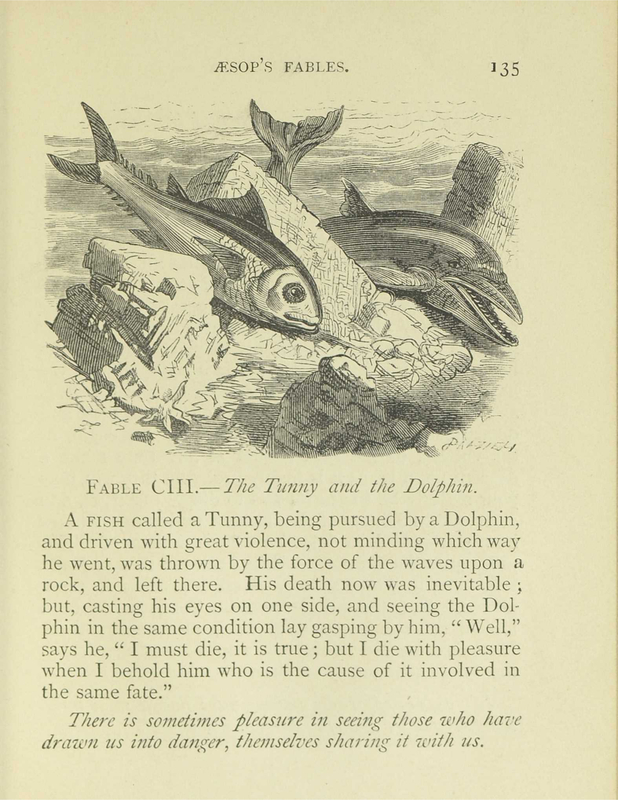
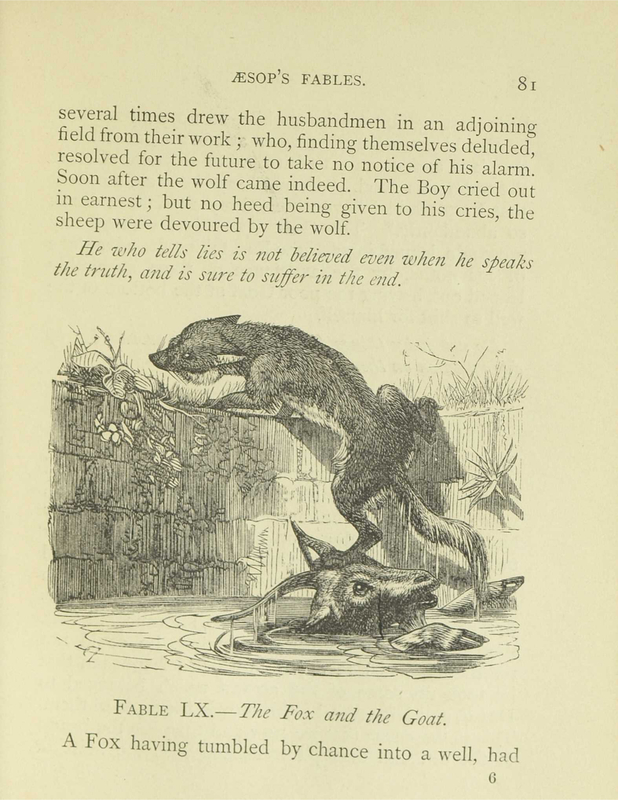
A fox climbs up and out of a well, water dripping from its body. In the foreground, a goat’s head and front hooves are barely above the water’s surface, the goat drowning as the fox looks on.
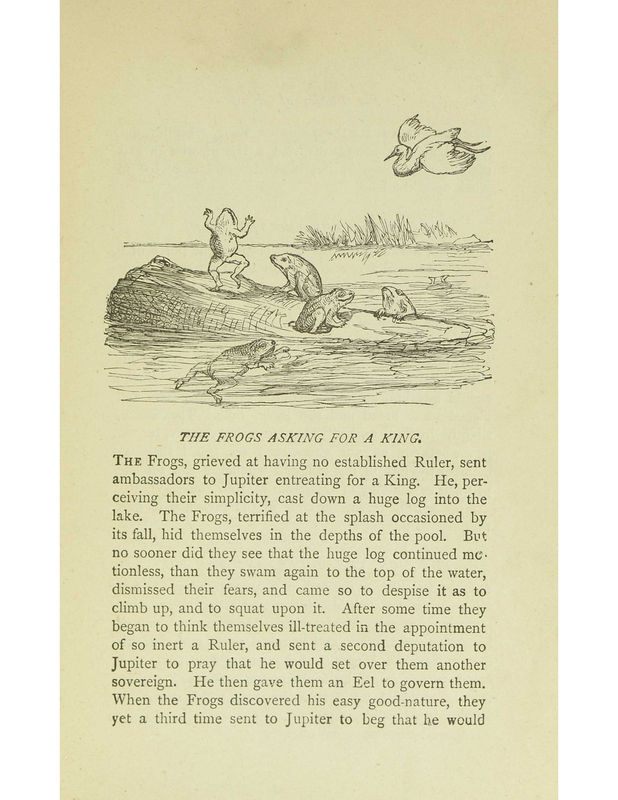
In a lake, on a wood log in the middle of it, rest five frogs. One remains swimming in the water, another is slowing climbing up the log and the other three are lounging on the log. On the left side of the piece of wood, the frog is standing on its back legs, dancing. In the background to the right, a crane flies down to land in the lake.

![[One Man Riding a Horse]](https://collections.cemvc.ca/files/large/c3b9a753f485540d30c3574fd974c6aecd4b0867.jpg)
![[Gulliver’s looks out the window at Lisbon]](https://collections.cemvc.ca/files/large/61287695a7047178313769a6b25f1fcd2f0bef6e.jpg)

![[Vanity Fair Chapter VI Historiated Initial]](https://collections.cemvc.ca/files/large/a4000c89b8d45e0ab01851cd8455ca20efb4c22b.jpg)
![[Indigenous Brazilians standing nude are contrasted with Europeans in flowing robes]](https://collections.cemvc.ca/files/large/21f06f6eaf1b497a37309f4790f1437e06948b9c.jpg)

![[A giant frog from Brobdingnag looks at Gulliver in his boat]](https://collections.cemvc.ca/files/large/7f6f3eec6158d849d39c99c59547590bd0e95aba.jpg)

![[a young Houyhnhnm]](https://collections.cemvc.ca/files/large/d1241245975db0d7b28e6bedb611bbbefe50d624.jpg)

![[Gulliver examines the corruption of the courts of Europe]](https://collections.cemvc.ca/files/large/3d7f5d1b9362b5cbfc32dadb1cd1599906689d1c.jpg)