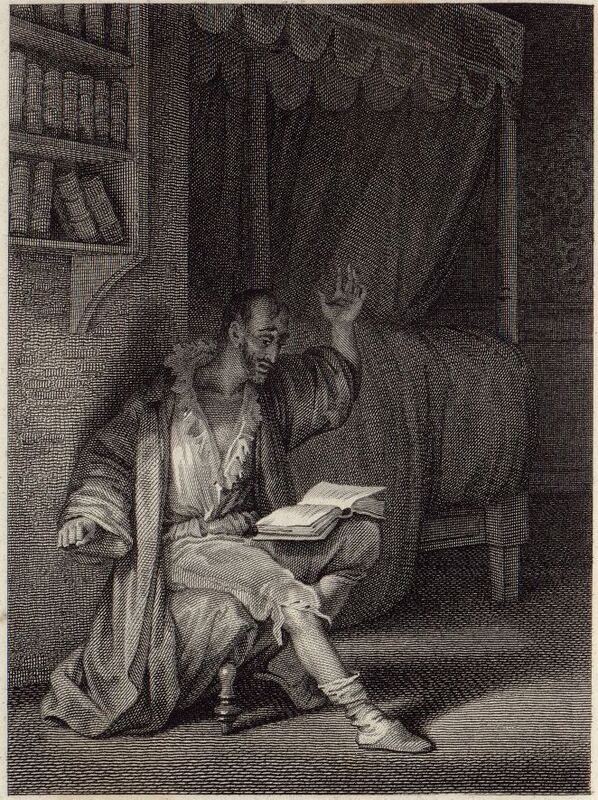
Alonso Quijana reads chivalric books in his library, slowly descending into madness (and becoming Don Quixote). Signed by E. Vernet (illustrator) and E. Lignon (engraver). Part 1, ch. 1.
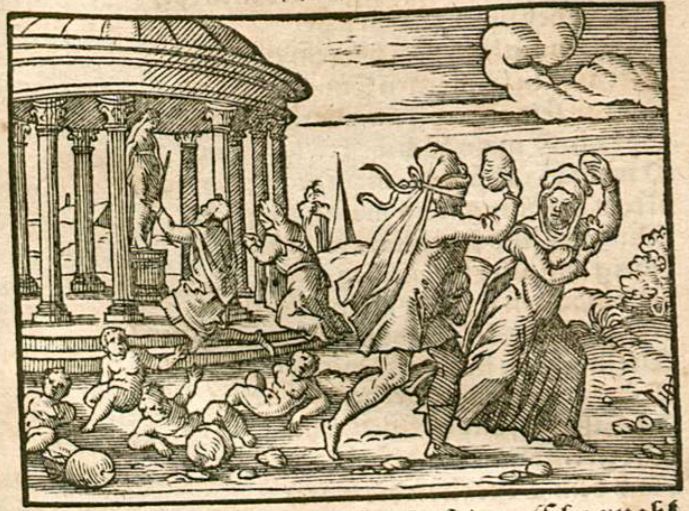
After pleading to the goddess Themis for help in restoring the world, Deucalion and Pyrrha receive her help. Themis instructs Deucalion and Pyrrha through oracular speech that they must veil their heads, loosen their belts, and throw the bones of their mothers behind their heads. Pyrrha does not wish to follow these orders, however Deucalion understands that Themis meant that the bones of the mother are the rocks of the earth. As instructed, Deucalion and Pyrrha then leave the temple that is depicted on the left side of the image and begin to throw rocks over their shoulders. The rocks then begin to turn into humans. The rocks that Pyrrha throw turn into women, and the rocks thrown by Deucalion turn into men. This image illustrates Deucalion and Pyrrha re-creating humankind as the rocks on the ground are transforming to humans.
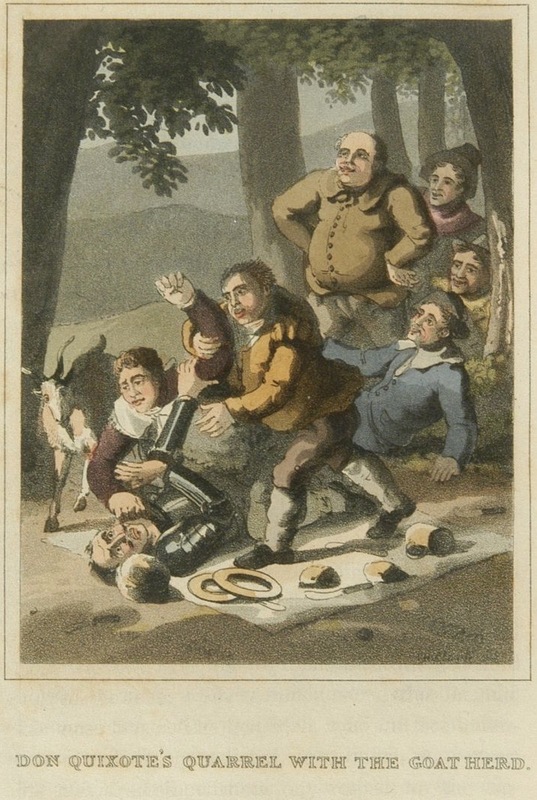
The goatherd ridicules Don Quixote, starting a fight. The knight seizes a loaf a bread from the table and hits the goatherd in the face. Sancho Panza disrupts the fight and prevents the goatherd from choking Don Quixote. The priest and the officers of the Holy Brotherhood look on. Unsigned. Part 1, ch. 3.
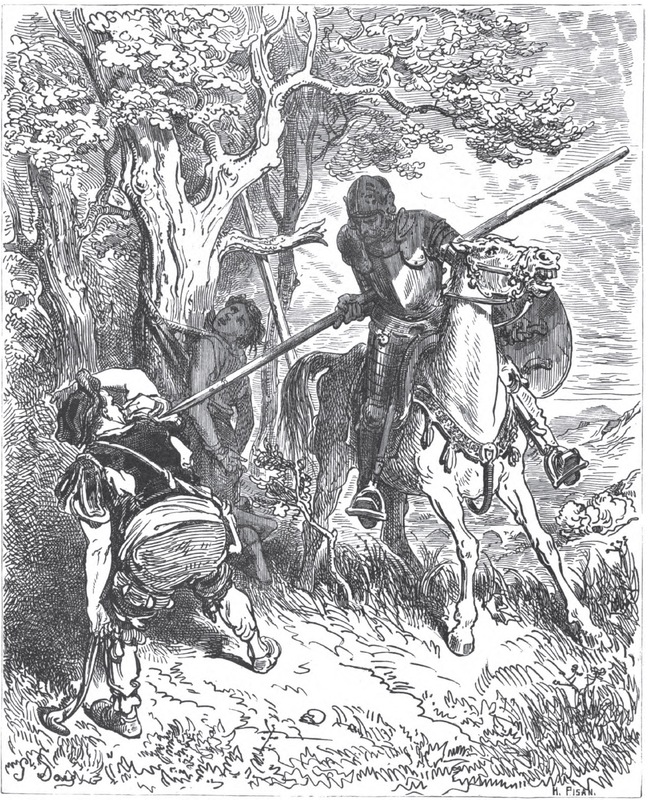
Don Quixote attempts to rescue a young boy being beaten by his master. He threatens to run the farmer through with his lance if the farmer does not let the boy go and pay him his full wages. This scene can be found in Part I, Book 1, Chapter 4.
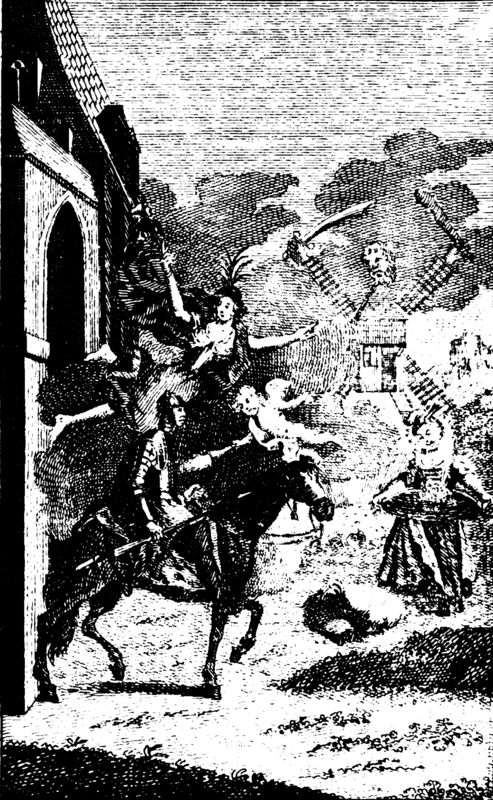
Don Quixote sets off in secret to begin his chivalrous journey. This image portrays the scene as Don Quixote might have envisioned it, for the windmill in the background is armed with a sword and club, while also having the head of a giant. Moreover, the woman flying next to him and the cherub is likely Dulcinea Del Toboso, the woman for whom he has given the soverignty of his heart while the woman curtsying by the fence is Aldonsa Lorenzo, the woman who Dulcinea Del Toboso is based on.
a small boat, without oars or any sort of tackle is tied to the trunk of a tree which grew on the brink of the river. In the river there are two lily pads and a growth of reeds on the right.
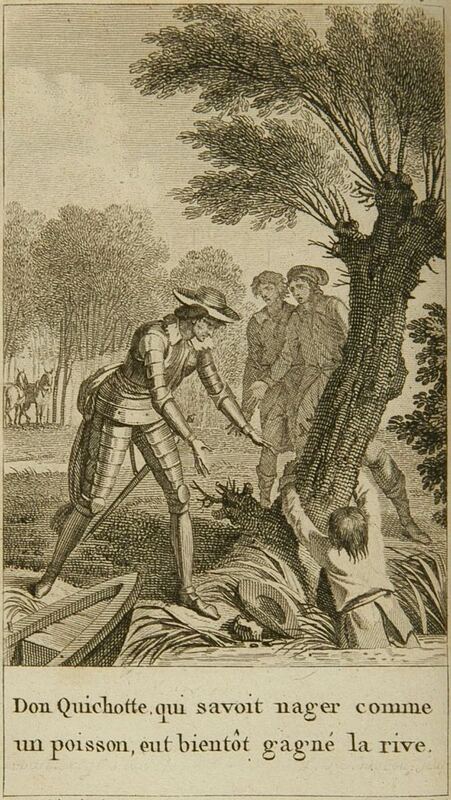
After the adventure of the enchanted boat on the river Ebro, Don Quixote helps Sancho Panza out of the water. Some millers are also pictured (right). The illustration is inaccurate to the text; Cervantes writes that Don Quixote and Sancho Panza are pulled to land by the millers, rescuing them from the millrace rapids of the Ebro. Signed by J.-J.-F. Le Barbier (illustrator) and L.-M. Halbou (engraver). Part 2, ch. 29.
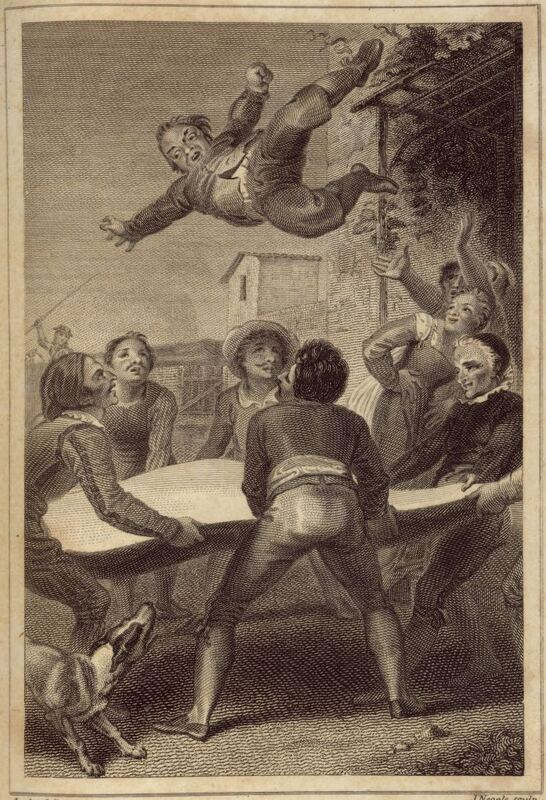
In the foreground, guests at the inn toss Sancho Panza into the air with a blanket when he refuses to pay the innkeeper. Among the guests are four wool carders from Segovia, three needlemakers from El Potro in Córdoba, and two residents of La Feria in Sevilla. In the background, Don Quixote stands on Rocinante so that he can see over the wall of the inn. Signed by T. Stothard (illustrator) and J. Neagle (engraver). Part 1, ch. 17.
In the foreground, the housekeeper and the niece prevent Sancho Panza from entering the house and visiting Don Quixote. In the background, Don Quixote, the barber, and the priest hear Sancho’s shouts and appear in the doorway of the house. Signed by F. Hayman (illustrator) and L. G. Scotin (engraver). Part 2, ch. 2.
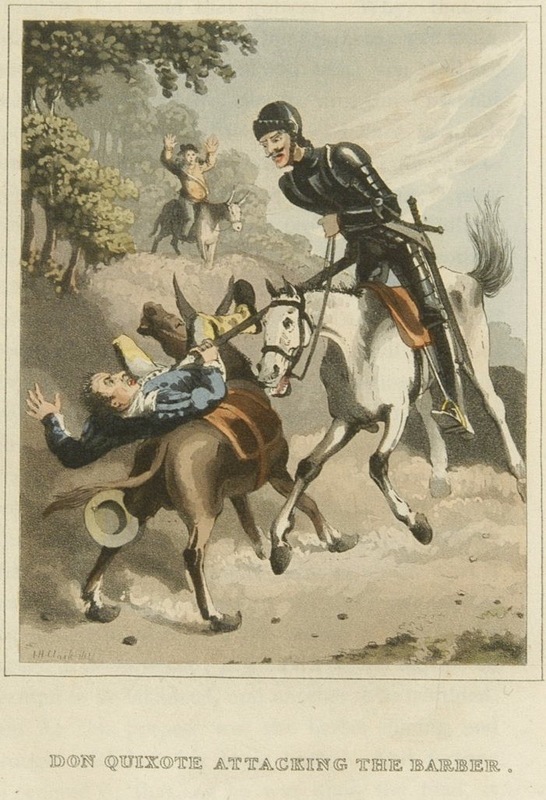
Mistaking a basin for what he believes to Mambrino’s legendary helmet, Don Quixote attacks the barber, who falls from his mount. In the background, Sancho throws up his arms. Unsigned. Part 1, ch. 3.
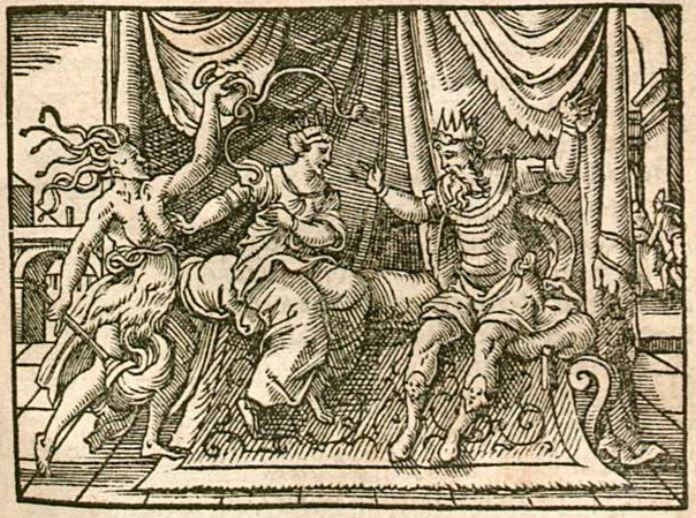
This engraving illustrates Ino and King Athamas sitting on their thrones while ruling over Thebes. One out of the three Furies, Tisiphone, is depicted on the left side of the illustration with snakes in her hair and a blood-soaked torch in her right hand. Her left hand is lifted above Ino and Athamas as she pours poisonous liquids over them. These liquids poison their minds and makes them crazy. Tisiphone was sent to do this by the vengeful goddess Juno.
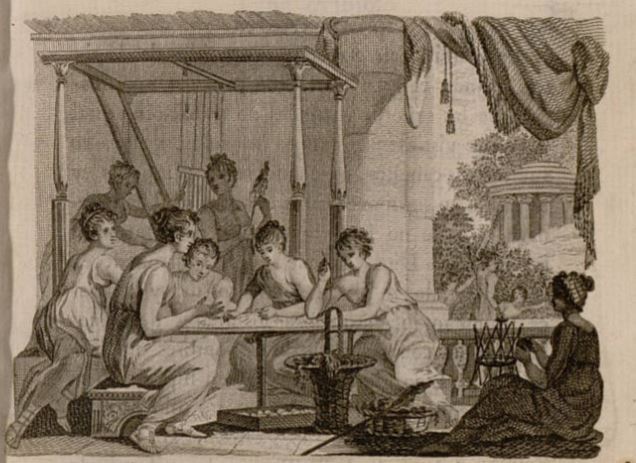
This image appears in the introduction of this volume. It depicts the Minyads (also spelled as Minyades), the daughters of King Minyas, who are telling stories to one another. While festivities were being held in worship for the god Bacchus, the Minyads decided to stay home and not take part in the festivals and told stories instead. As punishment for the lack of worship, Bacchus turns them into bats. The sisters are depicted sitting around a table and looking at one another as they recount their stories.
The body of a dead sparrow lies upon the ground, its head hanging over a ledge, its feet loft and poised, wings folded by its side. In the background a bird flies in the sky. The image is evoked by Don Quixote saying "Verily, verily, a sparrow in the hand is better than a vulture upon the wing".
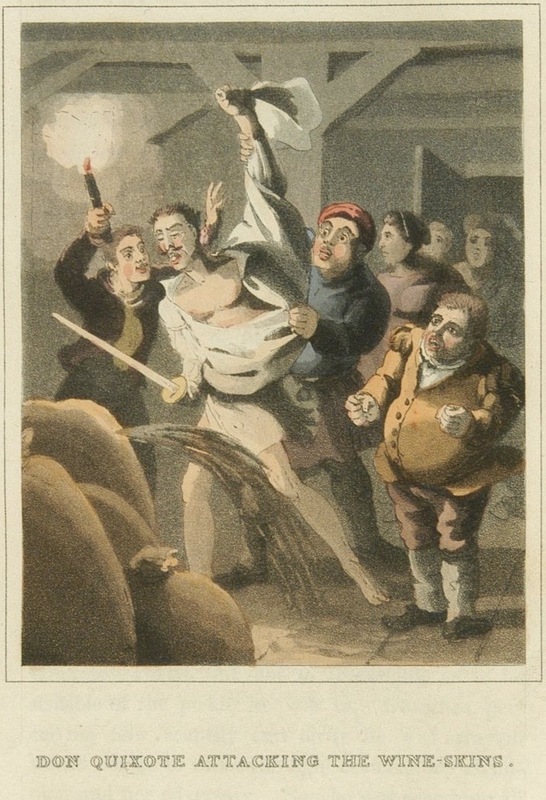
Don Quixote attacks the wineskins while sleepwalking. He is half-dressed, has a blanket draped over his right arm, and wields his sword. The innkeeper grabs him by the shoulder and clenches his fist, preparing to hit Don Quixote. The wine from a punctured wineskin spills onto the floor in the foreground. The barber, the priest, Sancho Panza, and Dorotea are also pictured. Unsigned. Part 1, ch. 3.
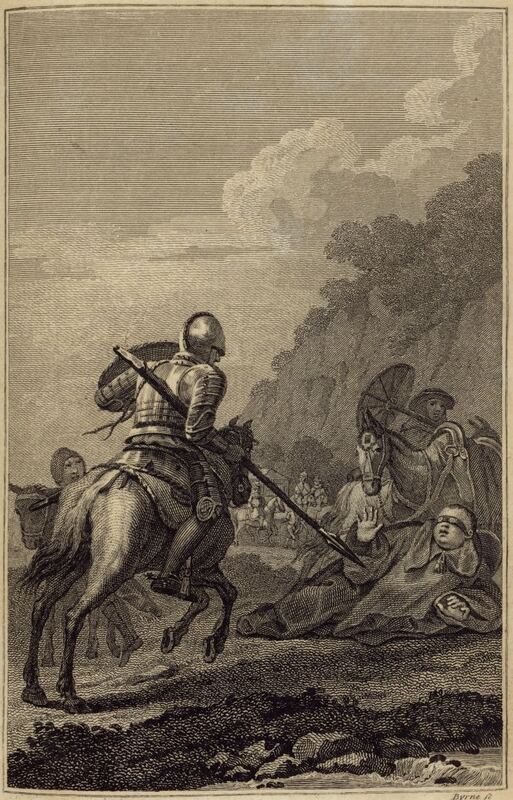
Don Quixote attacks one of the friars of Saint Benedict, who has fallen from his mule. Sancho Panza and another friar with a parasol are also pictured. In the background, the Basque lady’s carriage. Signed by W. Byrne (engraver). Part 1, ch. 8.
During his night round in Barataria Island, Sancho Panza discovers don Diego de la Llana’s daughter disguised as a man. The scene is illuminated by a soldier holding a lantern and a boy holding a torch. Signed by F. Hayman (illustrator) and C. Grignion I (engraver). Part 2, ch. 49.
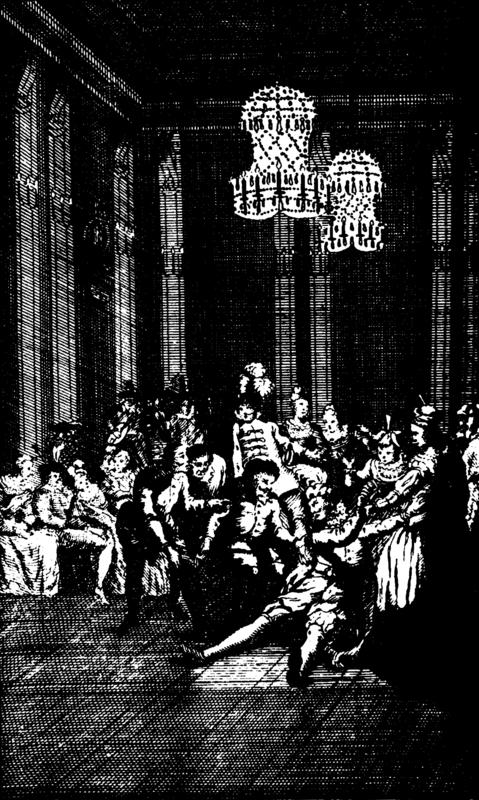
In the house of Don Antonio, his wife had invited many of her friends to a ball to honor their guest Don Quixote. The dancing began at ten o'clock at night, and two of the women present at the ball made their entertainment by dancing with Quixote one after the other until he could not longer stand, both his body and soul having been exhausted. Antonio (pictured to the left of Sancho Panza) gave order that Quixote should be carried to bed, and the first to lend a hand was Sancho Panza (pictured to the left of Quixote).
Alonso Quijana reads chivalric books in his library, slowly descending into madness. His arms and armour are strewn about on the floor. Signed by S. Sangster (engraver). Part 1, ch. 1.
Tom Cecial, Sancho Panza's neighbour, wears a wide brimmed hat and leans on a table with a glass of wine in his right hand, with his left hand he reaches into his jacket. To the right, a bottle of wine sits on a table; the fake nose he would use to fool Sancho as the Squire of the Woods hangs on his right forearm.
Two regidor's walk through a path in the wood and find the skeletal carcass of a mule, stripped clean and devoured of all meat by wolves. The regidor on the right carries a walking stick.
Having set downstream on a small fishing boat, Don Quixote (middle) and Sancho Panza are headed directly into the churning wheels of a mill. Seeking to stop the collision, millers gather by the bank to tip the boat. In response, Don Quixote, clad in armor, with his shield by his chest, grasps at his sword and fences with it in the air against the millers; who set themselves with their poles to stop the boat. Sancho falls upon his knees, and prayed to heaven devoutly to deliver him from the perilous situation.
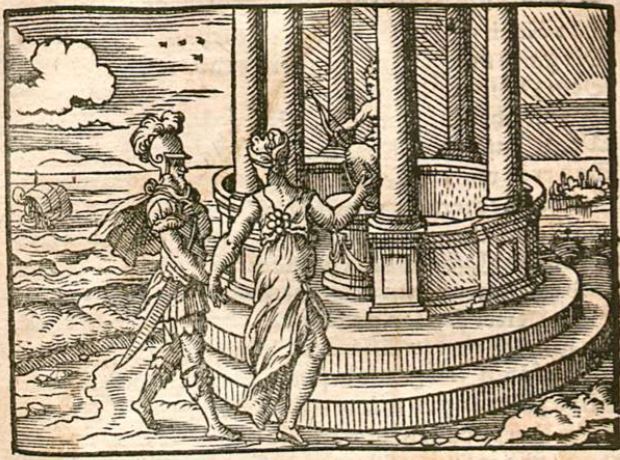
This engraving illustrates Medea, the daughter of King Aeetes, holding hands with Jason, the leader of the Argonauts. They are standing in front of an altar dedicated to Hecate. Jason is on a mission to retrieve the Golden Fleece, which King Aeetes currently has. King Aeetes has given Jason a challenge to complete in order to receive the Golden Fleece from him. Medea is completely infatuated with Jason and decides that she will betray her father in order to help him. In return for Medea’s assistance, Jason promises to marry her.
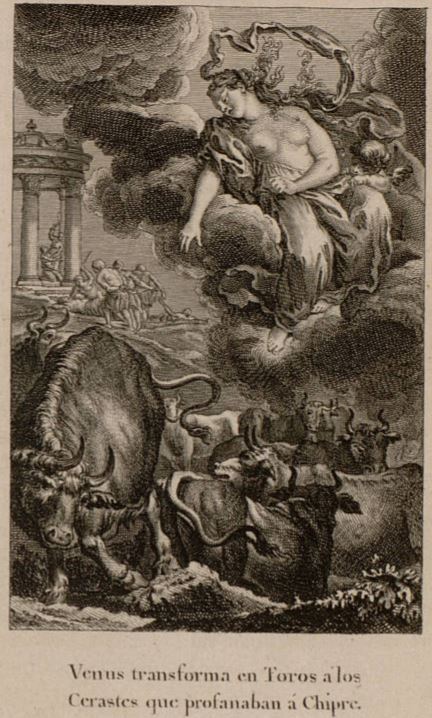
This image depicts the transformation of the Cerastae of Cyprus. The Cerastae of Cyprus had been failing to worship the god Jupiter properly by sacrificing people who visited their city. The temple to Jupiter is depicted in the background of the image where people are being sacrificed. Venus was angered by these forms of sacrifices and punished the Cerastae by transforming them into bulls. Venus is depicted floating on a bed of clouds at the top of the image while the transformed bulls are below her.
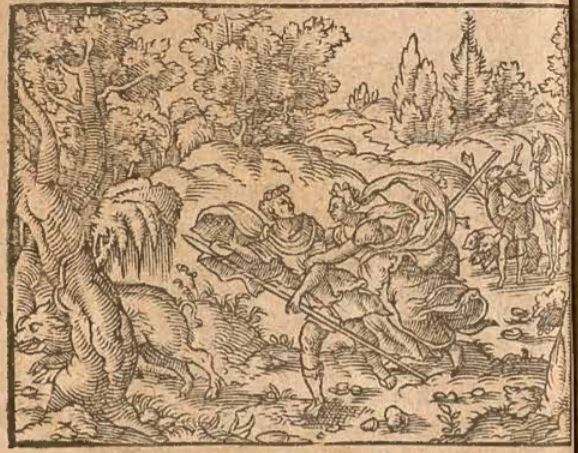
This engraving illustrates Picus, the King of Latium, chasing after a boar during a hunt. While on his hunt, the goddess Circe had caught sight of Picus and fell in love with him. He had been riding on his horse (illustrated in the background with his companions) and she could not catch up to him. Circe had conjured up an illusion of a pig which ran into the woods, which resulted in Picus getting off his horse to chase after it. The boar is pictured on the left-hand side of the engraving, running into the trees. Circe is depicted with her arms around Picus as she confesses her love to him. Unfortunately for Circe, Picus was in love with a nymph named Canens, and rejected her advances. She ends up transforming Picus into a woodpecker and turns his companions into animals.
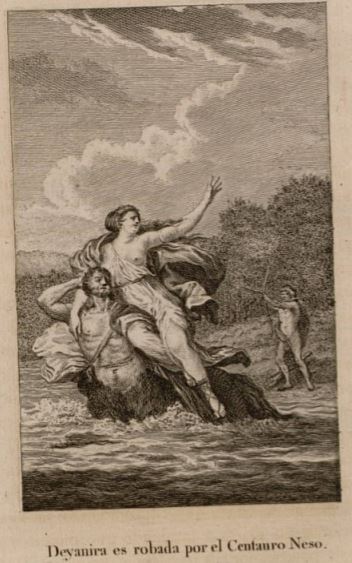
Deianira is illustrated on Nessus shoulders as he abducts her and carriers her across the river of Evenus. She is reaching out to her husband Heracles who is aiming his bow and arrow at Nessus the centaur. Nessus is pictured as half man, with the bottom half resembling a horse.

![[The 'Enchanted Boat' Tied to a Tree]](https://collections.cemvc.ca/files/large/f3b1d5e422b47aa62d8e79303b8ff140b49cb5d4.jpg)
![[The housekeeper and the niece prevent Sancho Panza from visiting Don Quixote]](https://collections.cemvc.ca/files/large/7971916d2d5c21b1a7e33c479cc5cbd3761a2977.jpg)
![[Dead Sparrow]](https://collections.cemvc.ca/files/large/319a59ba3b7eadd4b3d70d6b4c604d4a7d46d5f8.jpg)
![[Sancho discovers Don Diego de la Llana's daughter disguised as a man]](https://collections.cemvc.ca/files/large/b41fe10a93446ba484d4877297024ff464d385b6.jpg)
![[Don Quixote reads chivalric books in his library]](https://collections.cemvc.ca/files/large/f713008a5ed9557926f63190ee86cfdba2529fc4.jpg)
![[Tom Cecial With a Glass of Wine in Hand]](https://collections.cemvc.ca/files/large/09a571aaa87c0b86828708610af1cc0718de03b3.jpg)
![[Two Regidor's Find the Skeletal Carcass of a Mule]](https://collections.cemvc.ca/files/large/81d7fa065409124456d5937100bb05c3b00ff656.jpg)
![[Of How Quixote Tried to Stop the Millers From Tipping his Boat]](https://collections.cemvc.ca/files/large/c7c27a5b0fec0dd2cbda50b93ad7af2adda9bfed.jpg)